Blog Archives
Totally Under Control (2020)
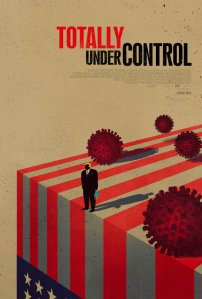 Over 220,000 Americans have died from COVID-19 as of this writing. We here in the U.S. are four percent of the world’s population and yet account for twenty-percent of the world’s deaths. I lament that this number will only go higher over the next many months of the pandemic that has defined 2020. Oscar-winning filmmaker Alex Gibney (Taxi to the Dark Side, Going Clear, Enron: The Smartest Guys in the Room) and his co-directors Ophelia Harutyunyan and Suzanne Hillinger conducted interviews around the world with special cameras and protective measures to complete the first major documentary on the coronavirus outbreak. Totally Under Control (title taken directly from Trump’s early February response to COVID-19) is their collaborative effort, and it’s both a timely work of criticism and destined to be inevitably out-of-date in short order.
Given the constant deluge of news about the by-the-minute Trump administration mistakes and questionable calls, the question for a documentary like Totally Under Control is whether or not it provides more insights than simply keeping up with the shocking and dispiriting headlines. I would argue that Gibney’s first pass at recounting our still-living history of calamity offers the benefit of hindsight but also an immediacy or urgency, considering we are still months away from a presumable vaccine. The movie feels like what the first part of the COVID-19 mini-series would cover, focusing on those first few critical months of bungled government response from January to April. The abbreviated focus allows Gibney and his crew to zero in on what the early mistakes were and how we have been paying for them ever since. The collapsed time also allows for more get-able interview subjects, people who might not currently be serving in the administration who feel comfortable or compelled to go on the record with their accounts. There are some great interview subjects here that were plugged in from the beginning, sounding the alarm, and who can give the public a clear understanding of just how woefully equipped a deeply un-serious administration was to handle the most serious public health crisis in a century.
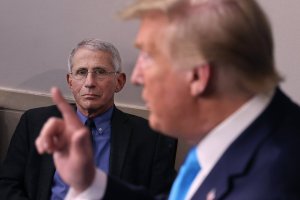 One of the more aggravating tragedies is that many of the thousands of COVID deaths could have been prevented if better steps had been taken early to contain its spread. Naturally, there’s always going to be clearer reflection when looking back on mistakes of the past, not knowing at the time that they were mistakes, but the Trump administration made a political calculus that would only exacerbate the spread of the coronavirus. Early on, the Trump administration’s guiding principle seemed to amount to stripping away anything and everything that the Obama administration had accomplished. It didn’t matter what it was, if Obama had built it, then Trump was motivated to tear it down. This included the pandemic response task force in 2018. This included ignoring the 70-page pandemic response playbook left behind. So when the early warnings appeared in December and January, the United States was already playing from behind. We could have been preparing with amping up production for necessary medical supplies and installing the infrastructure for a robust testing and tracing program; however, this all came into conflict with the other major political calculus that governed all of Trump’s decision-making. His mantra heading into 2020 and re-election was, simply, “Do no harm… to the economy.” Rather than take preventative measures or treat the virus as a danger, the Trump political apparatus was afraid acknowledging the threat so it would not spook the financial markets, a source of bragging for Trump to tout why the American people should re-elect him. When the CDC briefed government officials and media with updated predictions of normal life being uprooted, the markets responded negatively, and Trump fumed. From there, decisions were less about stopping the coronavirus and more about making everything appear like it was no big deal.
Totally Under Control keeps a running calendar of events to compare the U.S. response to South Korea, two countries that had their first official COVID infection on the same day. The Korean government had already taken preventative measures after the 2015 MERS scare to be ready if another frightening new contagion emerged. The politicians left the science to the scientists and followed their recommendations. The Korean people wore masks and were diligent about simple safety measures to stay safe. They had a system of contact tracing already installed. These moves are in sharp contrast to the American response, and while there would be some cultural roadblocks for Americans who consider themselves rugged individuals to submit themselves to a big data-harvesting consortium that contact tracing requires, we could have done so much better. In 1918, people wore masks because it made a real difference and saved lives. They took the Spanish flu epidemic seriously and they had fewer networks of knowledge at their disposal. Today, sadly, wearing a mask has become a political symbol and for many not wearing a mask has become a proud yet misguided act of defiance. Masks show consideration. Masks have been said to be even more effective at thwarting coronavirus spread than a vaccine. Masks work. The rest of the world, and South Korea, have showed what happens when you trust scientific recommendations. South Korea has less than 500 total COVID-19 deaths with a population of 52 million. Even if you multiply that figure by a generous seven to match the current U.S. population, that’s still only an estimated 3,500 total COVID-19 deaths during the same period.
 The level of ineptitude is highlighted by two key interview subjects. Rick Bright was the director of the Biomedical Advanced Research and Development Authority (BARDA) from 2016 to 2020. He filed a whistle-blower complaint about the Trump administration applying undue pressure to approve hydroxychloroquine, an experimental treatment that showed no signs of helping COVID patients. There was no medical reason to eliminate safeguards and protocols but the administration wanted a ready-to-market cure, and Bright was horrified that they wanted to make it widely available and over the counter, which would surely lead a panicked populace to request it and endanger their health. Recounting his experiences even brings Bright to tears as he recounts the disregard for safety and dereliction of duty of these political appointees dictating science. He’s a sobering and thoughtful voice to have in the documentary and also one of the biggest names of someone who worked inside the Trump response team. Another intriguing subject is Max Kennedy, who served on Jared Kushner’s White House supply chain task force. Kennedy thought he was going to be running errands or support tasks for the task force. He didn’t realize he and the other volunteers would be the entire task force. They were left to their personal laptops and emails to cold-call companies and perform Google searches to find personal protection equipment (PPE). They had no experience, no coordination with other government bodies, and they were competing against the federal government for the exact same dwindling supplies. Kennedy is breaking the NDA he was forced to sign to reveal the full extent of the chaos and inadequacy that Kushner’s “expertise” brought installing a solution to a very real problem. Kennedy and Bright’s first-hand insider accounts are both harrowing and maddening.
When it appeared that the Trump administration wasn’t going to be able to contain COVID-19, that’s when they pivoted to shifting blame and responsibility onto the states. The Trump administration could have authorized the Defense Production Act to force companies to begin manufacturing very needed PPE, but they didn’t. They thought, as conservative dogma has preached for decades, that government is the problem and the private market will solve it all. The problem with this line of thinking is that there are certain powers the states do not have in comparison to the federal government. State governments cannot run past their budgets. State governments do not have the power to set up a national system of testing. State governments were forced into a 50-way fight for supplies and were vulnerable to capitalistic gouging. The states were then also competing with the federal government, which was driving up the bids for these supplies and then overpaying for the same supplies by many times over their cost. The states were left on their own to duke it out and any slip-ups or shortages were disparaged from afar by a Trump administration that wanted to look in charge but didn’t want the responsibility.
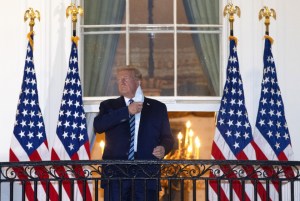 Totally Under Control is an essential documentary for our times but it also can’t help but feel like the beginning of an even bigger and more excoriating story. It’s frustratingly incomplete. It’s the opening chapter of the examination on the U.S. response to the coronavirus, and this story will likely only get more depressing and infuriating as the death toll rises and the regret of “what could have been” grows even more pressing with every week. Gibney and his fellow directors keep their movie pretty straightforward and efficient, and there is something powerful about putting all the relevant facts together into an easy to understand timeline and seeing all the dots connected. Gibney has always been blessed at his ability to artfully articulate a big picture with his films. Totally Under Control is a useful artifact for history and a denunciation of the early days when so much could have been so different if the United States had leaders that trusted science, didn’t dismantle key government bodies, took responsibility when the moment called upon rather than ducking leadership, and cared about more than their personal finances and standing. It’s only going to get worse from here, especially once we fully analyze all the important steps not taken.
Nate’s Grade: B+
Share this:

Client 9: The Rise and Fall of Eliot Spitzer (2010)
 Alex Gibney, the Oscar-winning documentary filmmaker behind Enron and Taxi to the Dark Side, rolls out his third 2010 entry in what must have been a rather exhausting year for the man. The focus is on former New York attorney general and governor Eliot Spitzer and his fall from grace after being linked to a high-end prostitution ring. Gibney charts the man’s rise and fall in a fairly straightforward and engaging manner, though you start to wonder if there’s really enough material to fill out a two-hour feature. Spitzer speaks candidly and will not humbly vanish as some may wish; the man is an intriguing mixture of righteousness, ego, and humility. What’s most fascinating about Client 9 (named after Spitzer’s name in the FBI sting) is that Spitzer gained a wealth of enemies when he went after Wall Street largesse and greedy shenanigans, and they all want to be on camera. No one with a serious grudge against Spitzer, including men who have since been convicted of crimes and ethics violations, refuses an interview. Gibney draws together a fairly convincing thesis on the take-down of Spitzer, a cabal of powerful execs, politically motivated prosecutors in the Bush administration, and government officials who reject accountability. It’s all circumstantial evidence, to be sure, but there’s a mountain of it. There is a definite conservative-backed coordinated effort to sully and embarrass the man. But ultimately, Spitzer admits that he is responsible for his sins. You will never get full satisfying clarity as to why he sought out the comfort of prostitutes in the first place. I don’t think even Spitzer knows for sure. But that’s an age-old mystery that can’t be tied up in two hours.
Nate’s Grade: B
Share this:

Casino Jack and the United States of Money (2010)
 Alex Gibney is a masterful documentary filmmaker, having crafted Enron: The Smartest Guys in the Room and the Oscar-winning Taxi to the Dark Side. His latest doc chronicling the rise and fall of corrupt lobbyist Jack Abramoff is insightful, clear-eyed, and entertaining like his other work, but something’s missing here and it’s hard to put my finger on it. Gibney’s doc lacks the fire and outrage of his previous exposes, so Casino Jack doesn’t hold your attention as strong. It focuses closely on Abramoff’s scandals and his influence peddling and gives shrift coverage to bigger issues about our government being for sale to the highest bidder. The lack of attention to a bigger picture hurts the movie’s power. But ultimately I think what makes Casino Jack lacking is that it is missing one very key participant — Abramoff. Gibney interviewed the man several times in prison but Abramoff declined to be involved after pressure from federal prosecutors. By all accounts, Abramoff is a charismatic, larger-than-life figure, whose Reagan era College Republican idealism transforms into greed and out-of-control hubris (Abramoff foolishly wrote every single thought down in e-mail). His absence is noticeable and blunts the storytelling angles the film can take. With Abramoff’s side, there could be much more insight and dirt. Casino Jack is a solid viewing but not up to snuff for Gibney. Wait for the Kevin Spacey film later this year.
Nate’s Grade: B
Share this:

Taxi to the Dark Side (2007)
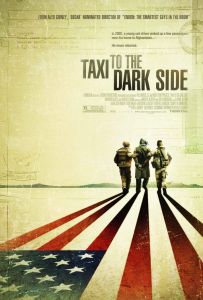 Just like he did in 2005’s excellent documentary Enron: The Smartest Guys in the Room, filmmaker Alex Gibney is able to distill a complex topic into a coherent argument. His Oscar-winning documentary Taxi to the Dark Side looks deep into the repugnant state of justice after 9/11 and the Bush Administration’s disregard for the law. It’s decidedly uncomfortable and upsetting, but Gibney’s film should be essential viewing for everyone to fully understand what questionable lessons we are sending out to the world under the guise of winning the indefinite War on Terror.
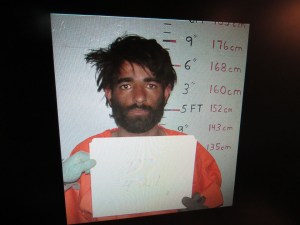
In late 2002, Dilawar drove two passengers out of town in his taxi. He was stopped at an Afghan militia checkpoint and he and his passengers were turned over to the U.S. military. The Afghan militia leader accused the trio of being responsible for rocket attacks against U.S. forces (In reality, the militia leader was responsible and just turning over innocent men to make inroads with military personnel). Dilawar was sent to Bagram prison where he was subjected to sleep deprivation, physical abuse, and made to stand for hours on end handcuffed to the ceiling. He died after two days in custody. The military coroner ruled that Dilawar’s death was a homicide. The report was swept under the rug until a New York Times journalist went searching for answers. The official who instigated the “interrogation techniques” was rewarded and sent to teach her harsh brand of degrading interrogation to another prison – Abu Ghraib. I think we all know how well that turned out.
 Like No End in Sight, which Gibney also produced, the film benefits enormously by staying away from brash finger pointing and hysterics. It slowly assembles its methodical case using hard evidence, like the prison coroner’s report and declassified memos, and a bevy of interviews from the people who were on the frontlines and behind the scenes in Washington. Gibney builds a devastating case that left me sick to my stomach and overwhelmed with the urge to weep. Taxi to the Dark Side is a powerful and masterfully assembled indictment on how far the United States of America has slid from its moral high ground. I felt sorry for the numerous innocent men plucked from their homes and tortured. I felt sorry for the soldiers being pressured to get results fast and through whatever creative means only to be turned into patsies by a government looking to pin “a few bad apples.” I felt intense shame in my own government condoning degrading and humiliating practices that stretch the legal definition of torture. And I felt burning anger at the realization that President Bush had tucked away a little provision in a bill signed into law that stated no officials in his administration could be tried for war crimes. The soldiers on the ground who followed orders set out by those officials, however, were fair game. Bush pardoned himself!
Gibney uses Dilawar’s story as a framing device that broadens the scope of the film. He explores the whole nature of torture and the questionable tactics our government and military have engaged in since 9/11 in the name of keeping the country safe. But as the film continues on we still remember Dilawar. His death casts a pall that hangs over the entire running time that serves as a potent rejoinder to any interview clip or TV segment where officials dismiss the severity of torture techniques (Secretary of Defense Rumsfeld scribbled on one memo complaining that he stands many hours a day, so how could this be torture?). Thankfully, the film also comes back to Dilawar during the closing moments to draw out the man’s humanity and shine a closer look at the personal cost of such illegal practices. It’s sad and shocking that well over 90 percent of the prisoners in Guantanamo Bay and U.S. coalition prisons were turned in by locals for money. Who knows however many innocent men like Dilawar are imprisoned without any path to see a court (recent Supreme Court rulings have said that detainees do have a right to contest their imprisonment in U.S. courts).
What is all too evident is that Bush administration officials were establishing a hazy and vague definition of torture on purpose. This of course had the benefit of not linking their names to illegal practices that could lead to war crimes. This also made sure there was no set guideline for interrogation and detention. Without any guidelines and rules the soldiers were expected to get results with no oversight. It doesn’t take a genius to figure out that being isolated in a foreign country and surrounded by a culture of machismo is going to breed cruelty if there is no enforcement of law. The U.S. skirted the Geneva Conventions by denying suspects any rights and saying they could be detained, without charge, for the rest of their lives. Vice President Cheney proudly declares that the enemy plays dirty and therefore America has to resort to the same dirty tactics. One soldier recounts a mentally handicapped prisoner who officials kept swearing was just putting on an act. “This is the new cover for al-Qaeda,” they were told even as the man ate his own feces. I’m sorry, but my country should be morally above whomever we deem an enemy. The “he started it” defense does not register for me.
 But perhaps the biggest non moral related sticking point is that torture is notorious for not generating factual claims. When someone is being tortured they will say whatever to make the situation cease, and this includes fabricating tales about terrorists and an Iraq link to 9/11. Instead of verifying and corroborating these confessions, the interrogators jot them down as fact, send them to the brass above, and that’s how the U.S. produced sources that said Saddam Hussein and Osama bin Ladin share a friendship bracelet and have brunch on Tuesdays. Even if you do not object to torture on moral grounds, and I pity you if you cannot, then a thinking person should at least object to torture on the very basis that it does not work. It produces bad intelligence, false intelligence, and in a rush to conflict that can yield terrible and far-reaching ramifications (six years in Iraq and counting, insurgent recruitment rising, the erosion of the U.S.’s standing over the world). The ends clearly do not even approach justifying the means.
After detainee abuses, President Bush declared to TV reporters that, “The United States doesn’t torture.” The asterisk to that declaration is that the U.S. rejects the internationally agreed upon definition of torture and will decide what constitutes torture, and even then we’ll just outsource it to countries that will torture. Taxi to the Dark Side is a sobering and powerful film that will serve as an important reminder for generations to come about the damning evidence of torture. The film is presented with clam and precise logic but it still manages to eradicate any argument that torture is acceptable under the right circumstances (advocates like to cite the idea of a ticking bomb and a suspect who knows the location). One interview says it all. He’s an FBI interrogator for over 20 years, and he says that to glean workable intelligence you don’t beat someone and make them fear you; you make them like you. You play “good cop” not “insane cop,” and you will gather actionable, verifiable, helpful intelligence and you have nothing to feel guilty over. If only the current administration had more men with such clarity and moral fiber.
Nate’s Grade: A
Share this:

No End in Sight (2007)
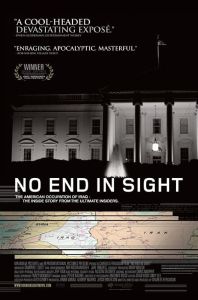 Director Charles Ferguson lived his life as a PhD political scientist, and then he felt compelled to make a movie. No End in Sight doesn’t focus much on the origins of the current Iraq War, which have been well documented and discussed in many other realms, instead the movie takes an exacting look into where the U.S. government fouled up the occupation after toppling Saddam Hussein. Because of this approach, Ferguson’s expose cannot be dismissed under false propaganda claims, and because his interviews mostly consist of the people on the ground who were responsible to stabilize the country, No End in Sight is blessed with plenty of hard-hitting first-hand accounts by the people given the hurried, thankless job of rebuilding a conquered nation.
General Jay Garner and his team, including Colonel Paul Hughes and Ambassador Barbara Bodine, were given 60 days to plan for a post-war Iraq. In contrast, FDR spent years planning ahead for an occupation of Germany. Planning was difficult because when they arrived in Baghdad the post-war looting made setting up a government a formidable task. They not only had to find means to contact people but they had to figure out ways simply to operate in an environment where looting had destroyed buildings and proper tools for communication. They were in charge of ORHA, the Office of Reconstruction and Humanitarian Assistance, which was not run through the State department, as would be normal, but run by the Defense department.
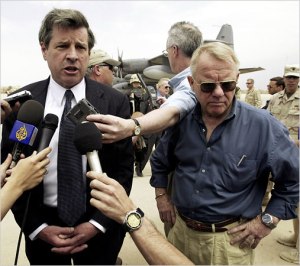 The film holds its harshest criticism for L. Paul Bremer, the man appointed to run the Coalition Provisional Authority, formerly ORHA. Bremer, like many who planned the post-war occupation and were placed in key positions within the occupation, had no military experience, no foreign policy experience with the Middle East, a notoriously tricky region, and he didn’t speak a lick of Arabic. In any other scenario, he would be judged unqualified for his heavy duty ahead. No End in Sight lays out three grievous errors that Bremer made in the summer of 2003 that gave birth to the ongoing insurgency and sent Iraq spinning out of control. The first was absolving any previous work to reach out and include Iraqis in helping to form a working provisional government. Bremer was more a my-way-or-the-highway kind of guy, which may be why he was esteemed in a presidential administration filled with these types. This alienated the Iraqi people and began Bremer’s calamitous habit of bridge burning. His second error was his decision to eliminate the Ba’ath party, Saddam Hussein’s ruling party, and bar members from any future government service. This stripped teachers, engineers, intellectuals, the very people integral to build the infrastructure of a nation, and made them permanently unemployed in Iraq. Many members had merely joined the Ba’ath party because it was the only way to secure a steady job.
But by far the most baffling and incompetent decision Bremer made was to disband Iraq’s army. This boneheaded move went against the recommendations of U.S. military figures, and in the blink of an eye, the 500,000-strong Iraqi army were without a job and an income. There were overtures from military leaders to ORHA; Paul Hughes recounts that one officer promised him 12,000 men in a week if asked. So, in a situation where the U.S. military did not have enough soldiers on the ground to even halt looting, Bremer disbanded Iraq’s best solution for restoring law and order. Half a million angry, disenfranchised, combat-trained, well-armed men were now left to fend for themselves, and if the U.S. didn’t care for their expertise then death militias would. It should come as no surprise that shortly after this colossal miscue is when Improvised Explosive Device (IED) attacks on the U.S. troops surged along with U.S. casualties. It seems like at that point the verdict had come against the U.S. occupation.
 Bremer’s decisions alienated, humiliated, and inflamed the people of Iraq, and they went against the recommendations by people that knew what they were talking about. The greatest tragedy that comes to mind is that, despite morally questionable, downright repugnant reasons for entering this conflict, the U.S. could have done this right. Saddam was indeed a bad man and the people of Iraq were initially receptive to see what the U.S. occupation would bring about. They weren’t expecting rampant unemployment, no tangible security force, being excluded from decision-making, having American private contractors bleed them dry, and an utter lack of basic human services like power and clean water. Add a long-standing religious feud into the mix and it’s no wonder the country has descended into a quagmire. No End in Sight makes the dots easy to follow and connect the cause-effect relationships into where we are today.
It’s hard to watch the film and not feel your blood boil. While No End in Sight is presented soberly and with clear-headed precision, watching the absurd miscalculations and naiveté prevail over the opinions of experts is infuriating. General Shinseki recommended to Congress that several hundred thousand troops would be required after toppling Saddam. Paul Wolfowitz, deputy Secretary of Defense, swiftly countered this assertion by claiming that it was unimaginable that it would require more troops to secure the peace rather than engage in war. “Unimaginable” is the key word here; Wolfowitz just couldn’t potentially fathom a reality that was known by most high-ranking military officials. Stabilizing a country is far more taxing than simply taking out an opposing force. Shinseki, who guided occupation forces in Bosnia and Kosovo, was ignored and pushed into “early retirement,” and Wolfowitz’s plan was followed (Wolfowitz also famously stated that the war would pay for itself thanks to Iraq’s oil revenues).
 No End in Sight does have a figure of amusement and it just so happens to be Secretary of Defense Donald Rumsfeld. The film opens with his farewell address after the 2006 midterm elections where Republicans lost control of Congress and Rumsfeld was shortly ousted from his job days later. He calls the Iraq War little understood and declares that Bush and his team’s accomplishments will one day get the full historical notation they deserve. Of course, the irony is that the designers of the Iraq War had little understanding of what they were getting into and ignored the warnings and advice of those whose opinions conflicted with the Administration line. Many clips of Rumsfeld news conferences are shown and the man comes across as flippant and disingenuous. He dismisses the looting as “stuff happens” and argues TV news is re-running the same image of a man absconding with a vase (“And you have to wonder, are there that many vases in the whole country?” he adds). The Iraq looting destroyed a museum that had artifacts dating back 7,000 years to the dawn of civilization and a library with hundreds of ancient manuscripts was burned to the ground; an entire country’s deep culture and history went up in smoke and Rumsfeld was using it as a setup to a vase joke. The clips further remind the audience that Rumsfeld, one of the chief architects of the war along with Vice President Dick Cheney and Wolfowitz, simply disregards information he doesn’t agree with, whether it may actually be right. The leaders of the Bush Administration demonstrate time and again a supreme disconnect from reality.
No End in Sight is one of the best documentaries yet on the Iraq War and a definitive indictment on the lack of substantial care given to post-war planning. No one can accuse this film of slander or pushing an agenda; this is an exacting autopsy on the current chaos in Iraq, and it has cold facts and hard truths to back up its convictions. Even if you feel that you know all the blunders tied to Iraq, this sensational film is not merely a repackaging of dogma. It’s eye-opening and intensely fascinating and one of the better films of the year; it’s an argument made on the merits of evidence and testimony, and it is damning. One soldier reflects upon the current conditions and flatly asks, “This is the best America can do? Don’t tell me that.” Then after a small pause he adds, “That makes me angry.” You are not alone, brother.
Nate’s Grade: A
Share this:

Enron: The Smartest Guys in the Room (2005)
 The brilliance of this Oscar-nominated documentary is how distills a complicated, math-heavy scandal and makes it so easily digestible. The Enron tale really is a story calling out for the medium of film, relying on sound bytes, testimonials, public statements, interviews, video clips, and director Alex Gibny masterfully orchestrates the telling. The film is insightful, informative, and incredibly entertaining. It’s a real pleasure to watch, and you’ll be left scratching your head at how certain economic laws are even possible. If you are confused by the Enron scandal or know little to nothing about the biggest corporate scandal of our times (Enron was the seventh biggest corp. at one point), spend two hours of your life and watch this excellent film.
Nate’s Grade: A


 nathanzoebl
You must be logged in to post a comment.