Blog Archives
Harry Potter and the Chamber of Secrets (2002)
 So is Harry Potter and the Chamber of Secrets better than the first film? Well, mostly yes. The story of Harry Potter is a long and complicated one, full of numerous funny names as well. Harry (Daniel Radcliffe) is still living with his abusive relatives and barred in his room. Hes warned by Doddy, a self-abusive CGI house elf, not to return to Hogwarts School of Magic because he will be in grave danger. Fat lot of luck this does. Before you can say Jar Jar Binks, Harry’s timid friend Ron Weasley (Rupert Grint) and his flying love bug rescue Harry. They meet up with old friend Hermione Granger (Emma Watson) and begin their second year of magical education. But danger surfaces as students with Muggle (a non-magically inclined family member) blood are turning into petrified statues. Lots of other stuff is crammed in (like broomstick rugby, Nancy Drew-like detection, and spiders oh my!) but lets all be honest here, its not like a plot synopsis is going to push you into seeing this movie.
 Much of the acting responsibilities falls on the shoulders of our three young leads, and all I can say is what a world of good puberty has done them all. Radcliffe, stiff and overly subdued in the first film, has grown a deeper voice. He seems to have settled into the part nicely. Grint, playing a noble coward, goes from squeal to grimace in 3.5 seconds. Watson has a winning smile and bounces with enthusiasm but sadly sits the last half of the film out.
Some notable additions to the Harry Potter family include Kenneth Branagh as the narcissistic new professor of the Defense Against the Dark Arts. Can anyone do ham better than Branagh? I dont think so. Jason Isaacs is malevolently delicious as the aristocratic father of Harrys school rival, Draco Malfoy. You could start shivering from the icy glare this man casts.
Chamber of Secrets is better than the earlier Sorcerer’s Stone in many ways. The story has less exposition and contains darker elements that suit the story surprisingly well. The special effects are vastly improved from the first film. The child acting, as previously mentioned, is much better.
Despite lacking prolonged setup, Chamber of Secrets clocks in around 2 hours and 40 minutes — 9 minutes longer than the first! You could watch your life go by sitting through a Potter movie marathon. This might seem like an eternity to small children if they weren’t so overly obsessed with the book series.
 So remember when I said Chamber of Secrets was “mostly” better than the first film? Well that “mostly” is because the amazing adult cast is hardly seen. Gentle giant Robbie Coltrane and Maggie Smith are mere background noise to the story. Headmaster Dumbledore (played by the late Richard Harris) has a weathered feel. What Chamber of Secrets needs are more scenes with the brilliant Alan Rickman, as moody professor Severus Snape. Rickman (Dogma) is perfect and a thrill to watch. I got a fever and only more Rickman can cure it.
Chris Columbus (Home Alone) is a director with no remarkable visual flair or distinct vision. Everything that is occurring is so faithful to the book that it has no individual flavor or distance. It’s directing with your hands tied. It should be Rowling’s name for the director’s credit because she’s the one with the vision being translated.
Harry Potter is a worldwide phenomenon that is already breaking box-office records and parents’ bank accounts. Chamber of Secrets plays toward audience expectations, but all of the components involved seem to be settling in their roles. Chances are whatever you felt about the first film youll relive during the second.
Nate’s Grade: B
Share this:

Harry Potter and the Sorcerer’s Stone (2001)
 If you don’t know about Harry Potter at this point you must be living under a stone, perhaps a Sorcerer’s stone. The little tyke with glasses and a lightning scar has become a sensation across the seas and of course a big budget movie was merely just a matter of time. The imagination of author J.K. Rowling is bustling with a complex world that has given her acclaim from children and parents all over, not to mention made her filthy rich. The movie is a meticulously faithful adaptation but this is both its strength and its weakness.
The story of Harry Potter is a long and complicated one, full of numerous funny names as well. Harry (Daniel Radcliffe) is an orphan living with his nasty aunt (Fiona Shaw) and uncle (Riachard Griffiths) who force Harry to live under the stairs. Harry is informed one night by a gigantic and bearded figure named Hagrid (Robbie Coltrane) that both Harry’s parents were magically inclined and he is to gather his own education at Hogwarts School of Magic. On his way there, after picking up supplies in a special place I have forgotten totally the name of, Harry meets and befriends the aloof Ron Weasley (Rupert Grint) and the Type-A studious Hermione Granger (Emma Watson). Once there Harry picks up a rival in Draco Malfoy, a cold glare from Professor Snape (Alan Rickman), a good scare from a poor CGI three headed guard dog, and a mastery in the art of broomstick flying. The school sessions are a barrage of characters and minute plot points that readers will just be grinning that have been included.Through later revelations it is divulged that Harry’s parents were killed by the powerful wizard Lord Voldermort. It seems that old Voldy for whatever reason decided not to kill Harry. Thus because of this Harry has worldwide fame as the boy who lived against Voldermort. It seems as well that this evil wizard is trying to achieve immortality by using the advantages of the hidden Sorcerer’s stone. It’s up to Harry and his friends to stop this from happening.
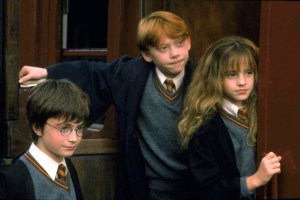 Chris Columbus (Home Alone, Mrs. Doubtfire) wrestled this franchise away from such directorial heavyweights like Spielberg, and it’s clear to see why he was selected. Rowling ordered the movie adaptation to be completely faithful to her book, and Columbus is a director with no remarkable visual flair or distinct vision. Everything that is occurring is so faithful to the book that it has no individual flavor or distance. It’s directing with your hands tied, which is fine for most people. With this project he seems like he is basically a go-between with Rowling and the studio suits. Basically it should be Rowling’s name for the director’s credit because she’s the one with the vision being translated.
Large portions of this film need to carried by the acting of several of its young stars and it’s quite a 120 million dollar weight. For the most part the child actors in Harry Potter deliver. Emma Watson is the standout as Hermione, with her extra energy and enthusiasm in every step and every smile simply winning over the audience in spades. The only real detraction acting wise in the entire film is, unfortunately, the star. Daniel Radcliffe plays Harry in a very stiff manor and spends most of the film looking overly subdued. After you experience more time with the other characters in the film one realizes how frightfully dull the character of Harry Potter really is. Any of the characters would be more exciting to watch than Harry. As characters go, he’s about as interesting or entertaining as stereo instructions.
Harry Potter contains an all-star all British cast for the fanciful faculty of Hogwarts. Everyone seems so meticulously cast that they were born to play these roles. Richard Harris becomes a gentle grandfatherly figure as the headmaster. Robbie Coltrane is a large and lovable figure that the audience can rely on again and again. Richard Griffiths is so over-the-top in a very entertaining light. Alan Rickman owns every scene he is in with such a snarling and full-of-life presence. He is perfect, as is most of the adult casting.
 The most exciting moment of the film occurs during a match of Quidditch, which is basically like rugby in the sky. Two teams on broomsticks whiz and zoom around one another in a fierce aerial competition. At this moment Columbus can declare himself the true director. The entire sequence is done that it perks the viewer’s imagination and also provides great moments of excitement. Seeing the scene itself was a testament to the wizardry of special effects.
The length of Harry Potter and the Sorcerer’s Stone clocks in around two hours and thirty minutes, which might seem like an eternity to small children if they weren’t so overly obsessed with the book series. The film is structured more like a novel than a screenplay (again with the induced restrictions), so instead of a usual three-act system it has moments that drag and moments that seem to go on endlessly (like the final near obstacle course the three kids must go through). The entire first hour or more is set-up explaining all of the characters and the world they inhabit, then they just sneak in a mention to the Sorcerer’s stone toward the end and introduce our titular story line. Hopefully, with the set-up out of the way now, the next movie will be a tad shorter.
Harry Potter is a worldwide phenomenon that is already breaking box-office records and parents’ bank accounts. The first four books have been optioned by Warner Bros. so expect to see an armada of kids dressed up in Halloween costumes around Thanksgiving for the next few years. Harry Potter is a fairly light-hearted but entertaining venture that I wouldn’t mind revisiting and reacquainting every now and then like an old friend.
Nate’s Grade: B
Share this:

Dogma (1999)
 In a time where simply having faith in anything, let alone religion, is scoffed at, Kevin Smith daringly and passionately expresses his personal search for answers and understanding. But while the zealots decree Dogma as blasphemy, what they truly miss is the biggest commercial for faith and God that American audiences have seen in decades of cinema.
The story of the religious epic causing all the hubbub begins with a pair of fallen angels (Ben Affleck and Matt Damon) spurned from the pearly gates of Heaven and banished to Wisconsin. One discovers a re-dedication of a church imploring a little used Catholic practice of plenary indulgence allowing whoever to enter through the church’s arches to have their slate cleaned of all sin. The two seize this opportunity of a dogmatic loophole to sneak back into heaven. The only slight problem is that by doing so they reverse a decree of God and disprove the Almighty’s unfallability, and thus will wipe out all of existence. The voice of God (Alan Rickman) recruits a lapsed Catholic named Bethany (Linda Fiorentino) for a Holy Crusade to halt the scheming angel’s plans for the good of the universe. Along the way she is aided by two unlikely prophets (the dynamic duo of Jay and Silent Bob), an racially discredited 13th Apostle (Chris Rock), and a shapely strip-teasing muse (Salma Hayek) as they engage with demons, seraphims, angles, and all sorts of celestial “who’s who” to stop the end of existence.
 Smith’s direction has taken strides since the point-and-click days of his earlier works; however, there’s still an awkward flatness to his framing and action. Fiorentino plays the role of a grounded character well. Rickman as the bitter Brit shows why he can still take anyone toe-to-toe for acting chops. Affleck and Damon have terrific chemistry together and play off one another for great comedy. Jason Mewes has never been funnier as the terminally stoned and foul mouthed Jay. Rock shows he can restrain his abrasive personality. Salma shows… well she shows she can dance. Jason Lee as an air conditioning-adoring demon and George Carlin as a used car salesman type Catholic Cardinal are so commanding in their presence and excellent in their performances that it’s a sin most of their scenes were cut during editing. Even Alanis Morrisette works as a humanly childish God. She’s given no lines but expresses great feeling and humor anyway.
Dogma is rambunctiously hilarious and a never ending joyride of fun as it jumps from jokes about demons made of excrement to “Buddy Christs” to insightful and sensitive thoughts on religion. Rarely does it bore even with the large plot it must always keep in successive movement. The only drawback Dogma suffers from is the amount of religious points it desires to make. The characters will reach a subject, chat, then directly move on to the next. The sporadic nature can easily keep an audience’s head spinning, but is brought back down to gentle rest from Smith’s Divine wit and sharp writing. Some of the opus’ many characters appear for only brief stretches as Hollywood’s A-list battle for valid screen time among each other.
 Smith is not one to shy away from controversy, or his quota of sexual innuendos and profanity. But the protestors for this film attacking its vulgarity are beyond missing the point; Dogma is reaching people the church hasn’t and can’t. It may be an audacious tweaker of a flick, but ultimately it’s bringing up religion into open debate and discussion amongst the masses where there was none before. And isn’t that in itself glorifying some type of achievement?
It would do well the opponents of Dogma to venture into a darkened theater sometime to see the movie and realize it is a humorous affirmation of faith and beliefs. The story of a crisis of faith is relatable to a society too jaded and cynical. Smith’s wrestle with theology is the public’s gain, and his halo only glows a little brighter for having the courage to do so.
Nate’s Grade: A-


 nathanzoebl
You must be logged in to post a comment.