Blog Archives
Funny People (2009)
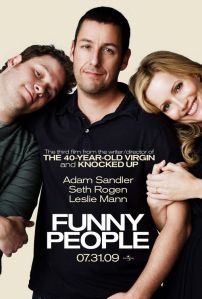 In two short years, Judd Apatow has become the king of comedy. He’s co-written and directed two bona fide hits that will go down as comedy classics (40-Year-Old Virgin, Knocked Up), and produced gut-busters with heart, like Superbad and Forgetting Sarah Marshall. The Apatow brand of comedy centers on characters and less on contrived set pieces. He’s built up enough comedy capital in Hollywood that he felt he could write and direct a project less ideally commercial, something tagged as being more personal and serious like in the James L. Brooks mold. Funny People is the mixed results. I applaud Apatow for trying to grow as an artist, but as the saying goes, if it ain’t broke don’t fix it. Funny People is a broken movie that isn’t funny enough to be fully redeemed.
George Simmons (Adam Sandler) is a famous comedy actor that has made several hit Hollywood comedies. He may live in a giant mansion but his life is extremely isolated and lonely. He has no real close friends and years ago he drove away the love of his life, Laura (Leslie Mann). He has no one to comfort him in his time of need. This prickly man has been informed that he has a terminal blood disease. Simmons decides to go back to his comedy roots, to stand-up, and it is there that he meets the young comedian Ira Wright (Seth Rogen). Ira has grown up with the comedy of George Simmons, so he is flabbergasted when the man himself asks Ira to write jokes for him. Ira’s roommates, fellow stand-up comic Leo (Jonah Hill) and crappy sitcom actor Mark Taylor Jackson (Jason Schwartzman), can’t believe his dumb luck. Ira and Simmons build an unorthodox friendship, and Ira is the only person George has confided in about his disease and his fear of dying. And then something amazing happens. George Simmons gets better. He’s got a new lease on life and he aims his attentions on the girl that got away. Laura is married to Clarke (Eric Bana), a handsome Australian businessman, and she has two adorable kids (Apatow’s own girls), which makes it a very poor time to restart her romance with George.
 Funny People is the first Apatow-helmed film that feels sadly incomplete, even at two and a half hours. The movie is staggeringly sloppy when it comes to plot structure and character work. First off, when a character is informed that he has a terminal illness at minute three, it doesn’t have the impact that it would if the audience got to know and feel for that individual. In fact, the first half of this movie feels like, and this may get confusing, the second half of another movie. It centers on a selfish character coming to grips with his choices in life, mostly wrong, and beginning to reconnect with people once more, building a mentor friendship and finding the “one that got away.” But there are segments during this first half of Funny People where the impact just cannot be felt because the dramatic legwork has not been achieved. Watching Simmons’ estranged family berate him through tears doesn’t have much of an impact when they discover the news. Seeing George Simmons spend his potential last days jamming with Jack White and other musicians is cool, but it doesn’t come across as anything but another indication that the fake George Simmons is famous in this alternative Los Angeles. It doesn’t have setup, like Simmons talking about one of his life’s pleasures is strumming the guitar or playing before things got complicated. So it’s basically just another celebrity cameo snapshot. While I’m on the topic, the multitudes of celebrity cameos are strangely unfunny, save for a bit where Sarah Silverman describes her lady parts.
This is also the first Apatow comedy where it feels like twenty percent of what I saw promised from TV spots, trailers, making-of specials (there was a good one on Comedy Central to check), the advertising unit if you will, was not in the movie. This gave me the distinct impression that even at a lengthy 150 minutes that Funny People feels misshapen, that there are swaths of material on the cutting room floor that would have assisted the narrative and sad amount of underwritten supporting characters. I’m not saying Funny People would necessarily be a better movie at three hours length, but it would at least feel more fully formed and satisfying.
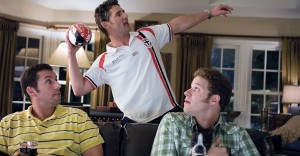 The main problem with the film, outside of the reverse plot structure, is that everything just goes slack during the uneven second half. George and Ira spend about an hour of the movie with Laura and her family, and it feels like one long uncomfortable detour. Part of the squirmy feeling is intentional, as the audience is supposed to be in Ira’s shoes and see George’s homewrecking as the bad decision train wreck it is. But I also felt uncomfortable because George kept extending his stay day after day and I was getting impatient. I wanted these characters to head back to L.A. and deal more with the Ira/George relationship. During this second half, Ira becomes a background figure that is good for nervous reaction shots. This stalls all the character work that had been done up to this point and Ira goes to pause mode for an hour. This second half section isn’t particularly funny, it isn’t romantic, and it gives little insights into the past between George and Laura. She has established a nice living for herself, with two cute kids and a hunky husband who seems to be a good father when he’s around. In fact, despite the movie’s insistence that Clarke is a cheater (thus ensuring the movie law that it is then acceptable to cheat on him), I found myself liking the hyperactive and sensitive lout. Every plot movement in this second half feels wrong, some of it intentional, but it makes Funny People feel like it has been hijacked and taken hostage. Where did the movie I was kinda liking go? What happened here? This hour feels like a separate movie and one that Funny People would have benefited from simply being dropped entirely.
Perhaps I’ve been watching too much Mad Men in anticipation of its third season, but this movie also disappoints by failing to delve into the creative process of comedians. Despite its running time and subject matter, there isn’t that much standup witnessed. Usually the movie will display about one line or one bit and then cut back to the characters offstage again. We don’t get to see the evolution of comedy or the professionals talking shop about what makes a good joke. There isn’t even much collaboration, so we don’t get to see multiple minds banging out jokes together. There’s a comedian named Randy (Aziz Ansari) who is popular with audiences because he’s loud and spastic, and all the other comedians hate him, but then the movie doesn’t return to this. Go back to this topic. I want to hear more about the divisions within the comedy world, the people that feel like they are more pure or textured in their funny compared to the people that play to the crowd and lap up the easy yuks. Ira’s character work is mostly explored through his changing standup persona, where he seems to gain more confidence and a voice. But there’s this whole other storyline where Ira is a “joke thief” and takes other people’s material and repackages it as his own. This is an interesting story and provides conflict and glimpses into the character of Ira as an insecure and ethically challenged opportunist in a competitive field. It makes him a more dynamic character. I saw more of this storyline in the making-of special for Funny People, and sadly it is only hinted at in the final product. The other comedy players, like Ira’s roommates and his quasi-love interest (Aubrey Plaza), are barely explored as people and professionals.
Apatow comedies are notable for being character-based, but Funny People doesn’t seem too concerned with establishing characters that you want to be around. I found little reason to care. I found most of the characters to not be engaging; some were unlikable but most were simply flat. George Simmons is supposed to be a selfish man, though there’s something inherently selfish about being famous in Hollywood. Comedy itself is inherently selfish, where individuals guard their observations and exploit personal stories for the endorphin highs of audience approval. Is successful comedy linked to selling out? Funny People occasionally visits the dark recesses that comedians utilize for material, like self-lacerating humiliation and family trauma that gets aired out as a means of therapy. Simmons is a selfish and lonely guy and the point of the whole movie is that even after a near-death experience, he’s still selfish and lonely. He’s said he’s changed but has he really? That seems to be the movie’s cosmic joke. This is clearly a personal movie for Apatow, which might explain why it has less resonance for an audience that isn’t as steeped in the history of comedy or the rigors of fame. I just don’t have the same point of interest.
 Sandler revealed his acting talent in 2002’s beguiling Punch-Drunk Love, and in Funny People he plays a completely different character than his other adolescent roles. He doesn’t pander to be likable at any point, and he’s generally standoffish from beginning to end. He hasn’t done a lewd, crude movie in over ten years, and this return to raunch rekindles the Sandler I remember listening to constantly in the mid 1990s. This role isn’t as taxing for him as an actor, nor is he given too many chances to reveal deeper layers to George Simmons. I think this is by design from Apatow. Rogen is less his charming self and during the second half of the movie he pretty much shifts his eyes and makes pained faces. He feels at ease in the stand-up sequences, probably because Rogen performed stand-up comedy when he was 13. Mann gets her biggest acting role in years and cries enough, but it made me realize that she works best as an actress that can steal scenes rather than an actress who has scenes built around her. I think Bana (Star Trek) actually comes off the best. He showcases an exuberance for comedy not seen before, and when his character gets emotional it still manages to be funny and believable.
In the end, Funny People just isn’t that funny. There aren’t any particularly clever comedic setups, the characters don’t get many chances to be humorous even as comedians, and the movie just goes slack during its uncomfortable and uneven second half. The Hollywood satire lacks bite, and the best bits are saved for the scathingly unhip and formulaic “Yo, Teach!” sitcom of Schwartzman’s. Apatow is more interested in purging a personal tale onto the screen rather than fashioning a relatable mainstream comedy. I feel that the salutations that Funny People is “more challenging” and “serious” are unwarranted. This is certainly a different movie but is it any more serious than navigating the uncertainty and awkwardness of an unplanned pregnancy or beginning sexuality at middle age? I don’t think so. Beyond this, the movie doesn’t establish its plot well and spends far too much time in side diversions, failing to round out characters and ignoring intriguing premises and storylines. Even the camaraderie, usually a hallmark of Apatow productions, feels lost as the characters have much more friction. On a personal note, I saw this movie while I was on vacation in the Outer Banks. On our car ride back to our beach house, my then-partner and I got into a car accident. We were both physically fine but her little Ford Focus was totaled. I will now forever associate Funny People with a car accident. If that isn’t enough of an on-the-nose metaphor, while we waited along the hot road for police and tow trucks, I thought to myself, “I just wish the movie was worth this.” It wasn’t.
Nate’s Grade: C
Share this:

Reign Over Me (2007)
 Adam Sandler in a serious drama? Well it worked in 2002’s Punch-Drunk Love, but that was aided by Paul Thomas Anderson deconstructing the typical Sandler goofball in his glut of crude yet successful comedies. Can Sandler work his thespian skills in a story not tailor-made for him? I think writer/director Mike Binder’s 9/11 human drama, Reign Over Me, is proof that Sandler can step outside his popular persona for a worthy cause. But this movie isn’t it.
Alan Johnson (Don Cheadle) is an ordinary dentist living his family life in Manhattan. Then one day he spots his old college roommate, Charlie Fineman (Sandler), zipping along on an electric scooter. He looks drastically different than Alan remembers, and this is because Charlie’s wife and children, and even his dog, were on one of the hijacked planes that crashed into the World Trade Center on 9/11. Charlie’s life now consists of a new adolescence where he does what he wants because of the insurance money, so he plays video games late at night, goes to see Mel Brooks retrospectives, and keeps remodeling his kitchen over and over. He is without friends and refuses to even think about any painful memories. Alan takes it upon himself to help his former dentist school pal confront his grief and get back on his feet.
 The varying elements never truly mesh, and Reign Over Me has a very haphazard, clumsy feel as it never comes to a firm landing. There’s a mixture of the serious and the sitcom, and both elements go together as well as vodka and motor oil — sure it may work in the immediate but couldn’t it be much better? Many of the connections feel tenuous and it’s hard to care about certain storylines, especially the film’s preoccupation with Alan’s midlife malaise. Are we supposed to be in Alan’s corner as he argues his adult life sucks because women at the office throw themselves at him and his wife wants him to open up? Am I really supposed to believe the film’s assertion that he covets the freedom of a 9/11 widower? Reign Over Me never shifts gears smoothly when it comes to tone. The audience is left to question why this story needs to be told through the prism of a bored dentist. It never truly feels right.
Charlie isn’t just bummed out, he is severely damaged from the shock of 9/11; this is far beyond post-traumatic. At several points he just freaks into violent fits out for no discernible reason, but people still tolerate him and don’t call for greater help. It would be naive to think that one friend could fix all of the psychological horrors of one man, but then you remember this is a movie. Charlie could use some serious meds. Friendship is important, but Reign Over Me toys with the object of abject loss without delving too deep, instead feeling that one good crying confessional and a terribly manipulative and unbelievable court battle will sum everything up.
I think that feeling was pervasive for me while watching Reign Over Me was that I felt toyed with. The drama takes a long time to wind down and even then it settles on surface-level solutions that always seem so easy in movies. Many of the comedic elements feel too dependent on sitcom generalizations. Charlie comes to Alan’s apartment late at night and asks his wife if he can go out and play. Alan chastises his friend, saying he’s an adult and doesn’t need his wife’s permission to go outside. Can anyone guess what the next moment will entail? That’s right, he asks his wife if he can go out and play. You’ll be forgiven if you hold for expectations of a laugh track. Reign Over Me even is also filled with the usual suspects like the brassy receptionist, the shyster lawyer, and the hilarious misunderstandings between the sexes that bring about sexual harassment lawsuits.
 Let me stop and illuminate on that last bit. Alan’s patient is obsessed with wanting to orally pleasure the good doctor, enough that she sues when he declines a second time. For whatever reason, he sees her again and she apologizes in some ham-handed back-story about how her husband dumping her left her devastated (and if you can figure out what Binder has in store for the film’s broken female and broken male, then you too deserve a lollipop). This storyline is beyond tacky, a bit humiliating for the actress, and a prime example of how poorly the all the female roles are written. It’s shocking that Reign Over Me can examine male adult male bonding so well but completely drop the ball with every single female character. Alan’s wife seems nice and responsible but the film tries to convince us she’s sucking the life out of him because she likes jigsaw puzzles, quiet nights at the home, and knowing where her husband is when he’s out odd hours of the night. It’s appalling how this movie treats its female characters. They are either seen as flighty beings at the control of their sexual desires or as cold, non-sexual wet blankets. After the hour mark you can almost forget about seeing anything about Alan’s family except for an implausibly tidy “I’m sorry/No I’m sorry” phone call.
Sandler can be a fine actor when given the right material, and a character that retreats into an infantile existence seems like a plum role for him. He effectively channels Charlie’s disconnect from reality, but a lot of his grief tics will start to remind you of Rain Man-style autism, like repeating phrases, obsessive behavior, and moaning and rocking while upset. He gets lots in his Bob Dylan bird’s nest of hair.
Cheadle is always dependable as an actor and proves to be a stable center the film needs because of its narrative shortcomings. He’s doing primarily a lot of reaction but still manages to work above his material and build sympathy to a character that really deserves less. Sandler bounces around like a ping-pong ball and Cheadle holds steady, and the two men form a rather strong acting unit that just makes me wish the material were up to their task.
Ultimately Reign Over Me is hard to pile on because of its wealth of good intentions and fleeting moments of dramatic heft. It’s a messy film that somehow believes all its disjointed elements fit together, when in reality the movie never settles on a cohesive tone. The acing is generally strong and there’s some mature and realistic writing regarding male relationships, however, there are just as many frustrating moments. The film skims the surface of Big Issues like 9/11 grieving but never wants to develop into something more thoughtful. Instead, the film retreats much like Charlie into an easier existence where the questions are only momentary. Reign Over Me is a fine if unremarkable drama, but good intentions can only take you so far. At some point, to be memorable, you have to actually be good.
Nate?s Grade: B-
Share this:

Grandma’s Boy (2006)
 This Adam Sandler crony comedy came out within the first weeks of 2006. Many predicted it could very well remain one of the worst films of the year. Let me verify that belief. This is an incredibly lazy stoner sex comedy that can’t even get gratuitous nudity right. Its premise (video game tester moves in with three old women) never takes off, and much of the movie just feels like one giant drunken party. The story doesn’t even kick in until an hour in; you’re not Brokeback Mountain, Grandma’s Boy, you cannot afford to take your time and sit on your ass. This stuff just isn’t funny. You want to know how unfunny? A character thinks he’s in The Matrix. Hi-larious and oh so timely. The movie trots out a nerd’s dream girl (Linda Cardalini) for a ridiculous romantic subplot that will just continue to give people who play Xbox 20 hours a day false hope. Sandler needs to stop bankrolling his buddies’ tired pet projects (Do we really need more Rob Schneider movies?). This one is written by and stars Allen Covert and is directed by a guy whose only other credit to his name is, honestly, as an assistant to Covert on another movie. You can see how interested in quality Sandler and Covert are. This is rather insultingly unfunny for a raunchy sex comedy. It even plays it all too safe. There’s strong potential for a grand gross-out comedy involving horny old women, but this isn’t it. You mostly just feel sorry for the actors. This is a movie that doesn’t work on any level, except to keep Sandler’s buddies busy so they won’t crash on his couch.
Nate’s Grade: D
Share this:

The Longest Yard (2005)
 Does anyone else remember an episode of South Park from the 2004 season where Eric Cartman dresses up as a robot named AWESOM-O? The best part of the episode came when Cartman stumbled into a Hollywood meeting and they asked the robot to pitch a movie idea. He came up with idea after idea of Adam Sandler in some wacky yet predictable situation, each a slight variation from the last. The Hollywood execs ate it up and scribbled everything down, chanting, “Goldmine!” I imagine The Longest Yard remake, the latest Sandler comedy vehicle, came about through similar creatively bankrupt circumstances.
Paul Crewe (Sandler) is at a low point in his life. The once star quarterback has been banned from football for throwing a game. His girlfriend (Courtney Cox) thinks they should split, and after being chased by police for drunk driving, he?s been sent to prison. The warden (James Cromwell, your go-to guy if you need someone old) has big plans for Crewe. He wants the young stud to organize an all-inmate football team to play against the cruel guards. Crewe gets help from a fellow inmate Caretaker (Chris Rock) and they set about finding the right men for their team. A former Heisman-winning football player (Burt Reynolds), who happens to be in the same prison, becomes the coach. Slowly but surely the group becomes a team united to get some revenge on their tormentors.
The Longest Yard is an Adam Sandler comedy in the worst way possible. The film is sloppy and sophomoric but generally unfunny. It sets its comedy heights on kicking people in the nuts and making fun of gay people. Mission accomplished. The sex jokes, while in abundance, generally fall flat because the movie is so ineptly transparent when it comes to comedy. It lets all the air out of the supposed punch lines. The humor is typically homophobic but infuriatingly also anti-women. You see, one of the guards is taking steroids in a bottle with a giant label that says, “Steroids?”(so much for keeping a low profile). The boys replace the steroids with -hee hee- estrogen pills. And in three days time, which would of course have no effect in such a short period, the guard is now crying, and overly emotional, and empathetic, and he has hot flashes, though I don’t know how in the world a man comes to that conclusion. Apparently it’s funny because women are weak and care about each other. I would be offended by this whole joke if it wasn’t so incompetently done. The Longest Yard exists in its own inept world where inmates have cells within arms reach of each other and there’s a prison football league. Lest we forget, this prison also keeps a star system to rank its inmates. Little did you know of Roger Ebert’s unorthodox side projects.
 Sandler plays Adam Sandler as he does in most of his Hollywood flicks. He’s likable, he’s a goofball, and it all works out. I wonder if we’ll ever see the true thespian side of Sandler again, like in Paul Thomas Anderson?s deconstructionist Punch-Drunk Love. Rock’s abrasiveness is toned down but he also loses his comedic edge. He’s basically another stereotypical black character in a movie making tired jokes about the difference between black people and white people. Cromwell and Reynolds both appear to be having fun mucking it up with the youngins. The rest of the supporting cast have their moments but aren’t very memorable. The movie fills out the athletes by having real football players and wrestlers.
What’s worse is that The Longest Yard wants to also be taken as a serious movie. This causes some intensely jarring scenes intended for dramatic impact but they just stick out sorely and are misplaced. Every time the movie goes from kicking people in the nuts to dealing with something like racism or death, the movie flounders from the tonal whiplash. The original movie was more of a prison drama than a sports movie, let alone a comedy. The Sandler remake wants to be all three and isn’t good at any of them.
This movie is so formulaic that it could have been written on a string of napkins, likely only totaling three. The Longest Yard feels like 2005’s greatest example of a cut-and-paste studio approved movie. Of course the embattled hero will once again face his demons and his past. Of course the motley crew of idiots and convicts will come together for something greater than themselves. Of course the evil guards will all get their comeuppance in appropriate ways. I expected all this from the start, but where The Longest Yard goes terribly wrong is when even the details can be correctly guessed. I watched the film with a couple friends and we accurately guessed every character move, scene transition, character development, and sadly, every punch line. This is a film that spells everything out, including the jokes. Here’s an example of the film’s shortsighted thought process: the dastardly warden soaks the player’s field and makes it all muddy with the intention of demoralizing the team. What? These are prisoners, and you think mud is going to demoralize them? Don’t even get me started on how insane it is sending Burt Reynolds into the game as a running back. There’s more attention spent on the limp football scenes than the story or the comedy.
 Another example of how weak the comedy is comes during the football game. It’s being telecast on ESPN and Chris Berman is providing the play-by-play. His sidekick in the booth is an inmate who doesn’t say anything. Berman even broaches this fact on air. Now, if The Longest Yard knew the facets of comedy, the natural payoff for this sequence would be for the silent inmate to say something at the very end, something funny or unexpected or even verbose. Instead, the film has the inmate talk two or three times and he adds no comedy. That’s The Longest Yard in a nutshell: all set-up and no return. And seriously, stop with the Rob Schneider cameos already.
The humor is a cocktail of physical slapstick and the occasional one-liner. There just isn’t anything satisfying to the comedy The Longest Yard has to offer. The jokes typically don’t build to anything greater and the humor is simply immediate with no lasting results. There’s nothing that will make you keel over with laughter, nothing that rises above a smirk or a slight giggle. The jokes are way too predictable and there’s nothing funny about the expected. That’s why most people don’t chuckle when the mail arrives. This just isn’t an entertaining comedy, plain and simple.
The Longest Yard is a tirelessly formulaic affair that is so ham-fisted with comedy it can’t even deliver jokes properly. This is a dumb, sanitized, audience-friendly easily digestible piece of puff that will get caught in your throat. This is a Franken-movie, with various parts crammed together for the best possible results by some studio overlord. The Longest Yard‘s comedy is sophomoric and generally insipid, the drama is a complete misstep and tonally out of place, and the football scenes are vapidly jazzed up. This is a sports move that doesn’t work as a comedy and a comedy that doesn’t work as a sports movie. Sandler’s devout army of fans will likely be satiated with this latest effort, feeling the flick to be stupid fun. For me, it was just stupid. Very stupid.
Nate’s Grade: D
Share this:

Punch-Drunk Love (2002)
 So what do you get when you cross clown prince Adam Sandler and the writer/director of the lengthy epics Magnolia and Boogie Nights? Well you get the most unique romantic comedy ever, that’s what.
Barry Egan (Sandler) is a self-employed supplier of novelty toilet plungers. His seven older sisters have made it their job to torment him ever since he was young. In moments of confession of his unhappiness Barry usually prefaces by pleading with people not to tell his sisters. Barry is a timid introverted wallflower yet full of volatile rage fit to senselessly trash a restaurant bathroom. Lena Leonard (Emily Watson) pursues Barry after being introduced through one of his sisters. Lena latches onto the oddball and he finds the maternal comfort and acceptance he has missed his entire life. Somehow these two souls have crossed paths and become exactly what the other has always needed.
But Barry has trouble ahead of him. One night he called a phone sex line and innocently gave out all of his personal information over the phone. Now a sleazy Provo mattress store owner (Phillip Seymour Hoffman) is extorting money from Barry and using four blond Mormon brothers as his muscle. When Barry confronts the thugs, whom have now begun to endanger Lena as well, he boldly states, ”I have a love in my life and that gives me more strength than you will ever know.” You cant help but believe it and genuinely feel for the resurgence of this character’s dignity.
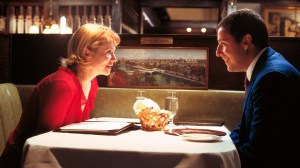 Writer/director Paul Thomas Anderson spins an engrossing character study deconstructing the angry goofball Sandler has been so accustomed to playing in all his slapstick comedies. He plays the same character archetype but is now given new dimensions to play with and depth. The true revelation of Punch-Drunk Love is that Sandler can really act. No, really, I’m dead serious.
The direction and writing are much more restrained than with Andersons previous films. The world of Punch-Drunk Love is full of stark colors, slow camera movements and vast amounts of spatial emptiness. The scope is much narrower, focusing on a small set of characters and just allowing them to tell the story without outside interference — like a frog shower. Due to the attention paid to Barry, everyone else becomes underwritten including the stoic love interest. After being convinced of Barry’s instabilities the audience is left to assume sheer blind faith at what Lena sees in Barry.
Punch-Drunk Love gleefully ignores and plays with romantic comedy conventions. The running time is under 90 minutes, (which is still only HALF of Magnolia) but the pacing is precise. John Brions percussion heavy musical score wonderfully displays the boiling anger behind Barrys placid exterior during key moments.
The storytelling of Punch-Drunk Love is full of uneasily accessible quirks and will likely be reacted to with hostility by mainstream America. What Anderson has crafted is an arty Adam Sandler movie that few thought even possible. Next thing you’ll tell me is that David Lynch will do a G-rated Disney Film. What’s that now?
Nate’s Grade: B+
Share this:

Mr. Deeds (2002)
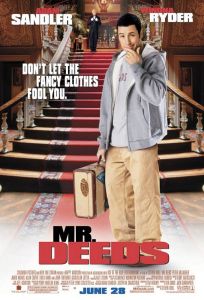 Adam Sandler seems like the reason they created the “no shirt no shoes” policy for restaurants. His niche is playing the lovable goodhearted goofball that triumph over the pretentious jackass and somehow wins the heart of the fawning one-dimensional love interest. Sandler appeals to the masses as our nation’s greatest warm-hearted simpleton. He’s the Jimmy Stewart of slobbery. So why mess with that? Well for starters, if you want entertainment anymore you might want to.
Mr. Deeds, Sandler’s latest idiot opus, is disastrously, even tragically unfunny. In the film Sandler stars as the only known heir of a multi-billionaire media mogul. Longfellow Deeds (Sandler) is a simple New Hampshire pizza delivery boy who treats people with respect and kindness. However, the mantra cruel to be kind must be alive and well because Sandler mercilessly beats people to about an inch of their life throughout Mr. Deeds for brutish comic effect.
 Peter Gallagher and his monstrous eyebrows serve as the stand-in villain. Hes a greedy tycoon who wants the Deeds fortune all to himself. Gallagher actually plays his part well and seems to at least have some fun with the broad comedy role. Wynona Ryder, on the other hand, does not. Ryder has never proven she can handle any comedy other than black, and slapstick just ain’t her thing. She painfully goes from scene to scene clueless as a tabloid journalist hiding her identity so she can get the scoop on Deeds, only to fall madly in love with him.
The film has some glimmers of comedy, mostly from its supporting cast including John Turturro as a very sneaky Spanish butler. It’s nice to see Turturro in something this high profile and get some recognition this journeyman deserves. There’s also a really funny cameo served up by a former tennis giant himself known for his boorish temperament. Steve Buscemi should be charged with grand theft movie because his three minutes on screen as the crazy-eyed local are funnier than anything with Sandler onscreen.
 The movie becomes far too redundant of Sandler’s other comedies to the point where seeing former stars like Rob Schneider in his Big Daddy character is somehow supposed to be funny. This kind of stuff is strewn throughout the film. It feels like everyone’s going through the motions. Now I’m not a total Sandler basher, because I do believe the man can be funny when worked right. Billy Madison is still hysterical to me upon every viewing and I do get some fun watching The Wedding Singer, but Mr. Deeds is sub-par Sandler even for Sandler.
I’m sure most of the people buying tickets for this have no idea that the concept is based upon the Capra film starring Gary Cooper. But what good is Gary Cooper? He didn’t write cutesy greeting cards or save a litter of kittens from a raging inferno like Sandler’s Deeds. In the end, this mostly laugh-free comedy is short on imagination, energy and entertainment.
Nate’s Grade: C-


 nathanzoebl
You must be logged in to post a comment.