Traffic (2000) [Review Re-View]
 Originally released December 27, 2000:
The war on drugs may be one worth fighting but it’s a battle that every day seems more and more impossible. Traffic is a mirror that communicates the fruition of our current procedures to stop the illegal flow of drugs.
Traffic is told through three distinct and different narratives. One involves an Ohio Supreme Court justice (Michael Douglas) newly appointed as the nation’s next Drug Czar. While he accepts his position and promises to fight for our nation’s children, back at home, unbeknownst to him, his daughter is free-basing with her bad influence boyfriend. Another story involves a wealthy bourgeois wife (Catherine Zeta-Jones) awakened to her husband’s arrest. Her shock continues when family lawyer Dennis Quaid informs her of her husband’s true source of income. He’s to be prosecuted by two DEA agents (Don Cheadle and Luis Guzman) unless she can do something. The final and most compelling narrative involves Benicio Del Toro as an honest cop in Tijuana battling frustration with the mass corruption surrounding the city. Each story weaves in and out at various points in the film.
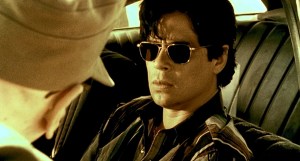 Traffic was photographed and directed by the man with the hottest hand in Hollywood, Steven Soderbergh. He uses a documentary feel to his filming that adds to the realism. Different color tones are assigned toward the three narratives as reflections of the emotional background. Soderbergh expertly handles the many facets of the drug industry and pulls out his typical “career best” performances from his onslaught of actors.
Benicio Del Toro is the emotional center of Traffic. His solemn demeanor and hound dog exterior reflect a good man trying to fight the good fight in a corrupt environment. He effortlessly encompasses determination, courage, and compassion that you’ll easily forget the majority of his lines are in Espanol. Benicio is an incredibly talented actor and one with such vibrant energy whenever he flashes on screen. It’ll be wonderful watching him collect all his awards.
Catherine Zeta-Jones also shows strong signs there may well indeed be an actress under her features. Her role is one of almost terror as you watch her so easily slip into her imprisoned hubby’s shoes. The ease of transformation is startling, but in an “evil begets evil” kind of fashion. The fact that she’s pregnant through the entire movie only makes the shift from loving house wife to drug smuggler more chilling.
 The entire cast does credible acting performances with particular attention paid toward the younger actors deservingly. Don Cheadle throws in another terrific performance showing he’s sublimely one of the best actors around today.
Traffic oversteps its ambitions and aims for a scope far too large. It is based on a 6 hour BBC mini-series, so trying to cram that material into a two hour plus format is taxing. As a result we get an assembly of characters, but too many with too little time in between to do any justice. Screenwriter Stephen Gaghan (Rules of Engagement) condenses the towering impact and influence drugs have well enough, but he intercuts the stories too sporadically that attachment never builds for either of the three narratives. He does balance the Douglas Drug Czar one carefully as not to fall into the cliched vigilante metamorphosis. But the mini-series had more characterization and depth to its tale.
Traffic is a good film but it has edges of greatness never fully visioned. Soderbergh shines bright yet again and all accolades will be deserved. Traffic is undeniably a good film, but it’s one you may not want to watch a second time.
Nate’s Grade: B
——————————————————
WRITER REFLECTIONS 20 YEARS LATER

So twenty years later, how is that war on drugs going? Considering the billions of dollars and countless lives that have gone into trying to stop the intricate infrastructure of supply and demand for the drug trade, the United States has little to show for its efforts. If anything, there has been a dawning realization of the futility of playing cartel whack-a-mole, removing one leader just for another to take their place in the supply chain. There have also been movements toward treating addicts rather than incarcerating them. The country has stubbornly become more accommodating and understanding of the ravages of addiction; it only seemed to take the spread of the opioid crisis where affluent families in the suburbs were affected personally. Tragically, it seems too many Americans have to have an “it could happen to me!” moment before their empathy for another person’s struggles kicks in. These relaxing attitudes have translated into recreational marijuana being legal in 15 states as of this review. Many other states have decriminalized marijuana, and Oregon has recently voted to decriminalize all drugs. It seems that in 2020, our concept of the war on drugs has dramatically changed. Some may find these developments an admission of giving up, of retreating from some moral duty, but others have concluded that maybe we’ve been fighting all wrong for 50 years and the only thing we have to show for our blood-soaked efforts is that multiple criminal elements got much richer.
 It’s an interesting social and cultural landscape for going back and re-watching 2000’s Traffic, the last film on my re-watch of 2000 cinema. Times have changed and this is felt in Steven Soderbergh’s Oscar-winning ensemble covering the globe-trotting scope of the war on drugs. Traffic won four Oscars, including for Soderbergh for Director, Benicio Del Toro for Best Supporting Actor, and for editing and adapted screenplay. The only Oscar it was nominated for that it didn’t win was Best Picture, losing to Ridley Scott’s sword-and-sandals epic, Gladiator. It was an ambitious movie and had over 100 speaking roles. Soderbergh served as his own cinematographer and cameraman, bringing a docu-drama versatility to the movie that added its own sense of realism. 2000 was the year Soderbergh hit his critical peak. He was an indie darling from 1989’s influential sex, lies, and videotape and puttered throughout the 90s with small, personal, weird movies (I loved Schizopolis as a teenager), and then in 1998 he gained a new level of credibility providing sheen and heat to Out of Sight, the movie that cemented George Clooney as a major movie star. The one-two punch of Traffic and Erin Brockovich in 2000 earned Soderbergh two Oscar nominations for director, a feat not accomplished since 1938, and after 2001’s highly successful Ocean’s 11 remake, Soderbergh had jumped to the top of the industry while maintaining his indie artistic credentials. He’s been dabbling and experimenting since (A movie shot on an iPhone!) with mixed results, but the man’s track record is hard to digest into simple categorization. He can jump from an action showcase for an MMA fighter, to a gleeful male stripper romp, to a four-hour epic covering the life of Che Guevera. With Traffic, Soderbergh was working with his biggest budget and cast yet. The decision to use different color tones is smart to easily distinguish the various storyline locations so that an audience can be immediately oriented when jumping around from place to place. It’s also extremely hard on the eyes at times. The Mexican storyline is so washed out in bleached colors that it looks like an atomic bomb just went off in the distance and is filtering the world with an excess of bright light to make you squint. Soderbergh also has a penchant for natural light coming through windows to be seen as giant blocks of white. Again, it achieves its artistic purpose but it also makes you want to avert your gaze.
The 150-minute movie is based on a sprawling 1989 BBC miniseries that totaled six hours. Stephen Gaghan (Syriana) adapted the screenplay and he does a fine job of condensing the major plot points of the mini-series into a manageable feature length. He also does a fine job of articulating the many intertwined players and motivations and contradictions of the drug trade. However, I can’t help but feel like some of the nuance and character development is lost by condensing everything into the body of a manageable American feature production. Take for example the character Catherine Zeta-Jones (Chicago) plays, Helena Ayala. She’s a rich southern California housewife who has her life upturned when she discovers her husband, recently arrested by the DEA, is one of the chief distributors for a Mexican cartel. Her character is in disbelief and shock at first, then she tries to make due with legal bills and mortgage payments. Things get considerably worse when the cartel threatens her children if Helena can’t pay her husband’s outstanding debts that have now fallen onto her. Her character arc goes from an ignorant, privileged housewife into a ruthless co-conspirator willing to do whatever it takes to protect her family and maintain the cushy lifestyle they have become accustomed to. Over the course of the BBC miniseries, you watch that version of the character undergo significant changes in six hours. In the 2000 film, the character undergoes significant changes in a matter of scenes. Helena goes from desperate to duplicitous in literally minutes, and the jump feels too unearned. The rushed storytelling caps some naturalism. A character can go from not trusting the DEA to providing damning evidence to the DEA in three scenes. A character can go from bored, privileged teenager to junkie prostitute in three scenes. For a movie about gritty realism, these character leaps can feel overly forced and inauthentic. There are so many characters and storylines and political points to make that the overall narrative can feel crowded, so while it’s always interesting, it can inadvertently fashion its own ceiling for emotional engagement because the many characters feel like impressions hitting their marks rather than as fully developed portrayals of people.
 The storyline that has aged the worst is Michael Douglas (Ant-Man) playing Robert Wakefield, a newly installed Drug Czar learning the ropes. For the majority, he’s akin to a 60 Minutes journalist just sitting in rooms and asking various professionals about their experiences and advice from their unique positions. From there, the storyline takes up the “it could happen to me!” trapping with Robert’s private school daughter (Erika Christensen) becoming an addict. It may have been surprising for a high-profile politician to have a child as an addict, but now this kind of irony feels passe. We’re used to politicians having ironic skeletons in their closet. The ongoing plot of her descent doesn’t really humanize her even as she makes some drastic decisions to chase that next high. She’s more an ironic counterpoint to shake her father, and the audience, of their preconceived mental imagery of what an addict might look like. It feels slightly retrograde and pearl-clutching, not simply that she goes through hell but that it’s set up to register that, oh my, WHITE PEOPLE, even RICH WHITE PEOPLE, can also be junkies. In 2000, this story might have been jolting and scared some older adults into wondering if this drug menace could find its way into their hallowed gated homes too. Nowadays, it seems obvious. If the storyline of a father dealing with his addict daughter had reveled more about one another as characters it would be worth the attention, but the daughter is kept as an example, a symbol, and Robert just has to take his lumps before the inevitable conclusion that his job is a lot harder than he would have imagined. His speech at his introduction at the White House has the hallmarks of drama ready and waiting, as he chokes over the political boilerplate he no longer believes in, but he simply walks out rather than sharing what he’s learned.
The best storyline in Traffic is, no surprise, the one closest to the action with Benicio Del Toro (Sicario) playing what feels like the only honest cop left in Mexico. Obviously that’s an over simplification, but the police force and political class are heavily corrupted by the cartels and their money. The character Javier Rodriguez has to navigate this tricky world without making himself as a target for those corrupt officials who think he’s an impediment. He’s trying to do good in a deeply flawed system and maybe even he knows he’s fighting a losing battle but he’s decided to keep his integrity while trying to fight what he considers is a worthy cause. A high-ranking general seeking his services reminds him of his lowly pay as a police officer, yet Javier Rodriguez is unmoved. Del Toro made a career of playing oddballs and sleazes, so it’s interesting to watch him play a fairly noble, straight forward role and in a language he didn’t speak before production (while born in Puerto Rico, he moved early and grew up in the U.S. and knew little Spanish). I don’t know if I would have awarded him the Oscar (my favorite for 2000 was Willem Dafoe as a vampire) but it’s certainly an understated performance with real gravitas. Del Toro is the quiet, churning contemplation of this movie and I would have been happy if the whole enterprise had been devoted to his south of the border exploits. I appreciated that the moves in this storyline would have larger effects on others, like a crackdown on a cartel being a reason why they need more money and the reason they now step up the pressure on Helena to pay up or else. It best encapsulates the knotty, interconnected framework that Gaghan and Soderbergh are going for.
 Traffic is one of those movies you know are good. It’s well written, well acted, and has a definite vision it’s going for that it mostly achieves. It’s also a movie that engages more intellectually than emotionally. There are some deaths and downturns but I doubt you’ll feel much regret or catharsis. The movie unfolds like an in-depth journalistic article, and the leaps in rushed characterization feel like a result of a looming deadline and a hard cap with its word count. It’s unfair for me to continue comparing the movie to its miniseries when that project had almost three times the length to fill out its tale (about poppy trafficking and heroin manufacturing in tribal Afghanistan) but it’s a clear-cut case of crammed plotting. My initial review back in 2000 keeps mostly to the plot and the many actors, though I think I overstated Zeta-Jones being “chilling” and I think my love of Del Toro in Way of the Gun that year transferred some extra praise for his performance here. It’s hard to remember but I was really anticipating this film my freshmen year of college. Traffic is a good movie but it’s not exactly one people get excited over. Every aspect is professional, proficient, but there isn’t exactly a lingering takeaway that changes your perception of the war on drugs. I’ll hold to the same grade and say it’s an admirable accomplishment but one better suited for a mini-series (it was adapted back into a TV miniseries in 2004).
Re-View Grade: B
Share this:

Tenet (2020)
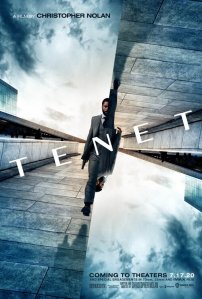 As my girlfriend described, Tenet is a headache disguised as a movie. I can agree about the confusion and irritation from trying to make sense of a 150-minute movie that almost defies you to even keep watching. From the opening sequence, my head was hurting from trying to make sense of everything and deduce meaning and connection. Christopher Nolan’s movie was set up to be the savior of the summer, a thinking man’s blockbuster with such size and scope that people would come back to the newly opened theaters to get a taste of the summer they missed because of COVID. It didn’t work out that way and Tenet’s box-office disappointment contributed to the recent decision for its parent studio to release its entire 2021 slate of movies onto its streaming service (nobody should risk their life to go see the Tom and Jerry film). Tenet has too much going on for me to call it a bad movie, but it also has too much going on for me to call it a good movie.
Protagonist (John David Washington) is recruited by a secret organization that is trying to thwart a cold war from becoming hot between the future and the past. Neil (Robert Pattinson) explains about “reverse entropy,” about effect before cause, and that there are machines that can allow people to reverse their direction in time. It’s less jumping through points than it is hitting the rewind button. A Russian oligarch (Kenneth Branagh) and his wife (Elizabeth Debicki) may be the key to preventing a future catastrophe or one that hasn’t happened yet or has already happened. It’s time travel so the tenses can get confusing. That’s not the only thing that’s going to likely confuse you.
 At around the half-hour mark, it felt like every character was talking past me, like they had no intention of being accessible. It is practically maddening to be in a conversation where everyone is talking above your level, relying upon lingo and references you are unfamiliar with, and you can try your best to grasp the basics of context clues to try and decipher a base level of understanding, and then, when you think you have things together, they start talking backwards. That is Tenet in a nutshell. It is a mystery how Nolan expected general audiences to even want to keep up with this. I’m not one of those people that needs my story spoon-fed to me, and I welcome challenging storytelling that rewards multiple viewings. However, the problem with that gambit is that if you require your movie to be seen a multitude of times to be understood, you better guarantee anyone will want to watch it a second time. I’m certain I’ll better understand Tenet with another watch and that I’ll find even more little clues to celebrate the exquisite cleverness of Nolan, but I don’t want to re-watch this any time soon, if possibly ever.
Nolan has been here before with 2010’s Inception, a movie that could have been confusing from its very conception given a heist upon four levels of dreams each with their own sense of linear time. Early on, Inception was also confounding, but slowly Nolan opened up his world, allowing the audience to adjust to a learning curve and process the information we needed to be set by the time the big heist got underway. Even after, we had mysteries and complications to be solved. It was a complex puzzle with layers but it was accessible. I thought early into Tenet we would be following a similar track, and I kept waiting to adjust to the learning curve, for things to gain a momentum. There needs to be rules, a demonstration of the rules, and then we proceed. I guess I understood things on a general level, stopping the bad guys from somehow destroying the world, and special turnstiles that make you go in reverse time, and there’s a palindromic plotting emphasis that becomes a late justification for 90 minutes of mostly boring blather with the occasional set piece. For the purposes of further clarity, I even read the Wikipedia plot summary to fill in the gaps of my personal comprehension, and it didn’t really assist beyond confirming for me that I understood the broad strokes of an otherwise confounding movie. It’s hard not to feel like Tenet is more an expensive, globe-trotting experiment for Nolan than a movie intended for mass entertainment. Again, I’m not deriding Tenet because it’s ambitious. I’m deriding it because it’s indignant of a potential audience.
I cannot stress enough that every time characters began speaking, I liked Tenet less. If somehow the movie had eliminated all dialogue, it might have worked better. It’s not like Nolan’s scripted words offer much comprehension anyway. It feels like the dialogue is nothing but impenetrable riddles about scientific jargon and vague pronouncements often given to too cute dialogue about the nature of time. There were points I just wanted to scream. Of course there were other moments I was straining just to try and understand what was being said. Tenet is another example of Nolan’s self-sabotaging sound design where he makes the volume of characters speaking subsumed to the volume of sound effects and score. It becomes another hindrance to try and understand an already confusing and aggravating movie experience.
 Another factor that made Tenet a slog was the lack of any emotional engagement. Nolan has often been criticized for being a cold filmmaker, one more beholden to the intricacies of his origami-styled plots and surprises. I think this is often an unfair charge but he’s certainly a filmmaker known for his preference for plots that take ownership of character. You would not confuse a Christopher Nolan blockbuster for some mumblecore indie. Even in a movie with as much plot groundwork as Inception, Nolan provides an emotional core with the story of a man literally haunted by the ghost of his wife and his grief over his own culpability for her demise. The climax even involves him having to finally let her go in order to save the day. With Tenet, we get nothing. There’s an abused wife and while I don’t want to watch her get threatened and attacked by her husband, that’s not exactly the same as providing an emotional anchor. She’s, at best, a supporting player. The world-saving stakes are all you’re going to get. I didn’t care about Protagonist as a protagonist, and I didn’t care about Tenet as a secret organization, and I didn’t even like spending time with these people. These characters are boring, but the movie thinks by keeping them moving fast enough, or talking nonsense long enough, that you will fail to notice.
I’m not even fully cognizant of the benefits of inverse time. You can travel backwards and watch people go in reverse but is this really a practical application of technology? Reverse fight choreography can be cool, like people doing reverse flips, and it can also look extremely silly with punches exchanged that look too fake and people scooting on the ground like child trying to break dance. For me, it’s a toss-up whether watching characters run in reverse is surreal and dreamlike or just plain goofy. I guess one could reverse and then un-reverse, more or less traveling back to a point in the past and going forward from there. This means you’ll have to live those extra days, weeks, whatever the time difference, but it also seems to indicate that you must do everything you did before because you have already done it. If this is the case, why bother going back in time if you’re just indebted to doing the same things all over again? Why take a test again when you have to give all the same responses to the same questions? It feels like Nolan wanted to try and make a time travel movie that isn’t quite a time travel movie, so he settled on people running backwards. There is an intriguing disorientation at work when Nolan really plays with the physics of reverse time, but I don’t think this core idea ever fully comes together in a satisfying manner.
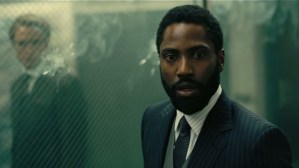 The last hour of Tenet does liven things up as we have two large action set pieces that play out with patience and an expansive scope. This is Nolan’s spy action-thriller. A high-speed heist on the road leads to a car chase with reverse cars to combat. It’s the only action sequence where the audience has a good understanding of the mini goals. Even an earlier art heist resulted in raising questions of credulity (“If the security system sucks out all oxygen, and they’re triggering this, why have they not come prepared with their own oxygen tanks?”). The high-speed heist and ensuring chase sequence flat-out works and is pretty cool. The conclusion involves two teams of soldiers, one going forward in time and one going in reverse, and that has such amazing potential for an intricate and exciting culmination of action. Imagine a character going back and forth and jumping from their unique perspectives to aid and inform each team. Unfortunately, in execution it comes across as jumbled chaos. Again, I imagine there are details and parallels I would notice more with a second viewing but I doubt when that will happen. For a movie essentially about time travel, it feels like Nolan has put more careful thought into trying to make his movie a palindrome than trying to come up with engaging and cool things to do with time travel action.
Christopher Nolan is one of the biggest names working today, a man whose risky, expensive blockbuster projects get greenlit because of his artistic audaciousness. You would never want a Nolan movie to simply play things safe. He seems at his most comfortable when it’s playing around with chronology and audience expectations of what moments have meant. There is a reverse palindromic feature to this screenplay I do admire from a writer’s perspective. However, knowing it takes a confounding 90 minutes to get to that reveal means that you’ve had to endure 90 minutes of protracted set up and with characters that are, at best, glib archetypes, empty suits, and guns with people attached to them to occasional bark orders or say confusing terminology. It makes for a very frustrating and at times disengaging viewing experience, one I even contemplated retreating from. I’m glad I stuck it out but cannot say it was worth the time and ensuing headache.
Nate’s Grade: C
Share this:

Nomadland (2020)
 Part poetic elegy for an America of old, part sunset-tinted road trip, part condemnation of economic fragility, part character study of a lost soul who prefers wide open spaces, Nomadland is a small indie trying to say a lot but in as few words as possible. Consider writer/director Chloe Zhao’s film a mixture of the compassionate, languid colorful character-driven slice-of-life Linklater movies and the romantic, spiritual hymns to nature and the universe from Terrence Malick. It’s ultimately about Fern (Frances McDormand) as a woman who travels the American southwest from season to season in her van, going from one temporary job to another. The temptation would be to make it about her running away from her past, her pain, and need to finally process her grief in a transformative way before she can settle down and make herself a home. Zhao’s movie rejects that easy formula; there are several moments where characters implore Fern to plant roots, to have a comfortable life with a man who adores her, but she can’t. She has to keep moving, from job to job and state to state. It’s not like a rejection of privilege and standing like 2007’s Into the Wild. If Fern could be rich, she’d happily not have to crap into a bucket in her van or sleep in parking lots or scrounge for food. She’s one of millions on the fringes of society because of how disposable so many corporations view their laborers. The opening text tells us that within one year of the factory in Fern’s hometown closing, the chief employer of the town, that its zip code was dissolved. Nomadland doesn’t ever feel like a preachy movie but it definitely has points it wants to raise about how we treat people in need, how business exploits them and their lack of options, and how others view these itinerant Americans and their plight. Really, though, it’s a movie of moments and there are some that are beautiful and powerfully poignant, like a woman stricken with cancer talking about her final desire to return to a lake frequented by birds, or another character discussing the death of his son and how that has informed his view of God and an afterlife. It’s these moments where a character just seems to take center stage and become fully developed, adding to Zhao’s humanist thesis about how every person, no matter their circumstances, is worthy of compassion and consideration. I enjoyed McDormand (Three Billboards) and thought she was a fine entry point into this under-seen world. I also think she was better served as a sort of living journalist letting us discover non-professional actors that open up their hearts and lives and feel like genuine human beings with a wealth of life inside them just waiting to be learned. That gracious, affirmative spirit hangs over every lovely frame and moment in a movie that could be described as Frances McDormand Tries All the Jobs. Still, it’s a movie of moments, and some of them truly sing and others just sort of go by without leaving as much of an impression. Nomadland is a pretty, thoughtful, meditative movie about persistent, stubborn creatures, namely us.
Nate’s Grade: B
Share this:

Promising Young Woman (2020)
 “I’m a gentleman,” says a man at his bachelor party, trying to bashfully turn down any sexual antics with the women paid to entertain him and his friends for one boozy night. He’s also trying to indicate he’s “not like those other guys” and genuinely respects women. He gets it. “Well,” says the woman in the shiny fetish outfit, “I’ll have you know in my experiences that ‘gentlemen’ can often be the worst.” This line summarizes Promising Young Woman, a revenge thriller in a post-Me Too era that is unsparing to all those who would proudly say, “Well, I support women.”
Cassandra (Carey Mulligan) was the top of her class at med school. Then her best friend was sexually assaulted at a party while she was inebriated, which allows the university to paint her as guilty and the accused as blameless (“What do you expect when you get drunk?” kind of victim-shaming). Years later, Cassandra has never been the same. She poses as a drunk at clubs and waits for her knight in shining armor to take her home, and often these modern men of chivalry prove to be creeps looking to take advantage of women and in needing of some harsh medicine.
 This is a movie that walks a fine line to stay out of the shadow of becoming just another exploitation film with a higher gloss. I was yelling at the screen early about the choices men were making with susceptible women in their care. Admittedly, it plays upon that icky genre and taps into our inherent feelings associated with it as well as vengeance thrillers, and writer/director Emerald Fennell (TV’s Killing Eve) smartly subverts our expectations and loyalties. We want Cassandra to achieve her righteous vengeance regardless of the moral or psychological effect it has upon her because vengeance is satisfying. We want to see bad people who have escaped punishment suffer, but Fennell challenges the audience to see how far we’re willing to go for this goal. There are moments where it appears that Cassandra is going to go the extra step to antagonize her targets, and this might involve facilitating other innocent women into potential danger. It’s a sharp turn that asks the audience how badly they want to hold onto that righteous sense of indignation. Do all ends justify the means? Now I won’t confirm whether or not Cassandra follows through for the sake of spoilers but this is one very knowing movie about how to make its audience uncomfortable. Obviously, dealing with the subject of sexual assault and predatory men, it should be uncomfortable because of the nature of the subject, but Fennell has a wicked sense of when to twist her audience into knots. She doesn’t let anyone off the hook easily and that includes her heroine and those close to her. Nobody looks clean here. It makes for a truly surprising experience. When I say that Promising Young Woman makes some bold choices, it really makes some bold choices. There were points I was sighing heavily and others where I was stunned silent. It brought to mind No Country for Old Men. The commitment that Fennell has to her excoriating artistic vision is startlingly provocative and effective.
One early scene stood out to me and let me know that Promising Young Woman was going to have more on its mind than bloodshed. Cassandra is walking home from a night out in her same soiled clothing and eating a sloppy hotdog with ketchup running down her body. A group of construction workers watch her and begin yelling from across the street, harassing her with unwanted sexual advances while they yuk it up. Cassandra stops, turns her head, and simply stares them down. She doesn’t glare at them or shout at them; all she does is look in silence. The workers get quiet very fast and then after several seconds they become angry and defensive, uncomfortable from her attention, and they walk away insulting her. Didn’t they want her attention? Weren’t they boasting? By merely drawing her focus onto these men and making them mildly reflective of their behavior they became uncomfortable and elected to leave. This scene only plays out for like twenty seconds and yet it serves as a symbol for what Fennell has planned with the rest of her thriller. She is going to take what you want and make you re-examine it with a fresh perspective that might just make you rather uneasy and disgusted with yourself.
The first half of the movie establishes a routine that explains what Cassandra has been doing since dropping out of med school. She’s never been able to move on from the trauma of her past and so she seeks out new potential perpetrators to inflict pain upon or scare straight through tests. By the second incident, we adjust to her formula and lie in wait for Cassandra to strike back. She’s the smartest person in the room and it’s deliciously enjoyable to watch her enact her plans. This avenging angel routine runs into a roadblock when she reunites with a friend from med school, Ryan (Bo Burnham), a pediatric surgeon. They share a meet cute that involves Ryan drinking a coffee that Cassandra has spit into as a declarative sign of his interest (trust me, I’m making it sound far creepier than it plays onscreen). They go on several dates and have a palpable romantic chemistry together. This is aided by Fennell’s excellent dialogue, which can be cutting when it needs to and also supremely charming when it wants to be. It’s a peculiar rom-com but on its own terms, including unashamedly reclaiming a forgettable Paris Hilton pop song with full sincerity. At this point, Promising Young Woman is sizing up a choice between following vengeance and following romance. It’s a formulaic fork in the road and Fennell completely understands this, as she’s also testing the audience how much they are willing to sacrifice to see Cassandra check off her guilty names. This storyline doesn’t feel like a cheap alternative either. I liked Ryan and Cassandra together. However, Fennell stays true to her poison-tipped plans and this storyline becomes another chapter in her larger thesis on the condemnation of “boys will be boys” rationalization.
 There is another scene worthy of being hailed because it goes against your and the character’s expectations (some spoilers). Cassandra tracks down the lawyer responsible for defending the university and discrediting her friend once she came forward with her rape accusation. Alfred Molina (Spider-Man 2) is this man and he’s quite antsy because he has been waiting for months for a visitor he anticipated would inevitably arrive. He’s been let go from his firm after having what they refer to as a “psychotic break” and what he refers to as a crisis of conscience. He’s made a career over sliming victims’ reputations, a fact he confesses has been made infinitely easier by modern technology. “We used to have to go digging through the trash,” he says, “But now all we need is one picture on Facebook of the girl at a party and you’ve got jury doubt.” Cassandra is taken aback by how eager this man is, not for absolution which he believes he will never earn, but to be punished. It’s not like a weird fetish but a genuine accounting of what he feels he deserves. It’s a short scene but it challenges Cassandra and the audience about the potential of redemption and forgiveness. This is what she wants after all, people to account for their part in the injustice that happened to her friend and to make amends for their guilt.
Mulligan is ferocious and on another level with this performance. She’s listed as a producer so I assume she had a personal connection with the material because she feels so aligned with the character that she can make you shudder. Mulligan has been an enchanting and empathetic actress since her breakout in 2009’s An Education, the source of her lone Oscar nomination. I’ve never seen her quite like this before. She has a natural sad-eyed expression, which made her perfect for Daisy Buchannan in the new Great Gatsby. With this role, she’s taken those natural sad-cute instincts and carved them out and replaced it with bile. Mulligan gets to play multiple false versions of Cassandra as she adopts disguises and personas to dupe her prey. This also makes the viewer subconsciously question which version they see is the real Cassandra. Is it a distortion upon a distortion? How well can we ever get to know this woman? I think Mulligan is most deserving of her second Academy Award nomination for this bracing, incendiary turn.
This is Fennell’s directorial debut and it will not be her last time in the director’s chair. Her command of pace and visuals can be sneaky good, framing figures to squeeze in potent symbolism as well as ratchet up tension and discomfort. The visuals can also be comedic poetry, like the opening images of men in khakis gyrating and thrusting on a dance floor. She also demonstrates supreme restraint where needed. The sexual assaults of past and present are never visualized but they are not mitigated either. She also has a tremendous ear for music. This soundtrack is sensational from the club bangers to the old timey country ditties. It feels as exceptionally selected as any Wes Anderson or Quentin Tarantino movie soundtrack. The score by Anthony Willis is deeply emotive with its use of strings and cello. They deliver a cello cover of Britney Spears’ “Toxic” and it’s as if the filmmakers made this choice specifically for me.
 If there is one slight downside, I’d have to say many of the supporting characters are under developed. There are plenty of famous faces in this enterprise, like Adam Brody, Laverne Cox, Clancy Brown, Connie Britton, Max Greenfield, Chris Lowell, Jennifer Coolidge, Christopher Mintz-Plasse, but most of them are deposed for a scene and then vanish. It starts to feel like a series of guest appearances from actors as they’re passing through town. Alison Brie (Happiest Season) has a longer and slightly more nuanced part as a former college friend who betrayed Cassandra when she needed her most. This character, along with Birtton’s school dean, illustrate that just because you happen to be a woman does not automatically mean you will be a helpful ally. I view it less as a snide “girls can be bad too” equivalency and more an indication just how insidious and prevalent rape culture can be and condition people into gross excuse-making complacency. I will say that it was nice to have Clancy Brown play a normal dad role and he was sweet too.
Beware, men of the world, the next time you size up a pretty young thing who looks meek and helpless. Promising Young Woman wears the skin of an exploitation movie but it’s so much more. Fennell has created a tart, twisted, and powerful film that is coursing with righteous fury. It’s a female revenge vehicle but with far, far more ambition than simply providing tingles to baser instincts. The artistry here is special and transforms the iconography of exploitation movies into a contemplative and jolting experience. Promising Young Woman is a definite conversation-starter and the first thing you might say upon its conclusion is a breathless exclamation of, “Wow.”
Nate’s Grade: A-
Share this:

I’m Your Woman (2020)
 I’m Your Woman does for the gangster/crime genre what You Were Never Really Here did for the loner revenge thriller, namely demystify popular tropes and find a humanity often missing below the surface. We’ve been inured to gangster cinema for decades and love following the criminal antics of bad men without fully thinking about the collateral damage on the periphery of their story. I’m Your Woman imagines a typical crime story but from a very human perspective, focusing on the wife who has to deal with the confusion and fallout from her husband’s misdeeds. It’s a refreshing and modern take that works as moody paranoia thriller just as much as it does a subversion of them.
It’s the 1970s. Jean (Rachel Brosnahan) is married to a man who she knows does some very bad things. One day Eddie (Bill Heck) comes home with a baby that he declares is theirs. Where did this baby come from? Jean cannot say but she chooses to raise this child as her own son. Another day, her husband goes out with some friends and never comes back. One of his associates barges into her home in the middle of the night, bloodied, and tells her that Eddie is gone and she needs to likewise be leaving in a hurry. He tasks Cal (Arinze Kene) to drive Jean and her baby out of town, watch over her, and wait until the heat dies down or everyone else just ends up dead.
 And with that, the movie is off to a gallop and Jean doesn’t know what’s happened to her life, only that it’s bad, and she doesn’t know where her husband may be, or even if he’s alive, but she’s told that people will be coming for her to get to him or to punish him, and so she must be whisked away in the middle of the night into hiding. We as the audience are left very much in the dark with Jean, and this precious little information allows us to very strongly feel her paranoia and anxiety. Every scene when she’s been left alone and sees a car coming closer, every knock on the door, it raises the suspense because your mind, like hers, is questioning everything. Admittedly, some will find this to be rather boring and a lacking perspective, but I thought the approach of director/co-writer Julia Hart (Stargirl) was to highlight the perspective of a character often taken for granted and forgotten in gangster cinema and its celebration of doomed antiheroes. We’re used to criminals neglecting their molls, and I’m Your Woman declares its allegiance right in the title. We’re on the run with this woman, trying to make sense of the plight as we go, and being trapped in a position of limited information is an intriguing and relatable dash of realism.
There are violent outbursts from time to time, but much like You Were Never Really Here (the two of these movies would make a good double-feature, folks), the violence is far from glorified and often denied to the viewer. Much of the violence is depicted off-screen and we watch Jean stumble upon its awful consequences, again linking up with the perspective of a bystander to the careening violence and mayhem from her romantic attachment to a life of crime. There’s a mass shooting inside a club that is deeply unnerving because of our limited perspective. We’re tethered to Jean and hear the off-screen gunshots getting closer, the screams of civilians, and the camera keeps running without a cut as she dashes down a long corridor but cannot find an exit. She ducks into a phone booth and we watch armed men pass by. She waits and makes her escape, tripping over bleeding bodies, and the camera continues in one ongoing take. It’s nerve-wracking but it also denies us coherency or clarity which makes it so much scarier (I was having visions of what people might have gone through with the Pulse nightclub massacre). Given its subject, there are moments of sudden, shocking violence but often it’s to disorient us and not as some delivery system of satisfaction. It would be very easy to follow a more traditional formula for Jean where being thrust into fending for herself turns her into a steely killer that lays waste to the men hunting her as finds her own means of authority. That was essentially the plot of last year’s The Kitchen, a fairly mediocre and disappointing movie about threatened mob wives. That’s not this movie. Jean doesn’t become a ruthless mob boss. She certainly attains an agency that she didn’t have at the start of the film and a well-earned resilience, but she’s always a grounded, frantic, and relatable person trying to keep their wits and not serve up a witty retort.
 Because much of the movie involves the protagonist in wait and picking up small pieces of information to reform her sense of self and her dire circumstances, the digressions had better be worth it. I fully believe I’m Your Woman is going to be a divisive movie and it will entertain likely as many people as it leaves cold. I found the small digressions to be interesting and doing their part to strip away the movie world heroics and trappings, allowing people to simply act like recognizable people. There are little things that stand out, like a kind neighbor simply recognizing how exhausted a new mother looks, or a method of soothing a baby passed down from father to son, or the discussion of making a child laugh being the clincher for parental ties. There’s a lovely moment halfway through where Jean and Cal are stopping at a café. She delivers a monologue about her unexpected child, about her inability to carry a pregnancy full-term, about her prior miscarriages and her divining what that means about her involvement in crime, and it’s one of those moments where it feels like a character is just baring their soul. Jean is so vulnerable, so remorseful, but also so lost yet hopeful of what being a mother could mean for her, a title she says she tries to downplay but had really been her heart’s desire. I enjoyed getting to spend time with Cal and those he links Jean up with later. There’s a found family aspect of dislocated people trying to navigate the hand they’re dealt without pity or commiseration. When the movie stops to take a breath, that’s when it kept solidifying its growing authenticity for me.
Brosnahan (The Marvelous Mrs. Maisel) is a fine anchor. She has to constantly be alert and anxious, as well as exhausted, so even when she’s at rest her character can never fully be rested. It means that even during the quiet moments alone, Bosnahan is giving the viewer a terrific sample of non-verbal acting prowess. I appreciated that Jean isn’t stupid. She’s ignorant insofar as she lacks crucial knowledge, but throughout I’m Your Woman she responds to potential threats and suspicions in ways you would hope and avoids more than a few disasters. Brosnahan also has an easygoing chemistry with Kene (How to Build a Girl) that makes them a winning team.
I found I’m Your Woman to be a refreshing take on crime stories by re-examining life from a character very often left behind while the men run their schemes and accrue their violent demise. It’s an interesting character study of a gangster’s moll and what living with the consequences of a bad marriage can involve. There’s terror and bloodshed but it never feels sensationalized or glamorized. Our heroine proves herself capable of surprising those who discount her, but that doesn’t mean she transforms from a scared, confused, and desperate person into an action hero. The filmmakers have brought a reflective and humanist take on the gangster genre, and your appreciation will likely also benefit from familiarity with the genre and its tropes. If you’re subverting expectations, knowing those expectations is somewhat essential to the desired effect. I’m Your Woman is worth your time if you ever wondered about the life of so many of those underwritten, possibly stock supporting roles in a gangster movie and asked about their interior lives.
Nate’s Grade: B+
Share this:

Red Penguins (2020)
 The sports documentary Red Penguins starts off as a fun, so-crazy-you-can’t-believe-it tale of larger-than-life characters mucking it up in post-Soviet Russia and having a ball without oversight. It begins slight and light, though entertaining, briskly jumping from bizarre anecdote after anecdote of the Russian hockey club that was controlled by the Pittsburgh Penguins ownership group (and co-owner Michael J. Fox). Steven Warshaw was a young, extroverted go-getter and tasked with overseeing the American-Russian operation and he was a natural salesman and born showman, using events like free beer and strippers on the ice to build a popular following with the Moscow fandom. At one point, Michael Eisner and Disney were highly interested in getting involved with all of the possibilities of the larger Disney empire. The first half of the movie is zipping from crazy stories about how wild the Penguins could get, at one point having circus bears perform on the ice. However, the movie transforms into something darker, more meaningful, and very ominous that explores how the Russia of today became what it is in the wake of chaos following the Soviet dissolution. In the early 1990s, millions were adjusting to abrupt free-market capitalism with no thoughtful transition from 80 yeas of life under communism. The police forces were ineffective when present, the food lines grew longer over scraps, and many were grappling with what to do next. The country wasn’t ready and in the ensuing chaos the system of authority shifted from the state to the mob. The Russian mafia became the banks for millions, including those within the government, and their influence seeped into politics and established an echelon of entrenched oligarchs. The good times of the Penguins got much more serious when their success drew the attention of criminal elements wanting in on the profits. Multiple people attached to the team and assembled media were murdered, and the Americans realized it was time to cut ties and get out. The film by writer/director Gabe Polsky serves as an almost sequel to his 2014 Red Army documenting the decades of dominance from Soviet hockey players. His interview subjects can provide colorful details with the anecdotes, but when the film makes its tonal evolution, those same red-faced, churlish Russians take on a more distressing stance. They justify the rampant graft, corruption, and violence in a flippant “that’s the cost of doing business” sort of fatalistic moralizing. It’s an intriguing process to see the dark contours of interview subjects who beforehand had been portrayed an amiable oddballs. Red Penguins is a cut above the average ESPN 30 For 30 sports documentary when it reaches beyond the crazy headlines to address the costs of runaway good times and how one rowdy hockey team could serve as a symbol for an entire country’s descent.
Nate’s Grade: B
Share this:

Mank (2020)

In 2003, director Peyton Reed (Ant-Man, Bring it On) recreated the “no-sex sex comedies” of the 1960s starring Doris Day and Rock Hudson, with Down with Love. It recreated not just that era in time but also the hokey filmmaking techniques of its time, including green screen for rear projection as the characters drive. It was a big homage to older Hollywood and a celebration of its outdated filmmaking and storytelling. But was the movie ever more than one elaborate homage? Did the film have any other reason for being than imitation? What about Gus van Sant’s shot-for-shot remake of Hitchcock’s Psycho? This is what I thought of as I watched David Fincher’s highly anticipated new movie, Mank, a surefire awards contender about Herman Mankiewicz as he writes early drafts of his career masterpiece, Citizen Kane. Fincher goes to a lot of trouble to recreate the look, feel, and sound of Mank’s creative era, but by the end I had one clear summation in mind: Mank is David Fincher’s Down with Love.
Herman “Mank” Mankiewicz (Gary Oldman) is washed up and he knows it. It’s 1940 and he’s worn out his welcome at the movie studios he used to be a screenwriting titan, heading story departments and adding witty, sardonic patter to dozens of studio pictures. He was a favored guest of newspaper tycoon William Randolph Hearst (Charles Dance) and a friend to his wife Marion Davies (Amanda Seyfried), an actress who got a boost from her high-profile marriage. Now he’s on the outs of the industry that has grown tired of his antics. Enter 24-year-old radio wunderkind Orson Welles (Tom Burke) who personally wants to work with Mank. Welles has been given full creative control for his feature film debut and wants to make something big. He tasks Mank with writing the first draft and Mank turns to the people he knows best to skewer.

I was not expecting my blasé reaction to a Fincher film. It’s his first movie in 6 years (Gone Girl) and I think maybe his least compelling movie of his career. I’m not going to say that The Game or Panic Room are more artistic movies than Mank, steeped in the Hollywood studio system and lovingly recreating a faded era of bigwigs and big mouths. However, I will resolutely claim that either The Game or Panic Room are more entertaining. I doubt I’ll ever watch Mank again in my life. Thanks to the convenience of Netflix streaming, I watched the 130-minute movie over the course of two days but I was starting and stopping throughout. At one point I found myself zoning out and realized I had missed the importance of the scene and had to rewind to watch again. Dear reader, this was not my expected response at all. Why did I find the movie so lackluster? I think it comes down to the fact that it doesn’t really give you any more insight into Mank, the old studio bosses, the life and allure of filmmaking, the ascending industry of motion pictures and their prevailing cultural dominance, or even on Hearst or intriguing behind the scenes struggles with Kane. You’re just witness to history and not actively digesting and assessing it. In all honesty, you would be better off watching the Oscar-winning documentary The Battle Over Citizen Kane or the underseen 1999 HBO TV movie RKO 281 (starring Liev Schireber as Welles and John Malkovich as Mank). Either of those two other movies would give you better intrigue and insight into the men and their legacies.
The character of Mank comes across so superficially like he’s just a catty, booze-soaked genius who is only good for a cutting retort and vomiting on your floor. I cannot state enough how uninteresting the character of Herman Mankiewicz comes across during this movie. He’s exactly the same from beginning to end and it gets rather tiresome. Even his first moments, where every dialogue response has to be pithy or setting up a later pithy remarks, can grow tiresome. It’s as if Fincher has made Mank one of his own characters in one of his own movies. He’s certainly not an unblemished protagonist. He has all manner of self-control problems, from his drinking to his mouth to his gambling to his general impulsivity. There should be drama here especially as he composes what every character tells him is “the best thing you’ve ever written.” I think part of the reason that I never really warmed to this character is that it never feels like anything really matters to him. Sure, he has his liberal values and trumpets causes and spats but I didn’t feel like I ever really knew Mank as an actual person. He’s too flippant, too passing, and too pleased to remain that way that spending an entire movie with this portrayal becomes exasperating.
The screenplay by Jack Fincher (the late father of the director) jumps back and forth between the framing device of Mank being cooped up in 1940 and writing Kane and his earlier experiences in Tinseltown through the 1930s. The framing device is unnecessary and boring. Mank’s relationship with the personal secretary (Lily Collins) tasked to write his dictation is just a dull storytelling device, another person in the room to give Mank a foil to launch his wit, and also, naturally, to remind him just how great a writer he can be. The 1940 Mank doesn’t feel like he’s gained any more wisdom or remorse. The flashbacks, accompanied by typewriter screenplay headlines, never fully coalesce into a clearer picture of the times. There is a lengthy subplot involving muckraking writer Upton Sinclair (literally played by Bill Nye “The Science Guy”) running for California governor, but all it does is establish that the studio heads are on one side of the ideological spectrum and Mank is on the other. There’s some conflict, yes, for him to continue working with these fat cats, the antithesis of his socialist politics, but it’s such a lengthy segment that I kept waiting for more relevance or life lessons. Then there’s a guy who might or might not kill himself and I’m supposed to care. The screenplay feels more like a series of anecdotes that jumps around a bit too much to really offer an insightful portrait of its star.

It also doesn’t help matters that Fincher’s film is part revisionist fantasy about the creation of Kane. This discredited theory stems from film critic Pauline Kael’s 1971 book, Raising Kane, where she proposed that it was solely Markiewicz and not Welles who wrote Citizen Kane. That is true… for the first two drafts. There were five drafts afterwards leading to production. It’s very true that much of the sturdy foundations were laid in place from Mank and his connections to Hearst and Davies (though Mank swore his portrayal of Davies was not intended to be her but the media version of her). It’s also true that Welles would shape and revise what Mank had begun and improve upon an already great start. There are plenty of articles to be read to better educate on the subject, or you can watch The Battle Over Citizen Kane, but the idea that Welles wanted to steal unearned credit and that Mank is some artistic martyr has not held up to decades of re-evaluation after Kael’s initial publication. There really is an interesting story how many ground-breaking rules Welles and Mank and cinematographer Gregg Tolland broke to tell their great American movie, and how revolutionary the movie was and continues to be so modern. You don’t have to resort to revisionist fantasy to tell the story of Mank and Kane, especially when the portrayal of Mankiewicz isn’t exactly notable to engender my passionate outrage.
Another bizarre choice is that Mank sidesteps the real blowback from Citizen Kane. Hearst was a powerful man and using his considerable influence to sabotage the movie. RKO Pictures was offered a sum to sell the film and bury it so it would never be seen. Hearst used his newspaper empire to discredit and defame Welles and his collaborators, but the genius of their work was too much to ignore and was nominated for nine Academy Awards in 1941 including Best Picture, Best Director, and Best Actor. It lost to How Green Was My Valley (the Crash of its day) and only won a single category, Best Original Screenplay. To turn the opposition against Hearst and the powerful mechanisms of capitalism into a squabble with Welles over sole ownership of a collaborative work just seems petty and insulting. Again, there is real drama and real backlash to Kane’s domestic release. Welles was never given complete control again and Mankiewicz faded back into alcoholic obscurity and eventually died in 1953 at age 55. There was much more that Mank could have gone into as a film and yet it just dragged through scene after scene of characters entering rooms, saying pithy remarks, and exiting rooms. More was required.

Oldman (Darkest Hour) is a reliable actor and can be enjoyable as Mank but he’s also victim to the overall tone and limited characterization. His performance is too smirky and self-satisfied, like the character knows he’s going to serve up the perfect one-liner waiting in his mouth at every turn. It’s also a little weird that Oldman is even older than Mank was after he died but Mank’s wife (Tuppence Middleton), who was the exact same age of Mank, is played by a woman almost 30 years younger than Oldman. I see some things from the old system still remain. I thought the two best actors in the movie were Dance (HBO’s Game of Thrones) as Hearst and Seyfried (First Reformed) as his wife, Marion Davies. Dance very much is modeling Hearst like a living king holding court, and Mank is his favorite jester, and the malevolent authority just under the surface is always noticeable, always on the cusp, a powerful man ready to act upon his power. Seyfried gets to reclaim Davies as a character and showcase her not just as a smart actress, who would act “dumb and silly” when she got ahead of herself with Hearst, but as a loving and supportive spouse. She’s goofy, humble, loyal, but also multi-dimensional, far more than the low-class, lonely wannabe opera singer Charles Foster Kane destroys his marriage over that she represented. If anyone deserves to be nominated for an Oscar for Mank, it’s Seyfried and the way she can breathe depth and life so brightly into her role.
Give the tremendous filmmaking pedigree of Fincher, there are obvious technical pleasures to admire. Mank is a stunning recreation of the old studio system, and there is an enjoyment simply watching this world come back to vivid life. The costumes and lavish production design are impressive. Knowing how mercurial Fincher can be as an artist, whenever you’re watching a crowd scene, I think about how long it took to stage every specific element. Fincher is rarely rivaled as a big screen visual stylist with his compositions and camera movements. There’s a gorgeous montage where Mank awaits the gubernatorial election returns and the imagery comes together like a Renaissance painting, reminding the viewer why Fincher made such a name for himself as a music video director in the 80s and 90s. Fincher also adopts much of the technical style of Mank’s era including a sound design that sounds like it’s crackling and humming constantly and “cigarette burns” in the top corner to denote reel changes. Atticus Ross and Trent Reznor produce a score that is jaunty, jazzy, and period appropriate, a big detour from their ominous, fuzzy, electronic-heavy scores we associate with them. It’s a whole lot of effort to make a painstaking homage of an older era but what does the movie offer outside of this homage? I don’t think much. If you’re a fan of Old Hollywood and Citizen Kane, you may get more out of Mank, but if you’re looking for insight and entertainment into the men and the movies beyond stylistic imitation, retreat to the real deal.
Nate’s Grade: B-
Share this:

Ammonite (2020)
 Fair or unfair, my mind kept comparing Ammonite to 2019’s Portrait of a Lady on Fire, another period film about repressed women, furtive expressions of forbidden love, and isolation-fueled intimacy, and Ammonite was inferior in every regard. In all fairness, Portrait of a Lady on Fire was one of the best films of 2019 and deeply emotional, romantic, and sumptuous. It would be hard for many films to compete in direct comparison, and as such Ammonite can’t compare.
In 1840s England, Mary Anning (Kate Winslet) is a nationally renowned paleontologist. She spends her days digging up fossils along the rocky shore of her small town, caring for her aging mother, and keeping to herself. Her life is turned upside down when Charlotte (Saoirse Ronan) becomes her boarder while recuperating from some melancholia following a miscarriage. Charlotte wants to learn from Mary but Mary is more annoyed, and yet the two lonely women find a kinship in one another that turns into a romantic courtship neither knows where it will lead.
Repressed romances work best when you feel the connection between the characters, a growing hunger or desire, and you’re compelling them together from afar. This was the case for me with Portrait of a Lady on Fire. This was not the case for me with Ammonite. I cannot tell you why either Mary or Charlotte fall for one another. Neither is a very interesting character, especially Mary, who is very private and closed-off. She’s been hurt in the past with a previous gay romance (an underused Fiona Shaw) so likely gun-shy about risking vulnerability once more. There are mentions about her career and the satisfaction it provides but much of it is kept as generalized motivation, a woman making a name for herself in a man’s world. Charlotte is recoiling from a personal tragedy and an absent husband, but why do these two feel any spark of romance for one another in this oppressively drab setting? There’s more intense heat between Winslet and her fossils than with Ronan. It feels like we’re only at this point out of boredom and a lack of better options.
 For a movie about repressed passions, Ammonite is decidedly grey. This muted color palette and tone extends to everything about the movie. It’s all grey skies, grey pebbles, grey shores, grey bonnets, grey leggings, grey carts, grey houses, grey this, grey that, irrepressible grey. This dreary life is effectively conveyed and saps the movie’s energy. The characters go about their dreary lives that you, as the viewer, are begging for some renewed life to emerge. We’re begging for these characters to find something with one another because the world, as depicted, is bereft of life and excitement. To that end, the movie has established a favorable threshold to succeed and yet it still falls short.
This stark, stately, and tight-lipped style of writer/director Francis Lee (God’s Own Country) smothers the resulting romance and drama at play. These two women should be able to unwind with one another, open up, become their true selves the rest of the world is denied, something that cannot be manifested separately. They should be more interesting together, plain and simple. This person should unlock something within. I don’t feel like I gained any more insight into either Charlotte or Mary when they were together. Part of this is because it takes so long to get there and also because their coupling seems, in retrospect, to be completely surface-level in personal meaning. Looking back from its completion, it appears that each woman seems to misread the other person and what their intimacy has meant. I’ll credit the filmmakers for at least tacking on a resolution that amounts to more than “woman returns to husband and they can never ever be together again because Evil Patriarchy.” There is an ending but it’s not that much better than the two of these women sadly parting knowing they’ll never see one another again and that this brief time together will remain precious. I don’t know if I’m supposed to leave with the impression that Charlotte and Mary have the opposite conclusion. While they likely enjoyed the companionship and sex, as the camera seemed to, it seems like maybe both women are realizing that’s where it stops. If this was the intended goal, that’s fine, but don’t set up the entire estate of your storytelling upon this romance if it’s meant to fizzle. This ends up becoming the latest film example of Women Looking Sad in Bonnets.
 I’m sorry dear reader but I was growing bored with this movie. In comparison, I was spellbound with Portrait of a Lady on Fire and found its awakened passions to be luminous and directly tied to two interesting characters. Charlotte and Mary are quite boring. Again, they have potential to be interesting; any lesbian romance set in the 1840s certainly has potential for appealing drama. I was asked by my girlfriend, who herself was giving voice to an argument carrying on social media, why there must be no shortage of forbidden queer romances, and why can’t gay audiences just have movies where gay characters can fall in love and be comfortable being gay? It’s a legitimate question, though my only answer is that these period piece queer tales inherently involve internal struggles given the secrecy and consequences that make for ready drama for big-time actors. There’s also the fact that Mary Anning is a celebrated paleontologist and recognized superstar in her field and there is no evidence that any of her close female friendships were anything more than that. I’m fine with rewriting historical figures as queer and changing things up (I heartily enjoyed the queer revisionism in The Favourite) as long as it still makes the people interesting. Imagine taking a historically celebrated female paleontologist, making her gay, and then somehow making this character even more boring? How do you even do that?
Winslet (Steve Jobs) does a fine job of looking and acting glum. My trouble was trying to determine what points of life were recognizable with her character. How does one acknowledge what this change agent is doing to her when she’s, by nature, so insular and shut off? Winslet is one of her generation’s finest actresses and can do so many amazing things, and yet her guiding directorial note must have been, “Can you dial it back even more?” There’s a fine line between subtlety and just being lifeless. Ronan (Little Women) has even less substance to work with. At first, her character is suffering and lonely, but she leaps at companionship with abandon. Her character doesn’t seem like she’s wild or reckless or impulsive in any other regard. She stops wearing black when she embraces her feelings for Mary (Get it? She’s no longer in mourning). Still, Charlotte’s ultimate view of the world is one of privilege but this doesn’t inform her character until the very end. Ronan does her part making an audience believe she’s lovesick for Mary, but feeling it is another matter, and even an actress of Ronan’s caliber cannot accomplish this with this flagging script.
Ammonite is so drab, so passionless except during its sweaty sex scenes, that you’d be forgiven for wondering why anyone would even bother making this story come alive in the first place. If you’re all about furtive gestures and glances and the color grey, well you might be in luck. Look, I’m just going to be blunt. If you’re even remotely thinking about watching Ammonite, just seek out and watch Portrait of a Lady on Fire. It’s superior in every regard and a forbidden romance that is actually, surprise surprise, romantic and full of evocative feeling. Plus it’s French, so automatically more romantic. Watch that instead.
Nate’s Grade: C+
Share this:

Cast Away (2000) [Review Re-View]
 Released December 22, 2000:
Strand Tom Hanks on a desert island for years? Sounds too good to be true to many a disgruntled movie goer. Such is the state in Cast Away, Robert Zemeckis’ existential meditation on man, nature, FedEx and their product placement checks, and of course… volleyballs.
Hanks is yet another everyman, except he’s a real stickler for time and order as a FedEx supervisor. His girlfriend (Helen Hunt) is pushing for marriage but hey – they’ve got all the time in the world, right? So Tom boards a FedEx flight headed for the South Pacific that hits a nasty collision with a powerful storm. The plane goes down abruptly in what is likely the most terrifying plane crash ever performed on film. Hanks washes ashore onto a mysterious deserted island after drifting alone in the vast ocean. Without civilization and without human contact he must start all over just to survive the day. So becomes the odyssey of Island Tom.
Cast Away hits one out of the park with its near dialogue free middle act with Tom’s first days upon his new island home. Hanks struggles to do everyday things from finding food to creating a makeshift shelter. As Hanks goes through these daily troubles the audience is with him every moment and learns as he does. Cast Away‘s middle is fascinating to watch. After a few days some packages from the crash wash ashore including a volleyball that Tom turns into his best friend. “Wilson” is Hanks’ companion and is totally understandable how one would branch out for contact under the circumstances. Plus, Wilson’s a dynamite celebrity of his own right now.
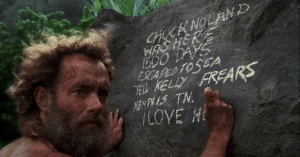 Hanks’ acting is his usually above average output, but his whole role seems more like a showcase for his method acting than the acting itself. The first half of Cast Away was shot then they took a year off so Hanks could become scruffy, thin Caveman/Unibomber Hanks. The transition is fun to watch and remarkable for an actor to devote himself completely to their role. But the part itself, and Hanks’ show, seem more spectacle than substance. Helen Hunt pops up in the beginning and end proving that she can somehow manage to be in every film in December. Pretty much the next actor in the film would be… well, a volleyball. Cast Away is basically a one-man show.
Despite a wonderful middle Cast Away is suffering from the opposite syndrome of Saving Private Ryan: strong middle, weaker beginning and end sandwiching it. Our opening plays like an extended commercial for FedEx, complete with the dazzling FedEx package POV cam (coming soon!). The end plays like a thank you card to FedEx. The ending also suffers from extreme let-down from multiple climaxes that don’t end the film but just give way to another climax. By the time the movie does end you’re exhausted.
Zemeckis lends a skilled hand toward the direction, the script plays to the strengths of the tale good enough, and Cast Away has its moments but becomes too heavy-handed at certain periods. Still, the volleyball is good. Go for the volleyball.
Nate’s Grade: B
(For fun, count the amount of times FedEx is mentioned or seen in the film. Hell, do it with this review too. I’ll even help you out – FedEx, FedEX, FedEx, FedEx, FedEx, FedEx, FedEx, FedEx, FedEx, FedEx, FedEx, FedEx, FedEx, FedEx, FedEx. Oh fun.)
——————————————————
WRITER REFLECTIONS 20 YEARS LATER

Twenty years later, Cast Away feels almost like finding a message in a bottle of another time, a time when director Robert Zemeckis was routinely making great movies, and when Tom Hanks ruled the box office and awards circuit (he has only been nominated for one Oscar since Cast Away, in 2019 for playing Fred Rogers). It’s also a movie that reminds you that despite all else that concept is king. It’s an especially easy movie to watch, and its middle portion is so beautifully clear and accessible that any group of people could keep up and find the island plot thrilling and fascinating. There are long, long portions where the only dialogue spoken in the movie is between one very harried man and a volleyball he has adopted as his only friend. Cast Away is in many ways a textbook example of elegant visual storytelling and also an example of the limitations of emotional engagement when there’s not much else going on but survival.
Please don’t get me wrong, I was mesmerized during the island portion of this movie, which makes about 80 minutes of an otherwise overly long 140-minute movie. When it’s Chuck Noland (Hanks) stranded on a deserted island and having to think step-by-step for shelter, food, and basic care, I was hooked. I was thinking each step of the way, learning and applying that new knowledge base with the main character, and it’s just an imminently enjoyable formula to witness a character work through problems and triumph under extreme circumstances. I felt the same thing with 2015’s The Martian, which was dubbed “Cast Away on Mars.” It even goes back to arguably the first novel, Robinson Crusoe, following one man and his wits and will alone on a perilous island. Very often the protagonist in these man-versus-nature stories is a stand-in for all of us, representing humanity’s quest to conquer the elements and prove our collective mettle to the universe. There is an immensely satisfying pleasure watching storytelling that is precise, efficient, and clean, imparting the necessary information to build onto the next scene and for each setup to expand your understanding and trace to the next payoff. Screenwriter William Broyles Jr. (Apollo 13, Planet of the Apes) deserves more plaudits than he has been given. The island portion of Cast Away is beautiful and near brilliant. Each moment builds so naturally. You learn the geography of the island, the mini goals of cracking open a coconut, building a fire, turning the FedEx trinkets into valuable tools of adaptation, it all builds and at your own pace.
 When we make that four-year time jump, Zemeckis definitely wants it to be a showstopper moment and it is earned. The camera slowly pans to linger on the image of Chuck, much more tan, gaunt, and with a beard that I wrote in 2000 could rival the Unibomber. It’s such a striking image coming right after an unexpected time jump. That’s Tom Hanks, one of the members of Hollywood royalty, and he looks so different from his earlier, schlubby everyman self. The sight is also a stark reminder of Hanks’ physical dedication to the role. He spent a year losing 50 pounds and growing out his scraggly beard. The entire film production went on hiatus and Zemeckis shot an entire other movie released in 2000 (the unremarkable What Lies Beneath). His performance is genuinely great and perhaps more deserving of the Oscar that year than eventual winner Russell Crowe for Gladiator. It’s a performance that is more than a Method physical transformation. His terror, elation, and worry are readily apparent onscreen. It’s a one-man show so you better not get complacent because the audience has nothing else to hold its attention than watching your face, your expressions, your tumult. Not everyone can share the screen with a volleyball and make you feel something when that ball drifts away.
It’s all the rest of Cast Away that can’t quite add up. The first act is mostly establishing Chuck as a figure fated for grand ironic punishment, a workaholic taskmaster who has all the time in the world and nothing more to do but sit with his thoughts. The first act establishes his Before life for our contrast, so we know what he will be leaving behind, and this only really works when the final act rolls around to offer the After period. Now we check in on these minor characters and what four years have done for their lives, how they mourned and moved on from Chuck, and how they’re handling his miraculous re-appearance. You could make an entire movie about a woman whose former love comes back years later after being presumed dead and how this shakes up her current relationship and her own mental sense of self and yearning. That’s a tremendous amount of internal struggle to sift through. Except, with Cast Away, Chuck has lost something but it doesn’t really feel like he’s lost much. Our only time spent with Kelly (Helen Hunt) is during the first act, and while he holds onto her memory and she ostensibly serves as a motivational force for him to get off the island, it’s not felt by the viewer. So when we learn she’s married and a mother, it doesn’t feel so tragic as it does mundane. Life carries on.
 By then it’s too late to make Chuck a more substantially interesting character. The point of interest was watching his survival on the island. Back at home, he’s just another guy, and there isn’t enough from an emotional standpoint to make him compelling. It’s not about him trying to readjust to a society he was ripped away from, catching up on lost time, feeling like a man who was in a coma and now has to pick up everything he’s been asleep for. These characterization shortcomings don’t become more notable until after Chuck gets rescued. Beforehand, I was caught in the immediate physical danger and conflicts of survival, but once we’re off the island, we’re just left with some guy. He hasn’t gone through a radical internal synthesis through his time on the island. He’ll probably be fine and live a normal life. The movie literally leaves him at a crossroads and sets up a handy romantic consolation for him. Does the audience really care which road Chuck takes from here? I doubt it. Chuck stops being interesting when he is saved.
Cast Away really was the last even semi-great movie by Zemeckis. He spent the bulk of the 2000s making animated movies using state-of-the-art motion capture technology. He’s since retreated back to live-action after his mo-cap experiments became too costly for studios. Strangely, Zemeckis has taken to remaking documentaries into entirely unnecessary dramatic features (2015’s The Walk, 2018’s Welcome to Marwen). The passion and pure filmmaking chops that placed Zemeckis as one of the most exciting filmmakers in Hollywood seems to have dimmed. Watch 2016’s Allied and tell me you feel passion. It’s like his interests in the technical side of filmmaking have swallowed his drive and creative expression as a storyteller. With Cast Away, it’s a return to basics of pure visual storytelling and Zemeckis excels so strongly. It makes me mourn what could have been considering Zemeckis abandoned live-action filmmaking, his own lost decade chasing after animated movies that felt like 3-D theme park rides. This is a man responsible for two of my favorite movies of all time (Back to the Future, Who Framed Roger Rabbit?) so I’ll always have hope that I can see glimmers of the same artist that delighted me.
Looking back at my original review from 2000, I’m becoming more and more proud of my younger self and his ability to analyze and articulate his film criticism. It’s a little fun to read words I wrote twenty years ago about a movie and nod along and go, “Right on,” with the same agreement to this day. I don’t want to get ahead of myself and say this was a shift in the complexity of my film reviews, but my major points still stand in 2020 as they did in 2000. Apparently, FedEx did not pay a dime for product placement, though the company reaped financial rewards for years after the exposure. They even made a Super Bowl ad in 2003 that provides a further epilogue where Chuck (Hanks again) finds out the one package he refused to open just had all these handy tools that could have saved him. Cast Away is still an invigorating movie today, even if that only amounts to 80 of its 140 minutes.
Re-View Grade: B+
Share this:

Super Intelligence (2020)
 Given the sad and off-putting output from Melissa McCarthy and her husband Ben Falcone when they collaborate, it’s a small victory that Super Intelligence is only really super bland and forgettable. McCarthy stars as an everywoman picked by a highly intelligent A.I. to be the test subject for whether or not humanity should be saved or wiped out of existence. It sounds like an amusing premise but what it becomes is just a boring romantic comedy. The super A.I. (voiced by James Corden) becomes more or less a magic genie, and now our heroine has all her wishes granted. She has a huge new bank account, a new car, a new luxury condo, and all to impress the guy she let get away played by Bobby Canavale. That’s right, the super A.I., meant to test and judge mankind, is really just the world’s most advanced wingman and trying to get his human pal some love. As far as tests go this seems a bit weak. This mighty A.I. should be working against our protagonist, throwing increasing obstacles that push her out of her comfort zone, rather than just handing her everything and looking from afar with approval. The comedy is resolutely flat save for the inherent charms of McCarthy, who doesn’t seem challenged by anything in the movie. Much of the film is watching McCarthy talking into high angle CCTV cameras. Visually, it’s quite boring. Super Intelligence feels like an interesting idea that can’t be bothered to find anything interesting in execution. It’s standard rom-com fluff but the two characters aren’t even appealing together. I found Canavale’s character to be far more annoying than endearing. I’ve found that Falcone is a bad director for his wife. He encourages her worst onscreen habits and doesn’t have the presence or vision to be able to assert restraint or imagination. If Falcone is attached as director, you know you’re getting McCarthy doing her familiar shtick with little self-control. She’s still a highly appealing comedian, and an underrated dramatic actor, but the only super intelligence here are the people who avoid this film.
Nate’s Grade: C


 nathanzoebl
You must be logged in to post a comment.