Willy’s Wonderland (2021)

I wanted to love Willy’s Wonderland. It’s easy to see the pitch: Nicolas Cage in Five Nights at Freddy’s. That sounds like everything you would need for a gonzo movie experience with, hopefully, an unrestrained Cage. The problem with Willy’s Wonderland is that it seems to have peaked at its inception. I’ll credit the creature designs of the many killer animatronic animals inhabited by the spirits of a dead Satanic cult demanding sacrifice. They’re chintzy and creepy and effective in their Chuck E. Cheese/Freddy’s reference points. However, the movie clearly appears to be out of ideas pretty early. Cage plays a janitor hoodwinked into working overnight at the abandoned pizza parlor and he doesn’t say a word for the entire movie. For those looking for the splendidly crazy moments that can define Nicolas Cage performances, I think you’ll be slightly disappointed. The character has a few quirks, like his surprisingly ironclad work ethic, but the character is just as underwritten, absent personality, and replaceable as any of the killer robots. For a movie where Cage fights a bunch of bloodthirsty robots, it starts to get a little boring because of the narrative redundancy. Toppling one robot after another feels too easy and the specific set pieces are unmemorable. There are a slew of highly annoying teenagers that stumble in so there are more victims to be terrorized. In one moment, these teens will denounce doing stupid acts and the unreasonable risk, and then the next minute they’re splitting up to go have sex in the scary birthday room or murder and not keeping their distance from the murder robots they know are alive and murderous. If the movie was more satirical, I might even give the filmmakers credit for the dumb teenagers reverting to form regardless of obvious circumstances. My disappointment is that what you get with any ten-minute segment of the movie is generally the same thing you’ll get with any other portion. It’s a lot of the same. Is that consistency or a lack of development and imagination? The movie still presents some degree of fun because that premise is enough to at least hold your attention if you’re a fan of horror, Cageisms, and movie kitsch. However, Willy’s Wonderland could have used more drafts and variety to really tap into the sheer gonzo potential of its ridiculous pitch.
Nate’s Grade: C-
Share this:

The Turn Out (2018)
 Indie drama The Turn Out frustrated me because I got excited by its premise and thought, “Here might be the first truly great Ohio indie I’ve watched for review,” and alas it let me down. It’s not a bad movie but it has such promising storytelling elements and to see them misused feels like a bigger regret than if the movie had never even had those important building blocks.
Jeff (James J. Gagne Jr.), a.k.a. “Crowbar,” is a hard-living truck driver also addicted to crack. He’s got a teen daughter, Amanda (Katie Stotllemire), and an exasperated wife, Kelly (Heather Caldwell), back home in southern Ohio. Crowbar is no stranger to the prostitutes that call truck stops their corner, but one young lady makes him reconsider his assumptions. He learns that Neveah (Regina Westerviller) is still in high school as well as in his own daughter’s class, and this revelation makes him contemplate whether he should get involved and help her.
Let’s take the central story of Crowbar and his relationship to the teenage prostitute, Neveah. If I were to tell you the movie was about a truck driver addicted to drugs who wrestles with what to do when he stumbles upon the reality of sex trafficking connected to truck stops, your mind already starts putting that movie together with clear arcs. It becomes something like a modern-day Western, where Crowbar is a man of the road, a contemporary high-plains drifter, and he makes the decision to reject his isolation in order to help this one girl. I asked my girlfriend, after describing the basic premise, what kind of relationship that Crowbar would have with his own teenaged daughter. “Oh, it’s got to be bad or non-existent, right?” she commented. You would think that but nope. He actually has a great relationship with his daughter, who is constantly trying to call and talk with dear old dad. See, if his relationship was poor and perhaps he had even elected to a life on the road rather than being a present father, this would force the character to confront his own life choices and legacies and see Neveah as a surrogate daughter he can save. You could argue it’s cliché and been portrayed in other neo-Westerns, but it works. The same confusion applies to Crowbar’s relationship with his wife. Our introduction to her is with the local police imposing a restraining order, which nobody throughout the movie takes seriously. The daughter frequently breaks it. The uncle who admonishes Crowbar about the restraining order will then enable Crowbar to break it to see his daughter at choir practice. He even meets up with his wife in a bar to reminisce about their relationship, which means even she is breaking her own restraining order. If everyone is going to be this flippant then why even bother with including it? A strained relationship between husband and wife can be communicated through other means. These are the kind of things that pecked away at the consistency, coherency, and natural dramatic potential.
 As it stands, I don’t really know what the motivation is for Crowbar throughout The Turn Out. What is his motivation for getting better? He already has a positive relationship with his daughter and apparently a workable relationship with her mother, and that’s while he’s smoking crack. He is already in a good place with the people that he cares about, so now what? You could say his motivation is to save this girl he comes into contact with through chance, but this is hard to argue as well considering the amount of time he takes to take fledgling steps to intervene. For a solid hour of the 74-minute movie (pre-end credits), Crowbar meets with Neveah and even visits her home but her situation isn’t any different from the start. It should be obvious that her family knows about her and is supporting her prostitution or forcing her to turn tricks. Even that description is a disservice because it’s not like Neveah has much of a choice in these matters. She’s a victim too, and the fact that our protagonist just kind of hangs around until the very end when the bad people get even more obvious about being bad, it questions his thinking. Why does he take so long to call the police? Is it because of his own personal fear of getting caught as a drug user? Well, that could be avoided with an anonymous tip. When he eventually elects to kick his drug habit, your guess is as good as mine why this is the moment for him. It feels too arbitrary, like any of these events could have happened earlier as they lack direct cause-effect connectivity.
It takes far too long for Crowbar to actually assert himself and try and make a difference but we’re absent the inner turmoil to justify the delay. I think there was a character arc here where Crowbar had to reconcile with his own contribution to a culture that has allowed truck stop prostitution to flourish. He’s partaken with these woman (all adults, mind you, but did they start as adults?) and he even argues, “They make good money.” His own guilt could be a worthy exploration but it takes a vision of his daughter in a predator’s van and the entreaty of child prostitution to finally shake him from his doldrums, and then the movie is pretty much over (again, only 74 minutes total). Otherwise, it feels like we spend a lot of redundant time watching the man drift through his life, smoking plenty of crack, and occasionally running into Neveah and conversing with her. There are points that prove he’s changing, like brandishing his fellow drivers over the CB radio for their gross demeaning chatter, and he even gets that Big Movie Moment of Symbolic Torment, sitting in a shower. The problem with The Turn Out is that these momentary glimpses don’t feel consistent enough to matter. As a character, Crowbar is too dependent on his substance abuse as a defining characteristic, and yet it feels less like a burden or addiction to the man and more like a hobby to pass the time. It doesn’t feel consequential.
 Again, the storytelling possibility was right there within reach, with his decision to save this young woman as the Act One break and not the climax of a relatively short movie. Then Act Two would have been them bonding and finding parallels and a genuine surrogate father-daughter affection over the course of a long road trip as Crowbar attempts to return her to the last vestige of her family that she left. Then, upon leaving her with this family in Act Three, Crowbar learns it’s just not as easy as that and that Neveah’s family might not be icky sex traffickers but they’re not helpful, and so he helps her set up an independent life and realizes he must now return home to mend his own relationship with the daughter he has left behind. Amanda should want nothing to do with her father rather than try and call him every chance she gets. Crowbar has nothing really to repair on this front, and the daughter is portrayed as a fawning fan who only jogs, tries to call dad, and sings in the choir. The same shrift characterization is given to every supporting player. Neveah wants to be an artist. She goes out looking for johns as a means of protecting her younger sister. That’s all we get as far as her inner life. It seems like a disservice to make this character so blank. I don’t understand Crowbar’s wife at all. I don’t understand why Amanda jealously cyber bullies Neveah because she sees her in a diner one time with her father, especially when dad hasn’t been playing favorites. I don’t understand why Crowbar seems to only be at the same local truck stop despite the nature of his job taking him all over.
The acting is a highlight of the movie and Gagne Jr. (When Skies Are Gray) delivers a convincing, lived-in performance. The very look of his hangdog face is enough to communicate what the screenplay doesn’t, the past years weighing on him, the accumulation of good times coming due. He’s also simply just got a great face for the part. He has some moments that test his resolve and I wish he had even more to push his acting prowess further. Stottlemire (Tragedy Girls) has plenty of talent which is why I wish her character had some actual anguish to her relationship with her father. Caldwell (After) likewise gives a solidly conflicted performance that made me wish she factored more into Crowbar’s interaction and turmoil. My favorite actors ended up the one-scene characters that provided a dose of vibrant local color, the tweakers and addicts and vagabonds, the diner owners, the other truckers, the people that feel genuinely authentic and well chosen. Unfortunately, I was not as big a fan of Westerviller in her debut film role. I can’t tell if her performance is very monotone and inexpressive because of the actress’ limited range or as a directing note from director Pearl Gluck (Divan) to convey the numbness that Neveah felt. Either way, it presents a dilemma as her relationship is the most essential.

Director Pearl Gluck on set.
From a technical standpoint, The Turn Out is a very professional looking and sounding movie. The usual sound design headaches I find with local low-budget indies are nowhere to be found here, and the frequent introspective, country-styled songs by Chris Rattie add a really nice impression that makes the whole enterprise feels accomplished. The reported $200,000 budget might be the highest of all the Ohio indies I’ve reviewed. There are some beautiful shots from the cinematography of Stephen Balhut, Jon Coy, and Daniel Garee, especially at sunset and twilight. The look of the movie is rich with details, like the run-down stores, and the dilapidated Rust Belt small towns providing a broader sense of economic desperation. I was expecting the movie to tap into its own Hillbilly Elegy-style social commentary on the decline of the American worker through the reality of this truck stop and the women who work it. Gluck handles her directorial duties with sensitivity but without flinching from harsh truths either.
It may sound like I’m more negative than intended with The Turn Out, and this is merely because I’m disappointed by the squandered potential. A truck driver deciding to do right and help a young girl, the victim of sex trafficking, has so much dramatic potential it hurts. Even if you wanted to avoid a more traditional thriller route, this could have been a powerful character study of two lonely, hurt souls finding a comfort with one another over a long journey and being able to start a healing process to pick up the pieces of their lives. It would be the kind of character examination that thrives in indie film, and from a topic I cannot recall other movies touching, namely the rings of prostitution trapping women along truck stops. I’m sure everyone involved was coming from a good place and wanting to highlight and not exploit the reality of sex trafficking. Gluck even based her script on her extensive research with trafficking survivors. Alas, the storytelling miscues and dawdling pacing make the movie feel like an overextended news article. This is still a decent movie with authentic details, good intentions, and solid acting with some exceptions. However, it’s the screenwriting shortcomings that drag down The Turn Out from its real potential and turn it into a message in search of a stronger narrative.
Nate’s Grade: C+
Share this:

Judas and the Black Messiah (2021)

Fred Hampton was the deputy chairman of the Black Panthers in Chicago and was only 21 years old when he was murdered in 1969 by federal agents. Judas and the Black Messiah is about Hampton and his life in political activism cut short, but it’s also another tragedy, one far less known. Bill O’Neal was a federal informant who was manipulated into betraying Hampton to the FBI and ultimately setting up the man’s execution. Both men are given consideration and brought to life by great actors, Laketih Stanfield as O’Neal and Daniel Kaluuya as Hampton. O’Neal is tasked with getting into the trusted inner circle of Hampton and the Black Panthers without blowing his cover, or else he’ll be going to jail for years on potentially pending charges. The FBI agent in charge (Jesse Plemons) is under pressure by J. Edgar Hoover (Martin Sheen), and this all provides even more pressure onto O’Neal, who is a pawn of the higher-ups who only care about neutralizing the growing power of the Black Panthers. The film plays out similar to an undercover mob movie, like The Departed, and much of the drama follows whether O’Neal will get caught, how he will navigate the tenuous territory he is in, and the paranoia of being in danger at all times and from multiple sides if he succeeds or fails. I appreciated the attention given to O’Neal and the consideration that he too is another victim. He is eager to succeed and thinks he might use his service as an introduction into the Bureau for legit work, but he also very much wants to be accepted by the Panthers because he agrees with their philosophies and is looking for a community that welcomes him and provides a sense of direction. If I had a complaint, it is simply that we get a lot more Judas here than we do the Black Messiah. It feels like we’re getting a rather simplified summation of Hampton and scrubbing clean some of his personal leanings (having him identity as a socialist rather than a Marxist) that would make him more controversial. By all definitions, Hampton was executed by agents of the state to pacify institutionally racist fears about powerful and gun-owning black Americans, but putting so much emphasis of the story on the man who betrayed him creates an imbalance in presentation and risks mitigating the depth of Hampton. After Hampton returns from prison, the movement he’s been so heavily involved with seems to dissolve onscreen, focusing solely on setting up our deadly climax. He is seen as a martyr first and foremost. There are two extended shootouts in the second half that don’t feel at all in keeping with the first half of the movie. Kaluuya (Get Out) is electric in public and awkward and sweet in private with his beloved girlfriend. It hints at much more that could have been explored away from his fiery public persona. Stanfield (Knives Out) has the more multi-dimensional role and yet even given the grand Shakespearean tragic proportions of his position, I can’t help but feel like O’Neal feels a tad underdeveloped. There’s a subtle ambiguity that follows his character’s motivations but many of his moments revolve around whether he will be accepted, fool someone, or get caught. There are greater questions of whether the mask he wears is real. The characterization gets a little lost because of the nature of the subterfuge. This movie is over two hours but has the potential to be an epic tragedy and could have sustained a limited series of storytelling. As it is, it’s a tense and powerful movie with great acting and an ending that will rightfully outrage and disquiet. Judas and the Black Messiah is stirring but I feel like it had lost potential by transposing its story and conflicts into two hours and with two central underwritten figures of tragedy. It’s quite good but man this could have been amazing.
Nate’s Grade: B+
Share this:

Hannibal (2001) [Review Re-View]
 Released February 9, 2001:
Trying to sequelize Silence of the Lambs is surely harder than trying to sequelize The Blair Witch Project. The novel Hannibal by Thomas Harris I don’t think will be confused as a necessary burst of creative ambition and more of a chance to cash in on the love of Hannibal Lector. Though I’ve not read a line from the book from what I’m told the movie is faithful until the much hated ending. Starting a film off a so-so book isn’t a good way to begin, especially when you lose four of the components that made it shine Oscar gold.
 The element that Silence of the Lambs carried with it was stealthily gripping psychological horror. It hung with you in every closed breath you would take, surrounding you and blanketing your mind. I mean, there aren’t many serial killer movies that win a slew of Oscars. Lambs excelled at psychological horror, but with Hannibal the horror turns into a slasher film more or less. What Lambs held back and left us terrified, Hannibal joyfully bathes in excess and gore.
Julianne Moore, a competent actress, takes over from the ditching Jodie Foster to fill the shoes of FBI agent Clarice Starling. Throughout the picture you know she’s trying her damndest to get that Foster backwoods drawl she used on the original down. The problem for poor Moore though is that her character spends half of the film in the FBI basement being ogled by higher-up Ray Liotta. She doesn’t even meet Hannibal Lector until 3/4 through. Then again, the title of the film isn’t Starling.
Anthony Hopkins returns back to the devil in the flesh and seems to have a grand old time de-boweling everyone. Lector worked in Lambs because he was caged up, like a wild animal not meant for four glass walls, and you never knew what would happen. He’d get in your head and he would know what to do with your grey matter – not that he doesn’t have a culinary degree in that department in this film. Lector on the loose is no better than a man with a chainsaw and a hockey mask, though he has a better knowledge of Dante and Florentine romantic literature. Lector worked bottled up, staring at you with dead unblinking calm. He doesn’t work saying goofy “goody-goody” lines and popping out of the shadows.
Since the director, screenwriter, and female lead didn’t show up for the Lambs rehash, it feels a tad chilled with Ridley Scott’s fluid and smooth direction. The cinematography is lush and very warm. Gary Oldman steals the show as the horribly disfigured former client of Lector’s seeking out revenge. His make-up is utterly magnificent and the best part of the film; he is made to look like a human peeled grape. Oldman instills a Texan drawl into the character yet making him the Meryl Streep of villainy.
Hannibal is nowhere near the landmark in excellence that Silence of the Lambs was but it’s not too bad. It might even be good if it wasn’t the sequel to a great film. As it is, it stands as it stands.
Nate’s Grade: B-
——————————————————
WRITER REFLECTIONS 20 YEARS LATER
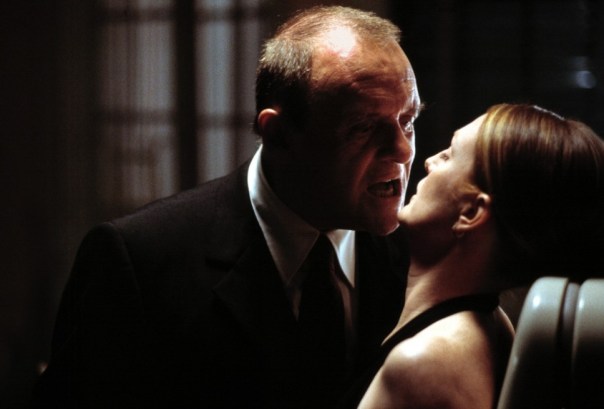
Serial killer culture dominated the 1990s and oddly enough it’s only gotten more highbrow since. Oh, that’s not to say that you won’t have any shortage of hacky, exploitative movies featuring elaborate murderers with gimmicky calling cards (The Hangman, a killer who literally stages his crime scenes like an ongoing game of hangman). However, the dark obsession with dangerous men (it’s almost always men) has given life to thousands of prestige cable documentaries, true-crime books, and high-profile podcasts like Serial and My Favorite Murder. We still very much have an unchecked fascination for these real and fictitious serial killers and what that may say about our society. In 1992, a serial killer thriller swept the Oscars, one of only three movies to win Best Picture, Actress, Actor, Director, and Screenplay (the others: It Happened One Night, One Flew Over the Cuckoo’s Nest, and American Beauty came close if it hadn’t been for Hilary Swank). That’s how good The Silence of the Lambs was as a movie to overcome the genre biases of older Academy membership (it also helped that there were other genre biases at play for the other Best Picture nominees like Beauty and the Beast, Bugsy, and JFK). It was special.
All of this is to say that Silence of the Lambs was a near impossible project to follow, and author Thomas Harris proved it with the middling-yet-best-selling sequel novel in 1999. It was obvious that it would be adapted into a major feature film, but the only returning Oscar winner from that first foray was Anthony Hopkins, which is kind of important considering his character is the title. The sequel was directed by Ridley Scott (Gladiator), adapted by none other than screenwriting titans David Mamet (The Untouchables) and Steven Zallian (Schindler’s List), and the movie made over $350 million worldwide at the box-office. By all accounts, it was a hit, but was it any good, or was it simply coasting from the acclaim and good will of its predecessor and the A-list cast and crew?
 The first thing that becomes immediately apparent while watching Hannibal is that this is not Silence of the Lambs and not in a sense of its accomplishments but more in its chosen ambitions. This is not a psychological thriller in the slightest. It’s a boogeyman monster movie. Nobody here is given to intense introspection about man’s inhumanity to man and other such Topics of Grand Weight. Scott’s sequel is more a Gothic B-movie content to spill stomachs rather than quicken pulses. The opening botched FBI raid is chaotic, action-packed, and the flimsy excuse for why Clarice Starling (Julianne Moore taking over for Jodie Foster) is shelved for most of the movie. It feels like the filmmakers know they need to delay the reunion of our favorite cannibal therapist and FBI agent as long as possible, so the 130-minute film feels like a protracted setup to tease how far audience anticipation can possibly be sustained.
In the meantime, the plot alternates between Dr. Hannibal Lector living it up in Florence, Italy and Starling slumming it in the FBI basement. Slowly, oh so slowly, she picks up the pieces to track Lector’s whereabouts, but until then we indulge a lot of narrative bloat. Do we need to follow an Italian inspector who suspects “Dr. Fell” is not who he says he is and then enact plans to prove his identity and eventually cash in? This man is literally on screen longer than Clarice Starling. We’re introduced to a rich villain, Mason Verger (Gary Oldman), but he’s more plot device than character, an all-expenses bank account to track and apprehend Lector for his bloody violence. I wish there was more to Oldman’s character given the actor and the impressive practical make-up application. He’s a symbol of rot, of vengeance, of obsession. Likewise, Ray Liotta’s lecherous FBI superior to Starling is less a character and more a plot device. He’s the stand-in for the harassment and dismissal Starling receives from her male colleagues, but a little of him goes a long way. His scenes where every other word is some creepy come-on, some sexual entreaty, or some off-color joke (he refers to Lector in homophobic slurs) are excessive. He’s an awful person but every line doesn’t have to be eye-rolling in how obviously terrible he can be. Spending extended time with all of these supporting characters is just a reminder that the movie is looking for excuses to keep its chief participants as far away for as long as possible. It’s frustrating.
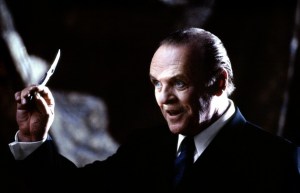 The depiction of Hannibal Lector in Silence versus Hannibal is also quite noticeably different. Like most things in this sequel, the character is baser, key characteristics heightened and broadened, and bordering on farce. He’s less a scary intellectual opponent and master manipulator and more a well-read serial killer on vacation. He is profoundly less interesting in Hannibal. That doesn’t mean there isn’t a pleasure to be had watching Hopkins slice and dice his way through Italy and elude capture. Hopkins seems to relish the amplification of the campy and grand Guignol tone of the sequel. He looks to be having a blast as an unleashed beast. His performance is fun but teeters over into self-parody at times. Hearing the erudite man spout ironic catchphrases meant for incongruous comedy de-fangs some of his mystique and intensity.
And yet there are things I still starkly remember even twenty years later. Hannibal is no Oscar-winning thriller operating at an ascendant technical level with engrossing multi-dimensional characters. It’s a boogeyman movie with a scary old man. The ambitions are just lower, but that doesn’t mean that Hannibal is subpar by those lowered goals. It’s still entertaining even when it’s getting silly or overly long. Scott’s visual presentation keeps things engaging and the lovely Italian art and locales are a definite benefit to establishing the gory, Gothic atmosphere. The makeup is outstanding and, as I said back in 2001, Verger resembles a human peeled grape. Feeding a man to wild boars is also quite memorable. The conclusion still has its squirm-worthy high-point with serving Liotta’s fresh brains to himself. It’s a gory comeuppance that feels fitting. In the original book, apparently Starling then bares her breast to Lector, and he goes down on one knee, and they run off together as fugitive lovers. Needless to say, this ending was met with controversy. The film smartly nixes this, especially since I never for one second felt a romantic coupling between these two embittered characters. The movie doesn’t kill the allure of the Hannibal character but it also positions him on the same level as Michael Myers instead of, say, John Doe (Seven). It’s like a Halloween mask version of a real serial killer, dulled and magnified in some ways, but still leaving a fair impression of its source.
 The Hannibal Lector incarnation had two more big screen ventures, the 2002 prequel Red Dragon and 2007’s even-further prequel, Hannibal Rising. Neither was terrific, neither was awful, though the answers that Rising offered as to what made Lector the man he is would inevitably prove disappointing (hello, childhood trauma). Arguably the best incarnation of the character, more so than Hopkins or Brian Cox (Succession) as the first big-screen Lector in 1986’s Manhunter, was from NBC’s television series from 2013-2015. Developed by Bryan Fuller (Pushing Daisies, American Gods), and starring Mads Mikkelsen (Casino Royale, Doctor Strange) as America’s favorite high-class cannibal, the series found a way to make a weekly crime procedural operatic and hypnotic and disgustingly beautiful. It’s like the artistic sensibilities from Silence and Hannibal were perfectly blended into a strange lovechild that deserved an even longer time to shine. Recently, just the week of this writing, CBS has begun a 2021 Clarice Starling TV series, though because of rights issues they cannot even reference Hannibal Lector. They have the rights to the senator and her daughter who was kidnapped by Buffalo Bill, as if those characters were what the fanbase was really clamoring for more time with. It looks like any other grisly CBS crime procedural just with a different name. I fully expect it to be canceled after one season.
Looking back at my review from 2001, I found myself nodding in agreement with my younger self from the past. I try not to read my earlier reviews before re-watching the films in question and perhaps might surprise myself by coming up with the same critiques independently. I also quite enjoy this line: “Lector on the loose is no better than a man with a chainsaw and a hockey mask, though he has a better knowledge of Dante and Florentine romantic literature.” I would even keep my grade the same. Twenty years later, the Hannibal Lector character still captures our intrigue and fascination even if he’s deposited in a lesser escapade not fully worth his full abilities.
Re-View Grade: B-
Share this:

The Father (2020)
 The Father is the kind of movie I’ve been clamoring for years from Hollywood, an Alzheimer’s empathy experiment using the rigors of a visual medium to place a viewer inside the mind of someone haunted by this debilitating mental illness. Film is inherently an immersive experience with a defined point of view, and I always thought it could be helpful in illuminating what it would be like to lose a sense of time, memory, and place as memories blend together and fragment. The Father is based on a play by director Florian Zeller. It’s a deeply empathetic and heartbreaking experience that works as a puzzle to decode but also as a character piece on the end of one ordinary man’s life.
Not much is known about Anthony (Anthony Hopkins) before his gradual mental decline. He had an apartment he lived in for thirty years, there’s definitely hints that a younger daughter had an accident and is no longer alive, and he listens to opera quite frequently. I think there’s a benefit to the audience knowing so little of Anthony before his illness; we do not know what variation of this man is the honest, lucid version from before. We’re only getting impressions and glimmers and some of them are non-linear, where we’ll get the context of a scene after the start of a scene, so it challenges a viewer to be constantly trying to contextualize what we’re seeing with what we know, and it’s an ongoing puzzle to determine a slippery orientation. It makes for an engaging and constantly changing environment and one tailored to engrossing empathy.
 It sounds like the movie might be an overwhelming downer, and most assuredly it will leave an emotional devastation, but it’s also a very fascinating experience. From the beginning, you’re dropped into a scenario that announces to you not to fully trust your eyes and ears. You’re trying to assess character relationships. Who is this woman? Is she Anthony’s adult daughter Anne (Olivia Colman)? Is she a figment of his imagination? Is she the possibly dead daughter? Sometimes characters will be referred to by the same name but be played by different actors, and you must question which version was real, or whether either of them was? Is he projecting his dead daughter onto the face of another woman? Is he projecting an antagonistic man (Mark Gattis) onto the face of a former son-in-law (Rufus Sewell)? Which home is he in at this time? There is much to unpack here and I’m positive that additional viewings would unveil even more clues hiding in plain sight. I’m certain that the paintings on walls in backgrounds are regularly changing with the timeline, and this small detail of set design is never even emphasized. It’s just one aspect of the presentation that has been thoughtfully developed to support its artistic vision.
As one would expect from the premise and its beginnings as a play, this is an actor’s showcase. Hopkins (The Two Popes) delivers one of the best performances of his storied career. We’re so used to seeing Hopkins play men in control, dominating others. I even just re-watched him killing people in the shadows from 2001’s Hannibal sequel. This is the most vulnerable the actor has ever been on screen, and I’ll freely admit that by the end tears were streaming down my face as Anthony has descended into a childish state of need. Hopkins goes through a gamut of emotions and shifts rapidly. In one moment, he can be gregarious and charming, another cold and paranoid, cruel and cutting, but often he’s confused and afraid. He’s trying to maintain his dignity throughout. By being our focal point, we feel the same feelings that this elderly man is experiencing in this moment out of time. Colman (The Favourite) is also terrific as Anthony’s put-upon daughter trying her best but reaching her limits. The accumulation of this man’s experiences, and the weight of the burden on his family, is a devastating conclusion that reminds you what millions of families are going through every day.
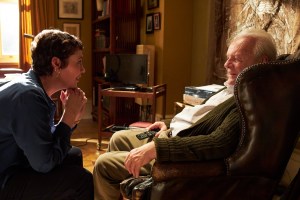 The trappings of plays adapted to film is the struggle to make them feel bigger than potent conversations happening in confined spaces. Zeller’s debut as a director does a fine job of using the techniques of filmmaking to his advantage. With editing and camera placement, he can better orient or disorient an audience, and the impact of character changes has more intensity with our proximity to the actors themselves. The attention toward the visual parallels like hallway shots and people being confined to shadows present an extra layer of symbolism to be decoded. Zeller has clearly thought out how to transcend the stage and to use the immersion of film and freedom of being non-linear with editing to shape the presentation and make it even more effective.
I’ll be honest with you, dear reader, and that is that Alzheimer’s terrifies me. We’re all the accumulation of our memories and experiences, and to think those could be stripped away, muddled and tainted, and change your conception of self, well that is absolutely haunting. It’s the kind of stuff that keeps me up at night, and while my maternal grandfather went through a spell of dementia before passing away at 92 years old, fortunately this illness does not run in my family. I have friends that are dealing with it currently with grandparents and it’s like approaching death before the actual death, watching that version of the person you love shrink to the point where they have been replaced by a stranger, all the while you are helpless to thwart this process. For those people, The Father will hit close to home and might even be too much to handle. It’s such an open-hearted and empathetic portrayal that puts you in the position of having to live with the ravages of Alzheimer’s. It’s so frustrating and confounding and sad, and yet film can open us all to the experiences of others like few other mediums, and The Father might be the closest any of us ever get to understanding what this terrible illness is like for those caught in its snare. It’s a fantastic movie with fantastic performances but even more than that it’s a wonderful experiment in empathy and understanding.
Nate’s Grade: A-
Share this:

Psycho Goreman (2021)
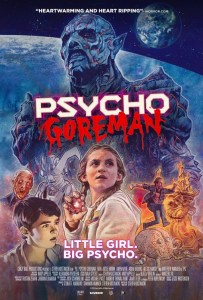
The Canadian quintet Astron-6 is a production company that specializes in practical horror effects to delight the eyes and churn the stomachs. In 2011, they decided to make their own films and released Manborg, a hilarious if sketchy and stretched-out horror-comedy replete with loving references to 1980s culture and movies. Their crazy, low-budget schlocky efforts have developed a following, and they earned extra credibility when they played things gravely serious and terrifying in 2016’s The Void. Now writer/director Steven Kostanski (one-fifth of Astron-6) has delivered Psycho Goreman, and this is what happens when gonzo, genre filmmakers are working at the top of their chintzy, delightfully deranged capability. The results are highly entertaining with equal parts great, good, and bad-good, and lovers of silly, schlock cinema will be in high heaven.
Mimi (Nita-Josee Hanna) is a little girl used to bullying her big brother Luke (Owen Myre) and generally getting her way. She and her brother discover a gem hidden in their backyard and it just so happens to connect to a powerful and murderous alien monster, the self-described “Archduke of Nightmares,” named by Mimi as Psycho Goreman (Matthew Ninaber), or PG for short. The creature was imprisoned by a galactic council who feared that unleashed he might conquer the universe in fire and blood. Unfortunately for PG, he’s at the mercy of Mimi, who can command him thanks to her ownership of that magic gem. For her, PG is her greatest new friend and play partner and woe unto thee anyone who tries to take PG away from her.

The movie feels like a cleverly constructed episode of Rick and Morty where a crazy idea is given unusual consideration and development and layers of humor and ridiculousness are uncovered so that the whole enterprise impresses. The basic premise is what if a brat had the power to control a monster, and while the movie pretends like life lessons will be learned or earned (“humans are the real monsters” is so trite that it’s an obvious put-upon), the movie also never downplays how much of a terror the little girl can be. It might be an easy joke but it’s still a good one, the fact that the universe shouldn’t fear this hideous monster but really this mean little girl is a fact that many parents will nod along with. The movie does some effort to redeem her, if that’s really important to you, but it also doesn’t soften her rough edges and her impudence. She is a brat, and she will inflict pain on others, and the fact that she has awesome power makes her a scary being the entire universe should really be quaking over.
The enjoyable fish-out-of-water dynamic elevates the comedy and payoffs of Psycho Goreman. This powerful monster is beholden to the childish whims and forced to do the bidding of a child, and he hates being out of control and every moment he is forced to play with her. The begrudging acclimation makes for several fun scenarios where he learns from her and also learns how far she’s willing to go. I enjoyed PG trying to make sense of Mimi’s made-up game and its nonsensical rules, and I enjoyed the levels of bizarre family domestic drama as PG integrates himself with this terrified clan. Having a normal dinner between humans and a blood-thirsty alien marauder is rife with comedic potential, and that’s even before the additional side story of the strife between the put-upon mother and the father who is just a gigantic loser. Their ongoing relationship troubles relate to some hilarious motivational turnarounds, like the father (Adam Brooks, another Astron-6 member) resenting the mother for thinking he’s a loser, so he’ll prove her wrong by being a supportive parent, which just happens to include helping his daughter’s involvement with a killer alien. He has an inspirational speech to his daughter late in the movie that had me cackling. The movie is more than its crazy, schlocky moments of gore and rubber costumes. It’s a fun but cleverly constructed comedy that understands the tenets of what makes crazy so genuinely funny.

But along the lines of gore and rubber costumes, Psycho Goreman is like a gloriously inappropriate Power Rangers episode for adults. The elaborate care and design of these monster and alien costumes is outstanding, especially for a relatively low-budget movie. It might look cheap from time to time, though I would argue this is also part of its unassailable charm, but the filmmakers show their real priorities with their monster designs. They are so varied and weird and good looking and have levels of detail to them as well. There’s one design that is simply a living cauldron of corpses (I think voiced by Rich Evans from Red Letter Media). Every new character is a new joy to behold, and when the clashes begin, as they inevitably do, you discover the extra care put into the creature designs with how they viciously come apart. There is a simple pleasure watching the great production design of the costumes and outfits as well as the outrageous gore. I loved that a kid is turned into a giant living brain monster and nobody seems to really care and it becomes a running joke of how callously everyone has viewed this child, including his own indifferent parents. If you’re a fan of goofy monster costumes and extravagant gore, this film is a twisted treat.
Mimi is going to be a love-her-or-hate-her character because she is exactly what Angela Pickles (Rugrats) would be like if given ultimate, unchecked authority over human life. She wields her power flippantly and will joke about siccing PG on her brother to kill him. She also hoots and hollers for PG’s violence against innocents because to her it’s all a big show of amusement. I found the high level of energy of Hanna’s performance to be the difference maker for me. Her character is an unrepentant brat but she’s so entertaining to watch because she holds to this very specific vision. Hanna is downright brilliant in her smarty-pants, mean girl articulation and has great physical expression. Watching her dance in discombobulated movements like the queen of the world made me laugh every time. I thought Hanna was terrific and her comedic timing was so well-honed for being so young. I understand many will find Mimi grating or overbearing or simply too much to handle. I get it, and I don’t think Psycho Goreman will be nearly as enjoyable for anyone who dislikes Mimi. You’re not meant to approve of her actions and warpath of destruction, but you can still enjoy the mayhem all the same.

If you’re a fan of low-rent, cheesy midnight movies, the deranged and demented, and giant silly costumes and bloody excess, Psycho Goreman will be everything you hope it to be. I will admit it peters out a little right before its big showdown, but otherwise the movie is consistently entertaining, consistently strange, and consistently funny. The comedy is better than you think as the filmmakers refuse to rest on the appeal of easy jokes and easy sentiment. They know why you’re watching and deliver, but the work under the surface is impressive and admirable. The filmmakers know they have a very specific, tailored audience that will celebrate their unique retro pastiche sensibilities, and if you happen to live on that same wavelength as I do, then you too will find Psycho Goreman to be an insane near masterpiece of low-budget, high-concept schlock. Give your 2021 a boost by checking out this Canadian splatter comedy and give in to the madness.
Nate’s Grade: A-
Share this:

Our Friend (2021)
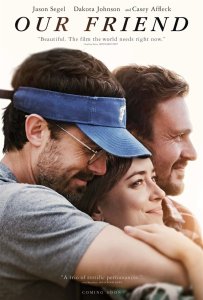 A sweet and heartfelt true story to friendship that also doesn’t sugarcoat the hardships of illness and the elongating circle of grief. Our Friend is based on the life of journalist Matthew Teague (Casey Affleck) whose life is thrown into turmoil after his wife, Nicole (Dakota Johnson), is diagnosed with terminal cancer. They rely upon their devoted friend, Dane (Jason Segel), for help during the months and years after the diagnosis. The movie jumps around in time, for minimal effect, but does a fine job of laying out the three central characters and their core relationship of love and compassion. Dane is scoffed at by Matt’s friends as a loser who hasn’t gotten his life together, and Dane even contemplates some drastic personal decisions, but he finds a purpose and definition with his servitude, even as it impacts his own outside relationships. I was expecting more attention to the titular “friend” of the title, and it is a slight detriment, but the dramatic core of this movie is solid. The topic of terminal illness can easily veer into soapy, maudlin territory, but the movie is on firm grounding early during a scene where Matt and Nicole discuss how to tell their two young girls that mommy isn’t getting better. Her angry outbursts later and final moments are also unvarnished yet still in character. The acting is quite good overall and there are plenty of one-scene players that leave a favorable and empathetic impression, like Gwendoline Christie and Cherry Jones. The non-linear jumps feel like an attempt to create more meaning than a simple story about friendship will afford and an invitation to sift out connections and parallels. It’s a movie that doesn’t necessarily break away from your expectations as a cancer weepie. You know what you’re headed for. Our Friend is an enjoyable and heartfelt drama with better-than-average performances and overly disjointed editing. If you’re in for a decent tearjerker, give it a try.
Nate’s Grade: B
Share this:

Shadow in the Cloud (2020)
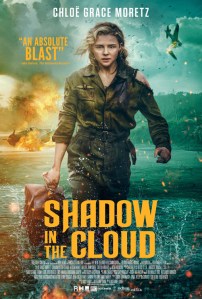 Shadow in the Cloud feels like a lot of movies smashed together with the slapdash glue of a SyFy Channel Original movie, combining crazy and crazier elements like a Jenga tower teetering on the brink of total disaster. Chloe Grace Moretz plays Maude, a female pilot during World War II and hitching a ride on a B-17 bomber plane leaving New Zealand. She says she has a secret mission to see through and a valuable package that cannot he opened. The men on the plane are skeptical and banish her to the lower turret on the plane. It’s there that she discovers they have another unwanted passenger, a furry, winged, blood-thirsty gremlin tearing apart the plane’s engines. Maude pleads for the men to listen to her warnings and ultimately takes matters into her own hands to ensure their safety and survival.
The first thing needed to be discussed is the wiry elephant in the room, namely the involvement of writer Max Landis. For those unaware, the successful Hollywood screenwriter of edgy, often glib genre fare (American Ultra, Bright, Chronicle) has faced a reckoning for his many years of abusive behavior with a litany of ex-girlfriends that accused him of gleefully manipulating them and bragging about giving them eating disorders. Landis’ script has since been rewritten by the director, Roseanne Liang, but it’s impossible to say what was on the page before and what was a new addition without reviewing multiple drafts. Suffice to say, Landis’ involvement may very well be a non-starter for many viewers, but it’s the first half that really makes things even more uncomfortable with his name attached. For about half of the movie, Maude is trapped and harassed by a bevy of off-screen men who joke about having their way with her and belittle her existence as a woman. I don’t believe that the movie is ever endorsing this misogynist and borderline rapey perspective of the men, but it is dwelling in this muck for quite some time, and to think that the famous screenwriter, who was credibly accused by multiple women of predatory and awful behavior, is writing these words, well it sure makes the entire protracted discomfort seem gratuitous and even risible. I’m sure women dealt with this sort of dismissive and harassing behavior while serving during wartime, obviously, but there’s a difference between reflecting realism and exploiting it for titillation. Was this aspect even worse before the director’s rewrites? Did she put her stamp on this harassment? It’s hard to say, but the lingering discomfort is a distraction to the overall entertainment value. It’s so heavy-handed that it becomes counterproductive to whatever message is attempted and becomes the lasting takeaway.
 With that being said, Shadow in the Cloud is a mess of a movie that feels rattled and tonally confused. I thought given the premise that this was going to be a mostly silly movie. We’re talking about a gremlin attacking an aircraft, which is pretty much a remake of that famous Twilight Zone episode “Nightmare at 20,000 Feet” starring William Shatner. There’s only so much you can do with, “There’s something on the wing” declarations and people not believing the crazy accusations. I wasn’t expecting fighting a literal furry, bat-like monster with the tension of whether or not the main character might be assaulted by a gang of men in the sky. If the filmmakers wanted to go with the grueling and uneasy tension of Maude being at the mercy of potentially lethal men, that would be fine, but don’t include a silly monster too. The moments simply don’t jibe. There’s a moment where Maude falls from the plane and a Japanese Zero plane above her explodes and the resulting explosion propels her back into her own plane. It’s like a cartoon. You could very easily eliminate any and all of the supernatural elements from this story and I think it would have been better served at that. There’s enough tension to be had with the Zero planes being out there and the crew not believing that Maude saw the enemy, let alone a monster. The musical score is all retro 80s synths and it feels jarringly discordant. I did not like it immediately. The tone veers so rapidly, at times from scene-to-scene, and while this can offer a sense of unpredictability, it can also hamper whatever had been working. The suspenseful time in the ball turret is mitigated with a finale that is so goofy that it exists in another universe. The movie ends on real-life footage of women serving in WWII and any sort of feminist inspiration is completely unearned from the crazy little contained thriller about mid-air monster battles and scrappy dames.
When the movie is locked in that ball turret, that’s when Shadow in the Cloud is at its best and presents an intriguing degree of potential before flaming out into self-parody. There are some genuinely well-wrought moments in that small space, and the natural tension of a woman on an all-male crew is enough to establish a dividing line of suspicion for the dismissive men. The director is also at her best during these sequences and finding resourceful use of her small space to still tell her story and reflect the dilemma of our protagonist. There’s a satisfying problem-solution plot formula to employ. There are a few mysteries to ponder, like why does Maude have a gun, what’s put her arm in a sling, what is her mission, and what is in that package she swears is more important than anything else? It’s enough to hold your intrigue while the men coalesce into a chorus of harassing voices interrogating her as their captive. She’s in such a vulnerable position and the movie can play up paranoia, vertigo, and claustrophobia all together to really ratchet up our fraying nerves. As the movie settled into this tight setting, I accepted that it might just be nothing more than a cost-effective contained thriller, and that excited me because it felt like the filmmakers were finding ways to make that idea work. I started getting visions of the last contained thriller that really knocked my proverbial socks off, 2010’s Buried. Alas, I was never taken with the silly gremlin aspect of the screenplay and how easily forgotten it becomes. This killer gremlin just sort of comes and goes whenever the story needs a convenient extra dash of blood. It’s likely what got the movie sold as a pitch but the first thing I wish had been removed.
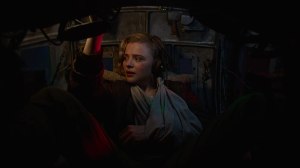 I have enjoyed Chloe Grace Moretz for years, all the way back in 2010’s Kick-Ass. While she’s now in her early twenties, she still comes across as so young, and the reveals relating to Maude and her motivation make it harder to accept Moretz in the role. I recognize that she is no longer a young girl and can elect to play adult women onscreen, but she never felt fully believable for me. She can do action and has proven herself to be tough and courageous, but something was lacking with the depiction of Maude. It felt too much like a kid playing war. Every other actor might as well be a vocal actor because the movie is pretty much a radio play with the exception of the first five minutes and the final ten minutes. The male voices tend to blend together and lack distinct personalities. When they’re all harassing and condescending then it makes it quite difficult to distinguish characters (“Oh, this is the OTHER gross guy with the higher pitch”). It’s excessive and another element exaggerated to the point that its aims become another self-sabotaging fault.
I’m sure there are more than a few that will have a blast with Shadow in the Cloud. They’ll celebrate the harshness of Maude’s harassment as a needed historical reality check. They’ll laugh up the goofiness of the gremlin attacks. They’ll shift nervously during the contained thriller centerpiece in the ball turret. They may even cheer during the big cheesy climactic brawl in the mud. However, I found the sum of its many parts to be too lacking. Shadow in the Cloud would have been better with a little more pruning, a little less Max Landis, and some tonal consistency. It might be crazy enough to entertain for its 80 minutes but it feels like its gasping for air by the ridiculous finish.
Nate’s Grade: C
Share this:

The Little Things (2021)
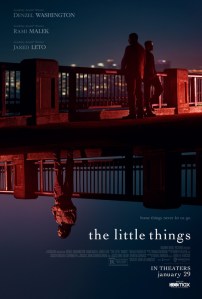 The Little Things wants to be Seven but it’s not even half of Seven (three-point-five?). It’s a meandering movie that doesn’t quite commit to being a prestige character study or a grisly, pulpy serial killer thriller, and so it operates in a middle-ground that achieves little more than prolonged boredom. It’s far too long, far too slow, and with not nearly enough excitement or intrigue or depth.
In 1990, Joe “Deke” Deacon (Denzel Washington) is a LASD deputy and living out his final days on the force in the relative anonymity of the unincorporated parts of Los Angeles. He used to be a big time L.A. cop but got far too involved in series of murders, and his obsession lead him to a heart attack, a divorce, and being removed from his office. Deacon delivers evidence to Jim Baxter (Rami Malek), the new chief detective on a series of murders that may be a continuation from Deacon’s days. The two men work together to untangle the details and target their primary suspect, Albert Sparma (Jared Leto), a bow-legged, greasy-haired creep who maybe confessed eight years ago.
 The Little Things was originally written in the 90s by writer/director John Lee Hancock (The Blind Side, Saving Mr. Banks) and it’s easy to see why. The 1990s was a heyday of serial killer thrillers; it felt like any studio would greenlight a project as long as the crazed killer had a gimmick to their murders (”This guy only kills people on Friday… because you can’t eat meat on Friday?”). While the preponderance of these kinds of movies has shifted to the ever-flowing world of direct-to-video (look for The Hangman, where Al Pacino chases a killer literally playing the game hangman with victims), there is still a perverse fascination with true crime culture and serial killers to be exploited by a canny writer. We still love these kinds of stories when done well. HBO’s True Detective has also taken the serial killer formula and transformed it into a contemplative, long-form character study that looks just as much at the flawed detectives as it does the killers. Over the course of eight elegiac episodes, True Detective can take the time to immerse you in the sordid and portentous details of these people, their cases, the lingering questions, and their demons and doubts made flesh. The depth of the tortured, flawed characters and the complexities of the cases are what sustain the multiple-episode investment (exception: season two). With a movie, you must be more judicious with your precious two hours of time for storytelling. This preamble was a long way of saying The Little Things doesn’t fit as either. Its cases and characters lack the depth to justify the time dwelt, and the thrills are decidedly dimmer, denying a serial killer audience a compelling case, compelling characters, and a unique killer.
I’m going to summarize the two-hour-plus plot for you now: two cops investigate a series of serial murders. They think they have a culprit. They tail the suspect. A slightly surprising ending that lacks the shock and contemplation I think Hancock is looking for. The end. I’ll keep it vaguer to preserve spoilers but suffice to say that is not enough plot for an investigation. I recently re-watched Seven, one of my favorite films of all time and a masterpiece in its genre, and it has a natural propulsion to it where each clue leads to the next by design from its grandly clever psychopath. You know there are seven deadly sins and each new victim is another step closer to achieving that mad goal. The story engine keeps the plot driving forward. With The Little Things, there are some bodies and a whole lot of waiting. And waiting. And waiting. Paired with the placid pacing, it sure makes The Little Things feel like it’s missing a big picture.
 There are also some moments that ripped me out of the movie, mostly involving a disconnect between what is intended on the page and what is delivered on the screen. We’re told that these characters are so obsessed, yet they don’t come across that way. Sure, they follow Sparma because he’s so obviously a guilty-looking suspect, but we don’t witness the lengths they’ll go and the people they’ll push away in order to close their case. In the end, Hancock approaches this territory, but it feels like a stab at subversion and relevance the rest of the movie has been missing. It feels like Hancock had two hours of one kind of thriller and then in the final five minutes said, “Eh, who cares?” This climax also involves a professional detective making so many bad decisions about his own personal safety that I felt my eyes rolling out of my head. It’s like Hancock is using the character’s dumb choices to declare how obsessed he is with finding the truth, and yet we didn’t witness this obsession earlier when he was making good decisions. Baxter is supposed to be a family man and a religious man, yet Malek is playing him so devoid of emotion and the script doesn’t present anything meaningful for his domestic life, that he feels more like a robot with a flimsy back-story provided as a default setting. Then there’s Deacon’s monologuing to the corpses of the dead women. He also sees ghosts of the victims. If the movie was presenting this as a sign of his tortured psyche, it should have gone all-in. Have him converse with them all the time, have them reappear and whisper in his ear, have the new crime scenes trigger the appearances of victims from the old crime scenes, take this unique angle and take ownership of it, really separate from the glut of other serial killer thrillers. Alas, it’s just an awkward personality motif that occurs from time to time to provoke an eyebrow raise.
All three central actors have won Oscars for their acting, and while nobody is outright bad, they all seem to be delivering wrongly attuned performances. Washington (Fences) dials down that natural charisma to go full quiet intensity, and there are few actors who can be as intimidating with looks and hushed words as this man. Except he’s supposed to be haunted and the wear and tear of the man’s past lacks weight because of the performance choice. The pain and struggle seem to be suffocated in that steady steely Washington glower. Malek (Bohemian Rhapsody) is too detached to convincingly play his young family man coming unglued thanks to the case. He’s playing the role like he’s secretly going to revealed as the real killer in a hasty last-second twist. Leto (Blade Runner 2049) is inherently drawn to off-putting oddballs and his appearance halfway through provides a necessary jolt for the movie. The problem is that he’s so creepy, he’s so weird, he’s so desirous of attention, that it makes the character overwhelmingly obvious. He’s not interesting so much as he’s just a neon sign flashing “Guilty,” and there are only two ways to go with this, neither exactly fulfilling given what has preceded. The best scene in the whole dirge of a movie, by far, is the interrogation with all three actors feeding off one another.
 The Little Things feels like a dated copy of 1990s serial killer thrillers without anything new to offer besides the star wattage of its cast. It’s even set in the 90s for no real reason than to deny its characters access to cell phones and the Internet. The look of the movie is awash in the cool, moody style of David Fincher’s signature look, like Hancock and his technical artists were reviewing Seven and Zodiac and aiming for a fawning homage to a modern master of crime cinema. I would advise people to just watch Seven again, or even any of the many junky serial killer thrillers from the 1990s (Copycat, anyone?). The Little Things just isn’t that interesting. The main characters are threadbare, the women are either colleagues, wives, or corpses, the plot meanders for far too long, the pacing is turgid, and it lacks memorable set pieces and reveals that linger. It needed to be better, or worse, but instead it’s just imitation David Fincher visual wallpaper.
Nate’s Grade: C
Share this:

News of the World (2020)
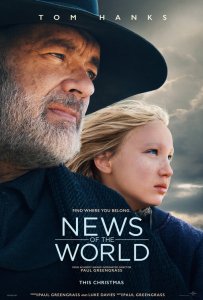 News of the World is an old-fashioned story, a Western and road movie, a grieving father taking a young girl under his wing, but with a slight modern polish thanks to the cinema verite style of director Paul Greengrass (The Bourne Supremacy, Captain Phillips). The handheld camerawork and close-ups create a different kind of mood for a genre defined by long takes of sterling vistas. Hanks plays Captain Kidd, a traveling performer in 1870 who would literally collect newspapers and read the news to the locals, providing a wider understanding of the wider world. Along the way he comes across a young German girl (Helena Zengel) who was raised by a Native American tribe (the same tribe killed her German family and adopted her). He is determined to take her to the last of her family 400 miles away and from there they encounter many dangers and detours. I feel like every big filmmaker at some point feels the need to make a Western, and now Greengrass has scratched that itch. The older genre is so mythic and filled with grandly romantic notions of the frontier. News of the World is more an old-fashioned Western, without much in the way of critique, and fairly episodic in plot, and Kidd and the kid travel from miniature set piece to set piece like little narrative cul-de-sacs rarely producing additional connections from their adventures. I hoped Greengrass would bring his docu-drama realism to deconstruct the American romanticism of the Wild West, pick apart at that myth-making and whitewashing, but the movie is more committed to being a safe, square, and traditional old movie. The little girl is less a character and more of a necessary plot device, something to drive this man to confront his grief and provide a purpose for him. I wish there was more to their dynamic but she could have just as easily been replaced with a dog. There is one shootout that serves as the highlight of the film and where Greengrass comes most alive with his sense of tension. I was expecting a bit more conflict or commentary given that Kidd is traveling post-Civil War Southwest and selecting what news each community wants to hear, tailoring to his audience and knowing everyone likes a good story during “these troubled times.” There’s one section where a local boss looks to take advantage of Kidd’s services by forcing him to read from the boss’ propaganda publication and Kidd turns the tables on him. It feels like an anecdote rather than a thesis statement. I kept waiting for more to arise with the characterization but was left disappointed, as much of the movie is kept at a surface-level of who these people are. Whether it’s victim, saint, marauder, or newsman, everyone is pretty much whom you assume on first impression. The movie’s staid pacing lingers. It’s two hours but it’s not in any sense of hurry. Part of this is because the screenplay, based upon a 2016 book by the same name, is entirely predictable. Even the revelations held until the very end for fitting tragic character back-stories can be sussed out. I watched News of the World and kept thinking, “What about this story got these people so excited?” I think it was Greengrass feeling that artistic itch to lend his stamp on the American Western (I was reminded of Ron Howard’s own itch, 2003’s The Missing) and yet it feels like Greengrass was holding back and just sublimated his style to the settled genre expectations. It’s not a bad movie by any means but it lacks anything exceptional to demand a viewing. It’s a perfectly fine movie with a handsome production, gorgeous setting, effective score, and sturdy acting, and when it’s over you’ll say, “Well, that was fine,” and then you’ll go on with your life.
Nate’s Grade: B-


 nathanzoebl
You must be logged in to post a comment.