IF (2024)/ The Imaginary (2024)/ Imaginary (2024)
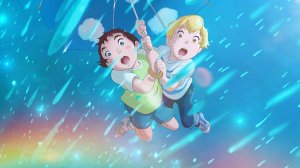
Every so often, I find myself drawn to reviewing movies in pairs, whether it’s because of the same source material (the 2022 Pinoochios), similar perspectives (2018’s BlackkKlansman and Sorry to Bother You), or even diametrically opposed artistic responses to a similar theme (2016’s Manchester by the Sea and Collateral Beauty). However, in my twenty-five years as a fledgling film critic, I don’t think I’ve ever reviewed three movies at the same time for whatever relevancy, yet that is what I find most appropriate for this trio of exceedingly similar films about imaginary friends. Earlier in the year, Blumhouse released Imaginary, their horror-thriller take on an imaginary friend refusing to go away. At the start of the summer, writer/director John Krasinski gave us IF, a live-action fantasy/comedy about imaginary friends finding their former children as adults. And recently, Netflix released an anime movie The Imaginary, a Studio Ghibli-esque fantasy about forgotten imaginary friends trying to find new kids and new homes. I’ve elected to review all three at once and, much like the Pinnochios, declare a winner through different categories.
Begin the critical gauntlet! Bring on the (imaginary) bloodshed!
- PREMISE

Two of these movies went in a sweetly sentimental direction and the other went in the horror direction, so let’s tackle that one first. Imaginary gets at a rarely spoken truth: children can be super creepy. Watch a child hold an involved conversation with some entity that isn’t there, or just stare into the dark and say, so plainly, “That’s where the eyes are watching me,” or any number of personal anecdotes to make you shudder, and you’ll understand the significant horror potential with a malevolent creature that the child can communicate with that adults cannot see. This also lends itself to a low-budget film production as so much of the wicked entity is implicit and unseen. It’s a cost-saving genius when you can just use your, wait for it, imagination. Now Imaginary isn’t the first horror version of this premise, but it deserves points for taking a childhood concept and thinking of an effective way to transform it into a diseased and malignant antagonist, haunting its adult child Jessica (DeWanda Wise) and seeking a new child, likely her youngest step-daughter Alice (Pyper Braun). It then presents its conflict like a curse that the past generation is trying to spare the next generation from suffering through. Of course this also includes getting adults to recognize the threat as they are often dismissing it. Nobody wants to believe that Chauncey the teddy bear is the one urging you to self-harm.
The other two movies take a far more family-friendly approach to their imaginary premises. There’s a lot of shared real estate between The Imaginary and IF. Both are about outdated imaginary friends finding refuge together in a sort of halfway house, a… foster home for imaginary friends (someone should make a cartoon series about that). Both of the movies follow imaginary friends trying to find new children who will accept them and give them a new life. IF briefly follows the possibility of reuniting the forgotten imaginary friends (a.k.a. IFs) with their former owners now grown up into adulthood. This is actually the movie at its best, as the creatures find a renewed sense of purpose and reconnect with a person they cherished but had to let go. For a strange reason, Krasinski only dabbles with this poignant story direction, switching gears to find them new homes with new kids, which serves as another story direction that is also quickly ditched. IF seems to be trying on so many different versions of its premise and then discarding them like the IFs themselves. The Imaginary has more focus on its central predicament, finding new homes before these characters fade away, or worse, get eaten by a cannibalistic imaginary fiend looking to gain more years of his own existence by consuming the life force of his imaginary peers. It also has the urgency of its main character, an imaginary boy named Rudger, hoping that his child wakes up from a car accident, and if so, that she’ll still need him. The other characters are trying to set Rudger up for a life after his child, since they’ve all experienced the same fate and are trying to help him adjust to not just letting go but also being open to a new child. It’s simplified but has plenty to still explore, plus a creepy super villain.
Winner: The Imaginary
2. WORLD-BUILDING

This is what really separates IF from The Imaginary. The world of imaginary figures populated in Kransinski’s movie are cute but their larger world context is unfortunately underdeveloped. This is likely because much of the movie is connected to the personal journey of one twelve-year-old girl, Bea (Cailley Fleming), trying to keep herself busy while her father (Krasinski) undergoes vague “heart surgery.” The IF Coney Island respite feels like a secret nursing home where the discarded friends just kind of hang out. There’s even swimming and painting lessons. There’s no further examination on whether these are only the IFs from this zip code, though Bradley Cooper voices a talking glass of ice water whose child originated in Arizona, so that’s undetermined. I was also hoping for an imaginary friend from decades back, like Franklin Roosevelt or Alexander Hamilton’s imaginary friend, or from other countries. Each character design can say something inherently about their past child creator, what they regarded as fulfilling or lacking from their present. Alas, the world-building is mostly one little girl’s discovery of her new friends and then how they ultimately support her with her family predicament looming over every scene. Seriously, for a father going through major surgery, the family in IF is pretty blase about Bea’s whereabouts. Her grandmother (Fiona Shaw) doesn’t seem too pressed about letting an unattended adolescent run around New York City for hours. Bea’s experience with helping the IFs are reflections of her optimism and hope. It all comes back to her, so the movie chooses to ignore the larger possibilities of its magical unseen world.
The Imaginary feels modeled after the Studio Ghibli movies that have delighted children and adults for generations. Its main character is Rudger, an imaginary friend, and not the child who birthed the imaginary friend, Amanda. That creates a different sense of discovery, as Rudger also learns about the hidden library housing other imaginary friends and the rules. He’s to stare at a bulletin board and await a prospective child he feels a connection to, then holds onto a picture of them to transport into the child’s imaginative play where they can contribute to the creative adventure. However, there are dangers like if you die in the imaginary world, you can die for real, which is never fully explored as a real threat. The imaginary characters are told to stay indoors at night, as they don’t want to run into Mr. Bunting, the cannibalistic antagonist. I got a little lost with the different rules, some of which seemed to be emphasized more or canceling out previous rules, but I appreciated the level of thought given to making its world alive.

This is also where Imaginary begins to get lost in its own hazy imagination. Imagine the bedroom door-hopping mechanic from Monsters Inc. but with the narrative formula of Insidious, and there you have Imaginary. The world of imagination is treated very similarly to a hellish dimensional getaway, much like what happens in Insidious where dad had to retrieve his son in the demon’s phantasmagorical realm. Because the spooky imaginary world relates back to the main character’s childhood, we have a few other characters that have history with this trauma. Jessica’s father Ben has been committed to a hospital and seemed mentally ill, until you realize he rescued his little girl from evil Chauncey and lost his mind in the process. He’s not some lost cause, he’s a hero. Also, there’s a former neighbor and babysitter (Betty Buckely, always welcomed) who is obsessed with childhood psychology and willing to do some extreme things to continue her obsession with Chauncey. It’s at least widening the scope to look at how these traumatic events have impacted other people, not just the little girl bottling up those nightmares. However, beyond the simple explanation of Chauncey existing as a parasite feasting on the imaginative power of children, little else is established about the creature or its own world. At one point, a character relishes the possibility of imagination as a wish-fulfillment service, but why would this evil creature delegate its power? It reminds me of all sorts of other movies where characters side with some apocalyptic power thinking they’ll somehow be the lucky exception.
Winner: The Imaginary
3. CHARACTERS

This is where IF shined the brightest. The little girl is cute and optimistic, a fitting tonal foil to Ryan Reynolds being such a loquaciously sardonic naysayer. She wants to be so helpful, though keeping herself so busy might just be her coping mechanism to try and stop her dreadful encroaching thoughts about the possibility of losing her second parent. Her taking the lead to help the IFs then allows for little episodic asides for the different characters to share their stories and their former creators. Having a protagonist be so driven at being empathetic is a natural conduit for championing the feelings and triumphs of others. It works. Reynolds is still doing his fast-talking cynical schtick, so your mileage will vary how well it continues to appeal. Curiously, I don’t think the character of Blue (voiced by Steve Carell) is fully utilized. He’s a more childlike exaggeration of the character features already provided by Bea’s involvement. Blue resembles the McDonalds’ Grimace, and is outwardly friendly, unafraid of big emotions, and a bit silly, but his elevation in the script as being the primary IF sidekick is arbitrary. The same story could have afforded tapping, say, the excitable unicorn (voiced by Emily Blunt) as the primary sidekick and produce similar results. Again, I think there’s so much that could have been further explored as to the existential requirement of the different imaginary characters, how they represented what their former kids felt they needed. Their exact existence was what a child yearned for (the strong IF to protect the child who is afraid, the squishy lovable IF to comfort a lonely child, etc.).
The characters from The Imaginary fall into general archetypes that any Miyazaki fan will be familiar with. There’s the bossy know-it-all, the excitable goof, the silent contemplative, the wise and warm-hearted authority figure, the dangerous rogue. They all work but it’s the larger themes that resonate more than any specific individual character. Mostly, the conflict is whether Rudger decides to move on from his creator and find a new child/home. He has loyalty and emotional attachment to little Amanda but the reality is that, at some point, she will grow up and he’ll be left behind. Whether that happens now, because she passes away, or years later through becoming an adult, there will be a parting and he will need to consider a new life. The loneliness and melancholy of this existence is ignored through the kooky characters, strange worlds, and pressing points of danger, so the reality of Rudger’s eventual loss is thematically sidelined.

With the Blumhouse Imaginary, the characters are relatively stock types for a supernatural horror mystery. There’s some effort to make it about Jessica trying to ingratiate herself with her new step-children, the oldest who looks at the new mom with great suspicion and resentment. At one point, the old mom serves as a jump scare, hiding in the house; the old mom is mentally ill but the stepdaughter thought, erroneously, that mom was “getting better.” Jessica is trying her best to rise to the challenges of being a parent, but it’s hard when there’s a sneaky ghost trying to emotionally manipulate your youngest to hurt herself. I don’t know why Jessica decided to move her new family back into her childhood home, the source of her trauma, except if you looked at the real estate market, it might have been by far the best deal she could swing. What’s some reawakened childhood trauma when it comes to skipping ballooning mortgage payments? Have you seen interest rates and the price of houses post-pandemic? That’s the real terror for adults.
Winner: IF
4. EMOTIONAL INVOLVEMENT/CONCLUSIONS
Despite what Pixar may have set in stone, it’s not a requirement for a children’s movie to make you cry. I did end up tearing up from two of these movies, and it should likely be obvious which of the three was the outlier. Krasinski’s movie is designed as a big warm hug, complete with soothing, milky light pouring in from every setting. I thought it looked very similar to how Steven Spielberg’s preferred cinematographer, Janusz Kaminski, shoots natural light, and lo and behold Kaminski was the cinematographer for IF (excuse my pat on the back here). Bea’s big emotional moment where she tells her story of adventure to her unconscious father in his hospital bed pulled some heartstrings, but what I felt even more emotionally cathartic were the asides where Bea helps the IFs reunite with their former kids. When an IF is being thought about, they start to glow from within, like happiness radiating out. It was these little moments, like Blossom (voiced by Phoebe Waller-Bridge) getting to dance with Bea’s grandmother like they used to, or the simple act of Blue wishing good feelings to his nervous former-child with a silent shoulder touch and world-clarifying exhale. It was the acknowledgement that these friends, while gone, are still fondly remembered, and that they will always have that connection even if their exact relationship has changed through the years. The Imaginary operates on a similar emotional wave of adults reuniting with their former childhood friends, and it’s that sweet acknowledgement of appreciation and love that hits hardest. It reminded me a little bit of 2001’s Amelie where she’s on a mission to help strangers remember beloved items from the past. The overarching worry about losing her father seems unnecessary as a complication, especially how “heart surgery” is kept so purposely vague and seemingly uneventful until that bedside chat. There is a difference between wanting to protect your kid from the possible trauma and downplaying it to the point where it becomes a strangely superfluous plot device.
I won’t pretend there’s much to get emotional over with the Blumhouse Imaginary, though there is one Act Two twist I thought was simply astounding, but in order to explain I will need to go into spoilers, so you have been warned, dear reader. For a solid hour, we watch Alice play with a teddy bear that she calls Chauncey, the embodiment of her imaginary friend. So far so good. Then after a disturbing session with a child psychologist, the professional shows Jessica her recorded session. This is where we discover that Chauncey the bear… has never been there. Alice has been talking to the unseen entity of Chauncey and Jessica has been the only person who was seeing a teddy bear. That’s right, the twist is that the bear was never there. Bam.
Winner: IF
Three imaginary friend movies and the exploration of the meaning these figures have to children and adults after years removed. I had my quibbles with each movie, but with adjusted expectations, each movie can supply a degree of entertainment. The animation in The Imaginary is gorgeously fluid, so that alone will prove a draw to hand-drawn animation fans such as myself. Krasinski’s family film is gooey at its well-meaning core though it has underdeveloped avenues I wish had been given more articulation and exploration. The Blumhouse Imaginary movie is fairly formulaic but has a couple enjoyable twists and turns, even if they’re ridiculous. There is a potent storytelling reservoir with imaginary friends, both benevolent and malevolent, so I imagine (no pun intended) this won’t be the end of these stories making their way to the big screen.
Nate’s Grades:
Imaginary: C
IF: B
The Imaginary: B
Share this:

Horizon: An American Saga – Chapter 1 (2024)
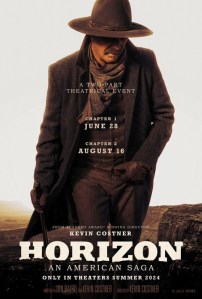
I admire Kevin Costner throwing out all the stops to achieve his passion, a four-part, twelve-hour film series to showcase a sprawling Western epic. The man put a hundred million of his own money into the first two parts of Horizon: An American Saga, and the time devoted to this project was so all-consuming that Costner quit the Yellowstone series, a cable TV juggernaut getting bigger ratings every season. It’s ballsy all right, to abandon a monumentally successful series at the height of its zeitgeist popularity so he can direct not just one but four throwback Westerns that will ultimately be as long as the Lord of the Rings trilogy. It’s rare to see this level of sheer chutzpah in Hollywood. Horizon’s first part was released in June, with its completed second part intended to be released a mere two months later in August. After the poor box-office of Part One, the studio decided to pull Part Two from the release schedule, ostensibly to give people more time to catch the first movie. Will we ever see Part Two in theaters? Will we ever see Part Three, which Costner is currently filming, or Part Four, which Costner is currently raising money for? Costner intended to release the whole saga as a miniseries upon completion, and this might be the best case scenario. As a movie, albeit one quarter of an intended whole, Horizon Part One feels far more structured as an incomplete and rather prosaic TV series.

Upon the completion of the 170 minutes, I was left wondering what was here that would make someone want to come back for a lengthy second part, let alone a third and a fourth. It doesn’t feel like a complete movie or even a completed chapter, and again let me cite Peter Jackson’s Lord of the Rings series. Released over the course of three years, each movie had its own form of a beginning, middle, and end, with each climaxing around some event that left one satisfied by its conclusion. They didn’t just feel like chapters linking to the next; they felt like completed stories that pushed forward a larger overall story. Now, with Horizon Part One, it doesn’t feel like a three-hour movie, rather like three one-hour episodes of a TV series. Each of those hours feels too separate from the other. I’m reminded of television in the streaming era, where producers anticipate viewers binging through multiple episodes in speedy succession. This tacit assumption lends itself toward the general pacing issues I find with too many streaming series, where the filmmakers take far too long to get things moving in a significant manner. I’m reminded of a joke by Topher Florence that back in the day a show like Surf Dracula would feature its lead character surfing in weekly adventures, but the streaming age version would take its entire first season showing how he got his surfboard and then spend five minutes surfing in the finale. When you’re pacing out only one quarter of your possible intended story, calling it slow and lacking development and payoffs is an obvious hazard, which is why every movie needs to be its own thing, to provide a sense of conclusion even if it’s not the final conclusion.
Part One is divided into three parts: 1) the early settlers of Horizon, in the San Pedro Valley, being massacred by the Apache, 2) an old gunslinger (Kevin Costner) tasked with protecting a woman and child on the run from vengeful gunmen, 3) a wagon train of settlers headed to Horizon. Now, from that very streamlined synopsis, which of those storylines sounds the most exciting? Which of those storylines sounds like it can lend itself toward having an in-movie climax? Which of these storylines feels the most fraught with danger and intrigue? It’s the one starring Costner himself, of course, fitting naturally into the role of a tough curmudgeon.
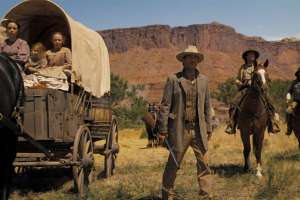
I’m confused why the entire first hour of this movie is devoted to following the frontier town when we’re only going to get two survivors total that go forward. As far as its narrative importance, this entire section could have been condensed to a terrifying flashback from Frances Kittredge (Sienna Miller) and her daughter after the fact. The majority of this hour is spent watching the fine Christian folk of the early days of Horizon die horribly. We’re confined inside the battered Kittredge home that serves as the foundation of a siege thriller, with the band of various townspeople trapped and trying to fight off their indigenous intruders. The attack is prolonged and unsparing in its violence, eliminating all these nice, smiling faces from before. What does it add up to? It’s the tragic back-story for Frances, but it also makes her conveniently romantically unattached so that the nice cavalryman, Trent Gephart (Sam Worthington), can swoon and she can Learn to Love Again. It also sets up a young Apache warrior, Pionsenay (Owen Crow Shoe), making aggressive moves that his elders disagree with in their continued efforts to find some balance with the American settlers grabbing their territory. It also sets up what serves as the only possible character arc completion, with young Russell (Etienne Kellici) escaping the massacre in the beginning to then witness a massacre of Apache, and as he observes the scalping butchery, it galls him, not providing the relief of vengeance he had sought. Now that’s a conceivably emotional storyline, but Russell isn’t the primary character, or even one of the most essential supporting characters. You might genuinely forget about him like I did.
Something else I forgot an hour in was that Part One opens with Ellen Harvey (Jena Malone) shooting her abusive husband and running out. This prologue eventually comes back to setting up the present-day conflicts of the second hour, where Ellen has started a new life as Lucy with her young son. She lives in the Wyoming territory with a prostitute, Marigold (Abbey Lee). This storyline picks up significantly with new characters coming into the mix and disrupting the status quo. The first is Hayes Ellison (Costner) who finds himself attracted to Marigold, perhaps recognizing a woman in over her head. The second are the Sykes brothers (Jamie Campebell Bower, Jon Beavers) who have come looking to retrieve Lucy and her child, the son of their dearly departed pa who was slain in the opening. I am astounded that Costner decided to make the audience wait an hour for this segment because it feels like a much better fit to open Part One. There’s an immediacy to the looming danger and the consequences of actions, and what would serve as the Act One break is when Hayes has to intervene at great risk. This is, by far, the best segment of Horizon Part One. The ensuing on-the-run segment doesn’t get much further, setting up ongoing antagonism between the two sides that presumably will come to blows again. It’s not exactly reinventing the wagon wheel here: drifter reluctantly becoming protector for the vulnerable and reckoning with his shady past and trying to make amends. However, for this first movie, at least this storyline provides a sustained level of engagement with needed urgency.

The weakest portion is the wagon train led by Matthew Van Weyden (Luke Wilson). The most significant conflict during this section isn’t even the protection of the wagon train, it’s whether or not the hoity-toity British couple (Tom Payne, Anna and the Apocalypse‘s Ella Hunt) will assimilate to life on the prairie. They’re privileged, though at least he seems to recognize this. She bathes in the drinking water supply in an extended sponge bath sequence that feels so oddly gratuitous and leery. Two scouts are caught eagerly peeping and this seems like the most significant conflict of this whole section. They’re headed for Horizon, the setting of tragedy and indigenous conflict we know, but the entire wagon train lacks any feeling of dread or even the opposite, a feeling of yearning for a new life. It’s just a literal pileup of underwritten characters in movement without giving us a reason to care.
Costner’s Western eschews the trappings of modern revisionism, deconstructing the heroism and Manifest Destiny mythology of popular Wild West media. This isn’t a deconstruction but a full blown romantic classical Western, embracing the tropes with stone-faced gusto. In some ways it feels like Costner’s version of a Taylor Sheridan show (1883, Yellowstone). He left a Sheridan show to make his own Sheridan show. It’s more measured in its portrayal of the Native Americans even as it shows them massacring men, women, and children as our first impression. I wager Costner is showing that the evils of violent tendencies pervade both sides of the conflict, with a troop of American scalp-hunters that don’t really care where those scalps come from. It’s hard to fully articulate the themes given this is only one-fourth of the overall intended picture. The expansive settings are stunning and gorgeously filmed. I can understand why Costner would want people to watch this movie on the big screen with scenery this beautiful from cinematographer J. Michael Muro, who served as Costner’s DP on 2003’s Open Range, another muscular Western. Fun fact: Muro also served as a Steadicam operator on Costner’s Best Picture-winning Dances with Wolves, so their professional relationship goes back thirty-five years and covers Costner’s love affair with Westerns.

During its conclusion, Horizon: An American Saga runs through a wordless montage of clips that serves as a trailer for the forthcoming Part Two. It’s not edited like a trailer, more so a very leisurely preview with clips that look good but, absent context, can be shrug-worthy. Oh look, a character looking out a window pensively. Oh look, a character walking along a trail. Oh look, a character dismounting from a horse. Oh look, another character looking out a window pensively. It’s hard for me to fathom this truncated preview getting too many people excited for what Part Two has to offer, but then I think that’s the same problem with Part One. It doesn’t serve as a grabber, with characters we really care about, with conflicts that keep us glued, and with revelations and character turns that can keep us intrigued and desperately wanting more. It’s hard for me to think of that many people walking out of Part One and being ravenous for nine more hours. I accept that stories might feel incomplete and characters might feel disjointed, but Horizon is perhaps a Western best left in the distance, at least until you can binge it in its completed form, whatever that may be, though I doubt we’re going to get four full movies. Ultimately, Costner’s opus will need to be judged as a whole rather than as consecutive parts.
Nate’s Grade: C
Share this:

Inside Out 2 (2024)

Of all the Pixar hits, 2015’s Inside Out is one of the better movies to develop a sequel for, and thankfully Inside Out 2 is a solid extension from the original. The internal world of Riley’s burgeoning sense of self is so deeply imaginative and creatively rewarding, balancing slapstick and broad humor with a deeper examination of abstract concepts and human psychology (Freud would have loved this movie… or hated it… or just thought about his mother). The unique setting was made so accessible by the nimble screenplay that the viewer was able to learn the rules of this setting and how interconnected the various parts are. While not being as marvelously inventive as its predecessor, nor as poignant (R.I.P. Bing Bong), Inside Out 2 is a heartwarming and reaffirming animated movie that will work for all ages.
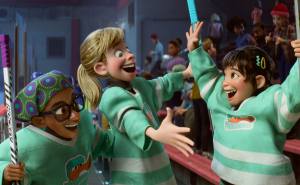
Riley is now turning thirteen years old and in the midst of puberty. That means new emotions, and Joy (voiced by Amy Poehler) has to learn to work well with her co-workers, such as Envy, Embarassment, and Ennui. The biggest new addition is Anxiety (voiced by Maya Hawke) who wants to prepare Riley for her life ahead, which seems especially rocky now that Riley knows her two best friends will be going to a different school. A weekend trip to hockey camp becomes Riley’s opportunity to test drive the “new Riley,” the one who impresses the cool older kids and gains their acceptance. This will force Riley to have to determine which set of friends to prioritize, the new or the old, and whether the goofy, kind version can survive to middle school or needs to be snuffed out.

With the sequel, there aren’t any dramatically new wrinkles to the world building already established. We don’t exactly discover any new portions of Riley’s mind, instead choosing to place most of the plot’s emphasis on another long journey back to home base. This time the other core emotions get to stick around with Joy, each of them proving useful during a key moment on the adventure. The externalization of the emotions invites the viewer to feel something toward feelings themselves. When Joy, at her lowest, laments that maybe a hard realization about growing up is that life will simply have less joy, it really hit me. Part of it was just the sad contemplation that accepting adulthood means accepting a life with less happiness, but a big part was teaching this concept to children and being unable to provide them the joy they deserve. Since the 2015 original, my life has gone through different changes and now I watch these movies not just as an individual viewer recalling life as a former adolescent figuring things out, but now I also come from the perspective of a parent with young children, including one turning thirteen. The development of the mind of this little growing person is a heavy responsibility given to people who are, hopefully, up to that very herculean task. We can all try our best, but recognizing limitations is also key. The kids have to have the freedom to be themselves and not pint-sized facsimiles of a parent.
The emotions inside Riley’s mind are featured like internal surrogate parents, tending to the development of Riley’s emotions, morals, and personality. They presumably want what’s best for her, there just happen to be opposing interpretations of what that exactly means, which leads to the majority of conflict with Anxiety. However, there’s also an understanding that Riley has to do things on her own and be able to make mistakes and learn from them. Inside Out 2 is ultimately about accepting the limitations of providing guidance. Joy and Anxiety are both trying to steer Riley down a deliberate path they think is best, but Riley needs to discover her own path rather than have it programmed for her. I appreciated that Anxiety is not treated as some dangerous one-dimensional villain hijacking Riley’s brain. Much like sadness, there is a real psychological purpose for anxiety, to keep us alert and prepared. Now that can certainly go into overdrive, as demonstrated throughout Inside Out 2, including a realistic depiction of a panic attack. It’s about finding balance, though one person’s balance will be inordinately different from another. The stakes may be intentionally low in this movie, all about making the hockey team and being welcomed by the popular girl she may or may not be crushing over (more on that later), but the focus is on the sense of who Riley chooses to be through her life’s inevitable ups and downs. It’s about our response to change as much as it is our response to the presence of anxiety.
Inside Out 2 also answers a thorny world-building question that the original creators never thought to go into greater detail. It’s established in the 2015 original that even the adults have the same five core emotions manning their brain battle stations: Disgust, Fear, Sadness, Anger, and Joy. So if adults only see these same emotions, what happens to those new puberty emotions? Do they go away? As an adult, do we gradually work through anxiety and embarrassment to the point where they are no longer present (this is where every adult can wryly laugh)? There’s an emotion introduced as Nostalgia, depicted as a kindly grandmother so eager to remember the ways things were. Joy tells Nostalgia to leave, as it’s not time for her to be developed yet until Riley is older. This one moment clears up the world-building question; the emotions don’t leave, they just sit out for periods of time like bench players waiting to be called into the big game. And just like that, it all works and makes sense. I wonder what other new emotions make their appearances later in life. Resentment? Choosing to rather die in authority rather than give up an iota of power to a younger generation? Sorry, that last one was more directed at those stubborn folks clinging to Congressional offices.
There is some sight narrative and thematic redundancy here. The first movie was about learning the importance of accepting sadness as a vital part of the human condition and how we can process our emotional states. It was about Joy learning that not every moment in life can or should be dominated by joy, and that the other emotions are also necessary functions. With the sequel, we have a starting point where Joy is picking and choosing what memories are worthy of being remembered, banishing the “bad moments” to the back of Riley’s mind, forming a cavernous landfill of junked memories. It’s treading some pretty similar ground, prioritizing one set of memories or emotions over others wherein the ultimate lesson is that repression in all forms is unhealthy and robbing one of the necessary tools for self-acceptance and growth. This is further epitomized by a trip to one of these memory vaults where Riley’s Deep Dark Secret is willfully imprisoned. The movie proper never comes back to this self-loathing figure, and the revelation could have really supported the overall message of self-acceptance. Pixar could have done something really special here, like having Riley coming to terms with being bisexual/queer, and that perhaps something we may personally agonize over as a horrifying secret could, once shared, be far from the dreaded life-destroying culprit our minds make it out to be. This would have really worked with the perceived lower stakes of the movie, naturally elevating the ordinary to the profound, as life can often unexpectedly become. Alas, the Deep Dark Secret is just a setup to an underwhelming post-credits joke – womp womp. That’s it? Again, if you’re going to tread the familiar thematic grounds about the dangers of repression, at least give us something bigger to reach than the same lesson that all emotions have a place.

The first Inside Out was a masterpiece. That’s a hard act to follow. This sequel, of which we can all assume there will be more given its billion-dollar box-office, is a solid double to the original’s home run of entertainment. It’s not among their best but it’s one of their better non-Toy Story sequels. Inside Out 2 is a heartwarming winner.
Nate’s Grade: B
Share this:

In a Violent Nature (2024)
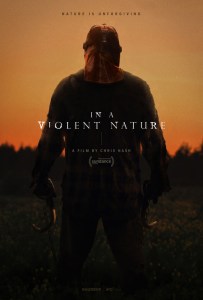 In a Violent Nature is going to be a very trying movie by design. Its entirety follows its very Jason-esque supernatural killer in near real-time as he goes through the woods and eventually kills several unlucky locals and partying teenagers. That means it’s several long sequences of watching the back of this hulking zombie killer walk through the woods and eventually get closer to victims. The actual kill scenes have some impressively nauseating gore, which might serve as a reward to the audience for enduring the lengthy walking. Seriously, this guy perambulates like a boss. He walks. And walks. And walks. Occasionally, he’ll kill someone in gruesome fashion, but most of his journey, and by extension the movie’s journey, is tagging along on his extensive nature hike. Is that going to be interesting to the average horror fan? Probably not. It’s designed to wear down your patience. The filmmakers clearly understand what effect their creative choices would have, and they went through with them anyway. It’s not like writer/director Chris Nash is lacking in style. His segment in 2014’s The ABCs of Death 2, “Z for Zygote,” is ingeniously horrifying. There is a great moment here where our killer’s hand is reaching toward the screaming face of his soon-to-be victim and then Nash performs a match cut with the same hand, now dripping with blood, reaching out for a desired necklace moments later. It’s quick and also subversive, denying the viewer our first opportunity at onscreen violence. This is a movie that works primarily in the realm of denying its target audience what it wants, and that is kind of fascinating to me. I don’t know if it’s enough to make me declare In a Violent Nature as good, but this movie seems destined to work on a different level than good/bad.
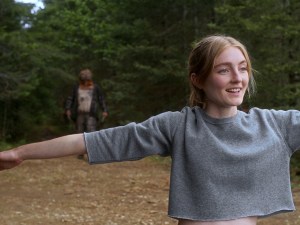 And yet, the movie invites a deeper contemplation through its very experimental nature. We’re walking side-by-side with this undead specter as he tromps through the woods looking to reclaim his special token, and it’s boring by design. I hate using that as an excuse because the movie does get rather tedious at parts, and yet it challenged me to engage more with the movie on an intellectual level, to examine its deliberate creative choices. Just about every slasher movie is designed around the clockwork killing of its easily disposable characters, usually dumb teenagers, by some powerful malevolent force. However, just about every slasher I can recall places the viewer in the perspective of the dumb teenagers engaging in dumb teenager antics, usually drinking and trying to engage in premarital sex. Let’s not pretend those characters are generally any more nuanced or well written than the villain stalking them. Instead of spending all our time with these character archetypes and the occasional pop-in from the villain, it’s reversed. It’s the dumb teenagers that pop-in while we’re on the journey with the slasher fiend. Does it make the kills hit harder because of the long stretches leading up to them because we see how many close calls there have been? Because this guy is trying his best? I don’t know, but the cries of In a Violent Nature being unbearably tedious makes me reflect on whether tedium is, by nature, part of the slasher genre, and perhaps we’ve all ignored the formula because of regular intervals of blood and boobs. Are dumb teenagers that much better company than a silent brute going for a walk?
It was around the halfway point where I began to question whether this approach was causing me to develop empathy for our supernatural killing machine. The back-story is tragic, being a young child tricked by kids he thought were his friends, only to plunge to his death from a water tower. Children can be cruel, and if this was one’s ever-lasting memory of human interaction, then I would understand coming back as a murderous revenant. He also didn’t ask to be brought back to life. The dumb teenagers stole his mother’s necklace and his goal is to simply reclaim it. Yes, he’ll kill plenty of people that had nothing to do with bringing him back, collateral damage from messing with forces that humans should never mess with. He’s just on the hunt for his dear departed mother’s keepsake. In essence, he is looking for the item to return back to the land of the dead, to end being pulled back into corporeal existence. When you look at that context, every dead teenager becomes one step closer to finding that necklace and going back to his eternal slumber. Perhaps our big bad is suffering and looking for that pain to cease. When you’re quite literally walking beside this figure for the duration of the movie, it sparks a personal reflection whether you may be unexpectedly developing empathy. Is it simply projection and all proximal, spending all this time with only one character? Is this a human byproduct of wanting to imbue emotional depth to characters for our sense of engagement? I cannot say. When you walk a mile, or more accurately several, in another (dead) man’s shoes, maybe you start to see the world in his weary, irritable perspective and want that big nap back.
 I have no idea how each viewer will respond to In a Violent Nature. I was wrestling with different mixed feelings, including boredom. I don’t think traditional fans of traditional horror will find the long slog worth taking its time to smell the proverbial flowers. I imagine most will grow restless, antsy, and maybe even angry, and that response is entirely valid and understandable. The novelty of watching the killer stalk his future victims in real time can be one of those ideas that, upon execution, feels better as a short film than as a feature experiment. I admire the gusto of embracing this approach and flipping the slasher script into what amounts to an unorthodox nature documentary between predator and prey. It’s an interesting approach that invites ongoing textual analysis with the genre, the depiction of the characters and their tired archetypes, as well as what makes these movies worth our time and passing investment. Likely there will be more people that shrug and deem In a Violent Nature a dull bore, but I’m also positive there will be people who find themselves unexpectedly thinking and feeling things they didn’t anticipate. Ultimately, it’s a movie I can begrudgingly admire more than engage with, but I appreciate taking the familiar and presenting it in a way we’ve seldom witnessed before.
Nate’s Grade: C+
Share this:

Napoleon Dynamite (2004) [Review Re-View]
 Originally released June 11, 2004:
Napoleon Dynamite was an audience smash at the 2004 Sundance film festival. Fox Searchlight jumped at the chance to distribute a film written and directed by Mormons, starring a Mormon, and set in film-friendly Idaho. MTV Films, the people behind alternating good movies (Better Luck Tomorrow, Election) and atrocious movies (Crossroads, Joe’’s Apartment, an upcoming film actually based on Avril Lavigne’s “Sk8r Boi” song), came aboard and basically said, “Look, we really like the movie, and we want to help bring it to a wider, MTV-influenced audience.” And thus, Napoleon Dynamite seems to have become the summer biggest must-see film for sk8r bois and sk8r grrrls nationwide.
Napoleon Dynamite (John Heder) is an Idaho teen that marches to the beat of his own drum. He lives with his Dune Buggy riding grandmother and 31-year-old brother Kip (Aaron Ruell), who surfs the Web talking to women. When their grandma gets injured, Uncle Rico (John Gries), stuck in the 80s in fashion and mind, takes up shop in the Dynamite home and coerces Kip to hustle money from neighbors. Meanwhile, Napoleon befriends Deb (Tina Majorino), an otherwise normal girl with a sideways ponytail, and Pedro (Efren Ramirez, who was actually in Kazaam!), the new kid at school. Together, they try and get Pedro elected to class president, but standing in their way is the mighty shadow of Summer (Haylie Duff), the most popular girl in school. Oh yeah, there’’s also a llama.
 First time director, Jared Hess, and first time cinematographer, Munn Powell, orchestrate shots very statically, with little, simple camera movements and many centered angles. The style is reminiscent of the films of Todd Solondz (Welcome to the Dollhouse), or, more precisely, Wes Anderson. This shooting technique makes the characters stand out even more, almost popping out at you behind flat backgrounds like some Magic Eye picture. Hess easily communicates the tedium of Idaho with his direction. Can anyone name any other film that takes place entirely in Idaho? (Please note that My Own Private Idaho takes place in Portland and Seattle, mostly).
The star of the show is, of course, Heder. His wickedly funny deadpan delivery helps to create a truly memorable character. He achieves a geek Zen and, judging from the incredible amount of kids under-14 that appeared both times I saw this film, is most likely the greatest film realization of a dork. It’s grand dork cinema, a genre long ignored after the collapse of the mighty Revenge of the Nerds franchise. So while Napoleon isn’’t exactly relatable (llamas, Dune Buggy grannies and all), the right audience will see reflections of themselves. You’’ll be quoting from Napoleon all summer.
Napoleon Dynamite is going to be an acquired taste. It’s filled to the brim with stone-faced absurdities and doesn’’t let up. If you’’re not pulled in with the bizarre antics of bizarre characters in the first 10 minutes, then you may as well leave because otherwise it will feel like the film is wearing you down with its “indie weirdness.” Napoleon Dynamite seems to skirt the sublimely skewed world of Wes Anderson, but Napoleon lacks the deep humanity of Anderson’s films. What the audience is left with is a sugary, sticky icing but little substance beneath, and, depending on your sweet tooth, it’’ll either be overpowering and a colossal disappointment or it’’ll taste just right for the occasion. Alright, I’’m done with baking analogies for the year.
 Some will find a certain condescension against the characters. Napoleon Dynamite doesn’’t outright look down upon its characters, but it does give them enough room to paint themselves fools. Uncle Rico is really the film’s antagonist, yet he’s too buffoonish to be threatening. It’’s a fine line for a film to have condescension toward its characters, but Napoleon Dynamite ultimately leaves with a bemused appreciation for its characters. The film presents the “good” characters as unusual but lovable and ready for growth (Kip, Pedro, and of course Napoleon), but the “bad” characters (Summer, Uncle Rico) aren’’t demonized. In essence, Napoleon Dynamite is the best example of a film that makes an audience laugh at and with its characters simultaneously.
Napoleon Dynamite is assuredly an odd duck. Some will cheer; others will want to head out the door after a few minutes. It’’s hard to say which reaction an individual will have. If you have a geek-enriched history populated with unicorns, Dungeons and Dragons, and/or social ostracism, then you may be more inclined to admire Napoleon Dynamite. I laughed out loud throughout the film and found it to be an enjoyable diversion, and I went the whole review without one Jimmy Walker reference.
Nate’s Grade: B
——————————————————
WRITER REFLECTIONS 20 YEARS LATER

I feel like trying to explain the unexpected pop-culture success of Napoleon Dynamite is a fool’s errand, ultimately leaving one sputtering out and ending with the disappointing culmination, “Well, you just had to be there, I guess.” It was 2004, before the rise of YouTube and dominant social media outlets, and for whatever reason, if you were under 30, you probably fell in love with this Idaho nerd, or at least fell in love sounding like this Idaho nerd. I couldn’t travel more than a few blocks without overhearing some loitering Millennial uttering, “Gawsh” in mock exasperation, or mentioning llamas, tater tots, ligers, or catching a significant other a “delicious bass.” If you can recall how annoying and omnipresent the Borat impressions were after that 2006 movie’s mainstream splash, well the silver lining to every person, usually a smirking male member of the species, saying, “My wiiiiiiife,” was that it finally pushed aside everyone else endlessly imitating Napoleon Dynamite (John Heder). This movie was everywhere in 2004. It was meme-ified before meme culture became prevalent. Re-watching this movie twenty years later is like excavating a novelty from a different time and trying to better analyze why this silly and stupid little movie about weirdos living their weird lives became a zeitgeist breakout.

If I had to explain the appeal of Napoleon Dynamite, I think it serves as the next step in the evolution of comedy for younger adults. The Muppets are a deservedly celebrated comedy troupe for over 50 years, and beyond the iconic characters and their mirthful camaraderie, I think their ongoing appeal is that it’s an introduction to the forms of irony for younger children. It’s teaching that there can be more behind the silly, and Napoleon Dynamite takes that PG-comedy baton and pushes it forward, as its entire being is one of ironic comedy. The entire movie is built upon the viewer finding the behavior and banter of these characters hilarious for being so straight. There aren’t really jokes in the traditional sense of setups and payoffs; every line has the potential to be a joke because it’s a character saying something ridiculous without the awareness of being ridiculous. As I said back in 2004, “If you’’re not pulled in with the bizarre antics of bizarre characters in the first 10 minutes, then you may as well leave because otherwise it will feel like the film is wearing you down with its “indie weirdness.” Perhaps this style of comedy, a feature fully dedicated to ironic detachment, served as an awakening for others in my age-range, who championed the absurdity of the everyday and lionized the liger-loving man. This movie doesn’t achieve the larger artistic ambitions in a heightened tone of a Wes Anderson or a Yorgos Lanthimos, two masters of droll deadpans. It’s not deep. It’s not complicated. It’s always obvious, but that made the comedy all the more accessible to so many, especially for younger teens and kids.
As a movie, Napoleon Dynamite can be overwhelming. Seeing any clip of this movie serves the same comedy function as watching the entire 96-minute experience. It helps to structure the movie around a nerd’s quest to win over the girl and help his fellow outcasts. It has a recognizable us-versus-them formula where we can root for the weirdos to, if not prove their naysayers wrong, at least prove to one another that they have found acceptance from the ones who matter. It works on that familiar territory. Napoleon’s big dance at the talent show is his triumph, showcasing to the rest of the school his skills, though he runs away before the adulation can be felt, robbing his character of the perceived victory but giving it to the audience instead.

For most of the people involved in this movie, they had a brief burst of wider success before gradually coming back down to Earth. Heder was the obvious breakout and was given bigger supporting roles in studio comedies like Just Like Heaven, School for Scoundrels, Blades of Glory, and Surf’s Up, the other animated penguin movie from 2006. Heder has worked almost exclusively in the realm of voice acting in the last decade, including 2024’s Thelma the Unicorn, directed by Jared Hess and co-written by Jared and his wife Jerusha, the same creative team that gave us Napoleon Dynamite. I never really vibed with any other Hess comedy. I didn’t get the love for 2006’s Nacho Libre, and from there the movies just got worse to unwatchable, like Gentlemen Broncos and Don Verdean, each trying to chase that same combination of detached irony and quirk that proved so successful for them in 2004. I think the inability to follow-up Napoleon Dynamite with another breakout comedy of its ilk speaks to the unpredictable nature of assembling the right mixture of actors, tone, and material, as well as good timing. Would Napoleon Dynamite have been as big a success in 2009 as opposed to 2004? Maybe not. There was a six-episode animated TV series version in 2012, and the fact that I never remembered this probably answers the question over whether the filmmakers got lucky in 2004.
Napoleon Dynamite is the exact same movie it was back in 2004 as it now resides in 2024, and forever more. It’s flat, detached, silly, light-hearted and the same joke on repeat, and if you feel yourself gravitating toward that comedy wavelength, then hop on and enjoy. Re-watching it for me was like revisiting a fad from the past that was hard to put into context. What was it that made so many buy “Vote for Pedro” T-shirts and talk about throwing footballs over mountains? Comedies more than any other movie lend themselves to audience dissemination, to take the jokes and moments and characters and run with them. Nearly every successful comedy has experienced some form of this, so why should Napoleon Dynamite be any different? It’s perfectly understandable to watch this movie unfazed, unamused, and questioning what exactly people found so amusing about this guy and his extended family and friends back in 2004. It’s also understandable to smile and chuckle at the absurdities played so matter-of-factly. Gawsh.
Re-View Grade: B-
Share this:

I Saw the TV Glow (2024)/ The Watchers (2024)
 I Saw the TV Glow is a strange experience by design, a hallucinatory ode to early 1990s television, coming of age sagas, feeling out of place in one’s own body and mind, and on a Lynchian dream logic wavelength that few filmmakers occupy. From a plot standpoint, Owen (Justice Smith) is a shy kid who looks up to an older girl at school, Maddy (Bridget Lundy-Paine), and they share a love for the TV show The Pink Opaque, a tween-aimed horror series in the vein of Goosebumps or Are You Afraid of the Dark?, which ultimately might be real after all. This movie exists more on a slippery emotional plane than on its story sense. Writer/director Jane Schoenbrun (We’re All Going to the World’s Fair) has created an allegory for self-actualization and self-acceptance through a love of 90s nostalgia and that transitional time of being young and just seeing the cusp of what adulthood promises for the good, the bad, and the mundane. The recreation of the SNICK-era television is perfect, and I loved the little glimpses of these horror monsters taking on new nightmarish incarnations. I wanted the movie to explore its premise more, that this old TV show might be real and posing a danger that only they would uncover. It’s really more a pathway for the characters to explore their selves, what animates them, what confuses them, what provides a sense of community. It’s a movie about the perils of loneliness and finding an outlet, a life raft, whatever that may be, and for Owen it’s this TV show. He connects more with this world than the real one, and when he revisits it later as an adult, it doesn’t live up to his memory. It’s a weird movie but it’s designed for weird kids, or weird adults who used to be weird kids, who found kinship through weird media. It’s a slow and provocative experience that asks you to give yourself over to its vision, but Schoenbrun also makes that engagement quite accessible. While existing as a clear trans allegory, I Saw the TV Glow is open to any outsider who felt unsure of themself and their body and their place in the universe. It’s about obsession and the price of holding onto said childhood obsessions, even if they prove disappointing in your adulthood. It doesn’t offer any general answers or catharsis and is kept on the slowest of slow burns. I began daydreaming of the less arty version of its spooky premise, but that’s simply not going to be this movie. I Saw the TV Glow is impressively personal and surreal and obtuse, but by the end I was hoping for a little more of a foundation to hold onto and its ideas to be fully realized.
Nate’s Grade: B
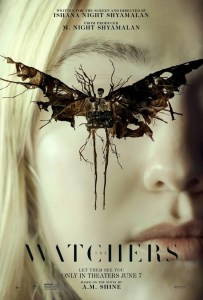 The expansion of the M. Night Shyamalan creative dynasty has begun. While based on a 2022 novel by A.M. Shine, The Watchers is brought to us primarily by Ishana Shyamalan, who makes her feature directing debut and adapted the screenplay. It has a buzzy premise that feels at home in a Shyamalan movie, namely a young woman (Dakota Fanning) who stumbles into a strange location with captive people telling her she cannot leave or her life will be in danger from monsters. The group of survivors have to “perform” for their unseen watchers, staring into a two-way mirror inside a closed room. There are certain rules that are hazy and unevenly applied: don’t go out after dark, never turn your back to the mirror, don’t go into the creatures’ subterranean dwelling. This poses an intriguing mystery for a while as the movie unpacks and reveals more about this world and the creatures. However, The Watchers ultimately cannot help feeling like an over-extended episode of a sci-fi anthology TV series like Black Mirror or maybe even Shyamalan’s own Apple Plus series Servant (Ishana wrote and directed several episodes). There just isn’t enough here. The revelations do not sustain our emotional and intellectual investment. Once it’s revealed what the monsters are, I kept waiting for extra levels of twists and turns, and there really aren’t any. Once we settle into Act Three, the movie becomes more or less about housekeeping and gaining acceptance. The whole reason the protagonist is on her journey is to deliver a bird in a cage, and every time this thing keeps appearing even so late into the movie, while she’s running for her life but cannot forget about the caged bird, I felt like laughing. It’s a case of inelegantly finding a way for the visual metaphor (the bird is her!) to continue being tied to the plot after it long stopped making sense. Likewise, there are cutaways to the captives watching a Love Island/Big Brother-stye reality TV show, but little is made as far as commentary on communal voyeurism, so they just come across as little odd comic asides. The movie loses some serious momentum once we get to the convenient info dump sequence (a Shyamalan family favorite: scientist vlogs) and you realize there are no more tricks to deliver. It’s disappointing that a movie with such potent folklore atmosphere becomes a lackluster variation on The Village.
Nate’s Grade: C
Share this:

Winnie the Pooh: Blood and Honey 2 (2024)
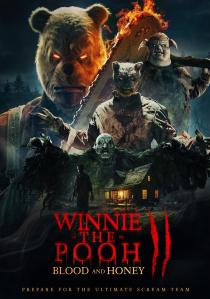 The first Winnie the Pooh: Blood and Honey was, unquestionably, my worst film of 2023. It wasn’t merely a bad horror movie, it was a depressingly cynical cash-grab with such little forethought of how to subvert the wholesome legacy of its classic characters. As I said in my review: “The startling lack of imagination of everything else is depressing, as is the fact that this movie has earned over four million at the global box-office, hoodwinking enough rubberneckers looking for a good bad time. The problem is that Winnie the Pooh: Blood and Honey is only a bad bad time.” Oh, dear reader, I wasn’t looking forward to the inevitable deluge of follow-ups, as writer/director Rhys Frake-Waterfield would resupply his surprising success with further sinister revisions to public domain properties. He’s planning on a “Poohniverse” crossover event with a combination of Pooh, evil Pinnochio, vengeance-fuelled Bambi, and a traumatized or villainous Peter Pan. Again, schlocky movies that lean into their schlock can be wonderful things, but a movie that does next to nothing with its subversive hook, with the history of its cutesy iconography, and could be easily replaced with any other menacing slasher killer is beyond lazy, it’s insulting. I figured there could be nowhere to go but up with a sequel, and while Blood and Honey 2 is an improvement in just about every way, it’s still not enough to qualify as a fun or ironic treat.
Wakefield and new co-writer Matt Leslie (Summer of 84) completely rework the mythology and history established in the first movie, which is now revealed to be the literal movie-within-a-movie of the account of the Massacre of the 100 Acre Wood where Pooh and Piglet slaughtered a troupe of bad-acting British coeds. In this prior film, it was established that Pooh and his buddies were angry with Christopher Robin (Scott Chambers, replacing Nikolai Leon) when he left for college. They felt abandoned and grew feral and monstrous, rejecting the ways of man (though still wearing the clothes of man and driving the cars of man). However, now in the sequel it’s revealed they were always feral and blood-thirsty and it was Christopher who incorrectly remembered them as cute and fluffy. This scene makes for the hilarious visual of a child waving innocently at a blood-strewn manimal lurking about. Also, Christopher had a young brother who was abducted by the creatures of the 100 Acre Wood and never seen again. Also also, there was a mad scientist who was creating human-animal hybrids from missing children, so the blood-thirsty animals might not be actual animals after all (can you see where this is going?). While the first Blood and Honey movie did nothing with the characters, this movie actively gives them a tragic history with some twists and turns, enough to lay a mythos. The use of hypnotherapy-induced flashbacks isn’t exactly smooth or subtle, but I’ll take it. At least this movie provides a distinguishing plot that makes some use of its particular elements. Don’t mistake me, dear reader, this is faint praise at best, but after enduring the creatively bankrupt first film, it’s like a desperately needed oasis. Ultimately, it might all just be a mirage but at least it’s something to those of us who suffered!
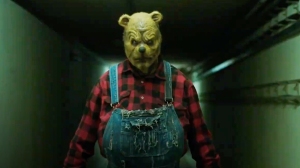 In the grand sequel tradition, bigger is better, and now instead of two ferocious beasts wreaking havoc, it’s four, with the addition of Owl (Marcus Massey) and Tigger (Lewis Santer). None of these monsters has a particular style or attitude that distinguishes them. I guess Tigger calls people “bitch” a lot and slashes people. There is one point where hapless cops are investigating a crime scene and say, “Let’s bounce,” and Tigger says from the luxury of the shadows, “Hey, that’s my line.” I figured they’d incorporate the signature Tigger bounce on his tail, but perhaps that was too expensive to perform or that bounce was more a byproduct of the Disney version of the character, still under copyright, and not the available A.A. Milne version. The animal costumes look better than the cheap Halloween masks of the original, though for my money Owl looks more like a turkey vulture wearing cray paper. I’m sure we’ll get Kanga in the inevitable third movie in 2025 where her zombie baby leaps out of her pouch to feed on brains. There is a snazzy addition late into the proceedings where Pooh is welding a fiery chainsaw. It makes little sense for the character but it’s cool, so it’s excusable in lapsed movie logic.
I was hoping for more unique kills, twisted takes related to the characters, like Pooh turning some poor soul’s head into a honeypot. The kills are just grizzly and extensive, favoring quantity over quality. There are plenty of decapitations, gougings, impalings, and other fraught and violent encounters, nearly all of them featuring squealing, terrified women. It’s always women that seem to get the worst in these movies, but of course this is a feature and not a bug of the genre back to its 80s heyday. It gets relentless but I suppose at least these girls aren’t having their tops mysteriously fall off while they’re being butchered. A third act rave set piece features maybe two dozen kills and risks becoming tedious slaughter. It got to the point where I was hoping not to see another cowering person hiding behind a corner because it meant the sequence was going to be even more unbearably long (I’m not personally cut out for the Terrifiers).
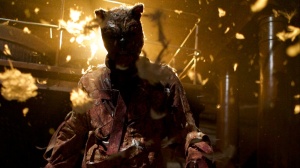 In between the spillings of blood and guts is the attempts at human drama, namely Christopher Robin trying to live a normal life while also re-examining his past. Apparently people think he’s to blame for the massacre from the 100 Acre Wood, and so he’s become a pariah, whose very presence unsettles others. He’s trying to find steady work in a hospital setting but he’s blacklisted from pursuing his career because of the negative attention his name generates. He even has a romance with a single mom so that when the Robin family is inevitably skewered we have other characters that can be personally threatened to provide meaningful stakes. The life of Christopher Robin and his discovery of repressed memories makes for a surprising story foundation for Blood and Honey 2, especially when the plot of its predecessor was mostly Christopher being held prisoner and the baddies casually roaming and killing coeds. I think Chambers is a better actor as well, and he’s posed to be the writer/director of Neverland Nightmares, which just began principal photography a month and a half ago as of this writing. Good luck, guy.
While the budget has increased tenfold, Blood and Honey 2 is still a scuzzy, sleazy slasher movie at heart. If you’re in the mood for a low-budget exploitation movie heavy with gore, there may be enough to qualify this sequel as moderately mediocre, which again is a marked improvement from what I declared the worst movie of 2023. I’ll credit the influence of co-writer Matt Leslie to try and put some standards in place for this runaway gravy train of IP allocation. What’s scariest of all is what Frake-Waterfield’s unexpected success has wrought, encouraging imitators to jump on his now proven novelty act. There’s a 2025 Steamboat Willie horror movie called Screamboat as Steamboat Willie has now entered the public domain (but not other versions of Mickey). Will it be any good? I sincerely doubt it. Will it make money from curious horror hounds looking for an ironic twist on a wholesome childhood fixture? Most assuredly. This is our present. This is our future, and it’s the legacy of Frake-Waterfield and his ilk that stumbled onto a lucrative novelty act. Winnie the Pooh: Blood and Honey 2 is just bad, and for that it’s an improvement.
Nate’s Grade: D+
Share this:

Back to Black (2024)
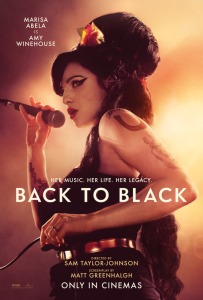 What do you remember about Amy Winehouse? The tragic singer with the booming voice that was mercilessly picked apart by a rabid tabloid media, as well as rampant online speculation, over every step of her addiction to drugs and alcohol? If that’s the extent of your memory, as well as some of her more notable songs like “Rehab” or “Back to Black,” then this musical biopic directed by Sam Taylor-Johnson (Fifty Shades of Grey, Nowhere Boy) is going to feel like a shallow exercise in piling on a troubled and talented performer gone far too soon.
Back to Black, the film, literally has Amy Winehouse (Marisa Abela) vocalize what she wants to be remembered for, not the drugs and alcohol, and the movie then erases Amy as a vibrant, complicated human being into a blurred statistic on the dangers of unchecked addiction. You can’t tell her story without documenting her demons, and yet the movie also seems exceptionally forgiving to the men who contributed to her downfall, her doting father Mitch (Eddie Marsan) who enabled her and her bad boy boyfriend Blake (Jack O’Connell) who introduced her to hard drug abuse. We spend so much emphasis on the bad times and her downfall and yet the movie is strangely reticent to cast much judgment on her bad influences, which makes it seem like the movie is further blaming Amy. At the same time, her downfall is focused on being rejected by a man, which is really insulting and limiting for her as an artist as well as a person capable of independent thought. It’s an even stranger decision given that these two influences, her father and ex, were given withering condemnation in the 2015 Oscar-nominated documentary on Winehouse. Apparently, Mitch Winehouse was furious with the documentary’s portrayal of him and Amy. His secondary complaint was that the documentary focused too much on the negative aspects of her life story, which is comical considering the skewed balance that Back to Black dwells upon. We speed through the good times to wallow in the bad, and without a stronger and more complex portrayal of Amy as a character, it all feels trashy and degrading. It’s harder to feel the heartbreak when the movie is only defining her by our foreknowledge of her death.
 Amy never feels like her own person in this movie, which is a shame since she was a dominant presence. We never get into her creative process or her inspirations. We never get to see the person behind the omnipresent tabloid headlines. The formulaic rise-and-fall structure is so rushed and uninterested in fleshing out Amy as a person, so we get simplistic impressions like she sure loved her “nan” (Leslie Manville) and never recovered from her death. The movie sets a midpoint montage where her grandma’s funeral pushes her to get a signature tattoo and beehive hairdo, and it plays like a superhero finally donning their cape and cowl (At last, she has become… Batman, I mean… the Amy We Remember). It’s played so dramatically that it might even unleash a titter or two. There is such scant insight into this woman and her demons that I doubt anyone will come away with a better understanding of Amy and her place in music history, as well as who she was as a person. The movie omits other struggles that might take the focus off its specific topic of drugs and alcohol. Her bulimia gets nary a mention except for maybe one scene where her inconsiderate roommate asks Amy to please vomit into the toilet a little less loudly. While skipping judgment over her enablers, the movie also avoids being too judgemental on the social impulses and rubbernecking that fed upon the harassment and mockery of Winehouse and her struggles. Again, by omission this is placing further blame onto Amy herself.
For each viewer, Back to Black is going to sink or swim depending upon your reaction to Abela’s (Industry) performance. She does her own singing and learned to imitate Winehouse’s signature soaring vocals, so that’s generally impressive. However, I felt her greatest moments of acting were the scenes where she wasn’t in song. Her over-extended enunciation and head bobs made me consistently cringe, like watching an overzealous Vegas impersonator. In the few instances where the movie slows down, that is where Abela is best, being distraught over the loss of her nan, infuriated by her ex, incredulous at music producers that want to market Amy like the Spice Girls, and charmingly innocent confiding to a young fan in a checkout line. If the movie had cut all of her vocal performances and given me more time with this Amy Winehouse, I would have gotten more insight and entertainment. Abela isn’t given the material to really bring Amy to life.
 Back to Black isn’t so much Amy’s movie as it is her father Mitch’s response to earlier portrayals. He’s portrayed here as a doting and loving father who only wanted what was best for her. You see, his initial refusal to the demands to send his daughter to rehab was because he wanted her to kick this whole addiction thing on her own. She didn’t want it so he wasn’t going to push her. If anything, he’s the hero of this movie, the proud papa who was let down by his daughter’s duplicitous boyfriend-turned-husband, the man who took his little girl away and turned her to the dark side of drugs. When you analyze the approach, it all comes across as a little insidious, a little icky, and unworthy of recreating this woman’s life experiences to better glorify her father. Abela gives it her all, it’s just too little to be had with Back to Black, a shallow biopic treading upon distaste. I’d recommend skipping this movie entirely, unless you’re irreversibly curious, and watch the 2015 documentary Amy instead. You’ll get a much better sense of Amy Winehouse the singer, the star, the addict, and most importantly, the complicated person.
Nate’s Grade: C
Share this:

The Ministry of Ungentlemanly Warfare (2024)

This is my kind of Guy Ritchie, leaning into the pulp sensibilities of genre movies with style, swagger, and cheek, and The Ministry of Ungentlemanly Warfare is his grand ode to the WWII men-on-a-mission capers. While reportedly based upon the recently divulged secret files of Winston Churchill, the heavily fictionalized account of Gus March-Phillips (Henry Cavill) assembling a team of experts to blow up Nazi plots treats the men like super heroes. For the first hour or so, the movie is rollicking, with the team mirthfully mowing down Nazis at a steady pace, chumming it up, and having a fine time. It’s only after that midpoint where some of the movie’s flaws start to drag and become more apparent. First of all, an extended mission of getting close to a Head Nazi (Til Sweiger) and abscond with some ships off the coast of Africa makes for a very labored stay but without much fekt in progression or complication. I was feeling wanderlust to get moving. Next, the entire team feels unstoppable to the point of becoming boring. They never break a sweat fighting and casually plow through their enemies, so the entertainment value of the slaughter begins to ebb when it all feels too easy for too long. You can do an entire movie of Nazi destruction from the hands of an unstoppable force, like Sisu, but the bloody appeal of that movie is its creative carnage. We needed more variation in the action and set pieces. These gents have no formidable adversary, no overwhelming odds, and no real bouts of bad luck to thwart them. Alan Ritchson (TV’s Reacher) is a hulking mountain of a man, and he has such poise and charisma to be the breakout character, and Ritchie just fumbles it. Ritchie has excelled in the past with easily imbuing striking and memorable personality and conflicts with his Cockney crime larks, and I was missing more of that peppy style and unique flavor. Don’t get me wrong, The Ministry of Ungentlemanly Warfare has great promise and entertainment value, but it unfortunately creates its own ceiling, stalling in the second half and failing to develop intriguing challenges to test its underwritten crew.
Nate’s Grade: B-
Share this:

Robot Dreams (2023)
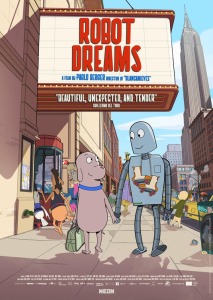 What a delightfully tender little movie Robot Dreams proves to be. It’s based on a picture book and its story is mostly about a lonely Dog who orders a build-your-own-robot for companionship and their friendship. Much of the movie hinges on the Robot being trapped on a Long Island beach closed for the season, so our intrepid Dog must go on living in his New York City apartment through the seasons while he waits to rescue his friend. The movie is wordless and based upon a picture book, but that doesn’t mean this is chiefly kid’s stuff. It touches upon the profound with such elegance and efficiency, brilliantly relatable and recognizably human. It’s all about our need for connections, and even when they are separated, both the Dog and Robot find other connections with other characters, and then it comes back to our worry that they won’t actually reunite after being apart for the majority of the movie. I was reading some gay coding between the two as well but maybe that was my own projection. My nine-year-old son was quite taken with the movie and could easily follow along, though he was also very much not a fan of the bittersweet ending, his first taste of providing the whole “what you need, not what you want” conclusion. Robot Dreams is lovingly realized, its animation so clean and crisp with wonderful characters populating an alternative 1980s NYC. It’s simple and sweet and irresistible.
Nate’s Grade: A-


 nathanzoebl
You must be logged in to post a comment.