Category Archives: Review Re-View
Lost in Translation (2003) [Review Re-View]
 Originally released October 3, 2023:
Sofia Coppola probably has had one of the most infamous beginnings in showbiz. Her father, Francis Ford, is one of the most famous directors of our times. He was getting ready to film Godfather Part III when Winona Ryder dropped out weeks before filming. Sophia Coppola, just at the age of 18, stepped into the role of Michael Corleone’s daughter. The level of scathing reviews Coppolas acting received is something perhaps only Tom Green and Britney Spears can relate to. Coppola never really acted again. Instead she married Spike Jonze (Being John Malkovich) and adapted and directed the acclaimed indie flick, The Virgin Suicides. So now Coppola is back again with Lost in Translation, and if this is the kind of rewards reaped by bad reviews early in your career, then I’m circling the 2008 Oscar date for Britney.
Bob Harris (Bill Murray) is a washed up actor visiting Tokyo to film some well-paying whiskey commercials. Bob’s long marriage is fading and he feels the pains of loneliness dig its claws into his soul. Bob finds a kindred spirit in Charlotte (Scarlet Johansson), a young newlywed who has followed her photographer husband (Giovanni Ribisi) to Japan and is second-guessing herself and her marriage. The two strike up a friendship of resistance as strangers in a strange land. They run around the big city and share enough adventures to leave an indelible impression on each other’s life.
 Lost in Translation is, simply put, a marvelously beautiful film. The emphasis for Coppola is less on a rigidly structured story and more on a consistently lovely mood of melancholy. There are many scenes of potent visual power, nuance of absence, that the viewer is left aching like the moments after a long, cleansing cry. There are certain images (like Johansson or Murray staring out at the impersonal glittering Tokyo) and certain scenes (like the final, tearful hug between the leads) that I will never forget. Its one thing when a film opens on the quiet image of a woman’s derriere in pink panties and just holds onto it. It’s quite another thing to do it and not draw laughs from an audience.
Murray is outstanding and heartbreaking. Had he not finally gotten the recognition he deserved with last year’s Oscar nomination I would have raged for a recounting of hanging chads. Murray has long been one of our most gifted funnymen, but later in his career he has been turning in soulful and stirring performances playing lonely men. When Murray sings Roxy Music’s “More Than This” to Johansson during a wild night out at a karaoke bar, the words penetrate you and symbolize the leads’ evolving relationship.
Johansson (Ghost World) herself is proving to be an acting revelation. It is the understatement of her words, the presence of a mature intelligence, and the totality of her wistful staring that nail the emotion of Charlotte. Never does the character falter into a Lolita-esque vibe. Shes a lonely soul and finds a beautiful match in Murray.
 Lost in Translation is an epic exploration of connection, and the quintessential film that perfectly frames those inescapable moments of life where we come into contact with people who shape our lives by their short stays. This is a reserved love story where the most tender of actions are moments like Murray carrying a sleeping Johansson to her room, tucking her in, then locking the door behind. The comedy of disconnect is delightful, like when Murray receives incomprehensible direction at a photo shoot. The score by Jean-Benoît Dunckel, front man of the French duo Air, is ambient and wraps around you like a warm blanket. The cinematography is also an amazing experience to behold, especially the many shots of the vast glittering life of Tokyo and, equally, its emptiness.
Everything works so well in Lost in Translation, from the bravura acting, to the stirring story, to the confident direction, that the viewer will be caught up in its lovely swirl. The film ends up becoming a humanistic love letter to what brings us together and what shapes how we are as people. Coppola’s film is bursting with such sharply insightful, quietly touching moments, that the viewer is overwhelmed at seeing such a remarkably mature and honest movie. The enjoyment of Lost in Translation lies in the understanding the audience can feel with the characters and their plight for connection and human warmth.
Writer/director Sofia Coppola’s come a long way from being Winona Ryder’s last-second replacement, and if Lost in Translation, arguably the best film of 2003, is any indication, hopefully well see even more brilliance yet to come. This is not going to be a film for everyone. A common argument from detractors is that Lost in Translation is a film lost without a plot. I’ve had just as many friends call this movie “boring and pointless” as I’ve had friends call it “brilliant and touching.” The right audience to enjoy Lost in Translation would be people who have some patience and are willing to immerse themselves in the nuances of character and silence.
Nate’s Grade: A
——————————————————
WRITER REFLECTIONS 20 YEARS LATER

I have never done this before in the four years of my re-reviewing movies, but I really just want to quote my introduction into Lost in Translation because I feel like this perfectly sets the scene, as well as giving my 21-year-old self some kudos: “Sofia Coppola probably has had one of the most infamous beginnings in showbiz. Her father, Francis Ford, is one of the most famous directors of our times. He was getting ready to film Godfather Part III when Winona Ryder dropped out weeks before filming. Sophia Coppola, just at the age of 18, stepped into the role of Michael Corleone’s daughter. The level of scathing reviews Coppola’s acting received is something perhaps only Tom Green and Britney Spears can relate to. Coppola never really acted again… So now Coppola is back again with Lost in Translation, and if this is the kind of rewards reaped by bad reviews early in your career, then I’m circling the 2008 Oscar date for Britney.” Besides the unnecessary broadside against Ms. Spears, who I’ve already apologized for with my re-review of 2002’s Crossroads, I think all this holds true. Within three films, Sofia Coppola went from an unfortunate punchline (not her fault!) to Oscar winner and indie darling.
Lost in Translation was my favorite American movie of 2003, so I’m always curious how my then-favorites stack up twenty years later. I’ve softened on American Beauty and Requiem for a Dream, and still consider The Iron Giant, Magnolia, and Moulin Rouge to be excellent. My feelings toward Lost in Translation, upon re-watch, remain mostly the same, though after two decades of watching other slow-burn, character-centric indies and widening my viewing, its highs aren’t quite the rhapsodic high for me in 2023 but it’s still an effective melancholy mood piece.
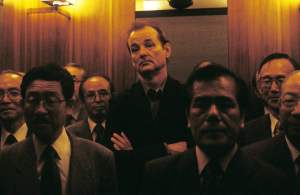 Lost in Translation taps directly into a universal feeling of yearning for connections in a time where it’s becoming easier and easier to disconnect into our own little bubbles. You don’t have to be stuck in a foreign country to feel isolated or out of sorts, and Coppola uses the external circumstances as a means of reinforcing the emotional isolation and then re-connection of her characters. This is why I brush aside some of the harsher criticisms levied against Coppola’s portrayal of Japanese culture and the locals. This is an outsider portrayal, and I don’t think there’s so much a critical judgment over Japanese culture as being inferior as just being different from what these characters are used to. They are clearly out of their element; it’s not that the culture is weird, it’s that the culture is different (that doesn’t mean there aren’t some overstayed stereotypes here as well). Trying to simply communicate with people that all speak another language is a quick and accessible dynamic to better visualize and articulate disconnect. I feel like this story could have been told from any racial or ethical perspective; it’s about two outsiders finding one another. The racial dynamics are less important. Obviously Coppola’s own personal experiences and outsider perspective in Japan are what provides the specific details with this tale, but I think what makes the movie still so effective in 2023 is because it’s so relatable on a deeper level that it eclipses any specific personal details. It’s about feeling lost and then feeling seen.
The key scene for me happens about seventy minutes into the movie, after Bob (Bill Murray) and Charlotte (Scarlett Johansson) have had an adventure with the Japanese hospital system. They’ve become one another’s insomnia buddies, teaming up to explore the city’s nightlife. As they lay side by side in bed during the wee hours, they have an intimate and poignant conversation, and it has nothing to do with sex. “I’m stuck,” she says. “Does it get any easier?” It’s about a young woman asking a middle-aged man for guidance and wisdom and him offering what he can with the caveat that he too is still struggling for his own wisdom. It’s the illusion that at some magic predetermined number of trips around the sun, the mystery of life will somehow become perfectly realized, as if now we can see the grand architectural design. There is no magic number. Everyone is trying their best and making it up as they go, and that’s what this conversation represents. She’s begging for reassurances that adult life will get easier, that she’ll find her footing, and Bob encourages her to continue pursuing her hobbies and passions even if she can’t stand her own art (which sounds like every artist I’ve ever known). Much of his actionable advice comes down to being patient including with yourself. Everybody is in their own way trying their best with what they have. He assures her that the more she gets comfortable with who she is the less things can bother her. It’s a beautiful scene and the reason it works even better is that Coppola doesn’t treat this moment with the gravity it has. It’s not even the film’s climax. Much like real life, when we look back at the exchanges that prove the most formative, we don’t have alarms ringing to better inform us that this is a moment that will have maximum import. We don’t know until it’s over.
 I have never viewed Lost in Translation as some kind of will-they-won’t-they May-December romance, and at no point was I secretly hoping that Bob and Charlotte would get together. This is because they do get together but it’s not a purely romantic connection, although once you start really analyzing romance itself, there are far more complicated and nuanced dimensions to this overly simplified concept, and one could argue this is a romance of sorts but not one about physical passion and infatuation that dominate our association. It’s about two human souls drifting along in life who find a kinship with one another when they need it the most. I never wondered at the end whether they would kiss or have some kind of affair or even run off together, because that wasn’t what was so essential to this dynamic. It wasn’t how far they would go for love, including what would they give up or who would they hurt, it was about each of them serving as a life preserver, something to hold onto during a turbulent time. I truly believe that if they had kissed and had some kind of tawdry love affair that the film would have been cheapened. When Bob carries Charlotte back into her hotel room bed, I never viewed this act as two lovers but of a father and daughter. It’s too easy to just reduce every relationship into a sexual pairing. We all have meaningful relationships with many people who occupy different spheres of our life and our experiences, and our lives could be irreversibly altered without their influence no matter how fleeting our time together may have been. To reduce everything into whether they spark something sexual or passionate is just plain boring.
This was a turning point in the careers of all three of its major figures. For Coppola, it was confirmation of her artistic voice and stepping from the long shadow of her father. She won an Oscar for Best Original Screenplay and was nominated for Best Director, only the third woman ever at that time. That’s a big deal. This was a statement film for her and she’s been making very leisurely paced, lushly photographed, somber character pieces since, very Sofia Coppola Movies (her latest promises to highlight the perspective of Priscilla Pressly). She never quite had another movie land as well as this one though 2006’s Marie Antoinette is due for a reappraisal as well. For Murray, it was confirmation that he had real dramatic acting skills that he’d shown flashes of in other movies like The Razor’s Edge and Rushmore, and it earned him his only Academy Award nomination. For Johansson, it was also the beginning of establishing her as an adult actress of serious caliber, and there was a critical stir that she had been snubbed by the Academy in 2004 not just for her role in Lost in Translation but also Girl with Pearl Earring. Johansson had been a steadily working actress since she was a child, and this was confirmation that she was ready to make the next jump. From there, she found a creative kinship with Woody Allen, and Wes Anderson, and even became an action movie star that could headline her own blockbusters. She finally got her first Oscar nominations in 2019, for both Marriage Story and Jojo Rabbit, becoming only the twelfth actor ever to be nominated twice in the same year. Murray’s star has fallen out of favor recently from his onerous onset behavior, though he did reunite with Coppola for 2020’s On the Rocks.
 One of the stranger post-scripts for this movie relates to Johansson’s singing. The karaoke scene in Lost in Translation is one of the best, and it works on a magical elemental level where the music becomes our means of expression. When Murray sings “More Than This,” it’s hard not to read more into the moment. It’s right there in the song choice. Both actors do their own singing, adding to the fun and authenticity. Johansson would later release her own album in 2008 titled Anywhere I Lay My Head. It wasn’t uncommon for young actresses to moonlight as singers for a vanity project (Paris Hilton and Lindsay Lohan did this too), but what set this album apart was that it was almost entirely comprised of Tom Waits covers. According to Yahoo, as of August 2009, it had sold only 25,000 copies, which to be fair is twenty-five thousand more than I’ve ever sold, so what do I know? She released one more music album, 2009’s Break Up.
Looking back at my original 2003 review, it’s easy to see how smitten I was discovering Lost in Translation and trying to argue its virtues in my college newspaper. I think I assumed most of my fellow collegians would rather watch raunchy comedies like Van Wilder rather than a slow-burn indie about sad people roaming a foreign city. To this day I still have an equal number of friends who deem Lost in Translation as slow navel-gazing fluff to beautiful and beguiling. As I said before, it’s a mood piece about disconnected people, and I think if you’re in the right mood, or an open mind with the patience to spare, then there’s still something appealing and rewarding about an understated movie about two lonely people finding an unexpected kinship that defies reductive romantic classification. I just experienced something on this level with 2023’s Past Lives. I’m glad that Coppola has kept the final whisper between Bob and Charlotte a secret because it doesn’t matter what he specifically says so much as the meaning of this exchange for the both of them. It’s a goodbye of sorts but also a recognition of one another’s help and compassion. It’s not for us to hear. It’s too intimate. It’s a perfect ending for a film that still proves indelible twenty years later.
Re-View Grade: A-
Share this:

Kill Bill vol. 1 (2003) [Review Re-View]

Originally released October 10, 2003:
Breathtaking and stylistically amazing. That’s all there is to it. Can’t wait for part two.
Nate’s Grade: A
——————————————————
WRITER REFLECTIONS 20 YEARS LATER
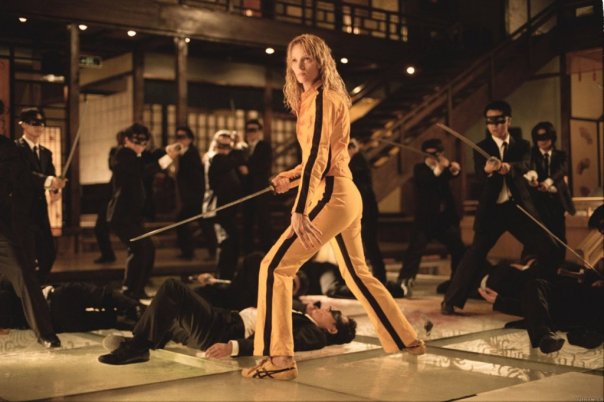
Kill Bill was a turning point in the career of one of the biggest cinematic artists of the past 30 years, and as exciting and stylish as Volume 1 proved, this is the point where Quentin Tarantino vanished within himself and became the ultimate B-movie revivalist. It only took two films for Tarantino to not just become an indie brand name but his own adjective, as Hollywood was flooded with “Tarantino-esque” imitators chasing after the man’s unique voice of snappy pop-culture soliloquies, hard-boiled dialogue, and meta-textual irony. Of course the imitators could never truly capture the full appeal of Tarantino’s movies, overvaluing the surface-level aspects (quirky characters, non-linear plots, unexpected bursts of violence) and missing the greater character depth and thematic intricacies that allow the style to accentuate the entertainment rather than solely serve as that value. 2003 was the crossroads where Tarantino switched from smaller dramas and crime thrillers about semi-recognizable and relatable people (the middle-aged romance in Jackie Brown is the most tender and sincere writing of his career) to remaking and re-packaging his favorite grindhouse exploitation movies. It was like Tarantino himself was following the path of the would-be Tarantino-esque imitators.

Kill Bill began as an idea between actress Uma Thurman and Tarantino on the set of Pulp Fiction; it even feels like a big-screen realization of the failed Fox Force Five pilot that Mia Wallace (Thurman) filmed. Thurman had the idea of the opening, a bloody and beaten woman in a wedding dress being executed only to survive her execution. The idea germinated for years and became two movies worth of material. It’s hard for me to envision Kill Bill as one whole entity because the two volumes feel so thematically distinct. The first is an homage to 1970s kung-fu movies and Eastern cultural influences whereas the second volume serves as an homage to spaghetti Westerns and Western cultural influences. I’m shocked that through the annals of numerous physical media releases at no point has someone released Kill Bill as one whole four-hour movie. It’s only ever been physically screened as such once by Tarantino, and I think the implicit admission is that, while conceived as one sprawling and gargantuan epic, the movies work better as halves that reflect and enrich one another due to that separation. As I wrote in my 2004 review of Volume 2, the first part is the “show” and the second is the “tell,” but what a show Tarantino pulls off.
There was a time where the idea of Tarantino helming an action movie felt antithetical, but he tapped every corner of his encyclopedic knowledge of genre cinema to give us one of the best action movies of all time. The centerpiece sequence pitting The Bride against the Crazy 88s, as well as the ball-and-chain-wielding schoolgirl Gogo, feels like the culmination of a lifetime of cinema geek passion. It’s viscerally exciting without getting boring over the course of twenty-something minutes because Tarantino keeps things shifting, never falling upon redundancies, as if he’s so eager to squeeze in each and every loving homage and reference point. The climax, which again feels so natural an escalation and end point for a “part one,” took eight weeks to film, and the MPAA insisted it be toned down to secure an R-rating (he turned it black and white to obscure the color of the blood, itself another indirect homage to martial arts movies of old when they played on American television). Reportedly over 450 gallons of fake blood was used during the production of both volumes, but this first edition is definitely the more gleefully over-the-top.

The revenge structure is shaped around The Bride (née Beatrix Kiddo) killing the five members of her former gang, the Deadly Viper Squad. Volume 1 only covers two members meeting their just desserts, one of which is the opening scene. That means after the first ten minutes fighting Vernita Green (Vivica A. Fox), we’re working the rest of the movie to the next boss fight. That’s where we get the character dynamics, the obstacles that The Bride must overcome (step one: wiggle your big toe), and the history of O-Ren Ishii (Lucy Lui) and her ascension to Japanese crime lord. With less careful filmmakers, this middle stretch might feel sluggish, but with Tarantino, it’s invigorating as the new world and its many faces connect together to create such an intriguing and engrossing larger picture. Volume 1 provides the structural bones of the story, as well as buckets of sticky viscera, whereas Volume 2 adds the meat and complexity and larger nuance. That doesn’t mean Volume 1 is lacking creativity, it’s just that it’s the half that has to perform more foundational lifting so that those character details and choices will have the larger impact they do. Volume 1 is a long straight line back to O-Ren Ishii, and the accelerating carnage is wonderful to behold.
Thurman has never been better than with her Quentin collabs. After her sudden rise in Pulp Fiction, it felt like her career stalled playing many “hot girl” roles in misfires like The Truth About Cats & Dogs, The Avengers, and of course Batman & Robin. After her Kill Bill revival, her star rose again only to once again falter from more reductive “hot girl” roles in misfires like Paycheck, My Super Ex-Girlfriend, and the movie musical of The Producers. She recently came into the casting orbit of Lars von Trier, a filmmaker who never met a beautiful woman he didn’t want to punish excessively onscreen for society’s ills. Her role in 2014’s Nymphomaniac volume 1 was a memorable high point as a contemptuous woman confronting her husband’s younger lover, the titular nymphomaniac. Perhaps it was the meta-textual comment of Thurman’s cinematic type-casting, the older “hot girl” replaced by the younger, newer beauty. I’m probably just grasping for greater meaning here. Thurman and Tarantino didn’t speak for years after the conclusion of the Kill Bill series, but it wasn’t until 2018 that we found out why. That’s when the public found out about the existence of a video where Thurman was driving a car and crashed. The problem was it should have been a stunt driver but Tarantino insisted and pressured Thurman into doing the stunt, she crashed, was injured, and still suffers to this day. She says she has since forgiven Tarantino even though he and Harvey Weinstein withheld footage of the incident for years.
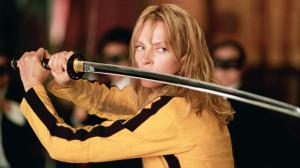
The music has taken on a life of its own. Much was repurposed from old movies and given new context, much like Tarantino’s overall creative mantra. The siren-blaring announcement of two foes facing each other has become its own pop-culture meme. The slow-motion walk to “Battle Without Honor or Humility” has also become pop-culture shorthand. “Twisted Nerve” is a great ringtone, and “Woo Hoo” by the Japanese surf rock girl group The 5,6,7,8s became so inescapably hummable that it eventually became the catchy theme of a wireless company.
This movie also holds a special place for me because the image that immediately comes to mind is watching my father uproariously laughing throughout the movie and rocking in his theater seat. A severed head leading to a geyser of endless blood had my father cackling like a child. By the end of the movie, I recall him turning to me, smiling ear-to-ear, and exclaiming, “Now that was a great movie!” Conversely, I also remember my college roommate falling asleep next to me as The House of Blue Leaves was bathed in (>450) gallons of (black and white) blood.
In the ensuing two decades, Tarantino has directed five other movies, published two books, been nominated for Best Director twice, won his second screenwriting Oscar, and essentially brought the tastes of the Academy to his own. He’s written three Best Supporting Actor winners (Christoph Waltz in 2009 and 2012, Brad Pitt in 2019) and become one of the most commercially reliable names, a director whose very name itself is a selling point for mainstream audiences. Even while some may bemoan that the indie provocateur might be “slumming” with his own highly polished version of B-movies, he’s dragged those same tastes to wide commercial appeal and industry acclaim. Kill Bill Volume 1 is the beginning of Tarantino tattooing ironic air quotes to his output, but when you’re this talented and passionate about movies of all kinds, even a kung-fu homage can become a cultural force and one of the best superhero origins ever (The Bride is pretty much a superhero and compared to Superman in Volume 2). Kill Bill Volume 1 is still a masterfully entertaining and bloody fun experience twenty years later.
Re-View Grade: A
Share this:

The Station Agent (2003) [Review Re-View]
 Originally released December 5, 2003:
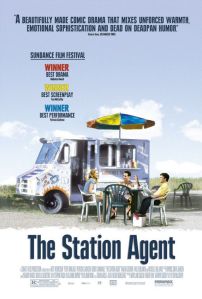
This is the most charming film of 2003, and Im not just saying this because I had an interview with one of its stars, Michelle Williams (Dawson’s Creek). Fnin McBride (Peter Dinklage) is a man with dwarfism. With every step he takes every look he gives, you witness the years of torture hes been through with glares and comments. Hes shut himself away from people and travels to an isolated train station to live. There he meets two other oddballs, a live-wire hot dog vendor (Bobby Cannavale) and a divorced mother (Patricia Clarkson). Together the three find a wonderful companionship and deep friendship. The moments showing the evolution of the relationship between the three are the films highlights. Its a film driven by characters but well-rounded and remarkable characters. Dinklage gives perhaps one of the coolest performances as the unforgettable Fin. Cannavale is hilarious as the loudmouth best friend that wants a human connection. Clarkson is equally impressive as yet another fragile mother (a similar role in the equally good Pieces of April). The writing and acting of The Station Agent are superb. Its an unforgettable slice of Americana brought together by three oddballs and their real friendship. You;ll leave The Station Agent abuzz in good feelings. This is a film you tell your friends about afterwards. There’s likely no shot for a dwarf to be nominated for an Oscar in our prejudiced times but Dinklage is deserving. The Station Agent is everything you could want in an excellent independent movie. It tells a tale that would normally not get told. And this is one beauty of a tale.
Nate’s Grade: A
——————————————————
WRITER REFLECTIONS 20 YEARS LATER
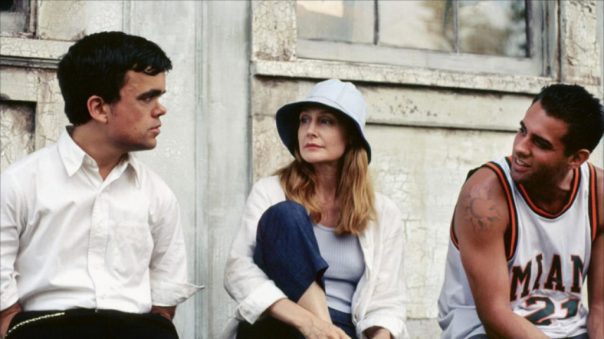
Tom McCarthy didn’t invent the quirky, found family indie but he sure seems to have nearly perfected it, starting with 2003’s The Station Agent. This little gem of a movie is so subdued, so relaxed, and so gentle that it seems to adopt the very personality of its lead character, Fin (Peter Dinklage), a dwarf who just likes trains a lot and wants to live his life in solitude. He’s an unassuming man who keeps to himself as a means of survival, because almost every time he goes into public life Fin is met with stares, snickers, and harassment (the convenience store lady gets his attention to take his unsolicited picture). Very few will get to know this man beyond his superficial physical characteristics, so he retreats within himself, perhaps purposely obsessing over an antiquated hobby as a means of escape to the past. He’s a lonely man and the movie is about him finding his clan, his place in the world, by slowly lowering his defenses. It’s a simple sort of story that is lifted by the strength of its characters and its wonderful ensemble cast.
With such a taciturn main character we need a contrasting character, a much more talkative person with high energy, and this is beautifully embodied by Bobby Cannavale. He plays Joe Oramas, a coffee truck operator who exemplifies joy de vie. He’s charming, garrulous, and relentlessly upbeat, which makes for a magnificent odd couple contrast with Fin, and it allows both characters to gradually change and grow attached to one another’s mutual friendship. Finn allows himself to become more vulnerable and form bonds and Joe starts to see the world from Fin’s point of view, allowing himself to slow down and appreciate the smaller things he might have missed in his excitable and irascible activity. Dinklage’s dry understated performance is a perfect counterpoint to the churning energy emanating from a grinning Cannavale. This is a fine showcase of both actors, who would go on to win six Emmys between them in the years ahead.
The third member of this found family is Olivia, played by Patricia Clarkson, and I actually think the movie might have worked better without her character. She does provide a point of view that our two guys lack; she’s experienced significant grief over a lost child and her life is in shambles as she tries to discover what she wants from her cratering marriage to a young-er John Slattery. Clarkson is also wryly enjoyable and gets some of the best lines in the movie, so she’s not at fault here. I think it’s because I’m confused about how this character is treated, especially compared to the natural opposites-attract dynamic of Fin and Joe’s friendship. Olivia feels like a broken thing that the boys need to try and help get better, but we were already covering this with Finn’s reserve from a lifetime of feeling ostracized. The possible romance between Fin and Olivia is also awkward because there are obvious implications that she sees Fin as a replacement son, even having him sleep in her son’s old bed. At one point, in her anger, she yells at Fin that she’s not his mother, but it feels much more like she’s the one who is looking for a surrogate son, and just because Fin is a dwarf and perhaps of similar heights makes the whole thing feel uncomfortable and ill-advsied. I’m not going to refuse an added Patricia Clarkson in my movie, but upon my re-watch twenty years later, it’s hard not to feel like McCarthy didn’t have as much envisioned for this part.
 McCarthy’s movie acclimates the viewer to the simple charms of its people and the small town, getting to know the various characters and their foibles and hopes, getting used to the rhythms of this life and adjusting much like Fin. There are small victories that are payoffs, like Fin finally getting a library card, or speaking in front of a school class about his affinity for trains. It works so well. McCarthy continued his found family writing with 2007’s The Visitor and 2011’s Win Win, both anchored by the emotional enormity of sad, lonely men learning to open up to companionship. There were some dips in the road but McCarthy worked his found family magic to the biggest stage with 2015’s Best Picture winner, Spotlight, which McCarthy directed and co-wrote. His only follow-up theatrical movie was 2021’s Stillwater, where an oil rig dad (Matt Damon) tries to save his daughter overseas from a very ripped-from-the-headlines scandal (Amanda Knox was very unhappy). There is also a 2020 Disney Plus movie about a kid detective and his imaginary polar bear best friend (that actually sounds adorable). I guess I figured a Best Picture Oscar on your resume, as well as a history of working within the studio system and world of indies, would have given McCarthy more work than directing a handful of episodes for 13 Reasons Why and creating Alaska Daily. I’ll always be looking for the next McCarthy project when I can.
McCarthy’s failures can be just as intriguing as his successes. The Cobbler is just such an astounding idea that it’s hard to imagine anyone thinking it would work out, with Adam Sandler as a magic shoe-maker. However, this same pessimistic mentality probably prevailed when McCarthy was trying to raise money for The Station Agent. His indie successes proved that he could take any jumble of strange characters and turn it into a functional movie. Maybe that hubris, well-earned along with his contributions to the Oscar-nominated Up script, finally caught up with 2014’s The Cobbler. I would pay good money to one day watch that un-aired footage of the original Thrones pilot, the one the producers themselves acknowledged to be deeply troubled. After retooling the show and cast, bringing in Michelle Fairley and Emilia Clarke, McCarthy departed, though is credited for helping to secure Dinklage’s involvement, and it’s impossible to think of the zeitgeist-defining excellence of the HBO series with anyone else playing the iconic role of Tyrion Lannister.
 Re-evaluating The Station Agent twenty years hence, its many charms are still abundant and I appreciated how gentle and relaxed everything felt. When indie movies deal with heavy amounts of quirk and oddities, it can often be heavy-handed and abrasive, never letting the audience forget for a second just how special and strange and different the movie must be (here comes 2024’s look at Napoleon Dynamite). McCarthy’s movie almost feels like a writing exercise where he plucked three very different characters out of a hat and challenged himself to build a grounded movie built upon their unexpected friendships. It’s a movie confident to just let the characters speak for themselves. It’s more a slice-of-life glimpse at people who feel far more real than most Sundance indies built upon oddballs and quirk. I would slightly lower the grade from an A to an A minus simply because of the Olivia character. Clarkson is great but her role feels undeveloped, somewhat redundant, and a little sloppy. Still, the enjoyable performances, the observational detail, and the simple pleasures of a story well told with characters you genuinely care about are what shines through even twenty years later.
Author’s note: In my original review, I cite having interviewed Michelle Williams (yes, surprise, she plays the small-town librarian). While I was my college newspaper’s film critic from January 2002 to May 2004, I did have the opportunity to interview several actors and directors through phone cattle calls with other collegiate journalists. These names include Angelina Jolie (Tomb Raider 2), Billy Bob Thornton (Bad Santa), Kevin Smith (Jersey Girl), and the late Paul Walker (Timeline). However, my school schedule was not accommodating for the Williams interview, so I had my dormitory neighbor and friend Tim Knopp call in and ask my question. It wasn’t me. I’m coming clean after twenty years, folks. I also recall having him quote a line her character says in The Station Agent, saying Fin had “a nice chin,” and being told that she was baffled and blanking on the reference. I’m sorry, eventual multi-Oscar nominee Michelle Williams, for trying to be clever.
Re-View Grade: A-
Share this:

The Rundown (2003) [Review Re-View]
 Originally released September 26, 2003:
In the beginning of the new action comedy The Rundown, Beck (The Rock), a bounty hunter, is entering a club on a job. On his way in Arnold Schwarzenegger passes him by and says, ”Have fun.” Consider it a proverbial torch passing, because while Schwarzenegger is going to be busting the campaign trail, The Rundown establishes The Rock as the fresh and capable marquee name for all future action films. This man is a star.
Beck is offered a chance to square off all debts to mobster Billy Walker by agreeing to journey into the Brazilian jungle. His mission is to retrieve Travis (Seann William Scott), a hyperactive screw-up who happens to be Walker’s son. One Beck travels to the Amazon he runs into Hatcher (Christopher Walken) who claims to own the jungle and whatever contents dwell within. He asserts that Travis has stumbled upon a wealthy artifact in his jungle and therefore refuses Beck to leave with Travis. It’s at this point that the chase is on.
I don’t care what your little sister told you, Vin Diesel is not the next face of action, no, it’s The Rock. Despite only appearing in three movies (and he was only in The Mummy Returns for like three minutes), The Rock displays a razor-sharp sense of comedy. He’s also huge, likeable, and he can even emote well during smaller moments, not that The Rundown will stretch you as an actor. He’s also honed in excessive eyebrow arching.
Walken exists in a plane of brilliant weirdness that we simple human will never be able to co-exist upon. His Hatcher is one mean villain who exploits indigenous workers, wears his pants up to his armpits, and says he put the heart in the darkness. Walken’s hysterical tooth fairy monologue is worth the price of admission alone.
Director Peter Berg (Very Bad Things) adds a delectable cartoonish flavor to the film. His action sequences pop with exaggerated energy and zestful humor, like when Travis and Beck roll down a hill for a near minute. This is everything an action film should be: lively, funny, with keen action sequences that are low on CGI but filled with characters we care about. The Rundown is the best summer film not released during the summer.
The Rundown is an adrenalized punch of fabulous action and hilarious banter. When you’re not laughing and spilling your popcorn you’ll be sitting straight up to catch every lovely eyeful of spectacular action. It’s a terrifically entertaining and fun flick. The Rock has arrived.
Nate’s Grade: A
——————————————————
WRITER REFLECTIONS 20 YEARS LATER

Looking back, The Rundown really was a sea change for action cinema, and it also helps that I called it all the way back in 2003, because even a little 21-year-old me could recognize what seems almost blindingly obvious over two decades of hindsight: The Rock was a born star.
The Arnold Schwarzenegger cameo in the opening scene of the movie feels even more like a passing of the baton, as Arnie was stepping out to join the world of politics and Dwayne “The Rock” Johnson was only beginning to get started building a movie career. “Have fun,” Schwarzenegger says in passing. The wrestling phenom had built a powerful following and had begun making the leap into mainstream features with 2002’s one-two-punch of The Mummy Returns and his spinoff, The Scorpion King (did you know there are five Scorpion King movies and the 2012 edition co-starred fellow wrestler-turned-movie star Dave Bautista? Well now you do!). His appearance in the Mummy sequel was minimal, and marred by some of the worst CGI of the new century, but his solo Scorpion King adventure wasn’t quite the launching pad Johnson’s team had hoped. It wasn’t really until his fortuitous inclusion with the re-surging Fast and Furious franchise in 2010 that Johnson finally hit superstardom. However, the same magnetic appeal that would come to define Johnson as one of the biggest and more consistent movie stars in the world can be seen so evidently in 2003’s The Rundown, an action-comedy vehicle that plays to all the man’s many strengths. He’s got an immediate presence, a trained comedian’s command of timing and inflection, a gift for slapstick and lack of vanity about being goofy, and the man is just an agile and impressive physical specimen who throws himself into the rough and tumble stunt work. In short, Johnson knows how to look cool, knows how to look tough, knows how to look silly, and knows when to change gears. He’s a generational talent. My friend Ben Bailey says Johnson should play Superman because he really is Superman hiding among us pitiably frail mortals.
 The Rundown, formerly known as Helldorardo, is also an excellent launching pad for director Peter Berg, who until this time had only one other movie on his resume as a director, 1998’s relentlessly dark comedy, Very Bad Things (a film I remember “enjoying,” if that could even qualify as the correct word). This was Berg’s coming out party for the realm of bigger studio fare, and while it didn’t launch his career much like his leading man, it led to Berg’s breakout, helming 2004’s Friday Night Lights. From there, Berg has directed blockbusters (Hancock), blockbuster misfires (the unjustly maligned Battleship), and five reportedly different Mark Wahlberg action dramas from 2013-2020, though you’d be forgiven if you inadvertently confused a Spenser Confidential with a Mile 22. Berg’s docu-drama style became entrenched in 2004, though it didn’t always suit every movie equally. That’s why the movies that stand out from this default cinema verite visual style are even more remarkable for me, especially when Berg showed he can do over-the-top flashy fun violence just as good as any other big screen movie maker. His zest for the outlandish makes the movie feel like a living cartoon, but in the best way. The screen is coursing with energy but within a dedicated vision of spectacle, unlike say the mass chaos and indifference to coherency that dominates a Micheal Bay extravaganza.
Chiefly, The Rundown is just such an overwhelmingly fun experience. The actors have an infectious and combustible chemistry, bringing to mind the likes of Midnight Run and Romancing the Stone. The plot holds up well and allows for momentous action and a pleasing revolt against an exploitative villain played with panache by none other than a cranky Christopher Walken. Even while being irreverent and ridiculous, the movie still works as a story and a buddy movie, and the ending feels fulfilling and satisfying on its own terms. As I said in my 2003 review, this is everything an action movie should be. It’s exciting with engaging set pieces and outlandish stunt work but it never loses sight of its characters and their fractious screwball relationship. I love movies where the two lead characters are working against odds and constantly one-upping each other, flipping who has the upper hand. It makes for a far more unpredictable experience and ensures neither character is ever too confidently in control.
 This is an excellent movie to just put on and dash away your cares for two hours. I’ve watched The Rundown probably a dozen times, introduced friends and students to it, and everyone walks away a believer. It’s got style and banter and enjoyable characters and surprises and is just one of those movies that nobody really ever talks about but deserves to be on everyone’s DVD shelf.
Re-View Grade: A
Share this:

Gigli (2003) [Review Re-View]
 Originally released August 1, 2003:
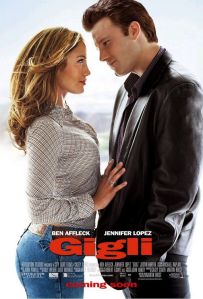
It’s the feel-good movie of the year revolving around a lunkhead mobster (Ben Affleck) and his mentally challenged kipnapee and their attempts to covert a lesbian hitman (Jennifer Lopez) in between her yoga/horrific monologues concerning the superiority of female genitalia. Believe the hype people; Gigli is indeed as bad as they have told you. It’s not even entertainingly bad, like Bulletproof Monk, no folks; Gigli is just mundane and awful. During the entire two-hour stretch, which feels much much longer, I kept saying one thing aloud: “How could anyone making this think they were making a good movie?” Did they think audiences would find it funny that Affleck’s mother (the mother from My Big Fat Greek Wedding) shows us her big fat Greek behind? Did they really think that a mentally challenged kid (who has an affinity for gangster rap and wishes to travel to the mythical “Baywatch”) would come off as endearing? Well instead it comes across as insulting. And what else is insulting is the laugh-out-loud dialogue Lopez is forced to spit out concerning her attraction for women. I can’t think of any actress that could say the line, “I love my pussy” convincingly. And I’m sure a lot of actresses out there have true affection for it. The writing is just atrocious. And so much else fails as well. The score is a perplexing mix of upbeat jazz and inappropriate string orchestra. I don’t understand what emotions they were going for during scenes in Gigli but a full string orchestra playing music better suited for a real drama does not fit. Maybe it was for a tragedy. In that case, then it’s right on the money. You won’t see a more sloppily executed, horribly acted, painfully written, lazily directed, inept film this year. And what the hell did Christopher Walken walking in have anything to do with anything?
Nate’s Grade: F
——————————————————
WRITER REFLECTIONS 20 YEARS LATER

Gigli. It’s a word that instantly trigger shudders and shivers, a code name for fiasco, for career-destroying miscalculations. Writer/director Martin Brest was a Hollywood heavyweight with hit adult comedies like Going in Style, Beverly Hills Cop, Midnight Run, and Scent of a Woman, and since the cataclysmic disaster that was Gigli in 2003, this man hasn’t directed a single thing in these twenty years. The man is still reeling from the wafting stink from this very bad movie. I thought it might be worthwhile to revisit what I dubbed the worst film of 2003, though I was not the only critic to make this distinction, but now I’m questioning why I even bothered. It’s not like this movie was somehow going to get that much better with two decades of safe distance. The amazingly miscalculated artistic decisions will still be the same, still bad. I guess it must have been primarily my own morbid curiosity, much like revisiting 2001’s Freddy Got Figured, about whether this famous flop could still live up to its reputation. Well, dear reader, allow me to put any lingering doubts to rest you may have had about Gigli. It’s still very very very bad.
I might possibly recommend watching this once in your life (depending upon how many years you are lucky to earn) for the sheer fascination; Hollywood so easily makes mediocre and boring and familiar movies that feel like pale imitators of some prior hit, but Gigli is something different in the realm of studio stinkers, a project where just about every single creative decision warranted the incredulous Tim Robinson gif response: “You sure about that? You sure about that?” Gigli feels like two tonally dissonant movies in conflict at every moment. The plot elements feel lifted from some mid-to-late 90s indie crime comedy, the likes where they would just throw together a grab-bag of ironic provocative plot elements you wouldn’t expect together. “Mobster doofus kidnaps mentally challenged kid who is obsessed with gangster rap and wants to visit the ‘Baywatch’ which he thinks is real! Romance with a lesbian! Severed thumb ruses!” The collection of strange parts feels like it’s supposed to be a madcap, wacky comedy, and yet the tonal approach is complete treacle, with a shockingly syrupy score that rises and falls throughout, trying to convince you that what you’re watching is quixotically aiming for Oscars. It is astounding if you stop and pay attention to the film score at any moment, no matter how strange, as it attempts to provide jazzy saunter to “comedy” scenes, like an ex-girlfriend showing up into an unstable situation, and then it segues to Spielbergian emotional heft, like when that same ex-girlfriend attempts to take her own life to convince Jennifer Lopez to come back. There were so many moments where my only response possible was to avert my eyes, shake my head, and wonder whether anyone at any stage had any misgivings, tried to reach out to Brest, but then shrugged and dismissed their very legitimate worries as, “Well, he made Midnight Run after all. What do I know?” You know enough that these different tonal approaches will not work.
 Apparently, the movie was intended to be a straightforward mob comedy but the studio wanted the focus to shift toward a romance because of the actual romance between its stars, Lopez and Ben Affleck. Whenever actors begin a relationship after a movie or over the course of making one together, it provides another lens to review the movie, to gauge their chemistry and, if you’re so lucky and observant, able to “see” them falling in love with one another. That is nowhere to be found with Gigli. Maybe it was the shared experience of finding what they could to cling to while making this movie that nobody fully understood but committed to anyway (I guess love can be described the same way under some circumstances). Regardless, the romance between the two characters is, like all other plot elements, haphazard and spontaneous and foolhardy.
The characters are all awful and they never remotely come across like relatable or even remotely interesting people. Affleck’s Italian lunkhead Larry Gigli is just awash in early 2000s misogyny and bravado, dubbing himself the “sultan of slick, the rule of cool, the straight-first-foremost, pimp-mack, hustler, original gangster’s gangster.” Allow that macho boast to also exemplify another critical problem with the movie in that almost all the dialogue will make you cringe. There’s an entire monologue by Lopez, while she’s contorting her body in a plethora of lithe yoga positions, all about how superior the vagina is in appearance and function. What about when Lopez, as an indication that she wants to engage in heterosexual congress, utters the immortal phrase: “It’s turkey time. Gobble gobble.” Larry slams a kid’s computer on the ground and triumphantly says to suck an appendage of his, but then adds, “dot com” because the kid’s a nerd or something because he likes computers. Ho ho, the kidnapped young man insists that he be read to before going to bed, and what does Larry have at his disposal? Not books, oh no, so he’s forced to read him instructions on shampoo and toilet paper. Hilarious, right? What about when this same mentally challenged kid says, “When my penis sneezes, I say, ‘God bless you.’” The early 2000s weren’t an enlightened time with depiction of mental handicaps, and poor Justin Bartha (National Treasure, The Hangover) goes fully into the worst of these impulses, making the performance feel like a minstrel show for those with mental challenges. At least this aspect is not alone. Nothing ages well in this movie and its comedy only falls flatter and the drama is only more inexplicable twenty years later. It’s a special kind of bad so rarely achieved at this level of Hollywood.
Given that the majority of the movie consists of kidnapping a naïf, most of the movie is set in Gigli’s apartment keeping the man unseen and unheard from. This makes the movie feel for a long stretch like a glorified one-set play, with special appearances from traveling guest actors popping through for a brief moment in the spotlight. Here’s Christopher Walken dispensing with a monologue and then never being seen again. thanks for coming. Here’s Al Pacino, yelling so hard I’m surprised Lopez and Affleck didn’t need to wash the layers of spittle off. Here’s Lanie Kazan (My Big Fat Greek Wedding) who needs an insulin shot in her butt and let’s make sure we see her thong while we’re at it. These incursions of well-known actors re-explain the plot, not that it was hard to keep up with, and it all feels like stretching for time when the movie is already two hours long. The resolution, where our characters drive off into their sunny endings, lasts twenty minutes itself, which feels as long as the endings of 2003’s Return of the King. It’s a screenplay that feels like it’s holding itself on ice, content that the kooky characters butting heads and trading quips and monologues would be enough, and one that feels unsure of those same impulses, relying upon a revolving door of one-scene guests to remind us what we already know. It makes you feel simultaneously trapped with awful characters yet also in the hands of someone who doesn’t quite think you’re understanding the nuance and hilarity of the strained effort.
 I’m not an automatic Affleck hater. I enjoyed his rise from the films of Kevin Smith to Hollywood leading man. I can understand the draw of working with a filmmaker like Brest, and it’s probably that same appeal that lead him to also star in 2003’s Paycheck, directed by John Woo, who like Brest never worked in Hollywood again. This was the period where Affleck’s star was on the decline, and Bennifer was dominating tabloid space, and if it weren’t for the failures we might not have ever gotten Affleck as film director, so maybe we never would have gotten The Town or Argo or Gone Baby Gone had it not been for Gigli, so there’s a silver lining for you.
Look, you already know you shouldn’t even get near Gigli and with good cause. It’s a rarity to see something this colossally bad with this level of artistic freedom to be bad, not simply having too many cooks in the kitchen but having one very wayward chef nobody felt they could interfere with. This was a runaway chef, the kind of fiasco that only comes from unchecked artistic hubris. In that regard, there may be some rubbernecking appeal here for those who can endure bad characters, bad drama, bad comedy, bad acting, and horrible depictions of human beings who never at any point sound like human beings. It’s hard to watch and two hours of your precious time. 2003 began as a rough year for movies, sporting fascinating disasters like Bulletproof Monk and The League of Extraordinary Gentlemen. Watch those movies if you’re looking for a good-bad time. With Gigli, it’s only going to be a bad-bad time, whether it’s 2003, 2023, or any year until the sun explodes. Hey, if Ben Affleck and Jennifer Lopez could put this movie behind them and reunite, and even get officially married in 2022, then we can put it behind us as well.
Re-View Grade: F
Share this:

The League of Extraordinary Gentlemen (2003) [Review Re-View]
 Originally released July 11, 2003:
This movie is certifiably insane. While a very literary X-Men seems like a great idea, what exactly does Tom Sawyer bring to the table? What, is he going to convince the bad guys to white wash a fence? And yet, this highly operatic bombast almost succeeds on its sheer level of lunacy, like when you realize you’re watching Sawyer get a crush on a vampire on a giant underwater submarine that’s so big it has end tables and vases in its hallways. Still, the handling of Jekyll/Hyde here is what Hulk should have been like. League of Extraordinary Gentlemen almost works, but its falls apart amidst shabby special effects, outlandish plotting, and very wooden dialogue. The director doesn’t make it any easier to follow, trumping his action sequences with rapid fire edits. Ah well, my bafflement was more entertaining.
Nate’s Grade: C
——————————————————
WRITER REFLECTIONS 20 YEARS LATER

The League of Extraordinary Gentlemen is a fascinating film in that it cannot be good but it also cannot be bad; it exists upon an extraordinary plane where few movies ever transpire, not so-bad-it’s-good but an altogether different realm, where it would be impossible to be good while also impossible for it to be bad. It’s a bizarre yet fascinating contraption of a movie, a literary X-Men that plays to the lowest common denominator, making awe-inspiring mistakes as it careens to a bombast that approaches self-parody but lacks self-awareness to properly execute. I do not regret watching this again in 2023 but I cannot in good conscience recommend that you, dear reader, watch it, and yet I still want every one of you to.
It began as an adaptation of Alan Moore and Kevin O’Neill’s graphic novel which was itself a combination of high art (classic literature) and popular culture (super hero team-up), and from there that high-art mashup got even more… mashy… as it made its way through the Hollywood studio system to become a big, dumb summer blockbuster. You can see the appeal to the studio bigwigs, forming their own superhero team but from recognizable literary characters, and it’s fun to see these classic characters interact as well as slotted into superhero archetypes, though I’m sure there are a few academics that consider this a debasing of canonical literary figures. Jekyll and Hyde (Jason Felmyng) makes obvious sense as the Hulk of the group. Captain Nemo (Naseeruddin Shah) works as the tech-savvy Tony Stark. The immortal Dorian Gray (Stuart Townsend) is practically the group’s erudite Wolverine. I guess Mina Harker (Petra Wilson) would be this group’s Blade. There is a certain intellectual thrill watching classic characters in a new setting that relies upon them to work together and utilize their own special powers, highlighting that we’ve had superheroes long before the halcyon of the twentieth century.

Almost every artistic decision feels designed to fully baffle you if you think about it long enough, and while shattering any sense of reality, I can almost begrudgingly respect this creative license to simply go all out with the absurdity. This high/low combination makes every scene utterly ridiculous while also being fascinating. Nemo’s fantastical Nautilus sub is designed like a giant straight razor, yet the bustling interiors are so stately, including lengthy hallways with end tables and vases, a decorative motif that makes absolutely no sense on a submersible. There is a literal scene where Allen Quartermain (Sean Connery) teaches Tom Sawyer (Shane West in a terrible haircut) how to shoot better when the guy already shoots plenty good and Tom, completely oblivious, asks, “Did you teach your son to shoot like this?” But why would Tom ask that, in this moment, unless to touch upon the fact that Quartermain’s son is dead, a fact that we the audience already know? There are hidden bombs placed that will be triggered by a hidden frequency when played on a record, and somehow every corner of this floating city of a sub will hear this one record player in one room? Why even record a triggering device and have it linked to the villains explaining their plan? Why would you need to steal Da Vinci’s architectural plans for Venice when, I’m going out on a limb here, there are more accessible and modern city infrastructure plans in 1899 Venice?
So much of the character dynamics and characterization are condensed to their formula necessity. Our reluctant lead gets a surrogate son to try and mentor. Quartermain hates the British government because he blames them for his son’s death, but it’s not like he’s abandoned the luxuries of colonialism while retiring in Kenya. The invisible man (Tony Curran) gets an opportunity to prove that a criminal can reform and be counted upon. Jekyll and Hyde learn to work together rather than fighting for dominance. Mina Harker is a powerful vampire and yet her role is to be a possible love interest to the young kid on the team and to seek vengeance on her other lover, placing her entire character arcs as past romantic partner and future partner. Look at the poster art and you’ll see they had to make extra allowance to squeeze in her vampire cleavage, her real feature as far as the movie is concerned. You have a vampire on your team and the movie simply treats her as a walking set of boobs. I suppose Tom Sawyer is meant to serve as our entry point into this world as the rookie, but every character on the team is a rookie, so having an even bigger novice seems superfluous as they’re bringing the League back together, except it’s revealed later there was NEVER any League of the past, which means the bad guy literally commissioned oil paintings of past member combinations that never existed just to sell a false history that never amounted to anything (again, pick at any detail and the entire reality unravels). Even the villain’s plot is needlessly convoluted and also astonishingly simplistic: create conflict, sell arms, get money. The secondary scheme could have been accomplished by just asking each of the League members to sit for a blood test. You didn’t need to destroy Venice for this.

The colossal miscalculations extend beyond the screenplay. This movie essentially ended the career of Connery and its director, Stephen Norrington (Blade). The story goes that Connery was offered the part of Morpheus but turned it down because he didn’t understand The Matrix, and he was offered the role of Gandalf but turned it down because he didn’t understand The Lord of the Rings, and after both became cultural phenoms, Connery was determined not to let his own questions stand in the way of what could be the next sci-fi/fantasy blockbuster. Those notable “no”s lead him to regrettably saying “yes” to this silly movie, and then he was done. In the seventeen years before his death in 2020, Connery only gave a handful of vocal performances, the last one for 2012’s Sir Billie, the first CGI-animated feature from Scotland, and oh is it bad. Norrington and Connery didn’t get along during the production and at one point the director tried to goad Connery into punching him in the face. Norrington refused to make another studio movie and has gone back to his makeup and special effects background for film productions, including providing creature effects for Feast and Exorcist: The Beginning. The fact that Connery’s character dies but they end on his possible resurrection, for a possible sequel never to come, is especially hilarious knowing Connery and Norrington elected to quit their jobs after this.
At some point, you just give into the movie and try and ride its absurdist wavelength. The climax involves an assault on a giant munitions compound making… metal-cased men? Like armor? Don’t we already have that? The movie’s rules posit that the invisible man is only truly invisible when he’s fully naked, and the movie makes sure you understand this at several points, so having a climactic battle in a frigid mountain compound just makes you worry that he’s going to be blue and invisible. I love that Dorian Gray’s weakness, his infamous supernatural doppelganger painting, isn’t like locked in some impenetrable fortress but just something he carries with him, like Superman keeping kryptonite in his travel bag. I also groaned when, while fighting Mina, he stakes her to his bed and blithely says, “I always wanted to nail you one more time.” Again, simply amazing and flabbergasting. Why do we have one member of the team that shoots good when we already have another member of the team who already shoots good? I would have laughed out loud had the filmmakers actually resorted to Tom Sawyer tricking the minions of evil to white wash a fence instead of threatening the new world order. There are no standout action sequences, the special effects can be rather dodgy for its budget, and the editing is jumbled to likely mask the absence of good action choreography, but what this movie has, in rich abundance, is lunacy, a plethora of ridiculous plot elements to digest.

In 2003, I didn’t have many words to say about The League of Extraordinary Gentlemen but all of them are correct and still accurate twenty years later. This is a movie that almost works on its own level of schlocky absurdity, and yet it could never work with this approach, but it’s littered with bizarre, miscalculated ideas and plot elements that make it all the more fascinating, like a car crash of a painting. They don’t really make movies quite often on the scale of disaster that is League of Extraordinary Gentlemen, and we all benefit by examining how something like this slipped through, to remind us all of the folly of man and the strive to do better. Somebody dissect this like a case study for our benefit as a species.
Re-View Grade: C-
Share this:

Hulk (2003) [Review Re-View]
 Originally released June 20, 2003:
Comic book movies are all the rage these days. The X-Men films, Spider-Man, even Daredevil all managed some level of success because they were, at their heart, entertaining pulp and treated the source material with some sense of reverence. Now Ang Lee’’s monstrous film Hulk lumbers into theaters and one could best describe it as being too serious for its own good.
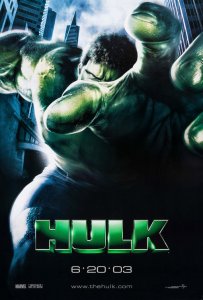
Bruce Banner (Eric Bana) is the quiet guy, the one who bottles everything inside. His lab partner Betty Ross (Jennifer Connelly) has recently broken off their relationship due to his emotionally shut-off demeanor. Well Bruce gets hit with a lethal dose of gamma rays and it kicks up something inside him. You see, Bruce’s long-absent father (Nick Nolte, looking frightfully like his drunken mug shot photo) experimented some kind of regeneration serum on himself. When he fathered Bruce he passed on whatever genetic alteration. So now when Bruce gets mad he turns into a 15-foot raging Jolly Green Giant (the CGI in this movie is not good). He starts enjoying the freedom letting go can bring. Nothing gets him more mad than some yuppie (Josh Lucas, badly miscast) trying to buy out his lab and then kill him to sell his DNA to the military. Along the way, Betty’’s father (Sam Elliott) tries to hunt Bruce and his greener-on-the-other-side alter ego for the good of us all.
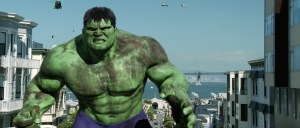 Director Ang Lee has injected most of his films with a sense of depression and repression, from the biting and darkly astute The Ice Storm to the stoic Gary Cooper-like silence of the aerobatic samurai in Crouching Tiger, Hidden Dragon. He’’s a master filmmaker without question. Lee bites off more than he can chew with Hulk much like the gifted Cameron Crowe did with the sci-fi Vanilla Sky. Lee is so damn ambitious that Hulk tries to be everything and it ends up fulfilling nothing. His film is the most ambitious and the most tedious super hero/comic book movie of all time. What does it say when the super green Hulk has more personality than the bland Bruce Banner?
The acting is a non-issue here. Connelly remains one of the most beautiful women in all of movies and has incredibly expressive eyes and brows. She has this strand of hair that’s always in the right side of her face. It’’s so awkward. Bana gets the least fun part as the mentally scarred kid afraid of his own anger. He doesn’’t do much but then he isn’’t given much. Elliott overacts with impressive gusto whereas Nolte overacts like every line was his last breath.
After about an hour or so of beleaguered talking and flat characters, I started to become restless. I wanted to see Hulk smash, Hulk smash good. Instead what you get is endless scenes of cheesy speeches, sci-fi babble speech, phony philosophy, and mind-numbingly awful pacing. Seriously, Hulk has worse pacing than glaciers. You’’ll see the Mona Lisa yellow faster than this movie will be over. And in some weird paradox, I think it’ will never be over.
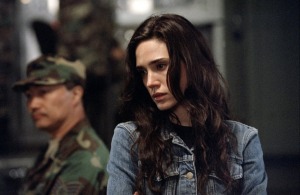 Lee attempts to make the film a living comic book. You’’ve never seen this many wipes short of a Brady Bunch marathon on TV Land. Lee splits his screen into multiple panels and slides them around much like the layout of a comic book. However, this visual cue is overused and calls attention to itself in a “how-arty-are-we” kind of pretentious way. If Hulk was attempting to be a comic book movie, then where the hell did all the action go? This movie could have been subtitled The Hulk Goes to Therapy because everything excluding an over-the-top final act revolves around people working out childhood issues. Man, there’’s nothing I like to see more during the summer than a $150 million-dollar movie about – people working out childhood issues.
Hulk is an overlong and meandering film that’s incredibly serious, incredibly labored, and incredibly boring. Someone needs to tell the creators of this film to lighten up. The big-screen adaptation of the big green id may have heavy doses of Freudian psychoanalysis (try and tie THAT with the merchandising onslaught) but the film is barren when it comes to fun. Even comic book fans should be disappointed. I heard a story of a kid who saw Hulk and asked his mom when the movie was going to start, and she replied, “90 minutes ago.” Should you see Hulk in the theater at full price? No. Instead, give your money to me. It will have more resonance.
Hulk mad? Audience mad! Audience leave theater. See other better movies instead. Hulk sad. No Hulk 2. Audience happy.
Nate’s Grade: D+
——————————————————
WRITER REFLECTIONS 20 YEARS LATER

Ang Lee’s Hulk is a unique experience that no other comic book movie has delivered in the ensuing twenty years. It’s clearly trying to do something heady, something more Freudian and psychological and cerebral, and yet it’s also doing so in a clumsy, wipe-heavy, panel-sliding bonanza of split screens and goofy transition shots. This movie would be fascinating to dissect if it wasn’t also so crushingly and unrepentantly boring. Even having seen the movie in 2003, I was still shocked how bored I was re-watching all 138 minutes in 2023. It’s such a strange experience to watch a movie that, at any moment, can be so weird and different, and then in the next minute make you contemplate doing your taxes again.
I think what Lee and his screenwriting partner James Schamus, who has written nine Lee movies going back to their very first, 1991’s Pushing Hands, were most intrigued by the Jekyll/Hyde allegory. Hulk is not alone in this regard in the realm of super hero dramatics; many characters lean into their alter ego as a form of personal wish-fulfillment, processing trauma, and/or freedom not allowed under their normal persona. The added complication with the Hulk is the monster factor, that when the man, Bruce Banner (Eric Bana), loses his temper and he unleashes his “big green id,” the ferocity he was holding back. The man/monster dynamic is what clearly interested Lee and Schamus, so we get plenty of dweeby Banner being bossed around and then confessing that, after his transformation, he likes it when he lets go and just succumbs to his more “smash everything” urges. However, this story angle is just crushed by the overwhelming weight of the overwrought psychoanalysis of Banner’s daddy issues and repression. The problem with this heavy-handed approach is that the answers are obvious and yet also confounding at every turn. Bruce’s father David (Nick Nolte) experimented on his own DNA, which he passed onto baby Bruce. The implications are used more as a handy explanation for why Bruce didn’t die from his fateful gamma radiation accident than as a cautionary tale of human experimentation. The repeated flashback reveals are drawn out far too long with the most obvious conclusions (Baby Bruce watched his father kill his mother and now he’s… upset). Every time his old family bedroom door showed up again, I would slump in my seat, losing more willpower. Likewise, it feels like Nolte is just crashing into the plot like an unwelcome sitcom guest, on a different acting plane and hamming it up as part-hobo and part-very transparent mad scientist. The man creates Hulk dogs from poodles and sets them on his son’s girlfriend. He bites a thick electrical cable like he’s in Who Framed Roger Rabbit?. It’s silly and not worthy of portentous psychoanalysis with a figure this one-dimensional. David is such a boring and obvious bad dad figure with traits of megalomania and score-settling, so Bruce’s daddy issues are an extended story obstacle I was eager to already have gotten over.
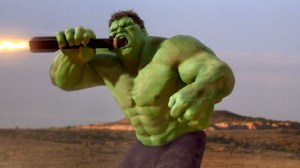 Then there’s Lee’s artistic decision to film the movie like a living comic book, with the screen transforming into the panels and splash page art of sequential media. The problem with this is that movies are already sequential media, they’re already one image leading to the next to create a specific artistic impression. Lee’s editing and visual artifice lets you know at every turn that You Are Watching a Comic Book Movie. It broke my immersion every time, and even worse it detracted from the drama of the moment. A poorly timed split-screen or image swap can create its own form of derisive attention. I challenge anyone to watch the demise of Josh Lucas’ smarmy corporate bully and celebrate the freeze frame that then gets engulfed with flames and speed wipes to the next scene. It’s reminiscent of 2008’s Speed Racer, a movie I also just recently re-watched for a new evaluation since it’s taken on a bit of cult status, where the screen is overburdened with oppressive visual gimmicks, many transitional, to make it feel like a living anime. The problem is that live-action is its own reality, and trying to duplicate one from the pages of comics or the screen of high-energy anime brings its own tonal risks. Some times an artist can perfectly meld the different worlds, like 2010’s Scott Pilgrim Versus the World or 2018’s Into the Spider-Verse, and then other times, most often, you get stuff like Speed Racer and Hulk, movies that are trying so hard and annoying you with their try-hard visual whimsy. It’s not pretension as I dubbed it in 2003, it’s more grasping desperation to ape the source material, and it gets oh so tiresome. You might as well turn it into a drinking game whenever there’s a snap zoom or a strange transition wipe that makes you roll your eyes or release a deep, lung-clearing sigh.
The special effects weren’t quite there at the time to better realize the big green guy, though they were close. Most of the brief Hulk appearances are during darkness, to better camouflage the special effects (naturally Lee would say it’s to build up anticipation, but I think we know why). The big action doesn’t kick in until 90 minutes, and it’s a long slog to get to that point, almost like Lee and Schamus were wanting to stoke audience rage, grumbling and demanding something get smashed after the protracted buildup to perhaps better identify with the hero. This is a movie with a Hulk poodle and Nick Nolte turning into an electrical monster (his infamous 2002 mugshot was mere weeks after filming finished). The abilities of the Hulk also feel inconsistent, and I’m not just talking about the elasticity of his pants never breaking. He can jump miles into the air from simply standing? The darker human impulses that gave birth to the Hulk are so emphasized that the green guy feels less like an alter ego or other half of Banner and more like a fleeting dream, a mirage of a character that is merely this boring man getting to feel like a big man. Even the dichotomy feels so overwrought and limited in exploration, settling on psycho babble patter. As I said in my incensed 2003 review, “This movie could have been subtitled The Hulk Goes to Therapy because everything excluding an over-the-top final act revolves around people working out childhood issues. Man, there’’s nothing I like to see more during the summer than a $150 million-dollar movie about – people working out childhood issues.”
 This is an interesting misstep for Lee, who has since gone to win two Oscars for Best Director in 2005 and 2012. He was hopping from genre to genre with wild abandon. He went from a dark suburban drama to a Civil War drama to a martial arts fantasy to Hulk to an award-winning tragic gay romance to a historical thriller set in occupied China that earned an NC-17 rating to a comedy about putting together the famous Woodstock concert to a mystical fantasy drama about a man abandoned at sea with a wild tiger. Perhaps only Steven Soderbergh could cite a comparatively varied resume. Lee’s last two movies feel more like failed exercises in the technology of high-frame rates than complete or engaging movies. He hasn’t directed a film since 2019’s Gemini Man, though he has a movie dramatizing the Thrilla in Manilla in the works (NOT written by Schamus, at least as of this writing). The man’s artistic need to experiment with form and special effects is evident with the entire visual approach to Hulk.
You’ll likely never see another Hulk solo movie again, and that’s because Universal still owns the rights to the character, at least for solo adventures. So if Marvel were to give their version of Banner (Mark Ruffalo) his own movie, they’d have to split the profits with Universal, and even though the Marvel Cinematic Universe (MCU) has become the gargantuan money-making machine it is today, they don’t want to share the wealth. You’ll just have to enjoy Ruffalo’s appearances in Marvel movies and the occasional TV series, like last year’s She Hulk. It’s probably for the best considering that the character seems to work best as part of an ensemble rather than a lead, as also evidenced by the 2008 big screen Incredible Hulk with Edward Norton. The only lasting factor from that movie that carried over into the ongoing MCU was William Hurt as General Ross, and since Hurt passed away in 2022, he has been recast as Harrison Ford, so now there is no connective tissue at all between the last big screen Hulk movie and the Marvel movies.
My original review in 2003 was full of incredulous snark, much of which I can still feel to this day. I’m less angry by this movie, as it takes something really offensive to get under my skin as a moviegoer these days, unless you’re Dinesh D’Souza, but I’m just as baffled, not that the filmmakers wanted to try something more cerebral and psychological but that their idea of that was so murky and underwritten. It’s not a smart movie, and the visual razzle dazzle is distracting, goofy, and tonally incongruent with the overwrought attempts at drama, in between killer poodles that is. This is a curious movie, a rare example of talented artists really just fumbling at a high level of studio money. I felt bad for Jennifer Connelly who seems to have been given one acting note: look wide-eyed and stunned. As a superhero movie, and as a summer blockbuster, Hulk will disappoint. As an experimental big-budget Freudian analysis of the duality of superheroes, Hulk will also disappoint. This is such a strange and boring movie, but it’s not worth your time in 2003 or 2023 or any other year. The grade remains the same twenty years later, sad to say.
Re-View Grade: D+
Share this:

The Matrix Reloaded (2003) [Review Re-View]
 Originally released May 15, 2003:
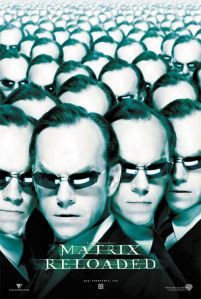
Imagine my disappointment as I viewed the highly anticipated sequel to 1999’s sci-fi smash The Matrix and learned that the writing and directing team of the Wachowski brothers had taken a page from good ole’ George Lucas on how to make sequels: the “bigger is better and more is more” approach. Like the first two Star Wars prequels, the second Matrix movie is overstuffed and unfocused. Unlike the Star Wars prequels, it’’s also extremely talky when it comes to psychobabble that would only impress the bong-carrying peanut gallery.
Reloaded picks up some time after the first. Morpheus (Lawrence Fishburne), Neo (Keanu Reeves), and Trinity (Carrie-Anne Moss) are late for a pow-wow with other leaders including Morpheus’ former flame, Niobe (Jada Pinkett Smith). In this meeting, which is within the Matrix, we learn that the humans have discovered that the machines are drilling at an incredible speed and will reach Zion, the last human city far beneath the Earth, in a matter of days. Add this to the bad dreams Neo keeps having where Trinity falls out of a building and gets shot by an Agent, and things are not looking good for our heroes from the first film.
At Zion, Morpheus stokes up the crowd who already believe that Neo is The One in the prophecy of the Oracle (Gloria Foster). They believe he is the one who will lead them to topple the machines. Morpheus informs the many citizens of Zion (okay, the last battalion of the human race lives in caves under the surface and people are STILL wearing sunglasses all the time? Watch your heads.) that the machines are digging to a town near you, and they have 250,000 Sentinels to wipe out what remains of humanity.
 So what do people do next; what would your standard response be? Apparently, in Zion, it involves a massive spontaneous, sex-charged rave. The multitudes of Zion start grinding and sweatily dancing to electronic beats. And curiously, as you’ll notice with the slow camera movement in the scene, NO ONE in the future wears a bra. Perhaps the machines got those too. So after a tremendously long span of raving with nipples, inter cut with Neo and Trinity knockin’’ boots (though could you imagine zero-gravity sex in the Matrix?), the heroes set off to find the Oracle once more. Zion is preparing to mount a counterstrike against the burrowing machines and is hopeful that it will buy them some time. They plan on sending the entire fleet out, save Morpheus’ ship and one or two to aid him in his quest.
Neo finally regroups with the Oracle along a park bench inside the Matrix. She puts forth more psychological babble about choice and how choices are already made before you make them. You may start zoning out and wondering when people are gonna’ start punching people again, because it takes a good 45-50 minutes to get into this movie. The Oracle does have an interesting tidbit of information however. She reveals that the Matrix if just chock full of rogue programs living out their days in the confines of this virtual reality. Included in this group are werewolves, vampires, ghosts, angels which are all programming errors that walk among the Matrix. So, wouldn’’t it be kind of neat to see Neo fight the monsters from Universal Studios (“Hey Frankenstein monster … I know kung-fu” “Fire baaaaaaaaaad!”)?
The supreme drawback of Reloaded is that it introduces us to a plethora of new characters, all with minimal screen time and even more minimal plot impact, and then fails to advance the story. Niobe is pointless except for the old action picture adage of being at the right place at the right time to rescue our seemingly doomed heroes. A rogue program that calls himself The Merovingian (Lambert Wilson), who decides on being a European playboy with an accent that renders all speech useless, snoots and huffs his way around. Monica Bellucci plays his wife. This Italian actress can be enthralling, and not just on the eyes, but she also serves minimal purpose other than some heaving chest shots. Then there’’s the Keymaker, who will somehow lead Neo to his destiny or whatever. There’’s about fifteen or so new characters and hardly any of them matter. The coolest additions are the twins, a pair of pasty dreadlocked fighters who can go through walls and parry any enemy assault. More time is needed for these two before they turn into another wasted villain, like Star Wars‘ Darth Maul.
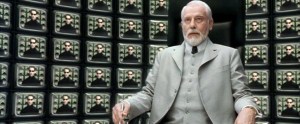 All of this criticism is moot, of course, because the center of The Matrix is on inventive and pulse-pounding action, right? Well I’’d say that is so with the 1999 film but its sequel suffers when its action sequences drone on and become repetitious and dull. Neo fighting twenty or so replicates of Agent Smith (Hugo Weaving) is interesting and fun, but when ninety more show up and it’s painfully and slightly embarrassing when the people fighting are CGI, then the fun level drops with the film. Neo ends the big brawl by flying away. My friend next to me whispered in my ear once this scene concluded, “If he could fly, why didn’’t he fly away at the beginning?” My response: “That would be using your brain.” Seriously, this action sequence is nifty and all but it serves no purpose, just like much of the first half of the film.
The freeway chase scene seems to already be famous and with due cause. Trinity and Morpheus zooming through traffic, fighting Agents and the twins, is a fantastic set piece that is reminiscent of the inventive action the first Matrix gave us. When Trinity zooms through oncoming traffic on her motorcycle the film comes alive and my attention was certainly front and center. The scene does fizzle a bit as it segues into Morpheus fighting an Agent atop a speeding semi. Again, the CGI rotoscoping of the landscape and the people is painfully obvious and detracts from the enjoyment.
What ultimately kills The Matrix sequel is that no one had the heart to question if maybe more wasn’’t better. Sure the Wachowski brothers had all the riches unto Caesar to make this movie, but what perplexes me is that once we do get much more it only feels like more of the same, and disappointment sets in. Agent Smith is shoved to the side of the film and pops up here and there to glare. He’s more or less just repackaged with nothing new and no personality, like much of the film. The purposely perplexing psycho-babble does not help. I’’m sure hundreds of websites will dissect the exact philosophical links the movie presents, but man, all this talking about stuff that’s shutting down my brain is getting in the way of ass-kicking. I felt bloodlust the more I heard people, usually some old bat, endlessly blab about causality and choice. When it comes to action-packed sequels from 2003, I’ll take X2 any day over Reloaded.
 This is not to say that Reloaded is a bad film because it does have some nice special effects, cinematography, and some cool action sequences. These points of interest do not, however, justify its bloated running time. Some things were better left to the imagination, like the city of Zion, which looks about as dreary and dull as you might expect the last bastion of human civilization to look like in a ruined world, but this is science-fiction. Where’s the fun in dreary and dull? Again, whereas the first Matrix took place mainly in the false virtual reality where we could watch fantastic feats defying the laws of physics, Reloaded spends half its time running around the dank real world.
Some moments did have me giggling, like the Merovingian’s joyous creation — an orgasm cake. A woman has a piece of cake and her temperature rises. Finally the camera literally zooms into her vagina (it’s in computer-code so it’s all columns of spicy green numbers) and we see an explosion of light. Very interesting indeed. Essentially, this is a key metaphor for the film itself: an attempt to have its cake and eat it too.
The Matrix: Reloaded is an occasionally entertaining and often mind-numbingly talky summer entry. You’ll get some thrills, maybe the philosophy will connect more for some (even though to me, at the heart, they say very little very eloquently), but because The Matrix is a colossal franchise that will make a gazillion dollars and then some, the power of editing has been kicked to the curb. If that power had been present perhaps someone could have trimmed a few of the many peripheral characters, kicked the pace up a few notches, reworked the fight scenes to advance the plot and stopped events from being so repetitive, and while they were at it maybe they could have done away with all the philosophy and stilted love dialogue. As it stands, The Matrix sequel has lost a lot of edge and this is because of the initial success of the first film. Sure, you might have an intermittently good time, but you should have had a great time. The Wachowski brothers had every tool at their fingertips but they became so enamored with fame and fortune that their work of creativity and genius has morphed into a self-indulgent, adolescent (with its hormone-driven sexual events and its stoner philosophy) cash cow.
Nate’s Grade: C+
——————————————————
WRITER REFLECTIONS 20 YEARS LATER

It’s taken me close to twenty years but I’ve come around on the notorious 2003 Matrix sequels. Before the release of The Matrix Resurrections in 2021, I sat and re-watched the two prior sequels, both of which I was dismissive and disappointed with when they were originally released, as it seemed was the general public. I had an ongoing joke about lambasting The Matrix sequels whenever I could in other film reviews, and my takeaway was that the Wachowskis had turned their masterpiece of a single film into a mediocre franchise. There are still criticisms to be had with Reloaded, released in May of 2003, and Revolutions, concluded in November of 2003, but I feel confident to say that the much-maligned sequels have gotten an unfair rep. Yes, part of this reappraisal was a result of just how staggeringly stilted and self-loathing the 2021 sequel/reboot was, so I guess we can just shift the sequel ire to the newest member of the club. I only selected one Matrix movie for my twenty-year re-watch and I chose the more controversial of the pair, the talkier and more esoteric one, and I’m here to say that The Matrix Reloaded, while not soaring to the same sci-fi heights as the first, is actually a worthy sequel that is ultimately sabotaged by unrealistic audience expectations as well as a pedestrian concluding movie.
 The charge against Reloaded, and one that I was making with the rest of the keyboard mob, was that it was pretentious and filled with too much bloated speechifying and not enough fun action. This is untrue on both counts. Much of the charges of pretension related to two specific characters within the virtual reality Matrix, the Merovingian (Lambert Wislon) and the man behind the curtain, The Architect (Helmut Bakaitis), and both of the characters are meant to be pompous. The Merovingian enjoys the sound of his own voice, though the language he most prefers is swearing in French (“Like wiping your ass with satin”). He’s the virtual equivalent of a self-satisfied mobster, experimenting and collecting old code that was meant to be eliminated over time, such as literal werewolves and specters. He’s full of himself because of his position and definitely condescends as a means of appearing even more the elite information broker. He cites choice as an illusion because he’s the collector and creator of code, controlling his reality. He’s annoying on purpose, so his verbal excursions are only meant to land in a broad sense. Choice versus fate will be the biggest and most obvious theme of Reloaded, so the Wachowskis don’t care about one more character nattering on a philosophical tangent of his own flattery.
The Architect was such a letdown for me in 2003 but I now appreciate the choice more for its subversive slap. You’re expecting our hero Neo (Keanu Reeves) to confront the machine version of himself, and instead it’s this fussy old man and his above-average vocabulary is part of his disdain and boredom. The revelation that Neo is not the Chosen One but the sixth Chosen One in an ongoing cycle of destruction and renovation is a startling revelation. It’s the necessary step to push Neo out of his boring overpowered Superman role. Now he has a real choice, to follow the script in order to save the masses, or to risk everything for the human equation of love. If everything in the two movies was following a predestined path, this is when the franchise and Neo chart their own path, choosing to be reckless in the face of redundant and never-ending conflict. The knowledge that what happens next will be a significant change is a far better ending than simply watching a CGI Neo pummel more CGI Agents. It’s the ending audiences weren’t prepared for but it redefined the conflict between the machines, the nature of Neo, and the relationship between Neo and Trinity (Carrie Anne-Moss). It was more interesting by rejecting the same old. It deepens the conflict and the personal sacrifices, and it set up the humans versus machines war to have even more meaning, a promise that Revolutions could not fulfill satisfactorily. There wasn’t even anything as weird as the slow-mo cave rave or the orgasm cake.
 As far as action, there are some clunky fight sequences that feel perfunctory, like the Wachowskis are closely monitoring the 140 minutes and making sure they have some fisticuffs at precise moments to sate their mass audience. However, the massive highway sequence is legitimately one of the greatest action set pieces of the twenty-first century. The movie takes a while to get going but once it hits the Merovingian part everything that follows is good-to-great. The fight with the Merovingian’s henchmen eschews guns for bludgeoning tools and allows a more interesting array of fight choreography. Then we’re introduced to the ghostly twins who can phase in and out of physical being, which adds a fun new complication to fight choreography. Then we’re onto the highway, the place that Morpheus (Lauerence Fishburne) always warned others to avoid at dire cost. We see why because it becomes a bumper-car collision course with Agents jumping in and out of drivers and creating even more havoc (Ford donated over 300 cars to the production and by the end each one was totaled). This entire sequence is exhilarating, morphing from new complication to another, and the Wachowskis make it clear at every point what is essential, what the geography is, and how the organic challenges emerge. It’s a big, splashy sequence and it’s no coincidence that Neo isn’t involved until the very end, serving as a convenient deus ex machina to snatch our characters from imminent danger. The problem with Neo is that he’s too powerful that it removes stakes. He can stop bullets, take on a hundred Mr. Smiths (Hugo Weaving, the devious highlight of the 2003 sequels), and even restart human hearts. Watching Neo flex his muscles in various fights is fine (though the CGI people drain the momentum of many of these brawls) but it’s far more exciting to watch “normal characters” against daunting challenges. Even the final mission involves an alignment of many people working together so it creates some sense of risk. The action might not be as innovative as it was in 1999 but it still packs its own explosive entertainment with a clear vision and sense of style.
I think my own previous sour feelings were a result of The Matrix Revolutions flubbing the hand-off, dropping many of the more interesting additions from Reloaded and spending far too much time in the dingy underground real world. It’s confusing to introduce a reality-defying world of the Matrix where characters can act like superheroes, and then the movie spends more of its time on people in mech suits firing endless bullets at a shapeless cloud of robot tentacles. The clever redefining of Neo as but one of many Chosen Ones is downplayed when it turns out he might be the most Chosen One-d of chosen ones, having mystical powers inexplicably outside the world of the Matrix. And the romance between Trinity and Neo was yet another aspect that felt swept up in an overly familiar messianic mission, which might be why Lana Wachowski chose to re-emphasize this relationship as a romance for the ages in Resurrections. It’s not Reloaded’s fault that the next two Matrix sequels failed to live up to its promising ideas, new characters, and dynamic action. I think the jilted reaction to Reloaded lowered the expectation bar for Revolutions, which might be why I, at the time, preferred the third movie to the talkier and more esoteric second entry.
 Re-reading my original 2003 review, I was clearly charged with my disappointment. There is a healthy level of snark throughout the review, as per a 21-year-old smart aleck. There’s more than a couple iffy references to stoner philosophy. I still agree with several of my old criticisms, such as spending far too much time in the “dank real world,” but I believe my hostility was misplaced. I was expecting a very different movie than the Wachowskis were interested in exploring, and it took me twenty years (technically 18 since I watched them all again in December 2021) to reassess my feelings and appreciate them on their own artistic terms. If you’re like me and only remember The Matrix sequels in a rather negative fashion, I recommend visiting them again with an open mind. That’s not to say they’re bulletproof, but after twenty years of rampant superhero movie escapades, I appreciate the thoughtful and subversive attempt to re-insert stakes and meaning into their original Chosen One franchise. Now, if Resurrections is any sign, please pass the creative reins to a worthy successor and let someone else dabble in this virtual reality sandbox for any possible future tales.
Re-View Grade: B
Share this:

Bulletproof Monk (2003) [Review Re-View]
 Originally released April 16, 2003:
This is one of the dumbest movies you will ever see. I don’t mean to sound overly sensational or alarmist, but this is the honest truth if you sit and watch all of Bulletproof Monk. Item #1: The bad guys in the film are –get this– the grandchildren of Nazis. Yes, that’s right, Nazis. We had to have Nazis as the bad guys. There’s actually a scene where a blonde-haired blue-eyed granddaughter wheels her decrepit Nazi grandpa around. Oh yeah, and one of the Nazis runs the –get this– Museum of Tolerance. Oh stop it, you’re killing me. Item #2: The titular monk (Chow-Yun Fat, pray for him) recruits pick-pocket Kar (Seann William Scott) to be his apprentice. Kar is an idiot. The Monk doesn’t help. His big mystery is –get this– why hot dogs and hot dog buns come in different numbers? Man, haven’t heard that one since the third grade. That would heartily explain why a character is called “Mr. Funktastic.” Item 3#: The monk teaches in stupid opposite talk (“You cannot be free until you have been taken. You cannot be cold until you are hot. You cannot die until you have lived,” you try some). One of the monk’s lessons is that the laws of physics, mind you the LAWS of physics, can be bent just by putting your mind to it. He says gravity can be overcome if you just don’t believe in it. This is insane. At least in The Matrix it had some plausibility. Item #4: The movie is a complete rip-off of The Matrix. I’m not just talking style, no, I’m talking everything. There is a scene where the monk and Kar run through a street and building, defying gravity, being chased by men in suits and sunglasses, and they get to a roof where they must combat a helicopter. What movie does this sound like, hmmm? Item #5: The visual effects are done by –get this– Burt Ward’s effects house. Yes, that’s right, the guy who played Robin on the campy 60s Batman show has an effects company. And they did the horrible work on Bulletproof Monk. This movie is so terrible at every level of filmmaking that it becomes enjoyable to watch, in the same vein as 2001’s stinker Dungeons and Dragons. I defy anyone to find merit in any of it. Sometimes you have to wonder what Hollywood was thinking.
Nate’s Grade: F
——————————————————
WRITER REFLECTIONS 20 YEARS LATER
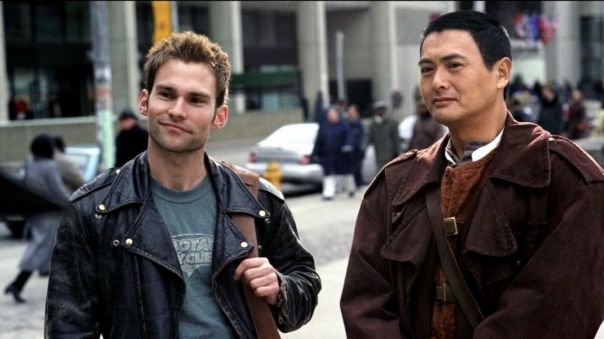
This is, without a doubt, one of the worst movies I have ever seen, and I was entertained for every bizarre, outlandish, and awful second of it. Bulletproof Monk is based on a comic book series but it’s really an incompetently designed and executed $50-million mock version of The Matrix. Within seconds of the movie, I was already laughing out loud, and I need to go into detail just for the first ten minutes, which I highly recommend to everyone as a taste setter. We open with two monks battling atop a rope bridge and, even accounting for the poor aging of special effects two decades later, it is some of the hokiest green screen I’ve ever seen. The way both characters leap, the way the movie haphazardly edits around the fight, the speedy levitating like a video game glitch, the duel spinning that goes on and on without orienting the audience, and then it all concludes with the apprentice grabbing the elder monk’s incongruous rubber sneaker before he falls. In just a short couple of minutes, we already have a clear indication what a mess this will be. Then the Nazis show up and kill the Tibetan monks and search for a mystical scroll that has the power to destroy all life on the planet, which is a good enough reason not to leave it easily accessible to Nazis. The lead Nazi massacres the monks with the exception of Chow Yun-Fat’s nameless monk who has just recently been dubbed the supreme monk in charge of scroll security. The main Nazi shoots him and the monk falls off a cliff, but not before the Nazi says “monk” a dozen times, including screaming it to the heavens to conclude the scene when he cannot find the fallen body. I defy anyone to watch and appreciate the opening on an intentional level.
The action goes from incomprehensible to boring. It’s the kind of movie where the bad guys will just show up with a helicopter with attached Gatling guns and fire into a warehouse even though there’s been no established reason they know our characters are inside or where inside they should start firing. It doesn’t matter because all the movie wants is a sudden burst of action with a vroom-vroom going pew-pew-pew until there’s a big boom. These same goons are also perhaps the dumbest hired goons in memory, as they’ll miraculously get the jump on our heroes, complete with helicopter action, but not check behind doors when coming onto a roof. There’s a moment where Sean William Scott is overpowering a man six inches taller than him and clearly with a hundred more pounds on him. This isn’t through some ingenious example of outsmarting the competition or using torque to your advantage, it’s just Scott out-pulling this guy, and this is before he even adopts the fantasy-blurring superpowers the monk will teach him.
The action scenes are all chopped up with jumbled edits. The choreography can be passable at points but seems to emphasize the exact wrong moments, like the duel spinning monks that twirl needlessly forever in the opening or Fat leaning forward and spinning around the floor while casually eating a bowl of noodles to clown Scott. It’s badly composed and badly edited. The action scenes are so silly and stupid and then you throw in the willful distortion of gravity because, as we’re told, physics are only real if you believe in them. The world of bending reality worked in The Matrix because reality was an illusion (or, as the Merovingian would say, “an eloooschean”) and a virtual reality setting where rules could be bent. What we’re entering here is a realm closer to 2008’s Wanted, where the tried-and-true laws of nature are merely suggestions, and all the cool kids can curve bullets if they really put their mind to it. It’s not like action movies don’t already exist in a heightened world of expectations and genre pyrotechnics, and then you add martial arts mysticism on top of it with wire-fu and we’re already stretching the bounds. I think what rubs me the wrong way thoroughly with Bulletproof Monk is how lazy it is. It’s not like this monk has some special power that allows him to overcome physics, some master knowledge that will educate his protégé. He just tells him that belief is stronger than physics, like this was a sentimental children’s movie about Santa Claus. If that’s the level of explanation that’s acceptable, it’s a bad sign how much more effort will be put into any storytelling or entertainment factor in this ridiculous mess.
Let’s also zero in on the apprentice character played by Scott, an actor I’ve generally enjoyed and who was hitting his commercial heights circa 2003. He plays Kar, though when the monk informs him that he is mispronouncing the Cantonese word for “family,” the American pickpocket brushes away the cultural correction from the native speaker. Here is a man who lives and works in an old Chinese movie theater with a crotchety old Japanese owner (Mako) and where he watches classic kung-fu movies and teaches himself martial arts. I suppose Kar could be a self-taught genius but he displays little dedication or skill beyond pickpocketing, which has always been a nagging movie cheat to me where people can just barely bump into you and magically gone inside your coat pocket and lifted a wallet all without your awareness. He’s the wise-cracking sidekick-slash-protégé learning about the wider world and breaking the rules, like Neo. Except he’s mostly obnoxious and useless, that is, whenever he isn’t inexplicably taking out professionally trained mercenaries with moves he learned from Bruce Lee marathons. Kar is not even an enjoyable annoying role for Scott like in 2003’s The Rundown.
Another ridiculous character and storyline involves the leader of the underground street gang and his name is Mr. Funktastic. I know this because Marcus Jean Pirae (Girl Next) literally has “Mister Funktastic” tattooed on his bare chest (though it looks like he might be missing a well-placed “N” as well). He’s British and the leader of a gang of would-be street toughs and orphans, and it’s like the movie has dipped into something downright Dickensian, or maybe the 1991 Teenage Mutant Ninja Turtles movie. These guys are upset that Kar is stealing on their turf and challenge him to prove his mettle. I don’t know what this idiot character adds to this universe besides further making it incredulous. He and “his girl” even party in the underground raves in old subway cars, and all of this just makes me wonder what adults think goes on in subway systems. Oh, and that’s right, the female love interest is named Jade, played by Jaimie King (Sin City, Pearl Harbor), and this plays into one of the most stupid yet hyper specific ancient prophecies that tips off the monk to Kar’s potential. All you need to know about the supporting characters in this movie is that there are multiple generations of Nazis and they are running a Holocaust museum secretly to hold onto their trophies under the cover of enlightening the world about anti-Semitism and white supremacy.
Bulletproof Monk is the only movie directed by Paul Hunter, a respected music video director who has worked for decades and is responsible for Aaliyah’s “One in a Million,” Mariah Carey’s “Honey,” the “Lady Marmalade” remake from Moulin Rouge, and the unfortunately titled duet by Jay-Z and convicted rapist R. Kelly, “Guilty Until Proven Innocent.” This experience must have been so bad that Hunter swore off ever helming another feature-length movie again. The nature of music video direction attracts stylists, but this movie is so overburdened with trying to ape The Matrix on a scaled-down budget, with janky bullet-time effects and wire work (our heroes are even on the run from men in suits and sunglasses). The wire work doesn’t add grandeur and majesty to the movie because it doesn’t have the understanding of how to present it so that it looks cool; it always just seems goofy and inferior to better references. I think Hunter’s personal vision and style were just swallowed whole by the demands of making this silly movie, encroaching studio pressure, and it feels like he just gave up and the movie was benignly born by committee. I don’t blame Hunter for giving up on this movie and I guess on all movies.
Can you enjoy Bulletproof Monk on a so-bad-it’s-good level? Do hotdogs come in packages of ten and hotdog buns come in packages of eight? The answer is an enthusiastic yes. This movie is ridiculous in every moment, only forming a somehow more ridiculous whole that defies not just the laws of physics but conventional storytelling and good taste. It’s a movie that has no idea what to do with Chow Yun-Fat and his abilities, instead coasting on the idea of the man’s involvement like the geezer teasers of recent memory that don’t so much challenge their famous stars as advertise they could afford them for a weekend or two of un-taxing demands. It’s a movie that begs to exist on a dumbed-down level of action movie junk science but doesn’t understand how to, properly, have fun within that setting. It’s so transparently indifferent or lazy or ripping off its many action/sci-fi inspirations, chiefly The Matrix. John Woo is a producer on the movie and it’s not hard to see how a Woo-directed Monk would have played to its outlandish peaks. Instead, everything is an inferior version of the better reference point. It’s silly and worthy of a night with friends, adult beverages, and lots of boorish and increasingly incoherent commentary.
Looking back at my initial review from 2003, I think my criticisms still hold but I would elevate the grade simply from its unintentional entertainment value. This is pure unintended camp, and as such Bulletproof Monk might be one of the worst movies I’ve watched and still undeserving of a failing grade, and so I will charitably raise it a letter to a D grade (on a curve, a bullet curve).
Nate’s Grade: D
Share this:

The Core (2003) [Review Re-View]
 Originally released March 28, 2003:
I knew about 15 minutes in that The Core was not going to take its science too seriously. Aaron Eckhart, as a hunky science professor, is addressing military generals and essentially says, “We broke the Earth.” He tells them that because the Earth no longer spins (don’t think about it, you’ll only hurt yourself) the electromagnetic shield will dissipate and the sun will cook our planet. And just to make sure people understand the term “cook” he sets a peach on fire as an example. At this point I knew The Core was going to be a ridiculous disaster flick with its tongue firmly planted in its cheek.
Earth’s core has stopped spinning and horrific disasters are starting to be unleashed with anything from drunken bird attacks to lightening strikes in Rome. I always love how in disaster films Mother Nature always instinctively goes after the monuments, the landmarks, the things of cultural importance. The United States government hires a ragtag group of scientists and NASA pilots to journey to the center of the Earth and jump-start our planet. Of course everything that can go wrong on this fantastic journey will eventually go wrong.
The Core is so improbable, so silly, that it ends up being guilty fun. If you let go, ignore the incredible amounts of birth imagery (the sperm-like ship tunneling through to get to the egg-like core), then the very game cast will take you for a fun ride.
There’s a scene where the government approaches kooky scientist Delroy Lindo to build the super-ship that will take them to said core. When asked how much he thinks it’ll cost Lindo laughs and says, ”Try fifty billion dollars.” The government responds, ”Can you take a check?” I was pleasantly reminded of an episode of Futurama where the space-time continuum is disrupted and time keeps skipping forward. The old scientist and a Harlem Globetrotter (it was a very funny episode) theorize that to create a machine to stop this problem they would need all the money on the Earth. Flash immediately to the two of them being handed a check that says, “All the money of the Earth.” Richard Nixon’s head, in its glass jar, then says, “Get going, you know we cant spend All the Money on the Earth every day.”
 The assembled cast is quite nice. Hilary Swank assumes a leadership role quite nicely. Eckhart is suitably hunky and dashing. Stanley Tucci is very funny as an arrogant science snob. Tcheky Karyo (the poor man’s Jean Reno) is … uh, French. I don’t think anyone would believe that these people were the best in their fields (only in movies are scientists not old white men but hunky and sexy fun-lovin folk).
Director Jon Amiel (Entrapment) seems to know the preposterous nature of his films proceedings and amps up the campy thrills. An impromptu landing of the space shuttle in an L.A. reservoir is a fantastic action set piece, yet is likely the reason the film was delayed after the Columbia crash. The cornball science and steady pacing make The Core an enjoyable if goofy ride. The film does run out of steam and goes on for 20 minutes longer than it should.
The Core is pure escapist entertainment without a thought in its head. And in dire times of war and harsh realism blaring at us every evening, there’s nothing wrong with a little juicy escapist fair. Buy a big tub of popcorn and enjoy. Does anyone else wonder if we broke the Earth just after its 5 billion-year warranty was up?
Nate’s Grade: C+
——————————————————
WRITER REFLECTIONS 20 YEARS LATER

I never knew just how influential the 2003 disaster movie The Core has been. It’s a schlocky Hollywood sci-fi thriller built upon junk science but still enjoyable junk food entertainment. However, the science was so unrepentantly bad, that the science community as a whole decided to do something about it, and in 2008 the Science & Entertainment Exchange was launched. Founded by the National Academy of Sciences (NAS), its director Rick Loverd told Salon magazine how influential pop culture can be in its depiction of science, citing Star Trek inspiring scientists, Top Gun inspiring pilots, and CSI inspiring young forensic students. He also cites the power of seeing positive representation, like 2016’s Hidden Figures. The Science & Entertainment Exchange is an organization that is intended to consult on the application and depictions of science in cinema, hoping to make things more realistic. Apparently, The Core’s director, Jon Amiel (Entrapment), was so taken back when a science advisor was bad-mouthing the movie to Scientific American because he was under the impression that his movie, including restarting the Earth’s iron core with atomic bombs, had been scientifically accurate. Among the scientific community, they regard The Core as the nadir of big screen accuracy (as an example of a movie that got the science fairly accurate, they cite 2014’s Interstellar). I bet you never knew how truly influential and world-changing The Core was, albeit for being a junk movie. However, as it was in 2003, and even twenty years later, this is exactly my kind of junk.
I recognized the campy appeal of The Core right away. It’s a goofy movie from the premise to the science to the action set pieces but it’s all played one hundred percent straight, which makes it that much more entertaining and amusing. The opening sequence involves people with pacemakers dropping dead (approximately 1.5 million people worldwide). Then the birds start acting funny and crashing into buildings and cars and panicked outdoor crowds. For a disaster movie literally about the possible demise of the planet, this is such a strange and minimalist start to the looming threat at hand. The movie feels like it’s a throwback to the science fiction mission movies of the 1950s with a touch of the worldwide disaster movies of the 1970s. Even with the modern special effects, which are as delightfully cheesy as the rest of the movie, it doesn’t feel akin to the disaster epics of Roman Emmerich. The movie feels cornier and more dated and less interested in large-scale disaster spectacle. The surface-level disaster carnage is marginal, mostly an out-of-control lightening storm in Rome that knows to always steer for the monuments and cultural artifacts. The Core, at its core, is about the fantastic journey of its brave scientists. Take for instance a scene where the Serge is locked behind and being crushed to death by extreme pressure. I don’t know how anyone could keep a straight face while Aaron Eckhart, our handsome lead scientist, shouts, “Serge!” over and over while Tcheky Karyo (The Patriot) pretends he’s being squished to death while the walls get closer and closer to his face. That’s the kind of stuff I want, not CGI waves killing thousands in large-scale yet antiseptic spectacle.
 The movie takes about an hour before it really gets going, which is also admirably silly. Why devote so much time to setting up the reality of this dilemma for the complications and solutions to seem so throwaway? Seriously, the government uses one hacker (DJ Qualls) to control the entire Internet so that they can cover up the news about the possible impending apocalypse. It reminds me of an episode of The X-Files from the early 1990s where the government sends out an “all-Internet alert.” Perhaps the screenwriters felt we needed more time to accept the outlandish premise, which is strange because most disaster movies get a significant benefit of the doubt from audiences. Just having a person in glasses, and maybe a lab coat, or sweater if you want it to be more casual, explaining in a grave tone while removing their glasses dramatically, is likely all we need to accept the craziness to come. However, we do spend more time with our characters so that, when they depart one-by-one through sacrifice and accident, I actually cared enough because I was enjoying their comradery. I enjoyed Stanley Tucci being a blowhard who would even record his own narration as they travel through the Earth. I enjoyed Bruce Greenwood as the stern father figure that of course has to die first. I enjoyed Delroy Lindo as our excited but exasperated drill scientist. I enjoyed Hilary Swank as, essentially, the “best damn pilot I’ve ever seen.” I liked simply watching them all banter and bond together. It had enough development that their losses actually felt like losses and/or the accumulation of a character arc.
The question arises how do you keep things interesting when you’re burrowing through layer after layer of rock, and the answer is to just make things up. How about a layer of air? Could the Earth, compact as it is through billions of years of gravitational forces, have a layer of air like it was an English muffin? I did enjoy how the team had to restart their vessel before the magma poured into the vacant and awaiting space from their entry point. Of course, that raises the question now that magma is filling this vacant layer, have these scientists unintentionally ruined this unknown layer of the Earth? How about a layer with diamonds the size of states? These internal layers might as well be alien planets for as little they connect to reality.
 The movie is overlong and too uneven, but for fans of schlocky science fiction, it’s a delicious combination of campy entertainment. The silliness, played completely straight, even down to the part where Richard Jenkins explains man’ hubris is at fault for destroying the rotation of the Earth, is the grand appeal. I’m not going to call The Core a good movie but it sure feels like it knows exactly what kind of movie it is, and boy does it lean into that. My original review in 2003 caught on right away and I still recognized that same knowing vibe (why do we need a visual demonstration for the obvious concept of the sun cooking the Earth?). There really is a lot of birthing imagery too with the shape of the vessel burrowing to that egg at the center, so there’s that as well. The special effects are pretty murky and hokey for this kind of budget, but in 2023, that even works to the bountiful charms of the movie. I won’t pretend that most people will watch The Core with derision regardless of whether or not you’re an actual scientist. It inspired a generation of movies to be more scientifically sound, and it also inspired one of the biggest filmmakers on the planet. The metal that encases the spaceship? Unobtanium. You cannot tell me James Cameron wasn’t watching and taking notes.
Re-View Grade: B


 nathanzoebl

You must be logged in to post a comment.