Category Archives: 2023 Movies
Pain Hustlers (2023)
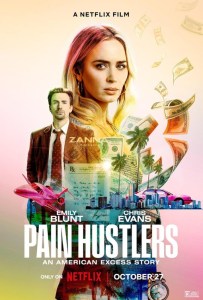
Pain Hustlers is the next attempt to dramatize the numerous stories behind the opioid crisis, a storytelling edict that is becoming its own tragic true-crime sub-genre (Dopesick, Pain Killer, Four Good Days, Recovery Boys, All the Beauty and the Bloodshed). The Netflix original has a starry cast and a topical and serious subject but it’s an un-serious movie caught up in the superficial quirks and appeal of being and making a goofy crime story of greedy sleazeballs.
Liza (Emily Blunt) is a struggling single mother trying to claw her way out of debt and, with her unfinished education and criminal record, few options are widely available. Then enters Pete Brenner (Chris Evans), a loud, gouache pharmaceutical rep for a powerful pain killer. He promises a lifestyle of luxury and power, as long as Liza is willing to ignore or bend a few ethics along the way. Together, they build a sales force of attractive women who wine and dine smaller doctors in order to get them to prescribe their special drug to anyone in need. It’s just that a drug intended for end-of-life pain wasn’t meant for common headaches. As sales boom, Liza begins to worry that her glitzy lifestyle is built upon a mountain of American corpses.
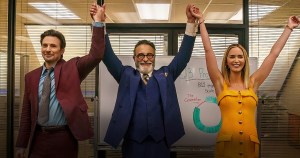
The biggest drawback of Pain Hustlers is that it fully focuses on the glitz and gives lip service to the cost of chasing that avarice. Plenty of movies illuminating bad people doing bad things are accused of glamorizing the misdeeds, from gangster movies to dark romances, though this narrow viewing often seems to conflate depiction with condoning the behavior (see: The Wolf of Wall Street). Watching stories about people stumbling their way into glamorous positions should provide some allure so as to better understand the seductive draw for the characters. The world of vice and power will be a compelling conflict, but for Pain Hustlers, it falters by just focusing on the high-powered lifestyle yet it still lacks specificity to make this story feel interesting on its own. You’ve seen variations of this kind of story before (we’ll call it Scorsese-esque) about the people struggling with less who get a ticket into a new world of access and freedom and then begin to worry At What Cost. Pain Hustlers goes through its plot beats with the most mechanical of movements. The personal details from this supposedly true story feel so generic, reminiscent of similar tales like, Love & Other Drugs and Hustlers. It feels less like an insider account of how these shady people exploited so many and more like the screenplay was cobbled together by what the filmmakers assumed this story must have pertained without reading much of the source novel by Evan Hughes. It’s absent the useful details that allow more of these accounts to prosper as we investigate moral relativism.
The other nagging shortcoming of Pain Hustlers is the consequences for all these bad people. I’m not saying that we need to see comeuppance and justice levied in order for the movie to work thematically; very often these white collar criminal types receive the faintest glance of judicial punishment. What this movie lacks is the emphasis on the consequences, and considering our main characters are pushing sleazy doctors to push highly addictive opioids, that’s a big miss. The movie is all about the climb for its heroine, the comparison of having the fancy life versus a life without. It shortchanges the extremely human cost of its bad actors in a way that does a disservice to the movie and its message. Because of its lack of specificity, this story could have been propelled by any prescription drug, from Viagra to Lipitor. The fact that we’re talking fentanyl, a drug responsible for 200 deaths every day last year according to the CDC, seems immaterial, and that is bizarre.

The effects of the opioid crisis begun by Purdue Pharma and the Sackler family, and then trickled down through the complicated tributaries of the American medical infrastructure, will be felt for generations. This is a major story. It would be like, say, telling the story of a struggling single mom who decides to take a career advancement in the Nazi Party in 1940s Germany. You’re not just doing a disservice to the people who really suffered, you’re doing a disservice to the audience to ignore the gravity of their moral culpability and excuse-making, of the drama of the character having to confront their part. For a movie about people profiting from opioid over-prescriptions, there is a grand total of one scene where Liza has to deal with the harsh real-world consequences of her actions (minor spoilers ahead, but I’d advise you to continue, dear reader). Early in the movie, when Liza was forced out of her home, she spent a few days living in a motel. The neighbor lady at the motel has a husband who dies from the opioid crisis, and this one man is meant to symbolize what she has wrought as a whole. It doesn’t work, and the fact that the movie presents Liza in tears trying to make amends to this widow, a character we haven’t had any thought over since Liza leaving her Act One beginnings, is a pitiful excuse for a reckoning.
Evans (The Grey Man) and Blunt (Oppenheimer) feel on autopilot here, namely because of the broad and bland characterization. Blunt resumes her Southern accent I recall from the Quiet Place movies, but her energy level feels too low, too disengaged, like she’s already at her quiet rectitude character phase when she should be at the gee-whiz giddiness of her moral slide. Evans is meant to be playing a cad prone to vulgar boasts and condescension for those he willfully steps over to reach his goals, but his “sleazeball” acting tics feel too forced, too played up, in all the ways that Blunt feels dialed down. There’s no baseline for the two of them, so the scenes they share together feel over and under-cooked, and with a generically developed rise-and-fall screenplay to boot. Andy Garcia (Father of the Bride) is the most interesting character as the head of the company, a doctor who began trying to ensure those in desperate need could have the dignity of mitigating their pain, and transforms into a megalomaniacal huckster who only wants to keep meeting the next sales projections. His rise-and-fall seems much more steep and intriguing than trying to give us Liza, a gutsy single mom (with a wacky mother of her own played by Catherine O’Hara) who we’re supposed to identify with and forgive for playing her part in a deadly chain that has wrecked untold lives across the country and world. She did it for her own kid’s medical treatment. So it’s all okay, right?

This is director David Yates’ first movie away from the familiar confines of the Harry Potter universe since the ill-fated 2016 Tarzan reboot, and only his second non-Potter movie since 2005. Given that history, I’m curious whenever this man jumps onto a non-Potter project because you would assume it has to be special in some manner. I’ll credit Yates with changing his visual preferences from the very drabby and gray palette of his Potter filmography.Pain Hustlers adopts a lot of the stylistic tics we expect in glitzy crime thrillers, from handheld camerawork to sun-bleached colors. There are other techniques to bring a documentary-like authenticity, but the constant cutting back to black-and-white interviews with the characters after the fact only serves as a narration crutch to keep things moving. The character narration lacks further insight from the distance or remorse of the onscreen events. The whole movie feels like a copy of a Scorsese imitator, something akin to 2009’s forgettable The Middle Men, a crime movie about a plunge into the underworld from a naif that doesn’t try too hard beyond empty reconfiguration of the superior style of its influences that I doubt anyone really remembers (you might as well add directorial narration, “Ever since I was young I always wanted to make a gangster movie…”). As immediate evidence to the case, there is a slow-motion house party in Pain Hustlers set to “Turn Down For What.”
Should you spend two hours watching Pain Hustlers? Not really, though if you have a fascination with the many schemers who contributed to making the opioid crisis as trenchant and terrible as it currently is, and likely will be for the near future, then maybe there’s some mild value to be had here. But even those people would be better served watching another Netflix series tackling the same subject matter, the 2023 limited series Pain Killer. For me, the Pain Hustlers story was too broad, and where it could have broken out with specificity is where it decided to wimp out and defer to genre cliches. It’s hard for me to argue that you should spend two hours watching this movie on the subject when you would be far better served, from an informative and entertainment standpoint, watching the two-part, four-hour 2021 documentary Crime of the Century by masterful filmmaker Alex Gibney. That film is damning and compelling and authentic in ways Pain Hustlers can only hope to imitate.
Nate’s Grade: C
Share this:

Mission: Impossible – Dead Reckoning Part One (2023)
 I was a nominal fan of the Mission: Impossible series after three movies, and it seemed like the American public was feeling the same. After 15 years, it felt like the franchise was considering a soft reboot/shift with 2011’s Ghost Protocol, setting up Jeremy Renner as the heir apparent to Tom Cruise’s super spy, Ethan Hunt (weirdly, Renner was also set up to be another franchise replacement for Matt Damon’s Jason Bourne in 2012). Except what may have been initially planned as a franchise hand-off became a franchise renewal, with a delightfully twisty plot, fun teamwork as they scramble to adapt, and a show-stopping action set-piece that remains the franchise’s high-point, the scaling of the towering Burj Khalifa skyscraper. It also reminded us that not only does Cruise love to run but the man has a death wish when it comes to performing his own amazing stunts. With Cruise firmly back in place as lead, and Renner jettisoned (which also happened after 2012’s The Bourne Legacy), the franchise was further boosted by two of its best additions: actress Rebecca Ferguson and writer/director Christopher McQuarrie. The Oscar-winning Hollywood screenwriting staple was not known as much for his directing efforts, but he became a Cruise confidant after 2008’s Valkyrie, and he’s worked almost exclusively on Cruise projects ever since. He earned the man’s trust and proved a fantastic action director. 2018’s Mission: Impossible Fallout is just blockbuster filmmaking at its high-stakes finest. I was bouncing in my chair with excitement and simply luxuriating in action thriller nirvana.
This time Ethan Hunt (Cruise) and his select team of trusted friends and colleagues are battling a villain terrifyingly relevant to our modern times, especially in light of the screenwriters’ strike – artificial intelligence. The big bad is an A.I. that can control the world’s security apparatus, and it’s become self-aware and resentful of its human overlords. It exists inside a computer console inside a Russian submarine at the bottom of the Arctic ocean under a wall of ice, and the A.I., known as “The Entity,” doesn’t want to ever be found (must be an introvert). If only it was that easy. The world is racing to be the first to claim this unparalleled prize, and the Impossible Missions team has to ensure they can find the location, which of course involves a MacGuffin, this time two interlocking keys to access the A.I. sub station. Can Ethan get there first and can he even trust his own government to do what’s best with access to this kind of power?
 Mission: Impossible – Dead Reckoning Part One is a mouthful of a title. We got a colon, a dash, and a “part one,” a presumptuous gamble that after 160 minutes the audience is going to be ravenously hungry for a continuation in a series that has never had a two-parter before. In short, the movie is a lot, a lot of the same action and renowned stunt work we expect, and a lot of setup and extension that might have been better trimmed by focusing on one movie rather than setting up two. McQuarrie has done this before and been successful without the need of a direct two-parter. For all intents and purposes, Fallout is a direct sequel to 2015’s Rogue Nation, carrying over the same villain for the first time in the series and the ongoing relationship between Ethan and Ilsa Faust (Ferguson). Both of those movies feel complete and satisfying and well-designed in structure and development without needing one part to complete the other. With Dead Reckoning Part One, henceforth known as M:I 7 to spare me from writing this title every time, it feels like an overlong setup. By the end of the movie, our characters know where the A.I. is located but they still don’t know where the sub is or how to get there, which means the entire movie could have been collapsed into a more streamlined venture. Part of this may be the production troubles where they had to shut down and rejigger the plot multiple times from COVID outbreaks, as M:I 7 is the last of the big Hollywood movies to release that was shutdown in 2020 by the devastating pandemic. It all feels a bit overstretched and absent a satisfying conclusion.
The draw of the franchise, and chiefly its 2010s renewal back into the zeitgeist, is still the eye-popping stunts and set-pieces and Dead Reckoning still delivers. Most viewers will likely find the final action sequence aboard a speeding train to be the high-point, and it’s got some wow moments, my favorite is when the train is hanging over a blown bridge and Ethan has to leap from train car to train car before it plummets, oh and it’s all at an incline. It turns each car into a new obstacle to overcome utilizing its specific dynamics, like a dining car with a falling piano to a kitchen with vats of hot grease to avoid. The standout stunt involves Cruise driving a motorcycle off a mountain in a desperate effort to parachute onto this speeding train. However, this whole train sequence didn’t excite me too much, outside of its beginning stunt and the end. Watching men chase one another atop the speeding train, let alone wrestle and fight with knives, only serves to limit what can be done and it reminds me how fake the moment is for a franchise that has made its mark on its daredevil realism. That extended middle feels a bit too much like other Hollywood thrillers and action movies, and that’s what made it disappointing for a series I consider the current gold standard of franchise action.
 A much less heralded sequence around the forty-five minute mark was my favorite, where Ethan is running around the Abu Dhabi airport while the following takes place: 1) Ethan trying to evade federal agents (the dependable Shea Whigham) looking to arrest him, 2) Ethan is trying to find the owner of one half of the MacGuffin keys who happens to be a pickpocket that keeps giving him the slip, 3) Ethan’s team, Luther (Ving Rhames, the only other actor who has appeared in every M:I film) and Benji (Simon Pegg) trying to find a nuclear bomb in a suitcase through the maze of baggage claim and disarm it, 4) the introduction of our villain Gabriel, well, our primary lackey to The Entity, who also happens to be a former IMF turncoat who killed Ethan’s girlfriend and essentially “made Ethan Hunt who he is” following Batman logic. This entire sequence is pure McQuarrie splendor, where it introduces the different characters, several at cross-purposes, lets them loose and then finds organic complications and specific turns that take advantage of the geography as well as the character’s emotional states. I loved it, and it made me hopeful that after a bit of a slow start that M:I 7 was now cooking and would be the prolonged deluge of near-perfect set-pieces that was Fallout. Not so much, but this sequence was indeed good fun.
Another issue I had was that our villain, again more like chief lackey, is so bland. I like Esai Morales (Ozark) as an actor, but the character of Gabriel is such a non-starter. Even giving him the personal history with Ethan feels like an admission that this bad guy has little to offer on his own. I think it’s part of how the character is written but I think it’s also a reflection that he’s the number two behind the all-powerful, scheming A.I., and then he too has a number two (number three?) played by Pom Klementieff (Guardians of the Galaxy vol. 3), and she is so much more engaging as an antagonistic presence. She’s the one driving through cars and stonework throughout Rome to chase down Ethan. She’s the one who fights him in a narrow alleyway, a nicely claustrophobic change-of-pace action moment for a series that gorges on scale. If the true villain is going to be an A.I., why can’t Pom simply be its number two hench-person? Gabriel is redundant and boring and his fight sequences don’t feel believable against this crew.
 There are a couple other storytelling choices that I wasn’t happy with, but I’ll save delving into those for the sake of spoilers. Suffice to say, I hope Dead Reckoning Part Two in 2024 course corrects and we have some welcomed returns. It’s kind of fun to see Kittridge (Henry Czerny, Ready or Not) make his first reappearance since the 1996 M:I and also get so much screen time. He’s essentially the face of the U.S. government infrastructure for the duration of the movie. His clenched-jaw consternation is a nice foil to the always rogue super spy.
Dead Reckoning – Part One is a good but not great Mission: Impossible movie, conceived as two parts and suffering some of the consequences of its over-extension. The thrills are still there, the sturdy production values, the emphasis on the spectacular stunts and fun action set pieces, so any fan of the franchise will find enough to enjoy over 160 minutes. The addition of Hayley Atwell (Avengers: Endgame) as the wily pickpocket who has stumbled into international espionage is great, though she cannot escape feeling like an Ilsa replacement while Ferguson is off-screen for too long. Cruise is still the movie star who delivers the most from film to film, and his high-wire efforts are appreciated. By the end of the movie, the sub is still at the bottom of the ocean, our characters are still in a race to find it, and I wondered why we couldn’t have ditched “Part One.” The answer, as much in Hollywood, is of course money, but I wish this Part One made me more psyched for Part Two.
Nate’s Grade: B
Share this:

The Meg 2:The Trench (2023)
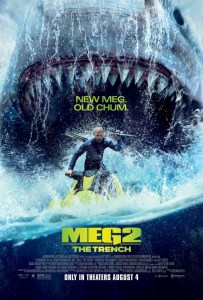 It’s Jason Statham riding a Jet ski and literally jousting giant sharks, so the fault should be on me expecting something more from The Meg 2, right? I wished there was more of this kind of gonzo schlocky action, moments like Statham kicking a guy into the mouth of a killer shark and saying, “So long, chum.” Too much of this movie is setting up an ensemble of characters that are boring and not Jason Statham, including villainous turncoats that I kept forgetting who they were. There are also small-sized dinosaurs but other characters just chase them down to shoot them. I was mostly fine with the first Meg movie as dumb fun, and this one seems to be going for the vibe of a bigger-budget Asylum/Sci-Fi Channel schlockbuster, the kind of movie with a “Sharktopus” or “Mega Shark” in its outlandish title. Unfortunately, the movie doesn’t seem to accomplish even that aim. I wish the movie had been even more crazy but it feels like, for whatever misplaced idea of tone, that the filmmakers held back. Next time just have Statham psychically linked to the shark and fighting dinosaurs and own it.
Nate’s Grade: C
Share this:

Retribution (2023)
 Liam Neeson has had one of the most unexpected second acts, from an esteemed dramatic thespian to Boomer action hero. The man’s natural gravitas elevated 2009’s Taken, plus the undiscovered thrill of watching Oskar Schindler karate chop goons in the neck, and ever since the Liam Neeson Action Vehicle was a 2010s Hollywood staple. He has been a downtrodden father, ex-husband, CIA agent, FBI agent, air marshal, border patrol agent, cop, ex-cop, ex-hitman, wolf-hunting marksman, snow plowman, ice road trucker, usually an alcoholic or recovering alcoholic, and always the beleaguered fighter called back reluctantly into action. But by the turn of the next decade, the Neeson Action Vehicle shifted from playing on the big screen to the small one, as the direct-to-DVD/streaming phase may likely extend to the remainder of the man’s career. He’s approaching his Geezer Teaser era (71 years old), though he has already made an appearance in an Expendables sequel, practically a subsidy for AARP action castoffs
I haven’t watched many of these latter Neeson action movies but the premise of Retribution intrigued me. Reminiscent of Speed, Neeson is Matt Turner, another beleaguered father who spends ninety percent of the movie in the confines of his car thanks to a pressure-triggered bomb that will explode if anyone exists. Unfortunately, Matt’s teen son and daughter are along for the ride in the backseat. They’re beset by antagonizing phone calls from a mysterious culprit with an escalating set of demands and orders. Can Matt save his family and maybe even his car too?
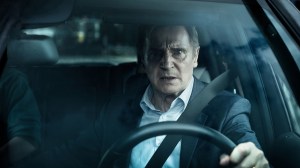 Apparently the third remake of a 2015 Spanish movie of the same name, Retribution moves along on a wholly predictable yet efficient plot as we’re introduced to supporting characters who will inevitably only serve one function. You don’t hire a famous name and then relegate them to one scene to get blown to smithereens. Likewise, there’s always an authority figure investigating the pieces who always has a supportive ear no matter the wild predicament of our hero. The kids are pretty much interchangeable as disaffected family members who will, over the course of 90 minutes of fantastic events, come to see that dad maybe cares after all and they shouldn’t be so rude to their old man. On the flip side, Matt will also come to better understand, through the intervention of a mad bomber, the importance of family he has been heretofore ignorant thereof. It’s all fairly mechanical clunky genre stuff, and if you’ve ever watched any relatively lower budget, straight-to-DVD action movie, especially the Geezer Teasers, then it’s all predictable. The viewing experience thusly comes down to finding nuggets of something memorable or different, something to hold onto unless the movie simply slips into a morass of mediocrity.
Retribution has one such moment and it just so happens to be its ending, so there will be spoilers ahead but I cannot fathom the person who would watch something like this, so formula-laden and familiar, and chafe at spoilers. Still, be warned, dear reader. It’s revealed by the end that our villain is none other than Matt’s business partner, a.k.a. The only other person that could profit off their personal bank stash who also happens to be played by a name actor (Matthew Modine, collect that paycheck). I don’t know why he personally sneaks into the backseat to threaten Matt at gunpoint when he’s been fine making threats from afar on the phone. Why the gun too when there’s already a bomb in play? Seriously, is it supposed to be surprising that Modine turns out to be our real villain, even after he fakes his own death as an elaborate fake-out? Anyway, after monologuing, Matt goes into full angry dad mode, growling a one-liner, and drives his precious car into the guardrails of a bridge, turning the car on its side. If Matt were to detach his seat belt, he would tumble into the river waters below, utilizing gravity as his savior from the potential blast radius (I suppose just forget about shrapnel or the real prospect of the car falling on top of him from the explosion). It makes for a satisfying if slightly clever (grading on a curve) comeuppance for our smarmy villain. Ending with your best moment is a sign that the filmmakers recognized what they had as a payoff. The movie literally ends seconds after, with Matt treading water, deserting any family resolution, admitting it was all just dross anyway.
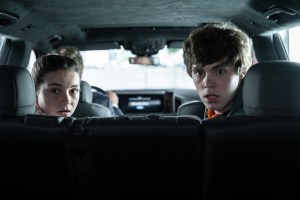 What’s funny is how inconsequential the family drama is that is intended to underpin the high-stakes peril. We find out mom is talking to a divorce attorney, and this news is a bigger bomb than the one under the seas. Suddenly the squabbling children realize the love of their family, even gruff dad, and they want things to stay the same. This storyline is so underwritten, really just serving as a catalyst for the kids to shut up and stop being jerks, that it all feels like self-parody that a mad bomber terrorizing a family has helped facilitate their renewed bonds.
As a late career action vehicle for an actor getting long in the tooth, the blandly titled Retribution is a relatively forgettable thriller that asks too little of its star and its audience. There are all sorts of directions a story can go with the concept of a man being unable to leave his car, so it’s disappointing that Retribution does so little, tying events to an obvious conspiracy with few complications. Imagine the funnier version of this movie, where Matt lives the rest of his life in the car. He gets drive-thru fast food for every meal. His daughter’s wedding has to be outdoors and near an easily accessible parking lot. He begins to see the car as an extension of himself and refers to the both of them in the third person. It takes a Titane-esque twist, and he wants to become the car itself. Then, as a decrepit 101-year-old man, the car breaks down on the side of the road and he has no choice but to leave it, and he accepts his fate with open arms. Then again maybe that isn’t as funny to anyone but me. Even Neeson’s weathered gravitas can only do so much when all the movie asks of him is to stay upright and look forward.
Nate’s Grade: C-
Share this:

No One Will Save You (2023)
 Brian Duffield has been an industry screenwriting phenom for years, though it took too many years for his ribald, clever, and high-concept stories to eventually find their way as finished films, or at least finished versions of his once ribald, clever, and high-concept stories. I fell in love with him as a storyteller with 2017’s The Babysitter, and that love matured into admiration and appreciation with 2020’s Spontaneous, his directorial debut, also my top movie of that year. As hyper verbal and bracing and layered as that stylish movie with major attitude was, and brilliantly so, his follow-up is a sprint in the other direction. No One Will Save You (I keep wanting to type You Will Not Survive This as its title) is a contained thriller with hardly a line of spoken dialogue as we follow Brynn (Kaitlin Dever) battle aliens. Being a nearly dialogue-free experience puts much on the immersive visual experience, and I don’t know if the movie fully sustains this, but the combined effort is solid and sneaky fun.
This is a throwback to the early 1990s invasion thriller, the heyday of The X-Files and Fire in the Sky when the little gray guys with the big black eyes became our default model for aliens. There’s an easy dread to compile when it comes to a powerful and otherworldly entity that has decided to target you, a lowly human. Duffield is able to engineer plenty of anxious moments and jump scares, allowing the scares to luxuriate by building suspense as well as the adrenaline bursts of sudden surprise (a moment with “toes” made me squirm). He makes a key creative decision early to showcase his aliens. Usually these kinds of movies are more guarded about their monsters, confining them to the shadows or at least relying upon the viewer’s imagination to fill in the blanks before pulling back and finally revealing their true form. There’s a reason that so many filmmakers follow this model, and it’s because the final reveal usually pales in comparison to whatever unseen horror the imagination can fathom. The slender creatures do make for creepy silhouettes, and there are three or four different versions of the aliens and this allows for some additional fun design discovery. A long-limbed one reminded me of a praying mantis. The chattering sound design and ominous lighting do a lot of atmospheric heavy lifting to elevate the mood. If you’re looking for a generally well-executed home invasion thriller with some gasp-inducing moments, No One Will Save You fulfills its promise. There’s a pleasing clarity to the plot mechanics, even if you are wondering why this woman doesn’t abandon her house.
 There isn’t much that needs explaining, which streamlines its 90 minutes into a series of reactive responses to the home invasion, with some clues and inferences throughout for us to start to piece together why our heroine is so troubled and seems so isolated by her small-town community. It makes for a visceral, visual method of storytelling but it also limits how much information and depth we are going to encounter. Our main character is still suffused by her own guilt and lasting trauma from her past, and as the movies seem to magically allow, she’s going to be given an external struggle that might just allow her to finally exorcise and resolve a dicey internal struggle. The alien encounters don’t seem to give us better insight into who our protagonist used to be, who she is now, and the misplaced perception of the townspeople. She’s retreated inward. She’s resourceful. She uses what she has to better guard from further close encounters, but all she has are ordinary items found in an old farmhouse, not high-powered weapons and booby traps. She’s just one frightened young woman in an old house trying to do her best. By holding back, we’re only given so much with this character, so she can feel somewhat underwritten and kept archetypal, underpinned by her past mistakes and her current otherworldly dilemmas. I just don’t know if there’s enough going on with this character even with the repeated alien visitation.
Dever (Booksmart) is one of our best young actresses and an excellent choice to anchor our drama. Without the safety of words, much is required from her, and Dever provides a compelling presence even when I feel like the character is hitting her limits. Carrying an entire movie and doing so much with non-verbal acting techniques can be a weighty ask, but Dever relishes the challenge, and through her capable performance we are given a hero worth rooting for.
 The movie does an acceptable job of keeping us, and her, relatively in the dark while still not making the sides too overwhelming. How can one Earth girl combat a species with such advanced technology, size, and power? Well, we don’t fully know what they want, and these little green men are still made of fleshy stuff and can still be hurt and killed like any other fleshy goo-filled life form. They may be advanced but they can still get killed, and that at least gives our heroine a chance that she shouldn’t have. The aliens’ plan is generally unknowable, and just trying to piece together a fuller picture of who they are, the different species and forms, and what their purpose might be for the town is plenty of work for the rest of us that don’t speak the space language. It’s enough of a reasonable learning curve to fill out a short movie while keeping focus on the task at hand, whether it’s hiding under the bed, running around the house, or simply trying to figure out whether going into town for help is worth the effort. I wish there was a little more deliberation on her part about whether the aliens might be preferable to her neighbors. The ending isn’t exactly ambiguous but reminds me a little of 2019’s Midsommar, where letting go of one’s personal hang ups might not be the catharsis of enlightenment it may appear to be.
No One Will Save You is a throwback sci-fi thriller that speaks to the human vulnerabilities we can all feel, being helpless against overwhelming powers, be they alien or our own guilt. It’s a fun thriller with some well-wrought sequences of suspense and jump scares. I don’t know if there’s more happening beyond the visceral appeal of the experience. The character and the situation don’t provide much in the way of larger depth and analysis, and more than a few will likely be able to guess her tragic back-story, though that’s also a credit to Duffield providing the key pieces. As a change of pace, No One Will Save You proves that Duffield is an entertaining and capable storyteller no matter what restrictions he holds himself to. I just prefer my Brain Duffield stories without any restrictions because we only have one Brian Duffield.
Nate’s Grade: B
Share this:

Teenage Mutant Ninja Turtles: Mutant Mayhem (2023)
 As an elder millennial, the Teenage Mutant Ninja Turtles have been a formative franchise for me. I grew up on the cartoon, got the toys for Christmas, died endlessly during the shockingly hard underwater stage of their Nintendo video game, and generally have a soft spot in my 80s nostalgia for the likes of Leonardo, Donatello, Raphael, and Michelangelo, plus their surrogate father, Master Splinter. Apparently Seth Rogen felt the same way, and he and his writing partner Evan Goldberg have spearheaded a new animated variation of TMNT that just so happens to also be co-written and directed by the man behind my favorite film of 2021, The Mitchells vs. The Machines. It was a recipe to guarantee my personal enjoyment, and Mutant Mayhem thusly delivered. The biggest selling point for me was how lovingly realized the “teenage” part of the title was, getting a foursome of actual adolescents to portray our heroes, and using high school experience about acceptance and fitting in as effective and even poignant parallels. I loved just hanging out with these characters, who view their surrogate dad (voied by Jackie Chan) with a mixture of love and embarrassment, and who want to be accepted by a world predisposed to finding them monstrous. Naturally, becoming crime-fighting heroes is their best method for winning over the public, with a young and aspiring journalist April O’Neil (The Bear‘s Ayo Edebiri) hoping to improve her own social standing at school by breaking the existence of these unknown mutants. The comedy is robust and layered while allowing for nice character details and moments, giving each turtle their own satisfying arc. The action is fun and inventively staged while still being thematically relevant. The vocal cast is great, and the young actors are tremendous together, sparking an enviable improvisational energy that made me smile constantly. The art style has an intentional messiness to it, like smeared colored pencil drawings, and the imperfections are themselves part of the vast visual appeal. It’s a family movie that will succeed with old fans and new, and Mutant Mayhem is the best film depiction yet of the famous heroes in a half-shell.
Nate’s Grade: B+
Share this:

Transformers: Rise of the Beasts (2023)
 Neither hitting the high of the character-centric, good-times 80s Ambin vibes of Bumblebee, nor the bombastic excess that defines Michael Bay’s OG series, Transformers: Rise of the Beasts is a new installment that flattens already well-trodden ground. It’s a mediocre action movie with big globs of CGI robots once again colliding in conflict that left me disengaged. We have more familiar Autobots in this one, including their leader Optimus Prime, and there’s a new slew of animal-themed robots, though I’m always left wondering why they choose specific builds and stick with them since it was established they can copy Earthly designs. Regardless, it’s another story about good robots and bad robots trying to beat one another to a special magical MacGuffin that may or may not destroy the universe, and it all feels a bit too same-y from the six other Transformers movies. The new characters are bland and stock, with Pete Davidson supplying our lead Transformer robot buddying up with the young man (Anthony Ramos) who turns to grand theft auto to try and pay for his little brother’s health care. To go along with our wide-eyed hero discovering this hidden war, we have a brainy sidekick (Dominique Fishback) who shares in the hyperventilating. I kept thinking about how filming these movies is just measuring out a lot of wide exterior shots and saying, “Yeah, there’s going to be a giant robot in there eventually.” Credit director Steven Caple Jr. (Creed II) for having relatively restrained editing to better orient his action and audience, which is not something we can say about Bay’s movies. The problem with Rise of the Beasts is that it’s movie number seven rather than the first, so it has no novelty and whatever differences it offers are microscopically minimal. If you’ve seen any of the other Transformers movies, you’ve seen essentially what this one has to offer, so unless you have young children who are heretofore unblemished in their cinematic knowledge of Transformers, feel free to just wait for a better movie.
Nate’s Grade: C
Share this:

Barbie (2023)

Who would have guessed a movie based upon a ubiquitous doll that dates back to the 1950s would become not just a cultural force and reclamation project but also the biggest moviegoing event of the year, as well as the highest-grossing movie in Warner Brothers’ history, even outpacing The Boy Who Lived? In 2023, it turns out we are all, every one, a Barbie girl living in a Barbie world. I came to this experience late, wondering if writer/director Greta Gerwig’s movie could live up to the lavish hype, the fawning praise, the hilarious offenses that many fragile males have levied against it. It couldn’t possibly be that good, could it? I saw it with three generations of women in my family, something I will privilege, and I must say, it is that good. Barbie is one of the best movies of the year and a shining example of what vision and passion can do to elevate any story. There’s so many ways this movie could have just been cheap corporate slop and instead it becomes an existential yet deeply personal treatise on life and death.
In the world of Barbies, women rule and the men are just afterthoughts. In this creation myth, the Kens were meant to compliment the Barbies. We watch “Stereotypical Barbie” (Margot Robbie) go through her daily routine of fun, frivolity, and nightly dance parties with all her best gal pals (no boys, er Kens, allowed). Then one day, this blonde Barbie started walking differently, started seeing the world differently, and started wondering about dying. Was there something wrong? Her human owner, in the real world, was in trouble, so Barbie sets off on an adventure to find her human owner and save the day, with help from her boyfriend, Ken (Ryan Gosling). Except for these two, the real world is very different from what they were expecting.

It’s easy to see how this movie could have been a mediocre fish-out-of-water comedy, with Barbie clashing in our modern-day world with its modern-day views of fashion, body image, and what skinny, buxom dolls represent to generations of young impressionable children. It’s clear to see what the scrapped version could have been when Amy Schumer was attached to star. What really impressed me with Barbie, beyond its delightful and inspired production values, is how ambitious and well-realized this movie is at every turn. It could have settled for easy jokes about Barbie and Ken not fitting in, not understanding human relationships and sex, and that stuff is there and it’s quite funny, but Gerwig and co-writer Noah Baumbach want to do so much more. This is a studio blockbuster, based upon a decades-long popular toy, that wants to do more with its platform. It aims higher, and in just about every measure, Barbie admirably succeeds. As a comedy, it had me howling with laughter, enough so that my response was providing another level of entertainment for my wife. There are jokes that are so specific, so beautifully targeted, that when they detonated, I was in awe and appreciation, (a reference to the literal definition of fascism and a Snyder Cut throwaway reference were perfectly attuned to my comedy sensibilities, thank you, Greta). As a frothy and fun fantasy, the movie has excellently crafted sets and costumes and retro visual aesthetics, making the movie a pink-accentuated sensory bombardment. But as a satire is where Barbie really becomes special.
Again, it would be easy for Barbie to learn lessons about body diversity and positivity and likely be browbeaten into what a good feminist is supposed to be, that the real world is a harder place for women than she previously thought. All of that is there, along with a consistent and entertaining critique of the faults of patriarchal society, but Barbie isn’t some reductive, man-hating screed to indoctrinate women into thinking they don’t need men (men are already very good at convincing women they don’t need men). This is a treatise on the power of inclusion and how this benefits society, both for men and for women. In Barbie Land, it’s a matriarchal society where girls rule and boys drool, but it’s a fantasy world reminiscent of a caste system, where the Kens will always be lesser afterthoughts because, well, they’re not Barbies, they’re just Kens. They are excluded in their own world. That’s why Gosling’s Ken is so excited by the real world, where the status quo is flipped, where the world is run by men, as he now sees this as an opportunity that has been denied to him. He wants to recreate his own version of the patriarchy not because he thinks women are inferior but because he just wants to be in power and respected, so he’s replicating his misguided understanding of what men in power are like, which naturally involves lots of horses. In the real world, Ken admonishes a suit-wearing corporate executive that they aren’t doing patriarchy right, to which the man winks and says, “We’re just better about hiding it.” The final act isn’t about “bringing down the patriarchy,” it’s about making a more inclusive world where people don’t have to feel marginalized and stuck and resentful.

Besides its social satire, there are other areas where Barbie goes deeper in surprising and affecting ways. There are more than a few applause-worthy moments explaining the perspective of women, particularly a monologue that is destined to be an audition piece for the rest of time, and it all works and is cutting without being too didactic. Gerwig even gets in a few jabs about corporate culture (“Are there any actual women in this boardroom?” “I’m a man with no power, does that make me a woman?”) and Mattel as an organization becomes another force of antagonism spearheaded by hapless buffoonish men (of course you get Will Ferrell to play the Mattel CEO). The biggest surprise is how emotional and deep the movie can become. There will be plenty that tear up just having a big Hollywood movie recognize their day-to-day emotional toil of being a woman in modern society. For me, the questions over what to do with the life we have flirted with some surprising existential contemplation, as Barbie is reminded at several points that death is a reality and yet would she want to move to the human world? An emotional highlight occurs when Stereotypical Barbie is speaking with the equivalent of her creator, and Billie Eilish’s tender-to-the-point-of-breaking song “What Was I Made For” lilts onto the soundtrack, and the sincerity of this sequence, topped with insert home video footage from the production cast and crew, really hit home how much more this movie is going for then bringing different dolls to life. It’s not just jokes about crotch-less creatures and weird feet, it’s about how we can live and why we do so, what inspires us. It’s a big studio summer release that flirts with the profundity and brevity of life.
There is one actor who deserves their own special recognition and that is Gosling (The Nice Guys), who so rarely gets to showcase his sharp comedy skills with the dour, serious, insular roles he gravitates to. Gosling is so committed to his role that he is operating on another plane of excellence, hitting sly jokes within jokes and selling every wonderfully stupid moment with Ken. This man isn’t afraid to look silly, he fully courts it, embraces it at every opportunity, and yet his performance doesn’t detract from Robbie but only makes them both shine brighter. He reminded me of Tommy Wiseau at points. His hilarious ballad “I’m Just Ken,” which segues into a wild West Side Story-style dance battle that is peak peacocking, is a phenomenal run of inspired silliness (the storming of the Malibu beach had me rolling), yet also connected to the character’s co-dependent arc and dissatisfaction with himself (when feeling down, just quote: “I’m just Ken, and I’m enough, and I’m great at doing stuff”). Ken has to learn to think of himself outside his combined definition with Barbie, and they both need to spend time discovering who they really are rather than who they think they’re supposed to be before considering forming attachments. I would not be surprised if Gosling earns a Best Supporting Actor nomination. It was the role he was born to play: insecure accessory doofus.

Gerwig has launched to mega-stardom with just three directing efforts (four if you count her co-directing effort in 2008 with Nights and Weekends, back in her early mumblecore breakout days). Already this woman has been nominated for Best Director, one of only seven ever, and she now owns the highest grossing movie of the year as well as in studio history. She’s proven herself with her 2017 coming-of-age semi-autobiographical Lady Bird, richly realized and achingly felt, with an established literary classic that is a foundation to generations, and had been adapted a dozen ways for the cinema, and yet she found ways to make her 2019 Little Women modern and personal, and now, on her biggest stage, being handled corporate IP that would be perfectly fine with just selling more toys, she has made a movie for the moment, something that compelled audiences back to theaters in droves, that will become a staple for a generation of film lovers. With just three movies, Gerwig has established herself in a league of her own as a director. Anyone who can turn the Barbie movie into a hilarious, poignant, and meaningful meditation on our times, on the relationships between mothers and daughters, and on life itself is a talent that deserves every creative latitude to achieve her vision. The voice and vision behind this, even to the smallest detail, is so impressive and fully committed and well developed and fabulous. Barbie is one of the best movies of the year and proof that studio blockbusters can indeed be more.
Nate’s Grade: A
Share this:

Talk to Me (2023)
 If you were at a party and were told that if you shake hands with a severed hand you could allow a ghost or spirit or whatever into your body, would you agree to this? I may be naive but I think most free-thinking adults would pass on this opportunity, but then again people are chasing all sorts of dangers as distractions or coping mechanisms, so perhaps I’m dead wrong. Now, if you present this same question to teenagers, I’m positive of different results. This is the kickoff for Talk to Me, the new hit horror movie of the summer. Mia (Sophia Wilde) discovers that this magic hand can allow her to see and talk with her mother, who killed herself about a year prior. How far will she go to reach out to her mother and what consequences is she willing to bear?
Reminiscent of Smile, the small horror hit from last year, Talk to Me is a small-scale horror thriller that might not have much extended thematic commentary but it knows how to goose an audience and ratchet up your sense of dread and compiling unease. The premise is gloriously straightforward and creepy from the start, allowing a possibly malevolent spirit to inhabit your body as a thrill. There are plenty of places to go with this premise, as flirting with the “other side” has been a staple of horror movies, just as much as teenagers making bad decisions. It’s a possession movie by way of an addiction metaphor, finding a new and impossible to replicate high, and this too as a vehicle for our protagonist to try and obliterate her grief. The characters feel downright euphoric afterwards, having communed with someone or something, and it certainly makes for fun spectator viewing. The vulnerability of losing control, and especially to a power that you have little understanding of, is a potent direction for the story. Naturally, once we’ve established “safe parameters,” we must then break them and suffer the consequences, and Talk to Me does a truly excellent job of making you feel that omnipresent trepidation. This is a creepy movie that makes fine use of practical effects and an engaged sound design. It’s nothing new from a technical standpoint but it’s yet another example of someone knowing what to do with their tools to create an affecting and uncomfortable atmosphere of uncertainty. It’s more a well-engineered thrill ride, much like my assessment of Smile, but when it’s this well done, you’re just happy to have a conductor who is operating on such a high level of execution.
 There isn’t much in the way of commentary with the movie besides some fleeting criticisms of transforming personal pain and discomfort into a spectator brand. The movie doesn’t have much to say on this front other than teenagers are predisposed to make bad decisions, and giving them cell phones, social media, and a magically cursed totem might be a damning combination. The different characters treat the possessions like a party, everyone with their phone ready to record the crazy and unexpected results, many of which they cannot fully understand. There’s something there about messing with forces beyond your control and feeling protected, possibly even nigh invincible, because you’re a bystander and not a direct participant, that holding a screen in front of your face somehow stops you from being complicit in the activity. The movie utilizes the severed hand as more of a plot device than a starting point for intriguing dimensions of social commentary. Thanks to how well executed the movie is, I forgave the oversight.
I wish the movie had explored some of its intriguing avenues a little further, but one area I’m glad we didn’t need to delve into was the origin of the severed hand. Many of these curse movies push the protagonist to investigate the mysterious origins of the Evil Thing and try to find the beginning of the chain of death and destruction, such as The Ring, Smile, and It Follows. There may be a fascinating story behind this totem but I’m more than comfortable just accepting it on its own vague terms as our catalyst for unrest. I don’t require its unholy backstory. This devotes more of the 90 minutes to focusing on the characters and their emotional turmoil, which allows the grief metaphors to really simmer. It also makes for an intriguing dilemma because Mia has been granted access to her deceased mother through these very unusual circumstances. She misses her dearly and is willing to break rules to continue that connection, which puts others at risk and brings about lingering consequences. Once mom is back, it becomes an ongoing game of whether or not this could be her real mother or something malevolent manipulating her. I found this storyline to be more compelling than a series of clues connecting to more clues to reveal the history of the severed hand, likely learning about a litany of prior owners who have experienced tragedy and ruin. This centered the movie more as an extension of our main character’s grief and the limits and risks she was willing to meet in order to find closure.
 The directors have been a mainstay on YouTube for a decade as the popular RackaRacka channel, and the Australian twin brothers Danny and Michael Philippou make a seamless transition into big screen horror. They don’t overload their movie with stylistic distractions, and the editing is very confident and patient to better build a sense of dread. It’s that atmosphere that proves to be the best element of Talk to Me, as the second half pushes the audience to question what we’re seeing and whether it’s reality or hallucination (also like Smile). When there are stylistic flourishes, it’s almost like its own form of a jump scare, a break from the normal. The opening house party sequence is filmed like one continuous tracking shot and it succeeds in building your unease and anticipation that some very bad things will be happening soon enough. I was especially impressed by the ending, which I won’t spoil in any significant sense, except to say that it’s a fitting and humbling conclusion that also provides a nicely morbid reversal.
If you’re in the mood for a spooky spine-tingler that delivers the goods with a streamlined story and extra emphasis on its protagonist’s fraying emotional state, then Talk to Me is for you. It’s nothing revolutionary but it is creepy and quite effective and evidence that the filmmakers have been taking careful notes about what makes horror stories and movies succeed. Sequels and prequels are likely inevitable, though I don’t know if the premise supports an extended universe of lore and complications, but I’m willing to be wrong. Go ahead. Take hold.
Nate’s Grade: B
Share this:

Heart of Stone (2023)
 Heart of Stone is pre-molded for the Netflix formula of star-driven action vehicles and spy thrillers that are meant to pass the time and do little else to stimulate your thinking or entertainment. These expensive and generally disappointing genre movies feel remote and mechanical, as if the almighty Netflix algorithm thought, after housing and documenting thousands of action movies, that it too could make a competent spy thriller.
Rachel Stone (Gal Gadot) belongs to MI-6 but also another organization, The Charter. They’re a clandestine peace keeping force powered by a super A.I. known as The Heart. Super hacker Keya (Alia Bhatt, RRR) is after the Heart, and she’ll wreck havoc until she gets it.
There are plenty of recognizable genre elements and inspirations here, but the problem with Heart of Stone is that it never gets beyond feeling like another bland summation of its formula-laden parts. You’ve seen bits and pieces of this movie before, so the viewing experience becomes a personal guessing game of how long it will take for Heart of Stone to utilize this genre cliche or that cliche. There’s no surprise or verve or quirk to be had here. Everything is pulled from a big bucket of cliches and then reassembled to best simulate a genre movie that you mostly remember seeing before. This lack of effort and finesse can make the movie quite a slog to sit through. The lack of imagination translates even to its generic title. See, her last name is Stone, and she works for a secret organization where people have code names after playing cards. Do you get it? This clunky name generator title feels like something that some feeble social media post would ask as it really intends to steal your identity from security questions.
 I keep going back to the very core construction of the plot and scratching my head in confusion. Stone is part of MI-6, a spy agency, but she’s also part of ANOTHER even more secret spy agency, which she must keep secret from her fellow secret keepers already doing their spy thing. Why do we need the extra layer of subterfuge? What does this add? The situation where the very deadly and skilled person is hiding in plain sight, the Superman pretending to be the bumbling Clark Kent, is already there with her being a hidden spy, so why do we need a second layer? It’s a complication that doesn’t add anything of value. She’s already on a mission and getting tech help from her own spy team and agency, and she’s also given even more secret tech help from the other more secret spy agency. It’s redundant. It’s not like TV’s Alias or Hydra in the Marvel movies where there was an opposition force within the spy agency, actively working against its aims. It also has the detriment of prolonging the eventual revelation and inevitable betrayal from within the team (don’t act like you didn’t see this coming from the opening mission). We all know it’s coming, so then I think that perhaps the filmmakers will use this extra time with these co-workers to better develop them, give them intriguing dimensions, or at least complicate the relationships with our protagonist who is actively lying to them about who she is. Nope. She does take care of one guy’s cat.
Another element that made little sense to me was the chosen villain. Spy and action movies lend themselves to larger-than-life characters that aim at world destruction and big swings. This movie introduces us to a super hacker who excelled in her field. Okay, and? The character feels more like a hostage than the antagonist that is masterminding the world-trotting schemes. There’s nothing of interest to this Keya character; she’s practically amorphous, so poorly defined that any other character can project onto her. I kept waiting for the motivation for why she’s resorted to her schemes, what she would want to do with the secret supercomputer, something to better add dimension or at least context for this character. Her motivation is just as frustratingly vague as the rest of her, as it’s revealed quite late that she wants the supercomputer to right the wrongs of the world, though what exactly those are, and whether she has a personal connection, who knows? She’s so bland as a villain that (mild spoilers) when she’s eventually deposed by another villain, I felt a little surge of relief that maybe someone else could do better villainy.
Even familiar genre movies can be saved with well constructed and exciting action, like those Chris Hemsworth Extraction movies that coast off the fumes of the most tortured military action cliches. Alas, there is no relief for Heart of Stone. The action is supremely bland and lacking better connections to the characters and their plights. It’s usually just chases and shootouts. There’s one sequence that takes place inside a floating satellite station, and I thought that for once things might get interesting. The subsequent action is just another fist fight and beating the other person to grab a thing before everything explodes from a gas leak. This could have just as easily taken place in a warehouse or a boat or a house or a basement or anywhere. Why introduce a fantastical setting and then ignore utilizing those unique aspects? I guess it does lead to a debris chase that reminded me of Black Widow’s finale. There is a mid-movie chase through the streets of Libson that has some life to it as we watch cars careen at high speeds, but it’s also nothing we haven’t seen before and better in a dozen other movies with more conviction than this one.
 Gadot has rocketed to fame from her Wonder Woman status and she can be a charming screen presence, but let’s acknowledge there are definite acting limitations as well. I challenge you, dear reader, to think of a beloved Gadot performance outside of her Amazonian warrior woman. Were you floored from Triple 9? Or Keeping Up with the Joneses? Or Death on the Nile? There’s a reason the producers decided to just make everyone on Wonder Woman’s ancient island mirror Gadot’s Israeli accent. With that said, Gadot seems so thoroughly bored here. It might be the groan-inducing dialogue that confuses what constitutes banter and quips; take for instance a moment when a member of the spy team remarks about her haphazard driving, “Are you trying to kill us?” and Gadot woodenly replies, “Actually quite the opposite.” The movie is filled with these lackluster quotes and genre buzzwords but without any real meaning behind the words. It’s a movie going through the motions, and Gadot is following suit. It’s not that she’s bad here. She’s never asked to really try.
The conclusion of this review is as good a place as any to talk about the implications of the story, something that Heart of Stone doesn’t seem slightly interested in. The “heroes” of the super secret spy agency have a supercomputer that makes scarily accurate predictions, enough so that the spy agency takes them on blind faith as operating orders. Nobody really asks whether this is a good thing, except for a scant reference by our antagonist before they decide to jump ship and join Team Follow the A.I. Nobody explores the more existential question of whether these things are accurate because the machine was right or because the people were just doing what the machine said, thus making these things become accurate because of the engineering direction. There’s a Minority Report aspect about free will and abdicating this to machines that is begging to be better explored. Unfortunately, this all-knowing supercomputer is just any other disposable spy thriller element jumbled together to best resemble another disposable product. I read that Netflix intended for this to be the start of a franchise, and without an intriguing world, lead character, spy agency, or set of ongoing conflicts, it’s hard for me to envision anything Heart of Stone could offer that people would request a return visit. If you need something loud and derivative to take a drowsy nap to, then Heart of Stone is the next The Grey Man.
Nate’s Grade: C-


 nathanzoebl
You must be logged in to post a comment.