Category Archives: 2022 Movies
They/Them/Us (2022)
 Jon Sherman has been a film professor at Kenyon College in Ohio since 2010. He has sought to build up the Columbus, Ohio film community and has often guest lectured at various film screenings held in central Ohio. Sherman has some personal experience with Hollywood, writing and directing his 1996 breakout indie rom-com Breathing Room (starring Dan Futterman!), and then given an even bigger stage with the 2002 rom-com I’m with Lucy (with Monica Potter!). He may be an academic but that filmmaking itch never really goes away, and so that brings us to another Sherman rom-com, 2022’s They/Them/Us, which is available to be viewed nationally through digital release. It’s a charming, offbeat romance with a sweet sensibility and an unexpected kink.
Charlie (Joey Slotnick) is a middle-aged man starting his life over. He’s re-entered the dating scene after a recent divorce, he splits custody of his two teenage children with their mother, and the only job he could find as a film professor is at a conservative Christian university. Lisa (Amy Hargreaves) is a woman in her forties, a successful artist with full custody of her two children, one of whom has recently identified as non-binary (preferring “they/them” pronouns, hence the title). They meet online, have their first date, and are immediately smitten, enough so that Lisa bends her rules about not getting too attached too soon. Charlie and Lisa decide to combine their clans into one modern blended family, and the reunification is a messy and awkward process.
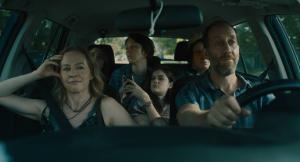 Given Sherman’s background as a film professor, you would hope that if anyone, when given the opportunity to make a feature film, could rise to the occasion, it should be somebody whose career rests upon the analysis of what makes movies work best. They/Them/Us succeeds as a relatively light-hearted rom-com and family drama with several nice moments. It’s hard to quantify, but you know better writing when you witness it, how characters interact and how witty the exchanges are and how much characterization they impart. Typically, a lesser writer will overstay their welcome or begin a scene before the importance. This can also be done to add unique character details, but often it’s a writer not knowing when to start and when to leave, a trait I’ve experienced so many times with Ohio-made indies. With Sherman’s scene writing, everything is to the point and moving, imparting the most important info or character detail, then chugging along. Early on, we establish Charlie as a man struggling to parent two surly teenagers and find someone special online. The fact that in the opening seconds he seems to be messaging two women who have BDSM kinks in their profile should be telling. After Charlie admonishes Danny for smoking pot in his house, he snatches the kid’s bong and runs upstairs, pacing and unsure of what to do next as his breathing calms and he focuses his attention to the bong in hand. Cut to Charlie smoking the bong to relax. It’s a quick, smart detail that demonstrates Charlie’s uncertainty on how to be the stable authority figure with his own dismissive children.
They/Them/Us is also a charming and sex positive romance between two middle-aged divorcees, a subject that rarely gets such big screen attention. The movie touches upon the challenges of modern dating when you’re not just dating a single individual but a person with attachments, about starting over later and finding a new life that will make appropriate space for you. Selecting a common dinner option can be its own minefield. It’s a perspective worthy of more attention by Hollywood. Beyond that angle, the movie is also surprisingly kinky for a “family comedy.” While unrated, They/Them/Us still exists in a more PG-13-friendly universe so it’s rather gentle when it explores the BDSM urges of Lisa. The movie is refreshingly free of judgements though has more than a few grand jokes drawn from Charlie’s squeamishness. He tries to throw himself into a more aggressive role, and Lisa asks him to pull her hair harder, and he says, “I’m sorry, I can’t. I’m a feminist.” I laughed out loud at that one. Another time, Charlie is attempting to spank Lisa and he keeps hesitating, finally admitting that it keeps bringing up unwanted and uncomfortable memories of spanking his unruly son as a child, something he still feels guilty over. In time, Charlie seeks out advice and instruction on how to be a better BDSM participant, and his educational process is a bit obvious, with more than a few easy gags (no pun intended), but it’s still one borne from a desire to better understand and fulfill his partner. It’s a sweet romance.
 Slotnick (Twister, The Marvelous Mrs. Maisel) has been a staple of TV and movies for decades, a reliable “that guy” with overly neurotic tendencies. He’s a terrific put-upon dad and his age has only added more authenticity to Charlie’s harried struggle. He’s got a warmth to him that is easily conveyed during his brighter, kinder moments, and he’s also got a wellspring of awkward, cringe-inducing comedy as a middle-aged dad trying too hard to connect with a brood of teenagers and often flailing. When he’s genuinely happy, Slotnick genuinely wins you over. I think the vague details about Charlie’s dismissal from his previous professor job are a mistake. We’re told by his ex-wife, who inexplicably is still trying to get him back for the sake of the children, that a coed sent Charlie inappropriate texts. That topic is way too big not to clarify, and it’s also strange that Sherman and co-writer and partner Melissa Vogley Woods never come back to this as a conflict with his new relationship. It also seems like a natural point of conflict for keeping his new position at the Christian college and yet it’s glossed over (the resolution over that is laughably too tidy and convenient but keeping with the low stakes).
Hargreaves (13 Reasons Why, Homeland) is very enjoyable as the more experienced and confident half of this blended relationship. Lisa knows what she likes and is not ashamed, and she’s patient with Charlie as he attempts to reach her on her level. Hargreaves has a fun spirit to her that doesn’t veer into exploitation. It would be easy for Sherman to just write her as a fetish object for Charlie, but Lisa comes across as a real woman with her own desires and doubts and questions. There’s a scene where Lisa and Charlie are talking after their less-than-stellar first date with the combined family unit, and Lisa’s children are impatiently waiting by the locked car. “Come one, mom,” they whine. “You have the keys.” In mid-sentence, Hargreaves just hurls the car keys to her children and then continues her conversation with Charlie without missing a beat. It’s a defiant, petulant, lovely moment that keys the audience into her devotion to Charlie and her own character. I adored it.
Lexie Bean, as Maddie, and Jack Steiner as Danny, are both acting breakthroughs. Both of the actors are so natural and with a great poise and presence. Steiner has minimal acting experience but could easily headline a movie with the sly charisma and comic timing he displays. He even finds a way to enliven one of the least funny segments in comedies, the drug trip. Bean has notable, obvious talent that I regret that They/Them/Us doesn’t draw more upon.
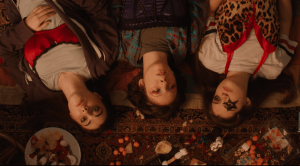 There is one significant critique I do have with They/Them/Us and that’s that this all feels like a far better fit for a television series than as a single film. Rare do I come across a story engine that seems like it has the output to keep going, but that’s what we have here. There are three significant storylines that all would have benefited with far more time and development that a wider field of narrative writing would afford: 1) at its core, this is a story about a blended family and all the troubles and revelations and connections that come from two established families suddenly sharing spaces and lives, 2) Charlie working at a conservative Christian university and having to awkwardly pose as devout while hiding his true feelings, and 3) it’s a BDSM rom-com.
Taken as a whole, it’s easy to see how those storylines could form the backbone of a series-long narrative. Charlie’s facade at work could get more and more complex to carry on, and as his secret gets discovered, more desperate. He could also experiment more with wanting to become sexually adventurous for his partner. There could even be the question over whether he was having an affair when he was really just getting one-on-one instruction with a helpful dominatrix to educate himself. That might sound like a generic sitcom contrivance, but the script makes plenty of these kinds of conflicts and too-easy resolutions. When Maddie refuses to eat, Charlie sits with them, and within literal seconds Maddie is confessing a teacher is deliberately misgendering them and it hurts. Charlie’s solution is to get donuts, and it’s during his exchange with the drive-thru intercom that he makes a heartfelt stand about Maddie being non-binary and preferred pronouns, and then it’s like we’ve wrapped up that conflict in a bow. It’s so absurdly quick, and these characters have not had a conversation together before this, that we’ve seen, so its resolution feels so abrupt as to be arbitrary. That’s where a TV series would allow these characters and their inter-family drama to really take shape. An entire episode could be devoted to Charlie trying, and awkwardly failing, to bond with Maddie, finding a small triumph at the end that would feel better earned. This goes especially in the last twenty minutes when Danny’s drug problems get way too serious for the film’s tone. For most of its running time, They/Them/Her has such a low-stakes sense about all of its family drama, keeping things light and loose. It can’t quite make that leap to melodrama that encapsulates the end of the movie, a transition that doesn’t feel properly established.
 When you’re dealing with human relationships, and with the battleground that a blended family would present, then squeezing everything into a measly 90 minutes feels like a disservice. At one point, Charlie and Lisa ask if they’re rushing things, going too fast, and they agree to move in together at the twenty-minute mark, but it’s almost like an admission to the audience about the movie. Everything is moving just too fast. We need the time to slow down, to really luxuriate in the awkwardness and unexpected connections, and the kind of narrative berths where each character can feel more fleshed out and less defined by a single note of distinction (the Non-Binary child, the Drug Problem child, the Sarcastic child, the Blame Shifter, etc.). I still enjoyed these characters and their interactions, but I would have enjoyed them even more with a larger scope to appreciate the depth and eccentricities of each person.
They/Them/Us is a rather wholesome movie that doesn’t feel like it’s talking down to its audience, judging its characters punitively, or overly sugar-coating their personal dilemmas. It’s not a particularly challenging movie but Sherman and his cohorts know what kind of movie they want to make. It’s technically proficient, assuredly low-budget but still professional in presentation. I often enjoyed the musical score by David Carbonara (Mad Men – what a get this guy was). While some subplots and conflicts are so swiftly and conveniently handled, the core of this charming movie remains its fractious, funny, and all too human relationships. When my biggest complaint stems from wanting more, more of these people, more of their adjustments and misunderstandings and triumphs, and more comic possibilities from a larger time frame of stories, then you’ve done something right with your 90 minutes of movie and clearly not everyone can accomplish even that.
Nate’s Grade: B
Share this:

Scream 5 (2022)
 The fun of the Scream franchise has been its meta-textual commentary, wry jabs at horror, and the guessing game of who the killer culprit(s) could be, and Scream 5 or Scr5am (what it SHOULD be called) is a good-fun B-movie that knows precisely what it wants to be and plays to the strengths of the franchise. We haven’t had a Scream sequel since 2011, and the landscape of horror has changed as well as the landscape of multi-media entertainment. There are new satirical horizons to be targeted. This is the first Scream after the death of legendary horror director Wes Craven, but it’s in good hands with the directors and writer of 2019’s bloody excellent Ready or Not. The fun, knowingly goofy elements are retained, and the filmmakers clearly have love for what they’re sending up. There’s a sequence of languishing shots of a character opening fridge doors and pantry doors and I felt everyone in my theater tense for the eventual reveal of the killer on the other side. Moments like these are the good kind of tension-release giggle that Scream can get away with. The plot is sufficient to gather the “legacy characters” back to the site of the original murders for a new stab at rewriting the movie franchise. There’s even some plot elements that are surprisingly resonant and deeper for a satirical slasher franchise, like tear-filled discussions over loss, abandonment, mental illness, and personal responsibility. There’s a sister-to-sister reconciliation that plays like a straight drama, and it plays well. There’s nothing terribly gruesome or memorable about the kills, and some of the meta-commentary can feel like talking in circles, especially as characters knowingly enact scenes from the original. It’s a copy of a copy, meant to mock Hollywood’s reboots, but it’s still a copy of a copy. Sometimes the knowing winks are obvious, like a shower sequence recreating Hitchcock’s angles, and sometimes the potential homage feels lost in translation. Still, Scream 5 is a fun, ironic, bloody hoot of a movie, and for fans of the franchise a more welcomed return to the creative heights of the original movie.
Nate’s Grade: B
Share this:

The 355 (2022)
 The most interesting part of The 355 is its inception and the reference of its title, a reveal that doesn’t come to light until the literal final minutes of this clunky two-hour spy thriller. I don’t know why this clarifying detail was withheld so long, as if it was its own spoiler or twist; the title is in reference to a female spy that reported to George Washington during the Revolutionary War, the identity of whom is still a mystery to this day. Maybe co-writer/director Simon Kinberg was afraid explaining this historical spy fact would make the audience envious of the story of Washington’s secret female spy being the movie they watch instead. The other point of interest is that The 355 began when actress/producer Jessica Chastain pitched Kinberg on the set of 2019’s Dark Phoenix to develop a female-lead Mission: Impossible-style spy team. It seems like a no-brainer of a concept, enough so that Universal bought the pitch for $20 million in May 2018, but the question I have is what about the production of Dark Phoenix, the woeful final whimper of the X-Men franchise, made Chastain want to re-saddle with Kinberg as a genre-action director? The 355 is a thoroughly mediocre spy thriller that recycles every trope and cliché imaginable, but this time it’s got a badass gang of women leading the charge. Is that considered genuine progress by most standards?
Mason “Mace” Browne (Chastain) is a secret agent still mourning the loss of her partner/best friend/possible lover (Sebastian Stan) during a mission gone bad in Paris. Her department director has told her, in coded terms, that he has to ground her, but if she went off on her own to seek vengeance, then he would understand. Mace recruits her old pal Khadijah (Lupita Nyong’o), a retired agent trying to live a normal life as a professor of technology. Together, they butt heads against Marie Schmidt (Diane Kruger), a German secret agent targeting Luis Roja (Edgar Ramirez), a Colombian officer who came into possession of a world-destroying device and attempted to sell it to the highest bidder. Graciela (Penelope Cruz) is a psychologist hired by Roja’s agency to bring him back and return the dangerous device. She gets swept up into the mission after becoming the only key to opening the device. She joins Mace, Khadijah, and Marie, along with a Chinese national (the previously incarcerated by the Chinese government Bingbing Fan), to retrieve the device at all costs.
 The 355 isn’t the worst movie by far to ever bear the spy thriller label, it’s just so disappointingly rote and predictable, even down to the double-crosses and secret villains. If anyone has watched more than one spy thriller, they will recognize so many familiar elements and settings. Why not throw in a missile silo and factory warehouse that doesn’t seem to produce anything other than sparks? The McGuffin is treated as essentially meaningless, and the fact that it’s a program only on one hard drive would make you think any villain with an iota of sense would at least make a copy. The opening prologue of how the McGuffin got into a Colombian officer’s hands is entirely superfluous. Apparently, the genius son of a Colombian cartel boss has created the world’s most dangerous technological weapon, and nobody seems to think this is worth a conversation. If this kid can develop a super weapon at this age, what more could he do? If I was his morally corrupted father, I would hug the boy, let him know how proud I was, and rather than sell it to the first scuzzy villain who will obviously murder you, I would place my son in a fortified palace nobody knows and tell him to just keep creating technological marvels that could improve the world. All of this is my way of saying the mechanics of how this came into being are unneeded and just another complication. Speaking of complications, if you cannot guess who the surprise villain is going to be immediately, then congratulations, this must be your first spy thriller, and you could do better.
A spy thriller lives and dies depending upon its action set pieces. The reason I have adored the Mission: Impossible films, especially since 2011, have been their eye-popping set pieces, stunt work, and masterful action orchestration. I’m not coming back for the characters. Good action sequences can redeem a fairly rote and predictable story with lackluster characters. Unfortunately, there is nothing on display in The 355 that will make you forgive its flaws. I’m unconvinced that Kinberg has a real feel for how to stage action. He’s written action sequences for decades as a high-concept Hollywood screenwriter but filming them in an exciting manner is another matter entirely. There are foot chases, fist fights, and shootouts galore, but none of them are ever filmed in an exciting or surprising way. Kinberg has adopted the shaky handheld Bourne-style camerawork to juice the sequences but to no avail. There’s one action scene that takes place in the dark broken up by the strobe of gunfire, and it doesn’t feel so much stylish as a quick fix around poor fight choreography. The editing and composition of the action will often deflate the action tension. It’s not in the ADD-drenched Michael Bay realm, but the editing and arrangement just feels so perfunctory. Some moments are even a little embarrassing, like punches that are wildly oversold that needed to be cut around better. It’s no better than what you might get from any run-of-the-mill direct-to-DVD effort, and if your movie cost $70 million and it plays no better than Bruce Willis’ fifth movie of the month, that’s bad. There’s a notable absence of fun like the movie was taken too seriously to be allowed fun.
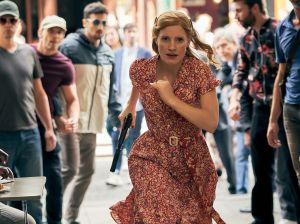
 The “girls can do it too!” vibe of the production is laudable but also feels stagnant and dated, not that we have it our threshold of exciting and capable women in action roles, but that’s its entire reason for being is to take a script and replace [generic male character] with [generic female character]. For some viewers, that might be enough to satisfy their genre cravings, and for some it might even prove empowering, which I assume was Chastain’s intention when developing the project. However, these powerful women feel less like human beings than gender-swapped one-note action staples. They will make quips about women having to clean up the messes men make, but these are no better than the quips in a 1990s action movie trying to earn cheap back-pats for being feminist in the least meaningful ways. The goons in the movie make fun of one another for losing fights to women. I guess in the opening mission, the fact that Mace is running around in a long sundress is meant to break the mold, but I also just kept wondering how much she would have preferred pants. The women of The 355 are routinely defined by their relationship to men. Mace is looking for vengeance because her best friend/lover was killed in the opening mission. Marie is bossed around by a glowering superior who explains, to the benefit of the audience, that she’s “good at everything except taking orders.” Graciela and Khadijah are defined by their familial connections and the one skill they have; one of them is the tech guru, the other is an agency psychologist. The male love interests are threatened, and even seriously harmed, as no more than a means to provide further motivation of Act Three vengeance. It’s bad storytelling when it’s featuring men, and it’s just as bad when it’s featuring women. If the movie was going this route to be satirical or even critical of the treatment of women in these kinds of genre fare, that would be something laudable and interesting. Atomic Blonde went there with gusto and pulled it off. This movie has nothing really to say. Taken together as a whole, it all makes any feminist aims of The 355 feel halfhearted.
There was a way to make this movie better and it was so obvious: making Cruz the lead. Her character is the only one not familiar to the world of spy craft and action, so she would serve as the best entry point for the audience. Why not make her perspective the main one? If the ensemble of characters is an ensemble of one-note stock characters, without personality to engage, then why not limit them further? Why make it an ensemble of bland characters? The character of Graciela has by far the most potential on paper, the woman pulled into a world she doesn’t understand and feels ill-equipped to survive within and then her learning to acclimate. This would have improved the screenplay by giving us more attention on a central character that has more clear vulnerabilities and points of empathy and intrigue. She has a family, she was never intended to be in this life, and she has to adapt quickly or there will be severe consequences. That is far more of an interesting start and arc than watching a group of grim-faced girl boss robots.
 Formulaic to a fault, The 355 reminded me of 2017’s The Great Wall, a $150-million Chinese-set action movie directed by Zhang Yimou and starring Matt Damon. It was a suitable action spectacle but I concluded with this question: “It’s not much better or worse than other empty-headed big-budget action cinema from the Hollywood assembly line, but is that progress? Is making an indistinguishable mediocre B-movie a success story?” That same question hangs over my analysis of The 355. It’s indistinguishable from other bland spy thrillers but this time with a group of lead characters played by women, several of them in their 40s at that. Maybe that’s progress considering the budget and representation, or maybe we can expect more than what we got here, a movie that recycles the same dated and tired tropes but now – with women! The action is middling, the characters are dull, the villain is predictable, and it finds itself in a frustrating middle-ground where it takes itself too seriously but doesn’t have the substantial material to cover. The 355 wastes its fab cast, possible points of intrigue, and proves that tropes without comment or exception are still as boring no matter the gender, race, or identity of those involved.
Nate’s Grade: C


 nathanzoebl
You must be logged in to post a comment.