Category Archives: 2014 Movies
The Fault in Our Stars (2014)
 With a premise involving two teenagers with terminal cancer, you’d be correct to assume that The Fault in Our Stars is a sad experience. It wants to be an unsentimental version of the Big Cancer Weepie, like a more hip version of Love Story. It wants to obliterate your tear ducts but in a way that won’t make you roll your eyes from an overdose of maudlin material. Based upon John Green’s international best-selling young adult novel, the doomed romance of the year has already devastated millions of moviegoers. Is it the feel-bad movie of the summer with a soundtrack Zach Braff would approve?
Hazel Grace (Shailene Woodley) is a 16-year-old girl dealing with lung cancer. She lugs around an oxygen canister to her group therapy sessions, really to everywhere she goes. Her parents (Laura Dern, Sam Trammell) try and give her enough space, try to make her feel like a normal teenager, but they all know what is coming. Then one day at group therapy she meets Gus (Ansel Elgort), a tall, handsome, effortlessly confident young man in remission himself (he had a leg amputated from cancer). Gus hones his sights on wooing Hazel, winning her over. She resist at first but then finds herself falling for the charming fella (“I fell for him like falling asleep; at first slowly, then all at once.”).
 With constant life and death stakes and the certainty of a young life, it would be easy for the film to go overboard with its emotional histrionics, and yet the real grace of the film is its more realistic approach to portraying this life. It just doesn’t seem fair for someone so young to be stricken with a deadly disease that will pluck him or her from the Earth before settling into adulthood, but these things happen. Hazel and Gus are characters that aren’t begging for sympathy or even special treatment; they’re tired of being treated like lab specimens too fragile to be left on their own. It’s easy to lose the person when the outside world completely identifies them as afflicted. The skill of this movie is that it’s heavy with drama and sadness but it doesn’t quite overwhelm, at least until the last act. Until then, much like the characters, the movie finds the moments of happiness, connection, and tenderness with human contact. You feel the bursts of nerves and excitement over the flirty connection between Gus and Hazel. You’ll enjoy the couple-y moments they share, finding their own identity as a pair, like claiming “okay” as their own secret coded language. You’ll feel warm and fuzzy over that first kiss. It’s a winning pairing that produces a steady stream of sweet exchanges and discoveries. This is something of a silver lining movie that can make you ruefully smile through your tears.
But as a Big Cancer Weepie, and with two suffering lovers, there is a definite cloud that hangs over the entire movie. You’re nervously waiting for some sort of turn for the worse. From a storytelling standpoint, I think every ticket-buyer knows with two cancer-stricken leads that at least one of them will be dead before the end credits. And so we wait for the bad news, wait for that other shoe to drop, and this unsettling dread permeates the first half of the movie, tainting all those happy couple moments. Gus and Hazel have several cute moments, but I found myself holding back, waiting for the proverbial hammer to drop on their small shared happiness, and sure enough it will come. The entire third act is dominated by one character’s descent into terminal. For the sake of spoilers I won’t say which, though readers with keen analytical skills can likely guess which of the pair is more expendable from a plot standpoint. It’s at this point when the movie transitions from sad to full-blown weepie, looking to draw out every last tear. With the diagnosis set, our couple heads toward that date with oblivion, and we get all sorts of weight heart-to-hearts, teens grappling with their own legacy, and even a practice funeral for friends to say exactly how much the soon-to-be-departed loved one mattered. Every step is wrung out, even to the point of one last letter/message before death that serves as the closing, considerate voice over. It’s hard to resist the cumulative effect of all these big dramatic plays at your emotions (I got teary at several points but held my ground).
The question arises at what point is this blatant emotional manipulation? The first half of The Fault in Our Stars finds a balance between the heaviness and the levity of first love, grounding its characters and their emotional highs. However, with that aforementioned turn of sullen events, the plot then becomes one long series of Sad Ruminations. What will the friends do without their pal? What will the family do? What does this harsh realization do to other terminal characters and their own family relationships? What about coming to grips with certain death? And then there’s the practice funeral. For a movie and a set of characters that refused to dwell in a pit of sadness, that’s all that the second half of the movie feels like. It also feels like the two-hour-plus plot is overextended to squeeze in one sad ruminating scene after another. In a way, it reminded me of the onslaught of emotional punishment that was the last act of Marley & Me, an otherwise enjoyable movie that devastated every dog owner by its conclusion. It feels a bit much.
 And this leads me to another issue with the adaptation process, namely that Gus is actually a character with little depth to him. He’s a smiling, immensely likeable figure who doggedly pursues Hazel and falls for her hard. But what is he as a person? He’s overly confident, compassionate to others, witty, charming, but these are more superficial descriptions than deeper analysis. I suppose one could argue he’s just decided to embrace life smiling, but for the most part Gus comes across as a prime figure of squishy wish fulfillment. He’s too good to be true, and with a lack of stronger characterization, that’s the way he plays. Now, I certainly liked the character and found Elgort (Divergent) to be a charming lad, but when the film transitioned to sadder territory, my feelings felt blunted. I would have felt more for this couple had Gus felt more like a real person.
It’s a good thing then that Hazel is the protagonist and main point of view, especially when Shailene Woodley as lead actress. I’ve raved about Woodley before, particularly last year’s underrated Spectacular Now, but every new leading performance is further proof that she is one of her generation’s best young actresses. There is no artificiality in this woman’s body. Her performances are master classes in exuding naturalism, blending into the character, finding subtle ways to express a wide range of emotions; seriously, this woman can express so much just with a tilt of her head and the right kind of smile. Woodley is terrific once again, instantly locking in your sympathy. Her trial of love and suffering run the danger of being heavy-handed but Woodley seamlessly anchors the movie, guiding the audience back to her sphere whenever things get too overwrought. When she tears up, I teared up. When she unleashes a howl of grief, I had to fight every impulse in my body to join her. Her chemistry with Elgort is suitable if unspectacular, but Woodley sells every emotion and without a hint of artifice. If she were in a Big Cancer Weepie, you’d never know it given the skill of her performance.
I can’t imagine there will be much surprise for anyone who watches The Fault in Our Stars. Two young lovers with terminal cancer have a way of writing itself. What separates this story from other sappy tearjerkers is its presentation and perspective. This is a movie that flirts between jaded and maudlin, scoffing at the overt sentimentality of grief culture yet finding a middle ground that feels humane and honest and earned. Woodley’s strong, emotive performance helps ground the film even when the long string of manipulation begins. I wish Gus was a stronger character rather than a charming romantic compliment, a dream boyfriend who indeed comes across as too good to be true. I wish the movie also would not get swallowed up by the heavier elements it found balance with before. With all that being said, this is an engaging drama first and an amiable romance second. You may see the end coming from the start, but the same can be said about all of us. We all know how our own story is going to end. The only difference is the people we touch in between the start and the stop. That is our lasting legacy. The Fault in Our Stars is more a journey than a destination, and it does enough right with enough sincerity and intelligence to endure the pain.
Nate’s Grade: B
Share this:

22 Jump Street (2014)
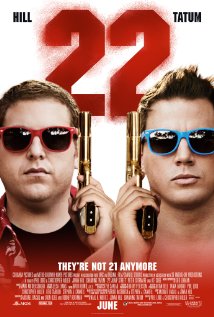 When 21 Jump Street was proposed as a movie, nobody thought it was a good idea. Even its stars and writers. They used that as an opportunity to craft one of the more charming, surprising, and hilarious films of 2012, a movie so good that it was also one of the best films of a relatively great year at the movies. Now that was something nobody expected with a 21 Jump Street movie. As often happens, Hollywood looks to keep the good times going, and 22 Jump Street is knocking at the door. In Hollywood tradition, sequels usually follow the “more of the same” format with a dash of “bigger is better,” a fact that 22 Jump Street takes to heart.
Having successfully busted a high school drug ring, Officers Schmidt (Jonah Hill) and Jenko (Channing Tatum) are the toast of their unit. That is until they let a dangerous criminal (Peter Stormare) get away with a shipment of drugs. It’s back to the Jump Street program, as their police chief (Nick Offerman) laments that everybody just needs to do the exact same thing that worked the last time. Captain Dickson (Ice Cube) has assigned Schmidt and Jenko to go undercover at the state university to sniff out where the student body is getting a powerful and deadly designer drug. Schmidt grows close to Maya (Amber Stevens), an art major who knew a girl who overdosed on the new drug. Likewise, Jenko is falling for team quarterback Zook (Wyatt Russell), or more accurately the bond they share as two athletes with a similar brain. The partnership of Schmidt and Jenko may be in trouble for the long haul if they can’t work together.
 This may be one of the most meta movies of all time, existing outside itself in tandem to always provide a winking dose of commentary about its own silliness, excess, and corporate mentality about replicating success through the least creative means possible. There’s even a character with a literal red herring tattooed on his bicep. There are plenty of in-jokes without breaking down the fourth wall, and the meta cleverness is an entertaining way to pave over the general same-ness that goes along with the limited undercover premise. While cracking wise for its full running time, 22 Jump Street really is “more of the same.” For most, myself included, that is completely acceptable since the first 21 Jump Street was an unexpectedly witty and comically brash outing. Seeing another adventure with this same team is more than justifiable, especially with the kind of comic kinship that Hill (The Wolf of Wall Street) and Tatum (White House Down) share. Once again the guys go undercover to bust a drug operation, and once again they each get close to a different set of students, and once again their relationship takes a personal hit. It’s the same plot beats but with different jokes (like the R-rated version of Anchorman 2). The entire “going undercover as a school student” concept is so dated to begin with, and neither Hill nor Tatum can credibly pass at this point, so the entire enterprise feels like they’re squeezing the most they can while they can, enjoying the good times, the good chemistry, being silly on the studio dime, and counting their luck.
The end credits for 22 Jump Street deserve special praise just for the appearance of burning down its franchise. Throughout the film the guys are mocking the very notion of a sequel. By the end, they mock, without abandon, the idea of a franchise. We flash through an absurd array of new assignments, new sequels, and new school-setting undercover gigs, and it’s almost like a flash-forward into the timeline of the movie, like the finale of Six Feet Under. There are some amusing cameos and business satire to mock with as well as the general ludicrous nature of repeating this plot/formula (Magician school?). The end credits leave the audience feeling buzzy and giggly, a perfect comic high, and it’s the best end credit high since the original Hangover.
The real enjoyment is watching Hill and Tatum continue to mine what has become one of film’s best onscreen bromances of all time. I never would have pictured these two fitting together so smoothly, or Tatum being such an unexpectedly natural comedic talent. Thank goodness for the 21 Jump Street movies for offering us these untold comic gifts and for knowing what the main attraction is and how to properly develop it. The relationship between friends/colleagues/bros Schmidt and Jenko is the most consistently interesting, surprisingly emotional, and comically ripe subject in the film. We have two great actors and watching them butt heads is just as fun as watching them get along. In the sequel, the guys go through what serves as an analogue for a separation, wanting to see other partners. We know in our hearts these two are meant to be together, and so much of the fun is watching just how this odd coupling now seems so indispensable to one another, with Tatum’s zigs blending ever so delightfully with Hill’s zags. I could watch another movie of just these guys doing paperwork.
In the first film, Jenko and Schmidt were set up to fall back into stereotypical roles before the movie found a better solution. Jenko was going to be the jock with sports classes, and Schmidt the nerd with AP classes and drama. Then a mix-up, and they have each other’s identities, and the movie is that much better, forcing each out of their comfort zone and finding the better comic scenario. With 22 Jump Street, the movie falls back to the old social order. Jenko hangs with the football jocks and the frat brothers and gets to be the super popular student-athlete, while Schmidt is left to investigate the art majors who knew the dead coed. It has them falling back into their high school roles (popular vs. outsider) and it’s not nearly as interesting, especially after seemingly growing beyond these moments. The side characters aren’t as interesting either, many lacking material to develop beyond one-note joke machines, like Zook. I was mildly intrigued by H. Jon Benjamin (TV’s Archer, Bob’s Burgers) as a football coach obsessed with protecting the goalpost, but I wanted more. Twin stoners who talk at the same time are not enough.
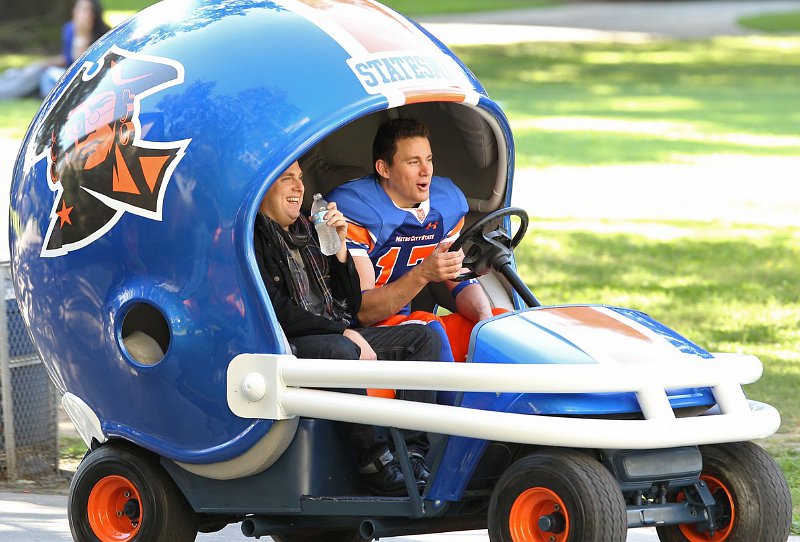 There is one supporting actor given enough material to shine and that is Workaholics’ actress Jillian Bell. She plays such a deadpan, biting, sarcastic, no-nonsense roommate who won’t entertain for one second that Schmidt is who he says he is, and she is wonderfully brutal with her insults. There’s a later scene where she keeps wrongly misinterpreting a fight with Schmidt into something else. It’s a highlight of the movie, a great example of her physical comedy skills and sense of timing, and it’s a plumb example of taking a topic that a situation that could be uncomfortable and finding the right balance to guide an audience along for the best laugh.
Like before, once the movie adapts to its action-filled climax, the jokes start taking a backseat to the action theatrics. Returning directors Phil Lord and Christopher Miller (The LEGO Movie) have kept their same brand of rambunctious spirited comedy alive and well, which keeps the movie’s pace brisk and always open to fresh weirdness. While some jokes don’t work as well the second time (Vietnamese Jesus, the drug freak-out fantasy sequence, though its use of Creed music almost makes up for that), this is still more sequel than retread. This is not an Austen Powers that repeats the exact same jokes with slightly different settings. Lord and Miller understand how to satiate an audience without overt pandering. They know how to build payoffs that are small and payoffs that are big, ones directly linked to character goals. There are strong comedic set pieces unrelated to any sort of meta commentary, Schmidt’s impromptu slam poem being one of them. It’s a manner of giving people what they want while still finding new ways to surprise, because otherwise comedy is dead without the subversion of expectations.
“More of the same” is the best and worst summary for 22 Jump Street, and despite 1500 words of film criticism, all you really need to ask yourself. Is more of the same good enough for you when it comes to another 21 Jump Street movie? Sure, we’d all wish for the same sort of unexpected cheeky revelation that was the first film, but then again no one had any expectations that a 21 Jump Street movie would be anything worth watching, let alone one of the best films of that year. 22 Jump Street is hilarious, witty, aggressive, irreverent, and even when it has to take on the role of action-comedy, it does so with a consistent wink, pointing toward all the sequel tropes and absurdity without rubbing your nose in every single reference and gag. The second time around Jump Street is, by definition, never going to be as fresh, but the company is still top-notch, the jokes are still layered and cracking, and the determination is high. It’s a sequel that delivers what it promises. I’m ready to take this franchise as far as it can conceivably go for two men well into their 30s-posing-as-high-schoolers. Magician school, here we come.
Nate’s Grade: B+
Share this:

Maleficent (2014)
 We’ve seen several stories try their hand at reclaiming villains, telling the tales from their relegated and forgotten points of view; after all, history is written by the winners. This technique can be illuminating and fascinating when done right, like Grendel or Gregory Maguire’s popular Wicked novels. However, does the public really have that much knowledge of Maleficent? Did most people even know what her name was? For that matter, do most people even know what the real name of Sleeping Beauty is or do they, like myself, just indifferently refer to her as Sleeping Beauty? That relative audience ignorance provides a wide canvas to retell this woman’s story.
In an ancient kingdom, there were two lands, one with men and one with magical creatures. Maleficent (Angelina Jolie) is a cheerful fairy with long angelic-like wings and a pair of horns coming from her head. She befriends Steffen (Sharlto Copley) an orphan with ambition to be the next king of men. He betrays Maleficent, drugging her and cutting off her wings to prove to the dying king that she is dead. Years later, and now king, Steffen has a christening for his new baby daughter, Aurora (Elle Fanning), and Maleficent shows up. She curses the young child, declaring that on her sixteenth birthday she shall prick her finger on a spinning needle, fall into a deep slumber, and only be awakened by true love’s kiss. Steffen destroys all the spinning wheels he can find and sends out his daughter into the countryside for protection where she’s raised by three fairies taking on the form of humans (Imelda Staunton, Leslie Manville, Juno Temple). It’s really Maleficent who helps raise her, watching over her and protecting her through the years, regretting the horrible choice she made in anger.
 I’ll start by saying the reason you should see this film, by far, is Angelina Jolie (Wanted). She is terrific. You can readily tell how much fun she’s having with the character, and everything from her command, her physicality, her presence, her vocal delivery, is top-notch. She’s great from start to finish, the perfect embodiment of the character. Would you believe this is her first live-action film role in almost four years? Wow, did movie audiences miss her. If only the remaining movie was as good as Jolie.
It’s a shame then that just about everything falls into a rigid fantasy formula that squeezes any sense of magic dry. Maleficent is the queen of the fantasy half of this world, and after her betrayal by Steffen (more on that below), she seeks vengeance, cursing an innocent child and then remarkably caring for her through a hasty montage. It’s hard to ever accept Maleficent as a malevolent character, and I’m sure that’s by design by the Mouse House. She doesn’t do anything too scary and when the time comes she ends up making the right decisions. There isn’t really much of an exploration of her character here. There’s the pretense that she’s hero and villain but that falls away very quickly, especially with her loving relationship with Aurora. She wants to do right and feels terrible about the curse, but again that’s quickly taken care of. Aurora literally spends five minutes onscreen in her “eternal slumber.” It’s more like a magical nap. If the relationship between Aurora is what makes our heroine whole again, then the climax is saving Aurora, not getting vengeance against Steffen in a dumb CGI battle.
The magical fantasy world also feels oddly underutilized. At least in past Disney efforts like Alice in Wonderland and Oz the Great and Powerful, the worlds at least felt like they had been explored, with many of the magical creatures pitching in during an Act Three battlefield. That isn’t the case here. The opening with young Maleficent (Isobele Molloy) introduces some strange creatures and some fairies, but they end up being little more than background dressing, meant to only communicate the change in Maleficent. In the end, it’s just Maleficent and her trusty crow (Sam Riley in human form) and that’s it. Question: if she can transform her pet into any number of creatures, including a dragon, then why didn’t she do this before? When she’s racing to save Aurora from pricking her finger, would a dragon have not been a faster mode of travel than a horse? Maleficent’s powers are also too ill defined, and her big weakness just happening to be iron feels trite, like her version of kryptonite. The fairy world and its powers aren’t given the examination it deserves. As a whole, the world of Maleficent feels less than magical. It feels more like a series of scenes rushing through a plot holding fast to the beats of recent Disney live-action hits.
I don’t think I’m reading too much into what is intended as a fantasy film for families, but Maleficent is one big analogue for rape. Hear me out. The title character falls in love with a man who likewise tells her he loves her but is just using her to his own advantage. He then drugs her drink and while she’s unconscious has his way with her, leaving her physically disfigured and feeling betrayed. She turns inward, rejects the outside world, and dwells in sadness and seclusion. She doesn’t tell others about her attacker until many years later. The public is quick to blame the victim. And then ultimately, once she feels “whole” again thanks to reaching out to others/support, she is able to confront her attacker and rise above his destructive influence, returning to some semblance of her former self. When looked at in its entirety, does that not sound like an intentional analogy for rape/sexual assault? Maleficent’s character arc mirrors the experiences of rape victims, and the fact that this kind of mature storyline is played out in a Disney summer family film is kind of extraordinary. It’s not so explicit that little kids will walk home asking mom and dad about the persistent nature of “rape culture,” but its presence and articulation is a start. As a rape analogue, it’s not offensively handled unless you are one who finds its very inclusion an offense for a PG-movie. Now, this storyline does transform the character in a way others may dislike. Rather than being a powerful agent of evil, she’s a woman who was victimized by a man and that’s why she turns toward the dark side. For some this will be a disappointing turn of events. I can’t say one approach is better than the other from a feminist point of view, but I credit Disney for following through with uncomfortable symbolism for rape to describe Maleficent’s arc.
 The rest of the cast fill out their roles but lack the flare of Jolie. Copley (District 9) is proving that he may be best under the guidance of Neil Blomkamp. He was one of the better parts of Elysium but without Blomkamp he makes such mystifying choices as an actor. His voice and performance were powerfully wrong for Spike Lee’s unnecessary Old Boy, and his demeanor is all over the place with Maleficent. To his credit, the character is horribly underwritten and given so little mooring to try and understand his ever-changing decisions and temperament. Fanning (Super 8) is an innocuous Aurora though the actress has often showed much more ability. Here she just laughs a lot. Riley (On the Road, Control) is wasted comic relief and as a companion. The three color-coded fairies are consigned to broad comic relief, usually bumbling and getting into slapstick brawls with one another. I can’t imagine children finding them too funny.
Maleficent the character is given great care by Jolie, the actress. Maleficent, the movie, is slapped together and feels devoid of any sort of engaging storytelling or big-screen magic to leave a favorable impression. It’s a rather expected and unexceptional retelling that hits all the notes you’d expect, though without as many magical fantasy creatures, which seems like an oversight for a world of fantasy. The rape analogue is a bold choice for the filmmakers and deserves credit. I wish I could also give them credit for the storytelling and characterization, both of which are rather flat and rote. The special effects are likewise unremarkable. Outside of the rape symbolism, this is a movie you can likely predict every step of the way just looking at the poster. I was able to even predict the left-turn ending concerning “true love’s kiss,” though Frozen already got there first. If you have low expectations and simply want to watch Jolie and her killer cheekbones be fierce, then perhaps Maleficent is worth checking out. Otherwise, this villain’s retelling feels far too familiar and safe and underwhelming to be worth the effort.
Nate’s Grade: C
Share this:

A Million Ways to Die in the West (2014)
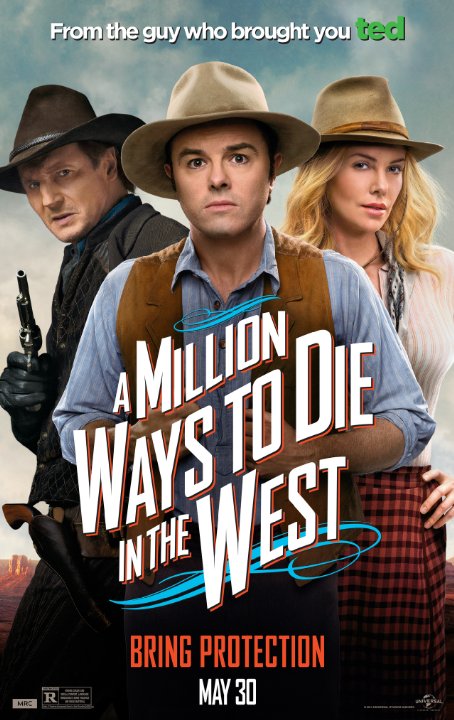 I was no fan of Seth MacFarlane’s first big-screen effort Ted, but I had my hopes up for his Western comedy after some genuinely funny trailers and the reported promise of a lack of anachronistic jokes. A Million Ways to Die in the West lands about half of its jokes, which is a definite improvement though still has enough dead spots that left me shifting around in my seat. The main conceit, a self-aware individual explaining all the myriad ways the Wild West is horrible and will kill you, is a fun operating principal that is also weirdly educational. And MacFarlane actually makes a pretty good comedic leading man, enough so that he could get gigs in other people’s movies. He plays a coward roped into fighting an outlaw (Liam Neeson) after unknowingly falling for the outlaw’s wife (Charlize Theron). The meta jokes critiquing the romanticized living conditions of the West have the highest percentage of laughs, and there are some great sequences like a trip at the local fair which turns deadly so easily. Theron and MacFaralane make a good pair and the supporting cast, with Giovanni Ribisi and Sarah Silverman, are funny and don’t overstay their welcome. Neil Patrick Harris is also amusing as ever and even gets a song-and-dance number about the virtues of mustaches that, honestly, should have been better. But every so often MacFarlane can’t help himself. There are some gross-out jokes that go a little too far. Then there’s the fact that the movie forgets to be a comedy for long stretches, morphing into an action thriller or budding romance. The scenery is nice but I would have liked more jokes. The movie is also far longer than it needs to be, dragging out the climax. I’m also somewhat disappointed that MacFaralne and his writers missed out on an obvious payoff, namely the myriad ways the West can kill you. It only seems natural for Neeson and his gang to be foiled by the West itself, which would present a fun guessing game for the audience to anticipate what deadly condition would strike next. Alas, a missed opportunity. A Million Ways to Die in the West is a hit-or-miss affair with just enough hits to warrant a casual viewing.
Nate’s Grade: B-
Share this:

Edge of Tomorrow (2014)
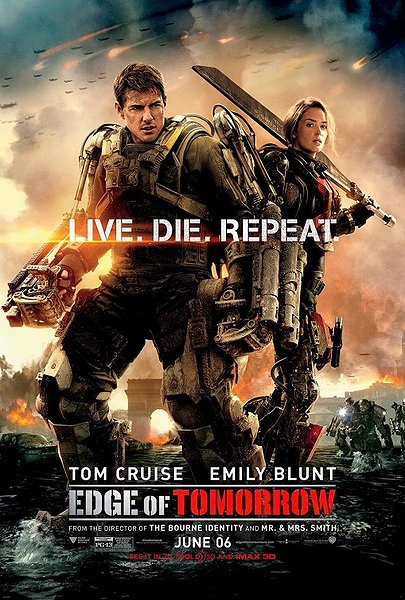 I’ve always been one able to separate the art from the artist, so while Tom Cruise may annoy people in real life because he jumped on a couch one summer, that doesn’t halt my enjoyment of the man’s movies. It seems with every new Cruise vehicle that under-performs at the box-office that I must be in the minority. Cruise hasn’t had a hit to his name since 2011’s suitably awesome Mission Impossible: Ghost Protocol. Both Oblivion and Jack Reacher, perfectly solid action movies, failed to make over $100 million domestically, further calling into question the drawing power of Tom Terrific. It seems that his latest, Edge of Tomorrow, is going to suffer a similar fate. This is a shame. As my critical colleague Ben Bailey said in his own review for the film: “Edge of Tomorrow might just be the most critically acclaimed box-office bomb of 2014.”
William Cage (Cruise) is chiefly an Armed Forces PR flak. He goes on TV to push the talking points of the United States military, which is in a heap of trouble. Aliens have landed in central Europe and spread quickly, proving to be nearly unstoppable. There was one soldier who was able to lead a successful counter attack. The “Angel of Verdun” is Rita (Emily Blunt), a soldier Cage proudly chirps only spent a day in her mechanical fighting suit beforehand yet proved to be so deadly. After vaguely threatening a high-ranking official rather than report for a doomed counter assault, Cage is shipped to the frontlines as a deserter. In hours he and a motley crew of ground forces are flown to the beaches of France, where the aliens will slaughter them. In the firefight, Cage is covered with alien blood and gains their special power. The reason the aliens have won every battle, save one, is because they have the power to reset time. They learn from their errors, which is why they always anticipate humanity’s attacks. Now Cage has this power. Every time he dies, the day resets and he starts over, trying once again to survive. The only person who understands him is Rita, who once had the same power. Together, with some extensive training, they may be able to thwart the alien invaders for good.
 Edge of Tomorrow is the ultimate video game movie, and while I would normally mean this in a pejorative sense, it is actually a compliment. With every death, Cage gets to start over, looking for a way to complete the next stage of the next level, learning from his costly mistakes and hoping to get to the boss battle that usually closes the level. From a structure standpoint, it’s a pure video game, albeit an older sidescroller (remember those, kids?). The visuals and mechanical battle suits also further support the video game comparisons. But really, Edge of Tomorrow is Groundhog Day meets Starship Troopers but brilliantly executed. There is something deeply satisfying about the Groundhog Day formula, namely getting seemingly endless chances to fix one’s mistakes, to try out new paths. It’s also inherently satisfying as an audience member because you watch your hero fail time and after time but they’re still active, they’re still trying to achieve a goal, or a new goal, and thus when they do succeed it’s even more triumphant and gratifying. We get to learn alongside our protagonist. Also, it allows the narrative to explore new material without going stale. In most stories we have one set path, but in films like this one with a time loop, it’s like we get to see all the wheels-within-wheels, the stories just offscreen happening simultaneously. It opens up the world in more interesting and playful ways, providing more payoffs than just one set narrative destination. We get assorted answers to our “what if”’s. Plus we get more screen time with Bill Paxton (2 Guns) as a comically hardass master sergeant. Edge of Tomorrow mines all these areas expertly. This is a movie that embraces the possibility of its sci-fi premise. It’s constantly clever, fast-paced, lively, and expects its audience to keep up with the pace.
It’s great to see director Doug Liman flex his action-thriller abilities again, ineffective or dormant since 2005’s Mr. and Mrs. Smith. The man has an innate ability to orchestrate action without losing sight of character. The beach invasion sequences have plenty going on, enough so that you won’t be bored after multiple trips, and unlike last summer’s disappointing Elysium, this is one movie that knows how to make proper use of a mech suit. These suits don’t look that impressive but they pack some mighty firepower. It’s rather cool when Cage, after a litany of failed trips, has the beats of combat to memory, knowing to shoot in this direction at the right second. It’s like watching a man harness the omniscient power of God (“I said I was a god. Not THE God.”). Under Liman’s guidance, the action is big and exciting and fun, more so than any other Hollywood action movie I’ve seen this year (The Raid 2 is still in a class its own).
The action sequences and special effects are all relatively good, but it’s just the sheer fun of the movie that makes it special for a summer would-be blockbuster. It’s like you get multiple movies smattered together but the eye is always forward to the goal, taking out the alien brain/host. The structure is almost foolproof: by the end of Act 1 he gets the time-tripping powers, and by the end of Act 2, he loses them and the heroics to close the movie have to count for real. I wish the final boss battle didn’t happen to take place in the bowels of a famous landmark/destination, but I suppose Liman and company needed a change of pace from all the beach activity. While the movie covers plenty of ground repeatedly it never feels old or directionless; while it has its share of sticky exposition and silly plot mechanics, it never overwhelms the story or the entertainment factor. The basics of who the aliens are, how they attack, what their magic blood does, what the rules are for utilizing said alien time-repeating power, you would imagine that they would be too silly or bog things down, but they don’t. Except for the very end (the concluding two minutes), the movie plays within its own system of rules. That also means no unrealistic romantic entanglement. Sure we expect movie stars to fall for one another, especially in peril, but for Rita, every day is the first day she’s ever met Cage. He develops feelings for her but she credibly keeps thoughts of romance at bay.
 It’s also a mordantly mirthful movie. Cage can only reset when he dies; if he is just wounded and passes out, he’ll lose his special reset power. So every insurmountable roadblock, wrong choice, or crippling injury must be met with one conclusion, namely Cage being snuffed out. Rita carries out most of the executions in the second half, with a blasé sense of routine duty, like a plumber fixing a clog. It doesn’t really get old and Liman utilizes montage well to give the comedy an extra punch. It lightens a movie more or less centered on human annihilation and mortality. And for the legions of Tom Cruise haters, there’s got to be some degree of entertainment value in watching the man die again and again and again and, well you get the point.
Cruise ably shows again that he is more than capable of carrying an action film (he’s over 50 now too). The man still has enough energy and physical stamina of an action hero in his 30s, and his charisma is still there in spades. It’s also interesting to watch Cruise play a cowardly character. I should have expected it considering that Cage’s arc has to start somewhere before he becomes the super soldier. However, the movie would never have been as good if Cruise didn’t have a strong leading lady, and the surprisingly buff Blunt (Looper) is an excellent match for her costar. She’s tough and can beat the snot out of you. Just her very walk exudes confidence and determination (is it too late for her to be Wonder Woman in the next Superman film?). Having walked in Cage’s shoes before with the time-replay power, she has an extra weariness to her, a certain devil-may-care attitude, especially in battle. The two actors make a winning team and Cage’s recruitment of Rita is another mission with another worthy payoff.
The original title was All You Need is Kill, based on a Japanese graphic novel, and I can’t help but think how much of a better, striking title that is to describe this movie. It’s a wonderfully entertaining movie, with its action spectacle tempered with an intelligence rare for a summer blockbuster that doesn’t have Christopher Nolan’s name attached as director. Here is a playful sci-fi movie that doesn’t downplay its sci-fi, doesn’t dumb down its plot, and explores the richness of its world one dead Cruise at a time. It’s clever and satisfying and brings all the visual fireworks you’d demand. It’s a rotten shame that Edge of Tomorrow appears destined for the cinematic scrapheap. We need more movies like this one. Reverse the tide people and see this movie on the big screen while you can. It’s everything we want in a summer blockbuster fully realized.
Nate’s Grade: A-
Share this:

Chef (2014)
 Chef must have been something of a needed break for its star, writer, and director, Jon Favreau. He’s directed three large-scale Hollywood sci-fi mega movies in a row, a long way from Favrieau’s first big break, Swingers, which he wrote for himself. It was time for something a little smaller, quieter, and more personal, and Chef is just the ticket, a familiar but still greatly satisfying slice-of-life movie about a frustrated chef finding his mojo. Favreau plays a famous chef who cracks under the pressure of delivering the same safe food day in and day out. He loses his job after an increasingly hostile Twitter war with a food critic who calls him out for his safety in blandness. This pushes Favreau out of his comfort zone; he starts an independent food truck, bonds with his son, and generally begins to embrace his new invigorating freedom. Don’t see this movie on an empty stomach because it will be torture. The food preparation shots are tantalizing as are the general discussions over the adoration of food, the heavenly feel of a good meal (an aspect that’s even utilized as foreplay in the film). The entire film is stoked by a laid back charm, an amiable camaraderie between Favreau and his cast, so much so that we don’t care when the film sort of stalls. It’s a far lengthier period between Favreau losing job and getting the food truck than necessary, and the ending is abrupt with an almost absurd amount of resolution tie-ups crammed together without additional progression. The characters are likeable enough, funny, and their passions have a way of enveloping the audience, so much so that a fairly predictable plot is excusable. Chef is a lovely little palate cleanser at the start of the summer movie season and an enjoyable excursion. Just fill up before seeing it or else.
Nate’s Grade: B+
Share this:

X-Men: Days of Future Past (2014)
 Ever since Marvel’s Avengers destroyed the box-office in 2012, every studio with super hero franchises has been looking to follow suit. It’s not just about comic book franchises; it’s about building a comic book universe. It’s been a long dark period for the X-Men ever since the regrettable 2006 debacle The Last Stand, which callously killed characters, butchered others, and botched the most famous storyline in the history of the comic. In 2011, Matthew Vaughn proved there was still life to be found in the franchise with his terrific 60s-era prequel, X-Men: First Class. Now, post-Avengers, Fox is salivating at combining the past X-Men and the present X-Men into one colossal movie with a colossal budget. Back on board is director Bryan Singer, the director of the first two X-Men films and the man who helped kickstart the modern superhero era. If that wasn’t enough riding on the film, X-Men: Days of Future Past also follows the second most famous storyline in the history of the comic.
In the horrible future, killer robots known as Sentinels hunt down mutants. These are the invention of Dr. Boliver Trask (Peter Dinklage), a military scientist who was killed back in 1973 by the vengeful shape-shifting mutant, Mystique (Jennifer Lawrence). The murder convinced humans to subsidize Trask’s killer robot plan of defense. Thanks to experiments replicating Mystique’s mutant ability, the Sentinels have the ability to adapt to any power, turning them practically indestructible. In the future, the Sentinels are eradicating all mutants, mutant sympathizers, and eventually human beings. Magneto (Ian McKellen) and Professor Xavier (Patrick Stewart) have teamed up with a small band of surviving mutants, including Wolverine (Hugh Jackman). Thanks to the phasing powers of Kitty Pryde (Ellen Page), they can send Wolverine’s consciousness back to 1973 so that he can prevent the Trask assassination. The only ones who can help Wolverine is the younger Xavier (James McAvoy) and Magneto (Michael Fassbender), former mentors to Mystique. Except Xavier is a recluse and strung-out on drugs to dull his powers and Magneto is locked away underneath the Pentagon.
 The X-Men films have always had a topical advantage to them that provided a weightier sense of drama than your typical story about a reluctant soul blessed with amazing powers. The mutant allegory automatically applies to any sub-group facing oppression mostly through fear and ignorance. What other superhero franchise has two opening scenes in a German concentration camp? The stakes are even larger with this movie because of the Horrible Nightmare Future that must be prevented. Now we all assume said Nightmare Future will be avoided by film’s end, so the movie provides a proverbial reset button that the filmmakers can have fun with, and they do (look out future mutants). Excluding the Nightmare Future framing device that becomes an unnecessary parallel storyline, the majority of the film takes place in 1973. If X-Men: First Class tapped into the groovy optimism and “take me for what I am” sense of social justice of the time, then this film certainly taps into the disillusionment of the 1970s, where the promise of reform and hope morphed into anger and cynicism (hey, that’s like us today!). This loss of innocence is typified in Mystique, who becomes the central figure of the movie in many ways. Her seething desire for vengeance is what animates her, as well as the pain of betrayal from the men closest in her life, as well as the world who once held such promise. Also, Jennifer Lawrence (The Hunger Games) has become one of the biggest female stars on the planet, so it makes sense to bolster her role. The central conflict is stopping an assassination, one domino that leads to many others, but it’s emotionally about Mystique having to confront her feelings of hate. It’s another platform for the ongoing conflict of perspectives between Xavier (restraint, tolerance) and Magneto (strong defense, eye for an eye). But as I found in First Class, it’s hard not to agree with Magneto as human overreaction leads to rash and thoughtless actions, like Horrible Nightmare Future.
That’s not to say that X-Men: Days of Future Past fails to deliver when it comes to the popcorn thrills and action highs we crave in our finest summer blockbusters. The action set pieces are large without dwarfing the characters, playful and imaginative without losing a sense of edge and danger. I loved how the character Blink (Bingbing Fan) would utilize her mutant power of opening portals as a fighting strategy. It makes action sequences so much more inventive and visually exciting to throw a series of portals. The pacing is swift short of the second half of Act Two, gearing up for the climactic showdown in D.C. that dominates Act Three. The time travel story starts with a lot of exposition but it gets smoothed out as it goes, the rules of the story fall into place. Every action sequence hits, some admittedly better than others, but it’s the small touches that Singer injects that made me smile most. I enjoyed Magneto pointing a gun, being toppled, but still using his power to have the gun fire in midair. I enjoyed the animalistic nature of the Beast/Wolverine brawl. Jackman is looking even veinier than usual in his bulked out form. Thankfully the fish-out of-water timeline jokes are kept to a minimum. Wolverine is the perfect glue to hold both timelines together. And then there’s that standout Pentagon prison break sequence (more on that later). Singer might not have the most natural instincts developing and staging action, but the man is a surefire talent when it comes to staging eye-catching visuals (I would say the same about Christopher Nolan). Even his unfairly maligned Superman Returns is proof of the man’s cinematic gifts. As far as entertainment value, this is right up there with X-Men 2. I still view Vaughn’s savvy First Class as the best X-film of the bunch, which has only gotten better the more I’ve watched it.
 And if that wasn’t enough, Singer’s new film does what every fan has been hoping for: (spoilers) it erases all the crummy X-Men movies, namely 2006’s Last Stand and the first Wolverine solo effort, from the official timeline. It’s time to start anew, toss out the old stuff nobody liked, and forge ahead with a new unified timeline. There can be two parallel X-Men franchises, one present/future and one with the prequel casts, and they can go on forever as desired, or until the prequel cast prices itself out. In one fell swoop, Singer and company have reset the mother franchise and given fans new hope about the possibilities. Make sure to stick around to the very end of the credits for a scene that indicates directly who the next major villain will be in the 2016 sequel.
Let me take time to single out just how expertly Evan Peters (TV’s American Horror Story) steals the entire mutant-heavy movie. First, he’s the most comically attuned character, which is a nice break from how serious, and rightly so, every character is so often. Quicksilver provides a whole new jolt of entertainment, and when he checks out after the prison break sequence you’ll dearly miss him. The character is a rapscallion (as my late grandmother might have termed) that enjoys using his super speed powers to mess with people, to test his limits, to see what he can get away with, and a Pentagon jailbreak is right up his alley. Ignore the silly yet period appropriate outfit and ignore what initially seems like Peters’ smirking self-involvement from trailers and ads. When this character is onscreen the movie has a joyful sense of irreverence. He is instrumental to freeing Magneto and the onscreen depiction of his super speed is the best illustration of the power ever conceived in film and TV. There is a segment sent to Jim Croce’s “Time in a Bottle,” and some wonderful special effects, which is just so playful, so giddy, and so cool that it very well might be my favorite moment in any superhero movie… ever. It is definitely an applause-worthy moment and my audience responded in kind. Quicksilver is a perfectly utilized supporting player in a movie stuffed to the gills with characters.
The time travel geek in me has a few quibbles with the parallel lines of action from past and present. Wolverine’s consciousness is sent back in time but he film plays out like it’s happening simultaneously to the events of the future. So if Wolverine is pulled out in the middle of the movie, he’ll have failed his mission to change the future, even though by going back in time he’s already, blah blah blah butterfly effect. Anyway, I understand how they want to make the future story have a sense of urgency but it’s not like waking Wolverine from a dream; the times are not happening concurrently. He’s in the past, meaning that the moment he goes back there, the future will already be altered due to the consequences of his actions, for better or worse. There is no race against time to keep his consciousness back in time until he complete his mission. I can see why they went this route for a summer blockbuster, but that doesn’t quell the quibbles.
 X-Men: Days of Future Past is a time-hopping, unabashedly fun time at the movies; well as fun as preventing nightmarish futures built from the consequences of oppression and prejudice can be. With Singer back in the saddle and the bridging of the two X-Men universes, the series is back on track and once again the promising font of stories and characters. The newest X-film is one of the most entertaining, funny while still being dramatic, and while burdened with the largest cast of any super franchise, finds notable moments for its characters big and small to remind us that these people matter. While less philosophical and funky than First Class, this is one of the best films in the franchise, on par with X2. The action sequences and visual eye-candy are great fun with some inventive and memorable touches. It’s also nerdy fun getting to watch the past and present interact, and for many this is their first return since 2006’s crappy Last Stand. It’s not a perfect movie; I wish there was more early Sentinel action, I wish Dinklage had much more to do, and I wish that the plot didn’t so transparently hinge on Xavier not having his powers. The slate is clean and all X-Men fans can breathe a sigh of relief. The future is once again rosy. The X-Men, and not just Wolverine, are relevant once again.
Nate’s Grade: B+
Share this:

Godzilla (2014)
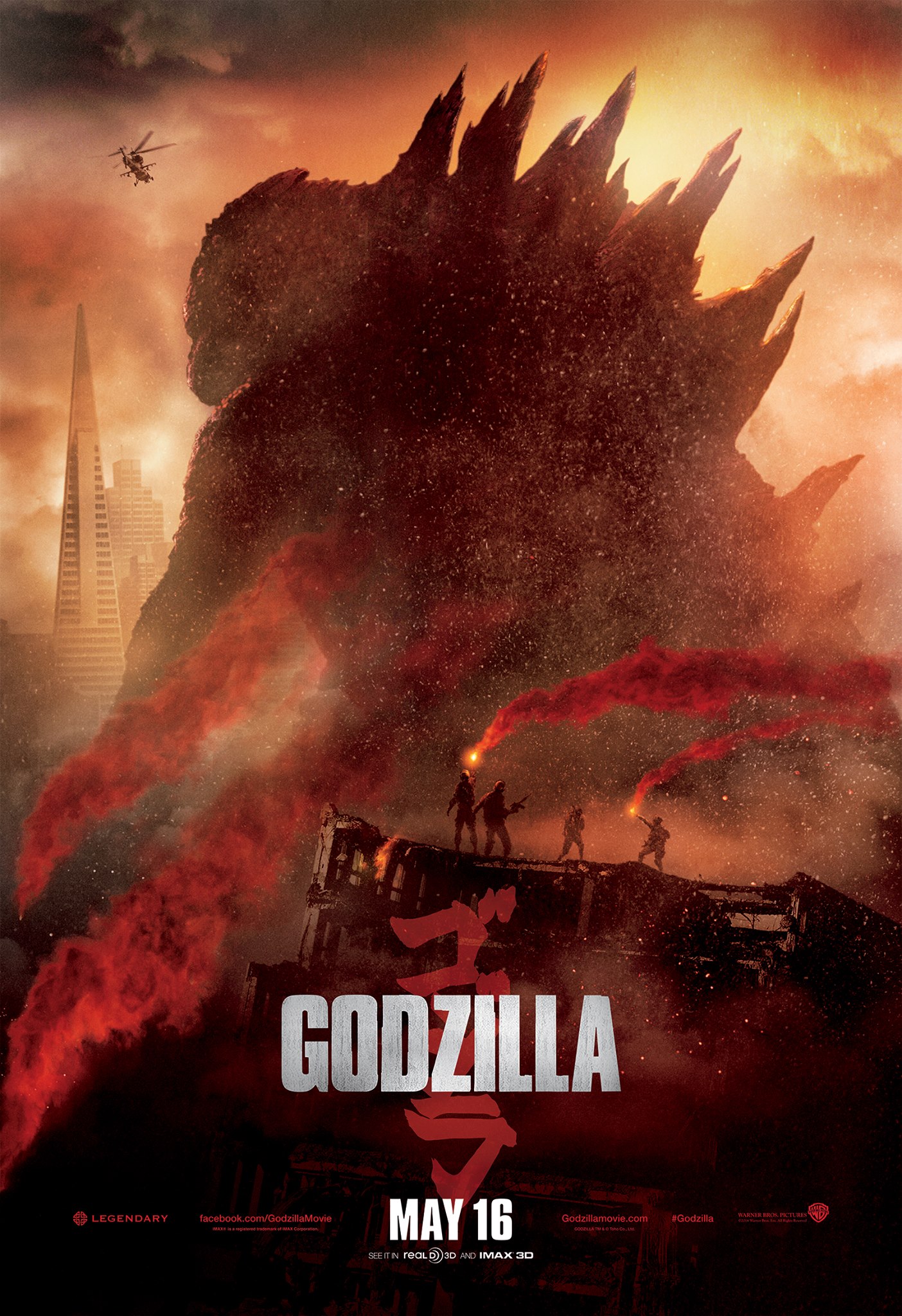 When it comes to the monsters of cinema, it’s hard to beat out Godzilla, and not just because, you know, he’s hundreds of feet high and can breath fire. The famous monster began as a cautionary tale about nuclear weapons, destroying man’s hubris and often the good people of Tokyo. The legendary beast has been hibernating as such since 1998’s not-so-spectacular big-budget return, a film that the Japanese loathed. But like all ancient being, Godzilla has been resurrected again and given a splashy new coating of CGI devastation. If only the filmmakers had decided to leave out the humans and make Godzilla the rightful star.
A scientist (Bryan Cranston) warns the Japanese government of a massive impending danger. The offspring of a giant creature, a Massive Unidentified Terrestrial Organism (MUTO), has hatched and heading straight for the United States coastline. Attracted by nuclear power, the U.S. military tries to lure it away from populated centers. Ford Brody (Aaron Taylor-Johnson) is witness to the monstrous destruction and just wants to get back home to his wife (Elizabeth Olsen) and child in San Francisco, exactly where the creature is headed. There’s also the emergence of an older creature, one that has taken to combating the MUTOs to the death. This is the legendary Godzilla.
The big guy is back in a very different approach from 1998’s Godzilla (i.e. “better” approach). Director Gareth Edwards (Monsters), an avowed Godzilla fan, has made a reverent big-budget ode to the king of all monsters; however, the resulting film is more of a disaster epic than a monster brawl. The perspective is often framed at the human-level, which grounds the film from going too overboard into disaster porn territory like, say, Man of Steel. The effect is thrilling and adds a greater sense of verisimilitude to the mass chaos and destruction. It reminded me in some ways to 2008’s Cloverfield, where a group of characters is just trying to survive the periphery of all the collateral damage of a giant monster. There are sequences that directly relate to Fukushima as well as the tsunami from 2004. It’s almost like somebody watched the stirring movie The Impossible and said, “Yeah, give us some of that in our giant monster movie.” I don’t know if these sequences are entirely necessary. Watching Ford carry around a little Japanese tyke, wondering where his parents might be amidst the confusion post-monster attack, it relates to our modern response to tragedy and worldwide disaster, but do you really want to watch Ford have to find this kid’s parents? If there is a commentary to be found in the movie, it’s the uncontrollable and destructive power of nature pushed to the brink by mankind’s own energy crises. After all, the MUTOs are attracted to and strengthened by consuming nuclear energy. Godzilla is argued to be an “alpha predator” but also a figure to bring balance back to nature. I think it means that there can be only one giant monster and Godzilla is going to eliminate the competition.
 But the real question of any giant monster movie is the degree of satisfying, smash-em-up fun it provides, and the new Godzilla is a mostly agreeable venture. The action sequences, mostly saved for the climax, are cool and well thought out, but Edwards proves to be a brilliant visual stylist than a composer of action. This is a movie where the moments stand out better than the action. Edwards’ command of cinematic visual arrangements is at Spielberg levels of being a natural showman. I can easily think back on small moments, images that pop, visual reveals that are executed with aplomb, far more so than a central example of an action piece. I loved the horror-esque reveal of the elevated train being on track to head right for the MUTO. I loved the hide-and-seek nature of Ford waiting for the MUTO to pass. I loved when Ken Watanabe’s advice was literally just, “Let them fight” (I started chanting it in my seat). My favorite part of the movie is actually what was previously shown as a teaser trailer, namely Ford and several other paratroopers diving into the destructive city scene. The eerie hum of the 2001: A Space Odyssey monolith plays over, each man has a red flare streaking from their leg, and we watch them quickly descend through the sky, nervously awaiting what is on the other side of those heavy clouds, only to discover a city on fire, glowing like a hearth, and through the goggles, a monster fight taking place. The entire sequence is a visual standout, a thrilling set piece, and a reminder that Edwards has more on his mind.
Edwards does a lot of intentional teasing of Godzilla, so much so that it can get frustrating for an audience. I understand he’s building to a payoff reminiscent of Jaws; we’ve been teased for so long that we will go nuts when we finally see Godzilla in full glory, and it works. However, it also works as a detriment. There are several points in the film where it looks like we’re about to get some exciting Godzilla/MUTO action, or even just a MUTO wrecking havoc, and then the film cuts away, often to news footage. It’s a choice that begins as artistically clever but can become maddening in time. There is a lot of visual obfuscation throughout the film, far more so than the same compliant I had with last year’s Pacific Rim. Edwards will show Godzilla’s tail just swinging behind a building, or his colossal foot coming down with authority, or the wispy shadow of giants in billowing clouds of smoke. All those near misses can add up to cinematic blue balls. And so much of the action and destruction happens at nighttime, leading to a dour color palette heavy in grey and dark blacks, making the good stuff all the harder to see. I cannot even fathom why someone would want to see this film in 3D with those darkened glasses. It’s 90 minutes of foreplay that you may start to grow restless that we’re getting a Godzilla movie that will never show the goods (shouldn’t Godzilla be in a Godzilla film?)
 The problem with a disaster movie on a human-scale is when you don’t give a damn about any of the human characters. Now, Godzilla should be the star of any Godzilla movie but I understand execs fearing that their monster movie needs some relatable human drama. The problem is that the writing doesn’t do anything with these characters, forcing them into tidy and token roles that we’ve come to expect from large-scale disaster movies. Did anyone really feel anything about whether Ford would get back to his wife and child? Did anyone feel anything for anyone in this movie, beyond a slight reservation whether they would be squished, if even that? I’m not expecting three-dimensional characters here but even Roland Emmerich films do a decent job of establishing a milieu of people at various points of the globe we know will somehow coalesce together. There is so little effort to mask the character’s grand design: exposition mouthpieces, symbols of military threats, the noble family man, the beleaguered and crying wife. Seriously, there is a great cast of actors in this movie and they are given nothing to work with. Olsen (Oldboy) gets to look realistically scared and cry but she deserves so much better. Cranston (TV’s Breaking Bad) gets all the best yell-worthy lines. But it’s really Taylor-Johnson (Kick-Ass 2) who suffers the most since he’s placed as our impassive stand-in for a human protagonist. He’s so blank throughout the film and there’s little charisma to pull you in. His character, and the performance, feels no better than an elevated extra, Grunt #13. When we have to spend 90 minutes with these lackluster characters rather than some awesome monster fights, that’s when the film flounders.
I’m conflicted about the end results of Godzilla, an entertaining, surprisingly artistic film that can nail small moments of cinematic grandeur but has trouble matching its vision. The human-scale approach grounds the action, but do we want a giant monster movie grounded from a limited vantage point? The constant teasing builds a payoff for finally seeing Godzilla, but don’t we want more actual Godzilla in a film bearing his name? The human-scale, as well as the slow dodging of showing Godzilla, mean the storytelling emphasis is on an array of human characters, but what happens when they are poorly written, poorly developed, and lacking in charisma? The movie does more right than wrong but I’m left with the unmistakable feeling that, while a step in the right direction, there is too much self-sabotage holding back the movie. It actually made me re-evaluate and appreciate Pacific Rim even more. I can’t say this movie is nearly half the fun as Rim was. The monster design of the MUTOs is rather lacking, resembling a cross between the monster from Cloverfield and more patently the arachnid aliens of Starship Troopers, down to the heads that look like staple removers. Edwards has proven himself a big screen talent with a terrific feel for grandiose visual spectacle. I just hope if there is a sequel that we can skip all the slow buildup and just get to the main event – Godzilla beating the crap out of some other lesser yet still giant monster.
Nate’s Grade: B
Share this:

Neighbors (2014)
 The first side-splitter of the summer, Neighbors is a bawdy comedy that has enough big laughs that you may miss how well it draws its characters, punctuating preconceptions. The premise is boiled down to family versus frat, as a pair of new parents (Seth Rogen, Rose Byrne) has a college fraternity, lead by Zac Efron, move next door. You expect the raucous humor, and there are plenty of well-conceived visual gags and payoffs. I did not expect to like the characters as much or see different shades of them. Rogen and Byrne are not yet ready to be official grown-ups, and their attempts to hang with the frat parties are hilarious as well as cringe-inducing. I especially appreciated that Byrne is given the chance to be just as careless and selfish as the men; there’s even a fight between husband and wife who is the Kevin James in their relationship. Byrne is terrific and deserves even more work that lets her cut loose and be in on the joke. Then there are the frat brothers who could easily come across as brainless hedonists, and many do, but Efron and his co-bro Dave Franco have an engaging relationship where they fear what happens next after school. The movie’s theme isn’t subtle (fear of growing up) but provides enough extra substance to make the film more than the sum of its jokes. And it’s quite funny. Rogen and Byrne have great chemistry, their angry riffs are often amusing, and the escalating tit-for-tat prank war is memorable and entertaining. Neighbors works on a cross-generational level; as a man in my 30s, I related to Rogen and Byrne’s plight but also their shifting concepts of what they consider fun that they once may have mocked in their younger years (“I love brunch”). Neighbors builds to a nice climax, the cast is uniformly funny, and with enough surprising shades with the characters, it satisfies the R-rated funny bone.
Nate’s Grade: B
Share this:

Devil’s Knot (2014)
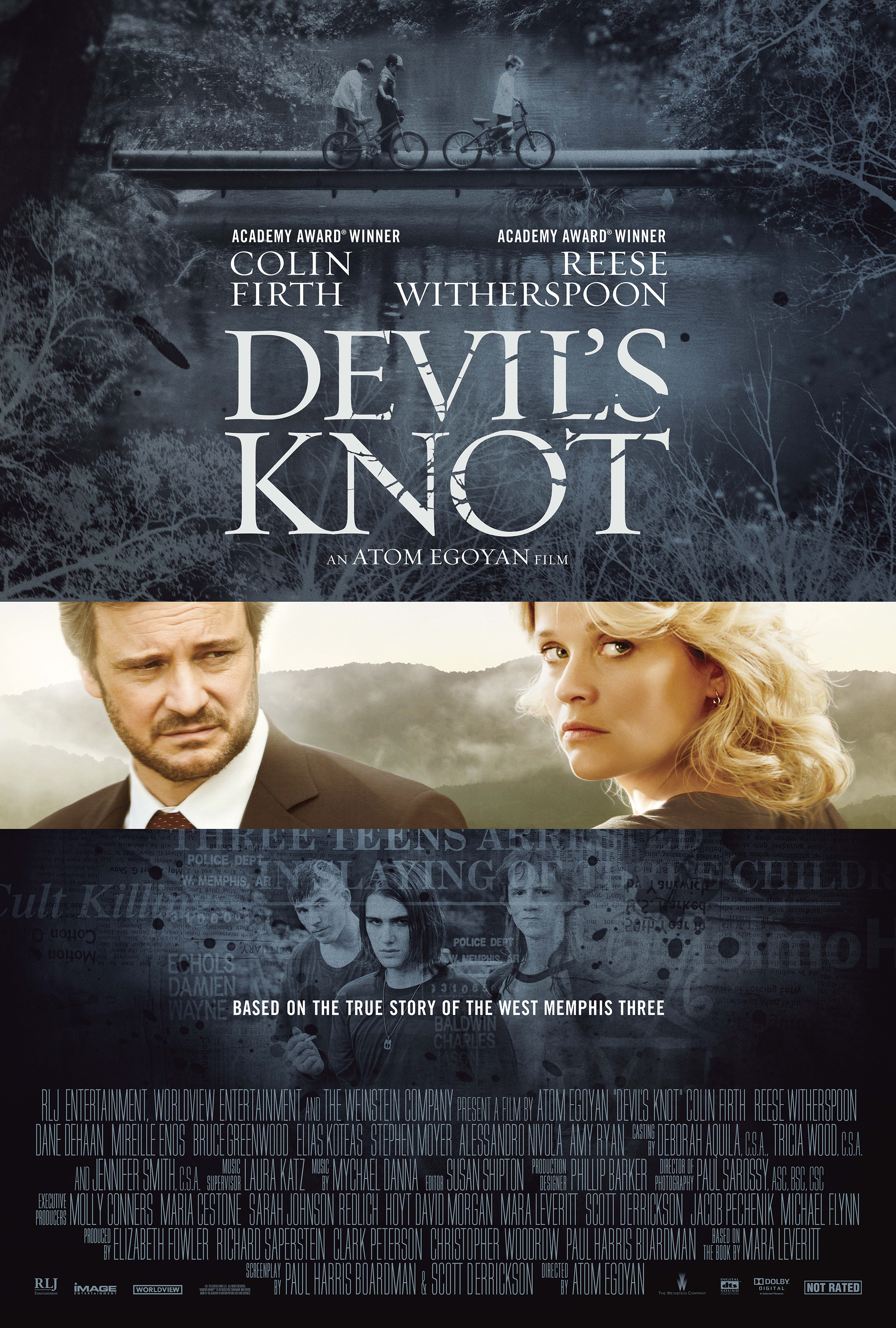 In 1993 in West Memphis, Arkansas, three eight-year-old boys went out late one night to ride their bikes. They were never seen alive again. The ensuing media circus that erupted lead to the conviction of three teenagers (The West Memphis Three) who many believed were innocent of these heinous crimes. Stop me if you’ve heard this story before. It was the basis of three stirring, powerful, galvanizing documentaries by Joe Berlinger and Bruce Sinofsky, two men credited with saving the West Memphis Three. Now after their release from prison, here comes Devil’s Knot, the first fictional film about the notorious case, Hollywood’s first crack at well-tread material. Is there anything new to be found?
Director Atom Egoyan (The Sweet Hereafter, Chloe) and his screenwriters do a credible job of distilling the complicated case against the West Memphis Three to its basics, relying on a modulated tone that shies away from the sensationalism that dominated the case back in 1993. With the benefit of time and hindsight, it’s easy for the movie to point out the erroneous thinking of the prosecution, the jump to conclusions, and the Satanic panic engulfing the community of Arkansas. We’re told by a police officer that they knew this “Satanic cult stuff” would hit town; they’ve just been waiting for the day. To its credit, the movie does a fine job of calmly and objectively pointing out the deficiencies in the police and prosecution’s case against the West Memphis Three. We’re told that from the twelve hours of interrogation with Jessie Misskelley, only 40-some minutes was recorded. The obvious mistakes in his confession, as well as the police coaching and coaxing him to their desired response, is made readily apparent. There’s “witness” Vicki Hutchernson (Mireille Enos of the oft-canceled The Killing) who says she say chief suspect Damien in a Satanic ritual, but the film cuts back from the imaginary to Vicki watching a movie on TV, the real source of her descriptive flourishes. Egoyan’s direction has a calm, objective overview that is reverent and respectful of the dead and the bereaved. It’s rarely boring and the facts of this case are such that any retelling would be somewhat compelling.
 So that brings me to the ultimate question: why even make a fictional movie about this subject? Four lengthy documentaries have covered the intricacies of the legal story, the breakdown in justice, and the personal toll on all sides of the crime. The only thing a fictional movie provides is: 1) the fun/distracting game of seeing relatively famous actors play the real-life people we’ve previously seen, and, 2) as an option for people who hate documentaries. If you’re one of those people who dislikes documentaries and doesn’t view them as “real movies,” then Devil’s Knot is for you, you dismissive filmgoer. Otherwise, literally everything was handled better in the Paradise Lost films. With the West Memphis Three thankfully out of prison, the omnipresent sense of urgency from the documentaries is now absent, replaced with a Monday morning quarterback sensibility pointing out all the obvious bias, judicial hypocrisy, and flaws of the case. And as anyone who has plowed through the powerful and addicting documentaries knows, there are plenty of flaws to point out for harsh scrutiny and incredulity. Movies have a long history of showing us an example of judicial injustice, and this is a prime example. However, Egoyan has put the emphasis of his movie on two outsiders rather than people in the center of this case. The West Memphis Three themselves are barely supporting actors in their own movie. I suppose the filmmakers may have wanted to present a different angle to the case since the Paradise Lost films showed the accused up close and personal. The construction of this plot just doesn’t work under the perspectives of Pam (Reese Witherspoon) and Ron (Colin Firth).
Ron serves as a pro-bono adviser to the defense, but that doesn’t mean he has the same access inside and outside the court. He can gather evidence on his own but really this guy is meant to be a fly-on-the-wall for the planning and frustration of all the legal roadblocks thrown at the defense. Is an added body in the room necessary? Could not one of the defense attorneys have provided the same purpose? Instead, he gets to grumble in the court and out about all the legal shenanigans going on to railroad innocent boys. He is essentially spelling it out to an audience. Pam has even less narrative purpose in the film. Her perspective makes sense early on as the mother of one of the murdered young children. Her panic, her worst nightmare come to life, it all makes for the stuff of major drama, which is why you’d imagine Witherspoon was drawn to the part. But once the case against the West Memphis Three gets going, Pam transforms into our Chief Reaction Shot Provider. Whenever a curious moment happens in court, we cut back to Pam and Witherspoon cocking her head in dawning curiosity and uncertainty. It’s as if she is meant to symbolically represent the entire community that was so fervent in their beliefs that these boys were guilty… until they heard the shaky case and the questionable experts put on the stand. So Pam and Ron end up becoming signals to the audience on how to feel and what to think. The movie doesn’t have enough faith in its audience to keep up with the minutia of the trail, or even the lawyers’ arguments, reducing a complex legal trial down to two nonessential characters nodding or shaking their heads.
 I’ll admit that I had some interest watching the actors inhabit the roles, and there are scads of people involved in this story. Bruce Greenwood (Star Trek) does a valiant job showcasing the head-scratching decisions of the trail judge, David Burnett, and his slimy dismissive nature. Stephen Moyer (TV’s True Blood) is particularly infuriating as John Fogleman, chief prosecuting attorney. Seth Meriwether (Trouble with the Curve) looks eerily like his character, the young and accused Jason Baldwin, and he nails his moral convictions and gentle nature. Dane DeHaan (The Amazing Spider-Man 2) gets to do his troubled youth thing he does so well. Kevin Durand is an actor I normally enjoy but even he can’t do justice to John Mark Byers, step-father to one of the slain boys, and easily the most memorable figure in the Paradise Lost films; the man is so theatrical and larger-than-life, and yet Devil’s Knot treats him like a featured extra, with many of his speaking scenes off camera. There isn’t a bad actor in the extremely large cast, though Firth’s Southern accent isn’t the most refined. If the movie lacks much reason for existing, at least the bevy of good actors respectfully bringing new life to these people, good, bad, and many somewhere in between, is the one credible quality to this movie.
What to make of Devil’s Knot, an example of a decent, modulated, and well acted movie that ultimately has no reason to exist in the wake of three excellent documentaries (Paradise Lost) and one other pretty good one (West of Memphis). The ground has been covered. However, that doesn’t mean that a well-told story can’t be told again, with a different angle, with a different approach, but Devil’s Knot hinges on two characters serving as metaphorical barometers to teach the audience what to think and how to feel. Then there’s the matter that the trail covers the entire 114-minute running time. There’s so much more that happens after the initial trial, so much that the last two minutes of this movie are almost a nonstop barrage of text updating the audience on many of the post-trial developments, including the West Memphis Three being released from prison in 2011. The movie feels too limited; there is so much more depth here, to the details of the case, to the personalities and human drama, to the story after the trial. Egoyan and his cast and crew have made a respectful fictional version of these sensational events, but the problem is that they don’t do enough to justify their own film’s existence. Unless you have an irrational hatred for documentaries, just watch those instead.
Nate’s Grade: C+


 nathanzoebl
You must be logged in to post a comment.