Category Archives: 2012 Movies
The Lorax (2012)
 Colorful, energetic, and with a nice message about conservation, The Lorax is an amusing film that is pleasant enough but with little else to recommend it. The visuals are terrific and the Dr. Suess-level of imagination is nicely incorporated in weird ways. The story is about a boy (voiced by Zac Efron) trying to impress a girl (Taylor Swift), but really it’s the story of the Once-ler (Ed Helms) and his destruction of the forest for the sake of making money. The Lorax (Danny DeVito) is an orange, mustachioed creature who “speaks for the trees,” and conflicts with the Once-ler. The framing devices of the young starlets feel unnecessary, and the movie descends into a series of wacky chase scenes. The humor stays around family-friendly slapstick and a few knowing winks for the adults. The songs are amiable and witty but fairly forgettable. I’m having a hard time even summoning a single melody hours after seeing the movie. The rest of the movie is kind of the same way. It’s pleasant and nice enough while watching, but afterwards it evaporates from your memory, leaving only the faint reminiscence of colorful imagery. It’s from the makers of Despicable Me but lacks that movie’s heart. The environmental message will drive some blowhards nuts, but the same activist message existed in Suess’ original book. Anyway, I think The Lorax is a bit too busy and yet simplistic to be anything other than a pleasant diversion. The story just can’t match the greatness of the animation.
Nate’s Grade: B-
Share this:

The Secret World of Arrietty (2012)
 This adaptation of Mary Norton’s classic book, The Borrowers, is colorful, imaginative, and the antithesis of what has become the modern-day family film. It’s less antic with its pacing, it has a more somber mood, and the ending is essentially anticlimactic. While commendable on one hand, The Secret World of Arrietty is also a minor work under the tutelage of the brilliant Hayao Miyazaki. Like other Miyazaki works, the film immerses you into an imaginative world where all the details fit. The story itself within that world is a bit low-key. Arrietty is a 13-year-old tiny person, a Borrower, living with her mother and father inside a human being’s home (they refer to people phonetically as “beans”). Her friendship with one of those “beans,” a boy named Shawn, is pleasant and gradual, as she feels she cannot trust the enormous human. I kept waiting for something larger and more significant to happen, but it didn’t. The story feels too slight to justify being the introduction, and likely final, chapter of these characters. The world of Arrietty is beautiful to watch but after a while you’re just watching pretty pictures.
Nate’s Grade: B
Share this:

The Woman in Black (2012)
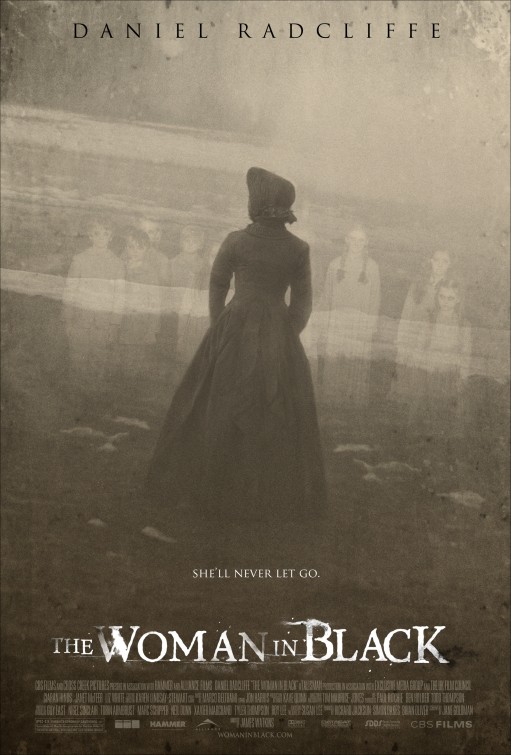 It’s got a decent ending but it’s a long, lumbering walk to get there. This handsomely mounted Hammer throwback involves Harry Potter himself, Daniel Radcliffe, slowly walking through a spooky old Victorian haunted house. And he slowly peeks around a door. And he slowly holds a candle. And I slowly go to sleep. There’s a 40-minute sequence where I swear only two things are spoken. Radcliffe plays a widowed father who has to investigate a haunted house to make ends meet. The movie has a few genuinely creepy moments, mostly owing to set design, but it gets hooked on jump scares and doesn’t know how to quit. The jump scares, accompanied by what sounds like an eagle screeching as music, happen at near two-minute intervals, like some sort of alarm the movie can’t turn off. Alas, The Woman in Black is a pretty staid ghost story where once again a restless spirit is terrorizing others and somebody takes it upon themselves to help that spirit find closure. The plot is so transparently predictable that it becomes fairly frustrating when the movie takes so long to get to its pre-designated stops. The pessimistic ending is weirdly given the most positive spin imaginable. For fans of this horror sub-genre, there may be enough going on to entertain. I just keep learning that ghosts are never grateful and satisfied even when you help them. Ghosts are jerks.
Nate’s Grade: C
Share this:

Chronicle (2012)
 I’ve learned a valuable lesson when it comes to genre movies – do not trust the marketing department of 20th Century Fox. Every promotional clip, trailer, TV spot, even the notion that people were flying around in cities as an attempt at viral marketing, it all coalesced into making me turn up my nose at Chronicle. It just looked like a bad movie. Then the critical reception was rather glowing and I took a chance, pleasantly surprised by the skill and execution of the flick. What made this thought-process notable was that it was almost an exact repeat of what I went through with Rise of the Planet of the Apes. Every piece of promotion stoked my disinterest into outright loathing, and then after the positive press I saw the movie, begrudgingly, and was floored. I guess when it comes to future 20th Century Fox genre releases, I’ll try and figure out my reaction and then turn that upside down. If a movie looks like utter crap, then under this new value system it must be good. I’m sure my new cinematic equation will prove me wrong as soon as the latest Eddie Murphy family vehicle terrorizes theaters (“This fall, Eddie Murphy is… The Governor. And his political opponent? His wife! Also played by Eddie Murphy”). In short, the marketing department at 20th Century Fox sucks but Chronicle does not.
Chronicle is the chronicle (heh) of three high-school friends who contract telekinetic powers. Andrew (Dane DeHaan) is a social outcast, determined to videotape his life as a means of escape from his ailing mother, his violent, alcoholic father (Michael Kelly), and the torment of school bullies. His cousin, Matt (Alex Russell), is trying to read up on philosophy to impress Casey (Ashley Hinshaw), a blogger/amateur documentary filmmaker. He’s more than some dumb jock. Steve (Michael B. Jordan) is the popular athlete planning to run for political office one day. The three guys discover what looks to be an alien craft underground. After coming into physical contact, the guys discover they suddenly have the ability to control objects with their minds. They test out their new powers in small ways at first, stopping speeding balls, assembling Legos. Matt insists they establish some system of rules to ensure they use their new powers for good. Andrew chafes at the idea of holding back, especially since he is by far the most powerful member of the group and eager to settle a few scores.
 Just as the found footage motif is starting to get old along comes a movie that makes creative and clever use of the narrative structure. Documenting one’s life, including the endless trivialities, has become normal habit for a younger generation accustomed to Twitter-style instantaneous information dissemination. Given that Andrew is abused and harassed, it makes sense for his character to use his camera as a means of security physical and emotional: the promise of being recorded should at least keep some of the bullying and physical abuse at bay, and it also provides a barrier for him and the real world, letting him stand outside himself. As John Malkovich said in Shadow of the Vampire, “If it isn’t in the frame, then it doesn’t exist.” This is one of the few found footage films where I didn’t feel constrained by the limitations of its concept. I suppose it helps when your main characters have super powers and can fly into the sky for a game of pigskin. The climactic battle is plenty thrilling but also subtly ingenuitous, as we cut back from various camera footage to piece together our super smackdown; we jump from security cameras, police dashboard cams, helicopter cameras, to even personal video cameras of people doing what people do… document the strange and unusual (I’m just curious who assembled the footage, though I have my theories).
The key to Chronicle’s success is that it’s a well-written, character-based piece that just so happens to morph into a superhero cautionary tale. Andrew has a pretty hard life and it’s easy to see why this insecure, neurotic, and angry young man takes his new-found gifts as a cosmic opportunity for retribution. In a way, Chronicle is like an all-male version of Carrie for the digital age; incidentally, Andrew was set to perform in a school talent show and I was cringing, saying to myself, “Oh no, here comes the Carrie moment.” He’s a tragic figure and you feel for the kid, which gives him a little more leeway when he starts to veer to the dark side. Until the very end, you can follow Andrew’s motivation for every action, so when he dresses up in his father’s firefighter outfit to shake down the neighborhood bullies, you can justify it to yourself, saying, “Well, he’s desperate and needs to pay for him mother’s super expensive medication. Oh, and those guys had it coming. Jerk.” The power of empathy is a mighty one, and writer Max Landis (son of director John Landis) takes a measured amount of time to connect everything back to the character. The best compliment I can give Landis is that nothing feels out of place. The characters behave in a relatively believable manner, the action intensifies at a natural incline, and the characters manage to have some brainy, existential debates about power and responsibility in between typical teenage pranks/antics (it’s only natural that teen boys would somehow use telekinesis to improve their sex life). Sure these characters aren’t terribly deep and the multitude of Andrew’s misery heaped upon misery almost seems ridiculous. In another universe, perhaps Andrew uses his powers to lash out at his tormentors at school, though that approach would questionably glamorize school shootings. However, by the time the big action hits, we’re emotionally invested in the characters and have watched Andrew’s long fuse finally blow.
The special effects are even more impressive given the low budget and the found footage gimmick. The camera makes some nifty telekinetic moves, floating around and giving the film a bigger space to play within. The flying effects are pretty convincing, especially when one of our guys ends up tumbling back to Earth in one tense sequence. Whether it’s floating Pringles or cars crushed inside out, the effects are smooth and well integrated, and any noticeable lack of polish just fits in with the fuzzy nature of our video recording as lone record of the events. There’s a notable solution for sub-par special effects in movies: blame the nature of the movie (Uwe Boll, that suggestion is free of charge).
 But the best special effect is young actor DeHaan (HBO’s first-rate show, In Treatment). Looking eerily like a young Leonardo DiCaprio, the guy manages to channel pent-up rage, frustration, and helplessness in a way that doesn’t feel histrionic or twerpy. His character is the point of view for our tale given that it is Andrew’s camera after all; we’re mostly locked into his perspective. Good thing that the character is interesting enough and so well played by DeHaan that I didn’t feel stuck with a loser. He reacts like most teenagers would react when bullied and harassed, trying to be aloof and ambivalent but only able to hide the pain and resentment for so long. When Andrew does start to give in to the allure of his powers, DeHaan seems practically seduced by his sense of superiority. There’s a dangerous look in his eyes that turns on that cues the audience for trouble to come. Russell is an amiable actor even if his character is bland and somewhat inconsistent as a foil to Andrew. Jordan (TV’s Friday Night Lights) is a charming guy who finds the right balance of exuberance and sarcasm with his character. Together, the threesome of guys has a winning chemistry and character dynamic. When they’re getting along and the good times are rolling, you feel part of the gang.
Being a super hero has become a dominant male fantasy as of late in the movies, so it’s invigorating to see a movie that puts a fresh spin on what seems ad infinitum. Chronicle is something of a small wonder, bringing new life to the found footage concept, making smart use of its narrative confines rather than chained by its limitations. The story is just as involving from a character standpoint as much as its sci-fi genre elements and superhero wish fulfillment. Landis and debut director Josh Trank are talents that I have no doubt Hollywood will snatch up. They’ve given the super hero genre a necessary human element, too often lost in the splashes of action and merchandising. Along with its engaging character-work, Chronicle also happens to be a clever action movie with some soaring thrills. Ignore the shoddy marketing and take a chance on Chronicle.
Nate’s Grade: B+
Share this:

The Grey (2012)
 I’ve always been fascinated with survival thriller/horror, where we think step-by-step with the characters through an unlikely scenario. I greatly enjoyed Frozen, a horror movie about three teens stranded on a ski lift, and Buried was in my top ten list for 2010. I enjoy the thought exercise and find the scenarios easily empathetic as long as people don’t make boneheaded decisions. Director Joe Carnahan has been paying his bills as of late with stylized, overdone, and generally overblown action movies like Smokin’ Aces and The A-Team. I would not have expected Carnahan to deliver anything that could be described as nuanced or meditative, but lo and behold The Grey is a survival thriller that’s as thoughtful and emotional as it is viscerally exhilarating. The Grey is the first great movie of 2012 and I’m astounded that it was released in January, the dumping ground for cinematic dreck.
We follow a group of grunts working on an oil pipeline way out in the northern Alaskan territory. They’re heading south for some R&R when their plane crashes due to electrical issues. Ottway (Liam Neeson) and seven other men are the lone survivors. While checking for supplies, they discover a pack of wolves feasting on some of the choicer corpses. Ottway is a wolf expert, hired by the oil company to patrol the grounds and hunt antagonistic wolves. He explains that wolves have a hunting radius of 300 miles and a kill radius of 30 within the den. It is uncertain where these men find themselves, so they bundle up and head south, hoping to escape the predators, find food and water, and discover a way to help.
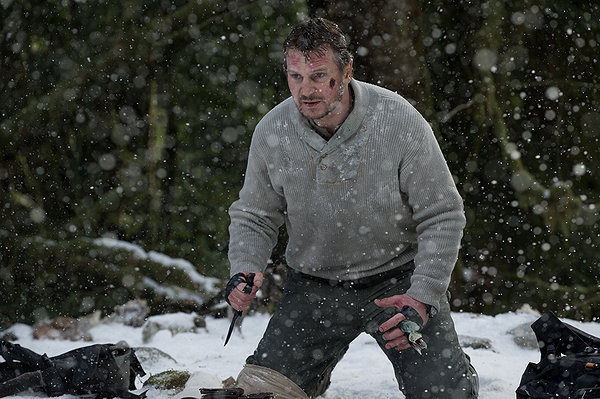 The Grey is a harrowing, haunting, and intense thriller, masterfully played by Carnahan. The threat is real and brutal, enough that it convinces the men to leave the safety of the plane wreckage to possibly escape the wolf kill radius. We’re told that wolves are the only animal that will kill out of vengeance (look out Sarah Palin). The attacks are vicious and the violence is bloody and occasionally shocking, though it never seems gratuitous. The special effects and canine animatronics are seamlessly integrated. The sound design for this movie is exceptional, probably the best use of sound to fashion anxiety since 2007’s No Country for Old Men or even Spielberg’s War of the Worlds. The sounds of the wolf pack echo around the theater, completely keeping you off guard, disorienting the audience. Carnahan creates such a vivid picture of dread that we’re convinced that the wolves could sic at any moment. And when they do the editing becomes chaotic, mimicking the ferocity of the animals and depicting the frenzied fear of the attacked.
I was a terrible bundle of nerves throughout most of this movie. The plane crash is an exemplary sequence of terror, capturing the terrifying moments from Ottway’s limited point of view. The rest of the movie doesn’t get any less tense just because they’re on stable footing. There’s one scene where the wolves attack a guy who has fallen back from the group. Carnahan brilliantly captures the helpless reality by showing the men trying to race back in knee-high snow. They can only stomp so far while the man is ripped apart in the background. The action sequences, though to be fair they’re really more suspense pieces, are the most nerve-wracking I’ve endured since the brilliant Best Picture winner, The Hurt Locker. Of course these being life and death stakes, there is plenty of death, as the men are generally picked off one by one, though not all by the pack of wolves. The frigid elements are just as dangerous as the killer wolves. The men could just as easily freeze to death. The need for shelter and food is dire (the men even joke about the famous cannibalism from Alive). One of them is suffering just from his brain being unable to acclimate to the elevated attitude. That’s almost enviable considering the doom that constantly hangs over the other survivors.
Naturally there’s some friction between the survivors as far as the best course of action. Ottway has assumed Alpha dog status thanks to his expertise on wolves and the Arctic climate, but that does not mean that the rest of the men follow lockstep. Give the alarming situation, it will be in these men’s best interest to work together for survival. Some of the men chafe at being what to do but the movie doesn’t drags out this conflict, thankfully, because jockeying for power positions seems like an absurd waste of time. There are heavier issues at play. The impact of the movie would be blunted if the characters came across as one-dimensional; then we wouldn’t care about their fate. Carnahan and co-writer Ian Mackenzie Jeffers, based on Jeffers’ short story “Ghost Walker,” find creative ways to enrich and reveal the character of these lone men. They feel believable and their reactions to the implausible dangers seem plausible, keeping us invested. Ottway keeps flashing back to an image of his wife (Anne Openshaw) for strength, this angelic brunette telling him not to worry. It’s what he has to hold onto, though when we learn more about the context of this image it becomes even more meaningful. One character has had enough struggling and has no will power to continue. He argues that whatever life he may return to is no reward.
 The thrills and scares are what are to be expected, but The Grey is also a much more thoughtful and intellectually stimulating picture than you may have hoped. Carnahan’s script covers a wide array of survival tactics without breaking from the reality of its premise. It’s just interesting to watch a group of men use their wits to make best use of their dwindling supplies and dire situation. It becomes a game that the audience plays, systematically judging every choice and assessing if we would follow suit. Beforehand, the men engage in a theological discussion regarding the existence of God, faith, the belief that there is a divine plan. The men are fighting for their survival but having an existential crisis all the same, trying to supply meaning to the horrific, find reasons to keep fighting. “We crashed going 400 miles per hour and we survived. That has to mean something,” one of them reasons. Or it all could just be very bad luck. Ottway at one point, an admitted non-believer in a higher power, bellows to the sky for something, anything. His desperation is effective and turns what could have been trite into a nice character moment. One of the men shares a memory of his daughter, who would wake him up by gently dangling her hair in his face. It’s a touching moment and when that same character meets an untimely end and is helped to the other side by a vision of that same daughter, it becomes profoundly moving (the quick snap to reality is a jarring point for grisly comparison). The Grey has plenty more on its mind than making an audience jump. It also wants to make the audience think and, in the end, feel genuine emotion.
The ending may rankle some who felt, especially with the advertising, that the film was going to be a two-hour Neeson ass-kicking vehicle, but for me it was fitting and the only way this story could have ended. Though let me advise all potential ticket-buyers to stay during the end credits for a small bit that offers a tad more resolution, though still leaves as much to be determined by the viewer. It’s not exactly ambiguous considering how things are left.
Neeson (Unknown, Clash of the Titans) has settled nicely into his newest incarnation as middle-aged ass-kicker, such an odd path for the man who famously portrayed Oskar Schindler. At some level, it’s below an actor of Neeson’s standards to be running through such genre frills, but it’s also a joy to see someone who can really, truly act give gravitas to his men of action. After he delivered his warning in Taken, I was completely on board and ready to watch this man bust some skulls. Beyond the physical challenges, the role really puts Neeson through an emotional wringer and the man gives a strong, stirring performance. You’d be glad to have this man in any predicament. The rest of the cast fill out their parts well, with Dermot Mulroney (The Family Stone) making the best use of his time onscreen to create a character.
The Grey is a startling movie; horrific, jolting, thrilling, moving, beautiful, philosophical, and extremely captivating. Carnahan has crafted an exciting movie that transcends genre. There were moments so tense that I was chewing on my knuckles. There were moments so intense I felt like I had to look away. And there were moments so poignant that tears welled up in my eyes. I look forward to watching this movie again and finding even more at work. No grey area here, this is one truly excellent movie.
Nate’s Grade: A
Share this:

Red Tails (2012)
 You’d think a big name like George Lucas would not have a problem getting a movie made. Lucas has been trying to get a movie about the Tuskegee Airmen made since the 1980s, but he says no studio would bite, concerned that American audiences would not be interested in a movie with an all-black cast. So Lucas just paid for the movie himself, forking over $50 million of his own money a.k.a. July’s paycheck from Star Wars toys, a.k.a. what Lucas just had in his pockets at the time. Even though only credited as an executive producer, it’s hard not to feel the Lucas imprint all over Red Tails. The emphasis is on the high-flying aerial combat, ladled heavily with CGI special effects work, rather than on a credible story and characters that we care about. Simply out, the Tuskegee Airmen deserve a better movie than this.
In 1944, the Tuskegee Airmen have been kept on the ground for most of the war. However, the bomber pilots need more protection. It seems that white pilots meant to provide protection of the bombers will easily get distracted, chasing after German fighter planes for a taste of glory. Colonel Bullard (Terrence Howard) and Major Stance (Cuba Gooding Jr.) have been notified that their unit of black pilots will finally get their shot. Marty “Easy” Julian (Nate Parker) leads the squad, followed by Joe “Lightening” Little (David Oyelowo) and Ray “Junior” Gannon (Tristan Wilds). They are to escort the bombers and stick to the bombers; the mission is paramount. The unit paints the tails of their planes a bright crimson to stand out from the pack. The Tuskegee Airmen keep to their creed, ensuring the bombers carry out their missions, and proving themselves every bit as courageous as capable as white servicemen.
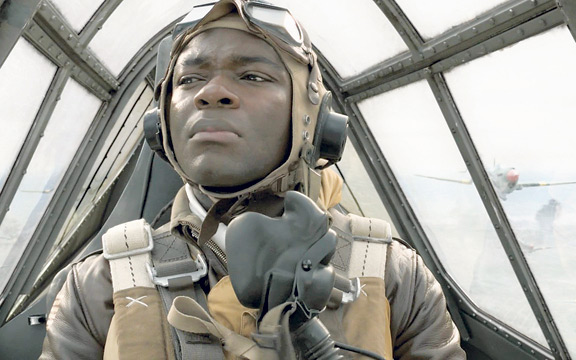 It’s like somebody transplanted a 1950s war film to present day but left every single hoary cliché imaginable. Just because African-American actors get to play the clichés doesn’t mean we’ve made progress. The Tuskegee Airmen are a historical account with enough real-life intrigue; Lucas and company didn’t need to create a fictional tale to illustrate their heroic deeds. The characters are all resoundingly one-note; the troubled leader with a drinking problem, the hotshot who doesn’t follow orders, the wisecracking pilot with a firm religious belief in “black Jesus,” the young guy trying to prove himself, and the guy who gets married and just wants to get back to his girl (guess what happens to him?). Let’s stop and analyze that plot point. Lightening first discovers his Italian beauty (NCIS: LA’s Daniela Ruah) waving while he’s zooming by in an airplane. Naturally he can find her home. After a series of strolls, Lightening asks her to be his wife, and eventually she accepts after some deliberation. Neither of them seems to find this interracial marriage concept a big deal, but in the 1940s, when the Army was still segregated and miscegenation was still illegal in certain states until 1967, you better believe it would be a big deal. Italy was no prejudice-free haven of tolerance, especially under Mussolini’s rule. And by the way, the portrayal of Italy in this movie looks like the war hasn’t even touched the land, physically and mentally. All those happy Italians just walking around smiling. And then there’s the white officers club where one of the black pilots visits and punches a guy after he calls him the N-word. In reality, this guy would have been beaten to an inch of his life. It’s even more bizarre then that, just after a month of flying missions, this say officer’s club greets the black pilots with open arms, fighting to by the guys rounds of drinks. Red Tails, at times, seems to exist in a different universe.
This has got to be the most boring part of a story you could tell about the Tuskegee Airmen. We watch the pilots escort the bombers and stick with the mission. While an interesting historical footnote, that’s about it. The story before the missions and after the missions is infinitely more interesting. I’d much rather see these brave heroes have to go back to a bitterly racist country, be declared honored men of valor by the government and then told they don’t deserve equal rights in the same breath. There’s so much more inherent drama in the conflict of going home to a segregationist country. Likewise, the Army was only integrated late into the war, meaning that African-American soldiers could not enter combat until 1944. Surely the journey these men took to enter the armed services is more compelling, and their experiences must have been even harder, battling the prejudices of their fellow brothers in arms. The early scenes in the film where Col. Bullard is fighting for respect and to get his men an actual mission, butting heads with brass who feel African-American soldiers are inferior, is far more gripping than anything that goes on in the air. The actual war part of this story is the least interesting part. If Lucas and company were so hell-bent on framing their story this way, they should have taken a cue from 1990’s Memphis Belle and stuck to a single mission being the majority of the plot. That would have kept the realism of the situation, ratcheted up suspense, and been a more natural way to get to know our characters.
While only thoroughly mediocre, Red Tails can have some pretty awful moments. The white bomber pilots provide, for lack of a better phrase, color commentary on the plot. Their dialogue is so on-the-nose and transparent, meant to lead an audience into some stilted realization that African-Americans are, gosh, not that different. The dialogue starts off with stuff like, “What? A colored man?! We’re done for,” then goes to, “Hey, these boys might actually be okay. I hope them Red Tails fly with us next time,” and then the movie might as well end on, “Wow, my altogether uninformed prejudices have been completely upended. I’m sorry I ever relied on such outdated notions of race that were completely ignorant. My paradigm has shifted and I’m going to look at people not as black or white anymore, but as people.” It’s so annoying and artificial. The dialogue is mostly cornball but the line that takes the cornball cake is after Lightening attacks a German munitions train, he shouts, “How you like that, Mr. Hitler?!” Really? “Mr. Hitler?” You’d think two African-American screenwriters (John Ridley and Boondocks creator Aaron McGruder) would have eschewed any phrases that could be racially loaded. Speaking of Germans, the movie has one German ace that keep reappearing again and again. Just so we understand that all those cockpit shots of ONE GERMAN are the same guy, the movie gives him a hideous scar along the side of his face. Being a scary scarred German fighter isn’t enough to convince us this man is a villain, so the movie also has him spout some pretty ludicrous racist dialogue, even for someone who may have believed wholeheartedly in the principles of an Aryan race. “Die you foolish, African,” he shouts at one point. Maybe he’s still steamed over that whole Jesse Owens thing.
 But the dumbest moment in a movie that will tax a minimal amount of brain cells is what happens to Junior after his plane goes down. He’s caught behind enemy lines and is thrown into a prisoner of war camp. But what luck, because it just so happens that these prisoners are planning an escape that very night (“At least they won’t see you at night,” one of the guys tells Junior). They’ve dug a tunnel beneath their barracks and Junior agrees to go first to be the lookout. He climbs out of the exit hole right in front of a forest clearing. When the next one in line pops out, however, a German guard has spotted them and turned his weapon on the American. Junior hops from behind a tree, waves his arms wildly to distract, and then runs off into the woods. Inexplicably, this is where the storyline concludes. You’re telling me that a German soldier with a gun isn’t going to give chase into the woods? These guys have the upper hand, plenty of armed men and dogs to track escaped prisoners. The rest of the American prisoners make it out to alive miraculously and one of the guys gives Junior’s dog tags to his unit. How did these prisoners, all escaping after the jig was up, get past everyone? And yet Junior does indeed live too and shows up just in time, in literally the last thirty seconds of the movie, to cut short everyone feeling sad about fallen soldiers. It’s like an angel just dropped him out of the sky. Junior’s escape and perilous journey back to American forces seems like a pretty good story worth telling. It has to be fraught with danger and thrills, but to just hastily end his storyline and magically zap him back to base isn’t just criminally lazy, it’s insulting.
The saving grace of Red Tails is its coterie of talented actors, doing the best they can with the wobbly material. This is a movie designed for the most mainstream of audiences, not for anybody who knows a whiff of history. The characters are one-note, the story is driven by every cliché imaginable, and the reality of the time period feels oddly glossed over at too many points, settling for safe rah-rah movie heroics. The aerial combat sequences can be exciting but they come across as weightless, with all the emotional investment of watching a video game. Credit Lucas giving this movie a decent-sized budget to pull off the special effects and involved combat sequences, but that money would have been better spent on a good script, not one just dusted off from the World War II era and the race of the characters altered. I find this kind of pandering mush to be insulting, especially the fact that the audience is supposed to feel grateful that black soldiers are finally getting the spotlight no matter the quality of film. The choice of “pandering mush” or nothing is a false choice. If giving black characters the chance to run through all the tired, hoary war clichés that went out of style decades ago is progress, then I shed a tear for this country.
Nate’s Grade: C
Share this:

Contraband (2012)
 January at the movies has long been a time for two kinds of releases: 1) award-worthy films expanding into wider release, and, 2) crap. That’s about it. I’ll let you figure out which category the action thriller Contraband belongs in.
Paul (Mark Wahlberg) was once the best smuggler in the business. He’s since gone legit, starting a family and his own private security business. His brother-in-law (Caleb Landry Jones) gets into trouble with some bad men. He tosses a load of smuggled drugs to elude Customs ships, but now Briggs (Giovanni Ribisi) wants the value of the drugs or else. Paul knows he has no choice but to put together one last job to save Kate’s (Kate Beckinsale) brother. Paul leaves his family in the hands of Sebastian (Ben Foster), a trusted accomplish on many missions. John puts together a team and plans to board a ship headed for Panama City. While there, the team will load large sums of confederate money. The sale of the fake currency should square things between John and Briggs. However, little goes according to plan.
 Contraband is a lousy heist picture that feels like it’s making it up as it goes. First off, the premise of John having to go back into his art of smuggling to settle a debt has been overdone, and the fact that John’s idiotic brother-in-law is as fault makes it hard to care that something might happen to the idiot. But why God do they bring this screw-up, the brother-in-law, along with them? He’s already proven to be a poor decision maker and a moron, and, surprise surprise, when in Panama the guy gets them into more danger. So irritating is this character, always foolishly making things worse for John, that you wish they had thrown this dolt overboard. This is a movie structured with a small beginning, a small end, and a great big fat middle, and it’s that middle that involves our destination to Panama. With heist movies, as well as most thrillers, we don’t want things to go according to plan. We want to see organic complications and watch our team of characters adjust. With Contraband, the complications don’t feel natural so much as like careening plot elements from other movies. John’s quick visit goes out of control, with the team losing their payment money for the confederate loot (guess who’s responsible for that? Guess?), and they have to go find a budding crime lord, Gonzalo (Milk’s Diego Luna), and then this crime lord just happens to be plotting a heist at THAT EXACT MOMENT and John and his team should come along and then the heist goes bad, as always, and the team ahs to get away, but Gonzalo demands to be taken to a hospital by gunpoint, and then the cargo ship is going to leave port, and, and, and, and, etc. There are so many breakneck plot turns thrown in that it feels like a broken blender spewing half-formed plot residue everywhere. It’s the film equivalent of the If You Give a Mouse a Cookie story (“If you give a smuggler a deadline, he’ll need a contact. If you give him a contact, he’ll need to do the contact a favor. If he does the contact a favor, he’ll have to do this one job for him. If he does this one job for him, he’ll need a crew. If he needs a crew, he’ll need… etc.).
Let’s take a moment to analyze the peculiar masks Gonzalo and his team choose to utilize. They literally wrap duct tape around their faces. That’s got to be the dumbest mask in the history of cinema, and there have been some stinkers. They couldn’t afford pantyhose? Anything? They had to use tape? First off, you can’t conceal key features, like your eyes and mouth, and lastly, isn’t it going to be something of a bitch to rip those things off? The only person who could properly wear a duct tape mask would be someone suffering from alopecia (condition that leaves a person hairless). Otherwise you’re sacrificing your eyebrows. Maybe this is just how things are done in Panama.
So much of this movie feels like it’s on autopilot, just drifting like that cargo ship. At this point, I don’t even think Wahlberg is trying to hide his indifference to the material. He’s a man with a shady past who went legit and has a family now, but in order to protect that family he is drawn back to his shady past. How many times has this plot device just been used in the last few years? The rest of the characters fill out the crime thriller cheat sheet: young screw-up who serves as plot catalyst, parent in prison to provide cautionary tale, best trusted pal that ultimately proves to be untrustworthy, and the harried, often victimized wife. Poor Beckinsale (Underworld) who gets beaten, threatened with a gun in her face, and victimized to a degree that it feels like exploitation. This woman can never catch a break. She gets few moments in the film where she is free from being terrorized with violence. I have no idea what would attract an actress like Beckinsale to this part other than the allure of a paycheck. Contraband stalls when it comes to thrills, and part of this is because the villains seem so lame. Briggs just comes across as an inept criminal, like somebody’s own screw-up brother-in-law that tagged along to play with the big boys. He’s routinely beaten and bossed around. It’s hard to take his threats seriously, so the movie cuts its losses and just has him threaten Kate some more. It becomes old quick. The only thing that keeps Contraband going is the great distance between Paula and his family, a divide that keeps Paul vulnerable. Too bad that the movie can’t think of anything thrilling to do with this scenario and settles, all too frequently, on scaring the wife. Wouldn’t the film have been more engrossing if Paul’s wife had been kidnapped this whole time? Would that not cause a better sense of urgency than the vague threat that a character we don’t care about might get offed for being stupid?
 From an action standpoint, the thrills rarely materialize, relying on a contingent of blunders and coincidences to provide the thrills. There wasn’t a moment where I worried for a character on screen. This may be because I didn’t care for a person on screen, thanks to workmanlike characterization, but it’s also got to fall on the feet of Icelandic director Baltasar Kormakur (who starred in Wahlberg’s role in the original Icleandic version of this flick) and his nascent camerawork. There will be moments where his camera does stutter-step zooms, mimicking the docu-drama camerawork that’s been en vogue with action cinema. And then he’ll never repeat it. There’s a shot of Gonzalo blowing the armored car up and it’s filmed in a high-speed, stylized shot to distill the strange beauty of the force, and then this never happens again. It’s like Kormakur is sampling all 31 flavors of action movie styles and can’t decide on a visual tone. The action is too dependent on arbitrary coincidences for it to be satisfying of thrilling; we’re just waiting for the next out-of-nowhere plot turn to move things along. The ending attempts to tie up things nicely but feels asinine and laughable in how John can take out three villains in one well-orchestrated, tidy swoop. Don’t even get me started on the impracticalities of John hearing a lone cell phone ringing to be able to trace his wife in an entire construction site. The resolution feels ludicrous and a stroke of dumb luck.
Contraband is a convoluted, knuckleheaded thriller that drags because of arbitrary maneuverings, poor characterization, a fat middle section plot-wise, and pedestrian action. The movie feels like it’s being made up on the spot. As a result of all this tiresome lateral plotting, Contraband feels like it’s going nowhere and spinning into oblivion. I found myself nodding off at various points, my brain bored by all the generic goings-on. The constant victimization of Paul’s wife is a rather ugly development for a movie that confuses salty language and furrowed brows for toughness. The movie is devoid of any sense of fun. It just becomes an empty enterprise of actors going through the motions to work of genre pap. Even by the dirt-low standards of January cinematic offerings, Contraband isn’t worth a cent of your hard-earned money.
Nate’s Grade: C-


 nathanzoebl
You must be logged in to post a comment.