Category Archives: 2012 Movies
Prometheus (2012)
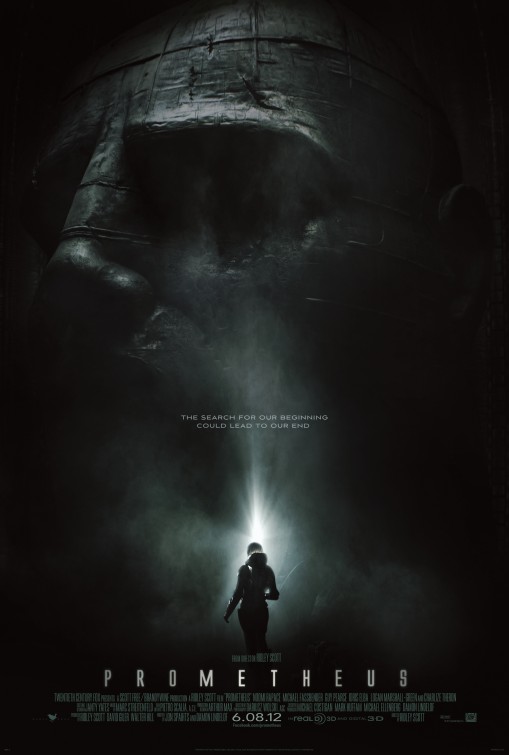 Ridley Scott has always wanted to go back to the Alien franchise that began with his 1979 sci-fi staple. There have been a lot of coy discussions over whether his big-budget sci-fi spectacle Prometheus is indeed an Alien prequel or not. Scott keeps hinting it has the DNA of the franchise but exists on its own. This movie has some Big Questions on its mind, like where did we come from, but the biggest question out there is whether it really is an Alien prequel or not. Well rest assured, that question will be sufficiently answered. Now if you have more than that, you will be left empty-handed with this gorgeous but ultimately confounding sci-fi thriller.
In 2089, a team of archeologists, lead by Elizabeth Shaw (Noomi Rapace), discover an ancient star map from 30,000 years in mankind’s past. This is not the only ancient illustration displaying the same constellation. Sure enough, in every ancient civilization across the globe, the same star pattern. Shaw believes it is an invitation and th key to finding the “engineers” who may be responsible for life on Earth. Four years later, the wealthy Peter Weyland (Guy Pearce) has funded a trip to that exact point in space, which harbors a moon that seems extraordinarily like Earth and capable of sustaining life. The ship is run by Meredith Vickers (Charlize Theron). who keeps asserting her company’s authority on this mission. Along for the ride is a cocksure pilot (Idris Elba), an android named David (Michael Fassbender), and Shaw’s own lover, a scientist in his own right, Charlie Halloway (Logan Marshall-Green). When the gang gets to that moon, they uncover large buried structure with some nasty surprises inside. Suffice to say, they should have stayed home.
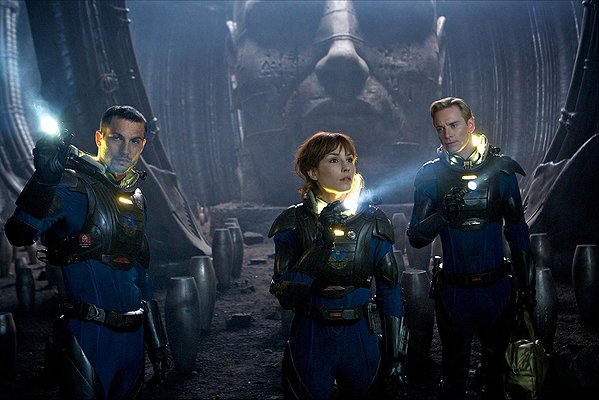 You can always count on Scott to deliver a visually extravagant picture, and Prometheus is packed with stunning, arresting visuals that fill up the big screen with lovely detail. The scale of some of these sets is massive, and your eyes just want to soak up every detail. The alien world is vast and eerie and you just want the characters to spend the rest of their lives exploring it (Scott shot in Iceland but it looks remarkably like a whole different world). The interior sets on the space ship are also sleek and cool. There’s a terrific sense of immersion in the movie. Scott has always done a great job at building worlds that feel completely lived-in, and Prometheus is another example of his talents. The special effects are astonishing but best when not dealing with the biological life forms. The giant spaceship is incredible; its inhabitants? Not so much. Apparently our DNA grandfathers looked like giant Michelin men (thankfully we take more after our mother’s side). Prometheus demands to be seen on the biggest screen possible.
Prometheus harkens back to the original Alien in its suspenseful “haunted house in space” setup. The movie has some terrifically taut moments and a great overwhelming sense of dread. The scientists let curiosity get the better of them, so they poke their heads in dark corners, touch unknown alien material, and get up close and personal with things better left unmolested. If slasher movies elicit a “Don’t go in there” audience response, then Prometheus certainly elicits a “Why are you touching that?” reaction. And yet, deep down, we want them to keep pushing further because like the best suspense films, we can’t stand the tension but we really want it to keep going. Probably the most memorable scene of them all involves Shaw performing her own hurried abdominal surgery to remove an alien from inside her. It’s creepy and caused me to wince repeatedly, but man is it fun and gruesome and a nice payoff to an earlier setup. The rest of the movie is pretty standard with its thrills, including the canon fodder supporting characters getting picked off unceremoniously, and the large-scale devastation climax. The movie delivers the goods when it comes to entertainment and suspense, though mostly in the first half. It’s almost like the movie is awed by the visuals as well, and then halfway in remembers, “Oh yeah, we got to do more than just poke at things,” and then it’s a rush to the end with a cascade of conflicts that don’t seem properly developed.
The film lays out a very essential question about the origins of mankind and plays around with theological concepts but it only plays in the shallow end of the philosophical pool. The screenplay by Jon Spaihts (The Darkest Hour) and Damon Lindelof (co-creator of TV’s Lost) deals with the conflicting origin stories via religion and observable science but never goes into specifics. “Religion” is always symbolized as a cross necklace that Shaw wears and her falling back point upon what she “chooses to believe.” The discovery that our alien forefathers have a similar appearance would be a huge revelation, except the movie spoils it with a clumsy prologue that shows us right off the bat what the “engineers” look like. Prometheus actually posits an Intelligent Design argument for human existence, albeit one the Raelians have been promoting for years, the idea that intelligent life outside our galaxy seeded Earth. Yet the one scientists on the crew, the one who objects to 300 years of evolutionary evidence, remains mum on the matter. I suppose the filmmakers didn’t want their monsters-in-space movie to be bogged down with that much pithy philosophy, but I would have appreciated some meatier conversations other than, “Should we touch this?” It’s not nearly as thought provoking or as compelling as it thinks it is.
As I sit here and I write this, the plot becomes a wispy memory of strong set pieces and eerie mood, but I cannot connect the story. It makes little sense and by the end of its 124 minutes we’re left with hardly any more answers than we started with (some spoilers to follow). Our genetic “engineers,” as they call them, remain pretty nebulous. I suppose one could argue that it would be impossible to fully understand an alien race’s habits and purposes without resorting to pandering, but that strikes me as a cop out (I’m reminded of Spielberg’s similar approach in Kingdom of the Crystal Skull, where the characters that wanted to know were punished for their intellectual curiosity by alien forces). Why did these super aliens create life on Earth and leave maps to a planet that was little more than a weapons depot? Why would these superior beings create life hundreds of thousands of years ago and then leave clues 35,000 years ago that would lead to the destruction of their little experiment? The motivation seems rather hazy. It’s not like the aliens created life on all these planets and waited to be contacted so that they knew their little biological Easy Bake oven was done and then they could reclaim a new planet. It’s not some imperialist empire or colonization scheme; it appears to just be wanton destruction. That seems like a waste of effort. Did these aliens keep checking back, see our ancestors hunting and gathering and go, “Oh my Space Deity, I can’t believe we created life on this planet? We were so wasted. Well, just wait until they conquer space travel and then we’ll kill them with a weird biological weapon.” If your desire is to destroy life, why even have a waiting period? If these “engineers” wanted to destroy Earth why not do it when there was far less clean up? Is there some kind of parent-child relationship I’m just not getting here?
 Fassbender (X-Men: First Class) makes the biggest impression as the fastidious android, David. He’s by far the most interesting character and he’s not even human. It doesn’t take long to figure out that David has his own agenda, and Fassbender plays the character with this eerie passive-aggressive arrogance. You get the sensation that he looks down on his human clientele, but you don’t know what lengths he will go. “How far will you go to get your answers?” he asks before doing something very not nice. He makes statements like, “Who doesn’t want to kill their parents?” and there’s an icy placidity to him; he’s just off enough to be menacing and unsettling without going overboard. Fassbender is excellent.
The rest of the cast cannot be at fault for failing to measure up to Fassbender (is that a Shame joke I stumbled upon?). Rapace (Sherlock Holmes: A Game of Shadows) is given top billing and does an admirable job of being a kickass heroine, which we already knew she was fully capable of in the Swedish Girl with the Dragon Tattoo trilogy. She even has a Ripley-esque haircut, which I doubt is a coincidence. Theron (Snow White & the Huntsman) gets to once again practice her ice queen routine, but I wish she had more to do than occasionally glower and bark orders. Her character’s secret background should be obvious to anyone well versed in the film economy of characters. Elba (TV’s superior Luther) tries to stick it out with some twangy Texas accent but can’t make his way through. His natural British accent pokes through routinely. Then there’s Guy Pearce (Lockout) as the wealthy benefactor who bankrolled the whole project. Apparently he was hired to film viral videos as himself, because in the movie he’s like a 100-year-old man in some pretty poor makeup (he resembles old Biff in Back to the Future: Part 2). Why hire an actor of Pearce’s caliber if you’re just going to hide him under a veil of old-age makeup? The actors do what they can but the film doesn’t give them much to work with. They’re stock roles and absent development. You don’t notice for a long while because you’re so caught up in the exploration and the gorgeous visuals, but when the end comes you realize that you hardly knew these people.
After all the pre-release coyness about whether this belonged in the Alien universe, Prometheus seems to be a victim of its own sky-high hype. The movie is moody and dark and intriguing and visually magnificent, but the plot does not hang together at all. The central mystery of the origins of mankind is given a face to start with, but that’s about it. The confusing story tries to mask its plot holes but eventually they just overtake the movie. It’s an entertaining movie in the moment but Prometheus pretty much evaporates as soon as you leave the theater and start thinking, “Hey wait a minute, that didn’t make any sense.” Why are mankind’s “engineers” a regretful bunch of jerks? Scott’s visuals are impressive, the film has a killer mood that’s hard to shake, but the plot is pretty shaky and reliant on supposedly smart people making pretty dumb decisions (why yes, I’ll try and touch the alien snake monster thing). That’s fine for basic thrills but it doesn’t elevate the movie into something headier, meatier, and more satisfying, like the original Alien. Prometheus was never going to meet the unattainably high expectations of fans stoked by tremendous trailers and the promise of Scott’s triumphant return to sci-fi, but much like the characters in the film, I was glad to go on this journey but wished I had more to take home with me.
Nate’s Grade: B
Share this:

Snow White & the Huntsman (2012)
 Snow White & the Huntsman is meant to be a darker, splashier, more action-packed retelling of the classic story, and when compared with the earlier 2012 Snow White venture, Mirror, Mirror, it certainly merits all those descriptions. With Twilight star Kristen Stewart at the helm, this movie seems tailored for teens looking for some girl power. I have no problem with reworking fairy tales to suit our modern-day cultural interest, but just giving a person a shield and a sword does not instantly make them a warrior. And just plopping Snow White into a medieval war does not instantly make this a movie worth watching.
The wicked Queen Ravenna (Charlize Theron) killed the king and installed herself on the throne. She sucks the youth directly from ingénues to keep those good Theron looks of hers. She is the fairest of them all but she is warned that one day the king’s daughter, Snow White (Stewart), will overtake her in fairness. Snow’s been living in a prison cell for about ten years since her evil step-mom took power. She escapes her imprisonment and flees to the Dark Forrest beyond the castle grounds. The Queen’s powers will not carry over into the Dark Forrest (for whatever unexplained reason), so she hires the Huntsman (Chris Hemsworth) to retrieve Snow White. The Huntsman changes sides, allies himself with Snow, and some dwarves, and then everyone bands together to retake the kingdom under Snow’s stout leadership.
 Snow White & the Huntsman falls victim to that age-old screenwriting curse of failing to show us its work. I get so sick of movies, or any narrative really, that heaps praise upon some person and then never shows us any convincing evidence. If somebody is said to be a great poet, I want to hear one of his or her great poems. If somebody is said to be a great leader, then I want to see him or her inspire. To make up for the plot shortcomings, the screenplay reminds us at every moment of downtime how special Snow White is, how glorious she is, how different she is, how she is the only one to bring down the tyrannical rule of Ravenna. At no point did I believe any of this. Just because I have characters tell me, ad naseum, that someone is special doesn’t make it so. I need to see the evidence, and from what Snow White has to show, it is not that impressive. She’s somewhat resourceful, escaping from captivity, but she’s not exactly a figure of compelling strength, magnetism, or inspiration. She gives one “rally the troops” speech that gets the townspeople all fired up to go to war; it’s no St. Crispin’s Day speech, but even if we’re grading on a curve, it’s a pretty weak motivational speech. There’s no reason these people would line up behind this displaced damsel other than the fact that the plot requires them to do so. This Snow lady has, much like the infamous Bella Swan, the personality of a dead plant, and all the proclamations to the contrary will not change that fact. Snow White is just not an interesting of compelling person, period.
There are two reasons why Stewart is completely wrong for this part. First off, when we’re objectively talking about one who is “fairest of them all,” and Charlize Theron is in your movie, you’re going to lose every time. I’m not saying Stewart is wretched looking; quite the contrary. Debut director Rupert Sanders finds ways to film her that make her look lush and vibrant. Some would argue “fairest of them all” is not in references to physical beauty, which it has always been, but to the fact that Snow’s heart is so pure and good. If that’s the case, that’s just stupid. Then why even make it Snow White if the nemesis to the evil queen is simply somebody who is morally just? You could have had a commoner play the role and that would have brought about more interesting class conflicts. Secondly, Stewart is such a modern era actress, someone who has so effectively channeled the rhythms of a blasé generation of young people, that dropping her into a medieval time period is jarring. She doesn’t fit. Everything about her aloof acting style screams modern times. Maybe that’s why her speaking is kept to a minimum. She can ride on horseback, dress in Joan of Arc armor, but she’ll never strike anyone as a fitting Epic Heroine. I feel that her acting has blended with the sullen nature of Bella Swan to the point that it’s hard to separate the two. I’m not a Stewart hater at all. I actually think she can be quite a capable actress (see: Speak, Adventureland, the upcoming adaptation of Kerouac’s On the Road) when paired with the proper material. Snow White & the Huntsman is not the proper material.
Aside from casting errors, this dark fairy tale doesn’t find any time to settle down and develop anything that could approximate characterization. Case in point: all we know about Snow is that she is a princess, everyone tells us how beautiful she has always been, she runs away, and then leads a rebellion, then she become queen (don’t pester me about spoilers). What else do we know about her? She’s defined entirely by outside forces, especially the charitable words of others. Snow White is not a character but a symbol, the prophetic Chosen One. She’s really a placeholder for every lazy archetype needed for epic fantasy. Stewart cannot connect with the material, so she seems to wander around, mouth agape, almost like she’s stumbling drunk through the whole movie. It seems that Snow White & the Huntsman just provides us the familiar elements of the story (evil stepmother, huntsman, dwarves) and expects us to fill in the rest with our own wealth of knowledge over the famous fairy tale. The rote insertion of a long-lost childhood friend/eventual love interest (Sam Claffin) is made tolerable only by the fact that he does not eventually become a love interest. This Snow doesn’t need a man, and good for her.
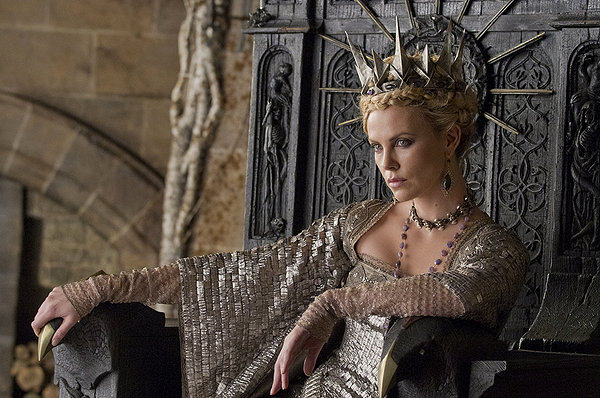
Sanders’ background in commercials definitely shows in his superb visual palate. The man knows how to frame a beautiful shot, and the visual highpoint is Snow’s hallucinogenic shamble through the Dark Forrest. Without the narrative traction, though, the movie starts to resemble one very long, very excruciating perfume ad, particularly when Snow comes across a white horse just laying down in the surf. Some of Sanders’ “ain’t nature great” creations deeper into the forest reminded me very strongly of Miyazaki’s Princess Mononoke, especially with the godly stag. Despite its considerable faults, Snow White & the Huntsman is a great looking movie. Sanders’ crisp visuals are further enhanced by wonderfully theatrical costumes from multiple Oscar-winner Colleen Atwood (expect another award on that mantle come 2013). Queen Ravenna has more eye-catching outfits than Cher in her heyday. They seem to be made out of interesting organic elements, like a gown accented with diminutive bird skulls. She may be a ruthless tyrant, but man does that lady know how to dress. The fashion choices became so exotic and intriguing that it provided another reason for me to hope we’d get more time with the queen. The production design by Dominic Watkins (United 93) is fittingly medieval. At least there’s always something nice to look at with this monotonous bore.
I don’t really get the geography of this kingdom. By all accounts, it looks like one poorly guarded castle, one poor mud town, and a deep expanse of forest. The fact that it’s labeled as the Dark Forrest seems shortsighted, since it takes a few hours continued walking to come across all sorts of other civilizations, including our scarred matriarchal society. And then there are dwarves too. It all feels so listless, lacking any sort of connective tissue to help round out this magical world. After a while, it just becomes an assortment of cool stuff just put into a movie because it’s cool. The fact that none of these magical creatures or assorted villagers ever pop back again, except for our coronation in the resolution, means they were meaningless to this story other than being a rest stop.
 The screenplay is surprisingly rushed; rarely do we spend more than five minutes in any location. I was interested in a city of women with self-inflicted facial scars to protect themselves from Ravenna coming for them. Just as things start to get interesting, it’s like the movie gets antsy and has to keep moving, and we’re off again. It’s hard to work up any sort of emotional engagement for anyone when we just spend a few minutes with these characters. The brisk pacing also gives the impression that the characters really don’t matter in the end. If it weren’t for a scene where the Huntsman blatantly explains every feeling he has to a comatose Snow White, we’d know nothing about him. The Huntsman is grieving over the loss of his wife, and oh she just happens to have been killed by Ravenna’s creepy albino brother (Sam Spruell). The pigment-challenged dolt confesses this convenient bit of information at a strange time. Why confess to killing a man’s wife when you’re battling to the death? Confess afterwards. It’s another example of lame screenwriting and nascent characterization. Even the queen gets a bizarre throwaway bit of characterization. For whatever reason, we have a flashback to when she was a child and her mother forced her to drink the magic immortality elixir. Why did we see this? It’s too late to make her sympathetic. And yet, even this brief glimpse at Ravenna’s back-story makes her more interesting than our feckless Snow White.
The bleakly brilliant Young Adult renewed my fondness for Theron as an actress. For a while, she seems to really sink her teeth into the role, lapping up the villainy in a satisfyingly menacing manner. It’s at this lower level of burn, the quiet intensity, where Theron is most enjoyable. When the movie requires her to raise her voice is when things start to go bad. She shrieks in such a campy, over-the-top, weird overly enunciated style. Any hope of secretly enjoying this movie died with Theron’s stagy agitation. Hemsworth (The Avengers) adopts a thick Scottish brogue but does little else. At times I found that he looked remarkably like a cartoon tough guy; just something about his face lends itself to clean, burly definitions. The best actor in the movie is Bob Hoskins (Mrs. Henderson Presents) as a blind dwarf, and perhaps that sentence alone should say all that needs saying.
This film is more Lord of the Rings than fairy tale. It’s got some battles and some siege action to pacify the men folk, but this is obviously aimed at the ladies. It’s a feminist, Robin Hood-esque reworking of the Snow White tale, recasting the damsel as action heroine, and I’d have no problem with this revision if: 1) the film made her an actual character, 2) it had been played by anyone other than Kristen Stewart. It’s got all the familial elements but they have no context in this reworking; it lacks internal logic. If I did not have sufficient background knowledge about this tale, I’d be left wondering why any of this should make sense (apples are poisonous now?). At every turn, the movie has to tell us why things should matter rather than showing us. There’s no evidence onscreen why this Snow White lady deserves any fuss. Snow White & the Huntsman is a movie obsessed with appearance and precious little else. Snow White & the Huntsman is one boring, truculent, dreary chore of a movie that goes on far too long. Just because it’s darker doesn’t make it more mature or exciting. Fairest of them all, my ass.
Nate’s Grade: C
Share this:

Bernie (2012)
 The last person the residents of small town Carthage, Texas would expect to be tried with murder would be Bernie Tiede (Jack Black). He was an assistant funeral director, a “born natural” we’re told at comforting others, but he was really the everyman glue of the town. He lead the choir at church functions, loaned his time and money to those in need, directed the town’s fledgling drama productions, coached the Little League team, and went out of his way to spend time with the town’s lonely little old ladies. It was a shock then, in 1996, to find out that Bernie had shot one of those little old ladies, Marjorie (Shirley MacLaine), the meanest one of them all, and stuffed her body in a freezer and kept it all a secret for nine months. During that time, Bernie used Marjorie’s considerable fortunes to help every community project he could. Despite the macabre nature of the crime (she had to thaw out for two days before an autopsy could be performed), the residents of Carthage rallied around their boy, Bernie. District attorney Danny Buck (Matthew McConaughey) had to move the trial to a different venue, not because the accused couldn’t get a fair trial, but because everyone in town wanted Bernie free.
Bernie is Richard Linklater (School of Rock, Dazed and Confused) returning back to his local color roots. The man is excellent at taking the natural peculiarities of regionalism and credibly establishing a slightly skewed yet authentic portrayal of small town Middle America that feels like it was lifted straight from the pages of Mark Twain. Aiding Linklater is the fact that the movie is composed like a true crime special replete with on camera interviews from many of the real townsfolk of Carthage who knew the real Bernie and Marjorie (what a strange experience it must have been acting with the fictional counterparts). They are all amusing, unassuming characters in their own right, many natural scene-stealers, and they’re still fiercely protective of Bernie 15 years after the events of the movie. The town’s unswayable loyalty and adulation for Bernie pretty much becomes the film’s own point of view. Despite confessing to murder, we find ourselves liking the guy. It’s hard not to love the guy when we see him lift the spirits of the bereaved, volunteer around town, and bring so much pride and joy to the citizens of Carthage. When forces are circling around him, we want him to escape. We want him to keep the illusion of Marjorie being alive just a little bit longer, especially when, in death, she is helping so many more people. Even when we reconcile the facts our gut still wants him to get slapped on the wrist for what is, after all, a capital crime. It’s a fascinating emotional journey for the audience in that regard, to ignore the reality of the offense because of how genuinely nice Bernie is, except for that time he killed an old lady and stuffed her in the freezer.
 Black (Tropic Thunder) does something completely different from his usually manic routine. By God, the man inhabits this character. The part plays to his strengths as a performer, his energy and natural likeability, but allows him to mellow out and try a very different tact. For the first time in perhaps his acting career, he’s not playing some variation of Jack Black. He’s playing a real-life person, though that doesn’t necessarily mean the actor is indebted to completely mimicking the living inspiration. Told from the perspective of fawning townsfolk, and one completely mystified prosecutor, Bernie remains something of a mystery as a character. He’s deeply repressed, probably closeted as well, and it’s that distance that keeps us from better understanding him. For all intents and purposes, the people of Carthage loved Bernie, but did any of them really know him? He was a genial presence, charitable and kind, but could anyone really say they truly knew him? Who is the real Bernie, the guy who would break his back helping his neighbors out of the good of his heart, or the guy who shot a little old lady four times in the back? Black doesn’t overplay the fey mannerisms or go to camp levels; he hides behind his friendly veneer and hints at more at work. Bernie’s canny salesmanship with funerals, as well as his lavish spending when he got in control of Marjorie’s finances, give a glimpse at a darker side of Bernie. It’s subtle work for a role that tempts him to go larger. I have no reservations when I say that Black’s controlled yet charismatic performance is worthy of Oscar attention. He’s that good, folks.
Supporting Black are two other great performances from established stars. MacLaine (Valentine’s Day) hasn’t had a role this good since the underrated In Her Shoes. She has great fun as the old sourpuss in town, but she too shows us glimpses of the real Marjorie, the one behind the wall of negativity. There’s a scene where she’s watching Bernie’s musical practice and she can’t help herself but smile. The very act has to break through the scowl that she has so permanently etched into her face, but break through it does triumphantly. MacLaine could have easily been portrayed as a caricature of the grouchy rich old lady, but she’s better than that. You don’t exactly sympathize with her but you do feel Marjorie’s budding comfort, even if it’s slathered in her usual contempt, and you feel her desperation at clinging to the one person who has shown her any personal interest. Likewise, McConaughey (The Lincoln Lawyer) could have been the one-note daffy lawman, and he’s certainly presented as such early on with his attention-seeking theatrics. We don’t really like Danny Buck, but from an objective standpoint he is the voice of reason. He counters the easily forgiving townsfolk, “If he killed you and stuffed you in a freezer, would you not want him to go to jail?” We know he’s right. And yet, strangely, we don’t seem to mind that much. It’s nice to see McConaughey flourish in a role that shows you he can be a real fine actor instead of just a real fine shirtless torso.
 Linklater balances a lot of different tones here but manages to find a satisfying middle ground. Bernie is a chuckler, a movie that will continuously make you laugh but leave your sides safe from splitting. I chuckled and guffawed my way through from beginning to end with great amusement. The comedy is dark but not unrepentantly (hence the PG-13 rating) or mean-spirited. Linklater doesn’t make light that a real woman was murdered, but his film raises a cracked mirror at the absurdities of our culture and the power of charisma/celebrity. There’s a mordant amusement to the entire movie, and you know you shouldn’t be laughing but you cannot help the urge. The constant interviews with the actual Carthage townsfolk add a nice color commentary to the proceedings, filling in the edges of the blanks left over by the screenplay. Some may feel that the constant commentary undercuts the movie, interrupts its flow and turns the movie into one of those grisly TV true-crime specials gussied up for the big screen. The movie does follow a similar trajectory but Linklater balances the small-town satire, tragedy, courtroom drama, and general morbid curiosity into one persuasive, cohesive whole.
Bernie is one of those stories that are so bizarre that it could only come from real life. Buoyed by strong comedic performances, a mordantly compelling story, and some rich supporting turns from real-life witnesses, Bernie is an amusing breath of fresh air amidst the summer movie-going extravaganza. It’s gentler than I would have anticipated, and funnier, and Black’s wonderful performance is worthy of serious awards attention, though I know it will be long forgotten come the fall. I don’t think Linklater was trying to make some kind of larger statement about the powerful allure of charisma, or our malleable sense of what constitutes right and wrong, but Bernie the movie is all about the fronts people put out there and the human willingness to be deceived. Or it’s just a really fun, country-fried slice-of-life comedy. Why not both? Bernie is worth discovering.
Nate’s Grade: B+
Share this:

God Bless America (2012)
 Bobcat Goldthwait’s (World’s Greatest Dad) pitch-black social satire is something akin to Idiocracy meets Falling Down. Frank is a terminally-ill man (Joel Murray), fired from his job, and he’s had enough with the coarsening of American culture. He teams up with Roxy (Tara Lynne Barr), a precocious teenager, and embarks on a killing spree intended to take out the people responsible for making us so mean. Nothing is subtle about Goldthwait’s satire, and while the victims are easy targets (reality TV, media fear-mongering, hateful religious extremists), the results are wickedly funny and entertaining on a vicarious level. Murray is given a few standout speeches about the poisoning of intelligence, the celebration of self-absorption and ignorance, and while it may be preaching to the choir, God Bless America has enough moments that make you want to stand up and salute. There is a sequence in a movie theater where Frank and Roxy kill a group of noisy, inconsiderate teenagers, and I think this part should be shown before every movie, in every theater, for the rest of time.
What stops the film from being an irresponsible 90 minutes of pure cranky wish-fulfillment is that Goldthwait does not condone his killer’s point of view. The movie finds ways to undercut the glamorization of what they do, whether it’s robbing Frank of a movie-style “cool kill,” having Roxy list off every annoyance she think is worthy of being killed over (including people who misuse the word “literally” and Diablo Cody) and having Frank reign her in, or the fact that Frank admits to finding some common ground with a blowhard pundit’s political views. This is definitely a movie for a select audience, but for people with a perverse sense of humor and a sense of rising frustration and dread over the popular culture, God Bless America is the movie equivalent of a cultural enema. It’s the darkest movie about manners you’ll likely see in a lifetime.
Nate’s Grade: A-
Share this:

Men in Black III (2012)
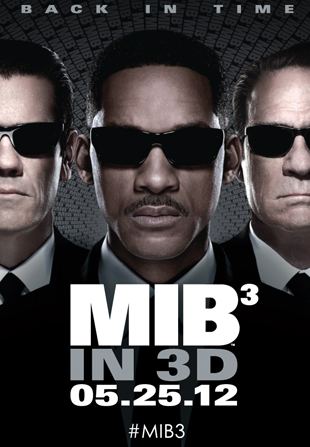 It wouldn’t be a Men in Black film without script problems. The first film languished for some time, originally taking place in Kansas of all places, before director Barry Sonnenfeld became attached and insisted upon a New York City location. The 1997 sci-fi buddy cop comedy was a hit, and rightfully so, and Will Smith became a megastar. Then the 2002 sequel’s climactic action sequence had to be rewritten due to the fact that it was originally going to take place in the World Trade Center. If only that lackluster sequel had gone through more extensive creative revisions. However, these past hiccups don’t seem to come close to Men in Black III, which to Sonnenfeld’s admission, started shooting in late 2010 without a finished script. It had a beginning, an ending, but nothing definite to tie together. So the whole production took eight months off to work on the meat of that movie sandwich. Hollywood movies, especially modern films of huge-scale budgets and set release dates, have routinely started production without completed scripts, including Gladiator, Jaws, Apocalypse Now, and Lawrence of Arabia. Naturally, those are the exceptions to the rule.
Boris the Animal (Jermaine Clement) has escaped from pison and out to seek revenge on the man who put him away and took his arm – Agent K (Tommy Lee Jones). Boris travels back to July 1969, when a young Agent K (Josh Brolin) thwarted the big bad Boris. Boris kills Agent K and alters the future. The Earth is now vulnerable to an alien invasion from Boris’ species. Agent J (Smith) has to travel back in time to save his old partner and the planet.
It’s been ten years since the spotty Men in Black II and almost four years since Smith has been seen in a movie. Where did the time go? Fortunately, this third movie hews closer to the droll brilliance of the first film. Part of that is a sharper story with a more clearly defined goal and a return of the playful exuberance that belies the franchise. Also, I must say that absence has made the heart grow stronger, because I’ve missed Smith’s effortless charisma onscreen. Agent K is such a natural fit for the guy and it’s just fun to watch him stumble through strange alien encounters (this time we learn all super models are aliens; listen good, young women of America who punish themselves to fit this image of beauty). Time travel is usually employed when a franchise seems like it’s all out of gas; it’s usually more focused on the comic fish-out-of-water possibilities, which there are a few in Men in Black III. As one characters notes, 1969 wasn’t exactly a great time for black people in America, and J combats casual racism, black panic, and ignorance with a defiant attitude that is amusing to watch. I’m glad the whole race-relations reality was addressed, though it’s also for the best that the movie doesn’t get bogged down with scenes of Agent J conflicting with bigoted authority. Men in Black III remembers that we’re here to have fun, and the screenplay by Etan Coen (Tropic Thunder) has a light-handed touch. I enjoyed the opening jailbreak sequence with Boris, though I would have thought a lunar prison would have better security. Bill Hader (Superbad) has a fun cameo as a self-hating Andy Warhol, really an undercover MIB agent, though the idea that Warhol’s Factory artists as aliens seem a tad simple. The glaring cameo omission was Jon Hamm (TV’s Mad Men) as a scotch-drinking MIB ladies man of legend.
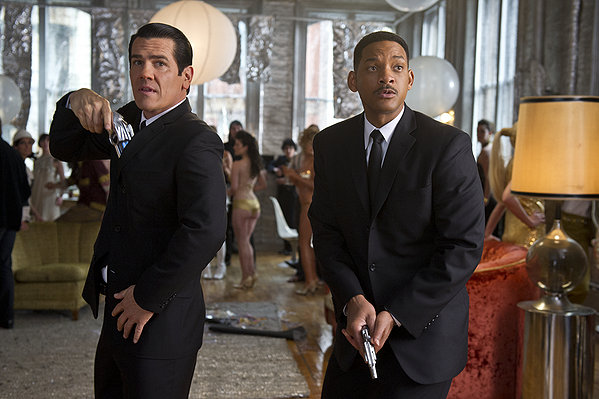 As evidenced from the trailers and marketing, Men in Black III is really Brolin’s movie. The guy establishes an uncanny Tommy Lee Jones impersonation. The eerie brick-faced stoicism, the melodic lilt of his voice, the syncopation of his speech patterns; Brolin nails it all. Watching his interaction with K are the film’s most enjoyable segments. At this point in the series, Agent J and K have gone beyond the rookie/mentor phase and now have something of a friendship, though their arguments at year fifteen of their partnership sound more like the arguments they would have in year two (you need to “open up” and be less grumpy, sounds elementary). Still, there is a personal connection to this case that eluded the last movie, and it gives the film a sense of urgency even when the comic shenanigans seem to hog the spotlight. The personal reveal in the last act didn’t have as much emotional power for me, mostly because I did the math and realized whom a certain unseen character of significance was before we got their true identity. The end does give the film series a circuitous sense of finality.
For a franchise that seems like it can go anywhere at any time with limitless possibilities, the worst thing you can do is be shut off to better avenues of storytelling. Take for instance the climax at Cape Canaveral, which itself is a rather anticlimactic sequence involving the launch of Apollo 11 (don’t they know that alternative 1960s history was sooo summer of 2011?). J has his time travel doohickey that lets him travel back. He gets to use this device once during the climactic fight, allowing him to travel back one minute in time so he knows how to properly duck. That is it. What a fantastic waste. If you’ve got a device that essentially allows for unlimited do-overs, then I want this device to be an integral part of the climax. I want J to have to regularly use it to fix past mistakes and learn more and more from each time jump. Just memorizing how to duck is lame. The entire subplot with Agent O (Emma Thompson in the present, Alice Eve in the past) and her dalliance with K is so carelessly thrown away that I wonder why the filmmakers even bothered to include it. Then there’s our villain, Boris, whose name itself is even lazy. He’s just a bad dude with some sort of insect that lives in his hand and shoots spikes. That is it. He’s a guy who can fire projectiles. So what? What about that makes him interesting? An unrecognizable Clement (Flight of the Conchords) does his best but the character just doesn’t have anything about him that deserves special attention; he could have been any villain (I think Vincent D’Onofrio was undervalued in his go-for-broke physical performance as the first film’s villain). I did like the idea of Present Boris arguing with Past Boris, but like most promising ideas in Men in Black III, this space-time sparring is never fully realized. While enjoyable, there’s little you’ll be able to think back on with Men in Black III and say, “That was well developed.”
Paradoxically, I think Men in Black III has a character that might simultaneously be the best and worst thing about the film. Allow me to explain. About halfway in, we’re introduced to the alien Griffin, played by the great Michael Stuhlberg from A Serious Man and TV’s Boardwalk Empire. He’s a creature who can see nigh unlimited timelines, all the variations of choice and possibility play out before his eyes, one after another. He never knows which timeline he’s in until the moment occurs, thus he’s constantly worried about every moment to come in his life. This foreknowledge sounds like a wretched curse, and with Stuhlberg gives a forlorn edge to his character’s eccentricity. So when J and K meet the guy, there are some clever moments, like when Griffin details every peculiar aspect of chance that lead to the 1969 Mets World Series victory. The moment, and by extension the character, is a nicely reflective idea that every moment is a miracle of causation. Griffin is just an interesting character. Here’s where the worst part comes in. Rarely is he treated as a character because, you see, Griffin is really a magic plot device. He can tell the Men in Black agents whatever they need to do at any point, instantly providing a narrative cheat. When in doubt, just ask the guy who sees the future and he’ll steer you without fail to the next necessary plot point.
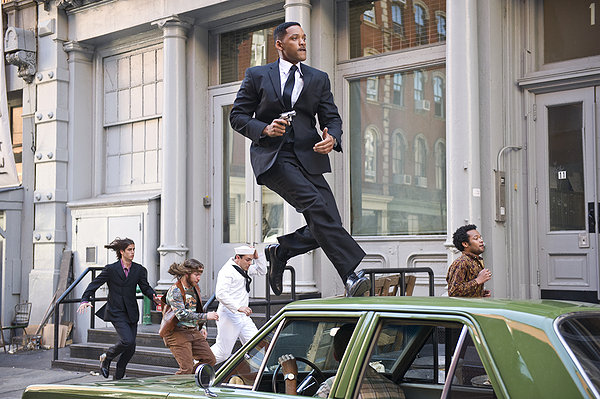 I saw this movie in 3D, not by choice mind you, and for the first half hour it felt like one of the better 3D conversions out there. Sonnenfeld’s camera plays a lot with depth of field and primarily forward-backwards movement, which made for a slightly elevated viewing experience. But somewhere around the halfway mark, I swear the movie forgot it was supposed to be 3D and the dimensional differences became negligent. It never really recovers, and so I advise all potential ticket-buyers to skip the 3D screenings.
With most time travel escapades, there’s going to be some plot holes. Working with a flurry of alien technology, it would have been exceptionally easy for the filmmakers to just explain away the plot holes with some magic device, much like the Paradox Machine in Dr. Who. Hey, there’s a machine that makes sure we don’t have paradoxes? Good enough for me. It’s like in Thank You for Smoking when Rob Lowe’s character explains why actors would be able to smoke in an all-oxygen space environment: “It’s an easy fix. One line of dialogue. ‘Thank God we invented the… you know, whatever device.’” The fact that Men in Black III doesn’t even address its biggest plot hole astounds me. If Agent K is killed in 1969, then he was never alive to recruit Agent J into the service. Let’s even assume that J’s credentials would still get him noticed and staffed with the MIB; if Boris killed Agent K in the past, then there was no reason for Boris in the future to travel back in time to kill Agent K. Again, these aren’t nit-picky gripes, these are major, easily understood plot holes, and I’m dumbfounded why no characters even address them. I could nit-pick over why Boris decides to go to 1969 when he just as readily could have gone to a time when K was a child and thus more vulnerable. Surely a child is easier to dispatch than a 29-year-old man.
Men in Black III is a far improvement over its stilted predecessor, but it still ends up falling well short of the potential it flashes. It’s intermittently amusing with some fun cameos and some visual panache, but this movie should have been stronger, stranger, and more playful with its central time travel conceit. It’s hard to work up that much distaste for the movie, especially since it has such a lively, jocular feel. Not all of the jokes work, but enough do, and the movie maintains an overall pleasant sensibility, zigzagging in imaginative directions that most Hollywood movies never beckon. It’s the stuff that works that illuminates the potential left behind as it goes into summer blockbuster territory. Men in Black III is an example of diminished returns, yes, but some franchises start so high that even latter, lesser sequels will have more entertainment value than their competitors. While it won’t set the world on fire, Men in Black III exceeds expectations and provides enough entertainment that it’s worth a look and little else.
Nate’s Grade: B
Share this:

Battleship (2012)
 On the surface, the classic board game Battleship would seem like a rather peculiar property to develop into a feature film. Unless someone was going the crafty Das Boot route, why would anybody even want to adapt the board game? And for that matter, why would anyone want to adapt the game and add killer aliens from outer space? Well actor-turned-director Peter Berg looked at the classic board game with the little pegs and the declarations of battleships sunk and said, “There’s a big summer movie in there.” With a hefty budget of $200 million, which is becoming alarmingly the norm for summer tent pole releases, Berg’s efforts have given birth to Battleship: The Movie. If it becomes a hit maybe it will start a trend. Who wouldn’t want to see Hungry, Hungry Hippos as a monster movie, or Connect Four as a searing domestic drama about alcoholism?
Off the Hawaiian Islands, the Navy is conducting an annual series of international war games in the Pacific. Oh but little did they expect to have to combat intergalactic foes. Alien spaceships crash land to Earth, emerging from the Pacific and creating a force field barrier. Along for the high seas action are the stoic Stone Hopper (Alexander Skarsgard), his screw-up little brother Alex (Taylor Kitsch), a Japanese captain (Tadanobu Asano), and a mess of other Navy personnel, including pop star Rihanna. On the other side of that force field is Alex’s girlfriend, Samantha (Brooklyn Decker), a naval physical therapist who finds herself in the middle of the aliens communications plans. The handful of Navy ships, some American and some Japanese, must figure out a way to topple the aliens before they get their communications up and running to broadcast that Earth is ripe for the taking.
 For some, Battleship will be the symbol of everything wrong with big-budget Hollywood filmmaking, a perceived slapdash effort meant to appeal to as many mass markets as possible, combining clichés and empty action sequences into a cacophony of noise deigned entertainment. And for most of those charges, I cannot defend Battleship. It has its fair share of clichés, gaps in logic, and some especially corny moments (WWII geezers save the day!). And yet, I found myself becoming entranced by Berg’s siren song, laughing at the comic relief, enjoying the stock characters enough to root for their triumphs, and having a total gas with the action sequences. I was shocked at how much fun I was having with Battleship. Perhaps that means that from a mechanical standpoint it knows all the pinpoints of the summer blockbuster model and knows how to craft a satisfying crowd-pleaser of an action movie. Or perhaps it just means I have lost my mind. Or maybe this is Berg’s expertly crafted satire of the Michael Bay School of filmmaking, brilliantly capturing the beautiful bombast and cheery jingoism of Bay’s career, especially when those salty WWII vets get to strut in slow motion. A movie based upon the board game Battleship is clearly not meant to be taken seriously, and Berg’s nautical adventure wants nothing more than to entertain the masses. Whatever the case may be, Battleship, weirdly enough works, and for some significant stretches, it works really well in the mold of summer spectacle.
I’m relieved that Berg has left behind his rigid docu-drama cinema verite approach he’s patterned after working on 2004’s Friday Night Lights. Berg’s verite style felt completely mismatched with 2008’s Hancock, an inexplicable global hit. With Battleship, Berg’s cameras settle down and give you plenty of action to soak up. Berg’s first foray into action, 2003’s The Rundown, was like the announcement of a great new talent and the herald of The Rock’s ascent in action. I’ve been waiting for Berg to return to that style he displayed with The Rundown, a slick, highly stylized flair, brimming with robust energy that popped at all the right moments. Thankfully, with his biggest budget yet, it’s like the return of the old Berg. Perhaps it’s just a reaction against the overindulgence of the “shaky cam” action style popularized by the Paul Greengrass Bourne films, but it’s nice to be able to actually follow what is happening. Berg’s cameras find different and exciting ways to frame the action. I enjoyed the speedy zoom outs to illustrate the size of the field of battle. The visuals really do feel like Berg is parlaying Bay’s shooting style, the tawny glow of people’s skin, especially women, a.k.a. sex objects, the fetishized ogling of giant toys/military hardware, the soaring camera. But unlike most of Bay’s pedigree, it’s spectacle on a mass scale without turning into a glorified video game.
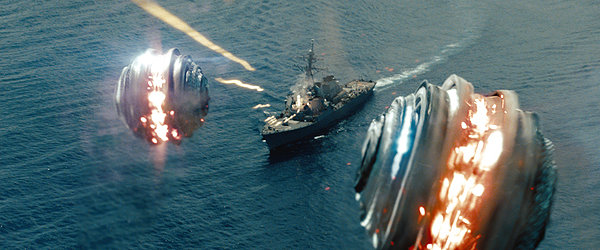
The action in Battleship is huge but never dull. The scale of the demolition does not get out of hand because the movie works in shifts, focusing on pockets of action before ramping up to something even bigger and better. The alien tech, particularly the spheroids that munch through metal like the Langoliers (please, somebody tell me they remember that Stephen King TV movie), is impressively powerful without feeling completely over matched. Being totally obliterated in the movies has its own thrill, but seeing a slug fest between man and alien is more compelling. Watching the Navy go blow-for-blow and eventually triumph through ingenuity in the face of adverse odds makes for some pretty satisfying action. The Navy is learning through trial and, much, error about how to combat these alien antagonists. I enjoyed the tactile nature of the battles. I must say I found the film to be weirdly informative about the attack features of naval war vessels. I don’t know if its genius or absurd that the movie finds a way to organically squeeze in the actual Battleship game play (the alien bombs also look like pegs from the board game). The aliens are something of a mystery and kept that way. When we do see them minus their Halo helmets, you wish they kept those helmets on. They have some unexplained moral code, as we cut to alien POVs that scan for threats, choosing to spare innocent lives in other circumstances. When the alien spacecraft fist appear, they take up position in a row and wait for their Earthly challengers to strike. It reminded me of the fighting sequences in turn-based RPG video games. These aliens are more sporting than your typical interstellar advanced civilization just interested in conquest. These aliens are into turn-based RPGs. These aliens are nerds.
 With all that surprising praise now established, Battleship the movie is still chock full of ridiculous moments and a rather leaky plot. The subplot involving a double-amputee veteran getting back his groove via alien invasion never feels well grafted to the major storyline. It feels like it was crowbarred in after the producers or Berg saw real-life double-amputee Gregory D. Gadson and declared, “This man needs to be in a movie.” He’s likeable enough but over the course of 130 minutes you realize likeable isn’t the same as being a skilled actor. This entire subplot involving Gadson, Samantha, and a computer techie (the amusing Hamish Linklater) strains credulity even for a dumb action movie. The fact that three easily over matched people can take out a load of well-armed aliens with little more than a Jeep and a briefcase mitigates the life-and-death stakes at sea. If these alien bad guys can lose so stupidly, then what’s the hold up? Also, the movie inserts a lot of bizarre tension between Japan and the U.S., like it’s trying to iron out the last unresolved conflict from the Second World War. The term “inelegant” cannot come close to describing the nativsm conflict and its dopey resolution. And then there’s the fact that the movie is long giant recruitment ad for the U.S. Navy. I suppose after the Marines had their own alien-fighting flick/recruitment ad last year (Battle: Los Angeles), the other branches of the armed services felt left out. I pray no one ever enlists over something this silly. No major life decisions should be made over the big screen adaptation of Battleship, people.
There’s a paucity of solid characters here. We get the bad boy younger brother who will discover his mettle and leadership by the end (by the by: having characters keep talking about how much “potential” somebody has is the annoying non-fantasy equivalent of talking about a prophecy being fulfilled). Kitsch comes off better than he did in Disney’s costly flop John Carter, but he seems too stiff and sullen for a leading man. If Battleship sinks, expect his leading man status to get dry-docked (okay, I’ll lay off the puns). Decker (Just Go with It) is still working out the kinks of transitioning from model to actress. Her romance with Kitsch is about as contrived as these things get in big action movies, a pathetic bone thrown to a deflated female audience who would rather see Decker in What to Expect When You’re Expecting. The additional seamen, including Rihanna’s acting debut (insert your “S.O.S.” joke here), are given one-note to play for over two hours. And as far as Ms. Umbrella-ella-ella is concerned, it’s certainly not the worst acting debut by a pop star (see: Crossroads, or better yet, don’t). Most disappointing is Neeson (Taken) who spends the far, far majority of the movie on the wrong side of the force field. I want this guy kicking ass and not barking impotently into a phone.
I don’t know if I can look myself in the mirror and declare, with solemn dignity, that Battleship is a good movie by the normal standards of objective excellence. Screw it, I had far too much fun with this film to stand back and pretend the movie’s flaws are too overpowering. Berg has slapped together what may be the most formulaic, pinpointed Big Summer Movie I’ve witnessed in some time, but I’d be lying if I said it didn’t win me over. They may be pushing buttons but Berg and company pushes them so well. Plus, I’m still uncertain whether or not the entire bloated affair is really the most expensive, subversive swipe at Michael Bay ever attempted. This is probably just wishful thinking from a critic looking to justify liking this movie. It’s got plenty of action, though doled out into bite-sized portions before the ACDC “Thunderstruck” montage ramps up the finale. Every now and then, you need a movie that gives you the right kind of stupid, and Battleship is the right kind of stupid for the summer movie season.
Nate’s Grade: B-
Share this:

Dark Shadows (2012)
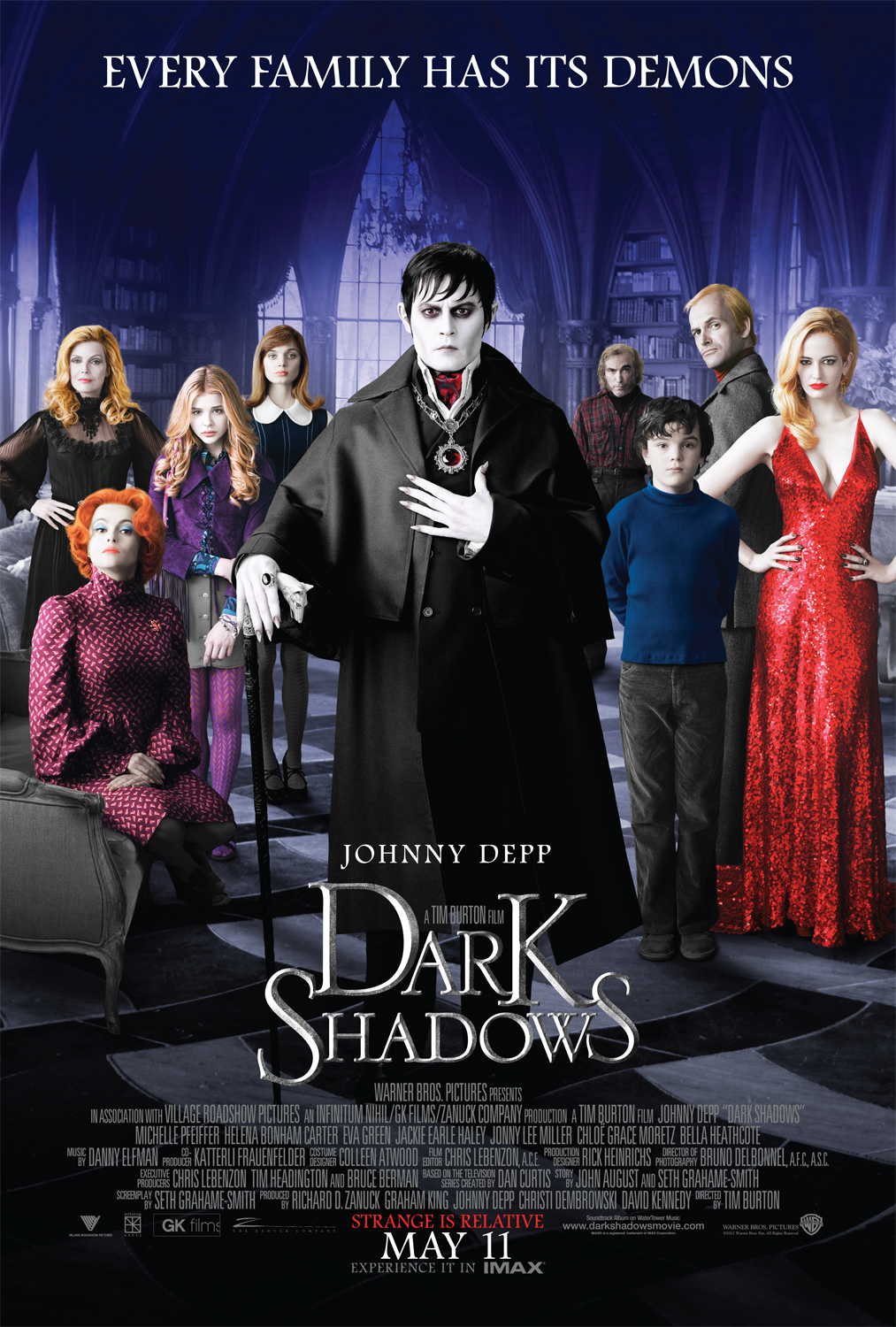 Dark Shadows was a daytime soap that aired for only a brief period of time as far as soaps are concerned, 1966-1971, but it was enough to make a lasting impression. The supernatural soap featured vampires, werewolves, and other creatures of the night, entangled in high-stakes drama and romantic excursions – it was the Twilight of its day. Director Tim Burton and his attached-at-the-hip collaborator, actor Johnny Depp, were fans as children and have kicked around a big-budget big screen version for years. Now that Dark Shadows hits theaters, you’ll be left wondering whether they really ever liked the original show or secretly despised it.
In the 1770s, Barnabus Collins (Depp) is the son of fishing and canning magnate in colonial Maine. He has a fling with Angelique (Eva Green), one of his family’s servant girls, and unfortunately for him, the gal is also a witch in her spare time. She curses the Collins family, killing Barnabus’ mother, father, and the woman he loves. She then turns him into a vampire, riles the villagers into mob mode, and Barnabus gets trapped in a coffin and buried for good.
Two hundred years later, a construction crew unearths an old coffin and out pops Barnabus from his prison. The world is a very different place. Elizabeth Collins Stoddard (Michelle Pfeiffer) is running the Collins family manor and canning company, which has fallen on hard times. A rival canning company is snapping up fisherman contracts, and this company is led by none other than the same ageless Angelique. Elizabeth tries to conceal her distant relative’s unique “condition” from the rest of her family, her brother Roger (Johnny Lee Miller), and his son David (Gulliver McGrath), grieving the loss of his mother, moody 15-year-old daughter Carolyn (Chloe Grace Moretz), and caretaker, Willie Loomis (Jackie Earle Haley). The Collins family also has a new hire, Victoria Winters (Bella Heathcote), who looks strikingly like Barnabus’ lost love from 200 years ago. He becomes smitten with the new lass, who may be the reincarnation of his lost love. That’s enough to rev up Angelique’s wild sense of jealousy, as she tries to get her long-desired man and destroy anyone that stands in her way.
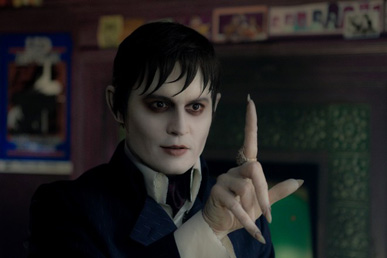 Is this ever one ghoulish mess of a movie. It never settles on a tone; is it supposed to be a larky tongue-in-cheek send-up, a Gothic melodrama, a dysfunctional oddball family comedy? What is this supposed to be, because whatever it is, it isn’t entertaining. Oh sure, it’s entertaining in a, “Where the hell is this going?” kind of way, but so is being kidnapped by a drifter. The movie feels like it has a box filled with ideas, and every so often it just shakes up that box, reaches inside, grabs one and says, “Let’s give this a try.” The screenplay, credited to author Seth Grahame-Smith (Abe Lincoln: Vampire Hunter), is awash with half-baked ideas and poorly developed characters. The live-in doctor, played by the second stalwart of the Burton Repertory Players, Helena Bonham Carter, is a hoot. Carter (The King’s Speech) has got an edge to her and an interesting dynamic with Barnabus, but sadly her storyline is tied up far too quickly. The character of Victoria is a rather interesting one, a girl who could communicate with her ghostly former relatives, who happen to look just like her. The gal was sent to a mental asylum by her parents and escaped, compelled to come to the Collins mansion. Why in the world wasn’t she the movie’s protagonist? That is a far more compelling perspective than a goofy vampire who speaks all old timey. Seriously, the Barnabus stuff is your basic fish-out-of-water comedy, lazily commenting on the times. There is no joke that is too obvious for this movie (Barnabus inquires why Carolyn has no husband; Barnabus is fascinated by a lava lamp; Barnabus thinks Alice Cooper is an ugly woman – sigh). A lot of the shapeless narrative would be forgivable if the movie was just funnier. Barnabus is just not that fun of a character. His anachronistic verbiage gets dull when you discover that seems to be the movie’s one joke. You may start tuning him out like I did.
The movie feels like a collection of subplots and no main storyline to gather traction. We’re told that the youngest Collins, little David, is enamored with Barnabus, though considering we’ve only seen the two together in like one previous scene, this seems like quite a leap. Unless David has gotten particularly skilled at hiding behind rocks, we haven’t seen any of this. The entire character of David and his sleazy father could be eliminated and they would only minimally affect the story. And then there’s the late revelation that one of our characters has a hidden secret identity, a revelation that fostered no setup. When the character looks into the camera to explain and ends with a curt, “Deal with it,” it’s like Grahame-Smith himself is speaking directly to the audience, mocking it for hoping that the movie would actually do a good job of setting up and paying off character development and relationships. Stupid audience. Why can’t you just be happy with all that neat Tim Burton set design?
 The final melee between the Collins family and Angelique keeps reminding you of the dashed promise of the flick. Angelique, in her witchy withiness, summons dark forces to make statues come alive. Well, sort of. They flail their arms a tad. And then she makes the walls bleed. Well, sort of. The dripping blood stops after just a few inches from where it began. If you’re going to make the house bleed, I want Shining-level torrents of the red stuff. The tonal inconsistency, matched with the muddled plot and scant character work, makes for a pretty frustrating bore of a movie.
You could usually count on Depp (Alice in Wonderland) for at least committing himself to another bravura weird performance, but the material fails him. He’s caked with alabaster makeup, given claw-like hands thanks to additional knuckles (why…?), and he’s trying his best to transform a list of peculiarities into a character, but like most things concerning the movie, it does not coalesce properly. I actually think the most entertaining actor in the movie is Green (Casino Royale). There’s not much to her role but at least she has fun with it, bringing an admirable level of energy while her peers remain laconic, content to submerge into the 70s scenery. She shows a nice flair for comedy heretofore unseen. Strangely, Green adopts a slightly raspy voice that sounded like an imitation of, none other than, Helena Bonham Carter. If Burton’s note to his film’s young, frisky, sexy antagonist was, “Sound more like my wife doing an American accent,” then I think we’ve butted into something personal best left between husband and wife.
Ultimately, I have no idea who this movie is going to appeal to. The fans of the original soap will surely not be pleased with the jokey, tongue-in-cheek manner that Dark Shadows treats its source material. Fans of Burton’s stylized, dreamy, Gothic fairy tale visuals will find the film tedious and a poor waste of the man’s talents. Even the casual Depp fan will probably find the movie mostly unfunny, weird, and boring. The tonal whiplash never settles down, and the plot is replete with half-developed characters, ideas, and plot points. It just seems to throw everything at the wall to see what sticks, but that’s not the best way to tell a story. Not even Burton’s visuals or Depp’s performance can save this movie. Dark Shadows is unquestionably amongst Burton’s worst films (2001’s Planet of the Apes debacle takes the crown), made all the more inexplicable by the fact that Burton and Depp are self-described fans of the TV show. Maybe we all have different definitions of “fan” that I am not privy to. This movie deserves a quick death.
Nate’s Grade: C
Share this:

The Five-Year Engagement (2012)
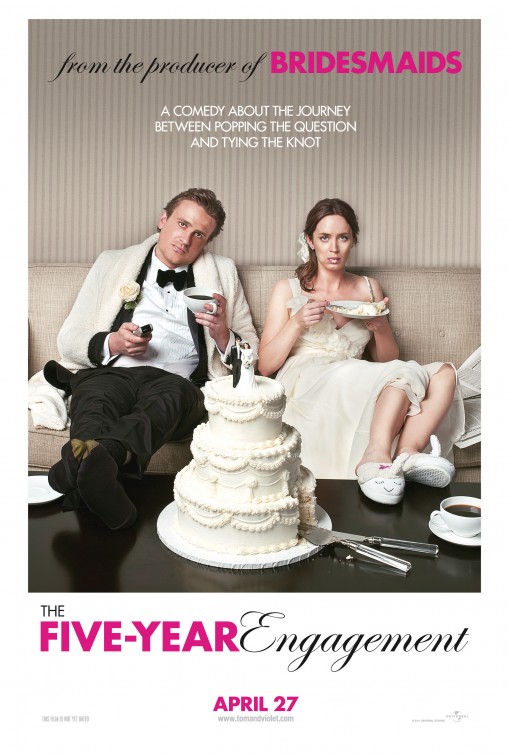 Relationships are serious business. In most Judd Apatow productions, they’re funny business. With The Five-Year Engagement, there’s romance to be found in surprising places, but the omnipresent feeling is one of dread. All those advertisements highlighting the comedy will start to melt away, and what you are left with is a funny, if bittersweet, anti-romantic comedy, more uncomfortable with hard-hitting truths than congenial laughs. My theater even had a few walkouts.
Tom (Jason Segel) and Violet (Emily Blunt) are happily in love. He’s a sous chef in a trendy San Francisco restaurant and she’s eager to gain a graduate fellowship at UC-Berkley in psychology. She doesn’t get accepted to Berkley, but the University of Michigan offers her a spot. Tom and Violet agree to put their wedding on hold and move to Michigan so that she can take advantage of an amazing opportunity. Michigan is not to Tom’s liking, especially since he can’t find a fulfilling job and settles with making sandwiches at a campus sub shop. It’s all just temporary, he keeps reminding himself. Then Violet’s two years gets extended, and Michigan isn’t just a temporary pit stop, it’s possibly home. Tom’s disappointment spirals, and he and Violet begin to drift apart, he resenting her for giving up his own dream to support hers. She begins getting emotionally attached to her Psychology professor, Dr. Childs (Rhys Ifans), in ways that straddle the mentor-student boundaries. Meanwhile, Violet’s sister, Suzie (Alison Brie), gets pregnant after a one-night stand with Alex (Chris Pratt), Tom’s best man and coworker, at the couple’s engagement party. They get married, have kids, and Tom and Violet are still stalling. This is the story of two people who deserve their happily ever after except life keeps putting obstacles in their path to the altar.
 You will be unprepared for how sobering The Five-Year Engagement can be. Some of these arguments between Tom and Violet cut right to the bone with an exacting level of painful authenticity. The level of uncomfortable intimacy can make the movie feel grueling. At the same time, I don’t want to give the impression that it’s some Apatow version of a John Cassavettes flick. There’s still plenty of comedy but the film is much more of a drama than any previous Apatow production. Part of the squirm factor comes in the very nature of the premise. The Five-Year Engagement picks up where most rom-coms end, with our happy couple together at last. We know these two are meant for one another; however, the majority of the screenplay involves watching two likeable, funny, loving people drift emotionally apart. Eventually they get back together in the end in a mad rush to staunch the gloom prevailing over the movie. It’s a hard act to watch people drift apart, losing the connections that once bound them together, and witnessing the glow of romance fade into complacency and resentment. Again, this is all handled in ways that find humor in uncomfortable places (like Tom, hopped up on painkillers, apologizing for smiling during sad news), but it can still be uncomfortable, and I don’t know if the ending, while happy, will justify the journey for many audience members.
I was shocked how much I found myself relating to the plight of the characters in The Five-Year Engagement, so much so that I simultaneously felt an extra level of engagement and discomfort. I will spare you the gory details, as I am a gentleman first and foremost, but relationships that just fizzle out rather than ending in some abrupt manner (infidelity, commitment issues, lack of availability, etc.) are not any more enviable. I related to the general sense of malaise that can plague a long-term relationship, the feeling of being forever a plus-one in your spouse’s circles, the resentment over the demands of a job or school, the small cracks that mask a lot of pain, the kind that is suffused with rationalization that to assert what you feel is to be selfish and inconsiderate, the loss of intimacy, physical and emotional, the guilt of being unhappy or making someone unhappy, and the sad realization that maybe love just wasn’t enough. What happens when nice people who are good for each other are just dealt rotten circumstances? Phew. I feel like I’m turning this into a therapy session. Let’s talk about something inappropriate in the next paragraph.
The biggest reason for sticking it out, both for Tom and Violet and the audience, is that Segel and Blunt have terrific chemistry together. Segel (Forgetting Sarah Marshall) is a big endearing lug of a man, and putting his career on hold to support his fiancé gives him an extra surplus of sympathy as we watch him spiral into despair and then resentment. He’s a funny, likeable guy, and we know he and Violet are meant for one another and we want them to get together, even as this looks less likely to come true after the circumstances that push them away. Granted, you must swallow the hard-to-believe reality that Tom couldn’t find a decent job in Ann Arbor, a college town that has to have some fine dining along the outskirts of town if not in the city. Blunt (The Adjustment Bureau) makes me fall in love with her yet again with a performance. Just like in 2011’s Bureau, she creates a charming, vibrant, luminescent portrayal of a person in love, so much so that I am envious of the man of her affections (her pantomime of “Circus Solei sex” made me feel all warm and fuzzy in multiple places). Violet has her own share of flaws but that just made her more relatable. I enjoy the way Segel, as a screenwriter (he co-wrote the movie with his regular collaborator, director Nicholas Stoller), is charitable with his characterization. He’s not afraid to make himself look mean and hurtful and wrong. He’s not afraid to make the girlfriends in his movies, even the ones who are about to dump him, justifiable in their decision-making. This is not a case of good guys and bad guys; it’s much more like life where everyone can draw good reasons, and the consequences just suck. Out of all of the Apatow films, Segel has done the best job of making his characters feel most like actual people than broad comedic types.
Luckily, the movie has its funny, peculiar little moments to make the drama bearable. I appreciate the little touches of comedy, which percolate through the heaviness. The wide supporting cast is peopled with the usual blend of oddballs and loudmouths. Pratt and Brie provide an ongoing foil as the couple who didn’t seem right for one another, made initial impulsive decisions, but have stuck it out and are happy; instead of waiting for the right time they embrace the mantra that there is no perfect time in life but the present. Pratt (TV’s Parks and Recreation) is great as a smart-aleck who grows into a responsible father. Brie adopts a British accent and becomes even more adorable, as all fans of Community would know. She’s quite funny as Violet’s sister and has a standout sequence where she and Violet have a very adult conversation in front of children so they disguise their voices as Cookie Monster and Elmo. The juxtaposition is a hoot and yet also a nice moment to add characterization. I also enjoyed seeing Chris Parnell (TV’s 30 Rock) as a sad sack faculty spouse stay-at-home father who clears his misery with kitting. There are some gory comedic set pieces around arrows being shot into legs and toes getting amputated, but the movie’s best comedy comes in the small moments, from Tom ‘s patchy “I’ve stopped caring” facial hair, to a self-described “pickle nerd” played by Brian Posehn, to the percentages of every undergrad named “Ashley” or “Zack,” to Tom’s hopelessly overmatched chase with Professor Childs, to a running gag about grandparents dying before Tom and Violet wed.
 I would like to take this time and observe that the University of Michigan, as well as its tenured professor, is responsible for the disruption of happiness between a young couple in love. How many other couples have you destroyed, U of M? When will your taste for suffering ever be quenched? And no, I’m not just saying this because I’m a diehard Ohio State Buckeyes fan, as well as a grad student. My point being: Michigan wants to kill Tom, Violet, and every person you hold dear (In short: Go Bucks).
You’d think with a title like The Five-Year Engagement they wouldn’t want to overstay their welcome, but like most Apatow productions, the film runs a bit on the long side. About 20 minutes into the movie, I felt the need to go to the bathroom. I rationalized staying put. Then about 90 minutes in, that urge became overwhelming but I reasoned the movie had to be over soon. And I kept telling myself that… for another 30 minutes. Then I just ran out and did my business, feeling the elation of relief. At over two hours, the movie feels excessive. Because of the drift away structure, the movie feels especially long in the second act, where we get hurtful scene after hurtful scene, and where Tom and Violet go their separate ways and start dating new people (the fact that Violet dates her smarmy professor feels realistic and yet also like a gut-punch to Tom). Some of the colorful characters that typical people Apatow productions feel more forced than usual, especially Violet’s collection of fellow psych grads played by the likes of Kevin Hart (Think Like a Man) and Mindy Kaling (TV’s The Office). They don’t seem well grafted to the story. The happy ending, while welcomed, also feels unlikely given the proceeding drama, and its brash adherence to rom-com conventions is a tad disappointing.
Watching the dissolution of a relationship is something of a hard sell to mainstream audiences, though Vince Vaughn was able to get audiences to see his anti-romantic comedy, 2006’s The Break-Up, which admittedly had bigger names and a lighter touch on the material. The Five-Year Engagement has its share of comedy but it’s pretty sublimated to the heavy drama of watching two people in love fall out of love and battle resentment, self-destruction, and apathy. Segel and Blunt are so good together we’re willing to give them a wider berth to stretch their wings, sow their oats, and eventually find one another again, falling back in love after a flurry of obstacles, realizing that finding and connecting with your right person is an ongoing process and not some prize to be awarded. I found myself connecting with the movie in several ways, so much so that it made me fee dour for the rest of the evening (you may feel differently). The movie gets so many subtle things right about how relationships can sour, and yet it still manages to overstay its welcome and fill its roly-poly narrative with annoying characters. At least the movie has helped me discover my perfect woman: Alison Brie with a British accent. However, Emily Blunt will also do in a pinch.
Nate’s Grade: B
Share this:

The Avengers (2012)
 For the past four years, Marvel has been seeding its all-star super hero collective in the storylines of its summer blockbusters. And with six super heroes, The Avengers carries some super expectations. The creative mind behind the film is none other than Joss Whedon, best known for creating and shepherding cult TV shows like Buffy the Vampire Slayer, Angel, and Firefly. Not exactly the first name you’d think Marvel would assemble to front a $200 million movie. For geeks, Whedon has become a reliable standard of quality (the patchy TV show Dollhouse notwithstanding). Here is a man who can marry big ideas with sharp characterization and delightfully skewed dialogue. In Whedon, geek nation has a savior, and Marvel knew this. The Avengers is 142 minutes of geek arousal stretched to orgasmic heights.
Nick Fury (Samuel L. Jackson), head of the agency S.H.I.E.L.D., has a dire need for Earth’s mightiest heroes. Loki (Tom Hiddleston) has traveled through a portal and plans on conquering Earth thanks to an approaching alien army. Fury has tasked Tony Stark (Robert Downey Jr.) a.k.a. Iron Man, Steve Rogers (Chris Evans) a.k.a. Captain America, and special agent Natasha “Black Widow” Romanof (Scarlett Johansson) with stopping Loki and rescuing one of S.H.I.E.L.D.’s own agents, the skilled marksman Clint “Hawkeye” Barton (Jeremy Renner), who is under Loki’s devious mind control. Loki’s brother, Thor (Chris Hemsworth), would like to cite jurisdiction and bring his wicked brother back to his home world. The only person who may be able to locate Loki’s path is Dr. Bruce Banner (Mark Ruffalo), a guy with his own anger issues. With this many egos, it’s bound to get dicey. As Banner puts it, “We’re not a team. We’re a time bomb.” Can they put aside their differences to unite to save the Earth? Does a Hulk smash?
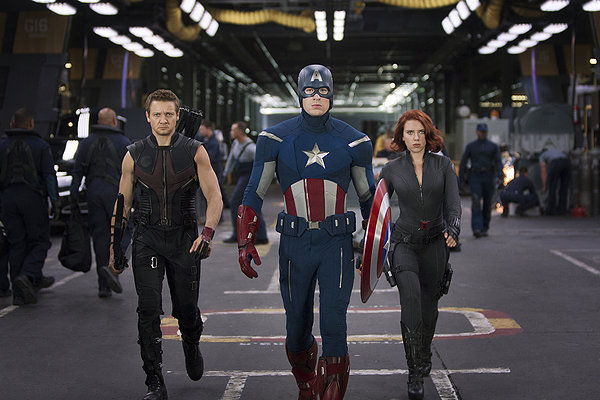 Whedon, the king of clever genre deconstruction last seen in the excellent meta-horror film Cabin in the Woods, plays it relatively straight, giving his big, effects-driven film a straight-laced sense of sincerity. It’s not making fun of these sort of big-budget, effects-driven smash-em-ups, it just wants to deliver the biggest smash-em-up yet. To that end, The Avengers achieves maximum smashitude (trademark pending). By its rousing finish, the movie has become so massively entertaining that you forget the draggy first half. The scope of this thing is just massive. The last thirty minutes is solid action across miles of crumbling, just-asking-to-be-exploded city landscape. But the trick that Whedon pulls off is how to orchestrate action on a monumental scale without losing sight of scale, pacing, and character. You’d think with a full deck of superheroes that somebody would be shortchanged when it came time for the rough and tumble stuff. Not so. Instead of fighting one another, the prospective Avengers work together in all sorts of combinations. The characters are well integrated into the fracas, making particular use of their abilities, and finding new locations of focus every few minutes. This expert hero shuffling keeps things feeling fresh amidst the constant din of chaos.
In fact, the movie finds time to give every hero his or her due, finding a small moment to reveal some characterization. I thought Whedon’s biggest challenge was going to be the juggling act of balancing so many heroes and so much screen time, but the man found a way, like he regularly does, to squeeze in character with ensemble action. The Hulk fares the best. After two movies, it feels like Whedon has finally nailed the character; granted, this success may be credited to the fact that Bruce Banner (all hail Ruffalo) is kept as a supporting character. The struggle of the character being likened to a recovering addict is a smart way to present the character without getting too morose (I enjoyed the revelation that the “Hulk” half prevented Banner from killing himself). When he’s told his mission is to smash, you can feel the exuberant joy of an unleashed Hulk id. The Hulk had two great audience-applause moments that made my theater go berserk. I also really liked the attention given to Black Widow and her lonely back-story. Hawkeye was a complete badass, though he only gets to do fun stuff in the madcap finale. The trouble with the hero team-up franchises is that not everyone’s on the same level of power. Thor is a god for crying out loud, Iron Man has super weapons, Hulk is Hulk, Captain America at least has superhuman strength but what do Hawkeye and Black Widow bring to the team? When you’re competing with all that power, being good with guns or a bow seems pretty puny. And with Hawkeye, there’s going to be a limit to his effectiveness unless he has a magic bag of replenishing arrows. Still, Whedon finds ways to make the heroes badass and humane in equal measure, and surprisingly funny, which is welcomed.
It’s hard to believe that Whedon had only directed one feature film before (2005’s Serenity, based upon Whedon’s canceled Firefly show) being given the keys to the Marvel universe. He’s directed several TV episodes of his signature shows but the man has never produced anything on this scale before. Given a gigantic canvas, Whedon delivers the goods. His action sequences are rollicking and fun and, best of all, shot and edited in a fashion where you can understand what is happening (take some notes, Hunger Games franchise). The action is well choreographed and elevated with organic complications and particular attention paid to location, like the Nicky Fury airship. Whedon is a master of the plot payoff, setting up his elements and then piloting the narrative to satisfying conclusions and integrations (Cabin in the Woods is also a pristine example of this gift). If you’re going to introduce an airship, you better believe that sucker is going to threaten to crash. I’m glad that Loki was brought back as he was the best Marvel big screen baddie yet, though I’m disappointed they essentially put him on ice for an hour.
 The technical elements are ably polished even for this kind of film. The cinematography by Seamus McGarvey (Atonement) is terrific, utilizing bright color in a way that the visuals pop. The special effects are top-notch and you just feel immersed into the action. The destruction is cataclysmic but rarely does the movie feel phony. I was impressed by the Hulk designs and the sequences in inky space with our alien adversaries. For that matter, are these aliens robots? It’s unclear whether the giant flying centipede-like ships are creatures. The 3D conversion is one of the better outings due to the fact that it doesn’t keep throwing stuff in your face. Plus, viewing Johansson’s leather-clad assets in 3D certainly has its own appeal, as does Gwyneth Paltrow in jean shorts. Hey How I Met Your Mother fans, Cobie Smulders looks practically smoldering in her S.H.I.E.L.D. agent outfit too. Okay, I swear I’m done with the female objectification.
I hesitate calling The Avengers the greatest super hero/comic book movie of all time, as the teaming hordes of Internet fanboys foaming at the mouth are wont to do. If your definition of a comic book movie is a giant sandbox with all the coolest toys, then this is your film. This is a comic book turned flesh. The Hulk and Thor fight and prove who is the strongest Marvel man, that’s got to be a geek’s wish come true. Many of the infighting sequences felt like, servicing the tastes of the fanboys, and after a while the constant hero on hero action felt tiresome. I get that we have a clash of egos going on here, but the movie suffers from a lack of narrative cohesion, by which I mean that the first hour of the movie feels like a series of guest appearances by heroes on loan. The movie doesn’t fully come together until the point where the team comes together; I doubt Whedon intended that symbiotic relationship. The movie feels more like a patchwork of standout scenes and memorable moments that a fully formed and cohesive story. If you haven’t seen the previous four Marvel movies (Iron Man, Iron Man 2, Thor, Captain America), you’ll be pretty hard-pressed to follow the story. Loki’s motivation and plan seems rather sketchy other than causing discord amongst the heroic ranks. His powers seem inconsistent and vague. Also I found the musical score by Alan Silvestri to be bland and unworthy.
The Avengers is sure to be geek nirvana for many of the comic book faithful. It’s an audience pleaser of mass scale, and I’m sure that your theater will be cheering in abundance. Whedon has pulled off the near impossible. The movie is a thoroughly entertaining, exciting, and witty popcorn spectacle of the first order. But where the movie hits the ceiling, at least for me, is that it ONLY wants to be the best super hero movie and this seems like limited ambitions. It’s like making the very best possible women in prison movie (great, but is this really all you set your sights on?). I had a great time watching Whedon’s handiwork but I wish it mined the outsized territory for bigger themes, a little more than audience-satisfying pyrotechnics, something I feel that X-Men: First Class did a better job of handling. Don’t get me wrong, I greatly enjoyed The Avengers and it’s a fantastic start to the summer movie season, but by no means is it The Dark Knight or even aspiring to be, and that’s okay. Enjoy the busy escapades of Marvel’s next smash franchise. Who knows when they’ll be able to wrangle everyone together for another adventure, but judging by the sounds of ringing cash registers, the answer is sooner than we think.
Nate’s Grade: B+
Share this:

The Raven (2012)

When “The Raven” was released in 1845, it was a literary sensation. I can’t say that the 2012 movie of the same name will be met with anywhere near the devoted fanfare. Edgar Allan Poe (John Cusack) has become embroiled in a deadly criminal investigation. The famous author is penniless, drunk, and depressed, but what else is new? What is new is that some Poe admirer has been stalking Baltimore and killing people in grisly styles fashioned after Poe’s macabre stories and poems. Detective Fields (Luke Evans) recognizes the connection to Poe and enlists the author to aid in capturing the murderer. Poe’s upper-class love, Emily Hamilton (Alice Eve), is captured by the unknown madman and buried alive. Poe must race against time to stop a killer, rescue the girl, and write a new horror-themed story to be published via the killer’s demands.
The Raven feels like an ill fit from the start. What is the point of featuring an American literary icon when all you’re going to do is plop the man into a pretty rote police procedural/serial killer thriller? The deadly flaw of The Raven isn’t its concept; it’s that the finished product didn’t embrace the particulars of its literary mash-up enough. Is it really a good use of Poe to just have him tag along on a police investigation? I wanted this premise to crackle with a devious slyness, a cleverness of genre and concept that the movie seems incapable of producing. You’re taking America’s singular literary voice of the Gothic and macabre and putting him into a game with a deranged fan. That’s a great start. I’m interested in that movie. But there needs to be some follow-through. This should be a battle of wits, an opportunity for Poe to backslide into the murky chasm of his own creations, bearing some pinning of guilt at having birthed a mad killer with the power of his words and imagination. This should be a psychological descent into hell for a man already famously tortured. Instead, the movie just becomes another rote serial killer movie but somebody typed in the name “Poe.” The various corpses, inspired by Poe’s works, just end up being gory, easily telegraphed deposits for clues. We don’t see these people in peril, terrified by the fiendish ye olde Saw-like death traps. We don’t even understand the process of the killer. The movie just ends up becoming one long, tiresome chase from dead body to next dead body, with Poe literary association haphazardly ladled in to tie stuff together. After a while, it feels like somebody took a thoroughly uninspiring serial killer script and just transported it into mid 19th century America. It’s nice to know that some clichés are timeless.
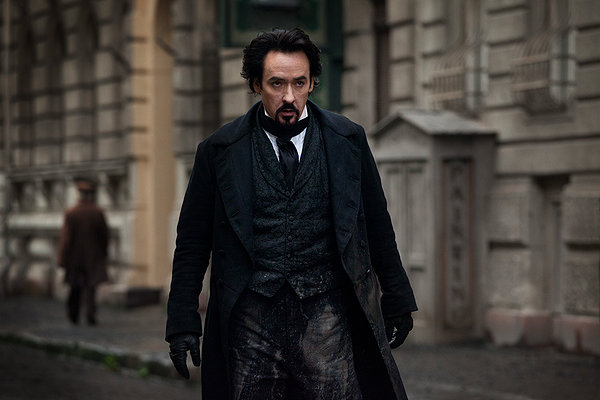 The movie never feels like it works properly, and the potential of its premise is completely unrealized. The murder mystery isn’t really ever given suitable footing to be a mystery, except in that tried-and-true “who’s going to be the bad guy” reveal. There aren’t really any clues left behind. So when characters suddenly come up with epiphanies on their murder investigation, you wish they would at least show their work. For a movie written by screenwriters with names like Ben Livingston and Hannah Shakespeare, The Raven certainly isn’t smart. The Poe stories feel tacked on in an arbitrary fashion instead of being interwoven into foundational elements of the story. Who cares how the characters die if their deaths have no impact on Poe or anyone else? The “how” of the equation becomes inconsequential. The title poem doesn’t even bear any weight on the story. The love interest/damsel in distress character is so bland and underwritten, that it’s hard to really feel Poe’s gnawing sense of urgency. Sidling the gloomy Gus Poe with a puppy-dog love story seems like a poor misunderstanding of the man and his demons. To top it off, the girl isn’t even his cousin (surely the oddest criticism of mine thrown at a movie)!
The movie doesn’t really ever become a convincing thriller either. The pulpier elements are ignored or downplayed, played with stodgy seriousness for a movie this ridiculous (Saw-style death traps in 1849?). Director James McTeigue (V for Vendetta), who after this and 2009’s Ninja Assassin is starting to look like a one-hit wonder, badly misplays the action elements. The dingy cinematography is unnaturally dark, making it exceedingly difficult to understand certain sequences and giving the audience yet another reason to lose interest. The impressive production design is totally mitigated when there’s not enough light to even see it. I understand given the nature of the story that we’d be dealing with lot of shadows and darkness, but this is just one poor looking movie. The only way you’d feel excitement from this movie is if in a fit of amnesia you forgot what you were watching and suddenly thought it might be a different, better movie, only to be disappointed ten minutes later when that sinking feeling reemerges and you realize, no, I am still watching The Raven.
I love me some John Cusack (Hot Tub Time Machine), but this guy is just the wrong fit for the movie. His sensibilities never really gel with the character, so Poe’s sense of melancholy comes across as more haughty boredom. He is not the right fit for the material. Eve (She’s Out of my League) has got nothing to do but look pretty and scream occasionally. The worst crime of all is utterly wasting one of my favorite contemporary character actors, the phenomenally great Brendan Gleeson (The Guard). He plays the uptight father of Poe’s love interest, which means he gets to pop onscreen and glare at Poe while looking worried. It’s a criminal waste of this man’s considerable talents.
 I think the best part of The Raven is actually it’s mostly unseen killer. It’s not because the guy is particularly clever or interesting or even remotely memorable (when they reveal who it is, make sure to pay attention to the constant reiteration of who he is, because if you’re like me, you plum forgot). The reason this guy is good is because of his impetus. He’s ultimately terrorizing Poe so that he can force the author to create more stories. Call it an extreme case of motivation. I can see our studious killer justifying his bad behavior, claiming to give the world new gifts of literary brilliance that we can all share, stories that will last the test of time. Isn’t that worth a few dead bodies, he’d argue. Ultimately, this rationale becomes more egotistical, about flattering the killer and his devious appetites, which is a shame. I’d prefer if the bad guy were more devoted to the cause of helping to shape the Canon of transcendental literature. I almost wish that the movie were told from this skewed perspective. I could have dealt with an entire catalogue of famous authors being victimized under the auspices of producing great literature. What if this one sick person is responsible for wresting the great works of the 19th century out of the authors’ minds and onto the page? I think we all owe this terrible individual a debt of gratitude.
I’m finding myself disliking The Raven the more thought I put into it, which, admittedly, my brain is actively fighting against. It does not want to spend more time processing this bore of a movie; a fun premise never fully realized, a conflict never truly developed, and characters that are the 19th century equivalent of the stock roles you’d find in any mechanical CSI/Law & Order TV episode. So in the interest of literary fairness, I’ve decided to channel the spirit of Edgar Allan Poe for the final word on The Raven:
And The Raven, never flowing, still is going, still is going,
On the pallid screen I silently stare at in unblinking bore,
And its plot is not that smart, missing heart and clues to start,
And it seems like the writers were tasked with an unfriendly chore,
The movie does not work; it’s dull and empty to its very core,
And so I lastly ask does this movie properly entertain?
Quoth The Raven – “nevermore.”
Nate’s Grade: C


 nathanzoebl
You must be logged in to post a comment.