Category Archives: 2011 Movies
Drive (2011)
 Driver (Ryan Gosling) is a Hollywood stunt driver who has a lucrative side-project. For the right price, he can be hired as a personal driver. He gives the client a five-minute window. Whatever happens in that window, he’s their driver no matter what. Miss it and he’s gone. As you can imagine, this kind of job offer is mostly filled with getaway driving duties. Driver takes an interest in his apartment neighbor, Irene (Carey Mulligan), a young mother. Her husband (Oscar Isaac) has just been released from prison and already feeling heat to pay his debts. He gets winds of a pawnshop holding a million in cash. Driver offers his services to square the guy’s debt and to keep Irene and her son safe. But of course things go wrong, as they tend to in these sorts of pictures, and Driver is left with a sack of money and two very angry gangsters. Nino (Ron Perlman) and Bernie (Albert Brooks) would like the money back and to eliminate the number of people that know about their involvement in this scheme.
Drive is being sold as one kind of movie, a high-octane action thriller with plenty of car chases, when it’s really a European art-thriller paying fawning homage to those kinds of movies. That means that Drive plays out much more placidly and contemplatively with sudden bursts of gruesome violence. My audience seemed to grow restless with the purposely plaintive pacing so when the violence exploded they would laugh or cheer, happy that something of conventional entertainment value was finally occurring. I was growing restless myself, not with the infrequent appearances of genre action or the artistic flourishes, but just with the prevalent pauses. Danish director Nicolas Winding Refn (Bronson) will have his camera hold onto a scene for several seconds longer than what feels necessary, or he’ll shoot dialogue between actors and Gosling will pause a full 20 seconds before answering. I understand that Refn is establishing a stoic loner akin to Clint Eastwood’s celebrated stable of strong silent types, a modern American cowboy. I’m sure that you could cut 10 minutes of out the film just from snipping these extended pauses and overlong shots, moments that seem to be filling time and giving the audience an opportunity to step outside the movie. I doubt that was ever the intent but it’s certainly the effect. When a scene or camera shot holds on longer than it should, we can feel it, and when it keeps going we start to wonder why, and when an answer is absent then we start to snicker or second-guess the artistic choices. I’m sure audiences that watched Drive will probably be scratching their heads wondering why there isn’t more, well, driving.
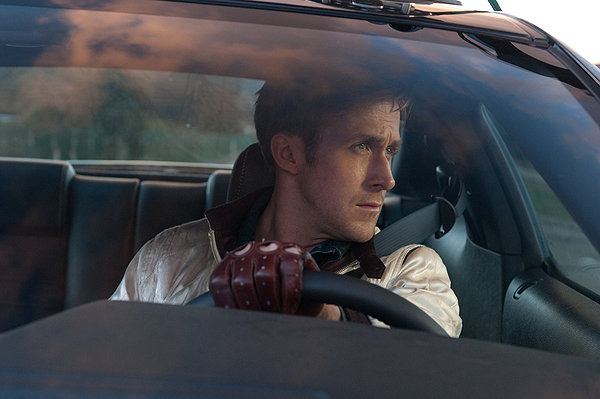 The action that does appear onscreen is extremely well choreographed. The car chases thrill and the edits allow for full audience orientation. You know what’s happening and you know what’s at stake. And we care. A car chase after a botched robbery is particularly exciting when Driver starts driving backwards to block his opponent’s view of the road. The opening chase sequence is notably almost an anti-car chase. Driver is listening to a police radio and choosing when to duck around side streets and wait out the patrolling cop cars. The tension isn’t watching one car chase another, it’s watching one car idly sneak away. What I’ve described, however, is about all the movie offers for car action, though Driver does ram one motorist off a ravine later.
You can tell Refn is a fan of Hollywood genre films, and Drive takes typical thriller tropes and puts them through an art-house prism, bringing a near Kubrickian level of beauty to the violence. Drive is a gorgeous movie to watch; the shot selections, the chiaroscuro lighting, the use of the 80s style Euro-synth score by Cliff Martinez (Traffic, Contagion), it all coalesces into a near hypnotic blend of visual and sound. It’s a beatific landscape even when horrible things are going on. There’s a sequence where Driver, Irene, and one of Nino’s thugs are in an elevator together. Driver notes the imminent danger and slowly motions Irene behind him. He then turns and kisses her, and while he does this the elevator lighting seems to brighten and darken, like it too is being charged through the power of a kiss. And then Driver sharply pivots, blocking the thug’s attack, knocks the guy to the ground and stomps on his head until it bursts. The looming violence is teased through slow motion, and then it hits with the power of a crescendo. The violence is always looming, always seeming to be just on the cusp of an explosion. But under Refn’s direction, the movie fulfills that audience bloodlust in unexpected ways. Instead of a big fight, Driver casually drowns one of the toughs in the surf of a beach. Instead of a brutal elimination, Bernie dispatches someone with what can almost be described as compassion, slitting a major artery and whispering, “It’s done. It’s all over. There’s no pain. Just let it happen.” Even the big showdown between Driver and Bernie plays out with flash-forward edits, giving the meeting an extra level of gravitas knowing what awaits when they leave the table.
Refn has created a beautiful movie, it’s just that it has so much empty space pretending to be nuance. And that’s the rub. I appreciate an art-house sensibilities elevating and celebrating classic American genre pictures. I though Joe Wright did an excellent job of this with Hanna earlier this year. However, Refn shortchanges his actors. The script by Hossein Amini (The Four Feathers) is light when it comes to character detail. Again, this might be because Refn wishes to make a statement on genre films by having his movie populated with genre types and sticking to this limited route of characterization. Whatever the rationale, it makes for some pretty elusive one-note characters. Irene is less a character than a symbol of innocence. It doesn’t help matters that Mulligan has little chemistry with Gosling. Nino and Bernie are interesting characters who have such unspoken histories. They’re mid-level criminals stationed out of a cheap pizza joint in a strip mall. Nino is tired of the criminal higher-ups always disrespecting him. Bernie used to be a movie producer in the 80s, and may have bankrolled something like Drive. He hates getting his hands dirty but he shows an eerie talent for violence. These small glimpses are hints at something more, but that is all Hossein and Refn leave us with.
 Gosling (Crazy, Stupid, Love) has very little to say in the film. He probably only ever speaks 80 words, but brevity does not mean he’s just sitting around. Gosling goes for understated in a genre known for histrionics. He plays things very close, a taciturn mystery man. The existential drifter. Gosling sure knows how to hone his flinty stares. Mulligan (An Education) gets very little to do in the film, so it’s another round of her crinkling her pretty face and blinking those glassy eyes. Christina Hendricks (TV’s Mad Men) also appears as a third wheel on the pawnshop scam. The real surprise is Brooks (The Muse). The famous comedian is shockingly believable as somebody you don’t want to cross. Even when he’s trying to be cordial there’s a veil of menace. If only there was more to his role. I would have loved to see him regrettably step back into his past, taking care of business with ruthless yet disdainful efficiency.
Drive is an action thriller that’s more a Euro-infused commentary on the genre. Fans of Hollywood action will likely be put off by the elusive characters, the sluggish pacing with numerous pauses, and the overall art-house nature of the finished product. Refn’s movie is beautiful to watch, with intricate precision taken to making the imagery and sound design mesmerize. If only that same level of care was paid to character and plot. We’re dropped into this criminal scenario and left to flesh out the characters given the hints and nods we accumulate in 100 minutes. I don’t need to be spoon-fed but I’d like my movie to have better attention to character than ambiance. Drive is a beautiful looking vehicle that just doesn’t have any particular place to go.
Nate’s Grade: B
Share this:

The Future (2011)
 Miranda July is a writer/performance artist/filmmaker whose unique voice earns as many praises of “precocious” as it does hails of “pretentious.” Her previous effort, 2005’s Me and You and Everyone We Know, had such oddities as a group of cars creating a caravan to save a goldfish left atop one’s roof and children engaging in online sex chat over sharing feces from behind to another ( ))<>(( is the visual articulation of this function). Yeah.
With her second feature film, The Future, we follow Sophie (July) and Jason (Hamish Linklater), a couple who decide to adopt an injured cat they find. Named Paw-Paw by Sophie, they must wait 30 days for the medical checks to clear before they can pick up the cat. They believe that they are doing a kindness and giving the cat a good place to live in its last month of life. Then the vet informs them that if bonded, the cat could live an additional five years. Sophie and Jason will be 40 in another five years, and this realization stops them cold in their tracks. Both are unhappy with their lives, he works as a technical help guru and she teaches dance to preschool-aged children. They decide that for the next 30 days they will reinvent themselves. They will take the road less traveled and see where it takes them. Jason volunteers to be an environmental solicitor on a whim. Sophie wants to do 30 dances in 30 days but is crippled by fear. She reaches out to Marshall (David Warshofsky), an older single dad who proves to be a source of unlikely temptation. Along the way to the conclusion of those 30 days, Jason will utilize his abilities to stop time, speak with the moon, an old T-shirt will crawl will come alive, and the story will be narrated at turns by Paw-Paw.
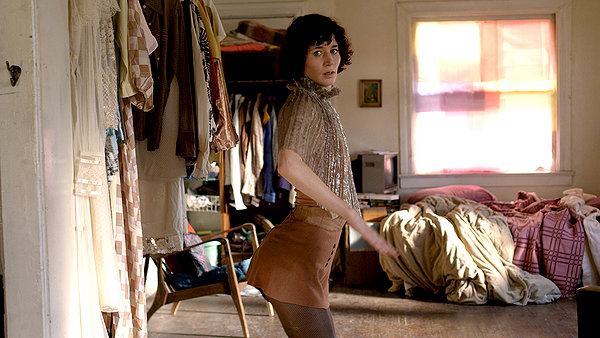 It should be obvious at this point that July is not going to be everyone’s taste. You could just as well furrow your brow at all these pseudo-intellectual bohemian artsy smartsy pretensions and make snide remarks under your breath. And I can’t say I’d blame you at points. However, if you happen to catch a ride on July’s funky wavelengths, then The Future becomes a poignant, observant, and occasionally profound rumination on human connection. July’s two main characters encounter a full crisis of self, fearing that their lives will essentially be over upon turning 35, which they reason is almost 40, which is practically 50, and all that back-half stuff is “loose change” (not enough to really get what you want). I believe I heard none other than Jessica Simpson herself utter a similar statement on her ill-fated Newlyweds reality TV show. She said, “I’m turning 23, which is practically 25, which is almost 30.” Perhaps Ms. July was also watching that episode, and if so this will be the only time in print that I congratulate Jessica Simpson for anything. This manufactured anxiety over doing something of worth and lasting value with your time on this planet is nothing new but it is deeply relatable, despite the silly numbers game the characters endure. It’s a paralyzing existential doubt. Who doesn’t want to feel like their life had purpose? You only get one. July makes a series of observant comments about human interaction. For their life project, Sophie decides to cancel the couple’s Internet connection. They have but moments, perhaps seconds left, before the Internet is lost to them for 30 days, and they scramble to open their laptops to do important stuff. “Only look up stuff we can’t find in books or by talking to people,” Jason intones. Slowly, both of them come to the same realization and close their laptops. It’s a silent admission that the technology we feel dependant upon might not be so.
There’s a striking clarity when an artist cuts through everything and finds something dwelling inside your grey matter. For me, July is that kind of artist. I loved a sequence where Sophie, out of slumming desperation, takes a job as a receptionist back at her old work place. One day two of her female friends come into the studio. Both women are several months pregnant, and Sophie is aghast that she let time get the better of her. She keeps shaking her head, rationalizing that it must have only been a couple weeks since last she saw her friends. Then through a series of edits, we witness a fantastic fantasy that highlights Sophie’s abject feelings of accomplishing little while time flies by. Every time the camera cuts back to the friends more time passes; we see them hold newborn babies, then we see those babies as kids, then as young adults, and finally as adults who themselves have married each other and wish to enroll their own daughter into pre-dance. They inform Sophie that their mothers passed some time ago. And all the while, Sophie is still in her dead-end job. It’s a terrific scene that highlights the anxiety we all feel about being lead footed in life, watching others skirt by and negatively assessing our own personal journeys by someone else’s accomplishments. The Future is full of moments like this that hit so hard you feel like the ground beneath you has vanished. Jason’s refusal to restart time is painfully identifiable, the wish to stay frozen in time to defer facing the hard pains of a breakup, the rueful knowledge that life will be forever different, and worse, in the passing of a second. The future can be a painful place we’d all like to hide under the covers and avoid.
Like July’s previous film, The Future is more a series of encapsulated vignettes, each with their own peculiarities, than a fully formed coherent story. While I enjoyed the separate vignettes better in Me and You, the overall story congeals better in The Future even if the results are messy. This is a less romantic and hopeful film than Me and You. It’s much more ambiguous (that’s saying something) and bleak when it exposes the missed chances that can haunt, none more so than Paw-Paw, our bandaged feline narrator. Scurry to the next paragraph if you’d like this part unspoiled for you, sensitive animal-loving readers. Paw-Paw speaks about her new sense of happiness, about having owners that will be kind to her, and this new sense of belonging fills the cat with a ballooning hope that her real life has finally begun. But then Paw-Paw doesn’t make it. She dies a day before either Sophie or Jason comes by to pick her up. But the cruel irony is that Sophie and Jason missed picking up their cat/metaphor of their relationship on its release date. Paw-Paw could have spent her last day on earth with the people she had yearned to be with, the people she wrote an imaginary letter to telling them how grateful she was and how much she promised to love them. Instead, the cat dies, forever waiting. That’s pretty rough, and even though July’s scratchy, high-pitched Paw-Paw voice can be annoying, God help me if the pet lover in me wasn’t in tears every time this damn cat was narrating, including after its death. That’s the kind of film The Future offers. It does not dish out easy answers for life’s Big Questions. Even as the end credits roll, you’re left to ponder whether you believe that Sophie and Jason will reconcile.
 July, resembling a cross between Kristen Schaal (Dinner for Schmucks) and Juliette Binoche (The English Patient), is probably also her biggest hindrance. She’s not that developed as an actress, or is being purposely opaque, and thus Sophie seems to be lost in a medicated fog. This was less of a problem with Me and You because the ensemble was larger. Here, it’s mainly three actors. July delivers every line in a flat style that makes her character harder to decipher and harder to empathize with when she goes off into her affair. The entire storyline with the sign making “other man” is kept at a mystery. We’re not really sure why Sophie would be attracted to this man or what problems are ailing her relationship with Jason. I suppose the early mid-life crisis could serve as a fire to get Sophie to reach out to someone who offers more security, but that’s merely my best estimation. It’s a detour that could use more attention to explain its significance. I suppose it could be July’s version of a romantic comedy staple of being with the wrong man and finding out late your mistake. It’ll be up to the viewer which guy fills the role of “wrong man.” Luckily, Linklater (TV’s New Adventures of Old Christine) is a winning presence, affable without being offbeat and striving for meaning without coming across as pompous.
Whether it’s a dance inside an oversized T-shirt or choosing a song to communicate undying love in the event of amnesia, The Future is chockablock with memorable moments, images, insights, and peculiarities. Whether all of that comes together into a fully realized movie is another matter. The scattershot nature and July’s own acting shortcomings clip the film’s momentum, but the uniqueness of voice and observant vision of July as writer/director makes me forgive much of The Future’s faults. It’s not exactly an easy sell of a movie, especially to concerned pet lovers, but July is one of those polarizing artists I’m glad finds the time to empty their brain every now and then. I may not fully understand everything but The Future held enough promise for me to leave feeling satisfied.
Nate’s Grade: B+
Share this:

Red Riding Hood (2011)
 In risk-adverse Hollywood, everything old is new again, so why not remake classic fairy tales for a modern audience? After all, there’s no rights fee. While we’ll have to wait on the competing Snow White films until 2012, Twilight director Catherine Hardwicke unleashes her stylized retelling of the Red Riding Hood tale, titled easily enough, Red Riding Hood. This messy and incompetent movie may cause you to run away screaming into the woods all the way to grandmother’s house.
In a small village on the crest of the big bad words, Valerie (Amanda Seyfried) is betrothed to Henry (Max Irons), a hunky blacksmith that comes from a family of high standing. She’s rather run away with Peter (Shiloh Fernandez), the town’s resident moody guy who’s also her childhood friend. Valerie’s family is ostracized due to past indiscretions, so her grandmother (Julie Christie) lives in a cottage off in the woods. Valerie’s mother died when she was young and she’s been raised by her father (Billy Burke) and her step-mother (Virginia Madsen). This happy hamlet is gripped with fear after a series of violent wolf attacks. Father Solomon (Gary Oldman) ushers into town with a proclamation that he will find the wolf and slay it. But he clarifies that they are hunting for a werewolf among the townsfolk. During one attack, Valerie discovers that she has an odd telepathic link with the wolf, which makes her further question her identity. Naturally, this makes the town fear her and offer her as a red riding sacrifice. But who is the wolf and what is his or her plan with Valerie?
This is a disaster of epic fairy tale proportions. Red Riding Hood attempts to reshape the oft told tale into a palatable mix of sex and violence for today’s pre-teens (teenagers will surely be bored by this), somehow forgetting that the original tale is filled with macabre violence. The filmmakers have tried to make Red Riding Hood (RRH) hip to a younger generation; this ain’t your granny’s fairy tale, yo. But they’ve really turned the simple story into a lumbering, idiotic, grating, and nearly impenetrable movie. This youthful infusion of hollow artifice and misplaced attitude, as well as a fumbling attempt at ill-conceived edge, makes the movie a metaphorical bratty teenager. You get tired of its taxing nature and empty posturing. It’s trying to be cool with last year’s catalogue. Hardwicke is using every tool at her disposal to appeal to an easily bored teenage demographic, so the movie takes several sidesteps that are only justifiable because someone might think they are cool. The musical score includes grating, churning anachronistic electric guitars. It feels like your neighbors are throwing a party and the music occasionally drifts over. These visual and narrative flourishes only remind you how desperate and out-of-tune this whole lousy production is.
 Screenwriter David Johnson (Orphan) takes the familiar woodland frolic and turns it into the world’s worst Agatha Christie-styled guessing game. The wolf is now a werewolf and then the town undergoes a witch-hunt that would make Arthur Miller wince (“I saw Goody Red with the wolf”). It’s here that the movie preposterously attempts to become some sort of important statement on, I kid you not, the war on terror. Solomon brings a metal elephant that he sticks prisoners in to soften them up. He also lights a fire below the belly of the elephant to expedite the process of getting the truth out of a suspect. Solomon’s status as a cleric has to serve as some sort of biting criticism of church authority, especially after he wants to get an inquisition going. I appreciate the wholly misguided attempt at topicality and commentary, but this was not the movie to make statements. Anyway, the plot is convoluted and every scene seems to just further dilute the clarity of the narrative. The movie just descends into a manic game of “Guess the Wolf.” We literally go through just about every speaking part at some point as a potential werewolf suspect. That means every bit part is given due consideration, including the mentally handicapped child. I actively wanted the wolf to be the mentally handicapped kid just for the awkward discussions of what to do next (“We can’t kill the wolf. He’s… special.”). Red Riding Hood works so hard to make like 8 characters look alternatingly guilty. The town seems to be populated by red herrings and not people.
Red Riding Hood is a neutered horror movie and a rather bloodless romance; there’s a lack of blood pumping with either. For a movie about a killer wolf there is precious little blood or wounds even considering some people are mauled to death. It seems the filmmakers had a choice of going with mild gore or mild sensuality to stick the PG-13 landing and erred on the side of hormones. The romantic elements are kept at a pre-teen simmer. For only they will blush at the more suggestive elements, including the table-dance-in-slow-mo shimmy dancing that the town seems to favor during their festivals. At one point Peter unties one of Valerie’s bodice strands. To be fair, in mythical land/mythical time setting, that’s probably like their equivalent of third base. The romantic triangle is desperate to ape the Twilight model, and the male characters are pinup pinheads. They occupy types, one being the brooding “darker” guy who Valerie really wants to be with, and the other is a nice guy from a proud family (sound familiar, Twi-hards?). The movie goes to shoddy lengths to keep these two at odds, when it appears that, like Bella Swan, our Valerie is one flower not worth the trouble of plucking. It’s hard to get involved in a romance when you’d rather watch every participant getting eaten by a wolf.
 “What big eyes you have” is something of an understatement when speaking about the saucer-eyed Seyfried (Letters to Juliet). She gets to make good use of her ocular abilities, though who knows if it’s acting or just expressions of disbelief about what kind of movie she is trapped inside. Seyfried does her whole blasé shtick, which makes the character feel more like an annoying know-it-all even when she admittedly knows nothing. Oldman (The Dark Knight) inhales scenery at a dangerous pace, acting ferociously over-the-top and unrestrained. It’s like he’s trying to channel a wolf in his performance. At least he’s entertaining to watch, which cannot be said for the movie as a whole. Irons (Dorian Gray) is bland but Fernandez (Skateland) is laugh-out-loud awful at a few points. Clearly talking is not this guy’s strong suit. Neither is emoting. The weirdest part of Red Riding Hood is merely seeing Madsen’s face. Clearly this woman has undergone plastic surgery since her Oscar-nominated turn in 2004’s Sideways. She almost resembles a gentler looking Mickey Rourke at certain unkind angles. Another famous face goes to sad lengths to alter her looks to be seen as acceptably good-looking in ageist Hollywood.
Red Riding Hood is a tragic misjudgment on the part of just about everyone involved. The screenwriter thought he must have been making a serious allegory, Hardwicke thought she was making a wild and witchy cousin to Twilight, and the producers thought they were making a film that had genuine appeal. They were all categorically wrong. The reworking of the fairy tale elements is mostly mundane. She gets a red cloak from her granny but otherwise this story might as well just be about a girl and a werewolf. It’s not an imaginative update or a clever reworking, this is just a dumb werewolf story with extra dashes of Twilight for seasoning. The key to unlocking the Red Riding Hood story is not by introducing a sterile love triangle. This hyperactive hodgepodge mistakes setting for atmosphere and a high number of characters for mystery. I was astounded as I sat and watched this movie; turn after turn it veers wildly in tone and execution. I haven’t even talked about the special effects for the wolf, and there’s a reason I am leaving that unsaid. Red Riding Hood is a movie 12-year-old girls might fawn over. If you find yourself outside that marginal demographic, then you’ll likely find this movie to be an irritating, nonsensical, dopey, pitiful bore. You can stuff that in your picnic basket, Red.
Nate’s Grade: D
Share this:

The Guard (2011)
 For fans of Brendan Gleeson, one of the best character actors around, a starring role in the profane dark Irish comedy, The Guard, is a starring role long overdue. The man plays an eccentric, self-destructive lawman that follows his own sets of rules and decorum: “Racist? I’m Irish. Racism is part of our culture.” Gleeson’s character gets teamed up with Don Cheadle’s Yankee FBI agent, and for a while it looks like the film might drown in fish-out-of-water gags. Writer/director John Michael McDonagh has a gifted wordsmith’s flourish with words. It may take some concentration to decipher through the thick Irish brogues, but there is a love of language and the witty, looping dialogue is almost musical in its sublime composition. His characters are pretty interesting too. The villains, a band of drug-runners, are introduced arguing philosophy, proving to be the most cultured big screen tough guys since Pulp Fiction. The hyper-literate stock roles trade plenty of insults, which had me regularly laughing. The characters do have a habit of feeling like they know they exist in a movie, so everything, even a man’s final moments, never seems to be that pressing. I just wish these richly drawn characters had a better movie plot to work with. There are too many subplots that don’t seem to reconnect to the main storyline. The Guard seems to lose its way in the middle of too many comic vignettes before going all serious action in climax, much like the similarly flavored In Bruges (written and directed by McDonagh’s brother). The movie feels like a first draft instead of a finished product, though for Gleeson fans, this will be worthy enough.
Nate’s Grade: B-
Share this:

The Debt (2011)
 A tense and mature spy thriller that’s as well written as it is acted, The Debt is a thriller that even stops to ponder some serious moral ambiguities along the way. Back in 1965, a group of Israel agents (Jessica Chastain, Sam Worthington, Marton Csokas) were sent to Berlin to capture a notorious ex-Nazi doctor (Jasper Christensen) and bring him back for justice. When things don’t go according to plan, the group must decide what is justifiable in the name of moral cost. In 1997, the aged former agents (Helen Mirren, Cirian Hinds, Tom Wilkinson) have to deal with the full consequences of their actions. A far majority of the film takes place in the 60s, and it’s for the best considering that’s where most of the tension and interest reside. As a thriller, drama, and non-linear mystery, there’s always something going on. The film is not without its genre clichés, but the sequences of holding Christensen (Quantum of Solace) hostage rise beyond genre mucking. He is a true monster and his dialogues with the various agents are chilling, reminiscent of Hannibal Lector’s tête-à-têtes. The cast is uniformly good, even Worthington, but the real star is Chastain (The Help, Tree of Life). She is magnetic. It’s a shame that The Debt felt it needed to tie up its loose ends in a conventional ending that discards the film’s more ambitious moral quandary. I suppose the toll of false identities and moral relativism just doesn’t make audiences happy like good old-fashioned vengeance. I guess that’s a debt everyone would rather have paid.
Nate’s Grade: B+
Share this:

Contagion (2011)
 For the germophobes amongst us, you probably want to skip seeing the new thriller, Contagion. Like for life. Never see this film if you’re the type that needs a paper toilet seat cover before sitting down to do their business. Contagion is a movie that makes you reevaluate basic human interaction. You may not leave the house again without covering yourself in plastic and a year’s worth of Purel. Director Stephen Soderbergh (Che, Ocean’s Thirteen) has assembled an all-star cast to drop like flies like only Hollywood’s most talented can do. Contagion is an intelligent, unnerving, technically authentic thriller that will make you cringe just watching people cough.
Contagion’s main character is a virus that begins its origin in a Hong Kong casino and quickly spreads from there. A British model takes it to the UK, a Chinese waiter goes home infected, a Japanese businessman keels over dead on a return trip home, and Beth Emhoff (Gwyneth Paltrow) comes home from her business tripe back to Minneapolis and goes into seizures. The next day, she’s dead and soon after having her brain dug out for an autopsy. The spooked docs alert the Centers for Disease Control immediately; something is definitely wrong with Paltrow’s brain (insert Coldplay joke here). The head of the CDC, Dr. Ellis Cheever (Laurence Fishburne), and his specialists track the expansion of the virus. He dispatches Dr. Erin Mears (Kate Winslet), to Minnesota to coordinate inter-agency action and interview Beth’s husband (Matt Damon), who appears to be immune to the virus. He’s in shock and isolated from his remaining daughter. He’s still trying to make sense of how quickly everything fell apart for his family. Capitalizing on fear, anti-establishment medical blogger Alan Krumweid (Jude Law) steers a panicked public toward a homeopathic medical alternative that he just so happens to have a financial stake with. The World Health Organization sends Dr. Leonora Orantes (Marion Cotillard) to investigate the Hong Kong casino and overview hours of security footage to glean the origins of the virus. But she, like others, soon find themselves in ever-increasing danger as the world races against time to beat this new threat.
For those expecting an action-thriller with plenty of doctors barking moral quandaries and racing against time to escape government agents… you will be sorely disappointed. Contagion is much more cerebral, cool, like a scientific procedural that plays the premise out in a realistic fashion, which means it’s often short the fireworks that mainstream audiences have come to expect from disaster movies. The CDC is really the main setting as they try and determine the origin of the virus, breaking down the virus, and projecting its rate on infection and contamination. Soderbergh has onscreen titles indicating how large the population centers are for the plot settings, reminding us simply with text how vulnerable to danger all those people are. The real pleasure of the film is watching A-level Oscar actors puzzle out how to solve this multi-faceted crisis. The movie does a minimal amount of explanation and expects an audience to be able to keep up with its scientific analysis. Soderbergh’s film is much more in keeping with The Andromeda Strain than Outbreak (find that monkey and all will be happy again!). You witness smart people doing smart things and still making little traction. This isn’t necessarily Irwin Allen territory of disaster. It’s a disaster that seems all too reasonably possible rather than being trapped in the belly of a ship that has turned upside down. Getting sick is a lot harder to avoid especially in our modern world. Globalization has done many wonders for the world, but by making the world a smaller place it also means that we’re all much more susceptible to the spreads of pandemics. No longer can geography be held as a total defense. We’re all one flight away from the spread of the next great illness (as the end credits to Rise of the Planet of the Apes also remind).
Soderbergh and screenwriter Scott Z. Burns (The Informant!) cast a wide net all over the world to see the ramifications of crisis. Things go rather quickly. By the end of the first week, the CDC is coordinating its resources and media strategy to not inflame panic. Easier said than done when ignorance and fear are in large quantities. The reaction to the news, the intra-government squabbles over resources and money, the exploitation of fear by opportune business types, the rising resentment of those left out of the loop, and even the kidnapping schemes for those known to have access to medicine. Contagion works because it gets the details right without losing track of the big picture. The film feels eerily plausible at every beat. Nurses are on strike refusing to be near the sick until uniform safety protocols are established. Funeral homes refuse to handle infected bodies out of health concerns. These are absorbing details that feel completely authentic yet would easily have been overlooked in other disaster pictures. The movie even addresses recent pandemic fears related to H1N1, SARS, and the perceived “overreaction” when these potential worldwide disasters turned out to be milder bugs. A government agent asks the head of the CDC if some terror organization could have weaponized the bird flu. “They don’t have to. The birds are already doing it,” the CDC head replies.
While Burns lies out a host of characters and scenarios with increasing tension as stakes mount and the death toll rises, Contagion just kind of drifts into an ending for the last 20 minutes. I was expecting another big wallop, some kind of sudden plot turn that reestablished an ongoing threat, but it wasn’t to be. The tension just sorts of lets out slowly like a balloon, playing against movie laws. That means that Contagion, wile tense, eschews a dramatic buildup for a climax. Burns and Soderbergh instead to play out their realistic “what if” experiment to its conclusion, which makes for a realistic if somewhat inert final act. There’s no chasing monkeys or butting with government agents willing to sacrifice infected town for “the good of mankind”; it’s just government employees doing good work and trying to minimize damages. It’s exciting to watch smart characters break down a nasty new virus and try to understand it and get ahead of it, but once they succeed, it’s not as exciting to watch the aftereffects of people getting better and returning to a normal existence (minus 30 million people on the planet – the solution to fixing unemployment?).
 Because the emphasis is on the cross-sections of plot and scientific breakdown, the emotional connection to the characters is limited. There are a lot of famous faces that appear in this movie; even bit parts are taken up by the likes of Bryan Cranston (TV’s Breaking Bad), John Hawkes (Winter’s Bone), Demetri Martin (Taking Woodstock), Enrico Colatoni (TV’s Veronica Mars). Damon (The Adjustment Bureau) is probably the closest thing the film has to an emotional center. He’s immune to the virus but he has to watch his family fall apart with the knowledge that his wife was Patient Zero. On top of that, he has to deal with the fact that she was cheating on him. That’s a healthy brew of emotions to confront in such a heightened situation, and Damon does a nice job of putting a human face to the mass tragedy. Winslet (The Reader) is superb as a CDC investigator, so duty-bound that even when she awakes to discover she has become infected she goes through protocol trying to investigate who serviced her room so that others will not share her fate. Law (Sherlock Holmes) is suitably sleazy as a moral relativist trying that uses his army of Internet followers to discredit the government’s response. Fishburne (Predators) has terrific poise as the man in charge of scrambling the response forces, keeping his cool, and being the public face of the government response until an all too human scandal tarnishes him. But perhaps the best performer is Jennifer Ehle (Pride and Glory, The King’s Speech). She plays one of the chief CDC scientists studying the virus and takes some extreme measures to test a potential vaccine. She has a scene with her sick father that is likely the most emotionally affecting moment in the film. Her sturdy determination even when most vulnerable is selfless.
Contagion is a smart by-the-book procedural thriller that may not be dramatic enough for audiences fed by Hollywood disaster films. The film is far more analytical and detail-oriented to its benefit and sometimes detraction. It’s got stars galore and some plenty of rising tension, but the film also follows a realistic blueprint toward a rapid world response to a new pandemic, which means that well-developed characterization is spared amidst all that fraught scientific lingo. As a result, Contagion feels more like a docu-drama than an amped-up Hollywood thriller with its finger firmly pressed upon American anxieties. Contagion is a bit overextended and data-heavy. It’s a stripped down indie in studio clothing. Soderbergh’s movie is a bit too lean and clinical to be fully satisfying and emotionally engaging, especially with its somewhat inert ending. It’ll sure make you look at free bowls of peanuts differently. And Gwyneth Paltrow’s skull.
Nate’s Grade: B
Share this:

Tabloid (2011)
 Legendary documentary filmmaker Errol Morris (The Thin Blue Line, The Fog of War) has always had a knack for telling quirky stories involving quirky real-life interview subjects. From people who taxidermy their dead pets to a capital punishment engineer/Holocaust denier, Morris has a gift for making his subjects comfortably candid, and then the man gets out of the way of a good story. And if nothing else, Tabloid is a juicy story that seems too good to be true. As one journalist says, “It had everything.” In 1977, Joyce McKinney, former Miss Wyoming beauty queen, was charged with kidnapping a Mormon man, who she claimed was her boyfriend and had been brainwashed by church leaders. This kidnapping included handcuffing the man to a bed and “three days of food, fun, and sex.” Taking place in Britain, the sensational “Case of the Manicaled Mormon” fascinated the U.K. and turned McKinney into a prized media figure. When she escaped back to the U.S. posing as a deaf mute with a suitcase full of wigs and disguises, it made her even more famous. British tabloids were in a McKinney arms race, trying to out-scoop the other, unearthing secret lusty bondage pictures. Amazingly, McKinney agreed to appear on camera and tell her story, and boy does this woman speak her mind. Morris does not present McKinney up for easy ridicule. She presents a perky version of events, and it’s easy to feel the pull of this woman who is a natural storyteller. Whether her version of the “truth” is real is another matter. I wish Tabloid had dug a little deeper and had more ambition to it. The nature of tabloid journalism, sensationalism, and the ambiguous nature of truth gets ultimately swept aside by the bizarre twists and turns of the story and the outsized personality of McKinney. Tabloid certainly isn’t close to the best documentaries Morris has fashioned, but it’s a fascinating story that sells itself.
Nate’s Grade: B
Share this:

Apollo 18 (2011)
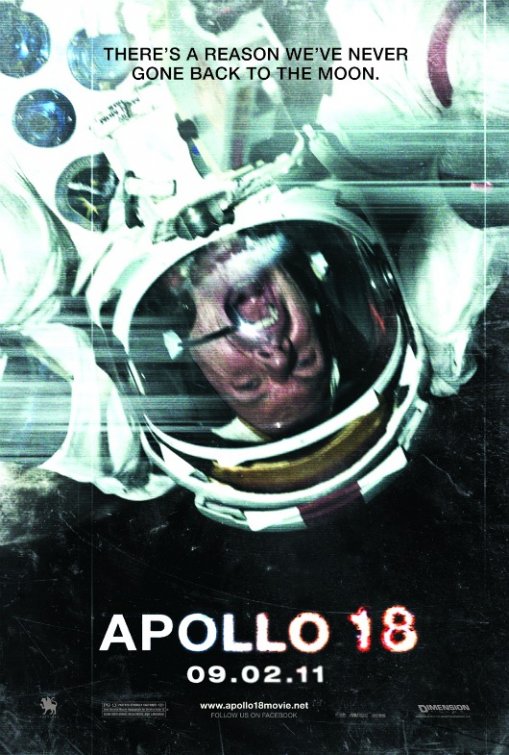 Apollo 18 is the latest in a swelling subcategory of films known as “found footage,” movies that purport to be discovered documents and aesthetically adhere to this premise. That means lots of handheld camerawork, selective editing, and other efforts meant to convey that what the audience is watching is not a movie made by professionals. It’s a professional attempt to look unpolished and amateurish, which is like having a four-star chef make you Taco Bell. 1999’s The Blair Witch Project popularized the found footage concept, and to this day there are still people today hoodwinked into believing it as unvarnished reality. Maybe that’s why NASA issued an actual press statement this week wishing to inform the general public that Apollo 18 is a work of fiction. I don’t think they have much to worry, because very few people will be seeing Apollo 18 and even fewer will enjoy it.
Apollo 18 concerns the failed secret mission of three astronauts (Warren Christie, Lloyd Owen, Ryan Robbins). The astronauts were sent to the moon for the Department of Defense, which means this is the second film of the year to concern a covert reason for landing on the moon. The two astronauts who actually land of the moon’s surface discover a dead Cosmonaut and some strange occurrences. They realize that they have been lied to by their own government and placed in a danger that few can comprehend.
But an intriguing premise can only get you so far and Apollo 18’s clumsy execution makes the movie disintegrate upon reentry, or, any critical thought. A secret NASA mission that went horribly wrong sounds like a great start to a conspiracy thriller, that is until you realize all you’re being presented with is the fake found footage. That means that we spend an eternity watching guys in suits float around, biding their time. Then they go outside and wander around the lunar surface. Then they hear an occasional noise. Or did they? Then they go back to floating around, to make up for the lost time they weren’t floating around. Really, this movie is an hour of nothing. It fails to create a sustainable atmosphere of dread or even basic curiosity. But when locked into the found footage concept, we are generally left with a lot of time on our hands. You would think that the basic premise that people have reassembled this footage would lead to cutting a lot of the filler and just getting to the good parts. It seems almost resentful that this hypothetical editor trying to showcase a long-buried truth would decide that the important stuff can wait. I was so thoroughly bored with Apollo 18 that I started counting stars.
 The structure of the story is just too insular and limited in scope. I strongly feel that Apollo 18 would have benefited greatly by opening up its storytelling parameters. It could have kept the found footage motif, but instead of being an entire 90-minute movie the found footage would be one component of a wider faux documentary. Interviews with science experts, conspiracy theorists, former NASA employees speaking under the protection of anonymity, and even family members, particularly the now grown-up son of one of the astronauts holding out hope, would add some balance. It would make the story feel larger and more authentic, let alone give the audience something new to watch. There could have been a parallel story of the discovery of this evidence, the process of getting it authenticated, and the potential dangers that would be exposed. It all seems a little too slapdash and simplistic to just say the footage was uploaded to a website. Anything, really, is what I’m looking for to broaden Apollo 18. There’s so much more that could have been added, but alas we’re stuck with three blander-than-bland, interchangeable characters collecting moon rocks and battling interstellar cabin fever.
Now I’m about to enter into the orbit of some serious spoilers concerning the ending to Apollo 18, so skip to the next paragraph if you wish to remain pure. The entire premise of this mission gone wrong (why did NASA create Apollo 18 uniform patches for a secret mission? It seems counterintuitive to create merchandise for something meant to be covert) is that there is something on the moon that the higher-ups in government want to investigate. This dangerous mystery claimed the life of a Russian cosmonaut, whose body is discovered by our American squad. When exactly the Russians put a man on the moon is never explained; yet another ingredient that would have worked better as a faux documentary. So you have one dead man on the moon, but soon the body count rises. It’s not some strange cosmic virus that infects the astronauts, leading them to psychotic episodes and murder. No, that would have been too plausible. You see, the villain of Apollo 18 is the moon rock. The rocks themselves somehow can transform into spider-like creatures that like to scurry around. Never mind the fact that we’re dealing with life that evolved in an environment without any atmosphere, but what have these moon rocks been doing for billions of years? It seems to me that after Neil Armstrong stepped onto the moon, the rocks must have been like, “There goes the neighborhood.” After twelve moon walkers, my only explanation for the motivation behind these killer rocks is that they just got sick and tired of being disturbed so often (“You stomp around like you own the place, you leave your trash behind, that’s it!”). A post-script tells us that these moon rocks were brought home and sent as “gifts” (their emphasis, not mine) to leaders and dignitaries of foreign countries. What are the implications with this? That the United States has kept its place atop the world because of the threat of moon rocks? Do the moon rocks even work on a planet with a vastly different climate than the arid moon? For that matter, since Apollo 18’s mission ended circling the moon, how the hell was any of the film footage retrieved? It wasn’t broadcast, so how did NASA or any truth-seeker come a hold of this damning evidence of killer lunar rocks? And to think we once thought that the moon was made of cheese. Oh how naïve we all were.
Apollo 18 is probably the most boring of all the found footage horror movies thus far. It does nothing to justify being 90-minutes, lacks any minor thrills or chills, and seems creatively stagnate. There are some cheap jolts, including having a character awake from a dream screaming twice. This Paranormal-Activity-on-the-moon fails to live up to the possibilities of its intriguing premise, instead settling for something aiming for slow-burn but achieves no-burn. The laughable conclusion is meant as a payoff but only for the nuttiest of geologists. Apollo 18 sticks with its core limited concept to the bitter end. This is a disappointment from all angles. It fails to scare, it fails to stimulate, and it fails to entertain big time. In space, no one can hear your boredom.
Nate’s Grade: C-
Share this:

Columbiana (2011)
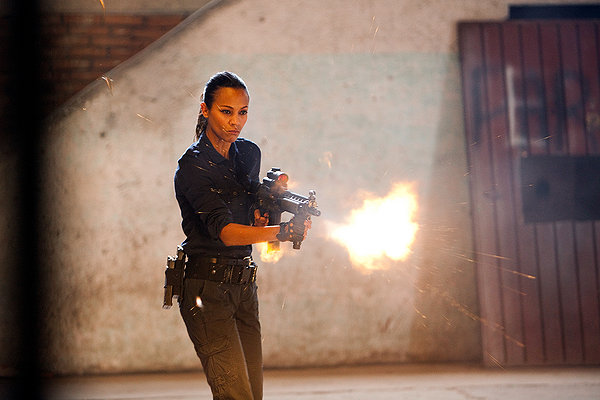
 Apparently, Columbians and several academic professors of Columbian descent have taken offense with the implications of the new action film from the stewardship of producer/co-writer Luc Besson (name a French action movie from the last 20 years and he’s likely had some hand in its development). The criticism being drawn is that Columbiana paints an unflattering picture of life in the South American country of the, almost, same name. I suppose that could be one charge against the film, but why be so limiting? Columbiana doesn’t make anybody look good, except for its star Zoe Saldana (Avatar, Star Trek), who could even stand to eat a few more sandwiches if you ask me.
10-year-old Cataleya (Amandla Stenberg, soon to breakout in a big way as Rue in next year’s Hunger Games) has the misfortune of watching her parents gunned down in front of her eyes. Her father ran afoul with the local drug lord, though we’re never told why. The drug lord’s main henchman, Marco (Jordi Molla), is looking for a microchip Cataleya’s father gave her. The girl stabs Marco in his hand and leaps out a window, darting through the streets of Bogotá with goons chasing after. She makes it into a U.S. embassy and offers up this microchip filled with significant data (what we’re never told) as her passport to America. She eventually finds her way to Chicago, where she lives with her Uncle Emilio (Cliff Curtis, doing an accent on loan from Scarface). She wants to be a killer to avenge her parents, and her uncle agrees to help. Flash forward 15 years, and the adult Cataleya (Saldana) is working as a hired assassin. Her calling card is painting the cataleya orchid on the chests of her victims. Why? To attract attention from the right parties. She’s playing a dangerous game, as they always do, romancing an artist (Alias’ Michael Vartan), staying a step ahead of the authorities, and working her way up the Colombian goon food chain to get back at Marco and his boss.
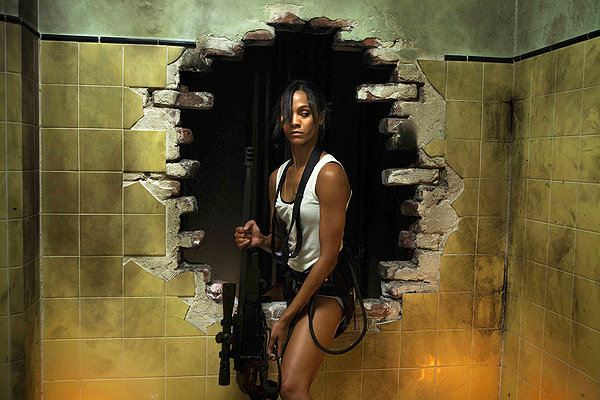 This is one of the dullest action movies I’ve had the privilege of sitting through. I was actively counting down the minutes until it would be over about halfway in. It’s not because Columbiana is particularly bad, it’s just so staggeringly routine, a French-styled action thriller cobbled together from the leftover bits of previous French-styled action thrillers (take one part La Femme Nikita, some faux Professional gravitas, add some District B13 parkour, how about a few outlandish Transporter getaways, and bake for 30-40 minutes). There are a few decent action sequences but lots of time in between, time that lets the film’s momentum lag and allows space to start contemplating all the questionable aspects of the picture. There are so many lazy, recognizable pieces onscreen, from the idiot FBI agents, who are always late on the trail, to the underwritten romantic love interest who is only there for booty calls and to accidentally be endangered, to the oblique bad guys who are just bad, and sometimes rather bad at being bad. These guys couldn’t outrun a 10-year-old girl in Columbia, what makes me think they’ll get their act together and take out the adult version? And I absolutely hate it when movies, set in other lands, have the characters speak one line in their native tongue and then transition immediately into English spiced with the occasional foreign phrase. Columbiana has the notoriety of making me yearn for the days where a female assassin picking off men twice her size was a novel concept/image.
Turn after turn, beat for beat, the plot has characters behaving in contrived ways because the story would not work without these contrivances. Cataleya says she’s an expert killer, but much of her expertise involves an insane number of coincidences and variables that are impossible to account for. We’re talking about the bathroom habits of guards, the amount of coffee consumption, the placement of specific prison cells, the precise number of guards and their own attention spans, the fact that every single person would not notice security cameras being messed with, and even nitty-gritty stuff like the amount of water in a plastic cup and the exact size of a hole that would allow the right amount of liquid to drip and pool into a spoon. Not to mention the fact that this also works on the assumption that police finding a plastic cup and a spoon inside a security panel would not find any of this suspicious. What the hell? That’s not rigorous planning and flawless execution? That’s divine intervention and/or good luck. At least in other hitman films that would study their prey to make it look like an accident. Not our Cataleya. She’s been taking out goons and leaving her calling card in an effort to attract attention from a certain Columbian cartel leader. The problem is that it takes her 15 years and over 22 murders before her skills attract media attention. That’s a frustration that the Son of Sam might identify with. But how would murders in Chicago attract attention in Columbia?
The only thing noteworthy for an enterprise that is so inherently generic is the weird moments that catch your attention. First, Saldana’s emaciated, wiry, potentially malnourished frame certainly draws your attention. Has there ever been a skinnier assassin on screen? There’s a reason that this woman is able to constantly squeeze inside air ducts and other cramped spaces; she’s practically a contortionist with her body. Now the actress has always been petite but her diminished physicality makes everything she does seem so much less believable. When she’s slinking around with a humongous assault rifle, you’d think the rifle weighs more than Saldana. And then when she engages in hand-to-hand combat, you keep waiting for some bad guy to grab her by the scruff of her neck and just hold her at arm’s length, a safe distance from potential kicks. Despite all her steely glares, Saldana just does not come across as a believable hitman. To top that off, the way director Olivier Megaton’s (Transporter 3) cameras seem to worship her lithe, leggy body gives an unsettling support for Saldana’s teeny tiny body. Now people can be just as discriminatory toward thin people as they can be with the overweight, but with Columbiana, Saldana’s skinny body negatively impacts the reality of a story already riddled with logic gaps.
 Then there’s Cataleya’s uncle who himself is something of a criminal under lord. She wants to grow up and be a killer and he just sort of shrugs and says, “Okay,” in the same tone of voice as if she had said she wanted to be a cowboy. But this is Movie World, a place where Cataleya’s father tells his driver, “We’ve got maybe an hour at most before he kills my whole family,” and then spends that fateful hour in such a lackadaisical fashion. He stops and walks around his car, sits down his little girl to have one last talk, waits for his wife to pack; there’s no sense of urgency here. People, you got one hour to supposedly live, you don’t pack a suitcase you just get in the car and run! But getting back to Uncle Emilio in Chicago. After he enrolls her in school, she’s sulky because she doesn’t think there’s anything she can gain from American education. She just wants to learn the ways of a killer. Her uncle, in a misguided feat to teach her a lesson, pulls out a gun and shoots randomly into a street, causing a car to crash and dozens of witnesses to huddle. “What can I teach you if you don’t learn?” he says, somehow giving the least inspiring case for public education. Then, preposterously enough, he and Cataleya scamper off at a mid-trot, casually eluding the police and all the dozens of witnesses who have clearly been able to see them this whole time.
Columbiana is one of those cookie-cutter action movies that just coasts on the apathetic expectations the audience has when they knowingly plop down money for a generic genre picture. And generic is certainly Columbiana. It’s a fairly standard revenge picture with some fairly standard action, devoid of any discernible kinetic style that might make for memorable sequences. Columbiana would not exist if it weren’t for a wealth of clichés and contrivances; the whole enterprise is bursting at the seams thanks to all its shortcuts in story and character. What does the title even mean? Is the film Columbia-esque? Is the depiction of skinny assassins and preposterous, illogical action supposed to be reminiscent of life in the country of Columbia? I think the film paints a worse picture of Chicago than Columbia, but at any rate this is an action thriller that can’t be bothered to thrill. Columbiana is generic to the point of desperation, where even the sight of Saldana in a skintight cat suit can become underwhelming in time, a tragedy of international proportions.
Nate’s Grade: C
Share this:

Rise of the Planet of the Apes (2011)
 I owe the makers behind Rise of the Planet of the Apes a huge apology. I have been vocally dismissive of a new Apes film from the first moments I heard about the project. I just thought rehashing this material was a stupid move. Then I heard James Franco (127 Hours) was going to be the lead, and I sighed. Then I saw the trailers and verbally impugned them in my theaters. Upon the conclusion of the trailer I yelled, “You can still shoot them!” and my criticism drew applause from those around me. The concept that we suddenly made apes smarter and they could now enter the Bronze Age, brandishing spears, didn’t overwhelm me. Just because the apes suddenly had tools didn’t seem like enough to topple mankind from the top of the evolutionary ladder. So in the months and weeks ahead I sneer, jeered, and overall dismissed Rise of the Planet of the Apes. And then the reviews came out and they weren’t just good, they were ecstatic. I went begrudgingly into the theater, waiting to hurl my own feces at the screen (figuratively, of course). Then I was completely taken aback by how much I unabashedly loved it.
Will Rodman (Franco) is a young scientists working hard at create a miracle cure for Alzheimer’s. His corporate company has been testing their drugs on chimps to mixed results. One day a promising ape, made smarter by a dose of ALZ 112, goes bananas and is put down by security. The lady ape left behind a baby ape that has taken on traits from the ALZ 112. Will takes the little chimp home to care for the “company property.” But then he ends up adopting the chimp, which his ailing father (John Lithgow) names Caesar. Due to the super drug, Caesar shows remarkable intelligence and looks to be getting even stronger. It looks like Will might have found his cure, and his boss (David Oyelowo) will make billions. But then complications ensue, as they always do, and Caesar is taken to an animal preserve facility run by a crooked father/son team (Brian Cox and Harry Potter’s Tom Felton). Caesar is mistreated and distraught to adjust to a life in pens. He makes plans to escape but then decides to rally his fellow imprisoned apes to a greater cause with the help of some of the ALZ 112.
Even through Franco is the headliner he’s really nothing more than a supporting character, a catalyst. The real star of the movie is undoubtedly Caesar the chimp. After about he 45-minute mark, Franco is reduced to making frowny faces while he scowls, trying to ascertain where his favorite monkey is. His dialogue is mostly reduced to different iterations of yelling Caesar’s name in different locations (the guy even manages to smirk in his sleep in one scene). But the major surprise is that Caesar is not only a compelling leading character but also a well-developed one at that. This is a living, breathing character brought to life thanks to top-notch computer wizardry and the talents of Andy Serkis, the leading authority for soulful motion-capture performances. Caesar may be the greatest single special effect of all time, not because of its life-like quality (it’s close, but again the creature’s features seem too waxy). But the reason Caesar is so impressive is because of the depth of emotion that can be read onscreen. This is a textured performance where you can read varying emotions through the looks of eyes, the twitching of facial muscles, the biting of lips. The emotions are genuinely recognizable; he flashes guilt, anger, frustration, heartache, disbelief, betrayal, fear, shame, just about everything in the book. From a DNA standpoint, chimps and humans share 96 percent of the same genes, so it’s understandable that we can relate to the plight of our distant relatives. Serkis is responsible for providing the groundwork for CGI creations like Gollum and King Kong, so he’s the world’s go-to guy when it comes to providing a framework for animators (Robert Zemeckis, why have you never called this guy?). It’s an amazing special effect accomplishment and works side-by-side with the storytelling to make Caesar a complicated, interesting, and deeply empathetic hero. He’s a terrific center for the movie and a figure that you root for, even with the tacit understanding that cheering on the apes’ escape is also tantamount to cheering the decline of the human race. But by God, during the apes-run-amok climactic sequences you are cheering for mankind’s downfall hardcore.
The Planet of the Apes saga (six films) is, let’s be honest here, rather abysmal. Everybody loves the first movie but the quality sharply drops from there, with four sequels in four years each managing to answer the depressing question, “Can this thing really get any worse?” The 2001 Tim Burton “re-imagining” was just embarrassing and filled with loopy logic (how can the apes take over Earth’s past when Marky Mark crashes on a DIFFERENT planet in the FUTURE?). Given that, the filmmakers behind Rise of the Planet of the Apes did not have to achieve much to separate themselves from the monkey-stank of the sci-fi franchise. The film serves as a prequel to the series but it’s easily the best film since the original. Easily. For one, the storytelling is not overwhelmed by the allegory of sci-fi packaging. The world is decidedly our own and the problems the characters grapple with are fairly relatable. Will may be responsible for the annihilation of the human race but his motivation is pure – he wants to save his ailing father. That’s a believable motivating force that would push the character to action over caution, testing his special serum without fully examining all the side effects. You know what they say about the road to Hell (my friend Eric Muller always suspected Franco would be linked to the end of civilization)? But in a Planet of the Apes movie there is a wealth of thoughtful human drama. Animal rights are one of the more obvious messages the movie deals with, but the film takes a character-driven approach following the animal himself. You care about these characters and when one CGI ape was cradling a dying CGI ape, I swear I was getting choked up over those computer pixels. That’s how emotionally involving this new Apes film can be. It’s refreshing to have a Hollywood action film that has more on its mind than blowing stuff up all good like.
 But when the action shapes up, mostly during a stirring man vs. apes climax, the film easily delivers. The nimble screenplay by Rick Jaffa and Amanda Silver (their first film since 1997’s Relic!) is a terrific example of economical big-budget pacing. Every scene moves the story forward and doesn’t waste a frame. The final running time is only 105 brisk minutes but it squeezes in so much entertainment and emotion. Director Rupert Wyatt keeps the thrills coming on a human-scale, never letting the enormity of the events getting too out of hand. Sure suddenly there are like 500 apes all of a sudden and all of them are super smart, but I can roll with that. The stakes are always clear and the action is easy to follow and easier to get swept up in. There are a few shout-outs to the original film’s iconic lines, which will either come across as fun or ham-handed. And thankfully a plausible scenario is put forth to explain why the humans would be overtaken by the apes. That’s not to say that everything is smartly woven into the narrative. Several of the side characters are but crude renderings. Frieda Pinto’s (Slumdog Millionaire) underdeveloped love interest could be completely taken out with minimal effect on the plot. Likewise the Evil Business Head seems to have nothing but speeches that remind you his sole interest is making lots of moolah.
Rise of the Planet of the Apes is a Hollywood movie with a soul. Finally late in the summer a major studio movie emerges that has the right balance of brains, brawn, and thrills. It’s an exciting action movie, a poignant drama from an animal’s point of view, a tour de force of special effects that manage to make the film more emotionally involving, and a sci-fi prequel that’s actually worthy of its name. Serkis’ gifts for physical performance are invaluable to the emotional core of the movie. By going back to its DNA, Rise of the Planet of the Apes has given new life to a franchise whose best days were 40 years ago. I don’t see where the series can go from here. A prequel to the prequel seems superfluous. A sequel would only really showcase the waning days of humanity and also seem superfluous. Then again, until the moment I was watching Rise of the Planet of the Apes I would have said this very movie was superfluous too. Instead this is the finest summer spectacle of the year and destined to make my top ten list for the year. If you can’t beat them, join them, damn dirty apes and all.
Nate’s Grade: A


 nathanzoebl
You must be logged in to post a comment.