Category Archives: 2011 Movies
My Week with Marilyn (2011)
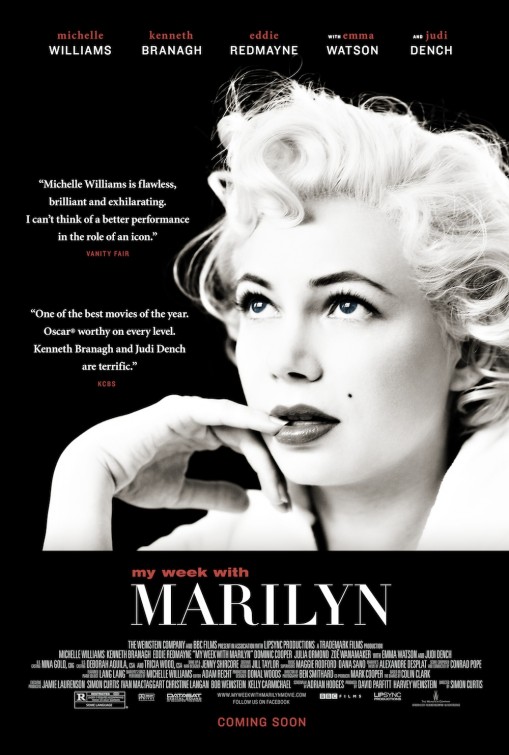 In 1957, Marilyn Monroe (Michelle Williams) was the biggest star in the world but she wanted to be taken seriously as an actress. Laurence Olivier (Kenneth Branagh) was an award-winning thespian considered to be acting royalty, but he was looking to siphon some of Monroe’s fame and vigor. Monroe flew over to England to shoot the light comedy The Prince and the Showgirl, directed by and starring Olivier, and it was here that she changed the life of Colin Clark (Eddie Redmayne). Clark was an ambitious young chap who served as the third assistant director and Oliver’s personal assistant as well. He was mainly a glorified go-fer but the position allowed him to glimpse the world of Marilyn Monroe and her various handlers, Paula Strasberg (Zoe Wanamaker) and Milton Greene (Dominic Cooper). Monroe’s flighty behavior and struggles with acting drive the more professional Oliver stark raving mad. Monroe’s rocky marriage to playwright Arthur Miller (Dougray Scott) is causing her fits of depression. Who better to cheer her up than young Colin Clark? Over the course of nine days, the two become inseparable and Clark falls head over heels for the world’s most glamorous woman.
The character of Colin Clark seems to be stripped of all defining personality traits. He’s this bland kid caught in continual awe. He just seems to be smiling and twinkling those big, compassionate eyes of his, typifying the earnestness of young love. I think he’s been rendered into a cipher for the audience to put themselves in his shoes, becoming star struck with Monroe’s attention. The screenplay takes far too much time on showing Clark coming to the repetitive rescue. His romance with a costume girl (Emma Watson) is a nonstarter and the movie doesn’t even try and hide the fact. She’s the backup romantic option, so the fact that he goes back to her after being spurned by Monroe and we’re supposed to feel that this is growth seems disingenuous and a bit caddish. Perhaps she didn’t take it too hard; if you’re going to be dumped for anyone else, there’s no shame if it’s Marilyn Monroe. Judging by the movie’s depiction, Clark is a rather boring young man, and I didn’t buy for a second that Monroe would cling to him as her hero.
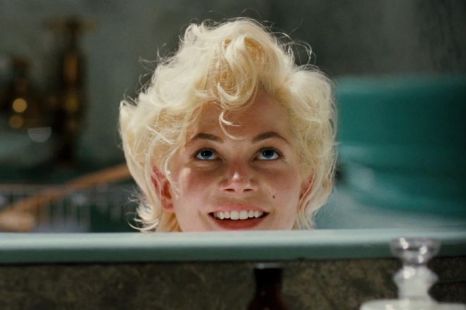 My Week with Marilyn is really focused on the titular star. Clark is just out path to the real star. I doubt there’s anything particularly revelatory about Monroe here. She was plagued with insecurities, a need to be loved, and the fatigue of “playing” herself all the time, all hips swivels and winks. At one point Clark and Monroe are taking a walk and met with a group of fans. “Shall I be her?” she coyly asks Clark and then turns into the vampy goddess the public loved, striking poses and smiling wide. By the very constricted nature of the timeline, we’re not going to learn too much about the famous beauty. She flubbed her lines, she and Olivier didn’t get along, and a mini-entourage of sycophants who were meant to be a surrogate family for the troubled gal surrounded her. Was she a lonely gal crushed by the weight of stardom or a manipulative lady who knew how to get what she wanted? The movie doesn’t take a side, instead serving up all sides of Marilyn Monroe, including a few in the buff. The film has some enjoyable juicy bits, particularly the friction between Monroe and Olivier, but the movie ultimately becomes another fawning admirer of its star. There are a couple musical numbers with Monroe that feel clumsily reproduced and the tone seems too light too often for the dramatic moments to have any real bearing. It becomes another fan that celebrating her image and sponging off her fame and legacy.
While the film may not be revelatory, Williams (Blue Valentine) herself is the revelation. She’s not exactly a dead ringer for the curvaceous, buxom blonde beauty, but she inhabits the spirit of the woman rather than sticking to a breathy imitation. She doesn’t capture the baby-doll voice but the demeanor she has down pat; when she turns it on you can feel the screen light up with the luminescence of star power. There’s quite a difference between the sad, depressed, codependent Marilyn and the sexy pinup fantasy. It’s an incredible performance in an otherwise so-so movie, though I wish the screenplay had given her more complexity to work with. Branagh (Valkyrie) is great fun as the stuffy, overbearing Olivier who gets plenty of snappy lines to vent his frustration over Monroe’s antics (“Teaching Marilyn how to act is as useful as teaching Urdu to a badger!”). Both actors are so good, and so good together, that I wish we could just remove the “my week with” from the title and focus on the relationship between Monroe and Olivier.
Allow me to question the voracity of Clark’s account. He waited until 1995 to publish his film set diaries, and then after his first memoir of his time with Monroe sold well he published another one in 2000, this one filling in a nine-day gap he says was that fateful week with the sex icon of the twentieth century (eat it, Clara Bow!). The second memoir was written fifty years after the fact and from the nostalgic perspective of an old man looking back to his youth. I feel that the particulars have been smoothed over and romanticized. The fact that surviving actors from The Prince and the Showgirl cannot verify any sort of relationship, and that several sources say that Monroe and her new husband Miller were inseparable at the time, cause me to doubt the validity of this personal account. In his first memoir, Clark even criticizes Monroe’s physical appearance (“Nasty complexion, a lot of facial hair, shapeless figure and, when the glasses came off, a very vague look in her eye. No wonder she is so insecure.“). Yet in the second book he becomes her defender. So which is it? Who wouldn’t, with sixty years of hindsight and a best-selling first memoir, embellish their one-time dalliance with a star like Monroe? The most desired woman in the world and he, a 23-year-old nobody, was the one to become her confidant? Aren’t we full of ourselves? And he crawled into her bedroom and was asked to stay the night and didn’t consummate that relationship? In the book she offers and he declines. Talk about the biggest mistake of your life.
 If you’re going to embellish, then you might as well get some action out of it. Then again, maybe in the books Clark says that Monroe gave him a pity handjob and the filmmakers deleted this (I can hear him screaming from beyond the grave, “You fools! The handjob was a metaphor. The whole tale falls apart without it!”). If I ever had even a fighting chance of getting lucky with Marilyn Monroe, you’d best believe I would be telling that story so often that my grandkids would roll their eyes in disgust (“Geez, we get it grandpa. Marilyn gave you a handy once.”). The post-script tells us that after The Prince and the Showgirl, Monroe went on to Some Like it Hot and Olivier went back to the theater for some of his best-reviewed runs of his career. So clearly, these two stars owe all their good success to the heroics of Colin Clark, who nudged them from greatness to legendary. We have only Clark’s take since Monroe cannot dispute Clark’s claims so I feel like the memoir, and the film adaptation, is an exercise in serving Clark’s ego.
My Week with Marilyn is a light, weightless movie that retells the shooting of a light, weightless movie. Well done, everyone. The emphasis on this bland kid and his fairly unbelievable whirlwind romance of the twentieth century’s most iconic sex symbol makes the movie feel self-serving. Does anyone honestly believe the events of this story? Whatever the validity of the events, a movie should be entertaining on its own rights. My Week with Marilyn has its bouncier moments and is saved by stellar acting from Branagh and the radiant Williams. But even the best acting in the world can’t save a movie that feels like it’s completely some old man’s exaggerated, embellished, and somewhat boring fantasy. If this is the relaxed standard for getting a movie made, then I look forward to the eventual film adaptation of my soon-to-be-released novel titled, My 28 Hours of Incredible Sex with Angelina Jolie.
Nate’s Grade: B-
Share this:

Melancholia (2011)
 Melancholia opens with a bang. Literally. Lars von Trier, film’s most polarizing and famous sadist, begins his movie with the ultimate spoiler alert, destroying the entire planet. Lars von Trier’s grandiose exploration of annihilation, both personal and species-level, can be maddening in how tedious the whole affair can become for long stretches. What’s even more maddening is that the movie flirts with being magnificent for other, regrettably smaller, stretches.
We open with the wedding of Justine (Kirsten Dunst) and Michael (True Blood’s Alexander Skarsgard). Hours late, the couple arrives at their reception at the palatial estate that belongs to her sister, Claire (Charlotte Gainsbourg), and her husband, amateur astronomer John (Kiefer Sutherland). Over the course of one very late night, Justine will quit her job, sleep with a random wedding guest, alienate her family, and end her brief marriage, putting Kim Kardashian to shame. Several months later, Justine has been released from a hospital for clinical depression and is now living with Claire and John’s along with their young son, Leo. A tiny star in the sky has gotten larger over the ensuing months, and scientists have determined that this new planet is heading straight for Earth. Named Melancholia, this rogue space rock is predicted to pass by, but the calculations are getting closer and closer. Eventually, the truth is evident and Melancholia is on a cataclysmic collision course with Earth.
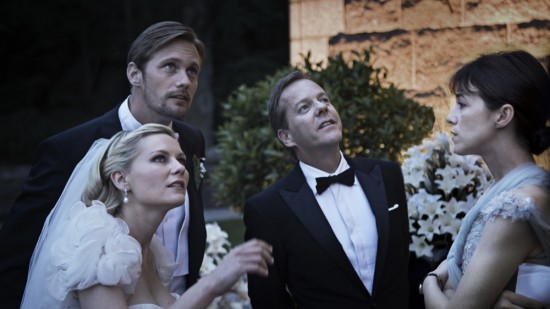 From a plot standpoint, the movie is completely lopsided. Melancholia opens with beautiful images that…. just…. keep…. going…. on…. and… on… set to thunderous Wagnerian overtures. It lets us know right away that von Trier is performing at an operatic level of melodrama. After this spoiler sequence, we jump back to the last months of Earth. The first hour of this movie is a boring wedding sequence that just seems to stretch for an eternity. You may wish that the rogue planet would show up and smash everyone to bits so we could get on with it. Justine and her groom are already several hours late because of the precarious route their limo had to take, so the fact that Justine takes frequent breaks and needs to be constantly retrieved can be draining. The hour of wedding blahs would be better time spent if I felt von Trier was laying the groundwork for characters. Little of the first hour seems to matter at all or has any lingering ramifications, which is bizarre considering the amount of personal nosedives Justine takes. It’s plain to see that Justine is unhappy and going through the motions, pretending to be happy for everyone’s benefit and maybe, just maybe, she can trick herself. What’s not plain to see is why we have to spend so much time on a room full of characters that will never be seen again. We learn so little about the characters, their relationships, and why any of this matters. The first half of this movie could have easily been condensed to 20 minutes. If the point was to test the audience’s patience, much like Justine does to her family, then bravo.
It’s that second hour where Melancholia flirts with the profound. The second half only concerns four principal characters. Unlike the first monotonous hour, there are events that actually matter and have substance to them, namely the encroaching obliteration of Earth. Having seen the pre-credit preview, we already know every life on the planet is doomed, but that doesn’t stop us from feeling the same pangs of anxiety as Claire discovers what we already know. Depression may be an elusive personal experience that not everybody can empathize with, especially when the depressed individual becomes overly taxing, but coming to terms with the end, not just your own, but of all of human history? That’s something every person can identify with. This confrontation of the inevitable can lead to some thoughtful soul-searching. This is an extinction event. There is no escape, unless you’re an astronaut (it’s now or never, lunar colonists).
Like most of us would be, Claire is terrified to die, to have all her loved ones die, but Justine is eerily placid. She feels that the Earth is evil and that “nobody will miss it.” To further drive von Trier’s bleak pessimism, Justine says there is no other life elsewhere in the universe. This is it, and it’ll all be over soon. “I just know,” she adds, unhelpfully. We watch Claire go through different stages of grief, fighting for some sense of closure, but von Trier will not allow any comforts. Gainsbourg was put through Trier’s typical emotional wringer in 2009’s unpleasant Antichrist, and here she’s really the entry point for the audience, and as such we sympathize the most with her since her reactions are so believable. It’s hard to feel like there’s any bond between these two sisters, which limits the impact of the end. Still, the end is fittingly devastating and makes me wish I had seen the beautiful destruction on the big screen, bathing in its apocalyptic splendor.
 The dread of that final hour is extremely palpable, with the presence of Melancholia in the sky played almost like an art-house existential horror movie. At first we’re told by John that the scientists predict it will fly-by at roughly 60,000 miles per hour, but slowly the realization becomes clear that Melancholia is coming back with a vengeance. There’s a terrific plot point where John introduces a way to judge the planet’s movement. A wire circle is held out at arm’s reach, designed to trace around the perimeter of Melancholia. Then five minutes later the wire ring goes back up and, voila, the rogue planet has shrunken in size or gained. It’s a smart device that helps establish the momentum of doom, and it’s practical enough for the characters to perform. As Melancholia comes closer to collision, it gives off an unnerving blue glow. I started joking with my friend Alan that the movie was going to descend into a slasher-style stalker movie, with Melancholia chasing to get you like a spurned and dangerous lover (“We’ve traced the phone call. The planet is calling from inside the house!”). These attempts at levity are inevitable when the subject matter is so depressing and the nature of von Trier’s film lends itself to operatic pomposity.
von Trier’s film is quite a departure from the most disaster cinema, but sometimes its Big Statements can seem inartful and obvious. The very idea that the planet of doom in this dance of death is called Melancholia… come on. Maybe this whole thing would have been avoided had those egghead astronomers had given this rogue planet a happier name (My suggestion: “Doug.”). The metaphorical connection to Justine’s own melancholy is just inane. The planet is but a tiny speck in the sky at her wedding, and Justine is desperately trying to hold it together, and then in the second half the planet is much bigger and, surprise, so is Justine’s melancholy.
I found it hard to care about Justine and her personal demons. Depression and mental illness can be exasperating conditions, but that doesn’t mean I sympathized with her any more than the other seven billion souls destined to be incinerated. Her rejection of niceties can seem cold when all her sister wants to do is find some level of reassurance before the end is near. Dunst (Marie Antoinette) won an acting award at the Cannes Film Festival for her performance, and it’s hard for me to see why. It’s a darker, somber, more serious role for the actress, but looking tired, sullen, and impassive doesn’t come across as a fully rendered performance, more of a bad mood swing. My feelings are likely tempered by the fact that I found her character to be unbearable and agonizingly opaque
Melancholia is half of a great movie, but only half. The movie can feel a little too isolated, a little too leisurely paced, a little too pretentious. The beginning wedding sequence is like a minor endurance test, but rewards await those who carry on to the bitter end. This uneven art-house disaster movie has stunning imagery, numbing dread, and an apocalyptic grandeur, the likes of which could only come from the perverse mind of Lars von Trier. It’s beautiful and lyrical in its best moments, a cold, surrealist nightmare. The boldness of von Trier’s vision is inescapable, but I only wished he had fashioned a better story and sharper characters for his experiment in nihilism. If we’re going to spend the last few hours on Earth, I’d rather it be with people I gave a damn about.
Nate’s Grade: B-
Share this:

Tinker, Tailor, Soldier, Spy (2011)
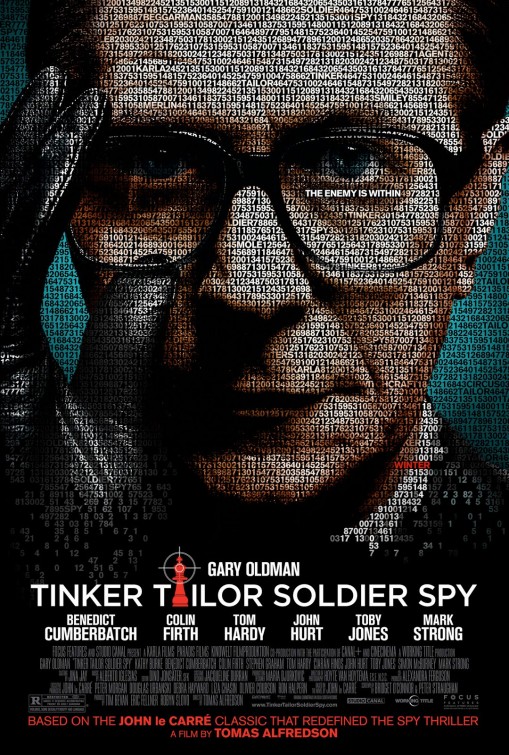 Billed as one of the most dense films of the holiday season, I was startled to discover that Tinker, Tailor, Soldier, Spy is not nearly as puzzling as people have protested. The adaptation of John le Carre’s famous novel follows retired British spy George Smiley (Gary Oldman) performing a clandestine investigation to flesh out a mole in the highest level of the agency. Directed by Tomas Alfredson (Let the Right One In), condensed form a 7-hour BBC miniseries, and stuffed with a wealth of terrific Brits, the movie is tricky, clever, and rather brainy, ultimately coming to the conclusion that these little communities of intelligence knew little. The movie has a rich array of characters and teases out back-story in flashbacks, meaning the film hops around time wise and will also take turns with different perspectives. It demands your attention but, honestly, I found it easy enough to follow. But in the end, what does all that narrative trickery and obfuscation get you? It’s a fairly dispassionate film about dispassionate people played out in a dispassionate manner. For some this will be hailed as a virtue, communicating the duty-first sacrifices and compartmentalization of these secret spies. For me, that just sounds like a cop out. Beyond the mystery, it’s hard to get involved in the movie. The reveal of the mole is anti-climactic, though the resolution, set to the tones of Julio Iglesias, is aces. The meticulous production design is stellar, including an agency meeting room that looks like it was wallpapered with checkerboards. The details of the ins and outs of the agency are absorbing. I’m debating whether I should watch the movie again, looking for nuance I must have missed. Tinker, Tailor, Soldier, Spy is an espionage thriller with a bit too many stiff upper lips.
Nate’s Grade: B
Share this:

Submarine (2011)
 Submarine is the latest coming-of-age story, this time set in 1980s Wales, and while not breaking any new ground, it manages to be witty, stylish, and a completely winning portrait of a unique kid and his unique view of the world.
Oliver Tate (Craig Roberts) is a 15-eyar-old kid with two life goals. He’s like to romance the rebellious loner Jordana (Yasmin Paige) and, if possible, lose his virginity in the process. Oliver is also on a mission to save his parent’ marriage. Jill Tate (Sally Hawkins) has been drifting from her husband, Lloyd (Noah Taylor), a marine biologist who has been in a depressive funk for years. Jill’s old boyfriend, Graham (Paddy Considine), has moved in next-door and begun to insert himself back in her life.
Submarine is going to be something of an acquired taste. It’s almost drowning in whimsy, following the numerous affectations of its main character. Fans will say that the movie borrows liberally from Wes Anderson’s 1998 film, Rushmore; non-fans will just say the movie cops to outright theft. Like Rushmore, this movie follows the coming-of-age trials and tribulations of an intelligent but lonely outcast, a wiseacre beyond his years. What sets this movie apart is that we taken on the point of view of Oliver. He often refers to his life as if it were a movie, noting dramatic moments that would be accompanied by dramatic music, and a solemn moment that would feature a crane shot rising above the ground but if the budget were low he’d settle for a slow zoom out (the actual movie chooses the slow zoom). “I have turned these moments into the Super-8 footage of memory,” he remarks. Oliver is a student of pop-culture, an early Rob Gordon (High Fidelity), and as such blurs the line between reality and the movies. He will routinely point out film tropes ad then indulge in them. We are each the stars of our own stories. In this manner, Submarine separates itself from the idiosyncratic, miniaturized-doll house world of Anderson’s films or the fanciful magic realism of Jean Piere Jeunet (Amelie). For me, the multitude of quirks were appealing instead of insufferable because we were inside the mind of Oliver, seeing his world through his unique worldview. This brings rationale for the whimsy.
 Oliver is both an unreliable narrator and a flawed protagonist, a fantastic development. So often coming-of-age tales are mainly autobiographical (this one is based off a book by Joe Dunthorne), and as such the authors usually portray themselves as individuals whose chief fault is that they are naïve. Some life experience will shatter their innocence, usually a girl, and thus they will grow and learn. With Submarine, Oliver gains our sympathy by being clever but then he tests it with the compromises he makes to fit in. He engages in some very mean bullying all to win over Jordana. He’s trying to seem so mature, using advanced vocabulary to provide the illusion of adulthood, but really Oliver can’t comprehend the subtleties of social cues. Just when Jordana appears to be opening up and looking to him for need, that’s when he botches it, acts kind of awful, and then justifies it in his head, like so many of us will do with our mistakes. Still, I never stopped rooting for this kid. I was rooting for him and Jordana to work out. So hard was I yearning for these two loner oddballs to have their happy ending, I think I pulled something (my dignity?). We can see Jordana through Oliver’s infatuated eyes, but then we can also see deeper, see the vulnerability that comes forward that Oliver might be blithe to. Paige (The Sarah Jane Adventures) is a true breakout star and it’s easy to see why Oliver is so infatuated with the charming lass. She’s bruised but approachable, risky but relatable. We can see the connection building between these two, and we want it to continue (maybe that’s my own high school experience speaking out). The youthful romance is sweet and unconventional without seeming like a coming-of-age folly, something that Oliver is supposed to learn some gallant life lesson.
The other plot development, the rocky relationship between Oliver’s parents, is less resonant but it does provide for some fine moments of humor. The new neighbor, Graham, who practices martial arts and believes himself to be a New Age mystic, healing people by sensing their aura colors, just feels like a leftover Napoleon Dynamite. It provides Considine (In America) a springboard to act goofy, which he’s quite good at. The goofiness of the character, however, cuts into the credibility of being a threat to steal away Jill. She may be caught up in this guy’s tiny bubble of fame, but there’s no way she would leave her husband for this doofus, even if her husband has been suffering from depression for years. Oliver’s attempts to reignite his parents’ marriage are plenty hilarious, but they’re also informed with a sweet, if misguided, earnestness. He loves his parents and wants them to stay together. He doesn’t want a ninja mystic for his new dad. Fortunately, Oliver’s attempts to sabotage Graham are kept to a minimum and restrained enough not to resort to cheap slapstick or gross-out humiliation. Maybe it’s the distinctive point of view steering the narrative, but the potential doom of the marriage never feels as portentous and heartbreaking as Oliver’s hope at wooing Jordana.
 Debut director Richard Ayoade, who also adapted the screenplay, utilizes every visual trick in the book to tell this story. If the main character weren’t so amusing, and his plight so interesting, all the visual artifice might be exhausting. Instead it keeps the movie lively, crafty, and constantly wonderful to observe. Ayoade’s also quite a talent when it comes to screenwriting. He smoothly captures the very mannered speaking style of Oliver. Then there are just lines that make you laugh out loud from the sheer absurdity of misplaced teenager awe: “He wasn’t even considered hard until the Watkin twins famously stabbed him in the back with compasses. He said nothing; showed no discomfort as his shirt blossomed with blood poppies. His stoicism reminded me of the brave men who died in the First World War.” Ayoade, best known for his starring role on The IT Crowd, will probably soon have a lot more offers to direct features once people get a gander at Submarine. The man’s a natural storyteller and will be snapped up by Hollywood in no time flat.
Finally, the movie’s lead actor needs to be good, better than good, if this movie is going to rise above the din of precocious, coming-of-age cinema. Roberts (Jane Eyre), hollow eyed and just a little “off” looking, handles the material with ease, never letting his performance transform into a series of tics strewn together. Oliver is straight-laced throughout, letting the peculiarities of his imagination and worldview seem ordinary. Roberts doesn’t get overwhelmed by the material and makes a strong impression as a more literate, less rebellious, more anxious, less despondent Welsh version of Holden Caulfield (okay, so maybe that allusion doesn’t hold).
Submarine is an unfailingly entertaining vehicle full of quirk and humor and surprising heart. Oliver’s relationship with Jordana is sweet and mildly touching. I was surprised at how emotionally invested I was in their romance. The movie is also refreshingly low in angst, resorting more to Oliver’s comic anxieties and insecurities. It certainly owes a debt to Anderson’s Rushmore, but Submarine is so good, so thrilling in its creative voice, that it can stand outside the mighty shadow of Anderson and his indomitable influence.
Nate’s Grade: A-
Share this:

Love, Wedding, Marriage (2011)
 I keep wanting to mistakenly refer to this movie as Love, Marriage, Divorce since that seems like a more prevailing plot element in this abysmal rom-com. Mandy Moore plays a couples counselor who’s a newlywed herself, having just gotten hitched with Charlie (the Twilight Saga’s Kellan Lutz). Her life is great, that is, until she learns her parents (James Brolin, Jane Seymour) are splitting up. Their pain will soon be felt by every person watching this wretched movie. Incompetently directed by actor Dermot Mulroney (My Best Friend’s Wedding), the movie’s tone approaches something like spastic cartoon. Mulroney frames everything in uncomfortable close-ups, which magnifies the exaggerated gyrations and facial expressions of his cast. It looks like every person onscreen is suffering a stroke at one point. The acting is so shockingly terrible. It’s like the actors have been replaced with the amateur dinner theater versions of themselves. Moore’s character is too shrewish and self-involved to be compelling, and Lutz, whose name rhymes with putz, is so wooden you’d swear they carved him out of a chunk of balsa right before cameras rolled. The sitcom plot suffers from every cliché imaginable in the rom-com genre. This is the worst case of bad drunk acting since 2006’s The Black Dahlia, where actors over-do just about every action. The funny part is that it’s only a slight difference from the way the characters are behaving sober. Criminally unfunny, I have only one theory how Mulroney was able to get this movie made because clearly the screenplay wasn’t reeling investors in. In the end credits are many producers and executive producers, several of them with Slavic surnames. There’s also a Slavic model with in a key role. Mulroney turned to the only people who would finance Love, Wedding, Marriage – the Russian mafia. If you see Mulroney in a wheelchair from an “accident” in the near future, you heard the truth here first.
Nate’s Grade: D-
Share this:

The Myth of the American Sleepover (2011)
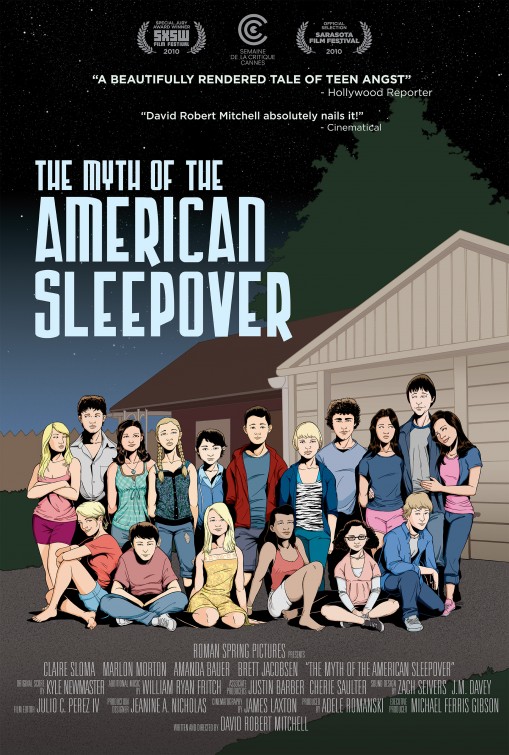 The curiously titled Myth of the American Sleepover owes as much to American Graffiti as it does to the works of John Hughes. This sprawling teenage opus by debut writer/director David Robert Mitchell resonates with all the beautiful aches and joys of adolescence, wonderfully understated but brilliantly realized. I fell in love with this movie.
Set over the course of one night in suburban Michigan, a slew of teenagers try and make the waning summer days worth remembering. Claudia (Amanda Bauer) is the new girl in school and invited to the cool gal’s (Shayla Curran) slumber party. She learns her boyfriend slept with the cool gal and plots a little boyfriend stealing of her own. Rob (Marlon Morton) is obsessed with a pretty blonde girl he once shared a look with in a supermarket. He is scouring the neighborhood, going from party to party, looking for her so he can reveal his true feelings. Scott (Brett Jacobson) is unsure of whether he wants to finish his final year of college, now the site of a painful breakup from his longtime girlfriend. One day while walking the halls of his former high school, he comes across a picture of him with twin sisters, Ady (Nikita Ramsey) and Anna Abbey (Jade Ramsey). He heads out to the University of Michigan, where the twins are enrolled, convinced he could win one, or both, of them over. Maggie (Claire Sloma) is navigating between the middle school sleepovers of her peers and the world of the cooler upperclassmen. She’s been nursing a crush on an older boy (Douglas Diedrich) who worked at the community pool all summer, and will find the courage to make a move.
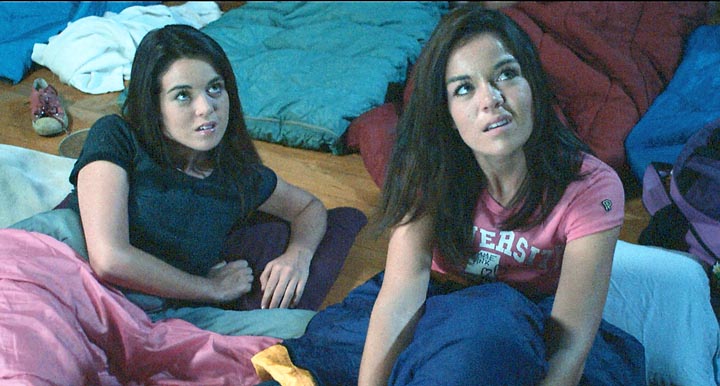 Unlike other coming-of-age entries, this is a movie that forgoes scatological comic setups and other Big Events meant to mark the passing into adulthood, like the loss of virginity, college admittance, or the prom; instead, Sleepover tackles a subject much more honestly and with tremendous naturalism. The level of detail is outstanding; set in what seems like the late 80s or early 90s, I was astounded at all the nostalgic artifacts of adolescence brought back to life. I kept going, “Oh yeah, I forgot about those,” or, “That’s totally something that me and my friends did.” I loved that the movie shows different social spheres and age ranges, so we go along with the late teen house party but we also get see a middle school/junior high sleepover that involves girls staying up late, talking about boys, and eating large bowls of chips. Obviously not everyone will have this reaction, but it just shows the commitment to recreating a very specific time, place, and sense of being. These feel entirely like real teenagers, and their troubles and desires are achingly articulated. You feel the powerful sense of yearning throughout, where the nudge of a knee, the closing distance between two hands that can cause your insides to fill up with a thousand butterflies. Sleepover is about teenagers grappling with emotional connection and personal identity, but it never drags out a soapbox or breaks from its verisimilitude. Every single character in this movie, even the ones meant to be seen in a questionable light, is deeply empathetic. Being an ensemble, you’ll gravitate to different characters and their pursuits, but the movie balances a nice mixture of storylines, cutting back and forth to build a graceful picture of the uncertainty of adolescence.
I found this movie to be so charming, so overwhelmingly affecting, and poignant without slipping into mock sentimentality, which would have been easy. It’s been a big year for nostalgia, but nostalgia is the “least authentic of all feelings,” according to Enrique de Heriz. It’s easy to sit back and say, “Oh I remember that too,” and feel the tingle of some wistful pull from the past, the yearning for a bygone time and place that has magically transformed in your mind into some idyllic spree. Does anyone remember those times, before there was an Internet, and cell phones, and social media, when you got together with your friends to witness the shared experience of a movie with female nudity (this might just be a guy thing), or when you didn’t know if you’d see your crush ever again? The Myth of the American Sleepover does, and so do I. In the words of Lou Reed: “I don’t like nostalgia unless it’s mine.”
 Indeed, it seems like the film exists in a bit of a cultural time warp, where sleepovers were the social apex and holding hands and making out were considered victories worth celebrating. There are no computers or cell phones, thank God. If you excuse the casual and extensive teenage drinking, Sleepover is a rather wholesome film. I was wary that some storyline might take an unexpected dark turn, especially with all the alcohol and hormones, but the movie maintains its sweet appeal without fail. While ostensibly existing in a late 80s/early 90s, I believe this movie is timeless and can be felt effortlessly by people of any age. The pains of adolescence and the anxiety of growing up, not to mention the peculiarities of the other sex, are universal. There is a superb scene where Rob and the girl who secretly likes him pass each other accompanied by friends. We get both sides of the story cut together; he tells his bud that one night he kissed her and then they made out. “It was a pretty good day,” he admits. She says she spent all night trying to get him to hold her hand and then just gave up. We instantly know that her side of this tale is far more accurate, but then this small exchange tells us even more about Rob, his fumbling attempt to be seen as cool with girls. Later, this same girl gives Rob a pep talk about unrequited crushes; she wonders if a person thinks hard enough about an individual, if they’ll know. Like most men, Rob misses her real meaning, but I’m happy to say that this story is tied up in such a sweet manner that I got choked up. The emotions of Sleepover are genuine and genuinely felt, no big overtures or outbursts, but the quiet moments of realizing who you are, who you like, and what you are and aren’t willing to compromise. It all feels utterly real and relatable.
The one storyline that seems to stand out amongst the rest of the panoply of sleepovers is that of Scott. He’s a college junior and at least three years outside the social realms of the majority of the other characters. You can’t help but feel at the start that he doesn’t belong and his presence, in a movie primarily about 14-15-year-olds, might feel a tad icky. Scott’s misguided attempt to get over his ex-girlfriend seems like some strange leftover plot from a sitcom. The fact that he’s trying to drown his sorrows in twin sisters almost seems skeevy. However, he comes clean early and opens up to reveal startling vulnerability, thanking the twins for a memory that would be incidental to them but has meant so much to him. It is this memory that gave him hope. The twins reveal that one of them had a huge crush on Scott back in high school, wishing he would one day reciprocate. But they won’t tell him who. He has to guess. The fact that this setup is actually a push toward personal growth and maturation is a great revelation and a relief.
 The cast of unknowns may be low when it comes to star-wattage but they lend the film another degree of authenticity. I wouldn’t say a single participant in this movie is a bad actor, though their characters are often understated, which under the wrong guidance can lead to blandness. None of these characters are exceptionally verbose or opinionated, which leaves the impression that they are thinly drawn. However, the characters coexist within the impressionistic nature of the film; it’s like a coming-of-age movie with the tone poem ambitions of Terrence Mallick. They are not as memorable or as sharp as the characters from Dazed and Confused and American Graffiti (Rob’s pursuit of his blonde dream girl, and his several near-misses, screams Graffiti homage), but the goal is a disarmingly sweet authenticity, allowing the viewer to discover relatable moments throughout the ensemble. I will say that Sloma imparts the biggest impression as the pieced, platinum pixie-gal feeling out the level of interest in her crush. I think we’ll be seeing more of Bauer and her cherubic, Scarlet Johansson-etched features as well.
The Myth of the American Sleepover is a sincere, observant, insightful, gentle, and overall wonderful little movie, brimming with life and the rocky experiences of growing up, but mostly it will make your heart sing. The details and small gestures feel completely believable; building an ode to youth that feels earnest without being sentimental and knowing without feeling like a know-it-all. There wasn’t a moment in this movie that didn’t leave me smiling, chuckling to myself, and feeling immersed in this innocent, heartfelt, exuberantly youthful world. The pleasures of Sleepover are small but numerous, and I don’t mind admitting to tearing up at several points, shaking in anticipation, and celebrating the personal triumphs of the cast of characters. The Myth of the American Sleepover made me feel like a teenager all over again, nervous, anxious, excited, and beguiled by the imprecise negotiations into adulthood. I’m sure some people will find this movie boring or too embryonic, a coming-of-age tale crystallized in dewy emo-earnestness. For me, I fell in love with this movie. It filled me with joy. I know it will do the same for others; Sleepover just needs a little tenderness and an open heart. The movie and its homespun magic will do the rest.
Nate’s Grade: A
Share this:

Cowboys & Aliens (2011)
 Never as good as a film should be given the talent involved, nor as bad as its detractors might have you believe, Cowboys & Aliens is an entertaining genre mash-up that’s about 60 percent Western, 30 percent alien thriller, and 10 percent naked Olivia Wilde, which is too small a percentage in my opinion. For a solid hour, the movie follows the rhythms of classic Westerns and Daniel Craig has a face vividly made for the Western canvas. The sci-fi elements feel well integrated in small doses, however, when the movie goes all-out intergalactic gun slinging is when the narrative gets swallowed whole by the crude blockbuster nature of this beast. The plot is pretty standard Man with a Dark Past stuff, and can we put a moratorium on people suffering amnesia and choosing to be better people? The characters never really feel real but they feel believably stock for their genre. For a PG-13 movie, the violence can get pretty gruesome, especially in its gooey disembodiment of the alien invaders. You almost feel sorry for these nefarious gold-hoarding (yes, you read that right, the aliens are after our gold – Glen Beck was right!) creatures. The action sequences are a notch above average, the emphasis on practical effects is appreciated, and the movie takes some darkly comic turns, which kept me amused even when the movie’s IQ was dropping at a precipitous rate for the last act. Cowboys & Aliens never pretends to be anything more, or smarter, than its blunt title.
Nate’s Grade: B-
Share this:

Coriolanus (2011)
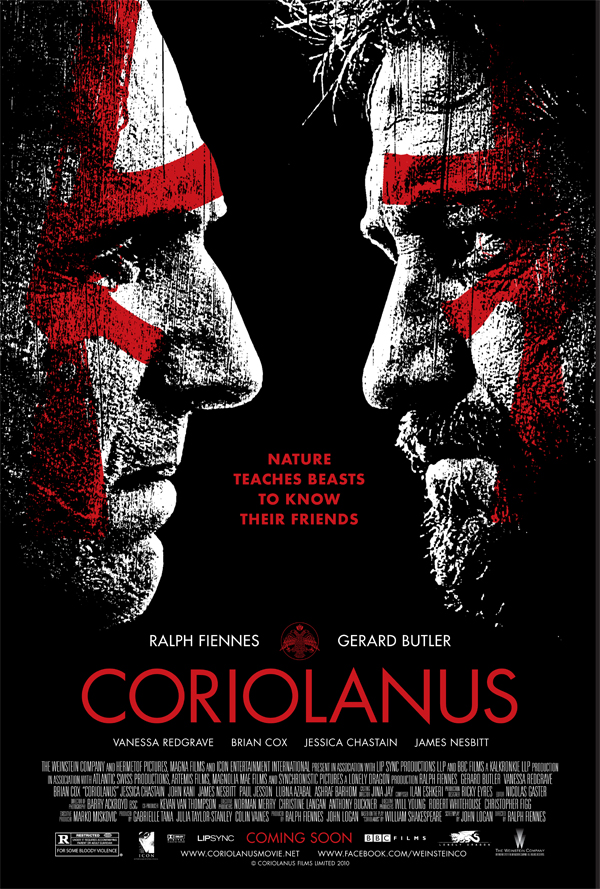 William Shakespeare’s little-known play has a surprising amount of cultural relevance: attacks on the border, suspension of civil liberties, political scheming, populist uprisings and riots, and a military elite arguing against the principles of appealing to the uneducated, mob-ruled masses. Plus Ralph Fiennes, taking on the hat of director for the first time, sets the play in modern-day. It seems like a struggle between Scotland and England, judging from the two mortal enemies, Coriolanus (Fiennes) and Tulius Aufidus (Gerard Butler). So it’s the Scotland/England struggle, termed ancient Rome, but set in what looks like the war-ravaged Balkans. Hey, at least Fiennes gets to have a nose in this film. The Shakespearean verbiage is certainly beautiful to hear, especially coming from the mouths of excellent thespians, notably Fiennes, Brian Cox, and Vanessa Redgrave. The actors achieve that synergetic level of excellence where it feels like they were always meant for the parts. Butler acquits himself well though his character sort of disappears unless needed by the plot. The elements that work best reside in Coriolanus’ refusal to play the game of political optics, neither serving a crowd of ignorant peasants he feels should remain out of the political process or the wily, double-crossing, self-serving politicians inflaming populist unrest. The movie sets itself up for some serious wrath to befall Rome, and besides the Greeks (and Koreans), nobody does revenge like this guy Shakespeare. We’re chomping at the bit for a cataclysm of death, but then the plot just sort of skips to a hasty conclusion, ditching the wrath. It makes you realize that, except for the intriguing title character, this isn’t one of the bard’s better plays. The characters are hard to empathize with, their conflicts too repetitive without deeper insight, and an ending that would be best described as a bit of a rush job. Still, even Shakespeare’s lesser work towers above most writers’ best material. Fiennes does a fine job as director, choosing lots of disorienting close-ups to communicate the rage of his character. Coriolanus is an interesting stab at something more, it’s just that sometimes it swings and misses.
Nate’s Grade: B
Share this:

The Smurfs (2011)
 What a smurfin’ terrible movie. This big screen debut for the little blue commune dwellers is a painful experience, magically transporting the little creatures to New York City. They find themselves in the care of Patrick (Neill Patrick Harris), an ad man who’s pretty much a jerk, especially to his doting, pregnant wife. At one point, in his ad man frenzy, he yells, “ I never wanted any little people running around here!” Oh no, what a bizarre outburst that somehow cuts directly to his fears of being a father. The movie spends so much time with the human characters, who are shrill, exasperating, and dull form the get-go. The comedy is a mixture of slapstick and insufferable kiddie wordplay, replacing “Smurf” for just about any word in a sentence for a miserable attempt at humor. It’s like the screenplay was a Mad Libs page (Am I being too generous crediting a whole page to the script?). The Smurfs is clearly designed for a 3D audience, hence there is crap flying at the screen at every turn. Yeah, another stupid thing thrown at the screen. Hank Azaria plays the thankless role of Gargemel, the man who created Smurfette (voiced, not too badly actually, by pop singer Katy Perry) but schemes to capture Smurfs for their… smurfness. I don’t know. If this guy could create his own Smurf, why doesn’t he just keep doing this? Instead, Azaria runs around New York speaking in an arch manner, falling down a lot. I suppose the real question is whether this piece of blue excrement could entertain children, its target audience. Perhaps the youngest of tykes will be tickled by the Smurf adventures, but I think most kids will be puzzled and bored and weirded out by the movie, wondering what they had done wrong to deserve watching this dreck.
Nate’s Grade: D
Share this:

11/11/11 (2011)
 Here’s a lesson for you. Not all elevens are the same. Case in point, the apocalyptic horror film 11/11/11, picking this eleven-friendly doomsday. That’s because there are two movies released in 2011 that have this exact same concept. The other movie was written and directed by Darren Lynn Bousman, the man behind three Saw films and Repo: The Genetic Opera. That one, actually released on 11/11/2011, has a bit more publicity to its numerological case. The only thing separating the two movies is their choice of numerical separation. You see there’s the direct-to-DVD 11/11/11 and the theatrically released, Bousman-directed 11-11-11. It’s dashes or slashes, folks. I’d have to imagine that the dashes movie is better than this, the slashes movie, just on Bousman. But then again, expecting a better movie from the guy behind the middle section of the Saw franchise might be asking for too much. Still, I’d have to assume that a blind monkey could make a movie better than 11/11/11, a horror movie that could only scare you with how bad it is.
The basic plot is that a family moves into a new home. Jack Vales (Jon Briddell) is teaching a college course, taking over for a professor who killed himself. The professor’s widow just happens to live next door, and she’s batty. Melissa (Erin Coker) has found out that she’s pregnant again. The town’s doctors are keeping her sedated an awful lot. Then there’s 10-year-old Nathan “Nat” (Hayden Byerly) who is turning eleven on November 11, 2011, and it seems like everybody wants to celebrate. The neighbor lady knows the truth: on that date (Veteran’s Day?) the gates of hell will open and Nat is the key. The boy must be stopped, though there is a whole nest of Satanists trying to arrange events so that Nat does bring about the end of the world as we know it.
 To call this movie low-rent is a disservice to grungy pornographers, exploitation peddlers, and inept amateur filmmakers. This movie is pathetic on just about every conceivable metric of filmmaking. First off, the premise is vague. We have this magical date looming, but what exactly happens? We’re told later that hell will open and maybe it’s the apocalypse or the rise of Satan or whatever. The kid, Nat, which by the way is the most annoying nick-name for somebody named Nathan (what was wrong with “Nate”?), is never made clear what role he will take. He’s the key to this whole deal but is Satan going to take over his body, as we see when he does some dastardly “no no” activities, or is Satan going to use him to release himself from hell? It’s never made clear, like much in the film, so the screenwriters make sure to cover their bases. Nat’s a demon child. Nat’s possessed. Nat’s scared of what’s under his bed. Nat’s mute. Nat can see into the future. Nat’s everything you need him to be. You’ll watch this movie constantly scratching your head, trying to get a feel for the rules or the boundaries of the narrative, grasping for nothing.
What you will be able to identify is the stupidity, which this movie has a never-ending supply of. Let’s tackle this numerological boogeyman thing head on. The shaky premise of 11/11/11 is that on that fated day the devil will rise up and… something. I’ll let the crazy old neighbor lady explain it best: “11 is God’s perfect number. One plus zero equals one [Editors note: Then shouldn’t one be the perfect number?]. Eleven is Satan’s number, it shows his arrogance, one more than God. Don’t you see? 11! Your son must die!” Well, I don’t need to hear anything else, pass the sacrificial blade this way. So I guess 666 just became passé and now 11 has become the new Satanic number of choice. Has anyone ever heard about this change? You know what, I’ll even go with this stupid idea. Let’s say what she said is true, so why does that mean that the year 2011 is the ultimate date of Armageddon? What about 1911, or 1811, or the first year 11 AD, or, God help us all, the year 1111? If eleven is Satan’s favorite integer then he missed a golden opportunity with that savory Middle Ages palindrome. Never mind the fact that our calendar is actually years off, but I’ll just assume that 11/11/11 takes place on its stated date even if people don’t know when that was. As a result of this numerological fanaticism, we’ll see lots and lots of clocks with some form of 11, like the very appearance of this number is meant to fashion fathomless dread. Oh no, the clock says it’s 11:40! Oh no, the clock says it’s 3:11! The clock face you dread the most is your own watch indicating that this movie is still not over. I thought we covered this numbers-are-evil nonsense with The Number 23. Once again, we have characters bending over backwards to try and make numbers fit into a pre-ordained pattern, supposedly enlightening us on all the spooky coincidences. So we have a character saying stuff like, “Flight 92 on September 11. 9 plus 2 equals 11.” Let me try: Wal-Mart has a special on PopTarts for $3.99. If you buy two, now 2 times 4 is 8, plus 10, divided by 8, times .5, and take the square root of who gives a shit?
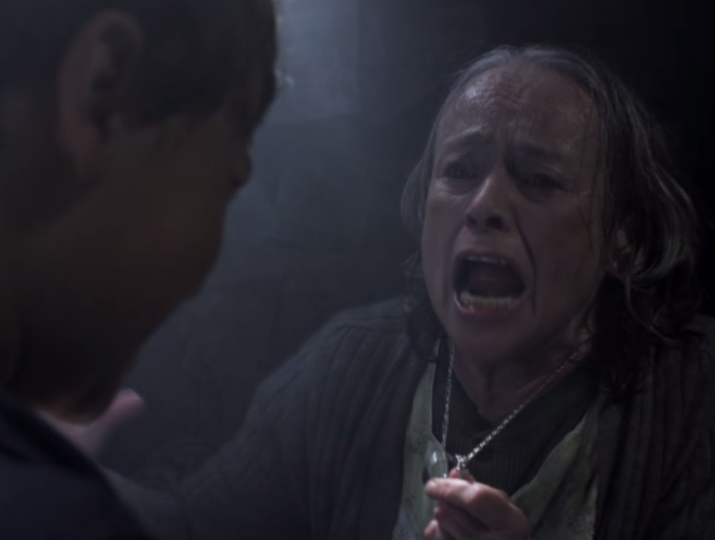 What else is stupid in this movie? Where do I start? The conspiracy of Satanists feels like a terrible rip-off of Rosemary’s Baby, as these people form the worst neighborhood watch imaginable. They’re scheming to get Nat to unlock the End of Days, so they all do their checking up on the Vales family and eliminate any neighbors who say too much. This cozy little neighborhood is replete with death, including the fact that the Vales home was the scene of a massacre. One skittish neighbor informs Jack and Melissa that somebody had an “accident” on the block. “Is he okay?” Melissa asks. “Well, he fell and got impaled on his fence. So, I’d say… no.” I kid you not, that’s his exact wording. This skittish neighbor is also murdered later. This band of secret Satanists includes the new Vales nanny, Denise (Aurelia Scheppers, looking like a poutier Denise Richards). This new nanny murdered the other prospective nannies, which is one way to move ahead of the competition. This nanny is bad news. She teaches Nat all sorts of bad behavior, from frying butterflies with glass to hurling rocks at joggers. And the dumb kid does it with glee, making me lose all interest in whether or not he is Satan’s seed/host/whatever. Then Denise gives the kid a birthday present – an old, spooky-looking comb. To demonstrate, in case Nat is unfamiliar with comb technology, she drags the teeth across her arm and draws blood. Then she gives it over to him to do the same. What? What kid is like, “Oh, wow, a way to ritualistically injure myself? That’s the best birthday present an eleven-year-old could want.” I’m pretty sure the kid would have liked an Xbox over a strange demonic comb. And wouldn’t you know it, this comb makes a return appearance when our Satanic neighborhood watch collects to conduct their business in, I kid you not, a station wagon parked on the side of the street. It’s literally a station wagon with eight or nine people crammed in it, and it’s there all hours of the day.
Then there’s our crazy neighbor lady, whose name I can’t even recall. The screenwriters want us to distrust her from the beginning, and that’s fairly easy when we see how weirdly creepy she’s behaving. She’s obsessed with luring young Nat into her shed, and she keeps offering promises of toy trains, glasses of (poison) lemonade, and promises of cool, fun things. If only she knew a comb was all it would take. This woman is trying to lure Nat with all the verve of a child molester. She’s frantic to kill Nat, even calling Jack at work to lecture him on the necessity of killing his son. Why does the Satanic neighborhood watch let this woman slide on by when they kill any other neighbor for the slightest slip-up? Anyway, this woman just so happens to have a machete in her shed and you can imagine what happens from there.
One more scene of ridiculousness, please indulge me. After Jack sees his son covered in bloody scratches, he accuses the nanny and has her arrested. In a scene of great hilarity for myself, we cut to a scene where the cop and nanny are already in the home, and Denise is dressed like she’s going out for a night on the town, and she’s twirling her hair in her fingertips. The image is so absurd. She gets arrested and thrown into the cop car. “You’re going to regret this,” she warns. Then, magically, wasps come out of a crevice in the side door and the car fills up with a swarm. The cop tries swatting them away and drives headfirst into a telephone pole. I need to note that the editing is so bad in this scene, cutting back and forth between the cop swatting and the car swerving, that the shots never match, so it seems like the longest reaction shots. The car crashes and mysteriously this has caused Denise to magically remove her handcuffs. She strolls out of the car, down the street, and then the car takes its cue and promptly explodes. If this wasn’t dumb enough, we then see different shots of characters around the block reacting to the explosion, heard over and over. One of the Satanic neighbors, still sitting in the damn station wagon, has adept hearing: “That must have been that cop car.” You see, her sense of hearing is so sharp that she can distinguish the make, model, and employability of the car via explosion. Just imagine how useful/useless she’d be in a Michael Bay movie.
 If 11/11/11 was just a supremely dumb movie it might work as camp, but it’s also inept as a scary movie. I don’t think director/co-writer Keith Allan could find an interesting looking shot if it held up a giant “11” sign. There is nothing scary about this movie whatsoever. All the shots of things with 11, it just doesn’t work, yet Allan keeps hitting it ad infinitum, mistakenly believing that while not effective on attempt 51, perhaps it will become effective on attempts 52-68. There’s a scene where Jack is standing watch at his son’s bed and the camera takes turns focusing on every stupid stuffed animal in the room, and Allan’s brilliant idea is to play a sound of the animal as we see its stuffed iteration. The stuffed bear is followed by a bear growl, etc. The fact that this series of animal noises continues for over a minute shows that Allan has no concept of what can scare or even what can entertain. His handling of actors is atrocious, as every single actor just bounces around the place, unmoored, unsure of what direction to take, so they take the wildest one. The actors are either monotone and flat or over-the-top, never believable for a second. Then there’s the “gotcha” ending which makes no sense considering Melissa is only three months pregnant and very much incapable of giving birth to a child, even if that unborn child is an unholy demonic terror.
11/11/11 is a date that will live in infamy, birthing this laughably awful, painfully ridiculous, atrociously inept movie, even by low-budget direct-to-DVD standards. The only entertainment you’ll find with this movie is the derisive sort, yukking it up over the unintended comedy bonanza that awaits. The movie is vague, silly, and overwhelmingly dumb, beholden to an inane numbers conspiracy that doesn’t hold up to scrutiny. I know my expectations should be kept at the minimum when dealing with this kind of movie, but that doesn’t mean I just ignore and excuse every artistic blunder, especially when I feel assaulted by them. 11/11/11 did bring on the apocalypse, and every audience member has left to go to a better place – the bathroom. Bousman should take some comfort knowing that the production house behind this movie, The Asylum, is somewhat notorious for rip-offs. I give you The Asylum releases: Battle of Los Angeles, Paranormal Entity, Transmoprhers, and The Day the Earth Stopped. 11/11/11 can hold one more numerical distinction: it’s the worst film of 2011.
Nate’s Grade: F


 nathanzoebl
You must be logged in to post a comment.