Category Archives: 2009 Movies
Observe & Report (2009)
 During the middle of a mean prank, a police officer walks out of hiding and says, “I thought this would be funny but it?s really just sad.” That’s my feelings with Observe and Report, the second mall cop comedy of 2009. Writer/director Jody Hill specializes in pained, awkward, tasteless humor, but with this it’s like he made a comedy and forgot to put jokes in it. The ongoing joke is how crazy a bipolar mall security guard named Ronnie (Seth Rogen) is, but it’s hard to laugh when he just keeps coming across as scary. Hill’s movie has more in common with Taxi Driver than other comedies. We follow one dangerous man with delusions of grandeur who has violent tendencies. The humor can be daring, off-putting, and extremely risqué, like a date rape joke where Anna Farris wakes up in the middle of the act and encourages Ronnie to continue. What is the point of all the provocative envelope pushing, in the end? Is Hill trying to lock his movie into a ready-made cult status? I enjoyed Hill’s TV show Eastbound & Down starring Danny McBride (who makes a cameo here as a crack dealer). That show succeeds with a blustery, unhinged, delusional lead character because we know the character is a vulnerable loser lashing out because he realizes he is a loser, we can empathize and eventually root for the brute. Rogen, often a chubby teddy bear in comedies like Knocked Up and Zack and Miri Make a Porno, is lashing out because he won’t stay on his meds. He’s too dim to even realize his lowly place in the universe, so his bluster and rude behavior is ultimately just repellent because it provides no insight to his character. And yet, after having said all that, the movie is consistently interesting, if you want to call it that, and goes in unforeseen directions. This is a challenging movie and the biggest challenge is to try liking it. Good luck.
Nate’s Grade: C
Share this:

Fame (2009)
 Was there anyone out there clamoring for a remake of the 1980 movie Fame? If so, was there anyone clamoring for a remake that drains all life and intensity and passion from the original, leaving behind a squeaky-clean, shallow, and dumbed down version perfect for teenagers? As we churn through Freshman Year to Senior Year, we will follow scads of teens (played unconvincingly by actors in their 20s) that aren’t worth our time. The movie is overproduced and utterly simplistic. Fame is a genuine waste of most of the talent on screen.
Apologies to the Fame theme song, but I was hard-pressed to remember anybody’s name even minutes after the movie ended. Literally, I was walking back to my car and for the life of me could not remember a single character’s name. This is because the movie crams about a dozen characters and gives little to no time to them for development. We don’t get scenes, more like snippets of scenes, snapshots compressing four years of life, and yet Fame also fails in displaying any maturation during that time period. I understand that the actors have to act like they?re plainly “acting” at the start, but the script doesn’t focus much on the rigorous training these kids undergo. Somehow in between one of the many fadeouts, the students are just better. Cutting to the chase makes for fine drama, don’t you think? Screenwriter Allison Burnett (Feast of Love) foolishly thought the audience would be more interested in watching the characters in sub-par soap opera dynamics rather than long moments of training talent. Inside the classrooms are expert teachers played by the likes of Kelsey Grammer, Bebe Neuwirth, Megan Mullally, and the stupendous Charles S. Dutton. We would all have been better served by spending more time at school.
 The structure works out to this: small character snippet, then song and dance number, small character snippet, then song and dance number. Repeat. But the movie’s fatal flaw is that it has no showstopper. This is a movie about forging talent, and yet the song-and-dance numbers feel uninspired. They look competently choreographed but there’s little to dazzle because the sequences are few, treated indifferently, and edited within an inch of their lives. We are rarely afforded the luxury of enjoying the dancing. At least the Step Up movies knew that the audience didn’t come for the story. The high points for the film include a Halloween party with some impressive stutter-stop gyrations (does the school have a production design class to make all those fancy costumes and sets?) and an improvisational jam in the school cafeteria. One kid lays down a beat, others join in adding texture to the jam session. Though I suppose the aspiring actors are left with little to do. This moment isn’t necessarily fully believable but it effectively communicates the creative energies that should be coursing through a school dedicated to performing arts.
I don’t care about any of these characters, mainly because these people are one-line descriptions of characters. These are cardboard cut-outs of characters, and they do a disservice to cardboard. Jenny (Kay Panabaker, looking like Ellen Page?s little sister) is the mousy girl-next-door who needs to come out of her shell. On the opposite end, Malik (Collins Pennie) is an angry street kid who needs to tap into his life experiences for acting power (Burnett also has to make sure the “street kid” character has a deadbeat dad and a little sister who was killed in a drive-by shooting). One girl’s entire story is that she wants to be a dancer and wouldn’t mind annoying her stuffy WASP parents. She invites her new Hispanic wannabe DJ boyfriend (Walter Perez) out to dinner. Cut to thirty minutes later ad she’s breaking up with him to tour with a dance company. It’s supposed to be a moment of drama but I defy anyone to care. Why should I care about this relationship or these characters when the movie doesn’t bother to care?
 The conflicts are usually contrived (oh no, the girl with the most talent in the rap group is told… she has the most talent), mostly involving grumpy, disapproving, fabulously wealthy parents. Denise (Naturi Naughton) is given both of these aforementioned conflicts. Her father demands she play piano, but she wants to sing, so how about she can play piano and sing? It hasn’t hurt Alicia Keys. In other instances, the conflict makes the characters annoyingly naïve, like when Jenny goes to the trailer of a sleazy soap actor to record an audition alone. When the characters do get a chance to speak their minds, well, you wish they would go back to dancing or singing. This also has to be the first time that Sesame Street is responsible for a student flunking out (an actor student gets a small-time gig on the long-running educational show and can’t keep her grades up at the same time).
Let’s face it, in the world of performing arts not everyone is on an even playing field of talent. The movie stumbles early during its montage of auditions, which provides some comic relief in watching the hopeless and untalented. Mostly, this audition process is a blur, but Fame loses serious credibility points when it reveals that some of the auditioning students who WERE the comic relief actually were accepted! How does that work? The movie wants me to make fun of a character for being bad and then the next minute the movie tells me that this applicant beat out thousands of other aspiring performers. I’m sorry, but that’s a credibility gap that Fame never recovers from.
For dancers and singers, it’s clear when they have talent, and it’s easy for a film to indulge. But what happens to the actors? Everyone in the movie is already an actor, per se, so when we get treated to supposedly revealing monologues, meant to display great acting talent, it comes across as unremarkable. The only time I have been blown away by a actor auditioning in a movie was when Naomi Watts just became a different person in 2001’s Mullholland Drive. It was sensational the way that she oozed sensuality and took control of her audition scene. Is it too much to ask that the actors who go through four years of intensive work in their chosen discipline be … better? But my biggest irk was the pseudo-filmmaker (Paul Iacono) who displays no discernible talent. His biggest creative break that we see is taping a drunken student poorly reciting NWA’s “Boys in the Hood” and then vomiting. But wait; being an auteur, he also uses split screens. I really hate it when movies involve amateur filmmakers because it always goes one of two ways, either 1) the movie overdoes it to the point of parody, or 2) the movie underplays the actual creative work, meaning that there is no foreseeable impression of talent. Why can’t amateur filmmakers ever be authentically good in movies? In Fame‘s case, I never saw anything that would justify this kid’s placement at such an esteemed performing arts school; and HE was one of the opening comic relief kids too. Is there a legacy program that they have to adhere to at this school or something?
 Now, Fame is rated PG but is it too much to ask for something a little edgier than another sanitized high school musical? For one thing, the movie dances around the subject of its would-be gay ballet dancer (Paul McGill) being gay. It’s implied in mannerism but that’s all the bait you get, folks. Any school that deals in theater, performing arts, dancing, and acting, well let’s just say that there?s more than one token homosexual. The original 1980 Fame dealt with sex, drugs, abortion, and the hardships of pushing your body to the limits for a dream. You don’t ever see these performers sweat. Instead, they sit around and spout bland “follow your dreams” platitudes.
The best moment in Fame is the end credits, and I don?t mean that to be disingenuous. During the end credits we roll through the various actors and they cut loose, dance, act goofy, and get an opportunity to be silly. And it is in those final moments where these people feel like people, where they have become unrestrained by the director and the screenplay. The movie itself is overly labored without having anything to show for it. The large amount of characters and quick jumps through time make it downright impossible to connect. Worst of all, the signature performance sections are few and lacking true style. This is a derivative, easily forgettable remake that doesn’t even know the right steps to be an entertaining movie.
Nate’s Grade: C
Share this:

9 (2009)
 9 began its life with acclaim. Director Shane Acker won a Student Academy Award and a 2004 Oscar nomination for Best Animated Short for his eleven-minute tale of post-apocalyptic ragdoll people. Blown up to feature length and with a screenplay by Pamela Pettler (Corpse Bride), 9 the film is being sold on the name appeal of producers Tim Burton and Timur Bekmambetov (director of Wanted). It’s being sold to gloomy animation aficionados. I can hear the producers saying, “These guys will see anything that?s dark and different.” I advise everyone to surf YouTube and watch the eleven-minute original short by Acker. You’ll save eight bucks and see the more effective and satisfying version of 9. If you wanted to boil 9 down, it’s like The Brave Little Toaster starring the villainous robots from The Matrix. Sound like a winner?
War machines have killed humans. The only life on our planet is a handful of numbered ragdoll creatures. The main hero, #9 (voiced by Elijah Wood), awakes in the home of a dead scientist. The outside world is demolished. He finds other little ragdoll people like him, each numbered 1-8. Together they must try and make sense of this scary new world and survive the roaming robots still on the hunt for… something. #9 accidentally gives life back to the monstrous Machine, who we learn is responsible for the downfall of mankind. Way to go, ragdoll. The Machine is patching together mechanical minions to take over the ashen remains of a post-apocalyptic world absent life. Seriously, I’m at a loss what the big evil Machine hopes to accomplish. Then again, maybe it’s just in need of a hobby.
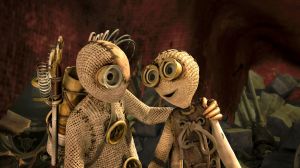 Even at a scant 79 minutes, 9 the movie still feels stretched and draggy, chiefly because the plot is lousy and the character work stopped at the design stage. I was bored throughout, I didn’t care about any character, and the movie failed to even arouse my curiosity to solve the mysteries of the movie. I didn’t even care if I found out why these ragdoll creatures existed or what had happened to leave the world in chaos. I sat in my chair, completely uninvolved with what was happening onscreen. Part of this is because a majority of the plot involves these tiny characters walking from one point (a church) to another (a factory) over and over again; the plot could be substituted by a linear line connecting Point A and Point B. It’s all so crushingly repetitious. And these are not short distances either, compounded by the fact that it’s little eight-inch ragdolls walking these great expanses of land. I invite every reader to position two fingers on their hand, index and middle, and then proceed to pretend to walk across. That, ladies and gentlemen, is the miniature plot of 9 magnified for your edification. Just imagine weird robots chasing after your fingers and you get the drill. There’s not enough story here to make the jump and fill out a feature film.
The characters have an interesting design, to be sure. Each has different sewn parts but Acker makes the mistake of animation where the design is the full personality of the character. #8 is a big dolt, #1 is an old tyrant, #6 is a loon (voiced by Crispin Glover, naturally), #7 is a lady rag doll warrior complete with some purposeful enhanced womanly hips, and so on. The bland characters don?t ever take a moment to ask more important questions. These creatures have just been given life in a hostile world absent of life, so how about a moment where they ponder something a bit existential (Why am I here? What is life?) before they immediately speak English fluently and assimilate perfectly in a world they were born into moments earlier? The characters are a challenge to feel any empathy for.
The mechanical monsters designs also come across as highly derivative; then again, so does the movie as a whole. The main villain, The Machine, looks exactly like the Sentinels from the Matrix movies. It has a central red glowing eye, a head lined with pistons, lots of twisty tentacles, and even creates shockwaves of electricity that seem to bathe over the mighty creature. I think it even makes a similar noise as the Sentinels. Then there’s also one mechanical minion whose key design feature is a mutilated doll head. Too bad I already saw this exact same design in Toy Story 14 years ago. Here’s the thing: I don’t automatically cry foul whenever a design concept looks familiar, but when things just keep hitting you in the face with familiarity then it develops into a pattern. The overall film feels stitched together by the parts of other, better movies.
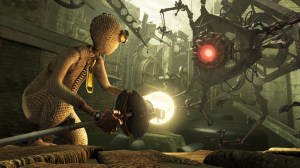 At least there’s a saving grace with bad animated films: you have something moderately interesting to watch considering the painstaking work that goes into every frame. That is not the case with the dreary 9. The entire landscape is post-apocalyptic, which means the sets are little more than ash, ruins, and barren remains. There are only so many scattered mechanical remains you can see before it all just starts resembling one vast junkyard. The setting is not 21st century, but more like mid twentieth in some unidentified Eastern European city (a film reel reveals that we’re in communist territory). I’m not saying that it’s impossible to find beauty in destruction, but this movie misses out. Acker and company has created a competently animated movie with a somewhat different look and feel, but there isn’t a single moment of wonder or awe to be had. It lacks an imaginative spark.
This animated tale lacks a sense of wonder, a sense of intrigue, even a sense of scale. The visuals and story are derivative of other sci-fi/fantasy films. In the original short, the characters were silent, causing the viewer to work harder at interpreting body language and context. If the ragdolls are just going to spout lame exposition gunk, they should have stayed silent. Director Rob Marshall’s upcoming big screen musical, Nine, need not worry about being confused with this film. In about two weeks, everyone except those with Hot Topic punch cards will have forgotten this mediocre movie. People who say, “It’s only an animated movie, give it a break,” are deluding themselves. No matter the genre, an audience should expect to be entertained. 9 just makes me hopeful that in the future Acker proves why he was targeted as a talent on the rise.
Nate’s Grade: C
Share this:

(500) Days of Summer (2009)
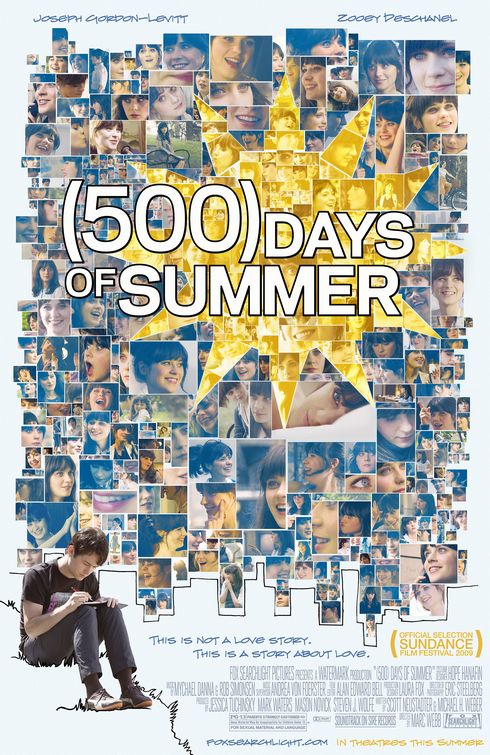
It doesn’t take long before you realize that (500) Days of Summer is a different kind of romantic comedy. In fact, to slap that genre title onto it does a disservice. I’ve watched plenty of romantic comedies (a notable rise in viewership since getting married in 2006), and the traditional Hollywood romantic comedy exists in a world not our own. It is a sitcom world where people blurt out their feelings, interact in bizarre manners, and get into wacky hijinks and contrived misunderstandings. These tales also exist in “movie world”; (500) Days of Summer, on the other hand, is refreshingly recognizable. Granted the characters still have fantastic if slightly off kilter jobs (writer of greeting cards), and the characters live in fabulous and gigantic apartments. Excusing those contextual quirks, the movie is upfront about its intention. “This is a story of boy meets girl,” a narrator intones, “but it is not a love story.”
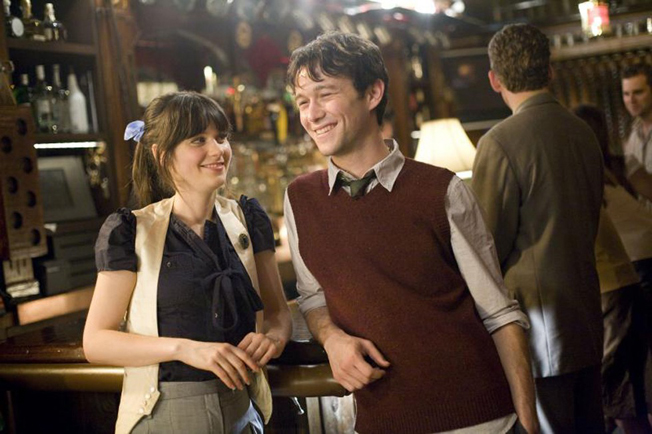
Tom (Joeseph Gordon-Levitt) recounts the 500 days he has spent with his ex-girlfriend, Summer (Zooey Deschanel), the girl he aches over because he feels her to be his “one.”
This is a movie about love and relationships but it has such a wider scope. It’s perceptive and insightful in the way that human beings engage in coupling. Tom ping-pongs between memories, tying together happy moments and the failed recapturing of those exact happy moments later. I enjoyed how reflexive the film can be with romance. When Tom is infatuated with Summer he lists her attributes: “I love her smile. I love her hair. I love her knees. I love how she licks her lips before she talks. I love her heart-shaped birthmark on her neck.” And then when he is frustrated with Summer, he lists her faults: “I hate her crooked teeth. I hate the way she smacks her lips. I hate her knobby knees. I hate that cockroach shape splotch on her neck.” I appreciate a movie that tries to tackle the complexities of love in a manner that doesn’t seem trite or sensational. A movie doesn’t have to say anything new about romance (is it even possible to scoop the Romantic poets?), but it can still say something true and revealing. It is a story about love, but not a love story.
 It also helps that the characters are meaty and are played by capable actors. Tom is a smart enough guy, though a bit of a foolish romantic. He buys into the love that is talked about in pop songs and greeting cards; he’s not naïve per se but plenty vulnerable enough to get his heart broken in the real world. Summer is an independent woman who says at the start that she is not looking for a boyfriend. She doesn’t wish to be constrained by a relationship and wants to enjoy the carefree days of youth. Yet Tom persists thinking he can wear her down or win her over, waiting for Summer to cave and find solace in Tom’s embrace. He fancies Summer as the “girl of his dreams,” though everyone else isn’t so sure. His little sister argues, “Just because she likes the same bizzaro crap you do doesn’t mean she’s your soul mate.” One of Tom’s friends has a really nice monologue describing his “perfect girl,” and these descriptions noticeably differ from that of his long-term high school sweetheart. But then he stops, reflects, and says that’s what his “perfect girl” would be like, but his current girlfriend, well, she’s better than his imaginary version of a perfect girl. But Summer isn’t a fantasy of romantic perfection, she’s a person. She has her own desires, her own insecurities, her own ambitions, and her own life to lead. These two feel like actual human beings and not stock players, though (500) Days of Summer does carry its own share of stock parts like the square boss (Clark Gregg) and the goofy, horny friend (Geoffrey Arend).
The saying “the camera loves” somebody seems outdated, old fashioned, and liberally applied. But when it comes to actress Zooey Deschanel, well, the camera just loves her. It’s hard not to fall in love with this blue-eyed beauty. She’s adorable, but not in an overly quirky way, and she’s smart, but still approachable, and altogether lovely. She is the face of unrequited love. She can be cold and aloof and jubilant. Deschanel plays the complications and complexities of an enigmatic woman who refuses to abide by labels. Her last conversation with Tom manages to be both crushing and inspirational. Her chemistry with Gordon-Levitt feels entirely naturalistic and pleasant. Gordon-Levitt has been cranking out strong performances in indie films like Brick, Mysterious Skin, and The Lookout. He’s quite possibly becoming one of the premier young actors working today. He has an everyman capability but he also can turn on the charm in a way that doesn’t seem forced, like Shia LaBeouf. Gordon-Levitt is the anchor of this movie and we see the world and Summer through his eyes. He brings great vulnerability to his role and we feel each step of his emotional journey. Both actors deliver terrific performances that don’t stoop to playing by the conventions of the romantic comedy.
 The nonlinear story structure seems like a gimmick until you realize that the writers, Scott Neustadter and Michael H. Weber, have cleverly freed themselves from the contrivances of movie romance time. MRT, for those who prefer their nomenclature in the shorthand, is that unbelievable breadth of time where the characters fall head over in heels in love with each other. It always feels so fast and far too fleeting, so that when complications have to arise late in the second act they too feel rushed. You could apply a healthy dose of montages to signify massive time passages, but those get old unless you’re Sylvester Stallone training to fight another boxing match. (500) Days of Summer tells you right away that this story takes place over a year and a half, and Day One isn’t when boy got girl but when boy met girl. By skipping around to specific dates, Neustadter and Weber are hitting only the highpoints, the memorable moments, and leaving out the unforeseen groundwork. All those mundane yet essential moments of pulling together a successful relationship are there, they are just now implicit. They are implied in the time jumps. The relationship between Tom and Summer, therefore, exists in an expanse of time that feels believable. The nonlinear structure also belies the way our memories work. Human beings don’t remember everything in a straight line, especially in matters of the heart.
There’s a lot of drama to be mined here with the breakup territory, but the movie is also playful and funny. Director Marc Webb, he of the video music world, pokes fun at other filmic expressions of love. At one point, Tom struts down the street and becomes the center of a lively choreographed dance sequence complete with animated blue birds. At another point, during Tom’s heartbreak, the movie descends through Bergman and Fellini visual tropes. It simultaneously communicates Tom’s emotional highs and lows and satirizes the histrionic nature of his feelings. Truly, when one’s in love you couldn’t feel better, or worse, but upon retrospect you can see how silly such in-the-heat-of-the-moment proclamations can be. There’s also a scene later in the film where Tom attends a party that Summer invited him to. The screen cuts in half, and on one side we see Tom’s expectations of what will happen that night and on the other side we see what actually occurs. The visual symmetry is interesting and a great glimpse inside the mind of a hopeful romantic.
 (500) Days of Summer manages to be breezy, moving, delightful, perceptive, charming, and just a great time at the movies. It’s a story about falling in love for the right reasons with the wrong girl. Summer isn’t the villain of the piece but her own woman, and she can be fickle and frustrating but she is not cruel or indifferent. Tom is desperately in search for his “one true love” but he’s playing by a checklist he’s drawn up from movies, TV, and love songs. All of this could have been sticky and formulaic (in fact, the dynamic vaguely resembles the characters from the abysmal Ugly Truth), but the filmmakers and the talented actors make the movie feel honest and relatable. The nonlinear narrative allows the movie to simultaneously be more playful, believable, and actually easier to understand, linking selective memories. No matter your current romantic situation, (500) Days of Summer is a slick antidote to Hollywood’s rom-com factory line.
Nate’s Grade: A
Share this:

New in Town (2009)
 Uninspired, slack, overly sentimental, deeply formulaic, the romantic comedy New in Town is so lazy it could have been written by a committee of trained chimps. This tired fish-out-of-water story takes a big city businesswoman (Renee Zellweger) and drops her in frigid small town Minnesota. Get ready for funny Fargo accents and dated stereotypes, doncha know. First the locals are ridiculed and then our big city gal discovers that these small town folk are to be envied. Just once, I’d like to see a Hollywood movie where a big city professional takes an extended jaunt in some Podunk town and discovers at the end… that small towns are overrated and they’ll take the big city any day. Sorry Sarah Palin, small towns do not have a monopoly on values and are not any more truly American than we city dwellers. Anyway, Zellweger looks like she’s in pain the whole time, then again that could be that natural contortion of her scrunched-up face. There’s a romance between her and the local union rep (Harry Connick Jr.), some lessons to be learned, and a late savior in the form of tapioca pudding. New in Town is moronic at most every step, and given the current wintry economic climate, a romantic comedy about downsizing feels like a bad joke in itself.
Nate’s Grade: C
Share this:

Inglourious Basterds (2009)
 Quentin Tarantino has always been an artist that thumbs his nose at convention. Just as critics accused his last film, Death Proof, as wallowing in exploitation muck, here comes Inglourious Basterds, very loosely based on the correctly spelled 1978 Italian movie. War movies seem like a natural fit for the QT mold with their staunch violence, tough guy bravado, and vengeance-filled storylines. Tarantino has been working on the script for this film for over ten years, taking a break to produce the Kill Bill features. The finished product is a bloody alternative history wish-fulfillment fantasy with little conscience. This isn’t any sentimental, well-meaning, reflective war movie. This is war Tarantino-style and a celebration of war movies in general. Cinema becomes the weapon we win the war with.
In 1944, Lt. Aldo Raine (Brad Pitt) is given a unique mission. He is to assemble and lead a crew of Jewish-American soldiers for one purpose — to kill Nazis. They will be dropped into German-occupied France and will use guerilla tactics to dismember Nazis and strike fear into the higher ranks. Aldo personally assigns each soldier with the task of collecting 100 Nazi scalps. “And I want my scalps,” he commands. The “basterds,” as they’re called, face steep opposition. S.S. Colonel Hans Landa (Christoph Waltz) has earned the nickname “Jew hunter” for his terrifying precision at sniffing out Jews hiding along the French countryside. In the film?s terrific opening sequence, he systematically interrogates a French farmer into giving up the Jews he is hiding. Shoshanna (Melanie Laurent) is a Jewish teenager who manages to miraculously escape this bloodbath.
Years later, she owns and operates a movie theater in Paris. The German high command wants to screen their newest propaganda masterpiece, Nation’s Pride about the exploits of sniper Fredrick Zoller (Daniel Brühl), in Shoshanna’s theater. Finally she can plot her vengeance, except that Landa will be providing security for the special screening. Meanwhile, Aldo and the basterds scheme to meet up with German actress Bridget von Hammersmark (Diane Kruger), who is secretly working with the British as a spy for Operation Kino. The top-secret mission involves attending the movie premier at Shoshanna’s theater and then killing all the high-ranking brass in attendance, thus ending the war.
 Those looking for a rip-roaring good time of watching Pitt prance through the countryside dispatching evil Nazis will be disappointed to learn that Inglourious Basterds is, after all, a Tarantino movie. That means there is talking. Lots of talking, but it’s great, glourious talking with deep undercurrents of menace. The movie boils down to about six set pieces and most of that time involves long, drawn out conversations where the tension percolates underneath the surface. The characters play a cat-and-mouse game of deception, and the conversation transforms into a slow fuse waiting to go off. The characters engage in an “I know, and you know I know” bout of play acting, going about their business as if all is calm, when each is waiting for the next move. Tarantino turns dialogue scenes into slow-burning combat, and eventually those lit fuses do finally go off and the scene will erupt in a great splash of violence. Then we are left to assess the situation and collect our bearings, much like the characters if they are fortunate enough to be alive. This is a talky war movie, and Tarantino does fall in love with his dialogue rhythms and allow his characters to overindulge and circle the same plot points more than is needed, like the sequence with von Hammersmark in the bar, but the naysayers looking for an action romp that complain nothing goes on are missing the point. A tremendous amount is going on, you just have to look beneath the surface, lie in wait, and luxuriate in the simmering tension that Tarantino plays like a pro.
Tarantino has an encyclopedic knowledge of film that allows him to blend and deconstruct genres, and Inglourious Basterds feels like an homage not to World War II but war movies in general, with a dash of spaghetti westerns. When the French farmer watches Landa drive up to his home, linked with the great Enrico Morricone’s score, you definitely feel like you’re in a western transported into mid-twentieth century Europe. The conversations feel like high-noon showdowns. Tarantino’s direction feels less stylized and idiosyncratic this time. He still plays around with time and back-story, even recruiting Samuel L. Jackson to be a God-like narrator, but Ingloruious Basterds is mostly a literal and linear pop deconstruction of war movies. When Tarantino deviates sharply from the known historical timeline, it feels within reason given the cracked mirror world he?s created. Tarantino can turn World War II into a campy Warner Brothers cartoon, replete with goofy over-the-top caricatures of Hitler and Goebbles. He can also takes digressions and hard right turns with his story, allowing characters to chew over the finer intricacies of German silent cinema. It’s bloody, messy, but boy is it entertaining as hell.
 Any conversation over Inglourious Basterds is inevitably going to gravitate to its fascinating central villain, Hans Landa. German actor Waltz plays the infamous “Jew Hunter” and he is astounding to watch; he enlivens every moment onscreen and won a Best Actor award at the Cannes Film Festival. Landa is an extremely intelligent and polite inquisitor. He comes across almost like a diabolical S.S. version of Colombo: he’s three steps ahead, feigns ignorance, circles his prey, and finally strikes after mentally tearing down the suspect. Waltz is practically giddy in some sequences, enthusiastic for such sick endeavors. He likes to screw with people and make them nervous. And yet, thanks to the wily brilliance and magnetism of Waltz, you develop a perverse appreciation for the man. Despite the horrors he is responsible for, you may actually find yourself liking Landa. He has moments of great cunning, like his deliberate reasons for switching to English with the French farmer or his off-the-cuff destruction of von Hammersmark’s alibi. When he suddenly and fluently launches into his fourth language, it is one of the film’s finest “oh crap” moments. This is a truly memorable character that dominates every scene, and Waltz gives an astounding star-making performance destined to be remembered when it comes time to draw Oscar nominees.
The rest of the actors do well but no one approaches the planet that Waltz resides on. Pitt seems to knowingly be shooting for parody with his performance. His accent is twangy and coats every word in a honeyed glaze; you almost expect him to wink at the camera after each line. He’s still amusing to behold in the rather few instances that Aldo graces the movie. Laurent (The Beat That My Heart Skipped) and Kruger (National Treasure) both have intriguing albeit underwritten roles, and both actresses give the best performances in the film after Waltz. Eli Roth (writer/director of Cabin Fever, one of my favorite movie indulgences) looks the part as the commanding “Bear Jew” with his lean physique and Louisville slugger, but I couldn’t tell what he was doing with his accent. Is he supposed to be from New York or Boston? In war movies, there was usually a colorful collection of characters but Inglourious Basterds doesn’t really do much to accentuate its second tier players. The only basterd that leaves an impression is Til Schweiger (Driven, Far Cry), all humorless resolve and flinty stares. And what happened to the basterds in the final act? Where did everybody go? Yes, that really is Mike Myers doing one of his Austin Powers-esque British impressions.
 What is truly surprising is that Basterds unflinchingly looks at all the ugly aspects of war. The movie doesn’t neatly categorize the villains and the heroes. Zoller is a German sniper that killed 300 Allied troops and yet he is portrayed as grounded and romantic, a film lover able to chip away at Shoshanna?s steely reserve. To the basterds, they refuse to see past the uniform and armband; there is no difference between a Nazi and a German soldier. They will mutilate both on principal. Tarantino also gives time to examining the collateral damage of war, watching innocents gunned down in the name of duty. Shoshanna’s plot for vengeance involves the horrific deaths of scads of people whose only sin may have been being German in Paris. Operation Kino is described by Landa as a “terrorist plot” and isn’t it, really? But then Aldo disputes that a “Nazi ain’t got no humanity” and that collaborators and bystanders are just as culpable. Aldo and his basterds march through France committing what could sensibly be described as war crimes, and these are the good guys! Even with all the camp and stylized violence, there may be moments where you want to cringe and ask yourself, “Am I supposed to be enjoying this??
There are those that bemoan that Tarantino is wasting away his remarkable talents on such low-rent enterprises. He is too caught up in genre filmmaking, they claim. He needs to go back to his earlier audacious works, like Reservoir Dogs and Pulp Fiction, films of startling intelligence and playfulness. He needs to stop making collages of movies and go back to making real movies, they cry. Ingloruious Basterds will not please these critics. This is a verbose deconstruction of war movies that runs over 150 minutes and mostly involves characters seated and chatting. It will clearly not be for everyone, especially those sold into thinking Basterds was going to be a more graphic version of The Dirty Dozen. This movie is more Cinema Paradiso than The Dirty Dozen. If Tarantino wants to keep making high-gloss genre goofs, that’s fine with me as long as the end results are as creative and entertaining as this movie. Who else is going to make a World War II fantasy with excellent use of David Bowie’s song “Cat People”? No one makes movies like Tarantino. I rest my case.
Nate’s Grade: A
Share this:

The Time Traveler’s Wife (2009)
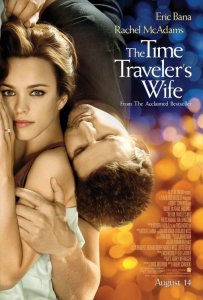 You think your romantic foibles are complicated? Based on Audrey Niffenegger’s best-selling novel, The Time Traveler’s Wife, we follow the life of Henry (Eric Bana), a librarian stricken with the unique genetic disorder of uncontrollable time travel. He first discovered this condition when he was six years old and disappeared out of his mother’s car, only to rematerialize and watch her die from afar. An older version of Henry happened to also be on hand and fill in his younger self on the details. Henry will randomly move backwards and forwards through time, and there’s nothing he can do to stop it. One of the side effects of spontaneous time travel is, naturally, nudity, as Henry travels in the buff a la the Terminator. So usually the first thing he must do when he winds up some place new is find some clothes. Henry seems destined to be a sad and lonely man, but then one day Clare (Rachel McAdams) enters his life, confessing that she’s known Henry for years and been waiting for this exact moment to arrive. She asserts herself and asks Henry for a dinner date that’s been in the works for some time. They fall in love, or fall further in love in Clare’s case, and try to make a relationship work despite Henry’s hiccups through time.
There’s a tenderness to the movie, though I found it tricky to fully engage in the characters. Much of the movie concerns the plot complications that befall such a strained and unique relationship. The flick gives new meaning to cold feet when Henry literally vanishes during his wedding, only to reappear as a mid-40s version of himself (hey makeup department, you couldn’t do more to effectively age Bana than add a dash of grey?). There is a great mind-bending section where Clare cheats (?) on Henry with… a younger version of himself. I was interested in the subdued proceedings and I felt underpinnings of empathy for Henry and Clare, but then my mind wandered into something a little darker and pessimistic. Now, The Time Traveler’s Wife is a polished traditional romance despite the sci-fi trappings but I started thinking about if what I was witnessing was actual romance? Henry first visits Clare as a child, telling her he will be her eventual husband. She falls in love with him in that moment and rejects all other suitors, knowing with absolute certainty that she will marry Henry. She just has to find him. And when adult Clare does meet Henry the librarian, he has never seen her before up to that point (it’s not as confusing as it may sound). She’s been waiting years to see his face again and she tells him that they are destined to get married. You see what’s at play here? The romantic plot is a loop where each character supplies the other’s conviction. Henry locked Clare into a life of looking for him and said they would marry, but then the adult Clare is the one who convinces Henry that they will indeed marry, and he tells young Clare this who will then convince Henry, etc. Is there any free will at play here, or is each partner in this relationship being manipulated by the certitude of the other? It’s sort of a metaphysical chicken/egg scenario.
 The best portion of the movie comes across during the second half when the movie focuses more on the emotional consequences of Henry’s condition. Early on Henry’s uncontrollable time traveling is played for laughs and some forced and somewhat trivial conflict (oh no, he missed another dinner!). Henry has a chilly relationship with his father (Arliss Howard) until, well, I’m not quite sure, but things improve. In the second half of The Time Traveler’s Wife, the drama gets more serious and intriguing when Clare and Henry attempt to conceive. Henry’s genetic disorder gets passed down to the baby fetuses, which means little babies are vanishing out of the womb and perishing before being zapped back inside. That’s a rather disturbing image and yet it is a thoughtful and plausible problem given the premise. As a result, Clare suffers through several traumatizing miscarriages. But they keep at it because Henry has seen his future lineage, also a time-traveler, and he knows that one of these pregnancies will go full term and become their eventual daughter, Alba (Tatum McCann). It was this storyline that stopped my mind from occasionally wandering and hooked my interest. Perhaps it’s cheap sentiment, but it’s hard not to feel for this loving couple when they endure pregnancies fraught with danger. The movie misses out on a dynamite dramatic opportunity with Alba. If I were adapting this to the screen, I would make sure to include Alba as a grown 30-something woman visiting her father on his deathbed, tearfully informing her dear dad on all the eventful moments that he won’t be around to experience. Picture an adult Alba talking about her own children to her dying father. There wouldn’t be a dry eye in the house. Hollywood, if you’d like to tack on an extra emotional ending to this movie, there’s still time. Call me.
It is here that I must address some key scenes that may pique curiosity. During Henry’s travels, he frequently visits the young child version of Clare. The first time Clare meets her future husband she is a little girl sitting in a meadow on the boundary of her family’s palatial estate. Henry, as he does every time he becomes unstuck through time, arrives in the nearby woods without a stitch on. Director Robert Swentke (Flightplan) and screenwriter Bruce Joel Rubin (an Oscar-winner for Ghost) work diligently to make sure the movie walks a very fine tone, and I confess that the scenes between loving child and naked time-traveling man escape creepy pedophilic overtones. Take that blurb for what you will in a romance: “Hey, no pedophilic overtones!”
 There are some other complications when it comes to this matter of unexpected time traveling. Firstly, the rules seem to be flexibly applied. At one point Henry is talking about how he cannot prevent his mother’s deadly car accident. The movie professed a destiny-entrenched approach to time travel, meaning every action you think you’re engaging out of free will was predetermined (the TV show Lost also subscribes to this theory). It cuts out time paradoxes. But then in another moment Henry uses his knowledge of the future to win the lottery. So which is it? Are the filmmakers trying to convince me that it was destiny for Henry and Clare to win the lottery, because I’m not buying it. Having a time-traveler for a boyfriend takes out some of the natural drama o relationships when one party can peak ahead. Relationships have danger and excitement and uncertainty to them, but when Henry can just matter-of-factly say, “We’re gonna be fine. We’re still together and in love fifteen years later, I saw it,” well it may make for good romance for some, but it makes for rather inert drama. How can you hope to win arguments? Naturally, the hefty book has been streamlined as much as possible for a mainstream moviegoing audience, which means that Henry’s scope of time traveling is scaled back. At one point he quantum leaps beyond his own lifetime, and because this has never happened before and is really only done to introduce a ticking death clock. I suppose there will always be inconsistencies when it comes to breaking the space-time continuum.
McAdams (The Notebook) is a great choice for the romantic center of the movie. She’s glassy-eyed and smiles so hard in her early sequences you think her dimples are going to explode off her cheery face. She is such a winning presence and her warm-hearted glow powers the character and the movie. Unfortunately, she doesn’t have very good chemistry with her onscreen mate. Henry is a victim of an existential cruel joke. Bana (Munich) is light-footed and makes Henry more than a space-time martyr. He’s somewhat amorphous as a character, a collection of niceties and genial, puppy-dog affection, which means that Henry is routinely upstaged by his genetic condition. However, when Henry faces the specter of his impending death is when the character gets a lot more attention and Bana is able to work his considerable talents. He gets ample opportunities to showcase his time-traveling buttocks. I don’t think too many women out there would be that put off if a naked Eric Bana magically materialized in their bedroom.
 The Time Traveler’s Wife is mildly reminiscent of The Lake House, and not just because of the time travel romantic complications. Deep down, these are traditional Hollywood romances with a fresh sci-fi coat of paint. The movie is best if you set the logic portion of your brain off so that inconsistencies and potential contrivances don’t distract from an intriguing story that presents some nice developments. There’s a tender love story here, though the characters don’t leave as much of an impression as they could have with such a plot-heavy romance. It finishes strongly and the mood throughout has a somber bittersweet quality, hammering home the “enjoy the time you have” message. McAdams is darling, Bana gets in the buff, their chemistry isn’t great, and the filmmakers refrain from the material getting overly sentimental or solipsistic. In a summer of relative disappointments, a tricky, clever approach at traditional romance is welcome amidst the explosions and wacky studio comedies.
Nate’s Grade: B
Share this:

G.I. Joe: Rise of Cobra (2009)
 While plenty stupid, the big-budget G.I. Joe movie is actually passably entertaining. Sure the characters are one-note, the motivations and romances are strained, the acting is abysmal, Dennis Quaid looks to be in particular pain, the plot has too many unneeded flashbacks, the special effects are cheesy, and the movie is crammed with deliberate toy merchandizing connections, but I had fun with this flick. Director Stephen Sommers (The Mummy) works the right kind of stupid, the loud noisy kind that manages to tickle a childlike sense of glee like watching an eight-year-old’s imagination blown up on screen. The scale of weapons and special vehicles and special suits and special ladies in special leather outfits for engaging in criminal activity should delight younger film goers. The action is frenetic (if there is a pane of glass within 100 miles, the movie assures that you will see it shatter) and the international collateral damage is colossal, so much so that G.I. Joe almost comes across as a goofy, straight-laced version of Team America. Certainly the benefactor of rock-bottom expectations, G.I. Joe: Rise of Cobra is a brash blast of acceptable action movie stupidity. Grab a big bag of popcorn, shut off your brain, and enjoy the film’s cartoonish yet entertaining qualities.
Nate’s Grade: C+
Share this:

He’s Just Not That Into You (2009)
 Based upon the best-selling nonfiction book, the movie follows the interconnected lives of a cadre of characters trying to get lucky in love. As with any ensemble piece, some storylines are better than others, notably Ginnifer Goodwin (HBO’s Big Love) as a naïve and hapless gal confused by the ever-changing rules and rituals of contemporary courtship. Her scenes with Justin Long, as her dating coach, are the movie’s high-point. The two actors have a light, charming chemistry and their scenes get at the heart of the male/female dating dysfunctionality without feeling trite. But in between, you get a lot of hackneyed yakking about the stereotypical differences between men and women, how dumb men are, how crazy women can be, etc. It’s all been covered to death by other romantic comedies to the point that it feels like common knowledge, which makes it tiring to sit through. Some of the drama feels overly manufactured, like Jennifer Aniston pushing to get married because she her little sister got engaged, there are characters that are just annoying people, like Kevin Connolly continuing to nip at the heels of Scarlett Johansson for some scraps, and Some of the material is weirdly dated, like Drew Barrymore talking about being “Myspace-ed” by a prospective date (Hello, it’s all Facebook all the time now). Naturally, it’s all rather predictable as well, however, this is not the fun date movie it may seem. It hits some rough dramatic patches, like the pains of infidelity, losing trust in a spouse, manipulating people, and occasionally there will be a moment that comes across as genuine and heartfelt, like when Ben Affleck wins over Aniston simply by being thoughtful and doing the dishes. It’s in these sporadic moments that He’s Just Not That Into You feels like it’s tapped something a little deeper and more meaningful than scraping the barrel of romantic comedy clichés.
Nate?s Grade: C+
Share this:

Moon (2009)
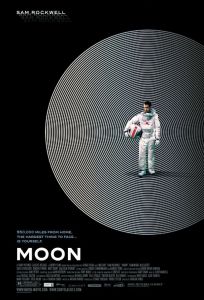 David Bowie’s son, Duncan Jones, directs two Sam Rockwells in this steely mood piece. Rockwell plays a lunar astronaut about to complete his three-year tour of duty when he finds another him. Is he hallucinating? Is this other Rockwell a clone? Who is the clone? The mystery unravels at a nice pace and Rockwell a pair of great performances, fully giving each character a different personality. Jones uses his small space to great use, multiplying the feeling of cabin fever more so than claustrophobia. Some will chafe that Moon doesn’t spell everything out, but the movie is smart enough to leave other things to the imagination. Moon tells a very specific, very select story and it does so with great economy that serves the story. This is Rockwell’s showcase and he carries the movie and nails the nervous breakdowns. For people let down by Hollywood’s slate of sci-fi duds, here is a satisfying small-scale sci-fi story told with intelligence and subtlety.
Nate’s Grade: B+


 nathanzoebl
You must be logged in to post a comment.