Category Archives: 2008 Movies
Deception (2008)
 Is there a more tired and pathetic genre of filmmaking than that of the erotic thriller? Deception is just about as lazy and bland as its title. The casting director got every role wrong. Ewan McGregor is an accounting nerd that befriends a swanky playboy (Hugh Jackman) and they accidentally switch phones. Of course this leads to people mistaking an accounting nerd for a swanky playboy, and McGregor is introduced to an underground web of anonymous sex (hasn’t anyone heard about Craig’s list?). I suppose the rich would rather take a chance on a stranger than have their handlers recruit some tail. Michelle Williams is completely wrong as the femme fatale who OF COURSE is in on the scheme. Deception plays out exactly as you could predict, and it even bears a somewhat strong resemblance to 2005’s Derailed, another mediocre thriller of little thrills. The chilly cinematography by Dante Spinotti is way too good for this kind of film. It seems that erotic thrillers have graduated from soft focus close-ups of copulating couples set to saxophone music to soft focus close-ups of copulating couples set to electronica beats. I suppose that’s progress for a genre defined by ridiculous plots, unrealistic characters acting like idiots, and, oh yeah, boobs.
Nate’s Grade: C
Share this:

The Sisterhood of the Traveling Pants 2 (2008)
 The ladies that inhabit The Sisterhood of the Traveling Pants 2 are not the same group of gals that charmed the pants off of me in the 2005 original film. This time the foursome is feeling some strain because they’ve all graduated and moved onto insanely ludicrous positions. Tibby (Amber Tamblyn) is making movies at NYU; Lena (Alexis Bledel) is studying art at the Rhode Island School of Design; Bridget (Blake Lively) is assisting with an archeological dig in Turkey; and Carmen (America Ferrera) is at the Brown theater department where she gets the lead in a summer production. Let’s face it, these are not the down-to-earth girls that were presented before. Was it too much to ask that one of the girls have a modestly plausible scenario? The drama is again split into two camps, the petty and comedic (Lena must choose between boyfriends, Carmen has to practice her lines) and the melodramatic (Bridget still has to deal with her mom’s suicide, Tibby has a pregnancy scare). The movie doesn’t work this go-round because every beat of the plot is wholly predictable (of course the guy Lena flirts with in art class will end up being the nude model), and much of the conflict is just inane. The characters act in stupid and contrived ways because the plot demands it. Sure the condom broke but can’t Tibby get the morning after pill at least? Sisterhood 2 also packs a baby birth, reunion between granddaughter and the grandmother she never knew existed, and a climactic trip to Greece for some serious girl power. It’s drama overload and lacks the notable sincerity of the first film.
Nate’s Grade: C
Share this:

Role Models (2008)
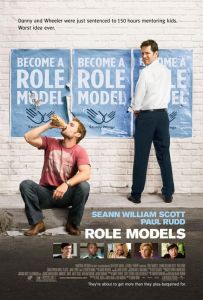 Is there an actor alive more charming than Paul Rudd? The always-affable actor has a terrific sarcastic yet lovable presence that never dips into being glib. Role Models is a great showcase for his sly comedic talents. The plot of irresponsible adults (Rudd, Sean William Scott) learning to be responsible by being big brothers to problem kids (Christopher Mintz-Plasse, Bobb’e J. Thompson) is mostly conventional, but it’s the character camaraderie that makes the movie special. Watching the cast interact is a great pleasure, and they constantly add sustained laughs that seem organic to the plot and the characters. I found myself laughing out loud steadily, and although the ending is a bit formulaic I was amused that film didn’t break character once. It goes for gusto when it comes to embracing the geekery and cheesiness of a climactic medieval battle. There are witty running gags, rewarding payoffs, and the film even packs some heart, though it never gets sentimental. Combine a wicked comedic turn by the daffy Jane Lynch and some added Elizabeth Banks sparkle, and it all adds up into what might be the most satisfying mainstream comedy in a non-Judd Apatow-directed year.
Nate’s Grade: B+
Share this:

Twilight (2008)
 It’s only been three years since the first book in the Twilight series was published, but man has it already become a phenomenon among young girls. Author Stephenie Meyer was a Mormon housewife who professed to never having seen an R-rated movie, so of course she seems like a natural fit for vampire literature. Meyer has taken the torch from Anne Rice and created an insanely popular series of books that chronicle the lives of humans and vampires in the rainy Northwest United States. I had never heard about the books until the spring of 2008, months before the hotly anticipated release of the fourth and final book in the series. Then again, I’m not a preteen girl, so excuse my ignorance. I decided to bear the hormonal, high-pitched squeals and sit with a packed house to experience the movie with the Twilight faithful. Judging from my screening, I think it might be mandatory for all girls between the ages of 7-14 to go see the Twilight film.
Bella Swan (Kristen Stewart, Into the Wild) is the new kid in school. She’s moved back to live with her father (Billy Burke), the sheriff of a tiny Washington town with a population of 3,000 people. Bella has her sights set on the Cullen family, a group of weird kids that are pale and keep to themselves. Edward Cullen (Robert Pattinson) goes out of his way to avoid Bella, and of course this just makes him more mysterious. He tells her that they shouldn’t be friends. Then one day at school he saves her life by stopping a van from crushing her. Bella suspects that this Cullen kid might not be a usual teenager. He’s not. He’s a vampire who hasn’t aged since 1918. Bella is smitten with her otherworldly protector. It’s your typical high school relationship. Bella doodles Edward’s name on her notebook and falls in love with an unattainable boy. Edward must resist the constant temptation to drink Bella’s blood (he and his vamp family are “vegetarians,” meaning they only drink animal blood).
 Let’s examine the distinctions of the Twilight vampire incarnation. Now, the vampire myth is not written in stone, so it allows for creative interpretation. Some vampires cast a reflection, others don’t. Some vampires are thwarted by garlic and crosses and others are not. Some vampires sleep in coffins and others just prefer a comfy mattress. It seems that the two characteristics that follow every vampire tale involve the insatiable thirst for blood to drink and the fact that sunlight is a vampire’s enemy. Meyer’s vampires don’t even adhere to this. They walk around in the daylight with no concern; in fact, we learn they never sleep at all, which means they must have all the late night infomercials memorized by this point. Removing the danger of daylight from the vampire myth proves to be somewhat troublesome decision. This is because, when you think about it, there are little to no drawbacks or limitations to being a vampire in Meyer’s world. Yeah you’ll live forever and crave an unorthodox beverage, but as a vamp you get super abilities, super strength, super speed, and a laughable diamond-like glow when the sun hits your exposed skin (think of those people that encase cell phones in tacky “bling” jewelry). If this is what it means to be a vampire in Meyer’s world then I wouldn’t be surprised if every freaking teenager in the world was signing up to join the army of the undead. The vampire myth brings with it plenty of baggage but it also helps to patch up holes in a narrative; just introducing the concept of a vampire allows an author some free pass with the details. However, vampire tales bring with them a certain set of expectations due to audience familiarity with the popular concept. I could care less if Meyer’s vampires have fangs or chow down on garlic bread, heavy on the garlic, but she loses me when she has vampires roam around during the day with little to no drawbacks. They just don’t feel like vampires. What they feel like are superheroes with skin conditions and a unique appetite. Which is fine, but don’t call it a traditional “vampire” flick.
I completely understand the enormous appeal of the Twilight series because it’s totally pre-teen wish fulfillment. I’m positive that the majority of the pre-teen readership projects themselves as Bella, the typical Every Girl. She encounters a sexy boy who ignores all the flashy and trashy girls and recognizes that special something in the Every Girl. In fact, he respects her and doesn’t want to be physical with her because he’s afraid of giving in to his urges (a rather obvious abstinence metaphor). He wants to love her forever and protect her. He has a dangerous bad boy angle but yet he’s still safe. In short, Edward Cullen is the idealized male for a nation of pre-teen girls who are just stepping into the world of boys (Bella also becomes an object of affection for no less than three boys at school). The Twilight tale even pulls a gender flip: the girl is pressuring the boy to give in to his carnal urges. And yet I can also understand why the books appeal to an older, mostly female, readership as well. If you remove the vampire angle from the story, it’s that old classic literary tale about a gal falling in love with the rebel, the boy who’s misunderstood. Hollywood has been making those sorts of love stories for decades, and so Meyer is able to tap into this classical romantic appeal.
 Twilight never delves too deeply into the dramatic dynamics of a 17-year-old girl dating a 90-year-old vampire. There are a lot of dramatic consequences drawn from dating somebody who cannot age. The Buffy the Vampire Slayer TV show explored the ins and outs of human-vampire relationships with wit and sincerity. Edward is forever seventeen but does that mean he still digs the high school girls? If you’re trapped in the body of a teenager does that mean you are still attracted to teenagers? If I were almost a century old I think I might seek out the comfort and conversation of a more mature woman, which is precisely the notion I’m sure the older female readership also fantasizes about (for all those guilty soccer moms, it doesn’t qualify as fantasizing an underage when he’s undead). Talking to teenagers for the rest of your life seems like a strange form of penance, as does repeatedly completing high school. Are the vampires just bored and attend school to pass the time? Don’t they know that TV was invented?
Twilight doesn’t have much of a plot to fill out a two-hour running time; the bulk of the movie consists of two characters feeling each other out. When the film does introduce an exterior threat (Cam Gigadet as a vamp obsessed with the hunt) it never feels that dangerous or fitting. The outside threat is saved for the very end and is easily dispatched, so the movie would have been better off without forcing a last-minute life-or-death dilemma into its love story. The love story itself doesn’t feel as properly nourished as it needed to be. The whole film experience feels like one long introduction and set-up, not so much an open-and-shut story.
Now, with all of that established, the Twilight film itself isn’t too bad. The movie is well made and certainly has a pulpy romantic vibe. The movie never feels overly burdened by excessive emotion or fake drama. It also follows a leisurely pace but never becomes dull. The actors are a big help. The leads don’t seem like they stepped out of a magazine photo spread; Stewart and Pattinson (Harry Potter and the Goblet of Fire) have a palpable chemistry that simmers throughout. Stewart is a terrific actress that embodies a typical teen, and Pattinson has the heartthrob glower down cold. I think there is rarely a scene where Edward isn’t glowering. Director Catherine Hardwicke (Thriteen) might as well provide onscreen instruction telling the audience when to swoon. Hardwicke is a filmmaker that doesn’t wallow in pretension, so she knows what kind of flick she has at her disposal. On the other hand, she is able to tamp down the inherent cheesiness that can go with a gooey supernatural love story. Twilight is able to work because it strikes the right balance between romance and silliness.
 Fans of Twilight should be delighted by the big screen adaptation of their favorite characters and heartthrobs. Sure the plot is a tad lightweight, the vampires might not be vampires as we traditionally understand them, the characters make giant leaps in their proclamations of love, and the outside conflict is a bit too poorly manufactured, but the movie has some bite. The movie isn’t moody, it isn’t too heavy, and it can come across as entertaining, though I’m at a loss to explain its extraordinary popularity. Now that Hardwicke and company have established the Twilight inhabitants, I hope the inevitable future installments will be better at providing resonating story and characters. If you doubt the certainty of sequels, need I remind you yet again that it is mandatory for girls age 7-14 to see this movie. The Twilight phenom has yet to reach its peak. Get used to it. It’s only a matter of time before Hollywood starts cranking out the Twilight knock-offs. Then, perhaps, I will join the armada of pre-teen girls and shriek wildly.
Nate’s Grade: B-
Share this:

Young @ Heart (2008)
 Old people and rock and roll seem like contradictory terms. It’s easier to imagine a 70-something grandma listening to the soothing tunes of Lawrence Welk or the Andrews Sisters than the likes of Sonic Youth and The Clash. Young @ Heart is a documentary that follows a unique chorus made completely of senior citizens (the youngest member is 72) who travel the country singing contemporary rock songs. Now, bear witness to great-grandmothers rocking at a reasonable hour and partying on days where they take their meds.
Once old people reach a certain aged age they fall into the same category as children, and by that I mean you can position them to do anything out of the ordinary and it suddenly becomes adorable. Seeing a baby wear a top hat? Cute. Seeing an old person dance to a modern rock song? Cute. I don’t make the rules, folks, but the end of life and the beginning of life have much in common, which includes the universal appeal of young and old doing things unlikely for their age. So, yes, Young @ Heart has a steady supply of adorable moments, especially as you watch how joyous many of the members are when they practice. Many members of the chorus have severe medical ailments and profess that participating and singing has medicinal benefits. They feel young and energized, and sometimes the members will defy doctor’s orders to attend. It is clear how much singing can mean to these people, and watching them come alive is undeniably heartwarming, but it’s downright moving when the Young at Heart chorus branch out. They perform at a prison and literally bring incarcerated prisoners to tears. I’ll admit that I was fighting back tears myself during the stirring performance of Coldplay’s “Fix You,” which is given a somewhat profound new meaning. The lyrics, “Lights will guide you home,” and “When you lose someone you can’t replace,” are given more relevance when sung by octogenarians who have all experienced recent loss amongst their ranks.
 With such a naturally intriguing premise, it’s a shame then that director Stephen Walker doesn’t do more with the material. In many ways, Young @ Heart is a rather ordinary documentary that forgoes several opportunities to dig deeper. The interviews are rather basic and rarely penetrating, and the narrative structure of practicing for the big show means that the concluding fifteen minutes will be locked into being the performance. Walker narrates the movie and often inserts himself into the film because it seems like he wants to be part of the fun. Documentaries can succeed from objective and subjective point of views, but I get frustrated when people like Walker don’t want to merely tell the story but piggyback so they are part of the story. It smacks me of narcissism.
I think there was a stronger dramatic dynamic with Young @ Heart than what Walker captures, and I think he misses this because he had lowered ambitions for the film simply to document the seven-week period of practice. Every now and then you’ll discover a moment that points to what Young @ Heart had the potential to become, but Walker’s intention is more along the lines at gushing at what geezers can do. I get that Walker feels affection for his subjects but couldn’t he have gone further than the old-people-sing-young-people-songs gimmick? Some times the film feels like it has as much depth as a prototypical behind-the-scenes featurette on a DVD.
Walker evenly divides the film between performances and interviews and he also doesn’t overdose on the pathos even after deaths hit the Young at Heart clan. The movie has several music videos where the old folks sing to songs like “Golden Years,” “I Wanna Be Sedated,” and “Stayin’ Alive.” As you can see, each song is given something of a twist. However, the music videos come across as cheesy and unnecessary since seeing the performers live would be more interesting and real. Including several music videos, of songs that we never see the chorus practice no less, seems like wasted time that could have been spent getting to know our cast of characters better. I’d rather better know them as people than laugh and giggle at them performing The Bee Gees at a bowling alley.
 There are some chorus members that separate from the pack like 92-year-old Eileen Hall who used to be a burlesque dancer many moons ago. She’s the oldest in the film and yet in many ways has the most indomitable spirit, frequently cracking jokes and making suggestive statements that Walker deems to be “flirting.” Fred Knittle is a man who was told he’d have two years to live after suffering his latest heart attack. By the time he rejoins the chorus he’s at two years and four months and running. He ably steps into the solo spot to sing “Fix You” after the original singer passes away. The moment is so pure and emotional that it reminds you about the power of music in a non-saccharine way. One of the more interesting figures in the film is Bob Cilman, the music director of the Young at Heart chorus. Here is a man in his 50s teaching contemporary rock songs to the elderly, and yet the film never explores this man and his infinite patience. What are his reasons for doing the Young at Heart chorus? What does he think about his own life’s purpose? The movie would have strongly benefited by spending more time exploring the life of this man and his unique mission. I want to know what makes him tick.
My faults with the film do not fall upon the subjects. This batch of senior citizen rockers is a delightful group and watching them perform can be entertaining and occasionally inspiring. However, I cannot fully recommend it because its scope and interests are far too narrow given the subject matter. Director Walker would rather treat his senior subjects like they were posing for a calendar in adorable poses, and I’m glad he has such warm affection for these lively octogenarians. But his affection clouds his filmmaking judgment and Walker ignores plenty of palpable drama. The concluding concert will certainly produce smiles and some toe tapping, but this drama could have been so much more. I can honestly say that, beyond the communal experience, there is no reason to catch this movie in a theater. It will play the same on your TV screen. If only Walker had listened a little harder to his older subjects then maybe he would have realized that true wisdom does not come merely from a cute gimmick.
Nate’s Grade: C+
Share this:

The Other Boleyn Girl (2008)
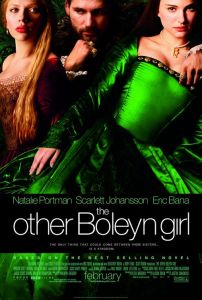 The story of Henry the Eighth and his many wives is a tale full of romance, danger, betrayal, and sweeping historical changes; it’s the most popular soap opera of its age. The 700-page book was naturally going to get slimmed down as a feature film, and The Other Boleyn Girl feels a bit too streamlined for all the heavy historical events that take place. The production values are all top-notch and the story has some juicy moments. It presents an intriguing angle by showcasing the conniving rivalry between the Boleyn sisters (Scarlett Johansson, Natalie Portman). The acting falls under that period film gravity where the actors all speak stately and enunciate every syllable slowly, like they were testing out the sound for the first time. Portman is especially fun in a villainous role. Eric Bana is completely at odds with history as Henry VIII, but I suppose it would be harder for modern audiences to accept young nubile ladies vying for the affection of a huge, ugly man with a leg of mutton in his grip.
Nate’s Grade: B
Share this:

Baby Mama (2008)
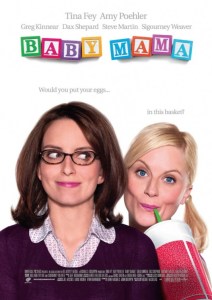 2008 is becoming a year dominated by Tina Fey. She won three Emmys for her Best Comedy TV series 30 Rock, including writing and acting, and her dead-on portrayal of vice presidential candidate Sarah Palin has branded the public perception of this political figure. Baby Mama is a mildly entertaining comedy that works because of the finely honed chemistry between Fey and her former Saturday Night Live co-star, Amy Poehler. The movie is at its best when these two women can play off one another. The banter isn’t laugh-out-loud funny but provokes plenty of smiles and chuckles. The movie goes in an unforeseen direction in the third act that attempts to raise the stakes through drama, but it feels like a disappointing direction for what is essentially a female buddy comedy. The jokes flow at a steady pace and the movie has a great supporting cast of big names that know how to leave their mark, like Steve Martin as a daffy New Age CEO and Sigourney Weaver as a amazingly fertile boss.
Nate’s Grade: B
Share this:

Fool’s Gold (2008)
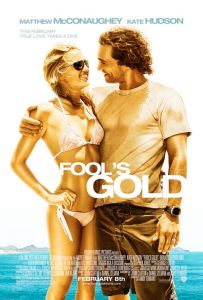 This may be the most boring film about treasure hunting I’ve seen in a long time. Clearly the filmmakers were intending to strike the comic/romance/adventure balance of Romancing the Stone, but boy does this flick flounder. It progresses but it never builds any sense of momentum; Fool’s Gold works almost entirely in lateral moves so no scene feels any more important than the other. It’s like the film succumbed to Matthew McConaughey’s foggy, stoner spirit and decides to just shrug its shoulders through gunfights and explosions. The characters are grotesquely annoying and yet the supporting characters keep elbowing into what should be a combative romance between Kate Hudson and McConaughey. It’s like the filmmakers thought exotic locations, sunny skies, and extremely tan lead actors would take care of the rest. Nothing in this movie ever crosses over into intentional comedy. The treasure angle is so contrived that it requires extensive sit-downs to just go over the convoluted exposition. Fool’s Gold is an empty-headed errand that takes far too long to go absolutely nowhere. For goodness sake, the movie has a puffy Malcolm-Jamal Warner (Theo from The Cosby Show) as a dreadlocked Caribbean gangster. You tell me if you think that sounds like a good idea.
Nate’s Grade: C-
Share this:

Harold and Kumar Escape from Guantanamo Bay (2008)
 I was a big fan of the first outing to White Castle, a crude stoner comedy that also happened to be clever in its outrageousness. The Harold and Kumar sequel returns the same writers but what the hell happened? The first film separated itself from its class of juvenile jokesters because it had charm and wit, but this mediocre movie just stumbles from one uninspired comedic setup to another. The boys get mistaken for terrorists and then the movie becomes a ramshackle road trip through America. The gags are lame and easily telegraphed. Regrettably, many jokes are reheated from the first film, like Kumar’s fantasies involving an anthropomorphic living bag of weed. The presence of the hysterically gifted Neil Patrick Harris gives the film a boost but even NPH cannot save these less-than-stellar shenanigans. The comic set pieces don’t add up together into something greater, and the only scene worth remembering is when the boys smoke weed with President Bush. You know you’re in bad shape when even the gratuitous nudity feels tacky and boring.
Nate’s Grade: C
Share this:

Zack and Miri Make a Porno (2008)
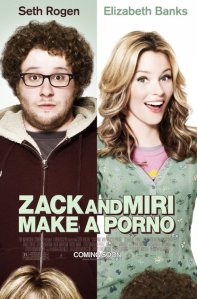 It’s amazing how integrated pornography has become in our culture. Merely a few decades ago people had to wear disguises to venture out to a ratty theater to watch an adult movie alongside plenty of folks in raincoats helping to add to the sticky floors. Nowadays releasing a sex tape is considered a career boost. Porn stars have replaced supermodels as rock star arm candy, porn has become more socially acceptable, and a wealth of bizarre and explicit possibilities exist just a few keystrokes away. In the end, it’s all fantasy with bad acting.
And yet Kevin Smith’s newest comedy, Zack and Miri Make a Porno, got in trouble with advertisers because of people getting in a tizzy over the goofy word “porno.” Major League Baseball was told that a father was uncomfortably asked by his son what a “porno” was after seeing a commercial during a ball game. Heaven forbid our nation’s parents have to deal with an uncomfortable subject, so baseball banned any ads for the movie. Many newspapers nationwide have refused to list the full title. The original poster was deemed too inappropriate so Smith and crew devised a poster of stick figures. Poster version 2.0 then came under fire for being attractive to children because of the stick figure art. It seems Zack and Miri is getting it at both ends (no pun intended).
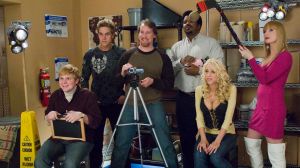
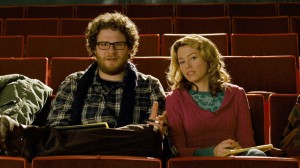 Times are tough for lifelong friends Zack (Seth Rogen) and Miri (Elizabeth Banks). They’re scrambling to pay their bills and keep the electricity in their apartment during a chilly winter in Pennsylvania. Inspired by a conversation with a chatty gay porn star (Justin Long) at their tenth year high school reunion, Zack believes amateur porn can solve their money woes. The two will make their own porn video and sell it to the alumni list from their graduating class, who, Zack rationalizes, would buy a porn if they knew someone involved. Zack convinces his coffee shop co-worker Delaney (Craig Robinson) to help fund the project. Delaney agrees as long as he can have a say in casting; after many years of marriage he is eager to see something new. The team also recruits a squeaky-voiced stripper (current porn starlet Katie Morgan), an old bachelor party performer (former porn starlet Traci Lords), a cameraman (Jeff Anderson), and a man free from any inhibition (Jason Mewes). But Zack and Miri must confront their unspoken feelings for one another as they approach their own sex scene. Can they go from platonic friends to lovers?
Being a Smith film, naturally Zack and Miri is outrageous and often hysterical. The film manages to become witty and dirty at the same time, often stringing together vulgarities in exciting and imaginative ways (the curious “Dutch Rudder” as a means of escaping being deemed gay). Smith has a love of the profane. The movie is vulgar like most Smith movies but the beauty of its filth is in the sparkling, rapid-fire dialogue that adds eloquence to the scatological. This is Smith’s comedic brand, the verbose dirty joke. As in other Smith comedies, the true humor is not found in set pieces and set-ups but in the everyday camaraderie of the cast and through casual conversations. Smith writes characters that you just want to listen to for hours. Zack and Miri does have some funny moments that are specific to the production of randy moviemaking, like an unforgettable de-clogging that “frosts” a cameraman. The joke is swift. However, akin to the Judd Apatow brand of comedy, this is a movie where the charm is watching the characters interact, regardless of setting. I do think the movie unfortunately missed plenty of other potential gags on the silly minutia of homemade pornography. How about the crazy duties for a sound design? Imagine a guy trying to recreate the many weird bodily sounds during sex. I’m mildly shocked that Smith didn’t even touch the vagaries of pubic hair style.
 What the movie does nicely is dwell upon the distinction between love and sex. Now I’m not conveniently forgetting the thousands of movies that have come before and dealt with the topic of intimacy and carnality, but Zack and Miri goes into the nuts and bolts (no pun intended) of an industry that has turned intimacy into a mass-market business model. Zack and Miri stress out about their Big Scene and try to convince themselves that it won’t mean anything, but of course their body language betrays them. The actual deed is an obvious turning point for the twosome and count this as one sex scene that is actually, well, emotionally climactic and, yes, sexy. Though the camera only stays at shoulder-length and alternates between two angles, the actors convincingly convey an array of genuine feelings, notably love. It’s not easy for an actor to display honest-to-goodness love, but Banks and Rogen achieve this feat. The aftermath of their onscreen coupling extends into a seemingly unnecessary third act that divides them apart in a contrived fashion. Seriously, the typical third act misunderstanding in standard romantic comedy fluff is alive and well in a Smith vehicle. The characters do not react to this misunderstanding in a realistic manner; one character would rather be sequestered than easily prove their innocence.
While Zack and Miri has plenty of laughs and a nice, mushy center, I cannot help but feel mixed about the results. The characters are not nearly as sharply drawn as they have been in other Apatow comedies, even other Kevin Smith movies. I can go back and remember the multiple dimensions of the funny people that populated Superbad, Sarah Marshall, 40-Year Old Virgin and others, but Kevin Smith’s latest comedy suffers in comparison. Zack and Miri are the only characters with moderate sums of characterization, and yet their unspoken love is essentially the bulk of that. Neither character is well defined or explored in a substantial way that doesn’t involve the other. I get that the movie is a romance. But I expect more from characters than to be defined by whom they desire. I just wanted more. Yes Zack is a slacker who says he’s just looking for a good time, though we know he has his sights set on more, and yes Miri is a gorgeous gal with a lot of patience, but these characters are staples of Kevin Smith movies. The assorted side characters have fun moments but are mostly insignificant. There’s the stripper with a heart of gold, the been-around-the-block type, the henpecked husband, the secret freak behind the button-down exterior, the loudmouth, and the sex-crazed dude. Zack and Miri establishes the idea of filmmaking as a community by introducing this lot, but the movie then forgets to incorporate the supporting characters in meaningful ways. They’re mostly used for jokes that fail to extend beyond the immediate. A late scene involving Delaney’s angry wife (Tisha Campbell-Martin) relies on too many grating “white boy” japes that I tuned out. I’m not intending to slam Smith’s film, but the lack of character work hampers the audience investment in the central romance.
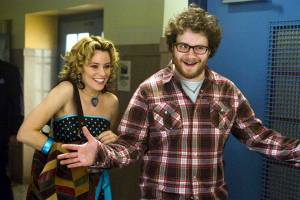 What is lacking on paper is nearly compensated by the great performances from Rogen and Banks. Both are on loan from the Apatow comedy company, and both are skilled at being raunchy one second and heartfelt the next. Rogen finds his comic groove easily and is an enjoyable schmo that taps hidden ambition in the most unlikely of scenarios. It really is Banks who comes across as the star of the flick. She can talk trash with the boys but she is radiant during the film’s dramatic moments, selling Miri’s emotional highs and lows with crinkling smiles and fluttering eyelashes. Banks has always been a solid actress underutilized by most of her marginal film roles. With Zack and Miri, Banks showcases a devilish comedic gleam. Of course yet again the audience must believe that a beautiful gal with a beaming smile would be down on her luck finding a good guy.
In the end (no pun intended), Zack and Miri Make a Porno is a crude romantic comedy that might have benefited by more attention spent on the romance or the comedy. The tone never breaks as sharply as with Chasing Amy, arguably still Smith’s finest accomplishment, but the dirty humor and the gooey romance have a hard time expanding because of the presence of each other. Too often the ribald humor doesn’t feel fully realized because the dirty jokes are just window dressing for the romance, and I had trouble fully engaging with the romance because the characters haven’t been rendered to have substantial depth. Smith may have been better served by making his movie longer; the film is barely an hour and 40 minutes long. Zack and Miri Make a Porno is a sweet movie with a dirty mind but it does not measure up to recent comedies like the best of Apatow’s brand. Smith is a talented wordsmith who certainly knows how to make an entertaining comedy, and Zack and Miri certainly entertains, but like pornography, it just made me want something more fleshed-out and real (no pun intended).
Nate’s Grade: B-


 nathanzoebl
You must be logged in to post a comment.