Category Archives: 2007 Movies
Dan in Real Life (2007)
 What is it about advice columnists that make filmmakers want to turn their lives upside down? I suppose there’s some karmic twist seeing someone who instructs others fall on their face when it comes to living their own life. I can readily think of several movies, mostly in the romantic comedy and sentimental weepie genre, that all involve an advice columnist who has their life torn asunder by fate. I suppose the extra dose of irony seems less cruel when dished out to someone who, supposedly, has all the answers. Dan in Real Life is an observant and enjoyable movie that centers on the stumbles and joys of the life of cinema’s favorite whipping boy.
Dan (Steve Carell) is an advice columnist raising three daughters on his own. His wife died years ago from an undisclosed illness and ever since he has been trying his darndest to be the best, if not slightly overprotective, dad. His oldest (Alison Pill) is eager for the car keys, his middle daughter (Brittany Robertson) is defiantly insistent upon her undying love for a boy, and his youngest (Marlene Lawston) is the kind of tyke that provides sage wisdom in time of need, usually at the very end of the movie. The lot of them head out to the family home along the Rhode Island coast to spend the week with the extended brood. Dan sleeps in the laundry room, is hated by his spiteful daughters, and forced into a blind date thanks to his concerned parents (John Mahoney, Dianne Wiest).
 While Dan is out trying to decompress he stumbled across Marie (Juliette Binoche) in a bookstore. They spend hours talking, well Dan does, and suddenly the rain cloud over his head seems destined to fade. He stammers to tell his family the good news when he discovers that his brother, Mitch (Dane Cook), has brought his new girlfriend to meet the folks and it’s, surprise, Marie. Dan respects his brother and tries to control his feelings of desire but still cannot help but flirt and pine for Marie, who is all too aware of the under the radar advancements.
I’m actually somewhat amazed at how well Dan in Real Life plays out in real life. The idea of a big family get-together as a source of comedy has been done to death, and this clan exists in an exaggerated world popularized by movies where families have spirited games of charades, robust sing-a-longs, and then perform a talent show complete with decorative furnishing. The family’s emphasis on togetherness plays out in expected wacky scenarios that would be regularly seen on TV sitcoms, but it is refreshing that an entire film based around an annual family reunion instills no fraternal bickering or bitterness. That’s got to be something new, and again, potentially a pure product of the cinema. Dan in Real Life has familiar staples and walks some dangerously sappy territory but the film manages to surprise and amuse because it all comes back to being character-centered. There’s a great scene where Dan is hiding in a shower and Marie is forced, in order to maintain the rouse, to step naked into the shower with him. Dan is thrown into some contrived situations, like the shower scene, but it is his wounded, deferential sensibilities that save him and also save the film from movie-of-the-week trappings.
Director/co-writer Peter Hedges (Pieces of April) knows how much anguish Dan can suffer before pulling back, and it gets to a point where Dan starts to seem like a comic Job (that might be redundant). Of course, like most sitcoms, lessons will be learned and wisdom will be doled out thanks to full and honest communication, and Dan in Real Life is no different in that regard. There’s a level of believability to the film that helps ground it even during the familiar sitcom moments, like the late rush to testify one’s feelings of true love.
 Carell isn’t a stranger to drama or comedy with some painful underpinnings to it, just look at his work in Little Miss Sunshine or the brilliant awkwardness of TV’s The Office. He’s very effective at communicating the exhausting exasperation of raising a trio of feisty females. There are some tender moments and Carell plays them well. He just has a physically natural look of sad befuddlement with his droopy yet piercing eyes and those bushy brows, so he knowingly underplays broad expressions and gestures and this works exceedingly well with the film’s un-sensational tone. When Dan does unleash the wilder, sillier side it’s usually a culmination of his pent up feelings; being denied happiness that appears within reach. He is a quietly becoming unwound as he tries to squash the feelings he doesn’t want to extinguish.
Binoche is a famous French actress who has an Oscar to boot, but she is simply radiant in this film and makes her character a prize worth perusing. She has an adorable sense of displacement and she and Carell exhibit a nice chemistry. Even in the tight timeframe, both the plot (3 days) and the film’s running length (93 minutes), Binoche manages to make us believe that someone could fall in love with her so easily.
Dan in Real Life is laid back, affable, and a sweet homespun comedy that escapes the sitcom trappings it very easily could have fallen prey to. What makes Dan so winning, ultimately, is how quietly and unassuming it goes about telling a familiar story of a sad man taking his first steps toward happiness. The movie has a gentle nature to it and succeeds thanks to an effective Carell performance and a really great turn by Binoche. Dan in Real Life is a feel-good drama that seems primarily aimed at adults, at least those with a working knowledge of the terrors of teenagers. This isn’t anything new or groundbreaking but it is heartfelt, somewhat moving, and very easy to like. My advice: give this movie a chance and prepare to be surprised.
Nate’s Grade: B
Share this:

Wild Hogs (2007)
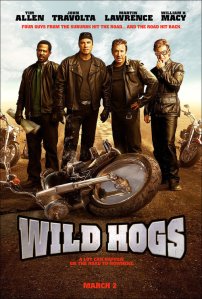 It’s hard to imagine that this lowbrow, homophobic, uninspired, painfully nostalgic film is the top grossing comedy of the year so far. I don’t really want to further elaborate on what this says about the general public. The boys (John Travolta, Tim Allen, Martin Lawrence, William H. Macy, a more random grouping of actors I challenge you to find) are all henpecked and unhappy with their dull, predictable, socially comfortable lives, so what’s a group of men facing midlife crises to do? Road trip. The idea of the freedom of the open road and the rebelliousness of touring the country on the back of a motorcycle seems quaint and naive at this point in life. What follows on their biker odyssey is a lot of lame slapstick and each actor trying to outdo the other in masculinity. A protracted third act standoff brings the film to a halt that it can never recuperate from. Wild Hogs isn’t a comedy disaster of sorts but it’s definitely got enough aimless misogyny and retroactive Boomer nostalgia to make you gag.
Nate’s Grade: C-
Share this:

Music and Lyrics (2007)
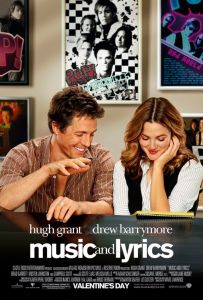 As bland and flavorless as the 1980s pop pap it hopes to skewer. For die-hard fans of the romantic comedy genre, there may be some minor level of enjoyment, but for the rest of us (those without ovaries) Music and Lyrics is predictable to the end and Hugh Grant and Drew Barrymore don’t elicit any semblance of chemistry. The songwriting is noticeably a cut above thanks to Fountain of Wayne’s bassist Adam Schlesinger writing them, but even the participation of one of my favorite bands can’t make Music and Lyrics worth seeing. The Duran Duran-esque music video that opens the film is a hoot and it all goes downhill from there, especially if you find it difficult to accept long durations of the cutesy baby act of Barrymore.
Nate’s Grade: C
Share this:

Perfect Stranger (2007)
 What starts as a pretty poor thriller goes absurdly over the top by the tired Hollywood convention of a forced twist ending, and this one isn’t just forced, no, it contradicts everything that happened before it for 100 minutes. The movie piles up red herring after red herring trying to keep the audience guessing, but I think this is because Perfect Stranger had no idea how to end and who would be deemed the killer. As a result, the hedging feels like a lousy board game of Clue until the awful, ludicrous, inconceivable twist ending. It’s the kind of ending that is supposed to somehow make sense because the filmmakers flashed short bursts of a childhood incident that lacked context and clarity. Perfect Stranger really has one of the worst twist endings of recent memory because it makes no sense and defies all logic. If the ending were right why would someone wait years upon years to plan a murder to hide something that seems inconsequential? Why does someone think their friend is a killer because their computer memory recalled that they visited a company website despite the fact that this person is a journalist and going undercover at this same company? And why, stupid Hollywood characters, do you recite how you’ve figured out their deeply convoluted plan to the murderer only to get murdered? Halle Berry gives a rather embarrassing performance; she’s all over the map and I question much of her character’s actions and anxiety, especially when seen ALONE, if the twist ending holds. Perfect Stranger is ridiculous junk that tries to outsmart an audience by confusing them and then openly negating their story thanks to a twist ending that is intended to blow minds but will simply leave people scratching their heads and pitying everyone involved in this disposable dreck. And no, this has nothing to do with Cousin Larry and Balki.
Nate’s Grade: D
Share this:

Epic Movie (2007)
 I wish to raise a call to arms to all moviegoers who enjoy real comedy, and by real comedy I mean exactly the opposite of what you’ll find in the abysmal Epic Movie. This latest spoof-fest is depressing to watch because I think of all the good independent movies that could have been bankrolled instead of this garbage, but I also drop my head in sorrow for the fact that a generation of mostly adolescent boys will grow to maturity thinking THIS is comedy.
The movie essentially sets its aims on anything from the year 2006 and it becomes almost like a fawning scrapbook for that year that will be obsolete in a hurry. The story is framed around a group of orphans discovering a hidden portal in a wardrobe that takes them to the wonderful world of Gnaria. The White Bitch (Jennifer Coolidge, who is actually referred to as “Stiffler’s mom” in this) is looking to take total control and… oh God, it hurts me to even recycle the plot summary. Epic Movie is littered with the same slumming celebrity faces like Carmen Electra and Tony Cox. Only Darrell Hammond is slightly amusing in a fairly decent impersonation of a pointlessly used Captain Jack Sparrow.
Let me make this abundantly clear: Epic Movie and its recent ilk do not parody movies or cultural events, they parrot them. They simply recycle references and treat the references as the joke, so just seeing a group of guys dressed like the NASCAR team in Talladega Nights is supposed to be funny. Epic Movie is spawned by the same team that made Date Movie, but at least that unfunny piece of junk at least had some slight semblance of focus. What qualifies as an “epic” movie exactly? Is Borat an epic movie? Is The Da Vinci Code an epic movie? Is Charlie and the Chocolate Factory an epic movie? Is Click and epic movie? Is “epic” an overused term to begin with? Don’t even get me started on the uselessness of attempting to parody Snakes on a Plane especially with a PG-13 rating.
At least I laughed twice, yes twice, during Date Movie, but I never stopped groaning during every minute of this woeful mess. Most of the jokes fall under uninspired slapstick or the scatological. There’s a running gag where the daffy redhead keeps repeating the sassy black girl. No one makes reference to it and it just keeps happening, so I’m expecting some kind of payoff. Nope. It builds to nothing. This movie makes Date Movie look like Annie Hall. I hope those sadly misguided few that find chuckles from Epic Movie will eventually discover that jokes are funnier when there’s setup, when you play against expectation or convention, and that wit does indeed exist in this universe. I pray that these terrible, cannibalistic, aimless spoofs will fade away, or else we may all be left with the disgusting possibility that the future idea of a comedy will be a movie that simply makes references to Epic Movie.
If comedy is to survive these movies must be stopped. I’m not advocating a violent overthrow but I’m certainly not not advocating it.
Nate’s Grade: F
Share this:

Across the Universe (2007)
 Julie Taymor is a one-of-a-kind artist. She made her name developing Disney’s The Lion King for the theater with highly elaborate and inventive costuming and staging. She then turned her vision to film and directed two strange yet visually splendid entires, 1999’s Titus and 2002’s Frida. Her latest is Across the Universe, a film constructed around actors singing Beatles songs. Hey, everyone likes the Beatles, so what could go wrong?
It’s the late 1960s and Jude (Jim Sturgess) has traveled from Liverpool (where else?) to Princeton to find his father. He makes friends with troublemaker Max (Joe Anderson) and they elect to travel to New York City and find their voice in these tumultuous times. They get a rather spacious apartment and their landlady, Sadie (Dana Fuchs), is a redheaded rock singer. Joe’s little sister, Lucy (Evan Rachel Wood) who just lost her boyfriend in the Vietnam War. JoJo (Martin Luther) and Prudence (T.V. Carpio) find their way to this apartment and into the increasing group of young, music-minded kids in the midst of a social revolution. Lucy fall hard for one another but their relationship is strained because Max has been shipped off to fight in Vietnam and Lucy is joining an increasingly violent radical resistance group.
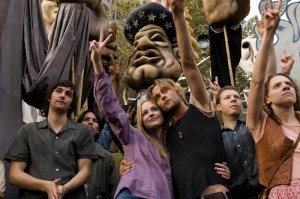 I can’t decide whether it is clever of simply lazy to structure a whole screenplay around 30-some songs by one band. Many of the tunes are used for pointless reasons like “Dear Prudence” is reduced to coaxing a character out of a closet literally, though she is gay so perhaps there’s a double-meaning there, but it’s still lame. In fact, the entire character of Prudence is pointless and grafted onto the story with no real care or precision. She disappears and then miraculously pops up again, with happy girlfriend in tow, and then that’s it. But what really chafes is that when Taymor uses the Beatles’ songs to tell the bulk of her story that means that little feels authentic. Lucy and Jude spout their love songs so quickly after their first encounter. Their romance doesn’t feel believable and, more importantly, it doesn’t feel worthy of our time and interest.
Across the Universe is dripping with Baby Boomer nostalgia and the film leaves no cliché left unturned in its account of history. This jumbled melting pot of every late 1960s cultural event feels as shallow as a junior high report on the subject. Everything from the Watts riots, to the assassination of Martin Luther King Jr., to the Columbia protests and LSD activist Ken Kesey and his colorful bus are elbowed into a story that feels empty and crowded at the same time. Across the Universe is a tad overextended and even goes to the trouble of climaxing with a rooftop jam similar to the Beatles’ last public performance together.
Taymor is a talented visionary but sometimes she lets her creative impulses take over her better judgment. The movie ultimately feels like 30-some music videos strung together by a flimsy boy-meets-girl story that will sink or swim depending upon the song-by-song visual follies. Sometimes Taymor excels with the sublimely surreal like some underwater canoodling to “Something,” Uncle Sam reaching out from a recruitment poster to the tune of “I Want You (She’s So Heavy),” and a spectacular rendition of “Happiness is a Warm Gun” where Max and other war vets cope with their trauma while multiple Salma Hayeks tempt them in sexy nurse outfits. But then Taymor gets a little too carried away with her runaway train of an imagination and her visuals can become simplistic (splattering strawberries = blood shed) or just way too funky, like a truly awful animated excursion where the wonderful Eddie Izzard speak-sings “For the Benefit of Mr. Kite” as a creepy circus ringleader. What does “Come Together” have to do with pimps and prostitutes and Joe Cocker as a bum? The worst moment may be when Taymor decides to visualize the parenthetical of “I Want You (She’s So Heavy)” by having underwear-clad soldiers hauling the Statue of Liberty over the jungles of Vietnam while they sing, “She’s so heavy.” I’m also uncertain about the flagrant jumps into theatricality like the synchronized acrobatic dancing; it’s a bit jarring at times.
 The cast is rather strong from a vocal standpoint and they recorded their performances live instead of within the confines of a recording studio. Wood has a particularly pure voice. Sturgess and his throaty pipes remind me of Ewan McGreggor in Moulin Rouge. Fuchs gives a favorable impression of Janis Joplin. Bono is great in his limited time on screen and hums one dandy version of “I Am the Walrus.” There isn’t a weak singer in the bunch and simply listening to them is one of the highlights of the film, but then I could accomplish this by plugging in the soundtrack. The new arrangements of the Beatles songs are a bit lackluster; they seem too bare and stripped down into vanilla ballads. “Something” sounds exactly note-for-note like how the Elliott Smith version sounded that hauntingly played over the closing credits of American Beauty. I seriously thought that Across the Universe just lifted Smith’s version.
Inherently goofy and occasionally garish, Across the Universe is a misguided trip through the back catalogue of the Beatles. There is a moderate level of fun with the concept and the quirky visuals, but the film plods on and on and eventually the appeal of the gimmick is long exhausted. The singing is strong and the visuals have a sense of whimsy when they work, but in the end the Beatles already had one failed movie constructed entirely from their songs (1978’s Sgt. Pepper’s Lonely Hearts Club Band starring Peter Frampton and the Bee Gees) and now they have one more for a new generation of fans.
Nate’s Grade: C
Share this:

3:10 to Yuma (2007)
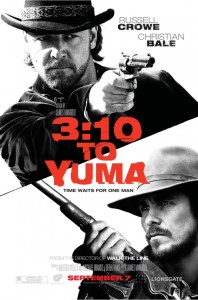 The Western used to dominate the pop culture landscape. In the 1950s, you had John Ford and Gary Cooper in a different dustup practically every week at the cinema, and the TV lineup was wall-to-wall cowboys, Indians, horses, and damsel retrieval. The Western has become rather inactive since its cultural heyday and now resides on the outskirts of movie land, idly chatting with Screwball Comedy and Busby Berkley Musicals about how good they had it back then (yes, I have just personified genres). With that said, director James Mangold (Walk the Line) has remade the 1957 John Ford film 3:10 to Yuma for a modern movie-going audience. The film has to work extra hard just to overcome the prejudices of a dormant genre, but fortunately 3:10 to Yuma is a rousing drama that could have knocked ’em dead way back when.
Dan (Christian Bale) is a wounded Civil War veteran trying to eek out a living in Arizona. He cannot grow any crops because of drought conditions, is behind on his payments, and his teen son has no respect for dear old one-footed dad. To keep his family financially afloat, Dan agrees to help transport notorious outlaw Ben Wade (Russell Crowe) to his date with justice.. It’s three days to ride across Arizona and get Wade onto the 3:10 train to Yuma prison, and along the way the posse is beset by unexpected setbacks and Wade’s gang hot on their heels to save their imprisoned leader.
 This is no deconstructionist Western or a modern revisionist Western, no this is an old-fashioned Western and Mangold embraces the genre staples instead of steering away from them (runaway stagecoaches, high-noon showdowns, ineffective lawmen, saloon girls). There’s a reverence for the genre and Mangold makes sure the audience soaks up the dusty details of frontier life with lots of revealing close-ups. You can practically taste the earth these men are caked in. The script is filled with plenty of surprises along the way as Ben keeps regaining the upper hand even as he’s outnumbered and in shackles. The story benefits greatly from really opening up and exploring in depth whom Dan and Ben are and what makes them this way. 3:10 to Yuma does not paint in broad strokes and dwells in a lot of grey, which presents opportunities for the actors to work their magic.
At the heart of the film is the moral battle between Ben and Dan, and both actors rise to the occasion. Crowe’s name is all but a guarantee for a quality performance and he shows an array of seemingly contradictory elements to Ben Wade. He has roguish charm and swagger, but then in an instant you can feel the intense glare of hatred in his eyes, and the scary calm in his voice, and you realize that this man is a caged tiger always stalking his prey. He can erupt in sudden and vicious violence and then fall back into a conscienceless laugh. He has moments that seem like empathy and kindness, but then you realize every seemingly kind gesture has a hidden meaning that links back to Ben’s own benefit. Crowe is magnificent and plays around with audience expectations to keep us jumping back and forth between liking the sly brute and fearing him.
Bale is equally as good as a martyr for his moral principles. He sticks to his ethical convictions no matter the hardships and temptations to take an easy way out. The painful lengths Dan goes to protect his family produce several touching exchanges and add substantial meat to a character that very easily could have been drawn as a simplistic do-gooder. Bale sells every moment with commendable authenticity.
 The rest of the supporting cast -Gretchen Mol, Alan Tudyk, a near unrecognizable Peter Fonda- add strong contributions to the movie, but none more memorable than Ben Foster. As Ben Wade’s sadistic right hand man, Foster displays a sick brand of hero worship and homicidal insanity. He’s an unpredictable and menacing figure and Foster magnifies these qualities to frightening realization. These excellent actors make 3:10 to Yuma more than throwback; it reminds you how great Westerns can be with the right actors and devotion to characters.
The only marks against 3:10 to Yuma occur during its climax. Things escalate immensely into a wild shoot-out that racks up a massive body count. While exciting, the sequence feels at odds with the intimate moral struggle between these two men. I’m also unsure about whatever prompted some eleventh hour motivational change for one key character. The ending is unnecessarily dark and will surely leave most audiences with a bad taste in their mouth to exit upon. Maybe it’s just the recent bout of films that I’ve been watching, but I’m starting to get tired of movies that are convinced that a pointlessly tragic ending somehow makes their story more meaningful (The Painted Veil, my wife is still upset with you, novel adaptation or not). A happy ending has long been perceived as a trite Hollywood cliché, but now I wonder of the pendulum has swung too far the other way so that conventional thinking says an audience has to be left wanting more or dissatisfied for a movie to attain higher artistic credibility. This is, of course, utter nonsense. A movie ending need only be appropriate for the scope of its story, but then again it doesn’t have to strive for forced wisdom delivered by unnecessary tragedy.
3:10 to Yuma is a hard-charging, stoic, classic American Western of the old guard with a bit more blood and profanity mixed in for a modern public. Despite a small handful of missteps toward the end, this is an engaging and often gripping morality tale catapulted by two strong performances from foreign-born actors showing Americans how the West was done right. Let 3:10 to Yuma stand as proof that any genre, no matter how outdated, can succeed as long as the filmmakers place care with character and treat the audience with a modicum of respect.
Nate’s Grade: B+
Share this:

Eastern Promises (2007)
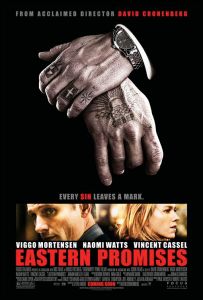 Director David Cronenberg is an idiosyncratic director who explores Big Ideas through the context of creepy horror movies where the body is violated. He’s covered everything from evil gnome-like children, ravenous monsters in Marilyn Chambers’ armpit, and Jeff Goldblum’s face unfortunately peeling away. But then Cronenberg struck it big with 2005’s A History of Violence, giving him the highest profile of his long Canadian career. The auteur of ick is now back in a similarly themed tale of the true impacts of bloodshed with Eastern Promises, a gripping and thoughtful work.
Anna (Naomi Watts) is a midwife working in London and come across a young Russian girl who dies in childbirth. She leaves behind a diary that Anna seeks to have translated so that she can find family members to contact about the newborn. This brings her unknowingly to the doorstep of Senyon (Armin Mueller-Stahl) who runs a restaurant in London’s Russian district. She inquires if Senyon or any of the employees knew the dead girl, and as soon as Senyon hears about the reality of a diary he becomes more concerned. And he should be since he is the head of one of London’s most notorious organized crime families. His loose canon of a son, Kirill (Vincent Cassel), has authorized a hit behind his father’s back and repercussions may soon be approaching. Nikolai (Viggo Mortensen) serves as the family’s chauffeur but takes an interest in Anna and is willing to assist her as she stumbles into impending danger the more she translates from the diary.
 Much like writer Steven Knight’s excellent previous film Dirty Pretty Things, this is a film that shines a light on the underbelly of London and focuses on the immigrant experience and how apt they are to be exploited. Eastern Promises is both a straightforward crime thriller with an intriguing, albeit simple central mystery, but then as it moves along it transforms into something far richer. Through the diary, we uncover the hidden inner workings of the Russian mafia, which is a truly global enterprise. Women are promised with great riches and freedoms in their Slavic homeland, and then once transported will spend the rest of their lives behind the bars of a whorehouse, kept dependent thanks to a drug habit forced upon them. We’re immersed in the culture of this crime family. Eastern Promises takes its noirsh sensibilities and then gives us the foreboding and enigmatic Nikolai, a mysterious figure that the audience, like Anna, is drawn to. He spent time in a Siberian prison and is covered in telling tattoos that serve as a resume for the mafia. Nikolai is such a dominating presence and proves to be more intriguing than the central diary mystery, and it’s here where the film performs a balancing act and transfers our attentions fully to this brooding brute.
Cronenberg subverts his usual irony and weirdness to stay true to his tale, and this may well be, even more so than A History of Violence, the most accessible Cronenberg movie yet. We’re a long way from flesh-eating-monster-in-Marilyn-Chambers’-armpit. He still works with such compact efficiency so that no scene feels wasted, and Eastern Promises is a brisk 1 hour 40 minutes. Where Eastern Promises really succeeds is by layering in strong characters within a relatively genre movie. People are not exactly who they seem and the actors do their best to give remarkable depth to their roles.
Cronenberg seems to have found an actor that shares his artistic sensibilities. Scorsese has Leonardo DiCaprio, Wes Anderson has Bill Murray, Kevin Smith has Ben Affleck, and now Cronenberg has Viggo Mortensen. I never thought much of Mortensen as an actor until Cronenberg unlocked something deep and mesmerizing in their first pairing. With Eastern Promises, Mortensen establishes himself as an extremely capable actor. Nikolai is a complex figure and he Mortensen displays a mastery of understatement; his stony silences and piercing stares speak volumes, but you can practically watch the decision-making of the character pass through the face of Mortensen. He skillfully displays the good inside a man bred for evil.
 Watts is an actress with few equals and she dazzles once more in a role that requires her to do a lot of legwork. And yet, there’s a sad, haunting quality to her thanks to the back-story where she lost a child due to miscarriage. Cassel is also impressive in a complicated role that requires a lot of internal languishing. He’s at one an impudent child willing to live high off the power of his family name, and at other times he comes across as a severely wounded man who cannot thrive in his hostile family (both little and big F) environment. There are interesting revelations that make Kirill a much more complex and captivating figure, and Cassel plays the many dimensions very well. Personally, I’m happy to see Armin Mueller-Stahl in another high profile movie. There was a time shortly after his 1996 Oscar nomination for Shine where if you needed an old guy for a movie, you got the Armin. Lately, it seems James Cromwell has taken his place as go-to old guy. In Eastern Promises, he has such a sly menace to him from the moment his ears prick up at the notion of a diary. He insists upon inserting himself into Anna’s life and casually makes remarks like, “You know where I work, now I know where you work,” with just the right amount of finesse to sound intimidating and yet potentially harmless.
One scene I will never forget is when Nikolai is ambushed in a bathhouse by two revenge-hungry thugs. He sits there naked and exposed and these two unhappy gentlemen descend upon him (fully clothed) with knives. Nikolai fights like a wounded animal and manages to successfully take down both men even though he is unarmed and un-clothed. Up to this point the character has been something of a gentle giant, knowing the vicious ways of the Russian mob but seemingly at distance from them for whatever ethical decision. But it’s at this moment that we bare witness, no pun intended, to the cagey survival instincts of a man who must live his life looking over his shoulder. It’s a bravura scene that is played out in agonizing detail. Nikolai is slashed and thrown against tiled walls (much penis-related mayhem is glimpsed), but he keeps coming back and knows precisely when to strike. It really is the actors doing all the hard knocks and brawling, which heightens the tension. Cronenberg stages the violence in his realistic drawn-out style, which horrifies an audience while simultaneously fascinating them. This is by far one of the most indelible film moments of the entire year.
 Eastern Promises is an engaging character-based thriller, and yet I wish it finished as strongly as it began. This is the kind of movie where much is implied or said in silence, which works great at respecting the intelligence of an audience as well as staying consistent with a believable reality where everyone in such dangerous positions is not explaining everything aloud. However, one of the drawbacks of a film where much is implied is that when it’s over you may wish that they implied less and showed more. The climax to Eastern Promises is a little weak, especially when it comes shortly after the incredible bathhouse attack. There’s a very hazy sense of a resolution. From an artistic standpoint, I suppose I can appreciate a thriller that doesn’t feel the need to end with a pile of dead bodies and much blood being spilt, but at the same time, from an audience point of view, I was really left wanting for more when the film finally comes to a halt.
Thanks to a smart, twisty script, Cronenberg’s sharp yet quirk-free direction, and some stirring performances, Eastern Promises is a first-rate thriller with the added benefit of strong characterization to add richer depth to this tale of mobsters, retribution, and sex slavery. Mortensen is the real deal when it comes to acting, folks. Cronenberg may have found a true match with Mortensen, and the added cache may give the director greater financial opportunities to tell more intriguing tales that may or may not feature ravenous armpits.
Nate’s Grade: B+
Share this:

Disturbia (2007)
 This Rear Window for the Facebook generation starts off strong with a solid performance by Shia LeBouf, but then quickly unravels once the filmmakers think they’re desperately running out of time. The teasing mystery is set up well and elicits some interest, but then, as if afraid of lulling an audience to sleep with a story that takes its damn time, Disturbia throws everything and the kitchen sink at you in the last 20 minutes. The movie falls on its face (the metaphors are flying today) trying to make up for lost time with jump scares and lame thriller conventions. The end gets a tad absurd as well as Shia discovers his serial killer neighbor isn’t just a murderer, but he’s a home decorator on par with the creature from Jeepers Creepers. By the time Shia falls into an underground water cavern filled with corpses, I wanted to scream myself for such wasted potential to a film that seemed like a formless rip-off on the surface.
Grade: C+
Share this:

Fracture (2007)
 This is a genre movie, pure and simple, but it has a tricky plot and is aided by two exceptionally high caliber performances from Anthony Hopkins, once again personifying evil and confidence, and Ryan Gosling. He imbues such meaty resonance to a character that would have seemed flimsy and altogether stock in another actor’s hands. Gosling and Hopkins have great tit-for-tat moments where each is trying to outwit the other, and their verbal chess match provides the best scenes in this procedural thriller. The disintegrating murder case keeps the audience guessing, but it’s Hopkins and Gosling that elevate the material into delicious crackling Southern-fried entertainment.
Nate’s Grade: B


 nathanzoebl
You must be logged in to post a comment.