Category Archives: 2004 Movies
Cellular (2004)
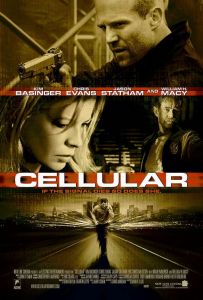 Cellular, a new thriller, relies on the simple device of a cell phone for the crux of its plot. With cell phones becoming ever more present, and ever more an eyesore in our daily lives, it was only a matter of time before they had their own movie. They’ve slimmed down from their heavier 1980s days, and become more useful, allowing one to surf the Web, take candid pictures of people in gyms, and are able to ring in the tone of the new hot rap song of the week. The premise for Cellular may be pitch-perfect for our modern society, but will an audience answer its call?
Jessica Martin (Kim Basinger) is a high school biology teacher caught up in some scary events. She’s been kidnapped by a gruff man (Jason Statham), and locked in an attic. She’s informed that her son and husband will be found and kidnapped, unless she tells him what he wants to know. Unfortunately, she’s clueless as to what her kidnappers want. There is a wall phone in the attic, and one kidnapper smashes it with a sledgehammer and walks away satisfied. Jessica goes to work re-configuring the shattered phone pieces, tapping wires until she can reach out and touch somebody.
Ryan (Chris Evans) is a hunky beach bum who’s chastised by his ex (Jessica Biel, I know, I didn’t believe it too) for being too irresponsible. He’s driving around in his cool ride when he gets a panicky phone call from, you guessed it, Jessica. At first he thinks it’s a practical joke until he overhears her kidnappers threaten her. Reluctant to help, Jessica asks him to stop the kidnappers from reaching her family. Ryan runs around town all day scrambling to help Jessica’s family and solve the case. He also enlists the help of a retiring police officer (William H. Macy), who’d rather open a day spa than do desk work.
 The premise for Cellular is near-genius and provides an abundance of smart, problematic possibilities. Ryan runs around and is always in danger of losing the signal. At one moment his cell phone is about to die from low battery charge. Another time the lines get crossed. Every step seems believable and the characters’ reactions seem credible. With Cellular, the audience thinks along with the characters step-by-step. When Ryan encounters stumbling blocks, the audience is with him in solving them, and this makes for a very engaging and thrilling movie.
The acting in thrillers is usually a minimal speed bump but the actors in Cellular do fine work. Basinger attempts to make up for her role in The Door in the Floor and plays harried and teary like a pro, but her best moments are when she uses her biology teacher know-how in precarious situations. She’s like a female MacGyver. Cellular is really a coming-out for Evans as a leading man. He’s had small roles before in The Perfect Score and Not Another Teen Movie, but this is his first leading-man role, and he handles the running, shouting, and panting with aplomb. Statham does his usually fine work of sneering and acting menacing. It’s also fun to watch William H. Macy, usually playing an every-man or a sadsack loser, play a bloodhound cop that morphs into an action hero.
The pacing in Cellular is breakneck. In the first 10 minutes, we witness Jessica’s kidnapping, and the momentum built up from that point is exhilarating. There is rarely a moment to catch your breath in Cellular. The action sequences are exciting but not redundant, and the tension readily mounts, especially when the audience is given more information than our heroes. There’s also some fun jabs at our country’s cell phone lifestyle.
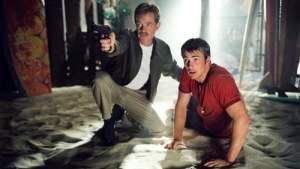 Director David R. Ellis worked as a stunt coordinator for 20 years, before advancing into the director?s chair and helming 2003’s schlocky gore-fest Final Destination 2. Ellis knows how to keep his plot moving, and something is always happening in Cellular to draw our attention or to push us on edge. Cellular was written by Larry Cohen, who also penned Phone Booth and probably won’t rest until he’s the Robert Rodat of telecommunications (Rodat wrote Saving Private Ryan and The Patriot, and seems destined to write a movie about every American war). Might I envision an erotic thriller with the “Can you hear me now?” Verizon guy just around the corner? Only time will tell.
As with any thriller, there are going to be lapses in logic that have the possibility of stopping the story dead in its tracks. Cellular‘s biggest logic loophole occurs right at the start, and if you can get behind it then you can enjoy the rest of the ride. Instead of smashing a telephone, why not yank it out of the wall and fully decommission it? Or, even better, why leave your kidnapped victim in a room, out of your sight, with a phone? Would it not have been easier to just tie her to a chair in plain sight? The mind boggles. The real answer we all know, of course, is because then we wouldn’t have a movie. There’s also a sequence late in the film where the bad guys discuss their evil plan on cell phones, which seems a tad careless considering anyone with a police scanner could listen in. As I said, gaps of logic are expected in this movie terrain and it’s your ability to rise above them that will determine if you enjoy the film.
Cellular is a thriller that dials the right numbers. It may have some gaps in logic, but it delivers when it comes to sharp suspense, smart action and a great premise. Fans of action thrillers should lick their lips with what Cellular has to offer. Just remember to keep your cell phones turned off during the movie, unless, of course, you’re surfing the Web, sneaking pictures of some girl, or jammin’ to the rap song of the week.
Nate’s Grade: B
Share this:

Catwoman (2004)
 Halle Berry has not exactly followed up her 2001 Best Actress Oscar with the wisest choices. There was a starring role in a James Bond movie, Die Another Day, there was Gothika, a spooker that didn’t scare anyone, except studio executives who saw the final gross. Now there’s Catwoman, a big-budget superhero film that’s got such a ripe odor to it to smell from miles away. It’s not good when a studio pulls a trailer because fans laugh at it, and it’s certainly not a good sign when the studio hires reshoots a month before the film is released. Catwoman’s looking for a big chunk of the superhero money out there, but will it land on all fours?
Patience Phillips (Berry) is a frazzled, down-on-her luck graphic designer at Hedare, a giant cosmetics corporation led by husband and wife team George and Laurel Hedare (Lambert Wilson and Sharon Stone). Patience is described as being “fun-deficient,” and lets people walk all over her. She tries saving a cat from a ledge one morning, and Officer Tom Lone (Benjamin Bratt) jumps out of his car to intervene, thinking she’s a jumper. He rescues her, though she doesn’t need it, and then asks to go out some time for coffee, the universal first date without it having to be a date.
 Patience is returning her designs late one night and overhears that Hedare’s newest product has the unfortunate side effect of making people’s faces melt if they discontinue use. The Hedare goons chase her down a water drain and flush her into a river. She’s revived somehow by the same cat she tried saving from the ledge. Patience reawakens with superhuman powers, heightened sense, and expert agility. There are some kinks, though. She sleeps in odd places, gobbles tuna by the handful, and loves to swing a whip. Who knows what she does to go to the bathroom. The new Patience is a bit confusing to Tom, but he goes along for the ride. He’s also on the hunt for the Catwoman, a mysterious leather-clad woman responsible for some jewelry theft. Patience unravels Hedare’s cosmetics conspiracy and aims to stop George and Laurel from mass production, all the while staying one step ahead of her boyfriend’s investigation. But Laurel is also experiencing some growing pains of her own. Unsatisfied with being pushed out her company’s advertising spotlight for being “too old,” she begins using heavy amounts of their newest beauty product and makes her skin as tough as living marble. With this new power, she schemes to retake power from her husband, as well as eliminate a pesky Catwoman.
Let’s not mince words and get directly to the elephant in the room: Berry’s hideous, trashy costume. This is, by far, the worst costume ever in a superhero movie, and possibly the worst costume in cinematic history. It’s so overwhelmingly ridiculous that perhaps the filmmakers felt Catwoman’s ultimate weapon against evil was having it die from laughter. It’s a bizarre combination of a mask with large mouse ears, leather bra, criss-crossing belts, gloves with diamond-tipped nails, and leather pants that look like they were mauled by a bear. Oh, and then there’s also the open-toed shoes. What? A superhero who wears open-toed shoes? All evil doers would have to do is step on her feet. The only purpose the outfit serves is to make Berry look sexy, but you didn’t need a stupid, tacky outfit for that.
The story of Catwoman takes a giant leap into weird mythology. Apparently, possibly immortal cats decide someone will become a Catwoman, a woman we’re told is not bound by our foolish rules. There’s no explanation why the cats choose who they do, what the purpose of this is, or what is even expected in return. We do get a montage of Catwomen through the ages dating back to ancient Egypt. Apparently, Catwomen follow the same lines of mythology like Buffy the Vampire Slayer: “Unto each generation, a Catwoman is born.” It’s also kind of funny that a film called Catwoman, about mythic Catwomen, has a crazy old cat lady (poor Ruth Fisher).
 The villainous scheme in Catwoman is awful. I can’t imagine the FDA not having some grumblings when their test bunnies start having their faces melt off. More importantly, what company would EVER release a product that melts your face in our litigious society? Just think of the mounting class action lawsuits that could very likely bankrupt that company. So, right there the villain’s plot is moronic for two big reasons. Don’t even get me started on Stone’s superhuman strength aided by the beauty cream we learn melts faces.
The acting is what you would expect. Berry is a beautiful woman, no doubt, but her performance is split between flighty wallflower and naughty dominatrix, neither of which is convincing. Bratt is the worst police officer ever (he can’t identify Catwoman even though only a tiny part of her face is obscured) and tries valiantly to hold his own amongst the ridiculousness. Wilson was such a stock corporate villain that they could have erected a cardboard cut-out of him and gotten the same performance. I never thought I’d say this, especially after The Muse, but Sharon Stone is the best thing about this movie. She’s an ice queen, but an entertaining one until she goes overboard on her beauty cream.
Catwoman is the first superhero film for Warner Brothers since their disastrous franchise-killing Batman and Robin in 1997. It’s hardly a coincidence that Catwoman is the also the worst superhero film since Batman and Robin. The film is trying really hard to be Spider-Man. Before her feline transformation, Berry is a frumpy dweeb, and afterwards she gets heightened senses, a new jolt of self-confidence, and the love of her man. Catwoman even has the guts to rip-off Daredevil, an amusing but fairly flawed movie itself trying to be Spider-Man. There’s a scene where Patience and Tom play a competitive game of basketball surrounded by chanting children. This is a direct rip-off of the scene in Daredevil where Ben Affleck and Jennifer Garner play fight on a playground. I don’t know about you, but when you’re ripping off Daredevil of all movies, you have problems.
This film has five credited writers, which works with my Rule of Five for films: if there are five or more people responsible for the script, then there was no script. Who amongst the five wants to take credit for all the dreadful cat puns in the dialogue, like Catwoman saying, “What a purrr-fect idea.” There’s also this wonderful repartee where Laurel says, “For you, Patience, it’s game over.” Then Catwoman responds, “It’s overtime!”
 Catwoman is director Pitof’s (perhaps short for Pitof-ful?) first real break as a director. He began his career as a visual effects artist on films like Alien: Resurrection, City of Lost Children, and The Messenger, but can anyone recount a visual effects artist that went on to become a decent director? (If you bothered to answer with Joe Johnston, then I don’t think you understood the question)
Movie Director Pitof has a love for cheesy CGI shots, but what’s more harmful is his penchant for confusing quick-cut edits. After watching Catwoman, I had to pop some Advil when I got home because the film’s editing had actually caused me a headache. It became so annoying that I started counting “one Mississippi, two Mississippi, etc.” to gauge the average length of a shot. Let’s just say that we didn’t make it past “one Mississippi” about 95% of the time. Now, there’s nothing inherently wrong with quick-edits; The Bourne Supremacy used them effectively to keep a lively, unpredictable experience. Catwoman’s editing is just jarring, especially during action sequences where you’d be hard-pressed to figure out what’s exactly going on.
The effects work is also rather pathetic. Pitof adores zooming exterior shots that become tiresome after the eighth or ninth time. Worse are all the scenes where Catwoman jumps and leaps through the city like she’s Spider-Man’s long-lost sister. The film is bending over backwards to try and ape Spider-Man, and these joyless, silly sequences of CGI Halle Berry crawling and jumping around the city don’t help the comparison. I do suppose that making a CGI Halle Berry flex and bend in her leather outfit was probably the most rewarding work for an animator since digitally making a breast grope itself in Hollow Man.
Who exactly is this movie intended for? If the filmmakers were going for fans of the Catwoman character, then why did they break away from the comic’s history and create something distant and different? If the filmmakers were strictly making an action movie, then why all the visual fluff, idiotic romance, and headache-inducing editing? I suspect that the producers felt that the names Catwoman and Halle Berry would be enough to put butts in the seats. So, then, I deduce that the selling point of Catwoman is, “Wanna see Halle Berry in a sexy leather outfit?” Now, most males will say, “Sure thing,” but why would they pay seven to ten dollars to see sexy non-nudity when they could go online. The short answer to who this film is intended for is, of course, no one.
 Catwoman is derivative, incomprehensible, dumb, and just plain boring. The only people who will get a kick out of Catwoman are either hormonal teenagers aroused by Berry’s outfit, or those who enjoy jeering a terrible movie. I can’t even recommend seeing Catwoman because of its ineptness. It’s bad, oh boy is it bad, but it’s not insanely idiotic like Bulletproof Monk or Dungeons and Dragons to the point where the lunacy is a must-see. It’s just boring bad, enough that it almost put me to sleep.
Perhaps the funniest thing of all, Berry has publicly stated in interviews weeks after Catwoman’s release that she’d love to don her leather outfit and do a sequel. Maybe she needs to talk to the producers who lost a bazillion dollars and inadvertently created a midnight movie howler. Catwoman will certainly get delegated to the litter box, but how many lives does Berry have left in Hollywood?
Nate’s Grade: D
Share this:

Kinsey (2004)
 Bill Condon’s probing, fascinating biopic of Indiana University sex pioneer Kinsey (Liam Neeson) could not come out at a more important time. Kinsey lived in the Dark Ages of sexuality and fought against what he saw as “morality disguised as fact.” Kinsey broke barriers studying the science of sexuality and gathered nationwide statements to amass the first thorough book on what’s under the sun and what’s going on under the sheets. Today, we live in a splintered world where people listen to information that affirms their beliefs, and tune out contradictory evidence even if it’s fact (look at the latest report on abstinence-only programs dishing out highly erroneous information). Kinsey railed against this dangerous line of thinking. The man was no saint and had issue comprehending some of the more complicated human emotions. Kinsey is exceptionally well acted and Neeson gives a career best performance. Kinsey is fearlessly graphic in its frank discussion but also enormously intelligent. The fact that conservative groups are actually protesting it shows that Kinsey’s work is far from over.
Nate’s Grade: A-
Share this:

Shaun of the Dead (2004)
 This British import was described as a “rom-zom-com” (something tells me that genre is rather spare). Director Edgar Wright and star/co-writer Simon Pegg plunk down an assortment of typical British sitcom characters and then throw zombies into the mix. Shaun of the Dead is hilarious from start to finish. Pegg and his batch of survivors go through the strange scenario with wit, grit, and a genial sense of irrelevance. It’s as if even flesh-eating zombies can’t ruin their day (Shaun devises a plan that involves killing his zombie step-dad and drinking a cup of tea). Shaun of the Dead gives a knowing wink to the Romero films but also tweaks the zombie genre’s rules and clichés. Wright has a clever sense of visuals and the film does provide some sticky, gory goods for horror fans. If more films were this much fun I’d probably never see natural light again.
Nate’s Grade: A-
Share this:

Maria Full of Grace (2004)
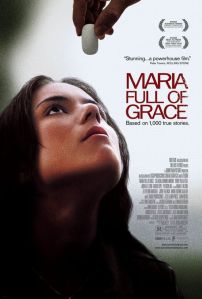 No other actress stood out to me this year as 23-year-old Catalina Sandino Moreno. She plays the movie’s Maria, a Colombian woman who agrees to carry 60-something condoms filled with heroin in her gut to the United States. The first half of the film is unjudegmental and nerve-racking, especially when Maria gets snagged by U.S. customs. The second half revolves around Maria trying to land on her feet in an unfamiliar land. The greatness of Maria Full of Grace relies on debut writer/director Joshua Marston framing his story like camera is an invisible voyeur. The film suggests that Maria is only one of thousands that have turned into drug mules to make ends meet or seek better lives. Maria Full of Grace is startling, immersive, delicate and quietly touching as Maria rediscovers the promise of the American dream.
Nate’s Grade: A
Share this:

Euro Trip (2004)/ Harold and Kumar Go to White Castle (2004)

 In 2004, there was a gold mine of smart but crude comedies. I cannot fathom why people have ignored both Euro Trip and Harold and Kumar Go to White Castle. Not only are both movies extremely funny, they serve as perfect examples of a great teen comedy. And both had characters that weren’t idiots or stoners. A trio of former Seinfeld writers penned Euro Trip and the fast-paced wit and love of the absurd is evident. The leads of Harold and Kumar are Asian-American and Indian-American, which gave and smart intriguing ethnic point of view to teen comedies. Harold and Kumar were studying to respectively become a doctor and an accountant. These characters aren’t dumb, just in over their heads as they hunt all night for those tiny White Castle burgers. Harold and Kumar has many laugh-out-loud moments that won’t make you ashamed for doing do. Neil Patrick Harris’ lurid cameo is a highpoint. Euro Trip and Harold and Kumar are intelligent, crude, and blisteringly funny. Rent them if you can.
Both Grades: B
Share this:

Open Water (2004)
 What a summer it has been for independent films. This summers most talked about movie wasn’t Spider-Man 2; no, it was Michael Moore’s Fahrenheit 9/11. This summer’s greatest triumphant underdog wasn’t Shrek; no, it was Napoleon Dynamite. And this summers scariest movie wasn’t The Village or the Exorcist prequel; no, it was Catwoman. A fine runner-up, though, is the 2004 Sundance smash, Open Water.
Susan and Daniel (Blanchard Ryan and Daniel Travis) are a couple vacationing in the islands. They sign up for a scuba diving voyage, but due to a counting error by the boats crew, are left stranded in the middle of the ocean. Susan and Daniel at first seem nonplussed, but as the hours wear down they begin to question how they’ll ever be rescued. Panic really starts to set in as they realize they have no control over where the current decides to take them. They turn to each other for support but that also doesn’t pan out. Sharks pop up here and there and Daniel tries to use what he learned on Shark Week to asses their danger. As the hours pass, and dehydration sets in, the sharks become more numerous, and Susan and Daniels’ fears become overpowering.
Writer/director/editor Chris Kentis creates a solid, tightly wound mood. His film was shot on a shoestring budget and sometimes it shows in the picture quality. He knows how to effectively draw out a scene and cut it to build tension. The plot could have been written on a napkin, and the characters are somewhat bland, but that doesn’t stop Kentis from masterfully drawing us in and making us care. Open Water is only 79 minutes long, and about 10 of that is the opening vacation footage, but Kentis makes the most of his time.
 The acting by the two relative unknowns is passably good. Ryan and Travis never trip up and become actors wading in water; they feel like real people. This is a testament to the writing and proximity to actual sharks, but Ryan and Travis should also be credited for keeping the illusion together. Early in the film, Ryan also bares all in a surprising full-frontal nude scene that I doubt few going to see Open Water ever heard a whiff about. I guess when you go on talk shows and all they ask you is, ”What was it like being around real sharks?”
One of the reasons that Open Water is so effective is how realistic it is. The film is based on a true incident at the Great Barrier Reef in the 90s. A scuba-diving couple was left behind by their tour boat and eventually died of thirst days later. Their bodies washed ashore. Now, slowly dying of thirst wont exactly ratchet up the terror, so one must forgive the inclusion of dangerous sea life this film brings to the table.
Open Water succeeds in creating a taut atmosphere. The greatest trick to establish tension in thrillers or horror films is to make the audience afraid of what they dont see. To a lesser extent, The Blair Witch Project tried this with rocks, stick figures, and an anticlimactic sit-in-the-corner ending. Open Water will succeed where Blair Witch failed for some (like me) because the fear of the unknown involves ferocious animals that can rip you apart, that are always just below the surface. Once a character starts openly bleeding, we dread the gruesome inevitability. That’s a whole lot scarier than rocks.
 I do not get scared by movies easily. When a jump scare occurs onscreen, and I can see the audience leap in waves, it registers nothing with me. Perhaps my body has just grown to predict them and register them as nothing special. I mean, can you remember one jump scare from a scary movie (the bus in Final Destination notwithstanding)? Jump scares are lame. Open Water, however, builds tension effortlessly. Your fear simmers the longer the couple bobs in the water. As time passes by, and they drift further and their chances of rescue diminish, the more helpless things become. When sharks begin to circle the couple, our fear is starting to strangle us. There’s a fantastic moment late in the film set at night. The screen is pitch black except for the occasional glimpse afforded by strikes of lightening. This is a film that really makes you uneasy and stays with you long after you shuffle out of the theater to your land-locked home.
Open Water‘s two leads have a certain blandness to them, but instead of being a detriment, this allows the audience to easily place themselves inside the characters. We become involved because we see ourselves and our own harried reactions. The dialogue in Open Water also feels 100% authentic to the situation. The characters stick to tired optimism, trade in gallows humor, discuss what they know about sharks and sea life, and eventually bat blame around for being in this incredible situation. Nothing about the way these characters speak feels ironic, or snappy, or fake. The characters feel real, their dialogue feels real, and the danger feels very real.
Open Water is a minimal, suspenseful, smart, and scary exercise in reality. Some people will be bored by the plot, complaining of endless scenes of people bobbing around the ocean and the series of climactic near misses. Fans of mainstream horror may not feel compelled by the minimal efforts of Open Water. However, for those out there who like scary films they can place themselves inside, Open Water is a low-budget chiller that will get under your skin. Think of it as The Blair Witch Project with sharks . . . but good.
Nate’s Grade: B+
Share this:

The Village (2004)
 When saying director names you can play a fun little game of word association. Someone says, “George Lucas,” and things like big-budget effects, empty storytelling, and wooden dialogue come to mind. Someone says, “David Lynch,” and weird, abstract, therapy sessions dance in your head. The behemoth of word association is M. Night Shyamalan. He burst onto the scene with 1999’s blockbuster, The Sixth Sense, a crafty, moody, intelligent thriller with a knock-out final twist. Now, though, it seems more and more evident that while The Sixth Sense was the making of M. Night Shyamalan, it also appears to be his undoing. His follow-up films, Unbreakable and Signs, have suffered by comparison, but what seems to be hampering Shyamalan’s growth as a writer is the tightening noose of audience expectation that he kowtows to.
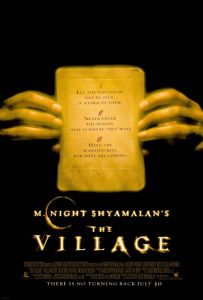
With this in mind, we have Shyamalan’s newest cinematic offering, The Village. Set in 1897, we follow the simple, agrarian lives of the people that inhabit a small secluded hamlet. The town is isolated because of a surrounding dense forest. Mythical creatures referred to as Those We Dont Speak Of populate the woods. An uneasy truce has been agreed upon between the creatures and the villagers, as long as neither camp ventures over into the others territory. When someone does enter the woods, foreboding signs arise. Animals are found skinned, red marks are found on doors, and people worry that the truce may be over. Within this setting, we follow the ordinary lives of the townsfolk. Ivy Walker (Bryce Dallas Howard) is the daughter of the towns self-appointed mayor (William Hurt), and doesnt let a little thing like being blind get in the way of her happiness. She is smitten with Lucius (Joaquin Phoenix), a soft-spoken loner. Noah (Adrien Brody), a mentally challenged man, also has feelings for Ivy, which cause greater conflict.
 Arguably, the best thing about The Village is the discovery of Howard. She proves herself to be an acting revelation that will have future success long after The Village is forgotten. Her winsome presence, wide radiant smile, and uncanny ability to quickly emote endear the character of Ivy to the audience. She is the only one onscreen with genuine personality and charisma, and when shes flirting and being cute about it you cannot help but fall in love with her. And when she is being torn up inside, the audience feels the same emotional turmoil. I am convinced that this is more so from Howard’s acting than from the writing of Shyamalan. She reminds me of a young Cate Blanchett, both in features and talent.
It seems to me that Shyamalan’s directing is getting better with every movie while his writing is getting proportionately worse. He has a masterful sense of pacing and mood, creating long takes that give the viewer a sense of unease. The first arrival of the creatures is an expertly handled scene that delivers plenty of suspense, and a slow-motion capper, with music swelling, that caused me to pump my fist. The cinematography by Roger Deakins is beautifully elegant. Even the violin-heavy score by James Newton Howard is a great asset to the film’s disposition.
So where does the film go wrong and the entertainment get sucked out?
What kills The Village is its incongruous ending. Beforehand, Shyamalan has built a somewhat unsettling tale, but when he finally lays out all his cards, the whole is most certainly not more than the sum of its parts. In fact, the ending is so illogical and stupid, and raises infinitely more questions than feeble answers, that it undermines the rest of the film. Unlike The Sixth Sense, the twist of The Village does not get better with increased thought.
Shyamalan’s sense of timing with his story revelations is maddening. He drops one twist with 30 minutes left in the film, but whats even more frustrating is he situates a character into supposed danger that the audience knows doesn’t exist anymore with this new knowledge. The audience has already been told the truth, and it deflates nearly all the tension. Its as if Shyamalan reveals a twist and then tells the audience to immediately forget about it. Only the naïve will fall for it.
 Shyamalan also exhibits a problem fully rendering his characters. They are so understated that they dont ever really jump from the screen. The dialogue is very stilted and flat, as Shyamalan tries to stubbornly fit his message to ye olde English vernacular (which brings about a whole other question when the film’s final shoe is dropped). Shyamalan also seems to strand his characters into soap opera-ish subplots involving forbidden or unrequited love. For a good hour or so, minus one sequence, The Village is really a Jane Austin story with the occasional monster.
The rest of the villagers don’t come away looking as good as Howard. Phoenix’s taciturn delivery seems to suit the brooding Lucius, but at other times he can give the impression of dead space. Hurt is a sturdy actor but can’t find a good balance between his solemn village leader and caring if sneaky father. Sigourney Weaver just seems adrift like shes looking for butter to churn. Brody is given the worst to work with. His mentally-challenged character is a terrible one-note plot device. He seems to inexplicably become clever when its needed.
The Village is a vast disappointment when the weight of the talent involved is accounted for. Shyamalan crafts an interesting premise, a portent sense of dread, and about two thirds of a decent-to-good movie, but as Brian Cox said in Adaptation, ”The last act makes the film. Wow them in the end, and you’ve got a hit. You can have flaws and problems, but wow them in the end, and you’ve got a hit.” It’s not that the final twists and revelations are bad; its that they paint everything that came before them in a worse light. An audience going into The Village wanting to be scared will likely not be pleased, and only Shyamalan’s core followers will walk away fully appreciating the movie. In the end, it may take a village to get Shyamalan to break his writing rut.
Nate’s Grade: C+
Share this:

Garden State (2004)
 Zack Braff is best known to most as the lead doc on NBC’s hilarious Scrubs. He has razor-sharp comic timing, a goofy charisma, and a deft gift for physical comedy. So who knew that behind those bushy eyebrows and bushier hair was an aspiring writer/director? Furthermore, who would have known that there was such a talented writer/director? Garden State, Braff’s ode to his home, boasts a big name cast, deafening buzz, and perhaps, the first great steps outward for a new Hollywood voice.
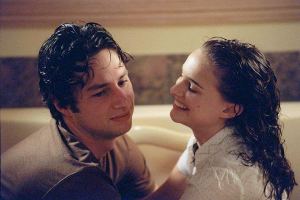
Andrew Large Largeman (Braff) is an out-of-work actor living in an anti-depressant haze in LA. He heads back to his old stomping grounds in New Jersey when he learns that his mother has recently died. Andrew has to reface his psychiatrist father (Ian Holm), the source of his guilt and prescribed numbness. He has forgotten his lithium for his trip, and the consequences allow Andrew to begin to awaken as a human being once more. He meets old friends, including Mark (Peter Sarsgaard), who now digs graves for a living and robs them when he can. He parties at the mansion of a friend made rich by the invention of silent Velcro. Things really get moving when Andrew meets Sam (Natalie Portman), a free spirit who has trouble telling the truth and staying still. Their budding relationship coalesces with Andrews re-connection to friends, family, and the joys life can offer.
 Braff has a natural directors eye for visuals and how to properly use them to convey his characters feelings. A scene where Andrew wears a shirt and blends into the wall is a perfect visual note on the characters sleep-walk through life. Braff’s writing is also familiar but satisfyingly unusual, like a repackaging of old stories told with a confident voice. His characters are interesting and memorable, but dont feel uselessly quirky, unlike the creations of other first time indie writers. The melancholy coming-out of Andrew from disconnected schlub to post-pharmaceutical hero really grabs the audience and gives them a rooting point. At times, though, it seems as though Braff may be caught up trying to craft a movie that speaks to a generation, and some will see Garden State as a generation’s voice of a yearning to feel connected.
Braff deserves a medal for finally coaxing out the actress in Portman. She herself has looked like an overly medicated, numb being in several of her recent films (Star Wars prequels, Im looking in your direction), but with her plucky, whimsical role in Garden State, Portman proves that her careers acting apex wasn’t in 1994’s The Professional, when she was 12. Her winsome performance gives Garden State its spark, and the sincere romance between Sam and Andrew gives it its heart.
Sarsgaard is fast becoming one of the best young character actors out there. After solid efforts in Boys Don’t Cry and Shattered Glass, he shines as a course but affectionate grave robber that serves as Andrews motivational elbow-in-the-ribs. Only the great Holm seems to disappoint with a rare stilted and vacant performance. This can be mostly blamed on Braff’s underdevelopment of the father role. Even Method Man pops up in a very amusing cameo.
The humor in Garden State truly blossoms. There are several outrageous moments and wonderfully peculiar characters, but their interaction and friction are what provide the biggest laughs. So while Braff may shoehorn in a frisky seeing-eye canine, a knight of the breakfast table, and a keeper of an ark, the audience gets its real chuckles from the characters and not the bizarre scenarios. Garden State has several wonderfully hilarious moments, and its sharp sense of humor directly attributes to its high entertainment value. The film also has some insightful looks at family life, guilt, romance, human connection, and acceptance. Garden State can cut close like a surgeon but it’s the surprisingly elegant tenderness that will resonate most with a crowd.
 Braff’s film has a careful selection of low-key, highly emotional tunes by artists like The Shins, Coldplay, Zero 7, and Paul Simon. The closing song, the airy Let Go by Frou Frou, has been a staple on my play list after I heard it used in the commercials.
Garden State is not a flawless first entry for Braff. It really is more a string of amusing anecdotes than an actual plot. The film’s aloof charm seems to be intended to cover over the cracks in its narrative. Braff’s film never ceases to be amusing, and it does have a warm likeability to it; nevertheless, it also loses some of its visual and emotional insights by the second half. Braff spends too much time on less essential moments, like the all-day trip by Mark that ends in a heavy-handed metaphor with an abyss. The emotional confrontation between father and son feels more like a baby step than a climax. Braff’s characters also talk in a manner that less resembles reality and more resembles snappy, glib movie dialogue. It’s still fun and often funny, but the characters speak more like they’ve been saving up witty one-liners just for the occasion.
Garden State is a movie thats richly comic, sweetly post-adolescent, and defiantly different. Braff reveals himself to be a talent both behind the camera and in front of it, and possesses an every-man quality of humility, observation, and warmth that could soon shoot him to Hollywood’s A-list. His film will speak to many, and its message about experiencing lifes pleasures and pains, as long as you are experiencing life, is uplifting enough that you may leave the theater floating on air. Garden State is a breezy, heartwarming look at New York’s armpit and the spirited inhabitants that call it home. Braff delivers a blast of fresh air during the summer blahs.
Nate’s Grade: B
Share this:

The Door in the Floor (2004)
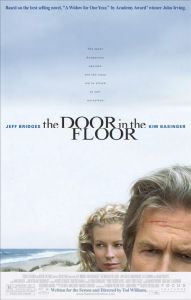 John Irving is one of the most accomplished and popular fiction writers of our times. His pulpy, unconventional, and compassionate novels have translated into many films with varying degrees of quality (World According to Garp, good; Cider House Rules, okay; Simon Birch, dreadful). The Door in the Floor is an adaptation of his novel, A Widow for One Year, but it only adapts the first third of the novel. This time around will the absence of quantity directly shape the quality of an Irving adaptation?
The plot for The Door in the Floor almost sounds like something you’d see late at night on Cinemax. Eddie (Jon Foster) is a teenager learning what it takes to be a writer. He becomes an assistant to Ted Cole (Jeff Bridges), a giant in the world of childrens literature but a playboy at home. Eddie spends the summer at Ted’s quaint cottage and is instantly smitten with Ted’s estranged wife, Marion (Kim Basinger). Theirs has been a loveless marriage ever since a tragic accident killed their two sons. Both are handling the grief in their own ways. Ted has become bitter and takes his anger out on his manipulation of other women, notably a neighbor (Mimi Rogers) who poses nude for his paintings. Marion has become insular and turns into a stone whenever the accident is mentioned.
 Eddie tires of his glorified chauffeuring duties for Ted and his mistress. He spends his lonely days fantasizing about Marion, including masturbating to the image of her clothes. When Marion accidentally stumbles into this embarrassing situation, she not only calmly apologizes but lays out additional pairs of clothing for Eddie to get his kink. This opens the door for Eddie to engage his fantasy, and embark on a deflowering tryst with Marion. Ted’s reaction isn’t one of anger or resentment but more of a job well done. It is around this time when we realize that Eddie looks remarkably like her two lost sons.
The film’s best moments are not the colorless, tepid tryst between Eddie and Marion, or the broader comic moments with Teds assault on tact; oh no, the best moments are when anyone onscreen shares time with Ruth (Elle Fanning), Ted and Marion’s precocious 4-year-old daughter. She’s a tad demanding, like insisting to know where every picture of her family remains, but comes across as adorable without stepping over into cloying. Her interaction with Bridges is wonderful, her wide-eyed questioning is sweet, and her acting is much more authentic than her sister, the more seasoned Dakota Fanning (Man on Fire). Hopefully the Fanning family has learned some dos and donts from the Culkin family.
Bridges performance is amazing. He bares more than just his backside in this film. The role of Ted is very meaty, and Bridges is the perfect actor to sink his teeth right into it. Bridges is alarmingly coy, blending a disarmingly comic roly-poly ability, as well as a brooding, stinging anger barely masked by ego and affability. I cannot imagine anyone else stepping into Ted’s shoes and delivering a better performance. Bridges’ tortured and droll work may be Oscar material.
 Basinger’s performance is equally amazing. Amazingly bad, that is. Her character is supposed to be shattered by the loss of her sons, but Basinger plays the role so heavily intoxicated by grief that Marion becomes nothing more than a walking ghost. She’s so zombie-like for the entire film, that her performance could be rivaled by a coma patient. For some reason unbeknownst to me, ever since winning a Best Supporting Actress Oscar in 1997, Basinger has yet to follow with a really good performance.
The Door in the Floor is Jon Foster’s real big break as a young actor. His previous roles amount to little, including Kevin Costner’s son in 13 Days and the vitally integral Gas Station Cashier in Terminator 3. Some awkwardness is apparent in his rise to larger material, but Fosters apprehension serves his character best, like a dinner scene between him and Marion where he tells a bad joke to break the ice. Foster’s performance is a bit bland, but that’s because his character is more of a transparent adolescent fantasy.
Poor Mimi Rogers, a.k.a. Mrs. Tom Cruise Number One. She’s a capable actress, and a fine-looking woman, but she’s been given such a small one-note character that it seems almost exploitative that such a well-known actress spends the majority of her time with her robe around her ankles. A late scene involving her violent hysteria at being dumped by Ted and it is meant to be comic but it seems more like a fizzy tantrum. All this and she gets the dubious notoriety of having a drawing of the most sensitive part of her anatomy projected in glorious widescreen.
By now an audience is more or less used to Irvings mix of slapstick and grief, of pathos and situational humor. The Door in the Floor follows this tried-and-true recipe and provides a healthy amount of entertainment for an audience. It can effectively make an audience laugh and supply knots in their throat at separate turns; however, in the harsh light of day, if you strip away at The Door in the Floor you’ll find that most every character is self-involved, curt, closed off, and just plain unlikable. Ted is a jerk. Marion is a zombie, and not so great a mother. Eddie is bland. The only real character worthy of empathy is Ruth.
 Now, movies dont necessarily all have to have likable characters, and in fact some of the most interesting and memorable characters are unlikable, but for a family melodrama its important to feel for their grief instead of feeling their grief. If you cant feel for the characters then youre just watching without any baited interest. Many films can make you feel bad by watching someone on hard times, but it’s a true accomplishment if you feel the character’s personal pains (and somehow the films of Lars von Trier accomplish both). Theres little investment beyond the surface level of amusement. So, The Door in the Floor is amusing,but it struggles to be anything beyond because of the limitations of its characters. For some, a movie that provides surface-level amusement from polished actors is good enough, and in some instances Id agree.
Director Tod Williams (The Adventures of Sebastian Cole) also served as the adapter of Irvings dense work. Williams knows a thing or two about family melodrama and the denial of guilt, and he keeps the pacing brisk and the laughs at an even pace. Williams’ best decisions are on the small visual notes he hangs on, like a stunning, visually alluring final image. The story is a bit uneven in tone, thanks to Irving’s eccentric source, but Williams saves his narrative whammy for the very end, and Bridges brilliantly delivers the backstory we’ve been holding our breath for.
The Door in the Floor is a solid, if surface-level enterprise in the exploration of guilt and mourning in a family setting. Bridges gives an amazing and memorable performance that helps make you forget about the rest of the films somewhat lackluster acting. Fans of Irving’s works will likely be taken back in pleasure, and fans of adult melodrama will not likely walk out disappointed. The Door in the Floor has glimpses of something more but settles for being a well-acted, nondescript affair.
Nate’s Grade: B-


 nathanzoebl
You must be logged in to post a comment.