Category Archives: 2004 Movies
Million Dollar Baby (2004) [Review Re-View]

Originally released December 15, 2004:
Million Dollar Baby, much like its fledgling female boxing character, has come out of nowhere and made a considerable deal of noise. This little homespun film directed by Clint Eastwood didn’t have the glitz and sheen of other awards friendly movies, but now it seems that Eastwood?s own baby may clean up come Oscar time. Can Million Dollar Baby tackle the enormous hype surrounding it? Yes and no.
]Frankie (Eastwood) is a hardened boxing trainer too concerned for his fighters’ welfare to allow them to fight in championship bouts. He’s the kind of cynical old man that enjoys pestering a priest and causing him to unleash an F-bomb. Frankie and his longtime friend Scrap (Morgan Freeman) run a rundown gym and talk un-sentimentally about their older days as prize fighters. Then along comes Maggie (Hilary Swank), a 32-year old waitress who’s got nothing to believe in except her possibility as a boxer. She wants Frank to train her into the champ she knows she can be. He refuses saying he doesn’t train girls. She’s so determined she won’t take no for an answer. Frank finally agrees, especially after some help from Scrap, and starts to teach Maggie everything she needs to know to be a star pugilist. The two begin to open up to each other emotionally and Maggie seems destined to become a force in the ring.

Million Dollar Baby‘s greasiest attribute is its trio of knockout performances. Swank owns every second of this movie. She’s unremittingly perky, conscientious but also dogged, stubborn, and irresistibly lovable. Swank embodies the role with a startling muscular physique and a million dollar smile. Her performance is equal parts charming and heartbreaking. Maggie’s the heart of Million Dollar Baby and Swank doesn’t let you forget it for a millisecond. Come Oscar time, I’m sure she will be walking onstage to grab her second Best Actress Oscar in five years.
No one does grizzled better than Eastwood, and maybe no other actor has made as much of an acting mark by squinting a lot. Million Dollar Baby is probably his best performance to date, though for a good while it sounds like Frank has something lodged in his throat (pride?). Frank has the greatest transformation, and Eastwood brilliantly understates each stop on the journey until landing in a vulnerable, emotionally needy place.
Freeman once again serves as a film’s gentle narrator. There isn’t a movie that can’t be made better by a Morgan Freeman performance. His give-and-take with Frank feels natural and casual to the point that it seems improvised on the spot. Freeman unloads some great monologues like he’s relishing every syllable, chief among them about how he lost his eye. It’s wonderful to watch such a great actor sink his teeth into ripe material and deliver a performance that may net him a long-awaited Oscar (I think he’s due, and likely so will the Academy).
For whatever reason, Eastwood is hitting a directing groove in his twilight years. First came Mystic River, an ordinary police whodunnit made exceptional by incredible acting. Now Eastwood follows up with Baby, an ordinary sports film made extraordinary by incredible acting. Hmmm, a pattern is forming. The cinematography is crisp and makes great use of light and shadow to convey emotion. Eastwood’s score is also appropriately delicate and somber. The boxing sequences are brief but efficient.
Million Dollar Baby is a very traditional story that is at times surprisingly ordinary. Maggie’s the scrappy underdog that just needs a chance, Frank’s the old timer that needs to find personal redemption, and Scrap’s the wise old black man. Once again, an old curmudgeon takes on a rookie and in the process has their tough facade melt away as the inevitable victories pile up. Million Dollar Baby is a very familiar story but then again most boxing tales are fairly the same in scope.
What eventually separates Million Dollar Baby from the pack is its third act twist. You think you know where Eastwood’s film is headed, especially given the well-worn terrain, but you have no clue where this story will wind up. The plot turn deepens the characters and their relationships to each other in very surprising ways. You may be flat-out shocked how much you’ve found yourself caring for the people onscreen. It almost seems like Eastwood and company have used the familiar rags-to-riches underdog drama to sucker punch an audience into Million Dollar Baby‘s final 30 minutes. We’re transported into an uncomfortable and challenging position, and Eastwood won’t let an audience turn away.

Million Dollar Baby is not the colossal masterpiece that critics have been drooling over. For one thing, the group of antagonists is not nearly as textured as our trio of leads. They’re actually more stock roles that further enforce the ordinary story of Million Dollar Baby. Maggie’s trailer trash family is lazy unsupportive batch of stereotypes. The evil female boxing champ just happens to be a German who doesn’t mind playing dirty. One of the boxers at Frank’s gym is an arrogant showboat just waiting to be nasty while the teacher’s back is turned. Million Dollar Baby excels at showing depth and humanity with its lead trio, yet it seems if you aren’t in that circle you’re doomed to wade in the shallow end.
Eastwood shows that great acting and great characters you love can elevate a common framework. The package may be similar to a lot of films before about scrappy underdogs, but Million Dollar Baby lacks comparison in its genre when it comes to its enthralling acting and characters. The father-daughter bond between Frank and Maggie is heartwarming. The final reveal of what her Gaelic boxing name means may just bring tears to your eyes. The results are a very fulfilling movie going experience, albeit one that regrettably may not live up to such hype.
Million Dollar Baby has been showered with heapings of praise and become a formidable Oscar contender. The story treads familiar waters but its outstanding acting and deep and humane characters elevate the material. The film can’t match the hyperbole of critics but Million Dollar Baby is an ordinary but greatly satisfying ride led by compelling acting. The film hums with professionalism and seems to just glide when everything comes together magnificently, particularly in that last 30 minutes. Eastwood is hitting an artistic stride and it’s actually exciting to see what Clint will do next. Million Dollar Baby may not be a first round knockout but it definitely wins by decision.
Nate’s Grade: B+
——————————————————
WRITER REFLECTIONS 20 YEARS LATER

Million Dollar Baby was its own underdog story that showed its strength when it mattered most, taking the 2004 Best Picture Oscar, as well as Best Actress for Hilary Swank and Best Supporting Actor for Morgan Freeman. It wasn’t even on many award prognosticators’ radar until the final month of the year. The odds-on favorite for most of 2004 had been Martin Scorsese’s Howard Hughes biopic The Aviator, a lavish recreation of Old Hollywood with the power of Harvey Weinstein behind it. After 2002’s Gangs of New York went 0-10 with its Oscar nominations, Weinstein vowed this would not happen again and that he would get Scorsese that first directing Academy Award, so no expense was spared with a $110 million-dollar budget, exceeding the previous highest Miramax budget from 2003’s Cold Mountain. The narrative was set, the power of Weinstein was behind it, and the context of Hollywood celebrating its own history has long been an appealing formula for an easy Oscar victory. Then came Clint Eastwood’s scrappy little boxing movie and it sucker-punched the established awards narrative, taking the top prize (Sorry Harvey, but if it was any consolation, The Aviator improved upon Gangs’ ratio, winning 5 of 11 noms).
Twenty years later it’s impossible to discuss the legacy of Million Dollar Baby without talking about the legacy of Eastwood as a director. He’s been directing movies ever since 1971’s Play Misty For Me. He initially stuck to what he knew, thrillers and Westerns, with the occasional passion project like 1988’s Charlie Parker biopic, Bird. It all changed for Eastwood with 1992’s Unforgiven, a searing deconstruction of the Western and masculinity and conveniently digested American myth-making that won Best Picture and Best Director for Eastwood. From there, the flinty-eyed, gravelly-voiced filmmaker was seen as an Oscar favorite, though he was only nominated for Best Director three other times out of the twenty-five films he directed after. Eastwood’s been regarded as some higher-minded adult director, but looking over his long list of directorial efforts, the man has always kept to his preferred milieu of thrillers and Westerns with the occasional somber biopic. The more assumed Academy-friendly projects typically gained minimal traction, usually acting nominations like with Richard Jewell, Invictus, and The Bridges of Madison County. Sometimes they’ve just been complete artistic whiffs, like J. Edgar, Jersey Boys, or Hereafter.

The movies that got the most acclaim from Eastwood as director were the elevated genre movies, be they crime thriller (Mystic River), Western (Unforgiven), or sports underdog drama (Million Dollar Baby). The man has an inherent interest in genre movies. He may make a WWII drama from the point of view of the Japanese, completely in Japanese, but then next he’ll make a movie about being a “Get off my lawn” grumpy grandfather taking on street gangs. He made a movie about sending geezers into space, a juror realizing he may actually be guilty of the crime he’s intended to judge, and a corrupt president covering up his crimes (that guy wasn’t even a convicted felon upon inauguration -ha). The man is at his best when he sticks to what he knows, and when he can collaborate with writers who can get the best out of his instincts, the results can be exceptional. He’s a man interested in telling genre stories, and I can respect that. He’s notoriously spartan in his directorial approach with actors, typically only allowing two or so takes before moving on, a.k.a. the anti-Kubrick. The photography is so stark is might be confused for being black and white. There is a stripped-down-to-its-studs quality to the best of Eastwood’s movies, which is why deconstructionist examinations over genres can be especially rewarding. It allows for a larger space for characters to expand and grow and challenge our expectations, which is where Million Dollar Baby still works so well twenty years after it unexpectedly KO’d the awards circuit.
This is a Cinderella sports story balanced by an invigorating surrogate father-daughter relationship. Maggie Fitzgerald (Swank) is so eager to prove herself as a boxer, and we’re so happy to see her gain success and dignity, helping to give her trainer Frankie Dunn (Eastwood) a new sense of purpose. Everything is going right for this pair and it feels like the Hollywood movie we would all know and love, and then it all gets violently torn away when Maggie is injured in the ring and becomes paralyzed from the neck down. From there, Million Dollar Baby transforms from its sports movie formula and becomes something so much more meaningful and interesting and emotionally affecting. We’re constantly playing a mental contrast from before and after the accident. She’s so optimistic and bouncy and full of life. To see the joyous Maggie using her body to give her confidence and identity and overcoming adversity and intimidating more professional opponents through force of will, and then to see her bedridden, wheezing through a ventilator, and so deeply lost in her slack eyes, it’s something awful. She survived the injury but her spirit has been obliterated. Now, this isn’t a commentary on how disabled people cannot live fulfilling lives and might as well be euthanized. Maggie is the one who makes the choice to be euthanized and she will not be swayed, and this decision puts it to her coach, a lifelong Catholic, to demonstrate his love for his pupil through assisted suicide. To me, all that is WAY more dramatically interesting than if she had simply won the big title fight and proven all her many doubters wrong.

Swank rightfully won her second Oscar for Best Actress with a performance of such vitality and despair. At the end, when she’s stuck in that hospital bed, and she’s trying to chew off her own tongue so she can bleed to death, it’s such a devastating change from the chipper, optimistic scrappy underdog. Eastwood is gruff and growly and nearly unintelligible at points, but his reactions and his generosity as an actor help Swank achieve even higher acting greatness. Strangely enough, while Freeman is perfectly good in his Oscar-winning role, you could have cut him completely from the movie and affected very little, besides needing a new outlet for Eastwood to unintelligibly grumble towards.
It can feel like Million Dollar Baby is two different movies smashed together, one without an ending and one without a beginning. If you felt like you were plugged into that rousing sports underdog movie, I can understand feeling cheated by the rug pull. I feel like the version of this movie, by its end, is the one it wanted to be all along, and it’s using your emotional investment in these characters to make the decisions all the more grueling and tragic. Twenty years later, I think I enjoyed the moments before the accident a little less and the moments after the accident much more, and considering the ending seems like the whole point for Million Dollar Baby, that seems like an endorsement for its staying power two decades hence. It still has enough power today from the performances and where it pushes those characters. Million Dollar Baby is still a winner because it fit so well as a vehicle that Eastwood could elevate. He’s 94 years old and not likely directing too many more movies, but if anyone can keep making movies into their triple digits, it’s this man.
Nate’s Grade: A-
Share this:

Primer (2004) [Review Re-View]
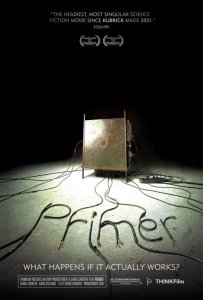 Originally released October 8, 2004:
I was intrigued about Primer because I had been told it was classy, smart sci-fi that’s so often missing in today’s entertainment line-up (see: Sci-Fi channel’s Mansquito). It won the Grand Jury Prize at the 2004 Sundance Film Festival and the critical reviews had been generally very positive. So my expectations were high for a well wrought, high brow film analyzing time travel. What I got was one long, pretentious, incomprehensible, poorly paced and shot techno lecture. Oh it got bad. Oh did it get bad.
Aaron (Shane Carruth) and Abe (David Sullivan) run a team of inventors out of their garage. Their newest invention seems promising but they’re still confused about what it does. Aaron and Abe’s more commercially minded partners want to patent it and sell it. Aaron and Abe inspect their invention further and discover it has the ability to distort time. They invent larger versions and time travel themselves and thus create all kinds of paradoxes and loops and confusion for themselves and a viewing audience.
Watching Primer is like reading an instruction manual. The movie is practically crushed to death by techno terminology and all kinds of geek speak. The only people that will be able to follow along are those well-versed in quantum physics and engineering. Indeed, Primer has been called an attempt to make a “realistic time-travel movie,” which means no cars that can go 88 miles per hour. That’s fine and dandy but it makes for one awfully boring movie.
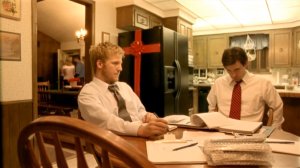 Primer would rather confound an audience than entertain them. There is a distinct difference between being complicated and being hard to follow. You’d need a couple volumes of Cliff Notes just to follow along Primer‘s talky and convoluted plot. I was so monumentally bored by Primer that I had to eject the DVD after 30 minutes. I have never in my life started a film at home and then turned it off, especially one I paid good money to rent, but after so many minutes of watching people talk above my head in a different language (techno jargon) I had reached my breaking point. Primer will frustrate most viewers because most will not be able to follow what is going on, and a normal human being can reasonably only sit for so long in the dark.
I did restart Primer and watched it to its completion, a scant 75 minutes long. The last 20 minutes is easier to grasp because it does finally deal with time travel and re-staging events. It’s a very long time to get to anything comprehensible. I probably should watch Primer again in all fairness but I have the suspicion that if I did my body would completely shut down on me in defense. Some people will love this and call it visionary, but those will be a very select group. It’s not just that Primer is incomprehensible but the film is also horrifically paced. When you don’t know what’s being said and what’s going on then scenes tend to drag because there is no connection. This movie is soooooo slow and it’s made all the worse by characters that are merely figureheads, dialogue that’s confusing and wooden, and a story that would rather spew ideas than a plot.
Writer/director/star Shane Carruth seems to have high ambitions but he has no empathy for an audience. Films can be dense and thought-provoking but they need to be accessible. Richard Kelly’s Donnie Darko is a sci-fi mind bender but it’s also an accessible, relatable, enjoyable movie that’s become a cult favorite. Carruth also seems to think that shooting half the movie out of focus is a good idea.
I’m not against a smart movie, nor am I against science fiction that attempts to explore profound concepts and ideals. What I am against, however, is wasting my time with a tech lecture disguised as quality entertainment. Primer is obtuse, slow, convoluted, frustrating and pretentiously impenetrable. After finally finishing Primer, I scanned the DVD spine and noticed it said, “Thriller.” I laughed so hard I almost fell over. The only way Primer could be a thriller is because you’ll be racing the clock for it to finish.
Nate’s Grade: C-
——————————————————
WRITER REFLECTIONS 20 YEARS LATER

I tried, dear reader. I had every intention of giving 2004’s Primer another chance, wanting to allow the distance of time to perhaps make the movie more palatable for my present-day self than it was when I was in my early twenties and irritated by this low-budget, high-concept Sundance DIY time travel indie. I thought with two decades of hindsight, I’d be able to find the brilliance that people cited back in 2004 where instead I only found maddening frustration. I consider myself a relatively intelligent individual, so I felt like I would be able to unpack what has been dubbed the most complex and realistic time travel movie ever created, let alone on a shoestring budget of only $7000, where the showcase was writer/director/star/editor/composer Shane Caruth’s intricate plotting. The whole intention with my re-watches is to give movies another chance and to honestly reflect upon why my feelings might have changed over time, for better or worse. That’s my intent, and while this day may have always been a matter of time for arriving, but I tried valiantly to watch Primer again and I quit. Yes, my apologies, but I tapped out.
I gave the movie twenty minutes before I came to the conclusion that I just wanted to do anything else with my time. I even tried watching a YouTube explanation video to give me a better summation, and even five minutes into that I came to the same conclusion that I wanted to do anything else with my fleeting sense of time. I think this is a case of accessibility and engagement.
Ultimately, this is the tale of two would-be inventors who keep reliving the same day to make money and win over a girl at a party. Reliving this day several times, with several iterations, and literally requiring a flowchart to keep it all together, is a lot of work for something that seemingly offers so little entertainment value beyond the academic pat on the back for being able to keep up with the inscrutable plotting. Look, I love time travel movies. I love the possibilities, the playfulness, the emphasis on ideas and casualty and imagination. I love the questions they raise and the dangers and, above all, the sheer fun. A time travel movie shouldn’t feel like you’re reading a book on arcane tax law. It needs to be, at the very least, interesting. Watching these two guys live out their lives, while on the peripheral more exciting things are happening with doubles, and we’re stuck with watching them migrate to this same party, or this same storage lockers and garages. It’s all so resoundingly low-stakes, even though betrayal and murder appear. I found this drama so powerfully uninteresting, and then structured and skewered and stacked to be an inscrutable, unknowable puzzle that makes you want to give up rather than engage. For me, there isn’t enough investment or intrigue to try and unpack this movie’s homework.
 This is a lesson for me, as I have a newborn baby in my house, and sleep deprivation and fatigue are more a presence in my life, that I’m going to be more selective with what I choose to spend those moments of free time. Do I want to invest my time watching a movie I am not engaging with, that gives me so little to hold onto? When my friend Liz Dollard had her first child, she talked about not watching downer movies like 2016’s Manchester by the Sea, only having the emotional space for stories that wouldn’t be draining to her mental well-being. This meant low-stakes, uplifting, generally happy or familiar tales. I remember at the time thinking that she was willfully shuttling so many potential movies from her viewership, great films that could be challenging or depressing and deserving of being seen. Now, I completely get it, because after you’ve woken up several times during that night to feed a small child who has no means of communicating with you other than volcanic screaming, watching a long movie about human suffering can feel like a tall order. While Primer isn’t overwhelming as some kind of miserable dirge, it is too hard for me to access and gives me too little to hold onto.
As a film critic for over twenty-five years of my life, I try my best to thoughtfully analyze every movie I sit down to write about, and I try to think about potential audiences and the artistic intentions for them, and whether choices help or hinder those intentions. Not every movie is going to be for me just like any other work of media; there are countless musical artists that I will never willfully listen to but have their respective fan bases. I know there are people that love Primer, as hard as it is for me to fathom. I know there are people out there that leap to the challenge of keeping the nine iterations and timelines together as time confusingly folds upon itself. I know there are sci-fi enthusiasts that respect and appreciate the stripped-down, more “realistic” application of time travel. I know there are people who celebrate this movie, but I am not one of them. Primer is simply not for me, and that’s okay. Not every work of art will be for every person. I doubt I’ll ever come back to Primer again for the rest of my life, but there’s so many more movies to watch every day, so why spend precious time on a movie you’re just not clicking with?
Adios, Primer. To someone else, you’re a wonderful movie. To me, you’re, as I wrote in 2004, a “techno lecture” disguised as an impenetrable film exercise.
Re-View Grade: Undetermined
Share this:

Sky Captain and the World of Tomorrow (2004) [Review Re-View]

Originally released September 17, 2004:
Sky Captain and the World of Tomorrow started as a six-minute home movie by Kerry Conran. He used computer software and blue screens to recreate New York City and depict a zeppelin docking at the top of the Empire State building. The six-minute short, which Conran spent several years completing, caught the attention of producer John Avnet (Fried Green Tomatoes). He commissioned Conran to flesh out a feature film, where computers would fill in everything except the actors (he even used the original short in the feature film). The dazzling, imaginative results are Sky Captain and the World of Tomorrow.
Polly (Gwyneth Paltrow) is a reporter in 1930s New York. She?s investigating the mysterious disappearance of World War scientists when the city is invaded by a fleet of robots. The city calls out for the aid of Sky Captain, a.k.a. Joe (Jude Law), a dashing flying ace that happens to also be Polly?s ex. Joe and Polly form an uneasy alliance. He wants to stop Totenkopf (archived footage of Laurence Olivier) from sending robots around the globe and rescue his kidnapped mechanic, Dex (Giovanni Ribisi). She wants to get the story of a lifetime, a madman spanning the world to abduct scientists, parts, and the required elements to start a doomsday device. Along the way, Captain Franky Cook (Angelina Jolie) lends her help with her flying amphibious brigade. Together they might stop Totenkopf on his island of mystery.

Sky Captain is a visual marvel. It isn’t necessary a landmark, as actors have performed long hours behind green screen before (just look at the Star Wars prequels). Sky Captain is the first film where everything, excluding props the actors handle, is digitally brought to life inside those wonderful computers. The results are breath-taking, like when Polly enters Radio City Music Hall or during an underwater dogfight with Franky’s amphibious squadron. Sky Captain is brimming with visual excitement. The film is such an idiosyncratic vision that there’s no way it could have been made within the studio system.
Sky Captain has definite problems. For one, the characters are little more than stock characters going through the motions. The story also takes a backseat to the visuals. The dialogue is wooden and full of clunkers like, “You won’t need high heels where we’re going.” Generally the dialogue consists of one actor yelling the name of another character (examples include: “Dex!” “Joe!” “Polly!” and “Totenkopf!”). My father remarked that watching Sky Captain was akin to watching What Dreams May Come, because you’re captivated by the painterly visuals enough to stop paying attention to the less-than-there story and characters. The characters running onscreen also appears awkward, like they’re running on treadmills we can’t see, reminiscent of early 1990s video games.
Let’s talk then about those characters then. Paltrow’s character is generally unlikable. She’ll scheme her way toward whatever gains she wishes, but not in a chirpy Lois Lane style, more like a tabloid reporter. She whines, she yells, she complains, she berates, and she doesn’t so much banter as she does argue. Sky Captain is more enigmatic as a character. He seems forever vexed. Jolie’s Captain Franky Cook gives her another opportunity for her to use her faux-British accent. Jolie’s character is the strong-willed, sexy, helpful heroine that should be the center of the film, not Paltrow’s pesky reporter.
It’s also a bit undignified to assemble Laurence Olivier as the villain. It’s very unnecessary, but at least he wasn’t dancing with a vacuum cleaner.

Now, having acknowledged the flaws of Sky Captain, I must now say this: I do not care at all. This is the first time I’ve totally sidestepped a film’s flaws because of overall enjoyment. I have never felt as giddy as I did while watching Sky Captain and the World of Tomorrow. When the giant robots first showed up I was hopping in my seat. When I saw the mixture of 1930s sci-fi, adventure serials, and Max Fleischer cartoons, I was transported to being a little kid again. No movie has done this so effectively for me since perhaps the first Back to the Future. I loved that we saw map lines when we traveled from country to country. I love the fact that the radio signal hailing Sky Captain is reminiscent of the RKO Pictures opening.This is a whirling, lovelorn homage that will make generations of classic movie geeks will smile from ear to ear. I don’t pretend to brush over the flaws, with which story and characters might be number one, but Sky Captain left me on such a cotton-candy high that my eyes were glazing over.
One could actually make a legitimate argument that the stock characters, stiff dialogue, and anemic story are in themselves a clever homage to the sci-fi serials of old, where the good guys were brave, the women plucky, and the bad guys always bent on world domination. I won?t make this argument, but it could lend credence more toward the general flaws of Sky Captain and the World of Tomorrow.
Sky Captain is an exciting ode to influences of old. It’s periodically breath-taking in its visuals and periodically head scratching with its story, but the film might awaken childhood glee within the viewer. I won’t pretend the film isn’t flawed, and I know the primary audience that will love Sky Captain are Boomers with a love and appreciation for classic cinema. Sky Captain and the World of Tomorrow will be a blast for a select audience, but outside of that group the film’s flaws may be too overwhelming.
Nate’s Grade: B+
——————————————————
WRITER REFLECTIONS 20 YEARS LATER

When I first watched Sky Captain and the World of Tomorrow in 2004, I was dazzled by its gee-whiz retro-futuristic homages and cutting-edge special effects. I wrote it felt like an appeal to your “Dad’s cinephile dad,” tapping into adventure serials and quaint sci-fi of Old Hollywood like Metropolis and Flash Gordon and German Expressionism and Max Fleischer cartoons. It was a giant nostalgic bombardment to a cinephile’s pleasure center. Now twenty years later, re-watching Sky Captain leaves me with a very different feeling. I found the majority of the movie in 2024 to be rather boring, and the special effects, while immersive and something special twenty years prior, are now dated and flawed. The whole thing propping up this underwritten homage enterprise are these murky visuals, making the ensuing 100 minutes feel much longer and more strained. It was transporting for me back in 2004, but now it just feels like empty homage run amok and lifted by special effects marked with an asterisk of history.
Sky Captain reminds me of 2001’s Final Fantasy: The Spirits Within, a momentary breakthrough at the time of its release in special effects technology that was inevitably to be passed, thus serving as little more than a footnote in visual effects history. It’s now less compelling to revisit. At the time, entire movies weren’t constructed on giant green screen stages and completely in the powerhouse computers processing new worlds of imagination. Now, it feels like most studio blockbusters above a certain budget are completely shot on large, empty green screen warehouses. Now we have entire movies constructed in a three-dimensional play space inside a computer, like 2016’s The Jungle Book and 2019’s The Lion King. It wasn’t even that much longer before another artist would replicate writer/director Kerry Conran’s everything-green-screen-for-maximum-style approach. Just a few months later, in April 2005, Robert Rodriguez released the highly stylized Sin City movie, bringing to vivid life the striking monochromatic artwork of Frank Miller’s celebration of film noir, pulp comics, and busty dames. In that case, the visuals nearly pop off the screen, fashioning something that cannot be served through live-action alone. Re-watching Sky Captain, I found a lot of the visual effects to be dark and blurry, like the filmmakers added a grimy filter. Maybe it was an ode to making the effects less polished to better replicate its older influences, or maybe it was simply a matter of hiding its budget, but the effect is still the same, making the onscreen visuals that much harder to fully observe and appreciate. If the appeal is going to be the then-cutting-edge special effects, then don’t make choices that will mitigate that appeal.

The story is so episodic and flimsy, held together only by the references it bestows. I understand that Conran was trying to recreate the screwball banter of Old Hollywood, but I found the relationship between Sky Captain (Jude Law) and his ex Polly Perkins (Gwyneth Paltrow) to be excruciating. The bickering is heightened, as the overall tone of the movie is generally heightened, but that makes all human interaction feel wrongly calibrated. Polly comes across as obnoxious, worthy of being booted at many points throughout the globe-trotting adventure. She gets into trouble repeatedly while whining about her big journalistic scoop, or rehashing who was at fault for the detonation of their relationship. I think Law has better chemistry with Angelina Jolie, who appears late as a flying navy commander, and even Giovanni Ribisi as Sky Captain’s trusty ace mechanic. These people feel like they understood the assignment, playing into the heightened pulpy nature. Paltrow is hitting the wrong notes from the start, so her character comes across as annoying and in constant need of rescue. There’s a reason that Conran keeps the plot busy and skipping from one set piece to another, because the more time spent with our two main characters the more you realize they would be better served as transitory archetypes in a short film.
In many ways, it feels like Conran was worried that he might never direct another movie again, and so Sky Captain includes just about every nod possible to his influences. It can become its own Easter egg guessing game, making all the connections to stories film properties of old, like King Kong, War of the Worlds, The Wizard of Oz, to lesser known titles like Captain Midnight and King of the Rocket Men. There’s hidden worlds with dinosaurs, spaceship arks for a fresh start, and Laurence Olivier reappearing as manipulated archival footage as our mysterious deceased mad doctor. It’s somewhat fun to watch Conran be so transparent about his passions and influences. However, all these reverent homages and special effects closed loops are attached to a thin story with grating characters. Again, for a very select audience, dissecting all the reference points will be its own entertainment. For most viewers, Sky Captain will be a tin-eared bore that keeps throwing more reference points into its ongoing stew. Any ten minutes chosen at random will have the same value and impact as any other ten minutes throughout the movie.
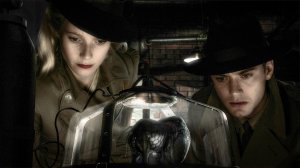
Perhaps Conran was prescient because he has no other feature film credits in the ensuing twenty years. There was a point where he was attached for the big screen John Carter of Mars adaptation (as was Robert Rodriguez at one point) but he eventually left for unknown creative reasons. Considering how much buzz Sky Captain had as a project from an unknown outside the system, you might think it would serve as a proof of concept to at least get Conran to helm some other mid-level studio project.
The lasting legacy of Sky Captain and the World of Tomorrow will be its look, now replicated by many studio blockbusters, though Conran and his team did so without the same studio coffers. The thing I’ll remember most about Sky Captain isn’t my own enjoyment but my father;s a man who grew up reading pulp sci-fi magazines, watching saucer men movies, and instilling in me a love of older movies. I remember the delight this movie seemed to unleash inside him, returning him to a euphoric sense of his childhood. That’s the association I’ll have with this movie, even if my own entertainment level and appreciation has noticeably dipped in twenty years. I know there are other fans out there who may feel that same childlike wonder and glee from the movie. I hope you do, dear reader. For me, for now, it’s like seeing behind the magic trick and wishing you could still feel the same current of exhilaration. Alas.
Nate’s Grade: C
Share this:

The Village (2004) [Review Re-View]
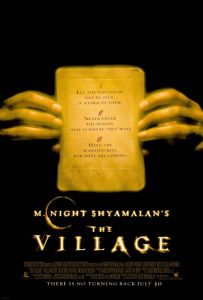 Originally released July 30, 2004:
When saying director names you can play a fun little game of word association. Someone says, “George Lucas,” and things like big-budget effects, empty storytelling, and wooden dialogue come to mind. Someone says, “David Lynch,” and weird, abstract, therapy sessions dance in your head. The behemoth of word association is M. Night Shyamalan. He burst onto the scene with 1999’s blockbuster, The Sixth Sense, a crafty, moody, intelligent thriller with a knock-out final twist. Now, though, it seems more and more evident that while The Sixth Sense was the making of M. Night Shyamalan, it also appears to be his undoing. His follow-up films, Unbreakable and Signs, have suffered by comparison, but what seems to be hampering Shyamalan’s growth as a writer is the tightening noose of audience expectation that he kowtows to.
With this in mind, we have Shyamalan’s newest cinematic offering, The Village. Set in 1897, we follow the simple, agrarian lives of the people that inhabit a small secluded hamlet. The town is isolated because of a surrounding dense forest. Mythical creatures referred to as Those We Dont Speak Of populate the woods. An uneasy truce has been agreed upon between the creatures and the villagers, as long as neither camp ventures over into the others territory. When someone does enter the woods, foreboding signs arise. Animals are found skinned, red marks are found on doors, and people worry that the truce may be over. Within this setting, we follow the ordinary lives of the townsfolk. Ivy Walker (Bryce Dallas Howard) is the daughter of the towns self-appointed mayor (William Hurt), and doesn’t let a little thing like being blind get in the way of her happiness. She is smitten with Lucius (Joaquin Phoenix), a soft-spoken loner. Noah (Adrien Brody), a mentally challenged man, also has feelings for Ivy, which cause greater conflict.
 Arguably, the best thing about The Village is the discovery of Howard. She proves herself to be an acting revelation that will have future success long after The Village is forgotten. Her winsome presence, wide radiant smile, and uncanny ability to quickly endear the character of Ivy to the audience. She is the only one onscreen with genuine personality and charisma, and when shes flirting and being cute about it you cannot help but fall in love with her. And when she is being torn up inside, the audience feels the same emotional turmoil. I am convinced that this is more so from Howard’s acting than from the writing of Shyamalan. She reminds me of a young Cate Blanchett, both in features and talent.
It seems to me that Shyamalan’s directing is getting better with every movie while his writing is getting proportionately worse. He has a masterful sense of pacing and mood, creating long takes that give the viewer a sense of unease. The first arrival of the creatures is an expertly handled scene that delivers plenty of suspense, and a slow-motion capper, with music swelling, that caused me to pump my fist. The cinematography by Roger Deakins is beautifully elegant. Even the violin-heavy score by James Newton Howard is a great asset to the film’s disposition.
So where does the film go wrong and the entertainment get sucked out?
What kills is its incongruous ending. Beforehand, Shyamalan has built a somewhat unsettling tale, but when he finally lays out all his cards, the whole is most certainly not more than the sum of its parts. In fact, the ending is so illogical, and raises infinitely more questions than feeble answers, that it undermines the rest of the film. Unlike The Sixth Sense, the twist of The Village does not get better with increased thought.
Shyamalan’s sense of timing with his story revelations is maddening. He drops one twist with 30 minutes left in the film, but what’s even more frustrating is he situates a character into supposed danger that the audience knows doesn’t exist anymore with this new knowledge. The audience has already been told the truth, and it deflates nearly all the tension. It’s as if Shyamalan reveals a twist and then tells the audience to immediately forget about it.
 Shyamalan also exhibits a problem fully rendering his characters. They are so understated that they don’t ever really jump from the screen. The dialogue is very stilted and flat, as Shyamalan tries to stubbornly fit his message to ye olde English vernacular (which brings about a whole other question when the film’s final shoe is dropped). Shyamalan also seems to strand his characters into soap opera-ish subplots involving forbidden or unrequited love. For a good hour or so, minus one sequence, The Village is really a Jane Austin story with the occasional monster.
The rest of the villagers don’t come away looking as good as Howard. Phoenix’s taciturn delivery seems to suit the brooding Lucius, but at other times he can give the impression of dead space. Hurt is a sturdy actor but can’t find a good balance between his solemn village leader and caring if sneaky father. Sigourney Weaver just seems adrift like she’s looking for butter to churn. Brody is given the worst to work with. His mentally-challenged character is a terrible one-note plot device. He seems to inexplicably become clever when needed.
The Village is a disappointment when the weight of the talent involved is accounted for. Shyamalan crafts an interesting premise, a portent sense of dread, and about two thirds of a decent-to-good movie, but as Brian Cox said in Adaptation, ”The last act makes the film. Wow them in the end, and you’ve got a hit. You can have flaws and problems, but wow them in the end, and you’ve got a hit.” It’s not that the final twists and revelations are bad; it’s that they paint everything that came before them in a worse light. An audience going into The Village wanting to be scared will likely not be pleased, and only Shyamalan’s core followers will walk away fully appreciating the movie. In the end, it may take a village to get Shyamalan to break his writing rut.
Nate’s Grade: C+
——————————————————
WRITER REFLECTIONS 20 YEARS LATER

Usually in the M. Night Shyamalan narratives, 2004’s The Village is where the cracks first started to show in the filmmaker’s game. While 2000’s Unbreakable didn’t exactly reach the box-office successes of The Sixth Sense and Signs, it still earned $250 million worldwide and was definitely ahead of the cultural curve, introducing a grounded superhero story before the oncoming wave of superhero cinema. No, it was The Village that started the questioning over whether Shyamalan’s need for big twist endings was hampering his creativity. While still earning almost the exact same box-office as Unbreakable, The Village was seen with more hesitation, a cautionary tale about a filmmaker, as Matt Singer recently put it, flying a little too close to the sun. From here, Shyamalan entered his down period, from 2006’s Lady in the Water, to 2008’s The Happening, and the big-budget sci-fi misfits of 2010’s Last Airbender and 2013’s After Earth. This was the beginning of the general public becoming wise to Shyamalan’s tricks.
The real kicker is that, twenty years later, it’s clear to me that The Village is two-thirds of a good-to-great movie, ultimately undone by the unyielding desire to juice up the proceedings with an outlandish twist ending. For that first hour, Shyamalan has done a fine job of dropping us into this outdated community, learning their rules and restrictions, and gradually feeling the dread that the old ways might not protect them from the monsters just along the boundaries. There’s an efficiency and confidence to that first hour, with carefully planned shots that establish key points of information, like little girls panicking at the sight of a red flower and burying it in the ground before going back to their chores. The cinematography is elegant and moody, and the violin-soaring score by James Newton Hoard is a consistent emotive strength. The first encounter with the monsters roaming around the town is fraught with tension, especially as our one character holds out her hand waiting for her friend/love interest to return. The cloaked monsters are also just a cool design, with their long claws and porcupine-like frills extending from their hides.
 The greatest strength is Bryce Dallas Howard (Jurassic World) as our surprise protagonist, Ivy, daughter of the community founder, Edward Walker (William Hurt). Howard had made small cameo roles in her father’s films, but she was cast by Shyamalan after he watched her perform on stage. She is spellbinding as Ivy, a woman of great vulnerability and strength, of integrity and charisma. The scene where she sits down on the porch beside Lucius (Joaquin Phoenix) and dance around the edges of flirting is sensational, and when she talks about seeing people’s colors, or auras, and then smirkingly whispers, “No, I will not tell you your color, stop asking,” in the same breath, I defy anyone not to fall in love with her like poor Lucius. This simple love story actually works well. Lucius is an introverted man given to great emotions he doesn’t know how to fully express, which pairs nicely with the chatty and ebullient Ivy. The protagonist shift works wonderfully as well. For the first hour we believe we’re following Lucius as our main character, especially since at this point Phoenix’s star power was rising and Howard had none. Then, with the sudden sticking of a knife, Lucius is taken down and the movie becomes Ivy’s story and her quest to save her beloved. Her cry of not being able to see Lucius’ color is a well-coordinated punch to the gut. This is an example of a rug pull that really works, elevating the stakes and presenting the real star, the girl so many have overlooked for one reason or another, who will be our hero when we need her most.
But then it all falls apart for me once Shyamalan reveals two twists: 1) the monsters are not real, merely costumes the adults wear to enforce their rules through fear, 2) the setting of this village is not 1897 but modern-day, with the villagers living in a secluded nature preserve. Apparently, Edward was able to gather enough violent crime victim relatives to begin this experiment in “returning to our roots.” He served as an American History professor, so who better than to create a thriving community? You know how to establish safe drinking water there, my guy? How about cabin-building? I assume one of the elders must have had some wealth as it’s revealed later, via Shyamalan’s onscreen cameo role, that the government got paid off to stop having airplanes fly over the nature preserve. I actually kind of hate this twist. It feels the most superfluous of all Shyamalan’s fabled twist endings. I was genuinely enjoying the movie and how it was spinning up until this point, but Shyamalan cannot leave well enough alone. I get that Shyamalan is crafting an allegory for the War on Terror and the constant anxiety of post-9/11 America, replete with color codes meant to serve as warning signs. I get that we’re meant to find the town elders as villains, keeping their community repressed through the fear of convenient monsters. The lessons are there to dissect, but I’m disappointed because I was enjoying the allegory on its literal level more than its intended themes. It’s also because I feel like the twists overburden the movie’s charms.
 Another reason the twist really falters is that it creates all sorts of nagging questions that sabotage whatever internal logic had been earlier accepted. Adults deciding to break free from modern society so they can start their own secluded LARP community can work as a premise, but it requires a lot more examination that cannot happen when it’s slotted as a concluding twist. Imagine the kind of determination it would take to retreat from modern society and rekindle an agrarian life from hundreds of years ago. That means abandoning all your family, friends, the comforts of modern-day, and the sacrifices could have been explored, but again, it’s just a twist. There are present-day communities, most famously the Amish, that shun the technological advances of modern society to retain an outdated sense of homespun culture and religious community, but often the members have grown up in this culture already. Regardless, retreating into the woods to start your own 18th century cosplay is a commitment, but when you know all the adults are in on this secret, why are they staying in character at all times? When it’s just two adults talking to one another, why are they keeping to their “characters” and talking in that antiquated jargon and syntax? Is it collective Method acting? Is it a sign they’ve ref-ramed what they consider normal? Have they gone so deep that their muscle memory is to say “thee” and “thou” vernacular in the mirror? They went through this elaborate facade because they lost people in the “real world,” but human impulses, violence, and accidents can occur in any community, no matter if you got cell phones or pitchforks. It starts to gnaw away at the tenuous reality of the scenario, a reality I was accepting until the late rug pull.
It also eliminates some of the stakes of Act Three when Ivy travels beyond the boundaries and may face the wrath of the monsters. It’s maddening that Shyamalan reveals the monsters are not real, mere tools to scare the children into obedience, and then has a supposed suspense sequence where Ivy stumbles upon a thicket of red flowers, the dreaded color the monsters hate. But wait, you might recall, there are no monsters, so then why does it matter? When you realize that her dad could just have taken a hike and driven to a drug store to gather medical supplies, without the supernatural threat keeping them confined, it kind of seems silly. Here you were, worried about the fate of this blind girl, when there’s no reason she had to even venture into this danger because one of the adults could have performed the same task without risking their big secret. I know they think Ivy’s blindness might uphold their secret, but why even risk her possible danger from falling down a hill she couldn’t see or a rock that twists her ankle? Her dad would rather have his blind daughter venture into the woods than do this trek “to the next town” himself. At the same time, her personal journey outside the community is robbed of the supernatural danger and it also re-frames the father as someone burdening his blind daughter with a task he could have achieved. He says she has the power of love and that will guide here, but you know a compass could also help. You could make the argument that maybe his guilt was eating away at upholding such a big secret, maybe he wanted to get caught, but I don’t buy it. Edward argues with his fellow elders that it is the next generation that will keep hold to their traditions and ways of life, and they must ensure this survival. That doesn’t sound like the perspective of a man wishing to break apart the close-knit community he helped build.
 What to make of Adrien Brody’s mentally challenged character, Noah? He’s living in a time that doesn’t know how to handle his condition, but he’s also set up as a quasi-villain. He’s the one who stabs Lucius out of jealousy that Ivy favors him. He’s the one who breaks free, steals a monster get-up, and antagonizes Ivy in the woods. He also falls into a pit and dies alone. I don’t really know how to feel about this character because I don’t think Shyamalan exactly knows what to do with him.
Having recently re-read my original 2004 review, I’m amazed that I am sharing almost the exact same response as I did with my younger self. Even some of the critical points have similar wording. My concluding summation still rings true for me: “It’s not that the final twists and revelations are bad; it’s that they paint everything that came before them in a worse light.” You can rightly tell an allegorical story about people rejecting modern society and living a secluded and hidden life. You can rightly tell a story about adults posing as monsters to keep their children in line and obedient. However, if you’re going to be telling me that story, don’t supply an hour’s worth of setup that will be damaged from these revelations. After The Village, it was a steady decline for the filmmaker once dubbed “the next Spielberg” until 2017’s stripped down thriller Split, anchored by a tour de force performance from James McAvoy. It’s frustrating to watch The Village because it has so much good to offer but ultimately feels constrained by the man’s need to follow a formula that had defined him as a mass market storyteller. This was a turning point for Shyamaln’s fortunes, but the quality of The Village has me pleading that he could have shook off the need for ruinous twists and just accepted the potency of what was already working so well.
Re-View Grade: B-
Share this:

Garden State (2004) [Review Re-View]
 Originally released July 28, 2004:
Zack Braff is best known to most as the lead doc on NBC’s hilarious Scrubs. He has razor-sharp comic timing, a goofy charisma, and a deft gift for physical comedy. So who knew that behind those bushy eyebrows and bushier hair was an aspiring writer/director? Furthermore, who would have known that there was such a talented writer/director? Garden State, Braff’s ode to his home, boasts a big name cast, deafening buzz, and perhaps, the first great steps outward for a new Hollywood voice.
Andrew Large Largeman (Braff) is an out-of-work actor living in an anti-depressant haze in LA. He heads back to his old stomping grounds in New Jersey when he learns that his mother has recently died. Andrew has to reface his psychiatrist father (Ian Holm), the source of his guilt and prescribed numbness. He has forgotten his lithium for his trip, and the consequences allow Andrew to begin to awaken as a human being once more. He meets old friends, including Mark (Peter Sarsgaard), who now digs graves for a living and robs them when he can. He parties at the mansion of a friend made rich by the invention of silent Velcro. Things really get moving when Andrew meets Sam (Natalie Portman), a free spirit who has trouble telling the truth and staying still. Their budding relationship coalesces with Andrews re-connection to friends, family, and the joys life can offer.
 Braff has a natural director’s eye for visuals and how to properly use them to convey his characters’ feelings. A scene where Andrew wears a shirt and blends into the wall is a perfect visual note on the character’s sleep-walk through life. Braff’s writing is also familiar but satisfyingly unusual, like a repackaging of old stories told with a confident voice. His characters are interesting and memorable, but don’t feel uselessly quirky, unlike the creations of other first-time indie writers. The melancholy coming-out of Andrew from disconnected schlub to post-pharmaceutical hero really grabs the audience and gives them a rooting point. At times, though, it seems as though Braff may be caught up trying to craft a movie that speaks to a generation, and some will see Garden State as a generation’s voice of a yearning to feel connected.
Braff deserves a medal for finally coaxing out the actress in Portman. She herself has looked like an overly medicated, numb being in several of her recent films (Star Wars prequels, I’m looking in your direction), but with her plucky, whimsical role in Garden State, Portman proves that her careers acting apex wasn’t in 1994’s The Professional when she was 12. Her winsome performance gives Garden State its spark, and the sincere romance between Sam and Andrew gives it its heart.
Sarsgaard is fast becoming one of the best young character actors out there. After solid efforts in Boys Don’t Cry and Shattered Glass, he shines as a coarse but affectionate grave robber that serves as Andrew’s motivational elbow-in-the-ribs. Only the great Holm seems to disappoint with a rare stilted and vacant performance. This can be mostly blamed on Braff’s underdevelopment of the father role. Even Method Man pops up in a very amusing cameo.
The humor in Garden State truly blossoms. There are several outrageous moments and wonderfully peculiar characters, but their interaction and friction are what provide the biggest laughs. So while Braff may shoehorn in a frisky seeing-eye canine, a knight of the breakfast table, and a keeper of an ark, the audience gets its real chuckles from the characters and not the bizarre scenarios. Garden State has several wonderfully hilarious moments, and its sharp sense of humor directly attributes to its high entertainment value. The film also has some insightful looks at family life, guilt, romance, human connection, and acceptance. Garden State can cut close like a surgeon but it’s the surprisingly elegant tenderness that will resonate most with a crowd.
 Braff’s film has a careful selection of low-key, highly emotional tunes by artists like The Shins, Coldplay, Zero 7, and Paul Simon. The closing song, the airy Let Go by Frou Frou, has been a staple on my playlist after I heard it used in the commercials.
Garden State is not a flawless first entry for Braff. It really is more a string of amusing anecdotes than an actual plot. The film’s aloof charm seems to be intended to cover over the cracks in its narrative. Braff’s film never ceases to be amusing, and it does have a warm likeability to it; nevertheless, it also loses some of its visual and emotional insights by the second half. Braff spends too much time on less essential moments, like the all-day trip by Mark that ends in a heavy-handed metaphor with an abyss. The emotional confrontation between father and son feels more like a baby step than a climax. Braff’s characters also talk in a manner that less resembles reality and more resembles snappy, glib movie dialogue. It’s still fun and often funny, but the characters speak more like they’ve been saving up witty one-liners just for the occasion.
Garden State is a movie thats richly comic, sweetly post-adolescent, and defiantly different. Braff reveals himself to be a talent both behind the camera and in front of it, and possesses an every-man quality of humility, observation, and warmth that could soon shoot him to Hollywood’s A-list. His film will speak to many, and its message about experiencing lifes pleasures and pains, as long as you are experiencing life, is uplifting enough that you may leave the theater floating on air. Garden State is a breezy, heartwarming look at New York’s armpit and the spirited inhabitants that call it home. Braff delivers a blast of fresh air during the summer blahs.
Nate’s Grade: B
——————————————————
WRITER REFLECTIONS 20 YEARS LATER
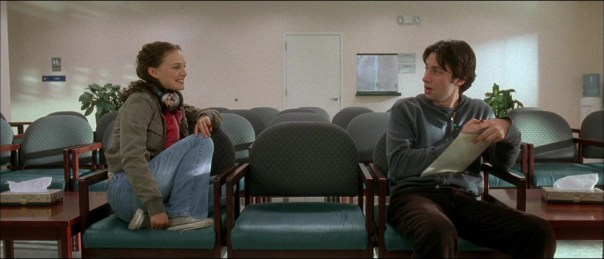
In the summer of 2024, there were two indie movies that defined the next years of your existence. If you were under 18, it was Napoleon Dynamite. If you were between 18 and 30, it was Garden State. Zack Braff’s debut as writer/director became a Millennial staple on DVD shelves, and I think at one time it might have been the law that everyone had to own the popular Grammy-winning soundtrack. It wasn’t just an indie hit, earning $35 million on a minimal budget of $2.5 million; it was a Real Big Deal, with big-hearted young people finding solace in its tale of self-discovery and shaking loose from jaded emotional malaise. If you had to determine a list of the most vital Millennial films, not necessarily on quality but on popularity and connection to the zeitgeist, then Garden State must be included. Twenty years later, it’s another artifact of its time, hard to fully square outside of that influential period. It’s a coming-of-age tale wrapped up in about every quirky indie trope of its era, including a chief example of the Manic Pixie Dream Girl, even though that term was first coined from the AV Club review of 2005’s Elizabethtown. Twenty years later, Garden State still has some warm fuzzies but loses its feels.
 Andrew Largeman (Braff) is a struggling actor in L.A. who returns to his hometown in New Jersey to attend the funeral of his mother. Right there we have the prodigal son formula mixed with the return-to-your-roots formula, wherein the cynical figure needs to learn about the important things they’ve forgotten from the good people they left behind for supposed bigger and better things in the big city. There’s a lot of familiarity with Garden State, both intentionally and unintentionally. It’s meant to evoke the loose, rougher-edged romantic comedies of Hal Ashby and older Woody Allen. It certainly feels more like a series of scenes than a united whole, and that can work in Braff’s favor. His character has gone off his meds for the first time since he was a child, and he’s experiencing a personal reawakening. He’s opening himself up more to the people and possibility of the world, so the movie works more on a thematic level to unify itself rather than strictly from a foundational plot with key turns. If you can connect on that relatable level, then you will likely be able to experience the same whimsy and enchantment that so many felt back in 2004. However, with twenty years of distance, I now see more seams than when I was but a wide-eyed 22-year-old romantic. Andrew is more a reactive symbol, more personified by his hardships or inability to chart a path for himself than by a personality. He’s easily eclipsed by the quirky characters dancing all around him, with Braff smiling ever so wryly at the sweet mysteries of life. This stop-and-smell-the-roses approach was also explored in 2014’s Wish I Was Here, Braff’s directing follow-up that placed him as a family man questioning himself amidst marital malaise. This movie was far less celebrated, I think, because of the thematic redundancy but also because Braff was playing an older character that needed to, kind of, grow up. It was more tolerable when Braff was playing a mid-20s melancholic experiencing his first brush with romantic love. Less so ten years later.
Natalie Portman had been an actress that I was more cool over until 2004 with the double-whammy of Garden State and her Oscar-nominated turn in Closer. She’s since become one of the most exciting actors who goes for broke in her performances whether they might work or not. In 2004, I thought her performance in Garden State was an awakening for her, and in 2024 it now feels so starkly pastiche. Bless her heart, but Portman is just calibrated for the wrong kind of movie. Her energy level is two to three times that of the rest of the movie, and while you can say she’s the spark plug of the film, the jolt meant to shake Andrew awake, her character comes across more as an overwritten cry for help. Sam is even more prototypical Manic Pixie Dream Girl (MPDG) than Kirsten Dunst’s bouncy character in Elizabethtown. Her entire existence is meant to provoke change upon our male character. This in itself is not an unreasonable fault; many characters in numerous stories are meant to represent a character’s emotional state. It’s just that there isn’t much to Sam besides a grab-bag of quirky characteristics: she’s a compulsive liar, though nothing is ever really done with this being a challenge to building lasting bonds; she’s incapable of keeping pets alive, and Andrew could be just another pet; she’s consumed with being unique to the point of having to stand up and blurt out nonsense words to convince herself that nobody in human history has duplicated her recent combination of sounds and body gestures, but she’s all archetype. She exists to push Andrew along on his reawakening, including introducing him and us to The Shins (“This song will change your life”). She’s entertaining, and Portman is charming, but it’s an example of trying so hard. I thought her cheeks must have hurt from holding a smile so long. I’m sure Braff would compare Sam to Annie Hall, as Diane Keaton was perhaps the mold for the MPDG, except she more than stood on her own and didn’t need a nebbish man to complete her.
 There are some enjoyable moments. It’s funny to watch a young Jim Parsons in a suit of armor eating breakfast cereal and expounding the romance language of Klingon. It’s funny to have a meet-cute in a doctor’s office while Andrew is repeatedly humped by a dog with personal boundary issues. It’s fun to go on a madcap journey around town with your former high school friend-turned-gravedigger that ends up in a sinkhole in a quarry, where characters can literally scream into the void. It’s darkly funny to run into a former classmate who became a cop who is still a screw-up except now he has authority. It’s poignant to listen to Andrew’s story about accidentally paralyzing his mother when he was an angry young child who, in a fit of rage, pushed her, and she hit her head on a faulty dishwasher latch. Given all these elements an overview, it feels like Garden State was Braff’s very loose collection of ideas and stories, jokes and bits collected over the years. It’s entertaining and quirky and silly and occasionally poignant, but it’s never more than the sum of its parts. Garden State wants to be about a man changing his life and perspective, but it’s really more a Wizard of Oz-style journey through the quirky indie backlot of kooky Jersey characters. The scenes with Andrew’s distant father (Ian Holm) feel too removed to have the catharsis desired. He feels like an absent character from the movie, so why should we overly value this father-son reconciliation?
Admittedly, that soundtrack is still a banger. It soars when it needs to, like Imogen Heep’s “Let Go” over the race-back-to-the-girl finale, and it’s deftly somber when it needs to, like Iron and Wine’s cover of “Such Great Heights” and “The Only Living Boy in New York” paired with our big movie kiss. It’s such a cohesive, thematic whole that lathers over the exposed seams of the movie’s scenic hodgepodge. Braff tried to find similar magic with his musical choices for 2006’s The Last Kiss, a movie he starred in but did not direct (he also provided un-credited rewrites to Paul Haggis’ adapted screenplay). That soundtrack is likewise packed with eclectic artists (he even snags Aimee Mann) but failed to resonate like Garden State. It’s probably because nobody saw the movie and Braff’s character was, as I described in my 2006 review, an overgrown man-child afraid his life lacks “surprises” now that he was going to be a father. Sheesh.
 Garden State is a movie that is winsome and amusing but also emblematic of its early 2000s era, of young people yearning to feel something in an era where we were afraid of feeling too much because of how painful the real world stood to be as an adult. Rejecting pain is rejecting the full human experience, which we even learned in Inside Out. There could have been a richer examination on parental desire to protect children from experiencing pain but creating more harm than good (kind of the theme of 2018’s God of War reboot). It’s just not there. My original review was far more smitten with the movie, doubled over by Portman’s performance and the effectiveness of Braff as a writer and a director. My criticisms at the end of my 2004 review are all shared with my present-day self, especially the dialogue: “Characters also talk in a manner that less resembles reality and more resembles snappy, glib movie dialogue. It’s still fun and often funny, but the characters speak more like they’ve been saving up witty one-liners just for the occasion.” I’d downgrade the movie ever so slightly, though there is still enough charm and whimsy to separate it from its twee indie brethren. In 2004, Garden State felt like a seminal movie for a breakthrough filmmaker. Now it feels like a fitfully amusing rom-com with slipshod plotting and a supporting character that needed re-calibration.
Re-View Grade: C+
Share this:

Napoleon Dynamite (2004) [Review Re-View]
 Originally released June 11, 2004:
Napoleon Dynamite was an audience smash at the 2004 Sundance film festival. Fox Searchlight jumped at the chance to distribute a film written and directed by Mormons, starring a Mormon, and set in film-friendly Idaho. MTV Films, the people behind alternating good movies (Better Luck Tomorrow, Election) and atrocious movies (Crossroads, Joe’’s Apartment, an upcoming film actually based on Avril Lavigne’s “Sk8r Boi” song), came aboard and basically said, “Look, we really like the movie, and we want to help bring it to a wider, MTV-influenced audience.” And thus, Napoleon Dynamite seems to have become the summer biggest must-see film for sk8r bois and sk8r grrrls nationwide.
Napoleon Dynamite (John Heder) is an Idaho teen that marches to the beat of his own drum. He lives with his Dune Buggy riding grandmother and 31-year-old brother Kip (Aaron Ruell), who surfs the Web talking to women. When their grandma gets injured, Uncle Rico (John Gries), stuck in the 80s in fashion and mind, takes up shop in the Dynamite home and coerces Kip to hustle money from neighbors. Meanwhile, Napoleon befriends Deb (Tina Majorino), an otherwise normal girl with a sideways ponytail, and Pedro (Efren Ramirez, who was actually in Kazaam!), the new kid at school. Together, they try and get Pedro elected to class president, but standing in their way is the mighty shadow of Summer (Haylie Duff), the most popular girl in school. Oh yeah, there’’s also a llama.
 First time director, Jared Hess, and first time cinematographer, Munn Powell, orchestrate shots very statically, with little, simple camera movements and many centered angles. The style is reminiscent of the films of Todd Solondz (Welcome to the Dollhouse), or, more precisely, Wes Anderson. This shooting technique makes the characters stand out even more, almost popping out at you behind flat backgrounds like some Magic Eye picture. Hess easily communicates the tedium of Idaho with his direction. Can anyone name any other film that takes place entirely in Idaho? (Please note that My Own Private Idaho takes place in Portland and Seattle, mostly).
The star of the show is, of course, Heder. His wickedly funny deadpan delivery helps to create a truly memorable character. He achieves a geek Zen and, judging from the incredible amount of kids under-14 that appeared both times I saw this film, is most likely the greatest film realization of a dork. It’s grand dork cinema, a genre long ignored after the collapse of the mighty Revenge of the Nerds franchise. So while Napoleon isn’’t exactly relatable (llamas, Dune Buggy grannies and all), the right audience will see reflections of themselves. You’’ll be quoting from Napoleon all summer.
Napoleon Dynamite is going to be an acquired taste. It’s filled to the brim with stone-faced absurdities and doesn’’t let up. If you’’re not pulled in with the bizarre antics of bizarre characters in the first 10 minutes, then you may as well leave because otherwise it will feel like the film is wearing you down with its “indie weirdness.” Napoleon Dynamite seems to skirt the sublimely skewed world of Wes Anderson, but Napoleon lacks the deep humanity of Anderson’s films. What the audience is left with is a sugary, sticky icing but little substance beneath, and, depending on your sweet tooth, it’’ll either be overpowering and a colossal disappointment or it’’ll taste just right for the occasion. Alright, I’’m done with baking analogies for the year.
 Some will find a certain condescension against the characters. Napoleon Dynamite doesn’’t outright look down upon its characters, but it does give them enough room to paint themselves fools. Uncle Rico is really the film’s antagonist, yet he’s too buffoonish to be threatening. It’’s a fine line for a film to have condescension toward its characters, but Napoleon Dynamite ultimately leaves with a bemused appreciation for its characters. The film presents the “good” characters as unusual but lovable and ready for growth (Kip, Pedro, and of course Napoleon), but the “bad” characters (Summer, Uncle Rico) aren’’t demonized. In essence, Napoleon Dynamite is the best example of a film that makes an audience laugh at and with its characters simultaneously.
Napoleon Dynamite is assuredly an odd duck. Some will cheer; others will want to head out the door after a few minutes. It’’s hard to say which reaction an individual will have. If you have a geek-enriched history populated with unicorns, Dungeons and Dragons, and/or social ostracism, then you may be more inclined to admire Napoleon Dynamite. I laughed out loud throughout the film and found it to be an enjoyable diversion, and I went the whole review without one Jimmy Walker reference.
Nate’s Grade: B
——————————————————
WRITER REFLECTIONS 20 YEARS LATER

I feel like trying to explain the unexpected pop-culture success of Napoleon Dynamite is a fool’s errand, ultimately leaving one sputtering out and ending with the disappointing culmination, “Well, you just had to be there, I guess.” It was 2004, before the rise of YouTube and dominant social media outlets, and for whatever reason, if you were under 30, you probably fell in love with this Idaho nerd, or at least fell in love sounding like this Idaho nerd. I couldn’t travel more than a few blocks without overhearing some loitering Millennial uttering, “Gawsh” in mock exasperation, or mentioning llamas, tater tots, ligers, or catching a significant other a “delicious bass.” If you can recall how annoying and omnipresent the Borat impressions were after that 2006 movie’s mainstream splash, well the silver lining to every person, usually a smirking male member of the species, saying, “My wiiiiiiife,” was that it finally pushed aside everyone else endlessly imitating Napoleon Dynamite (John Heder). This movie was everywhere in 2004. It was meme-ified before meme culture became prevalent. Re-watching this movie twenty years later is like excavating a novelty from a different time and trying to better analyze why this silly and stupid little movie about weirdos living their weird lives became a zeitgeist breakout.

If I had to explain the appeal of Napoleon Dynamite, I think it serves as the next step in the evolution of comedy for younger adults. The Muppets are a deservedly celebrated comedy troupe for over 50 years, and beyond the iconic characters and their mirthful camaraderie, I think their ongoing appeal is that it’s an introduction to the forms of irony for younger children. It’s teaching that there can be more behind the silly, and Napoleon Dynamite takes that PG-comedy baton and pushes it forward, as its entire being is one of ironic comedy. The entire movie is built upon the viewer finding the behavior and banter of these characters hilarious for being so straight. There aren’t really jokes in the traditional sense of setups and payoffs; every line has the potential to be a joke because it’s a character saying something ridiculous without the awareness of being ridiculous. As I said back in 2004, “If you’’re not pulled in with the bizarre antics of bizarre characters in the first 10 minutes, then you may as well leave because otherwise it will feel like the film is wearing you down with its “indie weirdness.” Perhaps this style of comedy, a feature fully dedicated to ironic detachment, served as an awakening for others in my age-range, who championed the absurdity of the everyday and lionized the liger-loving man. This movie doesn’t achieve the larger artistic ambitions in a heightened tone of a Wes Anderson or a Yorgos Lanthimos, two masters of droll deadpans. It’s not deep. It’s not complicated. It’s always obvious, but that made the comedy all the more accessible to so many, especially for younger teens and kids.
As a movie, Napoleon Dynamite can be overwhelming. Seeing any clip of this movie serves the same comedy function as watching the entire 96-minute experience. It helps to structure the movie around a nerd’s quest to win over the girl and help his fellow outcasts. It has a recognizable us-versus-them formula where we can root for the weirdos to, if not prove their naysayers wrong, at least prove to one another that they have found acceptance from the ones who matter. It works on that familiar territory. Napoleon’s big dance at the talent show is his triumph, showcasing to the rest of the school his skills, though he runs away before the adulation can be felt, robbing his character of the perceived victory but giving it to the audience instead.

For most of the people involved in this movie, they had a brief burst of wider success before gradually coming back down to Earth. Heder was the obvious breakout and was given bigger supporting roles in studio comedies like Just Like Heaven, School for Scoundrels, Blades of Glory, and Surf’s Up, the other animated penguin movie from 2006. Heder has worked almost exclusively in the realm of voice acting in the last decade, including 2024’s Thelma the Unicorn, directed by Jared Hess and co-written by Jared and his wife Jerusha, the same creative team that gave us Napoleon Dynamite. I never really vibed with any other Hess comedy. I didn’t get the love for 2006’s Nacho Libre, and from there the movies just got worse to unwatchable, like Gentlemen Broncos and Don Verdean, each trying to chase that same combination of detached irony and quirk that proved so successful for them in 2004. I think the inability to follow-up Napoleon Dynamite with another breakout comedy of its ilk speaks to the unpredictable nature of assembling the right mixture of actors, tone, and material, as well as good timing. Would Napoleon Dynamite have been as big a success in 2009 as opposed to 2004? Maybe not. There was a six-episode animated TV series version in 2012, and the fact that I never remembered this probably answers the question over whether the filmmakers got lucky in 2004.
Napoleon Dynamite is the exact same movie it was back in 2004 as it now resides in 2024, and forever more. It’s flat, detached, silly, light-hearted and the same joke on repeat, and if you feel yourself gravitating toward that comedy wavelength, then hop on and enjoy. Re-watching it for me was like revisiting a fad from the past that was hard to put into context. What was it that made so many buy “Vote for Pedro” T-shirts and talk about throwing footballs over mountains? Comedies more than any other movie lend themselves to audience dissemination, to take the jokes and moments and characters and run with them. Nearly every successful comedy has experienced some form of this, so why should Napoleon Dynamite be any different? It’s perfectly understandable to watch this movie unfazed, unamused, and questioning what exactly people found so amusing about this guy and his extended family and friends back in 2004. It’s also understandable to smile and chuckle at the absurdities played so matter-of-factly. Gawsh.
Re-View Grade: B-
Share this:

Van Helsing (2004) [Review Re-View]
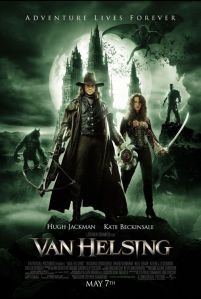
Originally released May 7, 2004:
Crossover movies have a distasteful history in the world of cinema. Some movie exec gets the notion, “Hey, why can’t two great tastes taste great together?” But what we’re left with is usually uninspired (The Flintstones Meet the Jetsons notwithstanding). Crossovers for horror movies are the worst of the lot. For every Freddy vs. Jason there’s a dud, like 1966’s Jesse James meets Frankenstein’s Daughter. That year went down in the annals of cinematic history, however, as it also gave us Billy the Kid versus Dracula, marking two entries in the expanding genre of cowboys battling famous monsters (as far as I know, this genre still stands at two movies). So what can one expect from Van Helsing, a big-budget creature feature that includes Dracula, Frankenstein, and the Wolfman?
Van Helsing (Hugh Jackman and a really big hat) is a secret soldier for a covert order of the Vatican. This covert order dispatches monsters and creepy-crawlies the world over. He’s been ordered to assist Anna Valerious (Kate Beckinsale), the last in a Romanian family line that has sought to kill the infamous Dracula (Richard Roxburgh). It seems that their family line is dwindling. And Anna’s brother being turned into a werewolf doesn’t help the situation. If her family line dies before Dracula then they cannot enter heaven. Van Helsing comes to town to help out the locals who are terrorized by Dracula’s flying brides. Van Helsing effectively kills one of the vamp ladies and is celebrated as a hero by the village. As he gets closer to Anna he also learns more about his own mysterious past and his connection to a certain figure with big teeth.
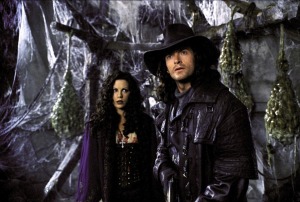
The Big D has a dastardly plan. He wants to find Frankenstein’s monster (Shuler Hensley) to channel enough power through him to awaken zillions of goo-sacks harboring the vamp’s undead brood. Of course, Frankenstein’s monster isn’t too keen on this. Together, he and Van Helsing, with the help of Anna as well as a comic relief monk, battle to stop Dracula from unleashing his children of the night.
Van Helsing is stupid, stupid, stupid. Director Stephen Sommers exists in his own indulgent world where bigger is better and some CGI spackle will fix any plot holes. He makes check-your-brain-at-the-door popcorn movies, but a “popcorn movie” is no excuse to forgive a rambling, incoherent, loud, stupid mess. I liked the first Mummy flick and even found some good with the second, but Van Helsing is Sommers at his rock-bottom worst, gorging on a trough of special effects and vomiting the results onto the big screen. Sommers’ idea of character development is knocking people through walls like they were in a Looney Tunes cartoon.
Van Helsing raises some interesting questions, like why do Dracula’s brides morph into flying demons that are conveniently genitalia-free? Why does a werewolf rolling over the top of a carriage somehow cause it to catch on fire? Why does Dracula keep his magic lycanthropy cure in the open? It doesn’t matter. Van Helsing is so straight-laced about its absurdities that questioning them will just get tiresome.
Not that you would expect much, but the acting in Van Helsing is bad. Beckinsale’s accent couldn’t be less convincing if her role were played by Charo. The trio of Dracula’s brides are played by swimsuit models and let me just say their performance is on par with what you would expect from swimsuit models. Roxburgh is quite possibly the worst vampire in the modern history of vampires, and that includes Blacula, Count Chocula and Tom Cruise. He couldn’t look any less sinister if he was in a diaper and bonnet. What’s up with those strands of hair that dangle in his face? Why do the Van Helsing creators want their Prince of Evil and son of Satan to look like he was the keyboardist for some 80s pop synth band?

This overly long film feels like a seven-year-old’s book report that he hasn’t read: it’s like a child is making this up as they go. “And then … a werewolf pops up … and then Dracula’s flying brides … and then they all need Frankenstein’s monster ….” Seriously, were the penning this script on the fly? It’s a $150 million improv film. The reels of the film could be switched around and no one would be able to tell the difference. Van Helsing is one long, exasperated action sequence that drags its heels instead of wowing. It beats the audience into submission with its stupidity and redundancy.
The entertainment level of Van Helsing is exceedingly weak. It runs an eternity, which wouldn’t be a problem if one were intrigued by the story, the characters, or the action sequences. The action could have been suitable but Sommers has gotten less reliant on the physical and more superfluous with his CGI. Watching a CGI monstrosity smash into a CGI monstrosity before a CGI background where no semblance of reality is present grows tiresome after 130 minutes. The effects are passable, but they overload the viewer and numb whatever slight interest may have existed for the classic monsters.
What should have been a clever homage turns instead into a hollow marketing ploy that’s so frenetic and tireless with its manic pacing and bad special effects. Even the many attempts at humor are flat. It has to be some kind of apocalyptic sign that Hellboy and now Van Helsing have been unleashed unto the innocents of this world. Some will find Van Helsing decent popcorn entertainment, but most will grow weary of its sloppy design and wafer-thin substance. For me, this is one to avoid, period. There isn’t an ounce of fun to be had while sitting through the painful pair of hours that is Van Helsing. This is one monster mash that’s a real monster mess.
Nate’s Grade: D
——————————————————
WRITER REFLECTIONS 20 YEARS LATER
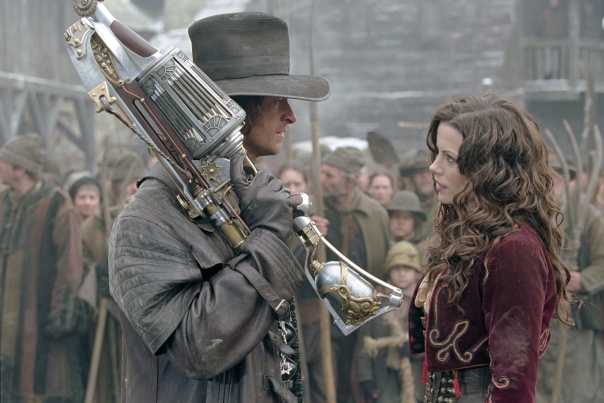
In 2004, Van Helsing was being primed to be not just a blockbuster but the forerunner for a new interconnected franchise revitalizing the classic Universal horror icons. Director Stephen Sommers was hot off the success of the first two Mummy movies, Hugh Jackman had become a household name playing everyone’s favorite growling superhero, and Kate Beckinsale had proven her own box-office mettle fighting vampires and werewolves in the Underworld series. The studio was expecting so much that it planned a sequel, a TV series on NBC called Transylvania, an animated prequel, a clothing line, a video game, maybe even theme park additions, and to maintain the Eastern European sets so that they could be utilized for the eventual show and sequels. Obviously, this never came to pass, and Sommers’ last big Hollywood action movie was the 2009 G.I. Joe movie, and he hasn’t directed a movie since 2013’s Odd Thomas adaptation. He chose not to direct the third Mummy movie in 2008, but it seems like this man’s career has never been the same since Van Helsing cratered in the summer of 2004. It began as the studio asking Sommers for even more monster movies, Sommers pitching them all together as an Avengers-style super movie, the studio getting carried away with larger plans of franchise dominance, and then when it didn’t materialize, a promising popcorn filmmaker in the highest blockbuster sphere just vanished in a poof of overzealous CGI.

Me wife’s crush circa 2004
In 2004, I did not like Van Helsing. That might be too charitable a description. I wrote in my original review, “Van Helsing is stupid, stupid, stupid. [Sommers] exists in his own indulgent world where bigger is better and some CGI spackle will fix any plot holes. He makes check-your-brain-at-the-door popcorn movies, but a ‘popcorn movie’ is no excuse to forgive a rambling, incoherent, loud, stupid mess.” It was one of my worst movies of 2004, and twenty years later, I’ve mostly come around on the movie. I won’t tell you that it’s a great movie, or even achieves that same magic alchemy of action-adventure swash buckle that The Mummy brought back to major studio filmmaking in 1999, but Van Helsing is enjoyably ridiculous schlock nonsense. It was also one of my wife’s favorite movies growing up, and she reminded me that her teenage self had a big crush on Richard Roxburgh’s version of Dracula, not Hugh.
I now view Van Helsing less as a horror monster action vehicle and more of a spy vehicle in a strange world. The titular Van Helsing is our secret agent complete with spy gadgets with his comedic relief sidekick, and he’s got his important missions and the sexy Bond Girl, and the villains and betrayals and added back-story that doesn’t seem even necessary. It’s Sommers taking the structure of a spy thriller and supplanting it onto a Victorian-era monster steampunk universe of demons and centuries-old church conspiracies. Jackman is enjoyably suave as the Vatican’s favorite killing machine learning his own life lessons about the nature of legacy. I even enjoyed the villain’s motivation for Dracula; he’s trying to learn the secrets of Dr. Frankenstein’s reanimation to ensure that his vampy babies survive. Here is a Dracula who is bereft because he cannot father living children. I suppose there could be further discussion over the different forms of life as converting humans into vampires is itself a rebirth. Perhaps the distinction is like the difference between having biological children and adopted children. Maybe dear old Drac just wants to have a bundle of joy he can call his own. That’s more interesting than versions that make him out to be some stalker ex-boyfriend. Likewise, the role of Anna (Beckinsale) is given more pathos than simply being the Strong Romani Badass. While her wardrobe consists of corsets and teased hair to appeal to a young male demo, her character’s mission is powerful and personal. Anna needs to kill Dracula not to save herself but to ensure the rest of her deceased family members can enter heaven. Talk about cumulative family guilt. That’s heavy. When her face appears in the clouds at the end like Mufasa, it’s a confirmation of generational rest. That’s an arc that’s more fulfilling than being any love interest that would be discarded later.
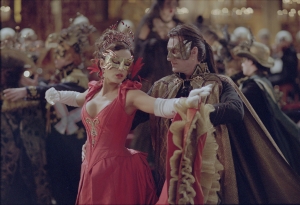
As soon as it got rolling, I said to my wife that this was going to go one of two ways: Van Helsing will learn that his organization is not as righteous as he believed them to be, manipulating him to eliminate threats to the organization’s standing rather than threats to humanity; or Dracula and Van Helsing have a personal connection that hasn’t been fully examined. Dear reader, it went in both directions because Sommers is slapping so many plot elements to make this movie feel full to bursting like a bloated tick. There’s ideas stacked upon ideas here, references and unexplored plot points for an untapped universe (vampires started werewolves?). An hour in, all of Dracula’s bats, a.k.a. his children have been slain, and you may erroneously think the movie is over. Well, there’s a whole other castle to explore with even more baby bats to kill. The last hour operates on pure video game mechanics of, go here, grab this item, battle this mini-boss. There’s definitely a level of redundancy and a “more is more” kitchen sink excess philosophy, but the bombast is part of his general appeal. There’s a touch of Sam Raimi here, a touch of Michael Bay; schlock with sheen. Maybe it was my nostalgia goggles, or maybe I was just attuning to Sommers’ wavelength, but the movie worked for me much better in 2024 as I was now charmed by its goofball sensibilities and less irritated by its over-plotted script.
You feel the admirable passion that Sommers has for this universe, adopting stylish pastiches to celebrate the older movies and lore, but definitely bringing his more modern sensibilities to the forefront. There’s a certain chaotic energy that animates Sommers big movies, bringing these classic characters together to run amok and crash into each other. That little kid’s imagination given the whole sandbox to play in can be enviable and lively, and it can also lead into unexpected directions that unexpectedly go nowhere. The incorporation of Frankenstein’s monster (Shuler Hensely) is more a plot device than a thoughtful character to bring to the team. He’s the magical MacGuffin both sides are fighting to claim for their own. Van Helsing’s major crime is trying too much and being too straight-laced about its silly. It’s not winking to the audience, it’s not self-commenting on its absurdities, it’s just living them lavishly. In 2004, I couldn’t appreciate that and this movie, and now I can find a place in my heart for such fun.

My original review in 2004 is scathing, with ready-to-blurb snark trying to communicate the intensity of my distaste. The line that Sommers is “gorging on a trough of special effects and vomiting the results onto the big screen” sticks with me. I’m surprised I restrained myself from making a “Van Helsing sucks” comment. Several of my criticisms about the acting, the confusing rules, the convoluted storytelling are entirely valid, but they just don’t bother me enough twenty years later. I can relax and enjoy the movie because it is a mess. That doesn’t mean every flawed movie deserves kindly dismissing its faults if it doesn’t aspire to anything other than mass entertainment. Big movies for big audiences can still be big bad. I think Van Helsing’s appeal is how sloppy it is and how excessive every element plays. In another universe, a… “dark universe” to borrow a phrase that came to me for no reason, this could have kicked off the interconnected Universal monster movies (any reference to Egyptian mummies is absent, implying perhaps that Sommers earlier movies exist in a shared world). It was not to be, and Sommers’ career has never been the same since, which is a real shame. The blockbuster space needs a filmmaker like Sommers, a man nimble enough to juggle tones and childlike glee with darker humor. Come back, Stephen Sommers, and maybe try your hand at the Creature From the Black Lagoon while you’re at it.
Nate’s Grade: C+
Share this:

Hellboy (2004) [Review Re-View]

Originally released April 2, 2004:
Guillermo del Toro loves things that go bump in the night. The Mexican born writer/director has shown prowess at slimy, spooky creatures with Cronos and 1997’s Mimic. He helmed the 2002 sequel to Blade, which had super vampires whose mouths would open up into four sections with rows of chattering teeth. The man sure loves his movie monsters. del Toro also loved Mike Mignola’s cult comic book Hellboy enough to turn down directing Harry Potter 3 and Blade 3 to ensure he could bring Hellboy to the big screen. Was it worth the sacrifice?
Let me just explain to you the villains of this movie as an example of how ridiculously stupid Hellboy is. The villains are … Nazis. Yes, the tried and true villains everyone can hate – Nazis. But these ain’t yo’ daddy’s Nazis; they’re immortal and led by zombie Rasputin (yes, the Rasputin). They all wish to puncture a hole into another dimension. What’s in this alternate dimension? Why nothing except for a giant floating spaceship that houses, I kid you not, the Seven Gods of Chaos, which all happen to be gigantic space squids. Why would anyone create a universe that has nothing but the imprisoned gods of evil? That seems awfully precarious. How exactly are giant squids going to take over the industrialized, nuclear-age world? Shoot ink at everyone? Sorry, space ink?

Let me not forget a Nazi assassin and his handy dandy arm-length blades. This assassin is also 100 years old and his body is filled entirely with sand. He winds himself up like a big clock. But if his body is filled completely with sand how can the clock gears work inside? You see what the normal audience member has to deal with? Plus these are just the villains, there’s a whole plot left to toil over as well.
The story revolves around a hulking, red demon named Hellboy (veteran character actor Ron Perlman). Hellboy escaped the space squid dimension in the 1940s when the Nazis unsuccessfully tried to open a dimensional hole large enough for your everyday on-the-go space squid. Now, Hellboy is an elite soldier for the government’s Bureau of Paranormal Research. He fights the creepy crawlies. He has to deal with a wide-eyed rookie, the watch of his “father” (John Hurt) and an attempt to rekindle a romance with a mentally troubled fire starter (Selma Blair). Oh yeah, and all the Nazi/Rasputin/space squid stuff mentioned before.
Perlman is really the only redeeming thing about this movie. The makeup is impressive, and he gives an enjoyably droll performance as a man who fights monsters with the same ho-hum-ness as a plumber reacts to clogged sinks. The rest of the acting runs the gamut of either being too serious (I’m looking at you Blair) or just too over-the-top silly (I’m looking at you, league of villains).
Hellboy is strung together with bizarre inanities, flat one-liners, heavy Catholic imagery, conflicting logic and contradictions, ridiculous villains, painful comic relief, half-baked romance and frustratingly ever-changing plot devices.
Watching Hellboy is like playing tag with a kid that keeps making up new rules as he goes (“You can’t tag me; I have an invisibility shield!”), and after a while you lose any interest. Late in the film, the Nazis will all of a sudden decide not to be immortal, and at a very inopportune time. Why? How? I don’t know. Hellboy also gets sudden new powers for some reason. Like he can bring people back to life by whispering otherworldly threats in their ears. For some reason nobody’s clothes burn when they’re set on fire.
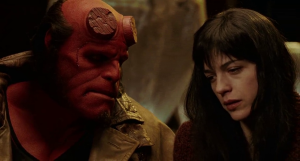
Not only does Hellboy frustrate by changing the rules of its world arbitrarily, it will also frustrate out of sheer uninhibited stupidity. How come characters can’t hear or see a pendulum the size of the Chrysler building? How come during a vision of the apocalypse we see a newspaper that actually had the time and staff, during the Apocalypse, to print an issue that reads, “APOCALYPSE”? Why doesn’t Blair use her pyro superpowers immediately to vanquish all the H.P. Lovecraft creatures instead of letting Hellboy foolishly wrestle with them all? The gaping holes in Hellboy are large enough to squeeze a gigantic space squid through.
All this frustration and insanity might have been moot if the action sequences were somewhat thrilling. Sadly, they are not. del Toro’s action sequences seldom matter. There’s such little consequence of what’s going on that the action becomes stiff and lifeless. The first time we see Hellboy chase a creature through city streets it’s a fun experience, but soon the novelty wears off. The overuse of CGI wears down the audience, and after the third or fourth time we watch Hellboy battle the same monster, the audience is ready to go to sleep. There’s little entertainment in the film’s action sequences but just as much frustration and stupidity.
I have never watched a film that induced more eye rolls, shoulder shrugs, raised eyebrows, pained and confused glances and mutters of, “What the hell (boy)?” Comic book aficionados may enjoy the fruits of Hellboy but general audiences will simply shrug. I’m amazed that the majority of film critics seem to think positively about this movie. Maybe I’m the last sane person in an insane world but Hellboy is one of the worst films of the year and one of the craziest films you could ever hope to see in a lifetime.
Nate’s Grade: D+
——————————————————
WRITER REFLECTIONS 20 YEARS LATER
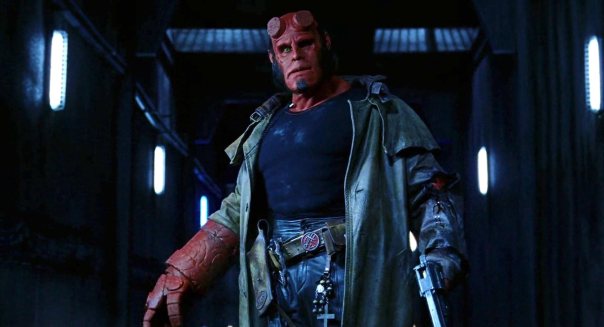
When I first saw 2004’s Hellboy, toward the tail end of my undergraduate years that April, I had no real familiarity with the character and went in with my pal, and fellow college newspaper entertainment critic Dan Hille. I went in a blank slate to the grumbling demonic lug created by Mike Mignola. To say I was underwhelmed would be an understatement in my original review. I had an extremely hard time gelling with the world and finding some firm internal logic, and my general astonishment colored every inch of that incredulous review from a snarky 22-year-old soon-to-be college grad. Twenty years later, we have a sequel, reboot, and a series of animated shorts and feature-length films, so the character is much better known today than back in 2004. I also think its occult-heavy, Lovecraftian world-building has also been further established through mainstream horror and science fiction projects. So, in 2024, I’m more familiar with the title character, the cultural connections and background, and especially Guilermo del Toro as a filmmaker, and I’m still left unmoved by this initial pitch to the character and his weird world.
It took del Toro and company years to get this movie made as the big studios lacked faith in the material, in Ron Perlamn as the lead, and in superhero and comic book properties period. This really was its own superhero story with outlandish villains, oversized heroes burdened with secrecy, shame, and guilt, and heavy themes reaching into religion and determinism. The concept of an underground agency of monsters to fight monsters is a good starting point for stories, and Perlman brings the right degree of curmudgeon charm to the outcast character who might become the ultimate hero of the world or its instrument of doom. The iconography of a demon trying to be a good guy provides a fun sense of irony, as well as a natural point of conflict as the wider world would have trouble seeing past the red skin, forked tail, and big curved horns. It makes me think of the gut-punch reveal from Arthur C. Clarke’s novel Childhood’s End where the benevolent aliens look exactly like the common visualization of a hooved and horned demon. The starting point for Hellboy has potential. However, it’s the rest that ultimately lost me.

Secret agencies and hidden conspiracies working behind the scene need to, themselves, be interesting. Think of the Men in Black and their assortment of goodies and agents. With the Bureau for Paranormal Research and Defense (BPRD), I expect more from the supporting characters and what they can unlock about our understanding of the world and the unknown. There really are only two super-powered supporting players, with Doug Jones playing Abe Sapian, a variation on the Creature from the Black Lagoon gillman, and Selma Blair as a pyrokinetic woman who checks herself into mental asylums to protect others. Both of these characters have possibility and are fellow outcasts like Hellboy, but neither feels sufficiently fleshed out and incorporated into this story. Because of Abe’s scenic limitations of being in water, he serves as more of a taste of “the world world” and narrative device. He’s not even involved in the entire final act of labyrinth misadventures. With Blair’s unstable pyro, her character is relegated to a tormented love interest for Hellboy to save, get jealous, and also save again through even more ludicrous means. For a secret agency, it all feels a little too small.
The biggest side character is John Myers (Rupert Evans, The Man in the High Castle), invented for the movie to be the audience’s entry point into learning more of this strange land of strange creatures. He’s a total bore, and he also doesn’t factor much more into the story than being a living reaction shot. He has one significant moment in the climax, and that’s simply telling Hellboy to remember who he is, ultimately convincing the big man to turn back from his destiny of enabling the apocalypse. Why do we need this character? Can’t another super-powered creature serve this same purpose? Why not Blair’s love interest figure, which would then present more attention on beginning that romantic connection between her and Hellboy? There’s a reason in X-Men that we followed a mutant to learn about other mutants and not some boring human. John Myers isn’t even included in the 2008 sequel, The Golden Army, because by that point he had served his only purpose of introducing us to a new world and being a benign romantic foil.

In a story with literal living Nazis brought to life through the magic of anti-Semitic clockwork, I’m dumbfounded why so much of the movie is watching Hellboy fight these boring lizard creatures with tongue tentacles. I appreciate the emphasis on practical effects and the reality that it’s a bunch of stunt performers in monster suits rather than complete CGI. The movie is another love letter of del Toro’s to his influences. His affection for the monsters and outsiders is apparent in every movie going back to his first, 1993’s Cronos. It’s too bad then that the primary opponent are these rudimentary lizard monsters that feel like the kind of easily disposable pawns you would see heroes fighting in other superhero spectacle. They’re faceless, and the fact they can regenerate and duplicate upon death doesn’t make them more formidable, only makes them more depressing as they can’t be easily rid of. If you’re going to give me giant space squids in an alternate dimension, then give me the giant space squids. If you’re going to give me Nazi zombies led by Rasputin, then give me that crazy mess. Don’t confine these potentially interesting villains to the opening and closing only. I will also say the ending is still a rather sizable letdown as far as how formidable these evil space squid gods might prove in a world of explosive devices and a modern military with a practical blank check for its budget.
Fun fact, at the time of its release, some theaters were so worried about playing a movie with “hell” in the title during Easter weekend, and coming off the ongoing success of The Passion of the Christ that brought in more conservative ticket-buyers, they decided to re-title it “Helloboy” on their theater marquis. I find this absolutely hilarious.
Hellboy has some points of interest, as del Toro was still fine-tuning his brand of fantasy-horror into a more mass-appealing conduit. It’s got terrific makeup effects and some fun ideas, and it’s also certifiably insane. It threw me for a loop back in 2004, and I just couldn’t process this level of hyper absurd elements jumbled together, and it still makes for a bumpy viewing. I enjoyed the 2008 sequel much more, which took more of a dark fantasy bent, and I wonder if I was more accepting of that realm of material than I was for Lovecraftian sci-fi nonsense. del Toro has learned from the Hellboy experience, becoming something of a masterful chameleon. He delivered one of the best kaiju action movies of all time that made me feel like a giddy kid. He created a haunting fairy tale timed to the Spanish Civil War. He created a charming romantic fable where a woman falls in love with a fish and it won an Oscar for Best Picture and he won Best Director. He created one of the most visually impressive stop-motion animated movies of all time that can make me cry like a baby and deservedly won another Oscar. Next up, he’s got another stop-motion animated movie and another creature feature, a remake of Frankenstein. Through his versatility, creative consistency, and inherent ability to find human drama in the most peculiar places, I’ll see any movie that del Toro decides to devote his worthy attention towards. Hellboy though? I’ve seen it twice now, and I think I can leave it at that. I’ll upgrade my earlier ranking but not too higher, Hoo boy is that 2004 review a fun read.
Re-View Grade: C
Share this:

Jersey Girl (2004) [Review Re-View]

Originally released March 25, 2004:
Writer/director Kevin Smith (Dogma) takes a stab at family friendly territory with the story of Ollie Trinke (Ben Affleck), a music publicist who must give up the glamour of the big city to realize the realities of single fatherhood. Despite brief J. Lo involvement, Jersey Girl is by no means Gigli 2: Electric Boogaloo. Alternating between edgy humor and sweet family melodrama, Smith shows a growing sense of maturity. Liv Tyler stars as Maya, a liberated video store clerk and Ollie’’s real love interest. Tyler and Affleck have terrific chemistry and their scenes together are a playful highlight. The real star of Jersey Girl is nine-year-old Raquel Castro, who plays Ollie’’s daughter. Castro is delightful and her cherubic smile can light up the screen. Smith deals heavily with familiar clichés (how many films recently end with some parent rushing to their child’’s theatrical production?), but at least they seem to be clichés and elements that Smith feels are worth something. Much cute kiddie stuff can be expected, but the strength of Jersey Girl is the earnest appeal of the characters. Some sequences are laugh-out-loud funny (like Affleck discovering his daughter and a neighbor boy engaging in “the time-honored game of “doctor””), but there are just as many small character beats that could have you feeling some emotion. A late exchange between Ollie and his father (George Carlin) is heartwarming, as is the final image of the movie, a father and daughter embracing and swaying to music. Jersey Girl proves to be a sweetly enjoyable date movie from one of the most unlikely sources.
Nate’s Grade: B
——————————————————
WRITER REFLECTIONS 20 YEARS LATER

When I started putting together my list of 2004 movies to re-watch for this year’s slate, my wife was not pregnant. We had been trying for a year and experienced some heartbreaking setbacks, but now, as I write my review of Jersey Girl, my reality is that my wife is indeed pregnant, and we’re expecting a baby this October and very excited. As you can expect, I’m also nervous. Now this movie about the changes of fatherhood has significantly more meaning for me personally.
In 2004, I was but a 22-year-old soon-to-be college graduate but also a devotee of writer/director Kevin Smith since my teenage years of discovering movies in the oh-so-exciting go-go decade of 1990s independent film. This was supposed to be Smith’s career pivot, as he’d reportedly closed the book on his View Askew universe of crude comedies and stoner hi-jinks with 2001’s Jay and Silent Bob Strikes Back. Smith had become a parent in 1999 and, naturally, this altered the kinds of stories he wanted to tell. Although this didn’t last too long. In 2004, America was sick of Bennifer 1.0 and Jersey Girl was the second movie in less than a year pairing real-life couple Ben Affleck and Jennifer Lopez. The stink from 2003’s Gigli, and the tabloid overexposure, had tamped down the country’s demand for more Bennifer, so Miramax removed all publicity of Lopez from the movie, pushed the release date back half a year, and even publicly revealed that Lopez’s character dies in childbirth in the first ten minutes. Even with its relatively modest budget for a studio film, Jersey Girl under-performed, critics lambasted it, and Smith returned to his vulgar adult comedy playground with 2006’s Clerks II, the sequel to where it all began. With the occasional stop into horror, Smith has stayed in his own insular world and only gotten more insular with sequels to his early comedies for his ever-shrinking fandom.
 More so than any other movie, Jersey Girl is the outlier, the oddity, the path not taken. Watching it again in 2024, I’m more forgiving of this outlier even if it proves harder to love. Much of this is likely my own relatability with the main character’s plight, a New York City workaholic publicist Ollie Trinkie (Affleck) who loses everything in a short window of time, namely his high-profile city job and his wife Gertrude (Lopez). Now he’s back living with his father Bart (George Carlin) in New Jersey and raising a little girl Gertie (Raquel Castro) on his own. It’s not a revolutionary film concept, a selfish adult takes on the responsibility of another and changes their perception of themself and the world. In a way, it likely happens to every new parent, or I would hope, a paradigm shift of perspective. The insights that Jersey Girl offers about parenthood and priorities are nothing new but that doesn’t mean they are bad or not worthwhile. Without the context of Smith’s tonal pivot, Jersey Girl would likely be forgotten, more than it already has been to history. It’s Smith’s spin on the family movie cliches we’ve seen before, and that means there’s a limit to how much further he can take the overly familiar.
It’s a little deflating to watch an artist known for his imagination and vocabulary utilizing the building blocks of maudlin family movies for his new story. Even with a different storyteller, they are still the same recognizable pieces seen before in hundreds of other feel-good movies about parents learning that children are more important than that big meeting or promotion. Of course reducing everything down in life is reductive, and maybe that big meeting could allow the parent to be more present for their kid, provide a better life being neglected, but whenever you set up the climactic choice between family and career, family always wins. Maybe David Wain (They Came Together) is the kind of subversive genre artist who could send up these age-old cliches and end with the workaholic parent choosing their selfish career. Regardless, the movie’s strengths are its sincerity rather than ironic detachment. It would be hard to make this kind of movie from a cynical smart-alecky approach, and Jersey Girl reveals what any View Askew fan has long known, that deep down at heart Smith is a big softie. It’s more apparent nowadays with Smith’s recent output of increasingly sentimental movies about relationships, as well as Smith’s copious social media posts showcasing his torrent of tears in response to a movie or TV show (as a man who frequently cries from movies and TV, this is no affront to me). Smith wanted to tell a personal story of his own life changes through the familiar family movie vehicle, and while it doesn’t entirely stretch beyond its copious influences, it’s still singing true to Smith’s sincerity.
 This is far from the disaster many have made it out to be in the past twenty years. Lopez is really good in her brief opening appearance with a natural radiant charm that makes you mourn her absence just like Ollie. Liv Tyler (Armageddon reunion) shows up midway through as Maya, a sexually progressive video store clerk who becomes the next love interest for our widower. When she discovers, to Ollie’s embarrassment, that he hasn’t had sex for seven years, the entire time after his wife’s passing, she takes it upon herself to help the guy out with some charitable casual sex. The scene is funny and finally makes use of a setup Smith has taken time with prior, Gertie not flushing the toilet after use (something I can already regrettably relate to raising children). When his daughter comes home early, Ollie and Maya hide in the shower, and it appears they have gotten away with it, except Gertie finally remembers to flush the toilet, sending a burst of hot water that causes Maya to screech and reveal their half-naked tryst. From there, little Gertie sits them both down, reminiscent of what Ollie did with her and a friend when he caught them playing “doctor,” and she squares her gaze and intones, very maturely: “What are your intentions with my father?” Even the big climactic event, the children’s musical performance the parent can’t miss lest they break their child’s heart, gets a little edge when Gertie and her family perform the throat-slitting/pie-making number from Sweeney Todd. There’s a terrific exchange between Ollie and Will Smith all about the changing dynamic of fatherhood, what they do for their kids, and how rewarding it proves, and having Smith be your ace-in-the-hole is great.
It would be neglectful of me to forget the postscript that, nearly twenty years after the demise of their engagement, that Affleck and Lopez reunited and married in 2022. We’re in the current realm of Bennifer 2.0 (unless your version of Bennifer 2.0 was when he married Jennifer Garner, but I’ll let you decide if this era is 2.0 or 3.0) and Lopez has released a companion documentary to her 2024 visual album (a.k.a. collection of music videos) that features her relationship with Affleck, and it’s called The Greatest Love Story Never Told, and it’s gotten good reviews. Also of note, Castro grew up into a budding pop idol and appeared on The Voice and Empire.
 There are things that work here, enough that Jersey Girl might honestly age better than the majority of Smith’s rude and crude comedies (see: re-reviews for Dogma and Strike Back, and Reboot). It will never garner the love of Smith’s more successful movies, but it doesn’t deserve any reputation as a forgotten stepchild among Smith’s oeuvre, especially when you consider the man also has Yoga Hosiers on that resume. In 2004, I referred to Jersey Girl as a “sweetly enjoyable date movie,” and this still stands twenty years later. I’m a little softer in several ways and more forgiving as an adult cinephile, and more welcome to genuine acts of sincerity, so the winning moments of the movie still hit their mark for me. I write this as my wife is still in her first trimester, and while the due date seems so far away I know it will rush by, and then I, like Ollie, will be juggling my life as I knew it with my life as I now know it (you better believe the scene where he loses his spouse in childbirth hit me harder as a new intrusive nightmare to occupy my mind). Jersey Girl isn’t anything new or special, but it was special for Smith, and he finds ways to make you understand what that means for him, and what it might mean for you. I’ll take that.
Re-View Grade: B-
Share this:

Eternal Sunshine of the Spotless Mind (2004) [Review Re-View]

Originally released March 19, 2004:
No other movie this year captured the possibility of film like Michel Gondry and Charlie Kaufman’s enigmatic collaboration. Eternal Sunshine was a mind-bending philosophical excursion that also ended up being one of the most nakedly realistic romances of all time. Joel (Jim Carrey restrained) embarks on having his memories erased involving the painful breakup of Clementine (Kate Winslet, wonderful), an impulsive woman whose vibrant hair changes as much as her moods. As Joel revisits his memories, they fade and die. He starts to fall in love with her all over again and tries to have the process stop. This labyrinth of a movie gets so many details right, from the weird physics of dreams to the small, tender moments of love and relationships. I see something new and marvelous every time I watch Eternal Sunshine, and the fact that it’s caught on with audiences (it was nominated for Favorite Movie by the People’s friggin’ Choice Awards) reaffirms its insights into memory and love. I never would have thought we’d get the perfect romance for the new millennium from Kaufman. This is a beautiful, dizzingly complex, elegant romance caked in visual grandeur, and it will be just as special in 5 years as it will be in 50, that is if monkeys don’t evolve and take over by then (it will happen).
Nate’s Grade: A
——————————————————
WRITER REFLECTIONS 20 YEARS LATER

“How happy is the blameless vestal’s lot!
The world forgetting, by the world forgot:
Eternal sunshine of the spotless mind!
Each prayer accepted, and each wish resigned;”
-Alexander Pope, Eloisa to Abelard (1717)
“Go ahead and break my heart, that’s fine
So unkind
Eternal sunshine of the spotless mind
Oh, love is blind
Why am I missin’ you tonight?
Was it all a lie?”
-Kelly Clarkson, Mine (2023)
This one was always going to be special. Eternal Sunshine of the Spotless Mind is not just one of my favorite movies, it’s one of those movies that occupies the place of Important Formative Art. It’s a movie that connected with me but it’s also one that profoundly affected me and changed me, that inspired me in my own creative ventures. With its elevated place in my memory, I’ll also admit that there was some mild trepidation about returning to it and having it not measure up to the impact it had all those twenty years ago. It’s impossible to recreate that first experience or to chase after it, but you hope that the art we consider great still has resonance over time. This happened before when I revisited 2000’s Requiem for a Dream, a movie that gobsmacked me in my youth, had such innate power and fascination, and had lessened over the decades. It was still good art but it wasn’t quite the same, and there’s a little tinge of disappointment that lingers.

When I saw the movie for the first time it was at a promotional screening. I was a senior in college and had dyed my hair bright red for the second time. After marveling over my first encounter with 1999’s Run Lola Run, I was determined to have hair like the titular Lola. My parents were hesitant and set parameters, like certain grade achievements, and I met them all. Afterwards they had nothing left to quibble so I dyed my hair red, as well as other colors, my sophomore year and then again my senior year. At the screening, a publicist for the studio asked if I wanted to compete for a prize. I demurred but then she came back and asked again, and sensing something to my advantage, I accepted. It turns out the pre-show contest was a Clementine (Kate Winslet) look alike contest and my only competition was a teen girl with one light swath of blue hair. The audience voted and I won in a landslide and was given a gift basket of official Eternal Sunshine merchandise that included the CD soundtrack and a bright orange hooded sweatshirt modeled after the one Clem wears in the movie. That sweatshirt quickly became one of my favorite items of clothing, something special that nobody else had from a movie I adored. I wore it everywhere and it became a comfort and a confidence builder. Back during my initial courtship with my wife, in the winter months of 2020, she held onto the orange hoodie as a memento to wear and think of me during our time apart. She said it even smelled like me, which was a comfort. It had meaning for us, and we cherished it. I had to marry her, of course, to ensure I’d eventually get the sweatshirt back in my possession (I kid).
The lessons of Eternal Sunshine run deep for me. On the surface it’s a breakup movie about an impulsive woman, Clem, deciding to erase her memories of her now ex-boyfriend Joel (Jim Carrey). Out of spite, he elects to have the same procedure, and from there we jump in and out of Joel’s head as a subconscious avatar experiences their relationship but in reverse. It’s the bad memories, the hurt and ache of a relationship nearing or past its end, but as each memory degrades and Joel goes further into the past, he discovers that there are actually plenty of enjoyable memories through those good times, the elation and discovery, the connections and development of love, that he doesn’t want to lose. He tries to fight against the procedure but it becomes a losing battle, and so he gets to ride shotgun in his cerebellum as this woman vanishes from his life. What began out of spite and heartache ends in mourning and self-reflection.
At its heart, the movie is asking us to reflect upon the importance of our personal experiences and how they shape us into the people that we are. This includes the ones that cause us pain and regret. The human experience is not one wholly given to happiness, unfortunately, but there are lessons to be had in the scars and pain of our individual pasts. I’m not saying that every point of discomfort or pain is worthwhile, as there are many victims who would say otherwise, but we are the sum total of our experiences, good and bad. With enough distance, wisdom can be gained, and perhaps those events that felt so raw and unending and terrible eventually put us on the path of becoming the person you are today. Now, of course, maybe you don’t like the person you are now, but that doesn’t mean you’re also a prisoner to your past and doomed to dwell in misery.
After my divorce from my previous wife in 2012, I wrote a sci-fi screenplay following some of the same themes from Eternal Sunshine. It was about two dueling time travelers trying to outsmart one another, one hired to ensure a romantic couple never got together and one hired to make sure that they had. The characters represented different viewpoints, one arguing that people are the total of their experiences and the other arguing people should be capable of choosing what experiences they want ultimately as formative. Naturally, through twists and turns, the one time traveler learns a lesson about “living in the now,” to stop literally living in the past and trying to correct other people’s perceived mistakes, and that our experiences, and our heartache, can be valuable in putting us into position to being the people we want or living the lives we seek. It shouldn’t be too hard to see that I was working through my own feelings with this creative venture. It got some attention within the industry and I dearly hope one day it can be made into a real movie. It’s one of my favorite stories I’ve ever written and I’m quite proud of it. It wouldn’t exist without Eternal Sunshine making its mark on me all those years ago.
It’s an amazing collaboration between director Michel Gondry and the brilliant mind of Charlie Kaufman. The whimsical, hardscrabble DIY-style of Gondry’s visuals masterfully keeps the viewer on our toes, as Joel’s memories begin vanishing and collapsing upon one another in visually inventive and memorable ways. There’s moments like Joel, after finding Clem once she’s erased her memory of him, and he storms off while row after row of lights shuts off, dooming this memory to the inky void. There’s one moment where he’s walking through a street and with every camera pan more details from the store exteriors vanish. A similar moment occurs through a store aisle where all the paperbacks become blank covers. It’s a consistent visual inventiveness to communicate the fraying memories and mind of Joel, which becomes its own playground that allows us to better understand him. The score by Jon Brion (Magnolia) is also a significant addition, constantly finding unique and chirpy sounds to provide a sense of earned melancholy. By experiencing their relationship backwards, it allows us to have a sense of discovery about the relationship. This is also aided by Kaufman’s sleight-of-hand structure, with the opening sequence misleadingly the beginning of their relationship when it’s actually their second first time meeting one another. The pointed details of relationships, both on the rise and decline, feel so achingly authentic, and the characters have more depth than they might appear on the surface. Joel is far more than a hopeless romantic. Clem is far more than some Manic Pixie Dream Girl, a term coined for 2005’s Elizabethtown. She tells Joel that she’s not some concept, she’s not here to complete his life and add excitement; she’s just a messed up girl looking for her own peace of mind and she doesn’t promise to be the answer for any wounded romantic soul.

The very end is such a unique combination of feelings. After Mary (Kirsten Dunst) discovers that she’s previously had her memories of an affair with her boss erased, she takes it upon herself to mail every client their files so that they too know the truth. Joel and Clem must suffer listening to their recorded interviews where they are viciously attacking one another, like Clem declaring Joel to be insufferably boring who puts her on edge, and Joel accuses her of using sex to get people to like her. Both are hurt by the accusations, both shake them off as being inaccurate, and yet it really is them saying these things, recorded proof about the ruination of their relationship. Would getting together be doomed to eventually repeat these same complaints? Clem walks off and Joel chases after her and tells her not to go. Teary-eyed, she warns that she’ll grow bored of him and resentful because that’s what she does, and she’ll become insufferable to him. And then Joel says, “Okay,” an acceptance that perhaps they may repeat their previous doomed path, maybe it’s inevitable, but maybe it also isn’t, and it’s worth it to try all the same. Maybe we’re not destined to repeat our same mistakes. Then it ends on a shot of our couple frolicing in the snow, the descending white beginning to blot out the screen, serving as a blank slate. It’s simultaneously a hopeful and pessimistic ending, a beautifully nuanced conclusion to a movie exploring the human condition.
Winslet received an Oscar nomination for her sprightly performance, and deservedly so, but it’s Carrey that really surprises. He had already begun to stretch his dramatic acting muscles before in the 1998 masterpiece The Truman Show and the far-from-masterpiece 2001 film The Majestic. He’s so restrained in this movie, perfectly capturing the awkwardness and passive aggressive irritability of the character, a man who views his life as too ordinary to be worth sharing. Clem begs him to share himself since she’s an open book but he’s more mercurial. She wants to get to know him better but to Joel there’s a question of whether or not he has anything worthwhile getting to know. Carrey sheds all his natural charisma to really bring this character to life. It’s one of his best performances because he’s truly devoted to playing a character, not aggressively obnoxious Method devotion like in 1999’s Man on the Moon.
Eternal Sunshine of the Spotless Mind is a messy, enlightening, profound, playful, poignant, and mesmerizing movie. A perfect collaboration between artists with unique creative perspectives. I see something new every time I watch it, and it’s already changed my life in different ways. I used to see myself as Joel when I was younger, but then I grew to see him as self-pitying and someone who too often sets himself up for failure by being too guarded and insular. It’s a reminder that our cherished relationships remain that way by allowing ourselves to be vulnerable and open. We are all capable and deserving of love.
Re-View Grade: A


 nathanzoebl
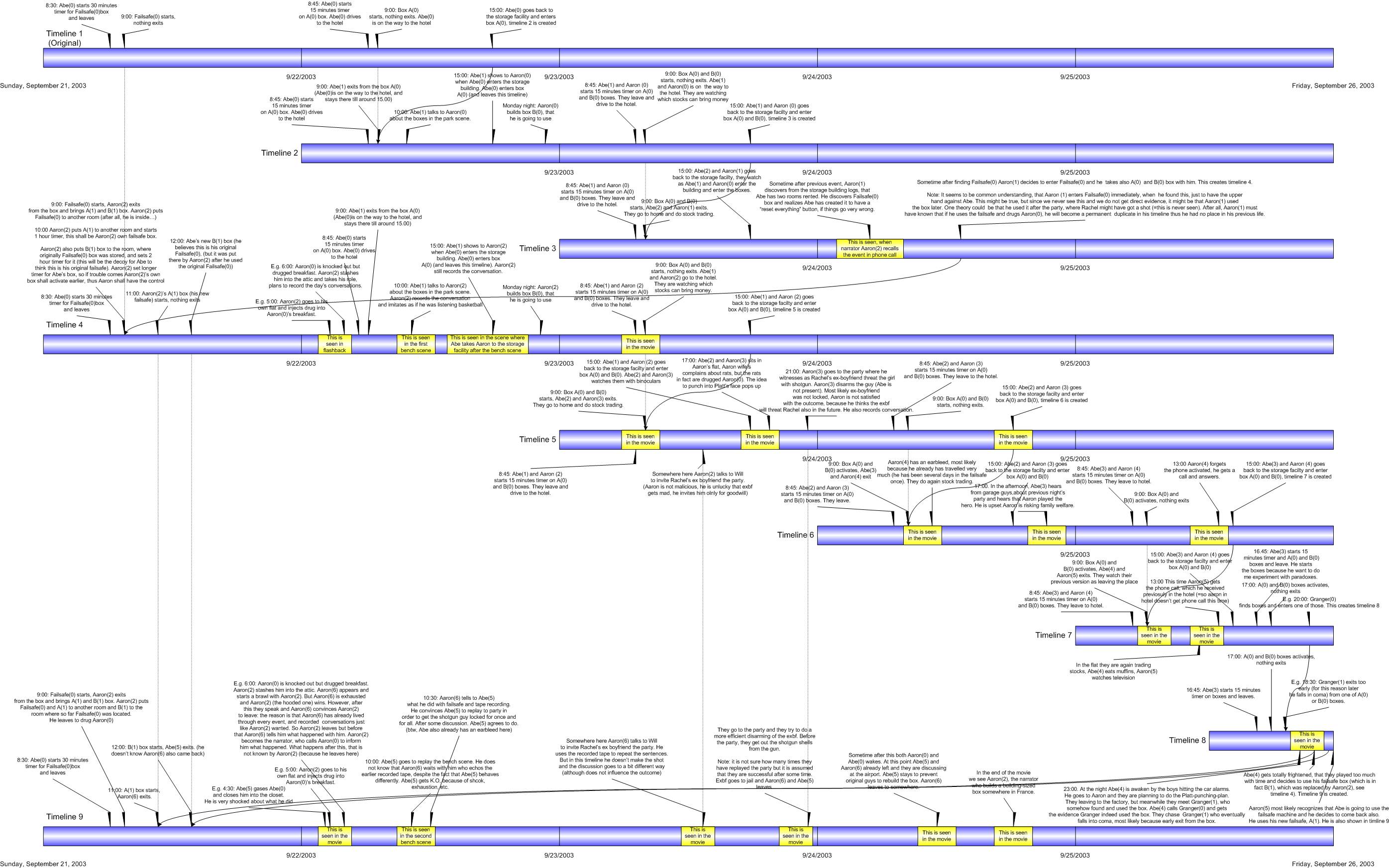
You must be logged in to post a comment.