Daily Archives: February 10, 2026
Mercy (2026)
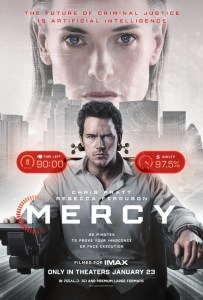 Detective Chris Raven (Chris Pratt) wakes up strapped to a chair. An A.I. judge (Rebecca Ferguson) informs him that he has been changed with the murder of his wife, and thanks to the new Mercy program instituted by the Los Angeles justice system, he will have 90 minutes to prove his innocence to a “reasonable doubt” level of 91% guilty (is that all a “reasonable doubt” is going for these days?). If he fails to convince the A.I. judge, then he will be terminated at the end of those 90 minutes. Start the clock.
Mercy is essentially a screen life movie with a high-concept twist, but at no time was I captivated with the mystery or intellectually satisfied by the application of its storytelling angle. We’ve seen similar movies recently, notably 2018’s Searching and far far less notably the 2025 War of the Worlds, where the movie screen is an extension of a computer screen that holds the borders and tools of our storytelling. In a way it reminds me of the found footage boom of the early 2010s, a hot gimmick that could get studio execs to say yes to projects that they would otherwise have passed on. However, there still needs to be careful ingenuity about how to incorporate these elements and, even more importantly, how to work within the limitations of your gimmick. With Mercy, our main character is basically trying to prove his innocence in real time with an A.I. judge who really functions more like an A.I. assistant, granting him access to people and databases even his police position would not have immediate access to. The recreation of the crime scene with the clues and evidence has a very Detroit Become Human feel (that’s a sci-fi video game that plays more like a movie). The A.I. judge is willing to help out this convicted man as long as he doesn’t admit guilt, because then it’s straight to execution time. For ninety minutes, Chris Raven has to crack his own murder case. The real-time element is meant to provide a sense of urgency, a literal ticking clock, but it’s also quite the misstep when your movie isn’t very good. This allows the audience to mentally count down how much time is left before your movie is finally over. The screen life aspects are pretty superficial and visually dull even if the graphics as being pulled around like interactive three-dimensional objects. The fact that this movie was shot for IMAX is astounding.
 The problem is that the plot is too predictable at every turn. We have a future criminal justice system made for automation and expediency, so it’s not going to be too much of a leap to suspect it might not be operating at the level of success its proponents profess. There’s a long history of stories presenting a new technological leap that is meant to be fool-proof that, shocker, is proven to be anything but. Right away, the audience is already going to be suspecting that the Mercy system is compromised or at least prone to errors like our present criminal justice system. We can safely assume that our protagonist is innocent, and if that’s the case then the implicit question is how many others who were tried and convicted were also ultimately innocent? Some might call it a death row metaphor but it’s literally the same thing just with a high-tech A.I. spin. The next question becomes is the potential error a sign of the limitations of assigning such power to seemingly infallible computers, or is it being deliberately compromised and manipulated? Are certain powers-that-be using this as an excuse to eliminate undesirable peoples and populations? The case of Chris Raven is meant to unveil a larger, systemic problem of justice not being served. And yet, the movie doesn’t exactly explore this obvious implication.
I’m going to dive into spoilers with this next paragraph because I think it’s worthwhile and also I don’t think you’re missing anything with Mercy. If you already assume that Chris is innocent or set up, there’s only so many other places you can go as a story. So with that warning addressed, the Mercy system is really easy to trick, as evidenced by our eventual culprit who has the know-how to digitally erase and alter security footage. Didn’t know this guy had those kinds of skills but, hey, people can surprise you or, more accurately, when the screenplay calls upon enough coincidences. However, there’s another layer of conspiracy afoot. This one guy is responsible for setting Chris Raven up because his own brother was accused and executed by Mercy even after he gave the police an alibi that was ignored. He wants vengeance for the injustice done to his family. This means there’s also the unraveling of who was responsible for this other guy’s wrongful arrest and execution, and wouldn’t you know it happens to be Chris Raven’s own partner, who needed the Mercy program to be seen as trustworthy. The movie never deals with the implications of this. It doesn’t really confront the moral turpitude of killing an innocent man, and it doesn’t think big picture to ask how many other innocent people have been sacrificed as cover. Amazingly, the last line of the movie involves Chris Raven saying, “Humans and A.I., we all make mistakes. And we learn.” What? Technology shouldn’t make mistakes. Alexander Pope didn’t say, “To err is human, and also these new contraptions. Have you seen these textile factories? Wild.” We don’t expect technology to fail us, especially if we are putting judgement over life and death as one of its tasks. This sounds like dubious excuse-making for a system literally killing innocents in the name of the law, and yet our hero treats the whole revelation like, “Well, you gotta break some eggs for an omelette.” It’s such a callous, incompetent response to an immediate problem that his own police force is exploiting. Yet the movie doesn’t blame the faulty A.I. system, which I repeat even some random guy was able to hack and manipulate, and instead looks at it as a tool, like when people try to separate guns from gun violence. However, in this case, the gun is making its own calculations on who deserves to die, and, again, being manipulated by randos. This gets a little more unseemly when you realize that the movie studio’s release is from Amazon, which would very much like you, dear citizen, to stop villainizing A.I. and accept its omnipresence in your new digital life.
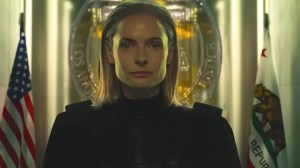 Mercifully, Mercy holds to its countdown, though there’s an extra period of “stoppage time” with an action sequence outside of the chair as climax. The mystery is dull, the plot is predictable (if you don’t suspect who the real killer is after 30 minutes, this might be your first movie, so I’ll tell you now – they get better), the world building is underwritten (who needs an exploration of the large-ranging moral implications of this system when we get police on drone cycles!), and the fun of its creative ingenuity is gasping. It’s forever going to be the Chris-Pratt-stuck-in-a-death-chair movie. This concept could have worked but there needed to be significant revisions, especially unpacking the larger implications for this new system of justice outsourcing justice to all-knowing machines. That’s not this movie. Mercy isn’t even overtly critical of artificial intelligence, instead excusing its faults as “user error” from bad actors. It’s a film too afraid to have any strong sentiments, which makes for a pretty lifeless time at the movies. The machines have won.
Nate’s Grade: D+


 nathanzoebl
You must be logged in to post a comment.