Monthly Archives: February 2025
Y2K (2024)
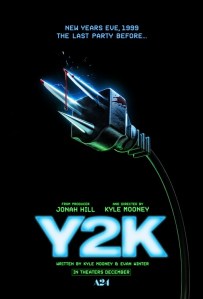
The premise for Y2K is ripe for fun. It’s a nostalgic retelling of that turn-of-the-millenium anxiety over computers getting confused, and the movie says what if technology had turned on humans at the stroke of midnight that fateful New Year? Add the lo-fi chintzy, quirky style of co-writer/director Kyle Mooney (Brigsby Bear) and it’s a setup for some strange and amusing techno-horror. It’s structured like a teen party movie with our group of high schoolers (Jaeden Martell, Julien Dennison, Rachel Zegler) trying to step out of their comfort zones and live their best lives… around machines trying to eviscerate them. The tonally messy movie lacks the heart and specific world-building weirdness of Brigsby Bear, instead relying upon the genre cliches of the high school movie, including the unrequited nerd crush and the pretty popular girl who’s more than what she seems. While watching Y2K, I kept getting the nagging feeling that this movie should be more: more funny, more imaginative, more weird. It’s quite uneven and veers wildly from set piece to set piece for fleeting entertainment. I chuckled occasionally but that was it. I enjoyed the villainous robot assembling itself with assorted junk available, and it’s hard not to see this as a general statement about the movie as a whole. It’s a bit lumbering, a bit underdeveloped, a bit formless, blindly swiping nostalgia and junk to build some form of an identity that never materializes beyond its parts. Y2K won’t make me bail on Mooney as a filmmaker but it’s a party worth missing.
Nate’s Grade: C
Share this:

The Gorge (2025)
 While watching the action-thriller The Gorge, I kept thinking, “Wow, I’m surprised this didn’t get a theatrical release at all.” The Apple Plus original is the kind of movie you’d want to watch on the big screen, with large-scale action, atmospheric imagery, and a creepy sound design meant to elicit shudders. It has a dynamite premise that grabbed me right away: two elite snipers from the East and West, Levi (Miles Teller) and Drasa (Anya-Taylor Joy), are tasked with manning watchtowers overlooking a cavernous and mysterious gorge. They have heavy-duty Gatling guns to make sure whatever is in the gorge stays in the gorge. It’s a year-long tour of duty and both snipers are forbidden to communicate with one another. Naturally, out of boredom and necessity, they break the no-contact rule, first through white board messages, then through shared experiences and competitions, and finally coming face-to-face. For the first 45 minutes or so, The Gorge is actually a pretty lean and effective long distance romance of sorts. There’s ingenuity in the process of getting to know someone from across a large hole in the ground, and both actors have solid chemistry that will help make you silently yearn for a little global collaboration. The movie also has an intriguing scenario with tantalizing details that point to its secret history, until everything is literally spelled out in Act Three. The monsters, who look like a combination of Groot and zombies, are an unsettling character design, though I wanted more variety in their appearance. When the characters finally delve into the gorge for the majority of our climax, we got some new and nasty creepy crawlies, like a tree with rib bones like insect mandibles that ensnare like a Venus flytrap. Alas, I found the stuff inside the gorge to be fun and creepy with a great atmosphere to play upon what we can and cannot see, but it was the stuff above and outside the gorge that made the movie for me. That’s The Gorge for ya: come for spooky monsters, stay for the surprisingly involving romance between monster killers.
Nate’s Grade: B
Share this:

Moana 2 (2024)
 It’s hard not to see the DNA of its original incarnations as a TV series for Disney Plus, as well as the awkward adjustments to slap this together into a feature film. Unless you’re a super fan of the original Moana who needs any additional content, you’ll likely have a less than impressive response to Moana 2. It feels quite episodic from villains and storylines popping up for small increments of time only to go away and be replaced by a new storyline, to a new batch of characters meant to hold our attention while other main characters, in particular Maui (Dwayne Johnson), sit out for long stretches. The animation is a notable step down as well, and while it’s still pleasing to watch and far from bad, it’s lacking the detail and refinement of the feature team, especially with lighting, as everything in this world lacks shadows with such high key lighting washing everything out. Without Lin-Manuel Miranda returning, it’s obvious the songs will not be nearly as catchy and enchanting, and the tunes for Moana 2 are pretty instantly forgettable. I’m struggling to rethink any melody right now as I write this. It’s hard not to feel like everything is so slight, from the storytelling to the visuals to the songs to the inclusion of the beloved characters from the original. I loved Moana and consider it the best of modern-day Disney, and I’m clearly not alone from the box-office dominance that the sequel was able to achieve. I actually think I would have preferred future Moana adventures as a TV series because the mythology and world has more to explore. But that version of new Moana has been transformed, Frankenstein-style, into a releasable feature film, one that suffers in the transformation into something it’s not suited for. Disney made a billion dollars from this gamut, but the rest of us are left with a Moana 2 that had much further to go.
Nate’s Grade: C
Share this:

Saturday Night (2024)/ September 5 (2024)
Recently two ensemble dramas were thought to have awards potential that never materialized, and I think I might know at least one reason why: they are both undone by decisions of scope to focus on either a single day or a 90-minute period to encapsulate their drama.
 With Saturday Night, we follow show creator Loren Michaels (Gabriel LaBelle) the night before the premiere episode of the iconic sketch TV series, Saturday Night Live. The story is told in relative real time covering the last 90 minutes before its initial 11:30 PM EST debut in 1975. We watch Michaels try and deal with squabbling cast members, striking union members, failing technology, his ex-wife (Rachel Sennot) who also happens to be a primary producer of the show, muppets, and studio bosses that are doubtful whether this project will ever make it to air. I understand in essence why the real-time setting is here to provide more pressure and urgency as Michaels is literally running out of time. The problem is that we know the show will be a success, so inventing doubtful older TV execs to add extra antagonists feels like maybe the framing by itself was lacking. Think about Air but you added a fictional exec whose only purpose was to say, “I don’t think this Michael Jordan guy will ever succeed.” There are interesting conflicts and subplots, especially with the different groups that Michaels has to manage, but when it’s all stuffed in such a tight time frame, rather than making the movie feel more chaotic and anxious, it makes those problems and subplots feel underdeveloped or arbitrary. I would relish a behind-the-scenes movie about SNL history but the best version of that would be season 11, the “lost season,” when Michaels came back to save the show and there were legitimate discussions over whether to cancel the show. Admittedly, we would already know the show survives, but does the public know what happened to people like Terry Sweeney and Danitra Vance? Does the public know what kind of sacrifices Michaels had to make? That’s the SNL movie we deserve. Alas, Saturday Night is an amiable movie with fun actors playing famous faces, but even the cast conflicts have to be consolidated to the confined time frame. This is a clear-cut example where the setting sabotages much of what this SNL movie could have offered for its fans.
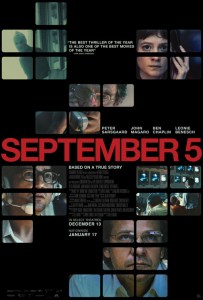 With September 5, we remain almost entirely in the control room of ABC Sports as they cover the fateful 1972 Munich Olympics after the Israeli athletes are taken hostage by terrorists. It’s a subject covered in plenty of other movies, including Steven Spielberg’s Munich and the 1999 Oscar-winning documentary One Day in September, but now we’re watching it from the perspective of the journalists thrust into the spotlight to try and cover an important and tragic incident as it plays out by the hour. It’s an interesting perspective and gives voice to several thorny ethical issues, like when the news team is live broadcasting an oncoming police assault, which the terrorists can watch and prepare for as well. The movie is filmed in a suitable docu-drama style and the pacing is as swift as the editing, and that’s ultimately what holds me back from celebrating the movie more. It’s an interesting anecdote about media history, but September 5 fails to feel like a truly insightful addition to the history and understanding of this tragedy. It’s so focused on the people in the studio and restrained to this one day that it doesn’t allow for us to really dwell or develop in the consequences of this day as well as the consequences of their choices on this fateful day. The movie feels like a dramatization of a select batch of interviews from a larger, more informative documentary on the same subject. It’s well-acted and generally well-written, though I challenge people to recall any significant detail of characters besides things like “German translator” and “Jewish guy.” It’s a worthy story but one that made me wish I could get a fuller picture of its impact and meaning. Instead, we get a procedural about a ragtag group of sports journalists thrust into a global political spotlight. There’s just larger things at stake, including the inherent drama of the lives at risk, than if they’ll get the shot.
Nate’s Grades:
Saturday Night: C+
September 5: B
Share this:

The Crow (2024)
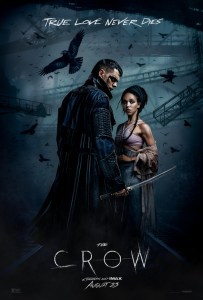 It’s been over twenty years since there’s been a movie based upon James O’Barr’s iconic graphic novel The Crow, and it’s been almost thirty years since there was a theatrically released movie. It’s a franchise that seems easy enough to make into a movie: a victim of violence comes back from the dead with some supernatural guidance to seek vengeance on those who killed them. Slather it in a moody atmosphere and some nice character beats, and you have yourself a born winner, like the 1994 movie that became a staple for a generation of disaffected teenagers. So why has it been so hard to bring this franchise back to life? There have been many starts and stops, with different directors and actors becoming attached and leaving over time, including Bradley Cooper, Luke Evans, Jason Momoah, and Alexander Skarsgard. Apparently, the producers finally found a story they felt could support a Crow reboot, or so they hoped. It crashed pretty hard at the box-office upon release. Despite its omnipresent placement on many worst of 2024 lists, I didn’t hate The Crow 2024. It has some serious problems but it also has some intriguing ideas that could have worked in a better version. It’s far less egregious than the 2005 Wicked Prayer where a literal plot point is stopping a climactic consummation between a villainous Tara Reid and David Boreanaz. It couldn’t be that bad, could it? It’s not, but it needed a lot of work.
Eric Draven (Bill Skarsgard) meets the love of his life, Shelly (FKA Twigs), where one meets all the hot and available singles these days – in drug rehab. She’s on the run from a criminal enterprise after she kept an incriminating video, so once she and Eric escape from their rehab center and try and make a go at a new life on the outside, the goons find them and kill them both. Except Eric’s spirit is sent to a purgatory netherworld and tge mysterious man Kronos offers to send him back to get vengeance. It seems this crime syndicate is led by Vincent Roeng (Danny Huston), who happens to be perpetuating his lifespan by offering fresh innocent souls to Hell. With the supernatural power of a guardian crow providing him invulnerability, Eric seeks to stop these bad people from dooming any other souls and maybe he can save Shelly’s soul in the process.
 Let’s tackle some of the more noteworthy mistakes of the reboot before I begin providing the compliments and where I think the movie actually has some worthy ideas. The biggest creative mistake is delaying the tragically fateful murder that spurs the entire movie until 45 minutes in. For contrast, the original movie has its Eric and Shelly getting killed through an opening montage. It doesn’t waste any time getting to the real premise of the material, the supernatural revenge tale. If you’re going to delay that key turn by so long, then that relationship better pop off the screen, or the chemistry has to be amazing, or the characters are so in depth and charming that with the considerably increased time we will feel a deep pain at the loss. If you’re putting more weight on the love story and their connection then you have to back it up, and this movie cannot. Therefore, it’s drawing out its necessary supernatural transformation to a point that there is only a measly hour left for all that superhuman stalking and avenging.
In the original, Eric (Brandon Lee) tracked down the gang responsible for his and his wife’s murder and each member got their own section where they established their character. Each section allowed us to learn more about the powers Eric now had at his disposal as well as how they might change him. The structure allows the bad guys to learn about their predicament and plan a defense. It allows the exciting elements from the premise to develop and adapt. With The Crow 2024, there’s one initial attack where Eric discovers he can bounce back from bullets, then there’s one ambush on a car carrying our bad guys, and finally there’s an extended assault at an opera that gruesomely kills every disposable henchman money can buy. That’s it. Eric isn’t picking them off one-by-one or even working up the food chain to the really bad guys. The bad guys don’t even seem that threatened, as Vincent is still going about his routines, albeit with more armored guards. It makes the whole Crow parts of The Crow feel small and underdeveloped. This is the first Crow movie where the titular bird, the symbolic partner from the underworld, doesn’t even connect in any meaningful way. It’s just a background “caw.”
 The entire inclusion of a villain who traffics innocent souls begs for further examination and probably a more formidable opponent. Vincent confesses he’s hundreds of years old and his agreement is with the Devil himself, so you would think this man would have learned some tricks in the ensuing hundreds of years. He has some vague super power where he can whisper suggestions into the ears of his victims and they’ll do what he commands, but does he use this power when he’s battling Eric or trying to flee from Eric? No. The demonstration of this super power basically resorts to being a more personal form of torture. Vincent doesn’t even seem worried about an undead warrior coming for him. Maybe that’s centuries of accrued over confidence, but if that’s the case, then make us love to hate this arrogant bastard. Also, if he’s had a successful transactional arrangement with the Devil for literal centuries, shouldn’t Ole Scratch have a thing or two to say about his soul supplier being brought to cosmic justice? If innocent souls are so much more delicious to the Prince of Darkness, there’s more to lose, and maybe that even brings the horned one into the fray, or he designates a promising underling or nepo baby demon, and then Eric has to fight the literal powers of Hell as well protecting his target, which raises the question how far is he willing to go to seek the vengeance that he craves.
That question is actually one of the more interesting points because this version of The Crow directly connects the hero’s strength to the power of love. This is where putting more emphasis and time with the love story could have worked… had the love story been compelling. I like that it’s not his hatred that gives him his powers but his love for Shelly. The movie also provides a more urgent reason for Eric to make these bad men feel his crow-y wrath: he can retrieve her from Hell if he thwarts Vincent and his soul-trafficking gang. Even though she’s dead, he can still save her, and that is meaningful and provides a better motivation for our protagonist. I don’t know why, and it seems like this Kronos guy could be far more active and helpful as an otherworldly guide, but it’s an effective goal to drive our hero to slay his targets. I liked that late in the movie, after he receives some upsetting news about Shelly, his conflicted feelings are detracting from his super powers. There’s a direct and personal sense of causality. His doubts in whether he loved Shelly are manifesting as physical vulnerability. This approach could have worked had the filmmakers given the audience an engaging love story. The movie also feels built around hiding the acting limitations of Twigs (Honeyboy). She tries but this performance feels so listless and lacking a spark or charisma that could convince why Eric would risk it all for her.
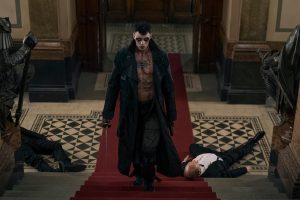 There’s one notable action sequence and it deserves some kudos for its morbid invention. When you have a hero that can take all the slings and arrows of outrageous fortune, it can lessen the stakes when it seems like they lack a credible weakness (call it the “Superman problem”). However, what I liked about the 2024 Crow is that even though he’s an undead warrior, that doesn’t mean Eric is somehow superior at fighting. He can take more punishment but that doesn’t mean he’s become an exemplary martial arts fighter, agile gymnast, or trained marksman. He’s still just a lanky guy, albeit one with washboard abs, the sculpted physique one naturally develops while recovering from substance abuse, of course. I enjoyed that this version of Eric was still struggling in his fights and could fall down and be bested. For his big assault scene at the opera house, he prioritizes a sword as his weapon of choice. At least that necessitates proximity to take out his opponents. The extended and very bloody fight scene is inventively gruesome; at one point, Eric uses the sword sticking out of his chest to lean forward and impale a henchman pinned on the floor. He even shoots through holes in his body to take out henchmen grappling him from behind. It’s the most thought put into utilizing the possibility of its premise. I don’t know why the rest of the movie couldn’t exhibit that same level of thought and creativity.
If you’re a fan of the comic or the 1994 movie, you’ll more than likely walk away from this newest Crow with some degree of disappointment. It wasn’t worthy of a placement on my own worst of the year list. Rather, it appears as a middling dark thriller that has some interesting creative choices that fail to pan out because the follow-through wasn’t as good as the idea. With a few more revisions, I think this basic approach could work, emphasizing the love story and devoting precious time to make it more impactful than just an innocent woman being avenged. However, by not fulfilling the possibility of these choices, instead we’re stuck with a lackluster romance eating up 45 minutes of screen time that could have been used for more satisfying supernatural action. By its sloppy end, I was just left shrugging. If this is what twenty-plus years of development wrought, maybe we needed a little longer for better results.
Nate’s Grade: C


 nathanzoebl
You must be logged in to post a comment.