Daily Archives: November 8, 2024
Joker: Folie à Deux (2024)
 Movie musicals can be sweeping, invigorating, and at their very best transporting, They mingle the high-flying fantasies and visual potential of cinema, and we’ve gone through many waves of kinds of musicals. Today, we’re in an outlandish world of the outlandish musical, an experience in ironic air quotes, where stories that you never would have thought could be musicals would then dare to be different and attempt to be musicals. The much-anticipated Joker sequel, Folie a Deux, dares to be a challenging jukebox musical of old favorites. The French movie Emilia Perez tells the story of a cartel leader that undergoes a sex change and tries to do good with her second life. Both movies are deeply interesting messes as well as experiences I don’t think actually work as musicals.
Joker 2, which I will be referring to it as for the duration of this review mostly because I don’t want to type out Folie a Deux, and not due to some explicit dislike of the French, is a fascinating misfire that comes across as downright disdainful of its audience, its studio, and its very existence. The last time I felt this way from a sequel was 2021’s Matrix Resurrections, another fitfully contemptuous movie that was alienating and self-erasing and also from Warner Brothers. The first Joker movie in 2019 was a surprise hit, grossing over a billion dollars, which meant that the studio wasn’t going to sit idly by and not force a sequel for a movie clearly intended to be one complete movie. While the first movie cost a modest $50 million, the sequel cost close to $200 million, with big pay days for Joaquin Phoenix, Lady Gaga, and co-writer/director Todd Phillips, who I have to remind you, dear reader, was actually nominated for a Best Director Oscar in 2019. Having gotten their paydays, it feels like Phillips and his collaborators have set out to scorch all available earth, going so far as to even insult fans of the earlier movie. Add the bizarre musical factor, and I don’t know how else to describe Joker 2 but as an alienating and miserable protracted exercise in self-immolating artistic hubris. It’s so rare to see this level of artistic clout used to proverbially stick a finger in the eye of every fan and studio exec who might have hoped there could be something of value here.
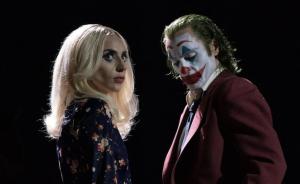 Let’s tackle the plot first, as we pick up months after the events of the 2019 film where lowly Arthur Fleck (Phoenix) is being tried for the murders he committed, most famously on a TV talk show where he debuted his stand-up comedian persona as Joker in full regalia. There’s an (un)healthy contingent of the rabble that idolize Arthur, finding the Joker to be some kind of mythic hero of class-conscious revolution, pointing out how society is failing all the little guys getting crushed by the rich and powerful and privileged, like that dead Wayne family. One of those fans is Lee (Gaga), a.k.a. Harleen Quinzel, a disturbed young woman obsessed with getting closer to Arthur, and he is extremely appreciative of the fawning attention. The defense case hinges upon whether or not Arthur was acting on his own accord or had a psychotic break, disassociating as “Joker,” and thus cannot be held accountable for the murders. Except it seems “Joker” is all the people of Gotham want to talk about, whether it’s the media or the public, and what about poor lonely Arthur?
If I had to fathom a larger thematic point, it feels like Phillips is trying to put our media ecosphere and comics fandom into judgement. He’s pointing to his movie and saying, “You wouldn’t have cared nearly as much about this project had it just been some other spooky, disturbed man losing his sanity and lashing out. You only care because he would eventually become the notorious Batman villain or lore, and that’s why you’re back.” Well, to answer succinctly, of course. When your movie’s conceptual conceit is all about providing a gritty back-story for a famous supervillain, don’t be surprised when there’s more attention and interest. This would be the same if Phillips had made a searing drama about teenage nihilism and easy access to guns and then called it Dylan Klebold: The Movie (one half of the Columbine killers, if you forgot). Stripping back layers to provide setup for a famous killer will always generate more interest than if it was some fictional nobody. It’s an accessible starting point for a viewer and there’s an innate intrigue in trying to answer the tantalizing puzzle of how terrible people got to be so terrible.
I found the 2019 movie to be a mostly interesting experiment without too much to say with its larger social commentary. It felt like Phillips relied a bit too heavily on that assumed familiarity with the character to fill in the missing gaps of his storytelling. It was a proof of concept for that proved successful beyond measure (a billion dollars, 11 Oscar nominations, including THREE for Phillips). This time, Phillips is taking even less subtlety with his blowtorch as he actively annihilates whatever audiences may have enjoyed or appreciated in the first movie.
 And in order to fully appreciate the scope of this movie’s active distaste for its own existence, I’ll be treading into some major spoilers, so jump forward a paragraph if you wish to remain unspoiled, dear reader. The conclusion of this sequel is a miserable succession of hits that degrades Arthur. At the conclusion of the 2019 original, at least you could say he was becoming a more realized version of what he wanted to be, albeit a disturbed murderer, but one who became the face of a revolution and gained a legion of adoring followers that he desperately craved. At the end of Joker 2, Arthur pathetically admits in his trial there is no alternate Joker persona and that he’s just a sad loser. Then Lee admits that she was only ever interested in “Joker” and wants nothing to do with Arthur the sad loser. And then upon returning to prison, another inmate confronts Arthur, apparently feeling personally betrayed for whatever reason. This irate prisoner stabs Arthur to death and then laughs in a corner, slicing a smile into the sides of his mouth, Heath Ledger-style. The movie literally ends with Arthur laying in a pool of his own blood, staring dead-eyed into the camera, with Phillips metaphorically painting emphatically at his corpse and defiantly saying, “Look, he’s not even the Joker now! Do you still care? Do you?” These movies were designed to be the untold history of the man who would be Joker, and they now have ended up being four hours about the guy whose idea maybe inspired a criminal lunatic to improve upon what he felt was another guy’s brand. What’s even the point? We followed two movies about the guy who isn’t the Joker? Seems pretty definitive there won’t be a third Arthur Fleck movie, as there’s nothing left for Phillips and his anarchic collaborators to demolish to smithereens.
When I heard that Joker 2 was going to be a musical, I actually got a little excited, as it felt like Phillips was going to try something very different. Now the curse of many modern movie musicals is trying to come up with an excuse for why the world is exploding in song and dance, like 2002’s Chicago implying it’s all in Roxy’s vivid imagination. Joker 2 takes a similar approach, conveying that when Arthur is breaking out into song that it’s a mental escape for him, that it’s not actually happening in his literal reality. Except… why are there sequences outside Arthur’s point of view where other characters are breaking into song, notably Lee? Is this perhaps a transference of Arthur’s perspective, like he’s imagining them on the outside joining him in tandem? The concept fits with his desperate desire to forge meaningful human connections with people that see him for who he is, and having another character harmonize with him provides a fantasy of validation. Except… there’s no meaningful personal connection between Arthur and the allure of movie musicals. It’s not like he or his domineering mother, the same woman he murdered if you recall, were lifelong fans of musicals and their magical possibilities. It’s not like 2001’s Dancer in the Dark where our lonely protagonist dreamed of being in a movie musical as an escape from her depressing life of exploitation and poverty. It just happens, and you’re listening to Phoenix’s off-putting, gravelly voice straining to recreate classics like “For Once in My Life” and “When You’re Smiling (The Whole World Smiles With You).” It’s also a criminal waste of a perfectly game Gaga.
 Phillips’ staging of his musical numbers are so lifelessly devoid of energy and imagination. Most of our musical numbers are merely in the same setting without any changes besides now one, or occasionally two, characters are singing. There’s one number that becomes a dance atop a roof, and several duets that appear like a hammy Sonny and Cher 1970s variety TV show, and that’s all you’re getting folks in the realm of visual escapism and choreography. In retrospect, it feels like the musical aspect of the sequel might have been a manner to pad it to feature-length, adding 16 performances and over 40 minutes of singing old standards. There’s a good deal of repetition with this sequel, as much of the plot is restating the events of the first film; that’s essentially what the courtroom drama facilitates as it trots out all the previous characters to recap their roles and point an accusatory finger back at Arthur.
There is one lone outstanding scene in Joker 2, and it happens to be when Arthur, in full Joker makeup, is cross-examining his old clown entertainer work buddy, Gary Puddles (Leigh Gill). Arthur admonishes Gary, saying he spared him, and Gary painfully articulates how hellish his life has been as witness to Arthur’s killing, how little he sleeps, how it torments him and makes him so afraid. For a brief moment, this character shares his vulnerability and the lingering trauma that Arthur has inflicted, and it appears like Arthur is wounded by this realization, until he settles back into the persona he’s trying to put forward, the “face” for his defense, and goes back to ridiculing Gary’s name and turning the cross-examination into an awkward standup session. It’s a palpable moment that feels raw and surprising and empathetic in a way the rest of the movie fails to.
Is there anything else to celebrate with Joker 2’s troubled existence? The cinematography by Lawrence Sher can be strikingly beautiful, especially with certain shot compositions and lighting contrasts. It makes it all the more confounding when almost all the musical numbers lack visual panache. The Oscar-winning composer returns and while still atmospheric and murky the score is also far less memorable and fades too often into the background, like too many of the technical elements. Joker 2 has plenty of talented people involved in front of and behind the camera, but to what end? What are all their troubles adding up to? It practically feels like a very expensive practical joke, on the audience, on the studio, and that is genuinely fascinating. However, it doesn’t make the end product any better, and the film’s transparent contempt sours every minute of action. Even if you were a super fan of Joker or morbidly curious, steer clear of Folie a Deux, a folly on all of us.
Nate’s Grade: D


 nathanzoebl
You must be logged in to post a comment.