Monthly Archives: June 2023
Nimona (2023)
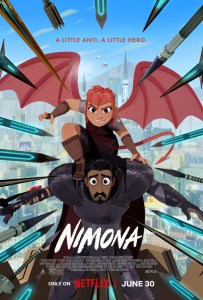
Based on the graphic novel by ND Stevenson (She-Ra), itself a web comic from 2012-2014, Nimona was developed by Blue Sky Animation Studios and originally scheduled to be released in 2020, and then Disney bought Fox, shut down Blue Sky, and pushed back against the gay content of Nimona before just canceling it altogether in 2021, and then Netflix came in and saved the project and released it, gay and all, during the last day of Pride Month. It’s been a long, protracted journey for Nimona to get to your screen and, reader, it was worth it. The movie is a rambunctious and revisionist fairy tale that is both subversive and deeply sincere, enough so that an emotional confrontation of accepting someone on their own terms elicited genuine tears on my part (for those keeping record, that’s three straight animated movies in the month of June that caused me to cry). Nimona (voiced superbly by Chloe Grace Moretz) is a high-energy prankster in a fantasy world melding Medieval culture with future technology. She befriends a fellow outsider, Ballister (voiced by Riz Ahmed), after the kingdom views him as a wanted villain. Together, they try and clear Ballister’s name by finding the real killer, and maybe they can wreck some stuff too just for fun. The cell-shaded style, a familiar aesthetic in the realm of video games, adds a bright and slickly appealing quality to the animation, and the frenetic pace and anarchic humor keep the movie bristling with entertainment, while the emotional core (vulnerable outcasts finding community) sneaks up on you and delivers a more resonating climactic finish than simply vanquishing a baddie. The ending even has rich thematic notes of The Iron Giant, which is never a bad influence. The queer content is also treated without sensationalism and treated as any other aspect of human compassion. The heart and message are just as impressive as the visuals and the humor. Nimona is a funny all-ages adventure that deserves its big screen moment after its long gestation.
Nate’s Grade: B
Share this:

No Hard Feelings (2023)
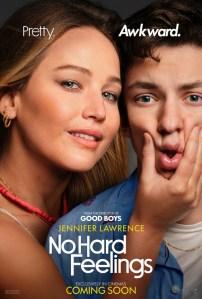 If you can get past the icky premise, No Hard Feelings might surprise you. It’s a raunchy, R-rated sex comedy with a very game Jennifer Lawrence, also a producer, giving it her all. The premise involves Lawrence playing a down-on-her-luck 32-year-old who accepts a wanted ad to help a rich couple who are concerned that their 18-year-old son Percy (Andrew Barth Feldman) is too inexperienced in the matters of women and romance. This leads to Lawrence broadly trying to seduce the awkward, introverted young man. The comedy is less related to set pieces and more on the changing relationship of the two leads, which leads to fewer highs but at least consistent, albeit mild, amusement. Lawrence is the headlining name but the real star is Feldman. His comedic awkwardness reminded me of Michael Cera, and his reactions and sputtering from the brassy, larger-than-life vamping from Lawrence were even funnier than the broad punchlines. There’s one scene where Feldman sits at a piano and plays a ballad version of “Maneater” by Hall and Oates, and it’s a terrific and sincere moment that further made me appreciate the range this actor’s range. He’s appeared in several Internet musical short videos, and with how big he can get, to watch him hold back with this character and find even more subtle laughs, it’s just allthe more impressive. No Hard Feelings is an adequate sex comedy that doesn’t break any new raunchy ground. I appreciated its conclusion that doesn’t feel the need to tie everything into tidy endings, and the age-gap is addressed throughout, with Lawrence feeling particularly out of touch with today’s teenagers. It’s a possible good time but with some reservations.
Nate’s Grade: B-
Share this:

The Flash (2023)/ Spider-Man: Across the Spider-Verse (2023)
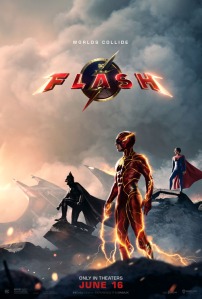
Released within two weeks of one another, two big summer movies take the concept of a multiverse, now becoming the norm in comic book cinema, and explore the imaginative possibilities and wish-fulfillment that it proposes, but only one of them does it well. Spider-Man: Across the Spider-Verse is the sequel to the Oscar-winning 2018 revolutionary animated film, and it’s a glorious and thrilling and visually sumptuous experience, whereas DC’s much-hyped and much-troubled movie The Flash feels like a deflated project running in place and coming apart. Let this be a lesson to any studio executive, that multiverses are harder than they look.
Barry Allen (Ezra Miller) has the ability to travel at fantastic speeds as his superhero alter ego, The Flash. He’s tired of being the Justice League’s errand boy and still fighting to prove his father is innocent of the crime of killing Barry’s mother. Then Barry discovers he can run fast enough to actually travel back in time, so he returns with the intention of trying to save his mother. Except now he’s an extra Flash and has to train his alternate self (also Miller) how to control his powers. In this different timeline, there is no Justice League to combat General Zod (Michael Shannon, so thoroughly bored) from destroying the planet for Kryptonians.
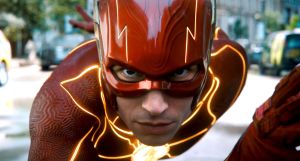
This is the first big screen solo outing for The Flash, and after none other than Tom Cruise, Stephen King, and James Gunn calling it one of the best superhero movies of all time, it’s hard to square how trifling and mediocre so much plays out as an example of a creative enterprise being pulled in too many directions. Miller was cast as the speedster almost ten years ago, and this tale has gone through so much tortured development, leaping through numerous filmmakers and writers, that its purpose has now gone from being a pillar of the expanding DC cinematic universe began with Zack Snyder’s Man of Steel in 2013 to becoming the Snyderverse’s death knell. The premise of traveling back in time is meant for Barry to learn important lessons about grief and responsibility and the limits of his powers, but it’s also intended as the reboot option for the future of these cross-connected comic franchises. It allows Gunn, now the co-head of the new way forward for DC movies and TV, to keep what they want (presumably Margot Robbie and Jason Momoa) and ditch the rest (Henry Cavill, Ben Affleck, Black Adam, Shazam, and Zack Snyder’s overall creative influence). So reviewing The Flash as only a movie is inadequate; it’s also a larger ploy by its corporate overlords to reset their comic book universe. In that regard, the quality level of the movie is secondary to its mission of wiping the creative slate clean.
Where the movie works best is with its personal stakes and the strange but appealing chemistry between the two Millers. It’s an easy starting point to understand why Barry does what he does, to save his mother. This provides a sturdy foundation to build a character arc, with Barry coming to terms with accepting his grief rather than trying to eradicate it. That stuff works, and the final talk he has to wrap up this storyline has an emotional pull that none of the other DCU movies have exhibited. Who wouldn’t want one last conversation with a departed loved one, one last opportunity to say how you feel or to even tell them goodbye? This search for closure is a relatable and an effective vehicle for Barry to learn, and it’s through his tutelage of the other Barry that he gets to see beyond himself. The movie is at its best not with all its assorted cameos and goofy action (more on both later) but when it’s a buddy comedy between the two Barrys. The older Barry becomes a mentor to himself and has to teach this inexperienced version how to hone and control his powers as well as their limits. It puts the hyper-charged character into a teaching position where he has to deal with a student just like him (or just him). It serves as a soft re-education for the audience alongside the other Barry without being a full origin story. The impetuous young Barry wanting to have everything, and the elation he feels about his powers, can be fun, but it’s even more fun with the older Barry having to corral his pupil. It also allows the character an interactive checkpoint for his own maturity and mental growth. Miller’s exuberant performances are quite entertaining and never fail to hit the comedy beats.
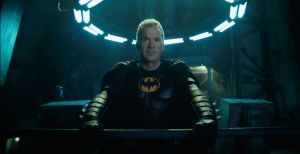
The problem is that the movie puts so much emphasis on too many things outside of its titular hero. Much was made of bringing back Keaton to reprise his Batman after 30 years. I just wish he came back for a better reason and had legitimate things to add. His role is that of the retired gunslinger being called back into action, and there’s an innate understanding with Barry wanting to go back in time and save his family, but too much of this character’s inclusion feels like a stab at stoking audience nostalgia (the callback lines all made me groan). I highly enjoyed Keaton as Batman and appreciated how weird he could make the billionaire-turned-vigilante, but he’s no more formed here than a hologram. The same thing happens with the inclusion of Super Girl a.k.a. Kara Zor-El (Sasha Callie). In this universe, there is no Superman, so she’s our requisite super-powered alien that Zod is hunting to complete his plans for terraforming Earth. She’s an intriguing character as a tortured refugee who has lingering doubts about whether humanity is worth the sacrifice, but much of her usage is meant only to make us think about Superman. She’s not given material to make her own impression, so she simply becomes the imitation of the familiar, the shadow to the archetype already being left behind. But these character additions aren’t even the worst of the nostalgia nods, as the final climactic sequence involves a collision of worlds that harkens to just about every iteration of the famous DC heroes, resurrecting several with dodgy CGI and uncomfortable implications (spoilers… the inclusion of George Reeves, when he felt so typecast as TV’s Superman that he supposedly killed himself because he thought his acting career was over, can be galling).
The action of The Flash is mostly fine but with one exceptional example that boggles my mind. In the opening sequence, no less, Barry is trying to help clean up a crumbling hospital when it collapses and literally sends a reign of babies falling through the air. I was beside myself when this happened, horrified and then stupefied that this absurd action sequence was actually happening. Barry goes into super speed to save the day, which more or less reverts the world into super slow-mo, though he needs to power up first, so we get a quick edit of him stuffing food into his face to load up on calories. We go from Barry breaking into a falling vending machine, stuffing himself in the face with snacks, getting the green light from his suit which I guess measures his caloric intake, and then grab a baby and literally put it in a microwave to shield it from danger. Just describing this event makes me feel insane. I figure the filmmakers were going for an over-the-top approach that also provides light-hearted goofiness to separate the movie from the oppressively dark grist of Snyder’s movies. However, this goes so far into the direction of absurdity that it destroys its credibility. It’s hard for me to fathom many watching this misguided and horrifying CGI baby-juggling sequence and say, “Yes, more please,” rather than scoff and shake their head. It’s not like the rest of the movie keeps to this tone either, which makes the sequence all the more baffling. There are Flash rules that are inconsistently applied to the action; Barry’s caloric intake is never a worry again, and the effects of moving a person during super speed don’t ever seem to be a problem except for one spewing gross-out gag.
While not being an unmitigated disaster, it’s hard for me to see the movie that got so many figures in the entertainment industry raving. The Flash has some notable emotional stakes, some amusing buddy comedy, and some goofy special effects sequences that run the gamut from amusing to confounding, but it’s also quite a mess of a movie, and too many of its nods to the fandom feel like empty gestures of nostalgia compensating for imagination. For all it gets right, or at least keeps interesting, it seems like another cog in a multi-billion-dollar machine, a stopping point also intended to be a reset and starting point. It feels like the character wasn’t trusted enough by the studio to lead his own solo movie even after years of buildup with Miller, nine seasons of the popular TV series, and 80-plus years of prominent placement in DC comics.
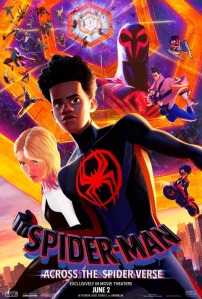
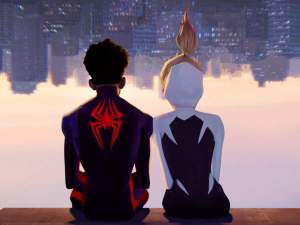
Conversely, Across the Spider-Verse is a sequel that expands an already stuffed story but knows what stories and themes to elevate so they don’t get lost amidst the fast-paced lunacy. Taking place a year later, Miles Morales (voiced by Shameik Moore) has grown into his role as the new Spider-Man for his world. He strains to meet the expectations of his parents, and keep up his grades, while fulfilling the duties of a superhero jumping into danger. When Gwen Stacey (voiced by Hailee Steinfeld) reappears to discuss joining the multiverse police, Miles jumps at the chance, having genuinely missed his other Spider friends, especially Gwen. There are countless Spider people in countless worlds, even including a Spider-T. Rex and a Spider-Car (Peter Parked Car, I believe the name was). Miguel O’Hara (voiced by Oscar Isaac) is the Spider-Man tasked with keeping order across the many interconnected multiverses, and he insists that sacrifice is essential to maintain balance, one that hits too close to home for Miles to abide.
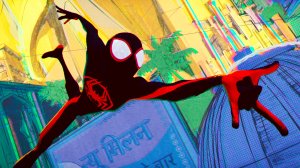
The 2018 original is a hard act to follow, and while Across the Spider-Verse doesn’t quite overrule its predecessor it is a more than worthy sequel that has everything fans loved about the first trip. The visual inventiveness has been taken even higher, with the mixture of even more different animation and art styles. I loved seeing each Spider person and how they fit into their unique art style of their world, like the living water colors of Gwen’s world and the punky paper collage style of Spider-Punk (voiced by Daniel Kaluuya). There’s a villain that comes from a paper universe, so he resembles a three-dimensional paper construction with hand-scribbled notes appearing around him like Da Vinci’s commentary. There is something to dazzle your senses in every second of this movie. The visuals are colorful, creative, and groundbreaking with the level of detail and development. There’s probably even too much to fully take in with just one viewing. I want to see the movie again not just because it’s outstanding but so I can catch the split-second vernacular asterisk boxes that pop up throughout the movie. Going further into living comic book aesthetics, new characters will be introduced with boxes citing their comics issue reference point, and certain names and vocab will get their own citations as well. These are split-second additions, nothing meant to distract from the larger narrative. Simply put, this is one of the most gorgeous looking movies of all time, animated or live action. It’s bursting, thrumming, nearly vibrating with life and love stuffed into every nook and cranny, and it’s exhilarating to just experience a vivid, thriving world with animators operating at peak talent.
However, the movie has an engrossing story to better position all those eye-popping visuals. The worry with any modern multiverse story is that the unlimited possibilities of variations and opportunities for characters to do just about anything will overwhelm a narrative, or like The Flash, become a checklist of overburdened and empty fan service. The screenplay by Phil Lord, Christopher Miller, and Dave Callaham is all about relationships. If Miles’ relationship with his stern police lieutenant father (voiced by Brian Tyree Henry) wasn’t such an important focal point, then the emotional stakes of the movie would be meaningless. We see a relatable struggle from both sides, the parents trying to connect with their growing child and give him enough space to find himself, and the child who clearly loves his parents but doesn’t fully appreciate or understand their concerns. They worry about Miles leaving them and whether others will love and support him like his parents. Miles has to experience a wider world of possibility, but these experiences make him appreciate what he has at home, and what could be permanently lost. I don’t mind saying there were more than a few moments that caused me to tear up. I found Gwen’s storyline equally compelling, and her turmoil over keeping her secret identity and then coming out to her father was rather moving. The family bond resurfacing will get me every time, and the simple action of a hug can be as heartwarming and fulfilling as any romantic ode. Across the Spider-Verse makes sure we care about the characters and their personal journeys.
At a towering 140 minutes, this is the longest (American) animated movie ever, and it’s still only one half of a larger story. I knew ahead of time this was only the first part so as soon as we entered Act Three I kept gearing up for the cliffhanger ending. Every five or so minutes I thought, “Okay, this is going to be the end,” and then it kept going, and I was relieved. Not just because I got to spend more time in this unique universe but each new moment added even more to raise the stakes, twist the intrigue, and make me excited for what could happen next. I was shaking in my seat at different points, from the excitement of different sequences to the emotional catharsis of other moments. I cannot wait to experience this same feeling when the story picks back up reportedly in March 2024, though I fear it will get delayed to late 2024.
Even with the unlimited possibility of jokes and silly mayhem, the filmmakers keenly understand that it doesn’t matter unless we care about the characters and their fates. I am shocked that a goofy character I thought was going to be a one-scene joke, The Spot (voiced by Jason Schwartzman), could end up becoming the ultimate destroyer of worlds. I think this reflection nicely summarizes the impeccable artistry of Across the Spider-Verse, where even the moments or characters misjudged as fleeting or inconsequential can be of great power. It’s a movie that is full of surprises and thrills and laughs, all in equal measure, and a blessed experience for a movie fan. In the crush of comic book multiverse madness, Across the Spider-Verse is a refreshing and rejuvenating creative enterprise, one that builds off the formidable talent of its predecessor and carries it even further into artistic excellence that reminds us how transporting movies can be. If you see one superhero multiverse movie this summer, the choice should be as obvious as an inter-dimensional spider bite.
Nate’s Grades:
The Flash: C
Across the Spider-Verse: A
Share this:

Elemental (2023)
 The joke is how Pixar has taken its storytelling motif of examining The Secret Life Of [Blank] and showing what happens in our world when we just aren’t paying attention. We’ve had toys with emotions, bugs with emotions, fish with emotion, cars with emotion, robots with emotion, rats with emotion, and even emotions with emotions, so why not break things down to their basics and give the elements of carbon-based life their own emotions too?
In Element City, Ember (voiced by Leah Lewis) belongs to the fire community living on the outskirts of town, as the big city wasn’t built for their kind. The earth people, and water people, and air people go about their business while the fire people form their own thriving offshoot. Her father and mother came across the sea to give their baby a new life, and the family shop will pass over to Ember’s management when her traditionalist father thinks she’s ready. Her whole life has been about serving her family and trying to live up to their hopes and dreams. This gets more complicated when Wade (voiced by Mamoudou Athie), a water person and a health inspector, has to report her family’s shop for code violations. They work together to save the shop and also learn from one another’s cultures and differing perspectives, and then this unexpected friendship becomes an even more unexpected romance, but can elements so different stay together?
 I was pleasantly surprised at how enjoyable Elemental is to experience and how wondrous its visual presentation is to watch. It is a certifiable treat for the eyes, with so many dazzling colors and quirky but easily readable character designs. There’s a mixture of hand-drawn animation used as Spider-Verse-style accents that provides a pleasing element that allows the images to pop even more. I was never bored looking at a single second of this movie, and even with my theater’s 3-D presentation, the glasses didn’t darken the screen and lessen my overall enjoyment. By existing within a fantasy universe, it allows for every scene and every location to better inform you about this new world and its rules and highlights (fire baby carriages that are barbecue grills). This is a bright, colorful, and supremely enchanting movie to watch because, at least visually, it feels very well developed as far as its world building and atmosphere. What would a community of fire people tend to look like? What would their jobs be? What would their celebrations be like? Their heritage from the Old Country? Naturally, with any fantasy universe, you can nit-pick it to death with questions, such as why do people even bother wearing clothes in this world? What part of the exposed fire or water is observed as obscene? How exactly do these different communities have their offspring? What does air exactly eat for food?
Where Elemental really takes off is with its charming and affecting romance. It’s been a while since romance was at the forefront for a Pixar movie, since 2008’s WALL-E (a.k.a. the greatest Pixar movie). Now there are themes and resonance that go beyond the romance and also enrich it, like Ember’s personal conflict of being a first-generation immigrant daughter and upholding the traditions and wishes of her family at the expense of her personal desires, but the core of this movie is on the burgeoning feelings between Ember and Wade. The movie begins with them butting heads as two elements seemingly in conflict but it doesn’t exactly follow an enemies-to-lovers path. She runs hot and explosive with trying to keep things under control whereas he is deeply empathetic of others and wants to help them become their best selves. He accepts who he is, and the movie doesn’t equate his full-bodied embrace of big feelings as some point of weakness. It brings about laughs from exaggeration, the streaming rivers that burst forth from his eyes upon crying, but it’s his compassion and acceptance that challenges Ember for the better and helps her assert her sense of self. They’re good together, and Wade helps serve as a guide to the wider world for Ember as she’s been isolated her whole life. Their interactions are cute and heartwarming and elevated by pleasant vocal performances. I was drawn into their story and cared about their well-being, enough that I don’t mind sharing that I shed some water myself by the end (I guess this could also make some people mistake that I peed my pants, and I assure you that was not the case, dear reader).
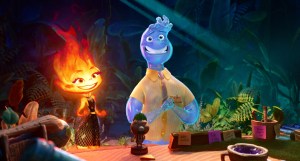 While the core relationships are poignant and winning, the world building and metaphorical allegories feel half-finished and a tad confusing. The movie also goes surprisingly soft exploring its miscegenation metaphor of two elements being forbidden to mix romantically. This universe has four communities of living elements, though air is represented as clouds and those are, literally, water vapor, and the xenophobia and discrimination that the fire people endure feels like a direct parallel to a disadvantaged minority group. However, this isn’t explored in any satisfying depth. We’re told that fire people aren’t really wanted in the city, and the city isn’t really built for them, which is typified by a rail line that splashes water discharge. There’s a lot more that could have gone into this including a more elaborate examination of the harm of red-lining and restricting the economic mobility of one group for bigoted reasons (I know, I can already hear people scolding me for even asking for such socio-political commentary in a family film). However, this metaphor gets a little murky when you take into account the literal danger that living fire exudes. Yes, you can drown, and you can get crushed under earth, but these creatures aren’t walking incendiary devices. This doesn’t translate directly to people, and thus applying class metaphors to actual races can be circumspect. Ember’s worry is that she’ll explode if she gets too angry, and this causes literal physical destruction around her. You can say it’s meant to represent when hurt, angry people lash out that they can inadvertently harm others, but not everyone can incinerate a block because they lose their temper. This kind of undercuts the lesson on misplaced fear.
Also, so much of the external story consists of bad public planning and everyone’s lackadaisical attitude toward fixing this infrastructure miscue. Again, if the larger point was a society that is actively hostile to the fire people, then the ignorant city planning that actively harms a disenfranchised group of people makes sense, but without that larger underlying conflict, it all seems so strangely forgotten. Much of this conflict is on the structure of a wall against a coming buildup of water, something possibly deadly to the fire community, so you would think this community would be a lot more concerned about this looming conflict. You might think that others would organize to provide better safeguards or maybe they would get the city’s attention. That this threat goes unreported and is played at such low stakes makes it all feel forced and manufactured. If the characters don’t seem to think it’s a big deal, then who are we to worry as well? And I can hear some of you trying to branch this out into, say, a metaphor for larger problems that go ignored, like climate change or societal inequalities, but that’s giving Elemental too much credit.
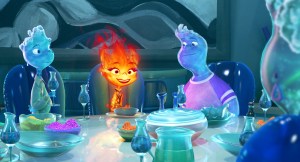 Elemental reminds me of 2020’s Onward, coincidentally one of the last movies I saw in theaters before the pandemic shutdown. I was worried that the core story looked weak but it was actually the world-building that was a bit hazy and under-developed and the emotional core was strong and authentic. It’s the same with Elemental, and while I can quibble about its dropped potential and misshapen world, it has a strong foundation that matters more. The relationships between Wade and Ember and Ember and her family are what makes the movie work and ultimately what made me smile and tear up. It’s an emotional nourishment that makes the movie feel satisfying and worthwhile no matter the lingering questions for this bizarre world. It’s also one of Pixar’s best looking movies, fully deserving of being seen on a large screen for added impact. Elemental has the right DNA for a charming and enjoyable family film for everyone.
Nate’s Grade: B
Share this:

Reality (2023)
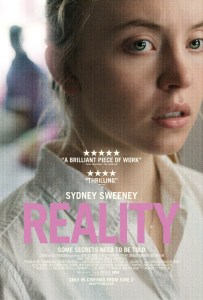 Reality is a film experience where the devotion to verisimilitude is at the sacrifice of drama. The dialogue is reportedly taken one hundred percent from the FBI recordings of their questioning of the preposterously named Reality Winner, played by Sydney Sweeney (Euphoria). She works for a branch of U.S. national security and smuggled a classified document and submitted it to journalists to expose Russia’s intent to hack U.S. voting systems in the 2016 presidential election. The movie takes place more or less in real time as two FBI agents (Josh Hamilton, Marchant Davis) come to Reality’s small home in Augusta, Georgia, begin a search, and question her duties, behavior, and security clearances at her work. We’re inundated early with mundane details of asking about dogs and yoga class coverage while FBI agents are raiding Reality’s home, and the movie doesn’t allude to what everything is about until halfway through. Again, strictly sticking to the script of the government encounter limits creatively where and what the actors can do, so the overall inert feeling is, I suppose, part of the appeal for writer/director Tina Setter’s movie, based on her stage play. I think some people will read the protracted build-up as unsettling in its stubborn ordinariness, or that withholding the juicy drama only makes the collateral mystery and suspicions stronger. Reality is an interesting story told in a frustrating and gimmicky fashion that lessens its dramatic impact. If I just wanted to watch actors re-enact the transcripts, I’d seek out a documentary. I’m thinking of something like 2012’s Compliance, based on a true story and told over the course of one day, but it was harrowing and made me have to watch with my fingers covering my eyes because of the grueling drama that would not look away. There are a few interesting visual quirks here, like actors blinking out of a scene when they say words redacted from the transcript, but mostly it feels too stage bound. Sweeney comes unglued in pretty convincing manner as her different defenses and obfuscations crumble through the interrogation. Reality is a well-meaning movie meant to better frame one young woman’s extraordinary actions through an ordinary lens, but I kept getting antsy for the movie to drop its gimmick and accept that there was more inherent drama in this story than what was going unsaid while we discussed yoga and dogs.
Nate’s Grade: C+
Share this:

Hulk (2003) [Review Re-View]
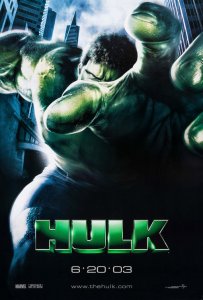 Originally released June 20, 2003:
Comic book movies are all the rage these days. The X-Men films, Spider-Man, even Daredevil all managed some level of success because they were, at their heart, entertaining pulp and treated the source material with some sense of reverence. Now Ang Lee’’s monstrous film Hulk lumbers into theaters and one could best describe it as being too serious for its own good.
Bruce Banner (Eric Bana) is the quiet guy, the one who bottles everything inside. His lab partner Betty Ross (Jennifer Connelly) has recently broken off their relationship due to his emotionally shut-off demeanor. Well Bruce gets hit with a lethal dose of gamma rays and it kicks up something inside him. You see, Bruce’s long-absent father (Nick Nolte, looking frightfully like his drunken mug shot photo) experimented some kind of regeneration serum on himself. When he fathered Bruce he passed on whatever genetic alteration. So now when Bruce gets mad he turns into a 15-foot raging Jolly Green Giant (the CGI in this movie is not good). He starts enjoying the freedom letting go can bring. Nothing gets him more mad than some yuppie (Josh Lucas, badly miscast) trying to buy out his lab and then kill him to sell his DNA to the military. Along the way, Betty’’s father (Sam Elliott) tries to hunt Bruce and his greener-on-the-other-side alter ego for the good of us all.
 Director Ang Lee has injected most of his films with a sense of depression and repression, from the biting and darkly astute The Ice Storm to the stoic Gary Cooper-like silence of the aerobatic samurai in Crouching Tiger, Hidden Dragon. He’’s a master filmmaker without question. Lee bites off more than he can chew with Hulk much like the gifted Cameron Crowe did with the sci-fi Vanilla Sky. Lee is so damn ambitious that Hulk tries to be everything and it ends up fulfilling nothing. His film is the most ambitious and the most tedious super hero/comic book movie of all time. What does it say when the super green Hulk has more personality than the bland Bruce Banner?
The acting is a non-issue here. Connelly remains one of the most beautiful women in all of movies and has incredibly expressive eyes and brows. She has this strand of hair that’s always in the right side of her face. It’’s so awkward. Bana gets the least fun part as the mentally scarred kid afraid of his own anger. He doesn’’t do much but then he isn’’t given much. Elliott overacts with impressive gusto whereas Nolte overacts like every line was his last breath.
After about an hour or so of beleaguered talking and flat characters, I started to become restless. I wanted to see Hulk smash, Hulk smash good. Instead what you get is endless scenes of cheesy speeches, sci-fi babble speech, phony philosophy, and mind-numbingly awful pacing. Seriously, Hulk has worse pacing than glaciers. You’’ll see the Mona Lisa yellow faster than this movie will be over. And in some weird paradox, I think it’ will never be over.
 Lee attempts to make the film a living comic book. You’’ve never seen this many wipes short of a Brady Bunch marathon on TV Land. Lee splits his screen into multiple panels and slides them around much like the layout of a comic book. However, this visual cue is overused and calls attention to itself in a “how-arty-are-we” kind of pretentious way. If Hulk was attempting to be a comic book movie, then where the hell did all the action go? This movie could have been subtitled The Hulk Goes to Therapy because everything excluding an over-the-top final act revolves around people working out childhood issues. Man, there’’s nothing I like to see more during the summer than a $150 million-dollar movie about – people working out childhood issues.
Hulk is an overlong and meandering film that’s incredibly serious, incredibly labored, and incredibly boring. Someone needs to tell the creators of this film to lighten up. The big-screen adaptation of the big green id may have heavy doses of Freudian psychoanalysis (try and tie THAT with the merchandising onslaught) but the film is barren when it comes to fun. Even comic book fans should be disappointed. I heard a story of a kid who saw Hulk and asked his mom when the movie was going to start, and she replied, “90 minutes ago.” Should you see Hulk in the theater at full price? No. Instead, give your money to me. It will have more resonance.
Hulk mad? Audience mad! Audience leave theater. See other better movies instead. Hulk sad. No Hulk 2. Audience happy.
Nate’s Grade: D+
——————————————————
WRITER REFLECTIONS 20 YEARS LATER

Ang Lee’s Hulk is a unique experience that no other comic book movie has delivered in the ensuing twenty years. It’s clearly trying to do something heady, something more Freudian and psychological and cerebral, and yet it’s also doing so in a clumsy, wipe-heavy, panel-sliding bonanza of split screens and goofy transition shots. This movie would be fascinating to dissect if it wasn’t also so crushingly and unrepentantly boring. Even having seen the movie in 2003, I was still shocked how bored I was re-watching all 138 minutes in 2023. It’s such a strange experience to watch a movie that, at any moment, can be so weird and different, and then in the next minute make you contemplate doing your taxes again.
I think what Lee and his screenwriting partner James Schamus, who has written nine Lee movies going back to their very first, 1991’s Pushing Hands, were most intrigued by the Jekyll/Hyde allegory. Hulk is not alone in this regard in the realm of super hero dramatics; many characters lean into their alter ego as a form of personal wish-fulfillment, processing trauma, and/or freedom not allowed under their normal persona. The added complication with the Hulk is the monster factor, that when the man, Bruce Banner (Eric Bana), loses his temper and he unleashes his “big green id,” the ferocity he was holding back. The man/monster dynamic is what clearly interested Lee and Schamus, so we get plenty of dweeby Banner being bossed around and then confessing that, after his transformation, he likes it when he lets go and just succumbs to his more “smash everything” urges. However, this story angle is just crushed by the overwhelming weight of the overwrought psychoanalysis of Banner’s daddy issues and repression. The problem with this heavy-handed approach is that the answers are obvious and yet also confounding at every turn. Bruce’s father David (Nick Nolte) experimented on his own DNA, which he passed onto baby Bruce. The implications are used more as a handy explanation for why Bruce didn’t die from his fateful gamma radiation accident than as a cautionary tale of human experimentation. The repeated flashback reveals are drawn out far too long with the most obvious conclusions (Baby Bruce watched his father kill his mother and now he’s… upset). Every time his old family bedroom door showed up again, I would slump in my seat, losing more willpower. Likewise, it feels like Nolte is just crashing into the plot like an unwelcome sitcom guest, on a different acting plane and hamming it up as part-hobo and part-very transparent mad scientist. The man creates Hulk dogs from poodles and sets them on his son’s girlfriend. He bites a thick electrical cable like he’s in Who Framed Roger Rabbit?. It’s silly and not worthy of portentous psychoanalysis with a figure this one-dimensional. David is such a boring and obvious bad dad figure with traits of megalomania and score-settling, so Bruce’s daddy issues are an extended story obstacle I was eager to already have gotten over.
 Then there’s Lee’s artistic decision to film the movie like a living comic book, with the screen transforming into the panels and splash page art of sequential media. The problem with this is that movies are already sequential media, they’re already one image leading to the next to create a specific artistic impression. Lee’s editing and visual artifice lets you know at every turn that You Are Watching a Comic Book Movie. It broke my immersion every time, and even worse it detracted from the drama of the moment. A poorly timed split-screen or image swap can create its own form of derisive attention. I challenge anyone to watch the demise of Josh Lucas’ smarmy corporate bully and celebrate the freeze frame that then gets engulfed with flames and speed wipes to the next scene. It’s reminiscent of 2008’s Speed Racer, a movie I also just recently re-watched for a new evaluation since it’s taken on a bit of cult status, where the screen is overburdened with oppressive visual gimmicks, many transitional, to make it feel like a living anime. The problem is that live-action is its own reality, and trying to duplicate one from the pages of comics or the screen of high-energy anime brings its own tonal risks. Some times an artist can perfectly meld the different worlds, like 2010’s Scott Pilgrim Versus the World or 2018’s Into the Spider-Verse, and then other times, most often, you get stuff like Speed Racer and Hulk, movies that are trying so hard and annoying you with their try-hard visual whimsy. It’s not pretension as I dubbed it in 2003, it’s more grasping desperation to ape the source material, and it gets oh so tiresome. You might as well turn it into a drinking game whenever there’s a snap zoom or a strange transition wipe that makes you roll your eyes or release a deep, lung-clearing sigh.
The special effects weren’t quite there at the time to better realize the big green guy, though they were close. Most of the brief Hulk appearances are during darkness, to better camouflage the special effects (naturally Lee would say it’s to build up anticipation, but I think we know why). The big action doesn’t kick in until 90 minutes, and it’s a long slog to get to that point, almost like Lee and Schamus were wanting to stoke audience rage, grumbling and demanding something get smashed after the protracted buildup to perhaps better identify with the hero. This is a movie with a Hulk poodle and Nick Nolte turning into an electrical monster (his infamous 2002 mugshot was mere weeks after filming finished). The abilities of the Hulk also feel inconsistent, and I’m not just talking about the elasticity of his pants never breaking. He can jump miles into the air from simply standing? The darker human impulses that gave birth to the Hulk are so emphasized that the green guy feels less like an alter ego or other half of Banner and more like a fleeting dream, a mirage of a character that is merely this boring man getting to feel like a big man. Even the dichotomy feels so overwrought and limited in exploration, settling on psycho babble patter. As I said in my incensed 2003 review, “This movie could have been subtitled The Hulk Goes to Therapy because everything excluding an over-the-top final act revolves around people working out childhood issues. Man, there’’s nothing I like to see more during the summer than a $150 million-dollar movie about – people working out childhood issues.”
 This is an interesting misstep for Lee, who has since gone to win two Oscars for Best Director in 2005 and 2012. He was hopping from genre to genre with wild abandon. He went from a dark suburban drama to a Civil War drama to a martial arts fantasy to Hulk to an award-winning tragic gay romance to a historical thriller set in occupied China that earned an NC-17 rating to a comedy about putting together the famous Woodstock concert to a mystical fantasy drama about a man abandoned at sea with a wild tiger. Perhaps only Steven Soderbergh could cite a comparatively varied resume. Lee’s last two movies feel more like failed exercises in the technology of high-frame rates than complete or engaging movies. He hasn’t directed a film since 2019’s Gemini Man, though he has a movie dramatizing the Thrilla in Manilla in the works (NOT written by Schamus, at least as of this writing). The man’s artistic need to experiment with form and special effects is evident with the entire visual approach to Hulk.
You’ll likely never see another Hulk solo movie again, and that’s because Universal still owns the rights to the character, at least for solo adventures. So if Marvel were to give their version of Banner (Mark Ruffalo) his own movie, they’d have to split the profits with Universal, and even though the Marvel Cinematic Universe (MCU) has become the gargantuan money-making machine it is today, they don’t want to share the wealth. You’ll just have to enjoy Ruffalo’s appearances in Marvel movies and the occasional TV series, like last year’s She Hulk. It’s probably for the best considering that the character seems to work best as part of an ensemble rather than a lead, as also evidenced by the 2008 big screen Incredible Hulk with Edward Norton. The only lasting factor from that movie that carried over into the ongoing MCU was William Hurt as General Ross, and since Hurt passed away in 2022, he has been recast as Harrison Ford, so now there is no connective tissue at all between the last big screen Hulk movie and the Marvel movies.
My original review in 2003 was full of incredulous snark, much of which I can still feel to this day. I’m less angry by this movie, as it takes something really offensive to get under my skin as a moviegoer these days, unless you’re Dinesh D’Souza, but I’m just as baffled, not that the filmmakers wanted to try something more cerebral and psychological but that their idea of that was so murky and underwritten. It’s not a smart movie, and the visual razzle dazzle is distracting, goofy, and tonally incongruent with the overwrought attempts at drama, in between killer poodles that is. This is a curious movie, a rare example of talented artists really just fumbling at a high level of studio money. I felt bad for Jennifer Connelly who seems to have been given one acting note: look wide-eyed and stunned. As a superhero movie, and as a summer blockbuster, Hulk will disappoint. As an experimental big-budget Freudian analysis of the duality of superheroes, Hulk will also disappoint. This is such a strange and boring movie, but it’s not worth your time in 2003 or 2023 or any other year. The grade remains the same twenty years later, sad to say.
Re-View Grade: D+
Share this:

Creed III (2023)
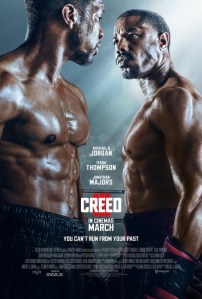 Now three films into its own rebirth, and nine films into the Rocky cinematic universe Sylvester Stallone begat in 1976, the story of Adonis Creed (Michael B. Jordan) fees confidant enough to leave behind Stallone. It’s still a formula-laden yet rousing sports movie, one where every turn will likely be predicted, but because of the conviction of the production, you can still cheer along with the familiar. This time Adonis is at the end of his career when an old face resurfaces with Damian “Dame” Anderson (Jonathan Majors), a childhood friend young Adonis looked up to who took the rap for Adonis’ fighting. He landed in prison and watched the journey of Adonis to being a world-championship boxer, which was Dame’s dream that was deferred. Adonis feels immense guilt and questions whether he’s earned his lot, and this trial of confidence and personal reckoning naturally comes down to an extensive pugilist battle, as all personal conflicts must. I laughed that Bianca (Tessa Thompson) was trying to make a point that not all conflict has to be decided by getting punched in the face, and ultimately that’s exactly where we’re headed. The requisite buildup, betrayal, training montage, and reclamation will be expected, but where the Creed franchise has separated itself was with its non-punching-in-the-face moments. I appreciate the added dimension of the characters and the allowances that make them more complex than simply cartoonish villains of the latter Rocky movies. Creed II humanized Ivan Drago Jr. to the point that I didn’t want either fighter to lose. I liked all the breather moments, from Adonis trying to raise a daughter with hearing impairments, to him reflecting and reminiscing with his forgotten friend like it was old times again, to the looming tragedy of saying goodbye to an ailing loved one (that deathbed scene was tremendously moving), and two men warring over hurt feelings of a friendship that meant so much and is trying to get beyond the pain of abandonment and guilt. When you devote that kind of attention to ensure that the drama matters, the boxing takes on added excitement. This is Jordan’s directorial debut and he does a fine job of helping his actors and providing them the space they need. He also finds some visually dynamic ways to film the boxing scenes and give them extra oomph (reportedly he based his approach off of anime and it honestly shows). Creed III may be more of the same but when the franchise devotes due attention to the small things as well as the big things, it’s still an elevated entertainment experience.
Nate’s Grade: B
Share this:

The Little Mermaid (2023)

With every new Disney live-action remake, and we’re not slowing down any time soon folks, I feel like I need to stipulate two reservations I have, so, dear reader, here is my boilerplate. First, I believe that simply because a film is animated does not mean it is missing something or somehow inferior to a live-action movie. Animation is a showcase of imagination and ingenuity and visual decadence, and often the live-action interpretations of this only serve to dilute and downgrade the quality of those presentations. I can’t believe the recently announced live-action Moana will add anything more magical or visually beautiful than the 2016 animated original. Second, the closer these original animated movies are to the present, the less likely that Disney will be to change things up. The core audience will be demanding fidelity to the source material, and thus we usually just get an inferior version of the same story with minimal alterations. Occasionally, Disney can really surprise with some of these live-action remakes; I adored Pete’s Dragon, was charmed by Cinderella, and will defend Tim Burton’s unfairly maligned Dumbo.
Now we reach The Little Mermaid, whose 1989 release began the much-heralded resurgence of Disney animation through the 1990s. I re-watched the original a couple years ago and found it still quite ebullient and compelling, but I was shocked at how short it was (only 80 minutes long) and how brisk much of its third act felt. With a few more old-fashioned wrinkles to iron out like gender roles and the prominence of securing a man, I felt there was actual room where a modern remake could actually improve upon the original. Having seen the live-action Little Mermaid, I can say that it falls into a middle zone where it can’t quite escape the shadow of its predecessor but it exhibits plenty of its own winning qualities to cheer audiences and fans of the original.

Ariel (Halle Bailey, not to be confused with Halle Berry) is a teenage mermaid and the youngest daughter of King Triton (Javier Bardem), the ruler of the seas. She longs to be part of the surface world, the world of man, and she’s willing to sacrifice her voice to her malevolent Aunt Ursula (Melissa McCarthy) for a pair of legs. She has three days to secure true love’s kiss, likely from Prince Eric (Jonah Hauer-King), but she can’t recall what she needs to do as part of Ursula’s spell. Her friends Sebastian (Daveed Diggs) the crab, Scuttle (Awkwafina) the gannet, and Flounder (Jacob Temblay) the fish must help protect and guide the new Ariel-with-legs.
Let’s start with the positive attributes that separate this Little Mermaid, and chief among them is the fantastic lead performance from Bailey (one half of the singing sisters Chloe x Halle). This is a star-making turn from this young woman who completely makes the role her own. She has a natural grace, curiosity, and charm to her Ariel, and when she gets her chance to belt the big musical numbers, she delivers a stirring rendition. I got tingles during different parts of “Part of Your World.” A good half of the movie takes place after her Faustian bargain, so Bailey is acting without her voice and she still is able to communicate so much through her physical performance as well as her facial expressions. The filmmakers decide to give Ariel several new songs through the guise of internal monologues where she can express all that she is feeling and thinking during her fish-out-of-water adjustments. I think it’s a smart move and while none of these new songs are particularly memorable, giving Bailey more opportunity to flex her own voice, both literally and thematically to express her character’s perspective, is a good creative choice.

I also was pleased that much of the added time, which amounts to almost a full hour of material, is devoted to fleshing out Eric and the development of the romance with Ariel. Rather than simply being a handsome himbo, this Eric is an adopted son of his island nation, and he feels more at home aboard a ship than in any royal ceremony. There’s a direct parallel with Ariel and Eric rejecting their predetermined roles under the pressure of royal expectations. This Eric even gets his own version of a “Part of Your World” ditty about dreaming for something more, especially after his chance encounter with a mermaid set his world afire. It’s not a particularly great song, as none of the new additions are on par with the Oscar-winning originals, and some of the lyrics made my wife physically cringe next to me in the theater (“Strange as a dream/ Real as the sea/ If you can hear me now/ Come set me free”). There is added time where the romance feels much more organic as we witness Ariel and Eric get to know one another and watch one another come alive and share their interests. The added curse of Ariel forgetting her end goal of true love’s kiss is an intelligent way to make the romantic feelings between them feel more believable and less the byproduct of her urgency and the manipulation of her friends. The added rom-com moments give more credence to their romance and it better reflects on both members.
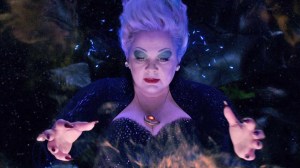
McCarthy (Thunder Force) acquits herself very well as the villainous sea witch. She puts her own spin on Pat Carrol’s famous vocal performance from the original, making her Ursula the seething also-ran waiting on the sidelines and nursing old grudges. The added back-story makes Ursula Ariel’s aunt now, which adds an extra degree of menace to their transactional bargain. I was also reminded how little Ursula is in this movie until it counts, so to justify her continuing presence, we have a few check-ins where she basically monologues her thoughts on the action. It feels like padding but I didn’t mind because I got to spend more time with McCarthy.
And now, dear reader, let’s go through some of the adaptation changes that aren’t quite as charming or beneficial. The colorful realm of the sea feels rather limited in this rendition. The vastness of the ocean and its mermaid kingdom feels strangely contained, and that’s a result of the reality of filming on a large empty set as well as the cost of extensive special effects. This is another case where the beauty and imagination of animation proves incomparable. The differing versions of “Under the Sea” really magnify this. Along those lines, making Ariel’s aquatic friends photo realistic robs them of the personality and expression they exuded in the animated movie, and it also drags them into an uncomfortable uncanny valley. Stop robbing characters of expression for the sake of added biological “realism.” It’s a bad trade. Stop it, Disney. Watching a photo realistic Flounder flop around on dry land while he tries to cheer Ariel on with his expressionless might-as-well-be-dead fish eye is not as whimsical as it should be. The original voice of Sebastian, Samuel E. Wright, has a small cameo as a fisherman, and it’s nice to hear his familiar voice again, especially knowing the actor sadly passed away in May 2021.
I’ve already discussed the new songs by Lin-Manuel Miranda being mostly agreeable but unremarkable, but there is one new track that stands out for all the wrong reasons. Being a Miranda musical, it’s not unexpected for the inclusion of a new hip-hop-infused song, especially with his Tony-winning Hamilton co-star in the movie. What is surprising is that Daveed Diggs doesn’t get the bulk of the new rap song but instead it’s Awkwafina, and her voice at these levels of gravely intensity feels like an aural assault. I was wincing throughout the song “Scuttlebutt” and kept wondering why Diggs wasn’t the star considering he handled the most linguistically complex flows in Hamilton. I even enjoy Awkwafina as a vocal artist but this song is painful to endure.
The 2023 live-action Little Mermaid has enough positive additions that fans of the 1989 original will likely enjoy while still checking the boxes of their own nostalgia requirements. Bailey is sensational and the added time for the romance to be more organic and believable, with some extra fleshing out supporting characters like the Queen and Grimsby also allowing the world to feel more textured and less archetypal. The visuals aren’t as murky as I feared but the magical world of this hidden undersea realm definitely feels lacking. The pacing is a bit sluggish too, as we don’t even get our deal with Ursula until an hour into the movie, and the added songs fail to compete with the classics even with the artistic prowess of Miranda. I don’t know if it needed to be this long, and I certainly don’t care for the photo realism approach, but I was smiling throughout the movie and found it charming. Consider this mid-tier Disney live-action scale, a remake with enough of its own to swim with the weight of expectations.
Nate’s Grade: B


 nathanzoebl
You must be logged in to post a comment.