Monthly Archives: December 2008
Gran Torino (2008)
 Clint Eastwood is an icon but he’s also proven to be a remarkable and thoughtful director in his twilight years. When the star first traveled behind the camera he mostly stuck with the action films that were his cinematic bread and butter. Then he showed something grander with 1992’s Unforgiven and rebounded back to that quality with a string of critically lauded flicks like Mystic River, Million Dollar Baby, Flags of our Fathers, and Letters from Iwo Jima. Three of those films were nominated for Best Picture, including three Best Director noms, and Baby won. The prolific screen icon has taken his directing skills up to another level in his older age and Eastwood has chosen to work on somber, mature, and meditative tales. Gran Torino is a movie caught between two different eras of Eastwood direction. It has the sheen and intentions of one of the recent loftier works and the film also taps into the suspense of his earlier action vehicles. It’s the only non-Batman movie targeted for Oscars this year that features ass kicking.
Walt Kowalski (Eastwood) is a retired Korean War veteran living in Detroit. He worked on the Ford factory lines for over 30 years and now has the pleasure of seeing his spoiled children driving foreign cars. His neighborhood has been inundated with Hmong immigrants from South East Asia. It seems the Hmong people sided with the Americans during the Vietnam War, and when the Americans left, well, it didn’t turn out so well for them. One old Hmong lady chastises Walt as a stupid old man and doesn’t know why he hasn’t fled like the other whites that used to live in the neighborhood. Things aren’t like they used to be. Gangs run rampant and terrorize the people into silence. We’re told that when it comes to the Hmong, the women go to college and the men go to jail. A Hmong gang keeps trying to recruit Tao (Bee Vang) into their ranks. He is looked down upon as a weakling and for doing women’s work, like gardening and the dishes. His initiation into the gang is to steal Walt’s pristine 1972 Gran Torino, the old man’s prized possession and one he helped build on the assembly line. Walt catches Tao in the act and eventually the boy works for Walt to repay the offense. Together, Walt and Tao form an unlikely bond. His Hmong neighbors cherish Walt for saving Tao from the gangs and the community opens its arms to him. Walt helps Tao find a job and stand up for himself, but the pull of the gangs is too strong. Walt realizes that Tao and his bright sister Sue (Ahney Her) will never be allowed to have a future as long as the Hmong gang is around.
 It’s hard to take the movie purely on the surface without some preparation. Because in synopsis, Gran Torino sounds like a ham-fisted after school special where Old Man Dirty Harry teaches the youngsters about the dangers of gangs and violence. The film is hard to fully describe without it sounding like a parody. Yet Gran Torino manages to come together along the journey. The movie balances gracefully even when it seems like it is going to dip into self-parody. Simply put, having Eastwood point a gun and growl, “Get off my lawn,” the quintessential geezer line, is almost calling out for ridicule. The gang storyline feels at times incredibly natural in approach and its casual, realistic dialogue, and at other times the storyline, like the film, feels like it is leading you by the nose. Some of the stock characters are sketched so thin, like the self-centered granddaughter who wears a midriff-bearing outfit to her grandmother’s funeral (all the better to witness your navel piercing, my dear). The spoiled children and grandchildren come across as too broad to be believable. The messages are all familiar, the characters are even somewhat familiar, but Gran Torino emerges as something more understated and perceptive than “Archie Bunker with a gun.” It’s a moderately rich character piece that follows one man resorting to his better nature in his golden years. Walt’s redemption may be predictable from the first minute but that doesn’t make Gran Torino any less satisfying. In fact, the movie on a whole is an embarrassingly entertaining experience. Sure, there’s a certain primal rah-rah vengeance angle to it, and watching a 78-year-old man kick around some youngster is always worth watching. But the novelty of the movie is not cheap xenophobic wish fulfillment, watching an old white war vet eliminate the immigrants in his neighborhood. The draw of this movie is an old-fashioned tale told well, which is equally earnest and glum.
The dialogue can be forcibly blunt as it spits out every offensive racial epithet, slur, and stereotype known to human ears (it’s practically the comedy routine of the unfunny Carlos Mencia). The screenplay by Nick Schenk confuses racist pabulum with comedy gold, like hearing an old lady cuss, but Eastwood manages to make it work. The rampant racist dialogue tends to get tiresome unless it begins to chip away and reveal more about a character. Naturally, Walt shuns being politically correct because he is uncompromising. He shakes his head and glowers at what the kids today have turned into. He’s meant to make others feel the same discomfort he feels in today’s world, and words are his weapons at his old age. The backbone of the script is the friendship Walt forms with Tao and his family. Because it begins so reluctantly and moves at a steady pace, the audience is emotionally invested and the friendship is rewarding to witness. The movie presents a fairly universal message about the redemptive power of human kindness, of helping one’s neighbor. It’s a petty big melting pot out there and there’s no reason to dig in and combat change. Gran Torino lacks the forced sanctimony and transparent manipulation of other “important” race-relations movies, like 2005’s Best Picture-winning Crash.
 The movie is impossible to view without it also becoming a commentary on an iconic actor’s screen legacy. What does a retired Dirty Harry at 80 look like? I imagine something like Walt, an embittered war vet grumbling about the change all around him that he is powerless to ignore. Eastwood takes great pains to be an angry curmudgeon even until the end, which allows the actor to tap his little seen comic ability. There’s a funny scene where Walt takes Tao to the barbershop for a lesson in how to “talk like a man,” which naturally involves playfully insulting your fellow man. Eastwood knows how to make a racist and standoffish character sympathetic and engaging. It’s a pleasure watching Walt become affectionate and protective, and yet the character’s redemption doesn’t ever feel contrived. His character is scarred and weary and wears his pants up to his armpits, but Clint makes it work. He can be sad and badass and appalling all at the same time. The character is somewhat similar to his character in Million Dollar Baby, a grumpy man closed off to the world who mentors a young kid. The flick presents a semi-dignified swan song to what happens when men of action grow old.
Eastwood directs with his typical steady hand and cool decision-making. The camerawork is intimate and sparing, never yanking the audience out of the story. The visuals mimic the characters in that nothing feels over polished. I enjoyed the small bits that pointed to something deeper, like Walt pointing his finger, a pistol and lining up his antagonists. I also enjoyed that Walt refrains from ever spilling his guts about his guilt during the Korean War except in a way that feels true to the character. Eastwood also shows a bit of his directorial prowess by hiring a bunch of Hmong actors that have had no acting experience. Some of them fare better than others, and some are in fact kind of bad, but this decision makes the movie feel more authentic. Now, it’s rare for me to cite sketchy acting as a plus for a movie, and that should be a testament to Eastwood’s directing skills. The man has a way with people; since 2003 he’s directed four different actors to Oscars. It must have been what Angelina Jolie was hoping for when she signed up for Changeling, the earlier Eastwood directorial effort from the fall. I think the biggest mistake Eastwood makes as a director is singing the closing song that unrolls right before the credits. Clint’s raspy singing voice is not the best way to close a movie.
 Gran Torino isn’t among the same ranks as Eastwood’s other output, like Letters from Iwo Jima or Mystic River, but it’s a small-scale story told with fortitude. Even as I write this review, and you dear reader read them, I feel like I’m failing in my attempt to make the movie sound good. True, on the surface it sounds like a bizarre after school special that would be destined to slip into self-parody and open mockery. Eastwood as star and director makes the material click. Walt’s journey from grumpy bigot to grumpy bigot who has opened up and made amends is greatly entertaining and humorous throughout. Gran Torino can be seen as a deconstructionist take on the fading era of Dirty Harry and Eastwood’s cinematic tough-guy legacy. Clint fans will eat all of this up.
Nate’s Grade: B+
Share this:

Let the Right One In (2008)
 This is a pre-teen vampire love story that is miles away from Twilight folks; it’s solemn, mature, stark, violent, tense, and astoundingly ambiguous. Director Tomas Alfredson pares down the emotions and the entire film takes on a very reserved and curious atmosphere, which I feel heightens the sense of wonder and dread about a supernatural romance. The relationship between 12-year-old Oskar (Kare Hedebrant) and 12-year-old looking vampire girl Elie (Lina Leandersson) is entirely believable and constantly intriguing, as key information is doled out like breadcrumbs. Oskar is negotiating puberty and Elie is well aware of what awaits. The movie works as an example of methodical horror where emphasis is placed upon anticipation and the imagination. The climax at a community pool is one of the best film finishes of the year. I was a tense ball of nerves, and I love the movie’s closing shot. Even better, the movie works as an intriguing and intricate drama about human relationships. I can revisit Let the Right One In and dub it an unconventional and moving romance. Or I can revisit the film and dub it a melancholy examination of a manipulative and parasitic relationship, as Oskar might be doomed to a fated life like Elie’s former guardian. I can keep revisiting this Swedish horror film and discover more to discuss and diagram each time. And I didn’t need a single scene where the vampires played super hero baseball games.
Nate’s Grade: A-
Share this:

Happy-Go-Lucky (2008)
 I wanted to turn this movie off for the first 30 minutes or so and that’s because of Poppy (Sally Hawkins), the deranged optimist that the movie follows. Writer/director Mike Leigh’s latest semi-improvised tale following the English working class centers on a primary school teacher who makes the conscious choice to be happy in life, no matter what life throws her way. Her presence is somewhat exhausting, like a customer who doesn’t know when making jokes has gone from fun to downright annoying. But you know what? Poppy eventually won me over, and I’m all but positive it was the scenes of her and her raging, pessimistic, tightly wound driving instructor (Eddie Marsan) that did it. Before their first driving lesson, I felt like the movie was giving me a slice-of-life that I was hesitant about; Poppy, like anyone who is insanely happy, can be grating. The humor is extremely dry and most of the clever dialogue exchanges will likely go by unnoticed because the actors aren’t delivering big punch lines. Hawkins goes all-out as the unflappable Poppy and she will make you smile through sheer force of will. This was a film I liked more by the time it was winding down, perhaps because Poppy might be easier to take knowing that time is coming to a close much like spending time with a distant relative during the holidays.
Nate’s Grade: B
Share this:

The Visitor (2008)
 The follow-up by Thomas McCarthy, the writer/director of the sparkling Station Agent, is an affecting indictment on our nation’s immigration policies that manages to say a lot of important things in small touches, ditching histrionic messages. Walter (Richard Jenkins, in a commanding and deeply empathetic performance) discovers a pair of illegal immigrant squatters living in his seldom-used New York City apartment. He strikes up an unlikely friendship that moves in subtle strokes that keeps the movie very character-based. The second half of the film revolves around Walter’s attempts to work within the system to free his new friend from detention. I could have spent more time with Walter and Tariq, the Syrian immigrant who teaches Walter how to play the African drum. The Visitor explores a man learning in his autumn years how to reconnect with people, and it has moments of astonishing emotional clarity. McCarthy is a filmmaker that can spin narrative gold from just about anything; The Station Agent had a hot dog vendor, a single mom, and a dwarf. The Visitor is further proof that McCarthy is an extremely talented man who knows how to target and tap the humanity of his unique characters. There are very few moments in this movie that feel false.
Nate’s Grade: B+
Share this:

The X-Files: I Want to Believe (2008)
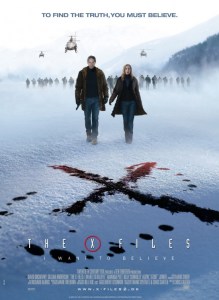 To all fellow X-Files fans out there, the movie is not nearly as bad as you may have been lead to believe. That said, it’s pretty much a so-so standalone episode of the TV show needlessly expanded. And yes, for all concerned fans, Mulder (David Duchovny) and Scully (Gillian Anderson) kiss on more than one occasion. The plot that reunites the characters is fairly mediocre, something about a ring of mad scientists that want to be a modern-day Dr. Frankenstein. You don’t need a two-headed attack dog to know that plot is way too hokey. The most intriguing aspect of the film is a priest (Billy Connolly) who also receives psychic visions, cries tears of blood, and, oh yeah, is a convicted pedophile. Could God be responsible for his special abilities as well as the abhorrent sexual urges? There is so much great conflict and human drama in this character worth examining, so it’s a pitiful shame that he just gets shoved off so the third act can concentrate on the lame mad scientists. A majority of the flick occurs in snowy West Virginia, which doesn’t translate into anything too special to look at. I’ll admit, my rating is inflated because I was an ardent fan of the TV show until the last years when it felt like they weren’t even trying any more. If you stripped away my allegiance, I’d say that the second X-Files movie serves little purpose other than to add a tiny coda to a TV show that went off the air in 2002. The characters are worth revisiting, just not in this tepid tale.
Nate’s Grade: C+
Share this:

Hellboy II: The Golden Army (2008)
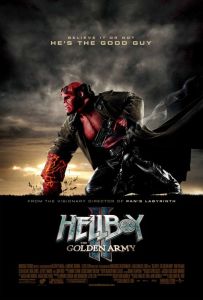 I disliked the first Hellboy, dubbing it the second worst film of 2004. The fact that I enjoyed the sequel is nothing short of shocking. Honestly, I think this mumbo jumbo is easier to swallow when it’s more fantasy based than science fiction based. I can accept an alternative magical world filled with elf princes, troll markets, and tiny “tooth fairy” creatures that act like piranhas with wings. Nazis and Zombie Rasputin trying to open a portal to giant squids? Hellboy II is even more imaginative and far more enjoyable. Writer/director Guilermo del Toro has refined the world and makes sure his story follows the rules it sets, which means that while the plot gets crazy it doesn’t feel cheap. I actually had some fun with Hellboy II and del Toro knocks out some pretty crafty action sequences. As expected, the makeup and creature designs are impeccable, which may explain why I had more fun watching the various magical creatures than following Nazis and slime wolves in the first flick. The lithe Angel of Death is particularly startling, with a head like a fried calzone and eyeballs dotted along expansive bird wings. This is a film that feels much more confident about its identity, thanks in part to getting rid of the rookie main character from the first film and focusing on the big red guy. If del Toro ever makes a third Hellboy film, I can honestly say I’ll be highly intrigued to see what weird wonders he cooks up. This statement is astounding considering I felt that there was only one 2004 film worse than the original Hellboy.
Nate’s Grade: B
Share this:

Man on Wire (2008)
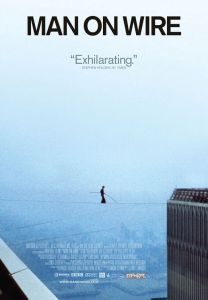 Why? That’s likely to be the question on many people’s minds when this documentary concludes. Why did effete Frenchman Philippe Petit decide to walk on a tight rope between the World Trade Center towers in 1974? Why devote an entire feature-length documentary to a subject that seems pretty limited? Well, Man on Wire is certainly an engaging film; amusingly, director James Marsh structures the flick like a heist movie, where we watch Petit assemble his team and practice his stunt. There is a sense of beauty watching a man balance on a wire hundreds of feet above the ground. The film also has colorfully French characters to fill in the details on how they pulled off the “artistic crime of the century.” Of course any modern art dealing with the World Trade Center is given new meaning, and Man on Wire is aided by added poignancy of watching the building construction and then the daring feats of Petit. I confess, though, that I’m dumbstruck at this movie being declared the finest documentary of 2008. It’s a good movie, sure, but not even the fourth best documentary I’ve seen in a doc-heavy year. The footage of Man on Wire is more amazing than the story behind how it happened.
Nate’s Grade: B
Share this:

Miss Pettigrew Lives for a Day (2008)
 The movie seems to float on the effervescent air of 1930s screwball comedies, and in truth it does possess some of that snappy allure. Francis McDormand travels into the inner circle of the upper social classes in London and befriends a bubbly lounge singer, played by bubbly actress Amy Adams. The film moves at a ridiculously fast pace, sometimes too fast as it tries to pile on complications and setbacks. This day-in-the-life confection is sweet and well natured but rather too digestible. Once the movie is over I do not see myself ever dwelling upon it once again. It’s a pleasant and entertaining experience even if it dances right out of your memory.
Nate’s Grade: B


 nathanzoebl
You must be logged in to post a comment.