Daily Archives: September 18, 2008
Lust, Caution (2008)
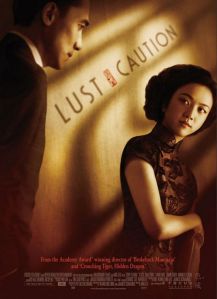 Ang Lee’s period romance is no Brokeback Mountain, though there is a heavy supply of thrusting. Lust, Caution is an NC-17 rated peak into life in China under Japanese occupation in the 1930s. Most of the film follows a school drama club that decides to become freedom fighters. They scheme to murder Chinese officials working with the Japanese government, and one gal (Wei Tang) is tapped to seduce and then kill a high-ranking official. For such a controversial movie, the sex scenes don’t even begin until 90 minutes into the flick (though our undercover heroine is deflowered by her drama club peer for the good of her mission). The movie is exquisitely shot, handsome in its details, and the lead performance by Tang is exceptional, simmering with conflicting emotions and some real sensual heat. The sex scenes doe have an erotic potency to them and they are more explicit than the kinder gentler fare found in typical Hollywood movies that consist of only seeing the slow-motion ecstasy result from a man on top. The offbeat love story gestates too late in the film’s run, leaving little time to delve deeper. Too much of the movie concerns back-story following the drama club’s road to becoming revolutionaries, and while it’s interesting it’s also rather needless on second thought. There’s a nine-minute difference between the R-rated version and the theatrical NC-17 cut; what’s in those nine minutes I do not know since I saw the edited version, but I’ve been told it’s a lot of thrusting. In lusty terms, the movie is heavy on foreplay and too short on a satisfying climax.
Nate’s Grade: B-
Share this:

Grace is Gone (2008)
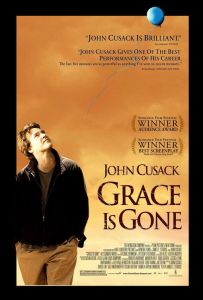 This Iraq War drama means well but it comes across as manipulative and morally questionable. John Cusack stars as a former military man who just found out his wife, on active duty in Iraq, has been killed. The bulk of the film’s conflict deals with how Cusack will tell his two daughters that mommy is not coming home again. Instead of being upfront with his children, he takes them out of school and whisks them away on a family trip to an amusement park. His reasoning is that he wants to squeeze in a few more happy memories before the kids hear the news. To me, this is irresponsible and psychologically damaging; those kids will resent their father holding onto such important information while he encouraged his kids to shop in ignorance. The film is about 80 minutes of watching a guillotine hang over someone’s head, just waiting for the moment to hit. It can get rather uncomfortable. Somewhere in this misguided drama is a poignant look at the domestic cost of the Iraq War from the family’s perspective, a perspective yet to be fully articulated by the movies. Instead, Grace is Gone is a well-acted but contrived drama that favors delaying the pains of reality to the point of incredulity.
Nate’s Grade: C+
Share this:

Be Kind, Rewind (2008)
 Be Kind, Rewind is a celebration of the love of movies and moviemaking, but it wants to shoot for a deeper message and stumbles. When the movie concentrates on remaking famous movies like Ghostbusters, Robocop, and Rush Hour 2, the movie has a ramshackle charm and great comedic spirit. When the film strays to tell a tale about community pride is when the movie gets dull and leaden. The concept of cheap, quick, homemade versions of Hollywood movies (the YouTube-ification if you will) is fun and Jack Black and Mos Def are definitely having fun in the process. But the movie has too many other elements that just don’t work together. The history of a local jazz legend feels awkward and bogs down the movie’s enjoyment. Director Michel Gondry can only do so much with his quirky visual sensibilities before you start to get bored. Be Kind, Rewind is occasionally entertaining and works best when it’s ripping off other movies than trying to stand on its own merits.
Nate’s Grade: C+
Share this:

W. (2008)
 Director Oliver Stone’s first draft at history is never boring but it’s rarely insightful. The film portrays George W. Bush (Josh Brolin) as a stubborn and simple man trying to live outside his abilities and the long shadow of his successful and emotionally distant father. George W. was not the favored son, as he is routinely reminded, and Ma and Pa Bush express their frustration. And yet the son who did not have his family’s support and acumen accomplished what no one else in the family had. He won reelection. He toppled Saddam Hussein. And then it all came crashing down. Ultimately, who was this movie made for? The detractors of Bush will view the film being too light, providing a psychological context that humanizes the man amongst his mistakes. You may even feel some sympathy as George W. repeatedly tries to earn his father’s approval. The movie is not a partisan or mean-spirited skewering. The fans of Bush will consider the film to be a cheap shot that restrings famous blunders and transplants Bush malapropisms into new settings. People may take offense at the idea of the current Iraq War being a result of unresolved daddy issues. Seriously, for a two-hour movie spanning the life and career of the most reviled modern day president, did Stone need to include the moment where Bush almost choked to death on a pretzel? Over the 2000 election debacle? Over the Air National Guard? Over 9/11?
W. lacks a strong point of view and the film’s timeline closes too soon, only going so far as January 2004, not even the halfway point for a two-term president who has only sunk lower in national approval from that moment. A miniseries would be a better medium to explore the failures and calamities and personalities of the Bush Administration. Brolin is terrific in the title role and he never dips into parody. The rest of the actors are hit-or-miss and the movie becomes somewhat of a game of identifying famous historical figures in their one-scene appearances. My biggest surprise was how much I felt emotionally connected to the first President Bush, played by James Cromwell in a performance that doesn’t even attempt to imitate the real-life figure. Stone and screenwriter Stanley Weiser (Wall Street) certainly don’t hide the characters they connect with (Colin Powell, often the voice of reason, is given a stirring speech calling for caution). Certain creative license is taken to provide dream sequences that can point toward the inner turmoil of Bush, like when his father admonishes him for destroying 200 years of the family’s name over the Iraq War. Overall, W. is an empathetic and sometimes dithering portrayal of the 43rd United States’ president that could have succeeded if it had more to say.
Nate’s Grade: B-


 nathanzoebl
You must be logged in to post a comment.