Daily Archives: July 18, 2008
Mamma Mia! (2008)
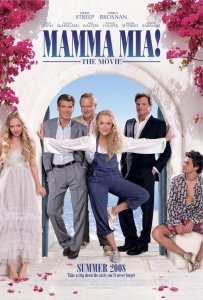 Mamma mia here we go again. This movie is going to be a middle-aged woman’s dream come true. It boasts a cast whose median age is in the mid 50s, one former yet still dashing James Bond, lots of good vibration getaway vibes, songs by a pop group whose heyday was over 30 years ago, and a heaping helping of girl power. In short, Mamma Mia will entertain the same mixture that made Sex and the City a monster hit, notably middle-aged women, teen girls, and gay males. I’ve seen the stage show and enjoyed it, as have millions of others around the world, but the movie fails to capitalize on reaching a broader audience. Mamma Mia is content to serve the faithful and delivers a less than satisfactory product. The world of cinema is not the best place for this material.
Raised all her life on a Greek island in a Mediterranean paradise, Sophie (Big Love‘s Amanda Seyfried) is getting married. Her disapproving mother, Donna (Meryl Streep), runs a hotel and has raised her daughter by herself. Then one day Sophie goes through her mother’s diary and discovers she has three possible fathers, Harry (Colin Firth), Bill (Stellan Skarsgård), or Sam (Pierce Brosnan). She invites all three to the island to vet her real father. In agitated response, Sophie invites her old gal pals Rosie (Julie Walters) and Tanya (Christine Baranski) to help her during this paternity crisis. Over time old loves will be rekindled, new love will bloom, and there will be a lot of singing.
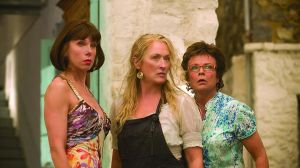 Let Mamma Mia stand as a future testament as to why you do not generally let someone helm a film when they have no film experience whatsoever. The creative talent behind the hit Broadway musical refused to grant anyone in Hollywood the rights to their worldwide sensation. So the stage director, Phyllinda Lloyd, is now also the film’s director, and oh my goodness was not the right choice. Her film inexperience shows with every second. The movie just doesn’t look right from beginning to end. There’s a noticeable “off” sensation due to Lloyd poorly shooting her scenes, editing her scenes, and directing her actors. I kept wanting, through sheer force of will, to nudge the camera angles, to change the composition a tad to make them more visually appealing, because Lloyd shoots the movie in bland static angles with minimal coverage. Mamma Mia looks so amateurish and fussily so, like Lloyd is purposefully thumbing her nose at the art of cinema. Lloyd also doesn’t bother to place any choreography in her scenes, and her actors just sort of spin and sway to the music like they were dancing in front of a bedroom mirror. It’s remarkable that a movie with so much riding on it looks so shoddy.
Presented in the reality of a stage, Mamma Mia is a shallow but fairly fun time. The movie version transports the musical into an actual Greek locale, which, to knock Lloyd yet again, she makes no real use out of (she mostly shoots her actors against rock faces and under harsh, glaring sunlight). What works on stage, when presented under the pretenses of the real world, comes across as incredibly cheesy and goofy beyond all relief (get a load of the high-stepping snorkerlers). The song and dance numbers, the character interactions, the sitcom generic plot (ripped off from 1968’s Buona Sera, Mrs. Campbell), they all start to transform into camp and beg for mockery. All of a sudden the entire island turns into a Greek chorus and provides backup during the impromptu singing. It’s strange and comes so late that it never feels properly established. The characterization is pretty slim, and once the movie establishes its characters it pushes the petal to the floor. The plot whizzes by in a whirlwind of one Abba song after another, with minimal breaks in between just to change setting and barely elbow the characters forward. I don’t think the actors had any chance to breathe in between the song numbers because I know I could barely exhale before another song assaulted my senses with forced giddiness.
But here’s the odd thing. The film is so silly and played to constant high-energy capacity that after a while Mamma Mia begins to wear you down. You may begin to smile, you may begin to clap, but you’ll be guaranteed to start humming the incredibly infectious tunes. Mamma Mia is essentially an Abba jukebox with a third-rate story strung along for the ride. As a story, it leaves much to be desired, but as a musical experience it makes you realize how glorious those Abba songs are. They’re like perfect pop bundles that somehow make you feel better even if the lyrics are more bittersweet than you realize at the time. The 18 Abba songs showcased, along with a few others during a weird curtain call sing-a-long, will certainly lift your spirits just as long as you concentrate more on the music than on the often-forced context.
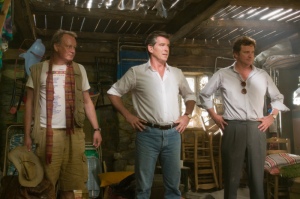 The actors are better than the material, clearly. Streep is her generation’s finest actress but she tries too hard to convince you of the great girl-power fun she’s having. The singing, on the other hand, is all over the map. Streep and Seyfried have the strongest voices of the bunch, which is good considering they also have the most musical numbers to sing and twirl to. Neither has a particularly sensational voice but then again they certainly distance themselves from their pitiful peers. Most of the other actors just have droning vocals but Brosnan, oh boy, I have to congratulate the man for having the courage he does. You feel embarrassed for the guy; I mean this is James Bond here. I found myself turning away whenever he opened his mouth, not wanting to look the man in the eye. Every time he started singing my theater crowd of Mamma Mia faithful began snickering and giggling. I almost feel so bad that I should send the guy a card saying, “Sorry about the singing, but hey, you’ll always have the paycheck.”
The real audience for a Mamma Mia movie is the fans of the Mamma Mia theatrical show, and the movie is tailored to their interests. The big screen version isn’t interested in converting new fans, hence the amateurish direction and disregard for reaching out for broader appeal. Mamma Mia the movie is pretty much a less zippy and ten times goofier version of the stage show except with bad singing. If that sounds like a fun evening out, then by all means enjoy. This is a mess of a movie and not a terribly good movie at that, and yet the power of those Abba songs will inject enough goodwill that you will forgive some of the movie’s transgressions. Some. Pierce Brosnan’s singing is something that cannot be forgiven nor forgotten.
Nate’s Grade: C+
Share this:

The Wackness (2008)
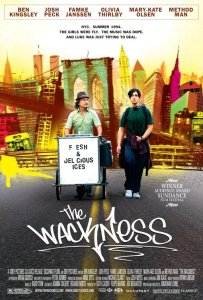 Every Sundance Film Festival seems to coronate new talent and new films that never seem to materialize once they step outside of the happy bubble of festival life. It happened with Happy, Texas, with Tadpole, with Hav Plenty, with Primer and numerous others that never managed to get started with the public. At the 2008 Sundance film festival, the biggest buzz followed the documentary American Teen and The Wackness. Writer/director Jonathan Levine’s coming-of-age tale won the Audience Award for Drama and boasts shimmering visuals, formidable actors, and a hip soundtrack. Too bad the drama gets the least attention in that package. I suspect The Wackness will be yet another Sundance buzz flick that, while well made, fails to leave a mark on mainstream crowds (here’s hoping more for American Teen).
Luke (Josh Peck) has just graduated from a New York City high school and is winding down the summer before he moves on to college. He has a unique summer job: Luke sells marijuana out of an ice cream vendor’s box. One of his clients, Dr. Squires (Ben Kingsley), is a therapist. He trades therapy time to Luke for pot. The two of them form an unanticipated bond and Dr. Squires makes it a point to see that Luke is making the most of his youth. Luke is smitten with the doc’s stepdaughter, Steph (Juno‘s Olivia Thirby, gratifyingly authentic), and determined to lose his virginity and find love before the summer fades away.
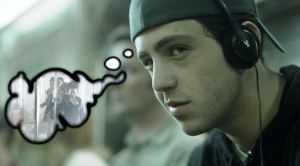 The strength of The Wackness is in the unexpected father/son relationship that forms between Luke and Dr. Squires. Kingsley is sensational in his role and provides all the pathos and unexpected discoveries that the coming-of-age genre is associated with. I think that’s what’s most interesting about Levine’s film, is that Kingsley is going through all the coming-of-age moments reserved for teenage protagonists. Dr. Squires and Luke form a surprising and deep relationship where they learn from each other. Luke learns to talk about his life’s sadness and make it a part of his life, instead of sweeping it under a proverbial rug. Dr. Squires learns to re-embrace life and to kick his heavy supply of pharmaceutical prescriptions. He is coming of age at middle age. He even gets to second base with an Olsen twin (Mary-Kate is only in the film for two scenes and an estimated five minutes). Most of all, Dr. Squires needs a friend and Luke fulfills this desperate void. Kingsley is funny, pathetic, and the real star of The Wackness.
My main problem with The Wackness is how familiar it all comes across. It follows the coming-of-age model down to the end, so a savvy audience is going to realize that Luke will fall in love, get his heart broken, stand up for himself, and gather a bit more wisdom by the time the end credits roll. You’ve seen this movie played in a thousand different ways before, and now The Wackness makes it 1001; you will essentially know every beat of this story before it happens. The film doesn’t break any new ground and doesn’t manage to provide much commentary or lasting insight while it comes of age. The screenwriting fails to hide what disinterests Levine. So we get quick glimpses of Luke’s home life and I swear in every one of them his parents are just yelling. That’s all Levine is interested in, setting up one ten second shot of Luke overhearing his parents shouting again and again. Dr. Squires’ wife (Famke Jannsen) gets the same kind of treatment. She gets a cursory amount of screen time to glower and that’s about it. I can tell Levine is only interested in his three main characters (Luke, Dr. Squires, Steph) but then why does he not concentrate on them further and scuttle what he feels is wasted time?
The Wackness is awash in pointless nostalgia. The movie is set during the summer of 1994 for no real reason. The time setting doesn’t impact the film in any manner except for some digs at Mayor Giuliani’s policies (he was only in office for sixth months or so when the film opens). Levine dishes out pop-culture references like the 8-bit Nintendo game system, old chunky GameBoys, Kurt Cobain’s suicide, mix tapes, and lots of rap music. The Wackness is an ode to mid 90s rap music and Luke is a lover of acts like A Tribe Called Quest, De La Soul, and some up-and-coming guy named The Notorious B.I.G. The soundtrack is also meant to convey good nostalgic vibes of a simpler time only — 14 years ago. Setting the film in 1994 is a lazy attempt to cover the lapses in screenwriting with cozy audience nostalgia. And is there anything really culturally transcendent about the summer of 1994?
 Peck may have lost like 100 pounds since he was fat comic relief on a Nickelodeon kids show, and he’s marginally handsome, but this kid needs some more practice before he’s a dramatic actor. I understand that his character gets stoned often and, as a typical teenager, is trying to pull off a too-cool-for-the-world-“whatever” attitude, but he seems freaking catatonic. He’s too aloof for his own good. His acting is dry and monotone and he feels like he’s constantly zoning out. Again, I understand that this works with his stoned persona but Peck is hardly ever convincing in the part and his acting shortcomings rob the role of a greater level of sympathy. A great actor can make you like a character that eats babies and kicks puppies, or the other way around, but Peck is not that actor. I believe that part of The Wackness‘ failure to connect and elevate beyond its genre trappings is due to Peck’s poor performance. He’s just kind of boring character and, to borrow a term from our pals on the other side of the pond, a bit of a wanker.
As a director, Levine has a playful and visually appealing look for the film, bathing it in arid tones to echo the hot summer days. The cinematography is a character all its own, giving the film a colorful and lively flair that makes every scene worth watching even if the script fails to do likewise. Levine has a handful of clever visual tricks up his sleeve, like a middle finger that moves through a crowd of New Yorkers at rapid speed before finding and dialing a pay phone. Levine has definite talent as a director and it shouldn’t be long before Hollywood comes knocking and plucks him away to make The Fast and the Furious 8: The Search for Curly’s Gold.
The Wackness feels like a coming-of-age film that goes through the motions. The main character is stoned to the point of comatose and he’s a rather boring protagonist, made even duller by Peck’s lackluster acting ability. Writer/director Levine flexes enough visual artistry to make him a talent to watch, however, his screenplay is too familiar with little personality or flavor to stand out against the pack. The movie looks good, it sounds good, and Kingsley is certainly good, it’s just a shame that it isn’t his movie. Steph tells the mopey Luke that all she sees is the goodness life has to offer and all he sees is “the wackness” (you can go home happy to understand the title). I guess I similarly be accused of focusing on the “wackness” of The Wackness because it’s certainly not a bad movie. It just happens to be ordinary. Though it does have some torrid Kingsley-on-Olsen Twin action. I suppose that isn’t too wack.
Nate’s Grade: C+


 nathanzoebl
You must be logged in to post a comment.