Blog Archives
Wonder Wheel (2017)
 It feels like Woody Allen is trying to recapture his magic from 2013’s Blue Jasmine, a character study of a tragic modern Blanche DuBois coming undone by her bad decisions. Whereas that film rightfully garnered Cate Blanchett an Oscar, Wonder Wheel is not going to do much for its own tragic heroine, Kate Winslet. She plays Ginny, and she’s stuck in a dull marriage, a dull life as a waitress at a Coney Island diner, and she keeps thinking of the life she could have and should have had as an aspiring actress. She has a summer affair with Mickey (Justin Timberlake), a lifeguard who wants to be a writer with experiences. Ginny’s affair is jeopardized when Mickey starts seeing her stepdaughter, Carolina (Juno Temple), who is on the run from her own mobster husband. All of this melodrama is kept at a fever pitch, and the film feels far too stagy, with characters careening in limited locations and having long, combative conversations. The cinematography is gorgeous as sets and people are draped with glowing, amber waves. Winslet’s character is not nearly as compelling as Allen intends as a tragic heroine being laid low by her flaws. She’s not exactly likeable but she’s also not exactly interesting, not like Blanchett. Losing her fling to a younger woman makes her even more desperate and self-destructive, which amplifies Winslet’s fussy and broad acting. Timberlake is strangely the narrator of this story and has several fourth wall breaking moments, and it doesn’t work, especially since his character is more a cobbled together cipher. There’s an odd subplot where Ginny’s young son is a pyromaniac and it adds nothing but stress. The story doesn’t add up to much and the characters just aren’t that interesting; they’re loud and abrasive but they don’t tap into anything larger about the human condition. It’s Allen’s half-baked homage to Eugene O’Neill. In a most unexpected move, I think the best actor in this movie is Jim Belushi as Ginny’s dimwitted husband. I think that says everything you need to know about Wonder Wheel, an up-and-down melodrama that has its mind set as a theatrical production and never leaves that space.
Nate’s Grade: C+
Share this:

I Love You, Daddy (2017)
 After years of rumors, highly influential comedian and television guru Louis C.K. has admitted that the sexual allegations against him are indeed true. Several women recently came forward in a New York Times article citing C.K. as asking them to watch him masturbate, forcing women to watch him masturbate, or masturbating over the phone with an unsuspecting woman. Right now in the new climate of Hollywood, it appears that C.K.’s comedy career is at a standstill if not legitimately over. And strangely amidst all this was the planned release of a little movie he wrote, directed and stars in called I Love You, Daddy, about a famous Hollywood director with rumors of sexual indecency. The movie has been pulled from release but not before screeners were sent to critics. I don’t know when the general public will get its chance to watch I Love You, Daddy, but allow me to attempt to digest my thoughts on the film and any possible deeper value (there will be spoilers but isn’t that why you’re reading anyway?).
Glen (Louis C.K.) is a successful TV writer and producer. He’s starting another show and Grace (Rose Byrne), a pregnant film actress, is interested in a starring role and perhaps in Glen himself. His 17-year-old daughter China (Chloe Grace Moritz) takes an interest in a much older director, Leslie Goodwin (John Malkovich), with a troubled past. Glen idolizes Leslie Goodwin but isn’t comfortable with the interest he’s shown in his underage daughter.
 It’s impossible to resist the urge to psychoanalyze the film especially considering it’s otherwise a fairly mediocre button-pushing comedy. The biggest question that comes to mind is why exactly did C.K. bring this movie into existence? He hasn’t directed a film since 2002’s blaxploitation parody Pootie Tang. It didn’t even come into being until this past June, when C.K. funded it himself and shot it over the course of a few weeks. What about this story was begging to be brought to life, especially with C.K. as its voice? He didn’t have to make this. He brought this into the world. Given the controversial subject matter, C.K. must have known that the film would at minimum reignite the long-standing rumors of his own sexual transgressions. So why would he make I Love You, Daddy? This is where the dime-store psychiatry comes in handy, because after viewing the finished film, it feels deeply confessional from its author. It feels like C.K. is unburdening himself. I cannot say whether it was conscious or subconscious, but this is a work of art where C.K. is showing who he is and hoping that you won’t realize.
This is very much C.K.’s riff on Woody Allen movies and Woody Allen’s own troubled history of sexual impropriety; it’s an ode to Allen and a commentary on Allen (C.K. had a supporting role in Allen’s Blue Jasmine in 2013). It’s filmed in black and white and even follows a similar plot setup from Manhattan, where Allen romances a 17-year-old Mariel Hemingway. It’s about our moral indignation giving way to compromise once our own heroes are affected or whether or not our own lives can be benefited. The stilted nature of human interaction among a privileged set of New Yorkers is reminiscent of Allen’s windows into the world of elites. It’s an approach that C.K. doesn’t wear well, especially coming from his much more organic and surreal television series. The movie is trying to find a deeper understanding in the Woody Allen-avatar but never really does. I grew tired of most of the conversations between flat characters that were poorly formed as mouthpieces for C.K.’s one-liners and discussion points (and an N-word joke for good measure). Leslie is an enigma simply meant to challenge Glen on his preconceived ideas. Leslie isn’t so much a character as a stand-in for Woody Allen as stand-in for C.K.’s own fears of hypocrisy and inadequacy. And that begets further examination below.
 In retrospect, looking for the analysis, there are moments that come across as obvious. C.K. has generally played a thinly veiled version of himself in his starring vehicles. Here he’s a highly regarded television writer and producer who seems to keep making new highly regarded television series. There are too many moments and lines for this movie not to feel like C.K. is confessing or mitigating his misdeeds. One of China’s friends, a fellow teen girl, makes the tidy rationalization that everyone is a pervert so what should it all matter? Sexuality may be a complicated mosaic but that doesn’t excuse relationships with underage minors and masturbating in front of women against their will. Glen says that people should not judge others based upon rumors and that no one can ever truly know what goes on in another person’s private life. There’s a moment late in the film where Glen is irritated and bellows an angry apology with the literal words, “I’m sorry to all women. I want all women to know I apologize for being me!” I almost stopped my screener just to listen to this line again. In the end, Glen has a fall from grace and loses his credibility in the industry. He’s told by his producing partner, “So you were a great man and now you’re not.” And the last moment we share with Glen before the time jump that reveals his fall from grace? It’s with China’s “everyone’s a pervert” friend and after she confesses that she once had a crush on Glen when she was younger and that she finds older men sexy. After a few seconds, he slightly lurches toward her like he’s going to attempt to kiss her and she recoils backwards. Glen interprets the moment very wrong and tries to make an unwanted move on a much younger woman. Yikes.
There’s also a supporting character that twice visually mimes masturbating in public. Yeah, C.K. literally included that gag twice. For a solid twenty minutes I didn’t know if Charlie Day’s character was real of a Tyler Durden-esque figment of Glen’s outré imagination. Day plays an actor with a close relationship with Glen. He’s not like any other character and seems to speak as Glen’s uncontrolled sense of id, urging him into bad decisions. During one of those furious masturbatory pantomimes (not a phrase one gets to write often in film criticism, let alone the plural) Day’s character is listening to Grace on speakerphone. This is literally the same kind of deviant act that C.K. perpetrated on a woman detailed in The New York Times expose. It’s gobsmacking, as if Bill Cosby wrote a best friend character that would drug women at a party he hosted, and Cosby wrote this after the rape allegations already gained traction. Double yikes.
 As a film, I Love You, Daddy feels rushed and incomplete. The editing is really choppy and speaks to a limited amount of camera setups and shooting time. Locations are fairly nondescript and the entire thing takes on a stagy feel that also permeates the acting. C.K.’s television work has revolved around a very observational, natural style of acting and a style that absorbs silence as part of its repertoire of techniques. I Love You, Daddy feels so stilted and unrealistic and it’s somewhat jarring for fans of C.K.’s series. The actors all do acceptable work with their parts but the characters are pretty thin. You feel a lack of energy throughout the film that saps performances of vitality. There’s a method to the reasoning on presenting China as an empty character until the very end, which speaks to Glen’s lack of understanding of who his daughter is as a person. The overall storytelling is pretty mundane, especially for C.K. and the topic. He seems to open conversations on topics he believes don’t have easy answers, like age of consent laws, statutory rape, and judging other people based upon their reputations, and then steps away. The film wants to be provocative but fails to fashion a follow-through to connect. There aren’t nearly enough nuances to achieve C.K.’s vision as saboteur of social mores.
It feels like C.K. might have anticipated having to come forward and accept the totality of his prior bad behavior, and maybe he felt I Love You, Daddy was his artistic stab at controlling the reckoning he knew would eventually arrive. I would only recommend this movie as a curiosity to the most ardent fans of C.K. comedy. I Love You, Daddy delivers a few chuckles but it’s mostly a mediocre and overlong Woody Allen throwback companion piece. It’s harder to separate the art from the artist when that artist has complete ownership over the vision. As of this writing, I can still watch Kevin Spacey acting performances and enjoy them for what they are, mostly because he is one component of a larger artistic whole. In C.K.’s case, he writes, directs, stars, and it’s his complete imprint upon the material. I consider 2016’s Horace and Pete to be of nigh unparalleled brilliance that I wouldn’t hesitate to call it a modern American theatrical masterpiece that could sit beside Eugene O’Neill. So much of C.K.’s material was based around his brutal sense of self-loathing and now the audience might feel that same sensation if they sit down and watch I Love You, Daddy. Unless you want to do like I did and unpack the film as a psychological exercise of a man crying out, there’s no real reason to watch this except as the possible final capstone on C.K.’s public career.
Nate’s Grade: C
Share this:

Blue Jasmine (2013)
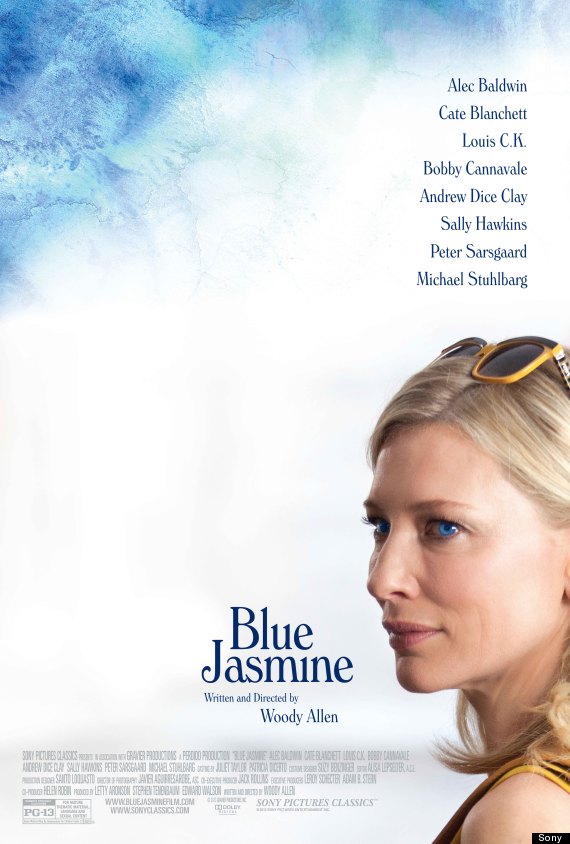 With writer/director Woody Allen’s proliferate output, cranking out a movie every year, it’s all too easy to take the man for granted. Critics will argue his halcyon days are long gone, that the man is coasting on his past laurels. Of course when you’re comparing everything to Manhattan, Annie Hall, or Crimes and Misdemeanors, well sure most movies will be found lacking, even Allen’s. And there’s no real forgiving of 2001’s Curse of the Jade Scorpion. But when Allen hits a rich topic with a capable cast, he can still produce knockout cinema, as is exactly the case with the engrossing Blue Jasmine.
Jasmine (Cate Blanchett) is experiencing a tumultuous change of living. Her wealthy husband Hal (Alec Baldwin) has been indicted for a Ponzi scheme that fleeced millions. Her posh New York lifestyle has vanished, Uncle Sam has frozen the assets that haven’t been repossessed, and she’s forced to move in with her working class sister, Ginger (Sally Hawkins), in San Francisco. Jasmine immediately has her complaints, mostly about the men that Ginger seems to date. She also tries adapting to a life she has been ill prepared for. Much like a domesticated animal, Jasmine’s social skills and pricy tastes do not have real-world transitions into her getting a job and supporting herself. She’s looking for a way to re-enter the shrine of privilege, and that it through a man of means.
 Blue Jasmine is a fascinating character study of a life of self-delusion, denial, greed, and guilt, and it is a marvelous film. Allen hasn’t done something this cutting, this precise in several years and it’s a reminder at just how skilled the man can be at building magnetic, fully realized characters, especially women. This is a rich, complex, and juicy character for an actress of the caliber of Blanchett (Hanna) to go wild with. Jasmine is something of a modern-day Blanch DuBois with a sprinkling of Jay Gatsby; she’s a woman who’s become accustomed to a luxurious fantasy world that she’s still striving to recreate, but she also is a woman who reinvented herself. As we learn in the opening scene, Jasmine left school without finishing her degree when Hal whisked her off her feet, to a world of privilege. She even changed her name from Jeanette to Jasmine at her husband’s whim. She also became particularly adept at looking the other way when it concerned her husband’s shady dealings. Surely she must have known what was happening (in the end, it’s pretty clear) but as long as her illusion of wealth was maintained then it was easy to not ask questions. Why ruin a good thing, even if that good thing is built upon ruining the lives of ordinary people? Two of those people bilked of their money were Ginger and Augie (Andrew Dice Clay), which make Jasmine’s complicity all the more troubling. Every line of dialogue from Jasmine needs to be studied and dissected, analyzing how buried is the real Jasmine.
Jasmine’s declining mental state is also given much attention and curiosity. We are watching in full view a woman go through various stages of a nervous breakdown. She’s medicating herself via booze and a cocktail of prescription drugs, but there are hints that point to something other than substances at play. She hints at undergoing electric chock therapy (does this still exist?) and she may have a touch of mental illness as well, though it’s unclear. Jasmine is given to talking to herself, reciting anecdotes and patter from previous parties with the rich and fabulous. It could be a sign of madness or it could be a desperate attempt by Jasmine to zone out, to return to that former life, to relive her former glory. Personally, I’ve done something similar, recited old conversations out loud to myself, though usually a line or so, not to the degree of recitation that Jasmine engages in. In the opening, it’s revealed that the lady she’s sitting next to on the plane, who we assume she’s talking with, is really just a bystander. She tells her husband she was confused because Jasmine was really just talking to herself. As Jasmine tries to get back on her feet, with delusions of grandeur about reinventing herself again, her world seems to be collapsing around her as she struggles to adapt to the real working world. A receptionist job for a dentist is beneath her as well as far too much for her to handle. She has one real sincere heart-to-heart where she lays out her true feelings, and it’s to her nephews in a pizza shop with no other adult present: “There’s only so many traumas a person can withstand until they take to the streets and start screaming.
An enthralling character study, but Blue Jasmine also benefits from Allen’s precise plotting, folding back into flashbacks to create contrast and revelations. There is an economical finesse to Allen’s writing and directing. Every scene is short and sweet and imparts key knowledge, keeping the plot moving and fresh. It also provides back-story in a manner that feels unobtrusive. Jasmine’s more modest living conditions with her sister are contrasted with apartment shopping in New York City’s Upper West side. The class differences between Jasmine and her sister are put on full display when Ginger and Augie visit New York. However, Allen isn’t only lambasting the out-of-touch rich elite here. Few characters escape analysis. In this story, everyone is pretending to be someone else, putting on fronts, personas, to try and puff themselves up. Once living with her sophisticated sister, Ginger starts seeing her world with new eyes, mainly finding dissatisfaction and a yearning that she could do better. She meets Al (Louis C.K.) at a fancy party and gets smitten, though he’s not what he seems. She dumps her current boyfriend, buying into Jasmine’s theory that she “dates losers because that’s what she thinks she deserves.” She tries to remodel herself into a posh, inaccurate version of herself, a knockoff on Jeanette to Jasmine. It’s a bad fit. The person with the most integrity in the entire film appears to be, surprise, Andrew Dice Clay’s character. Augie is a straightforward blue-collar guy but he has a clear sense of right and wrong, one that comes in handy when he’s able to bust people.
 This is much more a dramatic character study than a typical Allen comedy of neurosis, but I want to add that there are a number of laughs to be had, mostly derisive. There is comedy but it’s of a tragicomedy vibe, one where we laugh at the social absurdities of self-deluded characters and the irony of chance encounters. It’s far less bubbly than Midnight in Paris, Allen’s last hit, but that serves the more serious, critical tone. The class conflicts made me chuckle, as well as Jasmine’s hysterical antics and self-aggrandizing, but I was so thoroughly engaged with the characters and stories to complain about a lack of sufficient yuks. Confession: I generally enjoy Allen’s dramas more than his straight-up comedies.
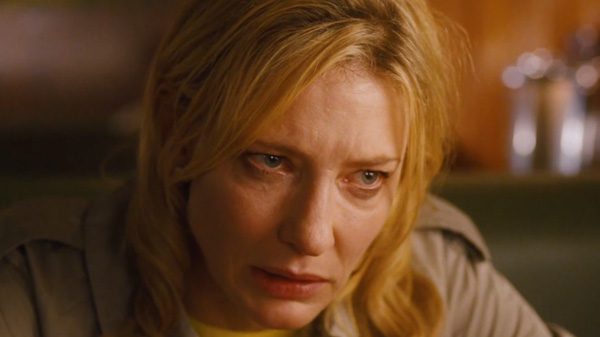
Naturally, the movie hinges on Blanchett’s performance and the Oscar-winning actress is remarkable. I expect her to be a lock for another Oscar nomination if not the front-runner until later. She fully inhabits the character and lays out every tic, every neurosis, every anxiety, and every glimmer of doubt, of delusion, of humanity. She is a fully developed character given center stage, and it’s a sheer pleasure to watch Blanchett give her such life. You’ll feel a mixture of emotions with the character, from intrigue, to derision, to perhaps some fraying sense of sympathy, especially as the movie comes to an end. Blanchett balances the different faces of Jasmine with startling ease; she can slip into glamorous hostess to self-pitying victim to naiveté like turning a dial. I never tired of the character and I certainly never tired of watching Blanchett on screen.
Woody Allen has been a hit-or-miss filmmaker for over a decade, and you’ll have that when the man has the perseverance to write and direct a movie every freaking year. I had a pet theory that, as of late, every three years was when we really got a great Allen movie: 2005’s Match Point, 2008’s Vicky Cristina Barcelona, 2011’s Midnight in Paris. Well now my theory has been put to rest, thank you very much, all because Allen couldn’t wait one more year to deliver Blue Jasmine, a truly great film. It’s a tragicomedy of entertainment, an exacting character study of a flawed, complex, deeply deluded woman as her carefully calculated world breaks down. Anchored by Blanchett’s supreme performance, the movie glides along with swift acumen, doling out revelations at a steady pace and consistently giving something dishy for the actors and audience to think about. It’s funny, it’s sad, but more than anything Blue Jasmine is compelling as hell. This is one of Allen’s best films and one I’d recommend even to non-fans of the Woodman. Give Blue Jasmine a chance and you may be surprised what you feel, for the film and the woman, both complex, engaging, and memorable.
Nate’s Grade: A
Share this:

Midnight in Paris (2011)
 Woody Allen hasn’t been this light-footed in a long time. Midnight in Paris is an effervescently charming film that flirts with overt sentimentality. But before you think Allen goes all gooey, the fatalist in him pulls back for some wisdom about the folly of nostalgia. Allen’s nebbish stand-in this time is Owen Wilson, assuredly better looking but on the same neurotic wavelength of his director. Wilson is a disgruntled Hollywood screenwriter visiting the City of Lights with his shrewish fiancé (Rachel McAdams) and her upper-class parents. One night a mysterious taxicab picks him up shortly after midnight. Wilson is transported back in time to his favorite era, 1920s Paris. He gets to rub elbows with literary and artistic giants, like Gertrude Stein (Kathy Bates), Ernest Hemmingway (Corey Stoll), Scott and Zelda Fitzgerald (Tom Hiddleston and Alison Pill), Salvador Dali (Adrien Brody), and others. He even falls for a lovely lady (Marion Cotillard) from that time period who served as a muse for several artists. Midnight in Paris is a far more enjoyable experience if you have a modicum of education in the humanities. Identifying the artists of old, albeit exaggerated cartoon versions of themselves, is part of the fun, fantasizing about interacting with the greats. But Allen is also playful with his storytelling, and for a while Midnight in Paris becomes a highly refined cross-time romance (think The Lake House written by Tom Stoppard). Midnight in Paris has been catching on with audiences, becoming Allen’s biggest hit in 25 years, and it’s easy to see why. It’s whimsical while being literate and romantic without being corny.
Nate’s Grade: B+
Share this:

Match Point (2005)
 This is an excellent return to form for Woody Allen and his best film since 1987’s Crimes and Misdemeanors. The first half is deliberately slow, yes, but it is justified by the second half which more than makes up for it. The first half needed to be as slow as it is to set up the incredible minutia of this rich, elite world that former tennis pro Chris (Jonathon Rhys-Myers) has been adopted into. We need to see how comfortable this life is to understand why he doesn’t want to give it up and why he goes through the machinations he does in the second half. The characters and dialogue are spot-on and Allen has transported his world of the upper crust New York elite so well over to London, and the change of scenery has reawakened his writing. Allen knows the privileged world very well and their disconnected view point. However, he rightly centers his film not on the neurotic upper crust but on his social climbers Chris and Nola (Scarlett Johansson), a beauty engaged to Chris’ prospective brother-in-law. It is the second half of Match Point that makes it great. Allen tightens the screws on his social climbers and the tension is superbly taut. The dark turns and in the final act are greatly entertaining, as Allen delves further into his look at a universe built around chance and disorder. The returning imagery of the ball hitting the tennis net elicited gasps from my audience, and I was one of them. I love that Allen lets his story continue to unfold after the dark twists. The film’s biggest flaw is anchoring the entire point of view on Rhys-Myers, a somewhat limited actor that reminded me of Jude Law’s character in Closer. Johansson is an excellent noir femme fatale, her husky voice perfectly suited. Frankly, if ever there was a Scarlett Johansson nude scene, this movie was crying out for it. She has her tawdry affair with Chris and there’s even a sequence where we see her laying on her stomach nude while he applies baby oil to her. Their sex is supposed to be so impassioned and carnal, in contrast to his boring but stable relationship with Chloe (Emily Mortimer). And yet no nudity? Woody Allen, you’ve let me down. Your film, on the other hand, is intelligent, sharp, dark, taut, and wonderfully entertaining.
Nate’s Grade: A


 nathanzoebl
You must be logged in to post a comment.