Blog Archives
Blades of Glory (2007)
 When the movie sticks to skating, it can often get hilarious with the on-ice performances and flashy, crafty costumes. Will Ferrell works his doughy man-child schtick and generates mostly amusing results.
Nate’s Grade: B-
Share this:

Stranger than Fiction (2006)
 Ever think your life would make for a good story? Be careful what you wish for. Harold Crick (Will Ferrell) is hearing voices. They aren’t telling him to kill or do anything subversive. In fact it’s just one voice, an English woman, and she isn’t instructing Crick to do anything. No, she’s more so just… narrating. She comes in and out and expresses the doldrums of Crick?s life. He’s an IRS agent whose life revolves around order, repetition, and numbers. We can even see his inner tabulations thanks to some snazzy onscreen visual effects. Crick is sent to audit Anna (Maggie Gyllenhaal), a baker with a disdain for civil servants and authority. Crick is stricken by this shrewd beauty and finds himself wanting her, something the Narrator affirms for him. Crick’s life takes a dour turn when the Narrator lets on that Harold Crick had set in motion his “imminent death.” Crick is confused and seeks advice from Professor Hilbert (Dustin Hoffman) an expert on literature. Then they figure out the Narrator is Kay Eiffel (Emma Thompson), a famous writer who has the unfortunate habit of bumping off every one of her main characters.
Make no mistake, Stranger than Fiction is funny, but it’s a different kind of funny than most people are accustomed to with Ferrell. In my theater, I kept an eye on a gaggle of teenagers sitting several rows in front of me. I just wanted to observe their body language and what I saw was a lot of fidgeting, getting up for trips to bathrooms and popcorn, and lots of whispery talk. I can only imagine the disappointment of those teenagers expecting Ferrell to rip his clothes off and run around like a buffoon. They were likely busily thumbing away at their ever-present cell phones, text messaging their friends. People that are looking for a wild, sidesplitting, slapstick comedy are going to shaking their head. Stranger than Fiction is funny, but it’s in a very dry, witty way, much like British humor; it’s a humor you can admire for being clever but might not make you roll in any aisle.
 The biggest fans of Stranger than Fiction will be bookworms. This is a very literate movie that works better for those with an appreciation or outright love of literature and storytelling. Professor Hilbert doesn’t initially believe Crick until he learns that Crick’s narrator said, “Little did he know.” That, ladies and gents, is all a professor of literature needs. He has to rule out what kind of story Crick may be apart of, so he subjects Crick to a series of hilarious questions along the lines of treasure-inheriting, nemesis-making, and magical-creature befriending. Crick keeps a notebook to tally examples in his life that may point to whether he is part of a Comedy or a Tragedy. Professor Hilton even explains the difference: in grand Shakespearean tradition, a comedy ends with people getting hitched and a tragedy ends with people getting snuffed. This is all fabulously witty and extremely fun, but I can think you’ll see why hard-core fans of Old School and Talladega Nights might be heading for the exits.
Writer Zach Helm has created a wonderfully whimsical tale that’s trippy but manages to still have warmth and a firm heart. It’s far more embraceable a movie than, say, Adaptation, and less smug. He has a smart sense of humor and loves deconstructing literature, like the Jasper Fforde (The Thursday Next books) of screenwriting. We are really sucked into the movie from the moment we can hear Thompson. The story has an innocence to it and this existential comedy feels out there but still grounded; it’s surprisingly poignant and full of dramatic revelations. Even better, Helm has done something that few have achieved: he wrote a story-within-a-story that works. Kay’s narrative voice is highly droll in her observations on Harold Crick’s life. It sounds like a genuine novel, and on top of that, a novel I would enjoy reading. Stranger than Fiction is all the proof I need that Helm is a talent to keep track of.
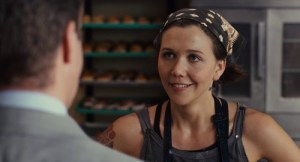 The performers all seem to have the same affection for the material. Ferrell is making that leap from funnyman into leading man, the same dramatic territory Robin Williams first tiptoed in Good Morning Vietnam and, likewise, Jim Carrey approached in The Truman Show. Ferrell won’t turn any heads but he underplays his performance maturely, playing a sad but sweet drone of a human being finally taking charge of his life under very insane circumstances. There’s a quiet moment toward the end where Ferrell is told he must accept his fate and he sits, shell-shocked, tearing up, his voice getting softer with every word. It’s only a moment but it piques my interest in what Ferrell may have in the tank. The comedy he can do in spades, including a desperate moment when he tries narrating his own life to coax his Narrator out of hiding.
Who will turn heads, however, is Gyllenhaal. I can already see a nation of teen boys falling in love with her tattooed, punky baker. To them I say, get in line pals, Gyllenhaal has made me dot my I’s with hearts ever since her star-making performance in 2002’s kinky romantic comedy, Secretary. She’s easy to fall in love with and expresses a fragile compassion to her role. The romance between Anna and Crick is unexpected but these two people need each other, and you feel that need as you watch their eyes light up as their relationship blossoms. Late moments between them add to the tenderness of the film and you will be on your knees pleading Crick is spared so he can return to loving Anna. I think Wreckless Eric’s “Whole Wide World” will become a potential staple on romantic teenage mix CDs sent to their sweethearts from now on.
Thompson and Hoffman have appealing supporting performances. Thompson has marvelous fun thinking of different grisly outcomes in store for Crick. Her interaction with the hospital staff to see the “not gonna make it people” is a howl. But Thompson is too good of an actress to play it straight. Once she discovers the life-altering implications of her writing she is crushed by guilt, obsessed over killing good people cruelly. Frankly, if I had anyone narrating my life, Thompson’s voice would definitely rank high. Hoffman plays a dedicated literary professor like a straight man, and everything seems on the level for him, even the fantastic. It’s a nice touch for a film that doesn’t require broad strokes.
 The movie doesn’t have the depth of feeling or dark turnarounds that I know Charlie Kaufman would have done. Stranger than Fiction has a lot of fun with a very ripe premise, and is very intellectually stimulating, but you do feel like it could have gone further, exploring the reaches and implications of its metaphysical setup. What if someone who read Kay’s manuscript thought it was such a masterpiece, a shining light of literature that could move mountains, that they knew Crick must die, and that they must kill him to make certain of it. Or what about the relationship between author and character, and the role each has over the other and perhaps a battle over the future, a typewriter, and a happy ending at the end of a tunnel. However, while all of these options would further explore the novel premise, it would betray the movie’s whimsical tone. This isn’t a very dark movie. It has an authentic sweetness to it, and Crick is a gentle and kind man, and to do anything too heavy would work against the film’s tone. The movie explores existential queries and the topics can be grim, but ultimately Stranger than Fiction is life affirming.
Stranger than fiction also has a buoyant, unexpectedly pleasing romance to it. Again, it doesn’t show the depth of love and human feeling that Kaufman’s Eternal Sunshine could, but this is an unfair comparison. This romance is more a subplot that carries increasing weight thanks to heartwarming performances and the winsomely adorable Gyllenhaal. The romance in Eternal Sunshine was the story, and everything else was outside variable coming into contact. It might sound dismissive to call Stranger than Fiction as decaf Charlie Kaufman, but it really is a compliment. Kaufman is the most exciting, brilliant, creative, insightful, and whacked out screenwriter working today. I would give one of my kidneys to write even one story that could be described as decaf Kaufman. Stranger than Fiction may not examine as many themes, conflicts, or relationships as Kaufman might with the material, but this movie is a sweet fable that floats by like a fluffy cloud on a sunny day. It’s just so damn pleasant you sort of soak it in and fall in love, not wanting to leave.
Stranger than Fiction is strange, all right, but gloriously so. Scribe Zach Helm has concocted an existential fairy tale aimed for bookworms and outsiders. The premise is clever but the film doesn’t stop there, and Helm explores the implications of his premise with whimsy, charm, and a sweetness that is hard to rebuke. The wacky story seems reminiscent of Kaufman’s works, but it has a more heartwarming and embraceable appeal. Great performances from a game cast help to push the material even further into excellence. It has a small handful of flaws, perhaps a too limited scope, but that doesn’t stop Stranger than Fiction from being one of the best stories of 2006 and one of the best movies too.
Nate?s Grade: A-
Share this:

Talladega Nights (2006)
 When it comes to clowning around, no one does stupid more smartly than Will Ferrell, a man perpetually in a state of arrested development. Talladega Nights: The Ballad of Ricky Bobby succeeds both as a satire on uplifting, redemptive sports movies and on the culture of NASCAR. The product placement is obscene in this movie, but then again, the same can be said with NASCAR racing. PowerAde had a contractual obligation to be cited at every family meal prayer, which itself turns into a competitive sport. Title buffoon Ricky Bobby (Ferrell) is so arrogant that he gets an ad for Fig Newtons on his windshield (“This ad is dangerous… but I do love Fig Newtons.”). Even the title is a perfect send-up. The redneck riffs are never very mean-spirited, but I like that the Southern bar keeps disco on the jukebox to “profile.” The sports clichés are picked apart, like the absentee father (Gary Cole) reappearing to learn the error of his ways. There’s a heavy reliance on slapstick and pretty much everyone in the movie is either a cad, a buffoon, or a jackass, so there are limits to that comedy.
True to 2004’s Anchorman, this movie hits its high points with the spontaneous moments of tangential weirdness, from sports announcers explaining how to put out invisible fire to Ricky Bobby learning to drive with a live cougar as a co-pilot. Talladega Nights doesn’t quite hit the absurdist highs of the infinitely quote-able Anchorman, and the movie spins its wheels all too often, but it’s got a greater number of solid belly laughs than most any movie out there today. Sacha Baron Cohen plays Jean Gerard, the gay, French Formula-One driver that upsets the stock car world. Cohen has great fun in an English language mangled performance Peter Sellers would have loved. When Ferrell and Cohen are face to face, you feel like anything can happen between these two quick-witted comedy titans. Ferrell has assembled another game cast of gifted improvisational artists and their blend of loony comedy feels like jazz. The downside with such a huge cast of very funny people is that not everyone gets the face-time they deserve (Oscar nominee Amy Adams comes to mind).
Talladega Nights is a big broad comedy with a great cast and some inspired chuckles. What other movie this summer could climax so perfectly with a man-on-man smooch and the observation, “You taste like… America”? Only one, baby, and it’s Ricky Bobby.
Nate’s Grade: B
Share this:

Wedding Crashers (2005)
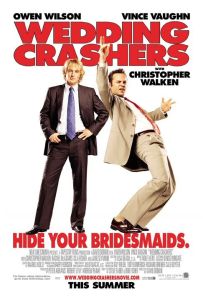 My friend Amanda Evans is quite possibly the biggest Vince Vaughn fan in the United States, nay, the planet Earth. She used to watch Dodgeball every day. Her brother-in-law even went so far as to stage an intervention for her Vaughn addiction. She has been talking about Wedding Crashers for months and months and counting down the days like a kid waiting for Christmas. It’s safe to say that Amanda loved the movie but how would your otherwise non-obsessed moviegoer feel?
Jeremy (Vaughn) and John (Owen Wilson) are divorce attorneys by day and ladies men come nightfall. Both men crash weddings they were not invited to with the strict purpose of getting laid by horny bridesmaids. They have got their honey hunting down to a science, from what relative they’re related to, to when to cry, to whom to slow dance with to convince those bridesmaids that they’re sweet gentlemen. Jeremy says that one day when they?re old men they’ll both look back on these days and smile. John retorts, “We’re not that young.”
The Super Bowl of all weddings is the daughter of the Secretary of the Treasury (Christopher Walken). John has his eye on his other daughter Claire (Rachel McAdams) while Jeremy sets his sights on the Secretary’s other daughter, the wild and vivacious Gloria (Isla Fisher). The only problem for John is that he’s actually falling in love with Claire, oh and she’s engaged to a real jackass (Alias‘ Bradley Cooper). Jeremy and John are such big hits at the wedding that the Secretary invites them both to vacation with his family at their summer home. Jeremy is hesitant and wants to stick to the love-em-and-leave-em lifestyle he and his buddy are so accustomed to, but John drags him along convinced he can win Claire over.
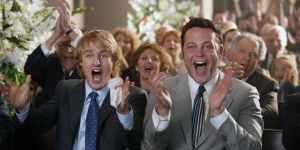 Vaughn kills in every single scene. He hits punchline after punchline like some king of comedic prizefighter. His mile-a-minute delivery gels ever so nicely with Wilson’s homesy charm and drawl. These two have never been matched before as leading men but now their marriage seems like a match made in heaven. Their chemistry is off the chart. Wilson is essentially the straight man to Vaughn. In most comedies, “straight man” is just another term for boring. However, Wilson gets his shots in as well especially with his give and take with Vaughn, who is in a comedic zone all his own.
Not to be out done by the men, both McAdams and Fisher give great performances. McAdams (Mean Girls) is a rising star and it’s easy to see why. She’s a beautiful woman but also has some good teeth for comedy. In comedy terms, she’s the romantic interest, which means she’s an even straighter (read: boring) man than Wilson’s straight man. And handed with all this, McAdams still shines as a leading lady you can fall in love with. The true scene-stealer of Wedding Crashers is Fisher (Scooby-Doo), who goes hilariously tit-for-tat with Vaughn. You might walk away believing she’s truly out of her mind. Fisher has a physical gift for comedy that hasn’t been showcased before, but with Wedding Crashers she gets unleashed and we?re the better for it.
After the brilliant work of McAdams and Fisher, most of the supporting cast’s performances comes off as being too forced. Cooper is a wide-eyed grinning jackass that?s obvious from the get-go. He plays the role so big that his eyebrows seem permanently pressed to the top of his head. There’s also the weird introverted son who Typical Crazy Grandma berates as being “a homo.” But not only is he gay hes also a freak. The role seems quizzically garish and even a bit homophobic. Jane Seymore jumps at her role as mom in heat, but the film forgets about her fast after an awkward encounter with Wilson. Walken can make me laugh just by watching him stare (and he did), but even he isn’t given much more to work with besides the supportive dad role. It seems odd for a comedy with such huge belly laughs to have several supporting players grind the film’s funny down. All of this is excusable though because the far majority of the film’s attention and laughs are derived from our central quartet.
Wedding Crashers is a raunchy delight. You know you’re in good hands when, in one scene, Wilson and Vaughn are dipping bridesmaids on the dance floor and it cuts to these same bridesmaids now falling topless onto hotel beds. This is one R-rated comedy that proudly wears its rating on its sleeve. And for a sex comedy, there’s a surprising amount of laughs mined just out of an adult discussion on sex, which cannot be curtailed or couched with euphemisms and soft language. I don’t know whether to credit the screenwriters or the off-the-cuff improving of Wilson and Vaughn, but Wedding Crashers proves there’s still more under the sun to talk about and giggle.
Usually with movies revolving around hedonistic characters, they meet one of two ends: 1) they find that One True Girl that makes them want to go straight, or 2) they meet their hedonistic match and rethink their ways now that the shoe is on the other foot. Wedding Crashers doesn’t give you one of these options, oh no, it gives you both. Sure things gets awfully predictable after a great rush out of the gate, but the interplay between Wilson and Vaughn and some genuinely funny gags should keep most laughing until the surprise cameo at the end by the founder/guru of the wedding crashing rule book (it should be no surprise if you’ve seen any movie with Wilson and Vaughn the last three years). The climax is a bit drawn out and Wedding Crashers is still another comedy built around deception whose climax involves apologizing for said deception. It’d be tiresome if the movie weren’t so damn funny.

Despite the sleazy premise, Wedding Crashers has a sweet and gooey center. These are two men who know exactly what women want and they’re eager to give it to them. They just don’t know what they really want, but when they find it both Jeremy and John set their minds to romantic conquests outside of the bedroom. It’s this gooey center that makes the characters likeable despite any misgivings an audience may hold over their wedding crashing plot.
Two hours is a near eternity for most comedies and Wedding Crashers seems to lose its sprint in the last 20-30 minutes. The film starts getting repetitious and overly predictable with few laughs to cover up. Wilson and Vaughn still make it work but the setup seems to have been taken as far as it will go and then some.
Wedding Crashers is a loud, jovial, ribs-in-the-elbows funny return to the crass classics of the 1970s R-rated comedy. Vaughn and Wilson are perfectly matched and McAdams and Fisher shine like stars. Wedding Crashers is a bawdy good time that will leave you aching from laughing so hard. This movie is profane, simple, crude, and joyously so. It does run out of gas toward its protracted climax and some of the supporting performances feel forced, but Wedding Crashers is easily the funniest film of the year. Amanda was foiled in seeing the film three times the weekend it opened. She had to settle for only seeing it twice. I don’t think she has slept since (UPDATE: Amanda has since seen the movie five more times).
Nate’s Grade: B+
Share this:

Old School (2003)
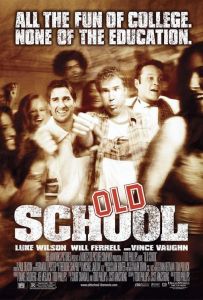 There’s something to be said for stupid comedies. Not necessarily the ones that are centered on large men getting hit in the head or crotch. Or films that climax with pie fights. Or any film where a wild animal plays some kind of pro sport. Or any film where Rob Schneider transforms into something and learns that life is indeed tough from a different perspective. As you can see, the stupid comedy has a very dubious history but when it succeeds at creating those hearty belly laughs, the kind where your face is sore afterwards from laughing so hard, few movies are as entertaining. Billy Madison is every bit as perfect in its humor as the more critically lauded comedies Rushmore and Raising Arizona. So then, is the crass college comedy Old School funny, stupid or both? It’s safe to say its makers did their homework and admirable achieve an unrepentant uproarious stupid comedy.
Mitch (Luke Wilson) is a real estate numbers cruncher who catches an early flight home from a business retreat only to discover his girlfriend (Juliet Lewis) blindfolded and ready to engage in an orgy. Mitch moves into a house on a local campus with the help of his two friends, smooth talker Beanie (Vince Vaughn) and man-child Frank (Will Ferrell). The trio of thirty somethings comes up with the idea to start their own fraternity and relive their youth. Their rebellion from adulthood leads to wild parties, underage girls, KY Jelly wrestling, drunken streaking, birthday party tranquilizers, eulogies featuring White Snake songs and, of course, taking it to the man that just wont let these kids have their fun.
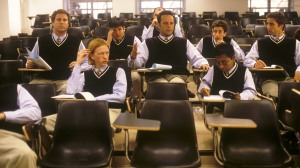 Wilson is relegated to the role of the straight man, which means he pretty much gets to make faces at the antics of Ferrell and Vaughn. Wilson is the nice guy of the film, which in comedy terms means hes the individual tortured by others. And in other terms, means hes normally quite bland. Consider both checked with Wilson in Old School. Wilson is a very capable actor but he’s more or less backdrop.
Ferrell is like instant comedy, just add water and he can make anything funnier. Much has been made of Kathy Bates strutting around in her 54-year-old birthday suit (which may have led to a Best Unsupported Actress nomination) but Ferrell equally jogs around jiggling his goods with glee. Ferrell is hysterical as the films biggest party animal. He takes everything to another level of comedy. Stick around during the end credits just to see him kick some woman’s shopping cart. I’m telling you this simple action is one of the funniest things in the movie.
Vaughn has made a career of playing fast-talking louts that would normally incite people with his caustic remarks if he weren’t so damn charming. What happened to ole Vince and his oodles of sex appeal? Circa 1998 or so he was going to be Hollywoods next leading man, especially after massive exposure from Spielberg’s Lost World. Yes, starring in the very ill conceived remake of Psycho (now with masturbation at no extra charge!) was a bad career move but it shouldn’t have been a killer. I mean, Anne Heche went on to other films after it and this was before she was communicating with aliens with her made up language. Hell, I’m just kind of glad to see Vaughn in films again. His running gag with a bread maker is great.
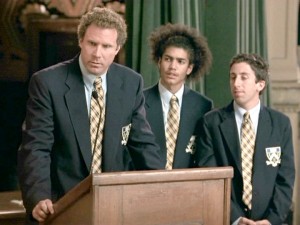 The plot of Old School is really nothing more than a paper-thin device for the jokes to spring forth from. There are only stock characters in these kinds of films. Theres the nice girl (Ellen Pompeo) that will eventually get together with our protagonist in the end. There’s her smug boyfriend played by the smug Craig Kilborn. Jeremy Piven is a stuffy dean trying to shut the boys down to settle old grudges with them.
The women of Old School are really left with nothing to do. Either they are there to have sex with the men or, when older, marry and control them. Lewis is the opposite of the good girl as the oversexed former flame of Wilson. Leah Remini has a very brief role as Vaughns wife who knows when to lead him by a chain. 24‘s Elisha Cuthbert is a naughty schoolgirl that could get Wilson in trouble after one unexpected night. The ladies of this world are really tools for the guys, but what kind of feminist analysis is needed for a film that features Snoop Dog and not one, but two correspondents from The Daily Show?
Old School is from the director and co-writer of Road Trip, a crude yet very entertaining and lively comedy. Old School is kind of a big brother companion to Road Trip, and while not rising to the level of Animal House (as every college comedy wishes to be now) the film is indeed a pristine example of a gloriously stupid comedy aided by a very game cast. See it and be prepared to laugh a few pounds off.
Nate’s Grade: B
Share this:

Jay and Silent Bob Strike Back (2001)
 Kevin Smith returns back to his comedy roots. No more movies with a message (Chasing Amy and Dogma) it’s back to good ole’ snowballing and stink palming. His latest, Jay and Silent Bob Strike Back, is like a giant thank-you card to all his fans that have made the man who he is today. It ties up the entire View Askew universe so Kevin can drift off into uncharted ventures of film making and not have to keep referencing the same damn characters. Plus there’s plenty of good-natured vulgarity to go around.
 The plot of Jay and Silent Bob is nothing too heavy but seems to keep the film on a continuous pace, unlike the sometimes stagnant feel Mallrats had (what, they’re in one location for 90 minutes). It seems that after getting a restraining order at the Quick Stop on them, Jay and Silent Bob learn that Miramax is making a movie from a comic book that is in fact based off of them. Learned of the riches they could make they seek out the comic’s author Holden McNeil (Ben Affleck’s first appearance in the film) and demand a piece of the pie. Holden tells them that he long ago sold his right to his partner Banky Edwards (Jason Lee, in his second appearance in the film) and that there’s nothing they can do to stop the film. Jay suddenly gets the idea that if they stop the movie from ever getting made then they don’t have to worry. So off go our stoner duo on a mission to sabotage and satirize Hollywood.
Along the way are a hitch-hiker (George Carlin) advising the best way to get a ride is to go down in your morals, a confused nun (Carrie Fisher), the cast of Scooby Doo offering a ride (which will be 100x funnier than the feature film coming out this summer), a beautiful band of international diamond thieves (Eliza Dusku, Ali Larter, Jennifer Swalbach-Smith, Shannon Elizabeth), a rescued chimpanzee, a dogged Wildlife agent (Will Ferrell), and a full barrage of hilarity once Hollywood is finally hit.
 The best barbs are laid out by Ben Affleck and Matt Damon bickering about the other’s film choices on the set of Good Will Hunting 2: Hunting Season. This moment is truly inspired and full of great humor from Gus van Sant too busy counting his money to yell action to Damon turning into a vigilante hero. I almost fell on the floor laughing during this sequence.
When Jay and Silent Bob hit Hollywood is when the comedy starts hitting its stride as this Jersey Greek chorus interacts with the Hollywood life and encounters many a celebrity. The jokes are usually right on target except for Chris Rock’s performance of a racism obsessed film director. Rock’s portrayal becomes grating to the moviegoer far before it’s over, though he does get a few choice lines.
Smith as a director has finally elevated his visual art into something that can sustain itself instead of his earlier just-hold-the-camera-and-shoot movies. There are pans, zooms, quick cuts, cranes, action sequences, and even CGI. Smith is evolving as an artist but still staying his “dick and fart joke” self, and Jay and Silent Bob Strike Back is evidence. And that’s fine by me.
Nate’s Grade: B
Reviewed 20 years later as part of the “Reviews Re-View: 2001” article.
Share this:

Dick (1999)
 What should have been a biting satire on the whole Watergate mess and Nixon’s resignation comes off as hackneyed and clumsily written. The jokes are stale and moronic, the script is sophomoric, and the satire is not even close to biting. It all appears like it was written by a freshman that got the Cliff Notes on Watergate then decided to watch an episode of Charlie’s Angels.
Kirsten Dunst once again manages to make me question when I will ever enjoy her in a performance. The ditzy girls idea grows thin by the opening sequence let alone stretched to the rest of the movie. There are some bright spots like Dan Hedaya playing Nixon uncannily, and some former SNL and Kids in the Hall alums having fun with the material and parodying their characters. So why didn’t they feature more of them?! Please tell me! The movie is lame and unfunny, and even more so when you account all the double entendres using the name “Dick.” I could very easily use the title of the movie in some sexually inuendous reference to how bad this movie sucks, but I’m above that. For now.
Nate’s Grade: C


 nathanzoebl
You must be logged in to post a comment.