Blog Archives
Battle of the Sexes (2017)
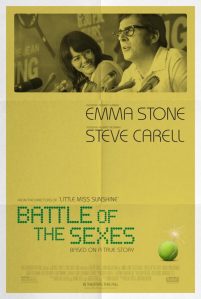 In 1973, tennis player Billie Jean King (Emma Stone) was the number one player in the world, but to many she was still only just a woman playing a man’s game. Bobby Riggs (Steve Carell) was a retired tennis player trying his hand at being a family man. He’s restless and eager to prove something. He’s a natural hustler and so he sees female tennis players fighting for equal pay as his opportunity at a comeback. Riggs wants to prove a point about the inferiority of female athletes. He will play and beat any female tennis pro. He embraces the term of being a male chauvinist and becomes a lightning rod. Men around the world cluck about their biological superiority in athleticism. Billie Jean King feel the full pressure to prove him wrong and make a stand for the women’s movement.
I was pleasantly surprised at the degree of depth given to the characters in Battle of the Sexes, turning what could have been a light-hearted and sprightly throwback to a sports novelty into something a bit deeper and more meaningful, a thoughtful character piece on this climactic conversion of sports, celebrity, and feminism that still resonates.
Billie Jean King is the number one women’s tennis player in the world at age 29. She’s also deeply in the closet and Battle of the Sexes gives considerable attention to this internal conflict of self. The film successfully makes you feel her yearning and unrestrained attraction to hair stylist Marilyn Barnett (Andrea Riseborough). The directors film their first interaction in extreme close-up, which forces them together tighter and allows us to see every little tremor of nerves play across Stone’s face. Her affair with Marilyn coasts on that combination of guilt and compulsion, the push and pull of what she desires and what she can have. Sponsors would not take kindly to an openly gay tennis star. Billie Jean King is struggling with her concept of who she is versus the expectations of others and society. By stepping up to Riggs’ challenge, she is fighting for her own sense of agency. She feels the intense pressure to perform with the credibility of women’s sports placed upon her shoulders. She’s fighting for equal pay and fair treatment, but what happens to that mission if she fails against a 55-year-old oaf? Billie Jean King comes across as a compelling specimen, feisty and independent but also hampered by what those around her would think over her feelings for another woman.
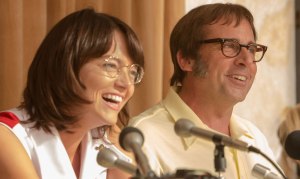 Stone delivers a far more layered and emotionally engaging performance here than in her Oscar-winning turn in La La Land. Hers is a character trying to become comfortable in her own skin. Riggs is the showboat while Billie Jean King is not comfortable in the spotlight. Stone displays the grit and tenacity as well as the vulnerability and complexity of her character’s self doubts and internal struggles. Her scenes with Marilyn have a vitality to them that is absent throughout the rest of the movie, allowing the audience to understand how that burgeoning romance unlocks something within her, something that she might not even fully comprehend. When she does win the big match, Stone seeks solitude and just cries her eyes out, finally able to let her guard down, acknowledge the toll of the moment, the relief of not letting down the women’s movement, and the sheer elation of rising to the occasion. It’s a moment where Billie Jean King feels her most free, where she’s sobbing by herself. Once that’s done she has to collect herself and get back in front of the cameras, adopting her shield once again to face the outside world.
And then there was Bobby Riggs, 55 years old at the time and languishing on the seniors’ tennis circuit and desperately missing the spotlight. The movie finds notes to make him more of a character rather than simply a misogynistic antagonist, and whether that shaded portrayal is deserved is another question. Riggs is fully convinced of his physical capabilities and that he can beat the stars of the women’s tour. These are women fighting for equality and equal pay but Bobby, and he’s certainly not alone, believe that the sexes are inherently unequal when it comes to physical competition. For him, it’s a way to prove his skills and send a message as well, but more so, as presented in the film, it seems like it’s the spotlight that he misses most. He’s enviously licking his lips at the tournament prize purses on the tennis circuit now, even the women’s prizes. He can make more money than he’s ever earned in his pro career. He can still contend, he can still prove something, and the money and stage has never been bigger. He’s getting far more attention at 55 than he ever received during his pro tennis career where he won four Grand Slam titles (he was the number one player for three years). Carell (The Big Short) is well suited to play broad characters that get even bigger with attention. He’s soaking up every moment as if he’s finally getting what he feels is long overdue, and every hammy PR stunt only magnifies the intensity of that attention. He’s a huckster who gleefully adopts the moniker of a misogynist. At 55, Bobby Riggs has found himself in the biggest spotlight with waves of adoring fans and he doesn’t want to give it up.
 You know who else comes across really well in this movie is Billie Jean’s husband, Larry King (not to be confused with the TV host of the same name). It’s not a film that props up the husband as the focal point of someone else’s story; there are more important aspects than how Billie Jean’s lesbianism affects him. However, he is still an important person in Billie Jean’s life and he is processing a form of loss. His relationship with her cannot stay the same, but Larry recognizes what she needs and chooses to be supportive rather than vindictive. He cares enough to put her needs ahead of his own, and that only increased my empathy for him. A marriage pulled in multiple directions is ripe for examination, and it’s rare to maintain sympathy for all of the participants and this movie does.
By the time that seismic tennis battle comes about, the directors Jonathan Dayton and Valerie Faris (Little Miss Sunshine, Ruby Sparks) smartly refrain from lots of edits and angles, instead preferring a standard TV shot to better immerse the audience. The camera angle allows for the entire tennis court to be displayed, and we’ll watch sets play out in long takes with the two athletes running up and down the court. This allows us better understand and appreciate the strategy of both players, and it also probably makes the special effects budget happy as they don’t have to do much to cover the presence of the stand-ins playing the game instead of our movie stars. Even though I knew how the match would end, I was glued to the screen because of everything the match represented. By forgoing the quick cuts and multiple angles that can jazz up the excitement of a tennis presentation, the film is able to carefully illustrate Billie Jean King’s strategy and skill. She intended to run Bobby Riggs up and down the court and exhaust him. Letting the tennis game play out in a wider presentation also better serves the sense of payoff. This is the moment we’ve all been waiting for, as were the 50 million Americans that tuned in. When she does win, I couldn’t get enough of the montage of chagrined male faces twisting in pained grimaces as this lady proved to be the superior player. You could give me a whole movie of pained reaction shots from misogynists and I would be ecstatic.
 It’s also hard to ignore the parallels Battle of the Sexes makes with our current climate. 44 years later, women are still fighting tooth and nail for equality and credibility without qualifiers. Serena Williams is not just the greatest female tennis player of all time; she’s also the greatest tennis player, period. Women’s sports are often seen as lesser in comparison to the men, and abhorrent pay discrepancies are still a reality. Look at the U.S. women’s soccer team, which won the World Cup in 2015, only earning a small fraction of the U.S. men’s team, who finished fifteenth out of a group of sixteen. The casual sexism and lowered expectations extend beyond the realm of sports, as the 2016 presidential election serves as a powerful reminder of the obstacles professional women face in modern society. It’s easy to view Battle of the Sexes through the lens of the 2016 election: a very capable woman who just wanted to do her job is lambasted by an inferior opponent coasting on puffed-up bravado, masculinity, sensationalism, and the sense that the established order of white males is losing something divinely theirs. I’ll admit that channeling this analogue does provide the ending with even more uplift.
Battle of the Sexes is an engrossing story with big personalities, big conflicts, and big stakes, and it feels just as socially resonant forty years later. The messaging can be a bit heavy-handed at time, as Bill Pullman’s character seems to be a composite of all male chauvinism personified, but it’s still easy to get swept along with its sunny cinematography, 1970s period soundtrack, and feel-good story that remembers to always be entertaining. The characters have more depth than I was expecting, and the actors bring extra layers and shades to their roles, making Bobby Riggs a better rounded character than he might have been in real life. Battle of the Sexes is a timely crowd pleaser that doesn’t lose sight of its characters in the guise of its message. By the end of the film, I was cheering, moved, and nicely satisfied, and what more could you ask for?
Nate’s Grade: B+
Share this:

Little Miss Sunshine (2006)
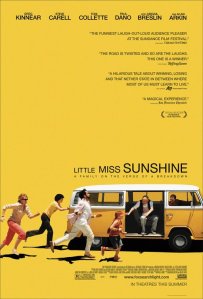 Slowly but surely, Little Miss Sunshine is gaining momentum as the breakout comedy of the summer. It’s gotten some of the most glowing reviews of the year and is poised to capture the hearts of not just fans of indie cinema but also patrons of the big suburban multiplexes, your red state soccer moms and NASCAR dads. After having seen Little Miss Sunshine, I feel like I must have missed the bandwagon.
Little Olive (Abigail Breslin) is bursting with shriek-worthy excitement. She just found out she’s a regional contestant in the national Little Miss Sunshine child beauty pageant. Her family crams into a beaten down, canary yellow Volkswagen bus and heads off on a cross-state journey for Olive. Along for the ride are Olive’s fractured family — older brother (Paul Dano), who has taken a vow of silence until he becomes a fighter pilot, stressed-out but supportive mom (Toni Collette), ambitious self-help failure dad (Greg Kinnear), a potty-mouthed, heroin-snorting grandpa (Alan Arkin), and a suicidal gay uncle (Steve Carell). It’s a long road to the pageant, especially with such an eclectic group of people whose only thing in common are their chromosomes.
 I just couldn’t shake the overwhelming feeling that Little Miss Sunshine should be more. It’s not really much of a comedy. There are some funny moments, and pushing the bus is a running gag with better legs than I would have guessed, but the film has a lot of stretches where the laughs are low to nonexistent. It’s not really much of a character piece either. None of the characters are that well defined or allowed to stretch out. The family members are all archetypes of indie film weirdness: the gay intellectual, the verbally inappropriate grandparent, the self-deluded father, the frazzled mother, the loner brother, and the precocious tyke. Little Miss Sunshine does a fine job of setting up its family of cracked characters but then seems to twiddle its thumbs when it comes to development. The only character insights come in a scattered few small moments with Olive. Dad is essentially poisoning his family with his self-help claptrap, casting the world into “winners” and “losers.” There’s a heartfelt moment brilliantly played Breslin where she confesses to grandpa that she doesn’t want to be a loser because her dad would stop loving her. Aside from that, Little Miss Sunshine seems to wind its characters up and then leave them be. I wanted more of just about everything but the movie wouldn’t budge.
The movie spends quite arguably too much time at the Little Miss Sunshine beauty pageant. Child beauty pageants are a well deserved, albeit easy, satirical punching bag, and they creep the hell out of me. Seriously, turning little girls into highly sexualized Barbie dolls seems cruel, unnatural, and very very creepy to me. There was a stupendous documentary that aired on HBO years ago called Living Dolls that traced the life of a six-year-old girl and her stage mother. It was a harrowing film, and the obsessive mother is one of the most disturbing villains I’ve ever seen in a movie, scripted or otherwise. In the film you see how people transform little girls into flirty, overly made-up little adults. It’s sickening.
The reason I bring this up is because Little Miss Sunshine because they lift a direct metaphor. In Living Dolls the main girl is playing one of those tiny slide puzzles where the finished result is an honest to God yellow smiley face. It’s a perfect metaphor of this child attempting to find happiness when no one seems to want her to live as a child. And then I saw the exact same moment in Little Miss Sunshine. Rip-off or accidental homage, you decide. In the same vein, every time Kinnear invokes the name of his literary agent, Stan Grossman, I kept thinking of Fargo.
In Sunshine, the family is aghast at the pageant scene but support Olive anyway. Then things get way too easy. The film concludes with the 5,785th rendition of the weirdos celebrating what makes them who they are, their weirdness, and sticking it to the thumb-nosing naysayers. Then the movie abruptly ends. That’s all, folks. Little Miss Sunshine was already built on the aching backs of two very familiar indie staples, dysfunctional families and road trips, and offers little else to justify its existence.
 It’s hard to really drag this film through the mud. It was proficiently made by the music video directing team of Jonathon Dayton and Valerie Faris (Smashing Pumpkins’ Tonight Tonight). The acting is generally good. The better actors rise to the top despite their limited character depth. Carell is a big name in comedy right now, and he gives a rather subdued, sarcastic performance that will resonate best with audiences. Kinnear is better at playing smug types than pathetic types. His character really is the villain of the piece, so it’s nice to see his transformation even if it is awfully spontaneous. Collette always looks to be on the verge of a nervous breakdown. Breslin (Signs) is pretty cute and will pierce your heart during the aforementioned talk with grandpa.
There are some amusing moments and fun pieces of dialogue, and the film has its heart in the right place. The screenplay needed to go through a few more drafts to strengthen character and story. I can honestly say my favorite part of Little Miss Sunshine was listening to its very Sufjan Stevens-like soundtrack full of meloncholic horns, cellos, violins, squeezebox and electronic whispers. I would recommend the soundtrack ahead of the movie.
I feel some shades of guilt as I gather my opinion, however I cannot deny the overwhelming urge that Little Miss Sunshine should have been more. It needed more comedy, more character depth, more attention to story, and more opportunity for its ensemble of actors to sink their teeth into the material. This appointed indie darling is intermittingly amusing, has some laughs, and may be worth a free afternoon or as a rental. To me, it’s also a big example of wasted potential. Little Miss Sunshine is a beauty that needs more work before it can shine on a greater stage.
Nate’s Grade: C+


 nathanzoebl
You must be logged in to post a comment.