Blog Archives
The 33 (2015)
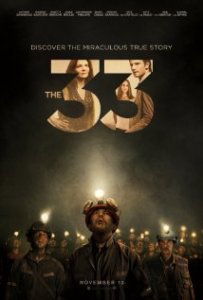 The problem with a rescue story is how to keep the audience engaged when the end seems obvious. A movie about the rescued miners in Chile seems like a no-brainer when it comes to cinematic storytelling. Survival stories are naturally rife with conflict and human triumph. But when everybody knows the ending how do you make it count? The 33, a would-be feel-good movie that aims to tug at your heartstrings, is not the answer.
In August of 2010, 33 men went over a thousand feet down into a gold mine in Chile. The mountain caved in on top of itself, trapping the men in a small refuge. They had enough food and water to last only so many days, let alone enough to subsist 33 people. Mario (Antonio Banderas) must keep his fellow miners from breaking into violence, while Lawrence (Rodrigo Santoro) must scramble the forces of the government to retrieve the miners with the pressure of the entire world watching. The men spent over 65 harrowing days trapped underground before finally reuniting with their loved ones.
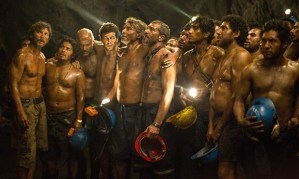 The 33 misses widely, relying on easy sentiment and generalities rather than exploring its entombed characters on more than a fundamental level. Just because certain plot turns are expected from a keen audience, whether the Titanic is going down or, say, in another survival story that James Franco is going to cut his arm off, it doesn’t mean that the proceeding time is merely setup for the predictable. Even plot turns that are predictable can be wholly satisfying if the storytelling earns the payoff. Therefore, while the world knows that the 33 miners will eventually be rescued relatively unscathed, that doesn’t mean that the movie is off the hook until that moment. It needs to make the scene count, and the best way to do so is to get us emotionally invested in these men as they struggle with their fears. That is the film’s biggest failing. It was expected that 33 characters would be a tad unwieldy as far as divvying up screen time, so we concentrate on about five or six actual “characters,” while the rest of the trapped miners are glorified extras (they’re even listed in the end credits as Miner #8, Miner #9, etc. rather than by their names). The characters fall into rather one-note territories, from the Guy Who Feels He’s Let Down His Miners, the Guy Who Feels Burdened as the Leader, the Comical Relief Guy, the Old Guy Close to Retirement, The Young Guy with a Baby on the Way, the Recovering Addict with Trust Issues, and the New Guy (a.k.a. The Bolivian). Even though the cave-in occurs about 15 minutes into the movie, we don’t really get to know any of these highlighted characters on a deeper level than the basic descriptions they’re categorized with. It’s as if The 33 expects us to be engaged in the survival struggle without people worth watching.
The script divides its focus among a few camps, which further makes the miners feel less developed. Garnering substantial screen time are the minister of mining and his team of engineers and Maria Segovia (Juliette Binoche), an empanada-vendor who becomes the face of the anguished family members. These factions vie for screen time but they never truly present much more than what is on the surface. It’s a lot of pacing and brow-wiping. I’m puzzled at how little the movie makes use of the miners’ family members. This seems like a story made for flashbacks to help tinge the struggle with heavier dramatic weight and irony. The problem with The 33 is that the rescue story isn’t as interesting from a conflict standpoint because it’s more a matter of a race against time than a matter of logistics. Digging through the bed of rock is arduous but it’s nothing terribly unexpected from a technology standpoint. It doesn’t help that The Martian is a recent hit film and a superior movie survival story, at least in its telling. The focus was tighter and Matt Damon’s character was beset with conflict after conflict. He was an active participant to lead to his survival. In contrast, the miners are left to hold onto their sanity and hopes while they wait for extrication. That struggle can be illuminating on the psyche and how people can pull together in times of extreme distress, but that’s not this movie. Sure, they pull together but it’s mostly the occasional inspirational speech from Mario and the reliance on the emotional push of James Horner’s score (his last in life). The movie relies on easy sentiment to fill the many gaps of its characterization.
There is one standout moment in the movie that gives you enough false hope about where The 33 could have gone with its storytelling. As the men pass around their daily ration, a squirt of water with some tuna inside it, the men fantasize a feast of their favorite foods delivered lovingly by their family members. It’s an exquisite visual detour that succinctly communicates the desires of the men and their mental defenses. It’s powered by a lilting musical score that makes it feel like a divine moment of relief for these weary men, and it’s visually playful without going over the top or losing the emotional truth. Then, just as succinctly, it transitions back to the dreary reality with as much skill as it began. It’s a terrific moment in an otherwise safe and sappy movie, and the artistry hints at the more visually poetic and psychologically probing movie that could have been. Going back to 127 Hours, Franco was literally stuck between a rock and a hard place but director Danny Boyle (Slumdog Millionaire) opened it up as a movie. The 33 is just too inert.
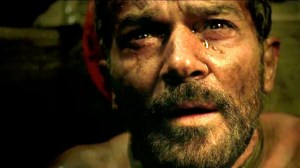 It may be slight but I can’t help but feel that the movie should have been told in Spanish rather than English. Now I know that English is going to greatly improve the movie’s mass appeal at the American box-office (though that didn’t seem to make a dent), but it harms the movie’s authenticity. On the contrary, I could forgive the white-washing of transforming the Spanish family into a white clan of Brits in the 2004 tsunami drama The Impossible but that was because their struggle was powerfully and universally felt and unrelated to ethnicity, which also assists in the argument of why change their ethnicity, but I digress. With The 33, the struggle is so specific to a nation and its people that there is some degree of authenticity lost in the actors speaking English in a multitude of accents meant to approximate Chilean. It’s also a bit strange to watch actors of varied backgrounds playing Chileans including a Frenchwoman (Binoche), an Irishman (Gabriel Byrne), and the warden from The Shawshank Redemption as the president of Chile. These are small things but when packaged together, and with the movie’s reliance on easy sentimentality, it’s hard not to feel like The 33 is a middling TV movie writ large.
The 33 is an acceptable story with a bevy of fine actors who give fine performances while we wait for the swell of the music to hit all the emotional highs. It’s effective at points and its heart seems to be in the right place, even giving each real-life member of the titular 33 a coda appearance before the credits (we’re told their lawsuit against the mining company apparently netted them zero money). The problem with The 33 is that it doesn’t make the men feel much more than a group of numbers, figures to eventually and predictably be saved, without giving us enough insight into their humanity. It feels like a disservice to their story and the compromises hobble its artistic latitude. It feels far too impersonal and rote, which are crippling attributes for a feel-good true story. It’s not fair but I fondly recall McFarland U.S.A. as a formulaic feel-good movie that nails its big moments while dropping its audience into a community of characters that feel fleshed out and given depth and relatability. If you want to know more about the Chilean miners, skip this movie and read the book. If you want a feel-good movie that genuinely makes you feel good, then skip The 33 and watch McFarland U.S.A instead.
Nate’s Grade: C+
Share this:

McFarland USA (2015)
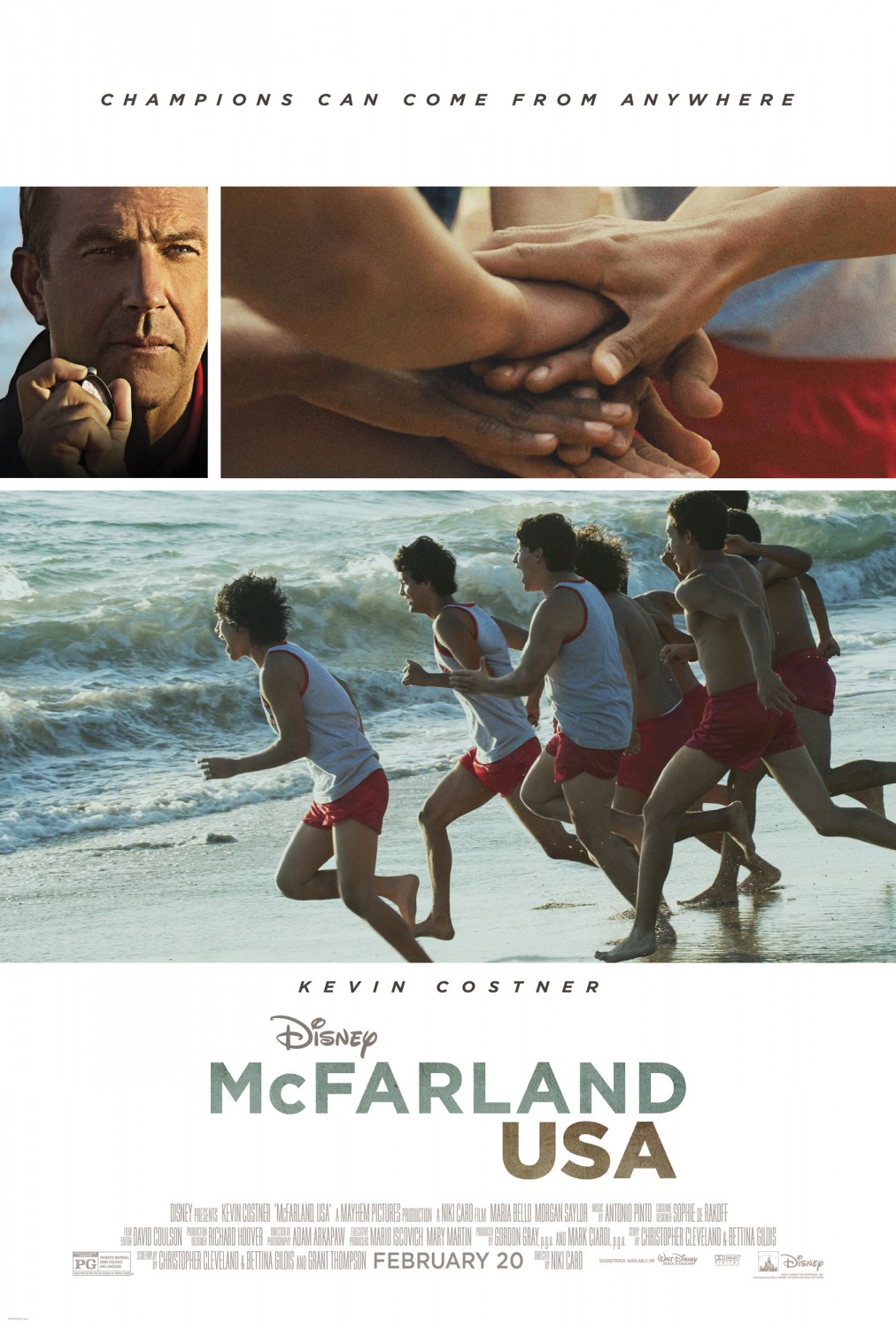 Many movies follow a proven formula very closely, but sometimes a well written, well executed formulaic movie can remind you how appealing that formula can be, and that is McFarland USA, an inspirational Disney sports film that warmed my heart. Kevin Costner stars as a science teacher and sports coach for a working class California town mostly populated with Mexican-American immigrant families. He sees the endurance and speed of several students and decides to form a cross-country team, even though he’s never coached anything related to track in his life. What follows is a mixture of the inspirational teacher film and the inspirational sports team film. Thankfully the screenplay and director Niki Caro (Whale Rider) take their time to flesh out the runners, giving them personalities and different degrees of depth, troubled by real-world problems without easy answers. The movie works as a great tool for empathy as it respectfully illuminates the limited economic opportunities and backbreaking labor of so many Mexican-American immigrants toiling in our fields. The movie creates an amiable sense of community and even though moments can feel contrived, I always had a smile on my face. The people came across as people, complicated, proud, hopeful. It opens up a world and showcases just how hard these people work to assist their families. Costner is a stable anchor for the film but it’s his young cast that really give the film its lift. The emotions are genuine and the uplift is earned, thanks to careful plotting and generous characterization. McFarland USA is a feel-good movie that’s better than good and a perfect film for the whole family.
Nate’s Grade: B+
Share this:

Selma (2014)/ Black or White (2014)
 There’s a reason that race is regarded as the “third rail” when it comes to American politics. A half-century after the marches and protests, chief among them the influence of Martin Luther King Jr., the world feels just as fractious as ever when it comes to race relations. The inauguration of America’s first black president was seen as a significant touchstone, but optimism has faded and recent headline-grabbing criminal cases, and the absence of indictments, have prompted thousands to voice their protest from assembly to street corner. Race relations are one of the thorniest issues today and will be for some time. Two recent films take two very different approaches to discussing race relations, and they’re clearly made for two very different audiences. Selma is an invigorating, moving, and exceptional film showcasing bravery and dignity. Where Selma is complex, Black or White is a simplified and misguided sitcom writ large.
In 1965, Alabama was the epicenter for the Civil Rights movement. Martin Luther King Jr. (David Oyelowo) has his sights set on organizing a march from Selma to the sate capital in Montgomery. His wife, Coretta (Carmen Ejogo), is worried about the safety of their children, as death threats are sadly common for MLK. He needs to turn the tide of public perception to light a fire under President Lyndon Johnson (Tom Wilkinson) to get him to prioritize legislation that would protect every citizen’s right to vote.
 Without question, Selma is one of the finest films of 2014. It is powerful, resonant, nuanced, political, immediate, and generally excellent on all fronts. It’s a rarity in Hollywood, namely a movie about the Civil Rights movement without a prominent white savior. This is a film about the ordinary and famous black faces on the ground fighting in the trenches for their freedoms. There are compassionate white people who heed the call, don’t get me wrong, but this is a movie told from the black perspective. I suspect the portrayal of President Johnson had something to do with Selma’s poor showing with the Oscars, though I can’t fully comprehend why. Yes, Johnson is portrayed as a man who has to be won over, but he’s on MLK’s side from the beginning. He is not opposed to legislation to protect voting rights; he’s just hesitant about the timing. Johnson says, “You got one issue, I got 100,” and the pragmatic reality of pushing forward legislation through a divided Congress was real. Johnson was not opposed to MLK’s wishes; he just wanted him to wait until the political process would be easier. In fact, in my eyes, Johnson comes across as compassionate, politically savvy, and he clearly makes his stakes on which side of history he’s going to be associated when he has a sit-down with the obstinate Alabama governor, George Wallace (Tim Roth). Like the rest of the varied characters in Selma, it’s a nuanced portrayal of a man in the moment.
The march in Selma is a moment that seems like an afterthought in the narrative of the Civil Rights movement, dwarfed by the Montgomery bus boycott and the March on Washington. The movie does a great job of re-examining why this moment in history is as significant, an eye-opening moment for the nation to the brutal reality of oppression. The opposition is entrenched, thanks to a stagnant system that wants to hold onto its “way of life.” It just so happens that way of life meant very different things for black people. The movie is politically sharp, with dissenting perspectives arguing over the next course of action in Selma and the national stage. Selma is another in the current crop of biopics eschewing the standard cradle-to-grave approach to highlight a significant moment that highlights exactly who their central figure is (Lincoln, Invictus). With Selma, we get a battleground that allows us to explore in both micro and macro MLK, the man. The courage of ordinary citizens in the face of violent beatdowns and police bullying is effortlessly moving and often heartbreaking. There is a moment when an elderly man, reflecting upon a recent family tragedy, cannot find words to express his grief, and my heart just ached right then and there. I teared up at several points, I don’t mind saying.
 There isn’t a moment where I didn’t feel that director Anna DuVernay (Middle of Nowhere) was taking the easy road or pulling her punches. The screenplay respects the intelligence of the audience to sift through the politics and the arguments, to recognize when MLK is igniting a spark, and just how complicated and fragile the Selma situation was back then. Here’s a movie ostensibly about MLK but spends much of its time on the lesser known individuals like James Bevel and Congressman John Lewis, who walked alongside the man, taking time to flesh them out as people rather than plot points. MLK’s wife is also given an important part to play and she’s much more than just being the Wife of Great Man. DuVernay’s direction is impeccable; you feel like she has command over every frame. The sun-dappled cinematography by Bradford Young (A Most Violent Year) makes great use of shadows, often bathing its subjects in low-light settings. The score is rousing without being overpowering, just like every other technical aspect. This is a prime example of Hollywood filmmaking with vision and drive.
With respect to the Academy, it’s hard for me to imagine there being five better performances than the one Oyelowo (Lee Daniels’ The Butler) delivers as the indomitable Martin Luther King Jr. It is rare to see an actor inhabit his or her character so completely, and Oyelowo just sinks into the skin of this man. You never feel like you’re watching an actor but the living embodiment of history made flesh. This is a complex performance that shows refreshing degrees of humanity for a figure sanctified. He was a man first and foremost, and one prone to doubts and weaknesses as well. An excellent scene with top-notch tension and peak emotion involves MLK and Coretta listening to a supposed tape of Martin’s infidelity. In the ensuing tense conversation, both parties acknowledge the reality of his affairs. It’s a scene that’s underplayed, letting the audience know she knows, and he knows she knows, but not having to rely upon large histrionics and confrontations. It’s the behind-the-scenes moments with King that brought him to life for me, watching him coordinate and plan where to go with the movement. Oyelowo perfectly captures his fiery inspirational side, knocking out every single speech with ease. It’s a performance of great nuance and grace, where you see the fear in the man’s eyes as he steps forward, hoping he’s making the best decision possible for those in desperation.
There isn’t one bad performance in the entire film, and this is a deep supporting cast including Wendell Pierce (HBO’s The Wire), Tessa Thompson (Dear White People), Common, Giovanni Ribisi, Dylan Baker, Lorraine Toussaint (Netflix’s Orange is the New Black), Stephen Root, Cuba Gooding Jr, Jeremy Strong, and Oprah Winfrey.
It’s been weeks now since I watched Selma but there are still many moments that I can recall that still have a tremendous power on me even in mere recollection. The opening sequence of the Birmingham bombing, a moment of horror frozen in chaos and debris, is a gut punch of a way to begin a movie about human beings fighting for equality. The sheer brutality of the response from the Selma police force and associates is horrifying, and a true pivot point for the movement in the eyes of the public. More so than anything else, Selma brilliantly and beautifully recreates the suffocating reality of injustice that was so prevalent for many African-American citizens, especially in the South. This is an era where people are being lynched with impunity just for being “uppity.” There was a supreme danger in simply standing up for equal rights, and many suffered as a result. The movie recreates this mood, this permeating feeling of dread and outrage and sorrow, so expertly and so artfully. From an early scene with a middle-aged black woman jumping through hoop after arbitrary hoop just to register to vote, you quickly realize that this vehemently hostile environment was never going to settle things on their “own time,” as apologists are prone to citing in lieu of federal intervention. Selma makes it abundantly clear why MLK felt the movement just could not wait, as Johnson requested. People are senselessly dying and being beaten all for the right to fairly vote. You feel the same sense of urgency with every scene, whether it’s cold-blooded murder, noxious intimidation, or reciprocation that goes above and beyond any sense of responsibility, you understand exactly the terror it was to be black in the South during this time period.
 Another potent point of acclaim for Selma is how relevant it is to our own world today. While 12 Years a Slave was an often stirring and very professionally made biopic that exposed the ugly reality of slavery, it was not a film that screamed “immediacy.” Slavery ended in this country over 150 years ago, and while we’re still dealing with the repercussions of treating other human beings as property, it’s an easy film to dismiss in a backhanded, “Well, that was so long ago, and we’ve come so far” manner. The actions of Selma and MLK are still being felt to this day. We live in a world where many feel the justice system has its own separate-but-equal division, and the recent controversial grand jury decisions in the cases of Michael Brown and Eric Garner cannot be ignored. The reality for many black men in this country is statistically far more dangerous than others, fueled by a culture of entrenched racial bias that assumes the worst at first. The transit officer who executed Oscar Grant (detailed in the harrowing 2013 film Fruitvale Station) served eleven months in prison for a crime that had scads of witnesses. Garner’s death is captured on video, and yet even the Staten Island coroner’s report of “homicide” wasn’t enough to convince a grand jury that there was sufficient cause to at least go to trial. It’s been noted that prosecutors could get a grand jury to “indict a ham sandwich.” According to the U.S. Bureau of Justice Statistics, of the 30,000 cases that were not prosecuted in this country, only 11 were because a grand jury did not return an indictment (.0004%). However, grand juries rarely indict when a police officer is accused (In Dallas between 2008 and 2012, there were 81 grand jury investigations of officer shootings and only one actual indictment). It’s hard not to feel like these things don’t add up.
Then there’s the all-important struggle of voting, central to Selma and the plight of African-Americans in the South. You would think with Johnson’s passage of the Voting Rights Act that we wouldn’t be litigating the same issues of the past, but the Supreme Court determined that this country is far different then it was in the 1960s and there was no need for the Voting Rights Act today. Within hours of striking it down, scads of new legislation appeared in the (primarily Southern) states that had been limited beforehand because of their past history of discrimination. The right to vote is just as relevant as it was during MLK’s time and there are forces trying to stifle that right, to throw up new obstacles, new hoops, new challenges, all in the name of “polling security,” never mind that the cases of in-person voter fraud are so rare as to be one in every 15 million voters. It’s a solution without a cause, and it’s why many see it as a disingenuous political ploy. It’s the twentieth-century, and yet the struggle for equality frustratingly repeats too many of the same battles. It’s this historical and contemporary context that gives Selma its extra surge of relevancy, reminding how far we still have to go, reminding the world that MLK’s work is by no means complete and that it is up to the rest of the populace to fight for the kind of country that he spoke of in his “I Have a Dream” speech.
 It is this complex, complicated, and dire reality that hobbles another movie that tackles modern-day race relations, Mike Binder’s imprudent Black or White. The plot of the film, inspired by a true story reportedly, centers on Kevin Costner as Elliot Anderson, a rich lawyer who has custody over his biracial granddaughter Eloise (the angelically adorable Jillian Estell). Now that Elliot has lost his wife, Eloise’s other grandmother, Rowena Jeffers (Octavia Spencer), wants joint custody so Eloise can spend time around “her own people.” The two of them push and pull and lock horns over what’s best for their grandchild, which gets more complicated when her biological father (Andre Holland, who is actually in Selma as well) comes back into the picture.
Right away you can tell very early on that there will not be anything approaching subtlety in the world of Black or White, its own title serving as the first clue. The characters are sketched broad and the premise feels like a weird mishmash of Archie Bunker appearing in a court drama. It’s a preachy movie that doesn’t have a deft hand when it comes to crafting a message that rises above easy observations disguised as something deeper. Eloise’s father, Reggie, is so poorly underwritten that he feels like he stepped off the set of some after school special. He’s addicted to crack, a lifelong screw-up, and a general disappointment that has never been present for his daughter’s life. He even smokes crack out in the open on the front porch across the street from where his mother lives. At one point, Anthony Mackie’s character berates Reggie for being a walking stereotype. Just because Binder calls attention to it doesn’t excuse it. But he’s not alone, because Spencer’s sassy black matriarch character and Costner’s gruff and frequently soused character are right there with him. The frequent arguments feel like they should be punctuated by studio audience hoots and applause, that is, if you could hear them over Terrence Blanchard’s relentlessly overpowering musical score instructing the audience exactly how to feel with every clunky moment.
 In a way, the overbearing musical score gets at the major problem of Black or White, which is that a complicated case is being told from the safest point of view. Elliot is more akin to Clint Eastwood’s character from Gran Torino then, say, Archie Bunker. He’s irritable and prejudiced and old-fashioned and wary but balks if you call him a bigot. I mean he’s polite to his Hispanic housekeeper. The more you examine the character the more you realize this is a movie designed to coddle an older generation (my tiny theater was packed with patrons over 60). The movie doesn’t challenge anybody and actually rewards Costner’s character and his outdated viewpoints. The opening conflict over his refusal to share custody with Rowena makes no sense. She’s an excellent grandmother, caring, nurturing, a fine role model as well for her perseverance and starting several small businesses out of her home. Not only that but Rowena is surrounded by a large family of relatives that adore Eloise. It’s contrived that these two could not agree on shared custody when they both have much to offer the girl. The only way any of this works is if Reggie is somehow responsible for the death of Eloise’s mom. Perhaps he introduced her to crack and she overdosed. Unfortunately, it’s never explained in the slightest, and so Elliot’s hostility for the entire Jeffers clan seems petulant, especially with the happiness of his granddaughter in the balance. Without better context, his rampant anger seems to be guilt-by-association overkill. To his credit, Rowena has a major and annoying blind spot when it comes to Reggie’s stability as a parent. In fact he’s so obviously still on drugs that her ongoing refusal to accept reality harms her character irreparably.
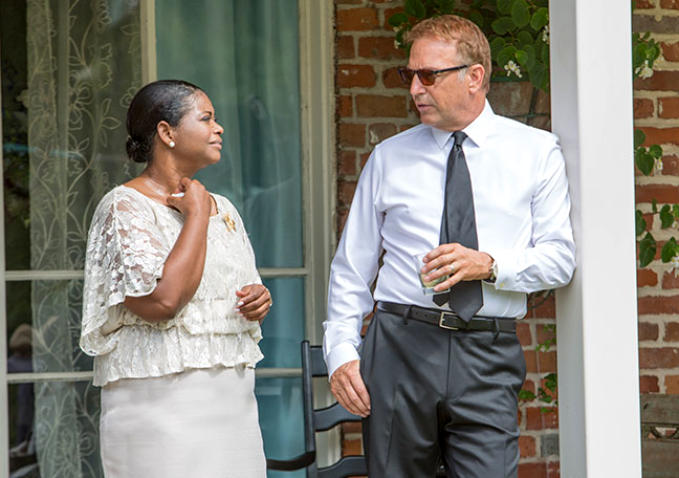 In the end, Black or White isn’t so much a film that about race relations as it is about privilege. Costner’s would-be bigot doesn’t have a problem with black people, just as long as those black people abide by his rules of conduct and expectation. It’s the same kind of qualification he’s never had to consider for himself, and one the intended audience will likewise miss. He comes from a wealthy position and Rowena and her family are likely lower middle class at best. He has a world of class privilege at his disposal that the loving Jeffers family does not, and because of that he feels they are less suited to raising little Eloise. Perhaps he’s worried about Reggie re-entering her life, but what animates Elliot Anderson is spite. He’s consumed with the overriding assumption that he must be right in all things. While the film draws many heavy-handed parallels between Reggie’s drug abuse and Elliot’s alcoholism, it clearly presents the both of them on completely different planes of judgment. One of them is ultimately redeemable and the other less so. Elliot’s perspective is essentially he can provide more and therefore more has to be better, but his definition of more is a private school, a housekeeper, a tutor who is treated as a caricature of initiative. Rowena provides a large and loving support system, but apparently they are less valued in the eyes of Elliot. And if you needed any more of a clue that Elliot and his sense of privilege are the unbeknownst star of the movie, he gets to deliver the big speech at the end that Says Something Meaningful. It feels a bit odd that the one character that uses the N-word in the film (albeit there is context) is the one telling lower-class black families how to live.
I don’t doubt the sincerity of writer/director Mike Binder (The Upside of Anger); I don’t think he purposely made a film to make older, primarily white Americans feel better about thinking what they do about these troublesome times. It’s not a nefarious movie but it is misguided and will provide cover for a certain selection of audience members who wonder why nobody is asking the old white guys their opinions on modern race relations. Even overlooking this charge, Black or White is just overblown melodrama that has to constantly explain everything to you at all times and guide you through every strained point. Selma and Black or White are both aiming at hearts and minds, looking to add to the conversation on contemporary race relations, but only one of them works as both an eye-opening message of empathy and as an exceptionally made film itself.
Nate’s Grades:
Selma: A
Black or White: C
Share this:

Big Eyes (2014)
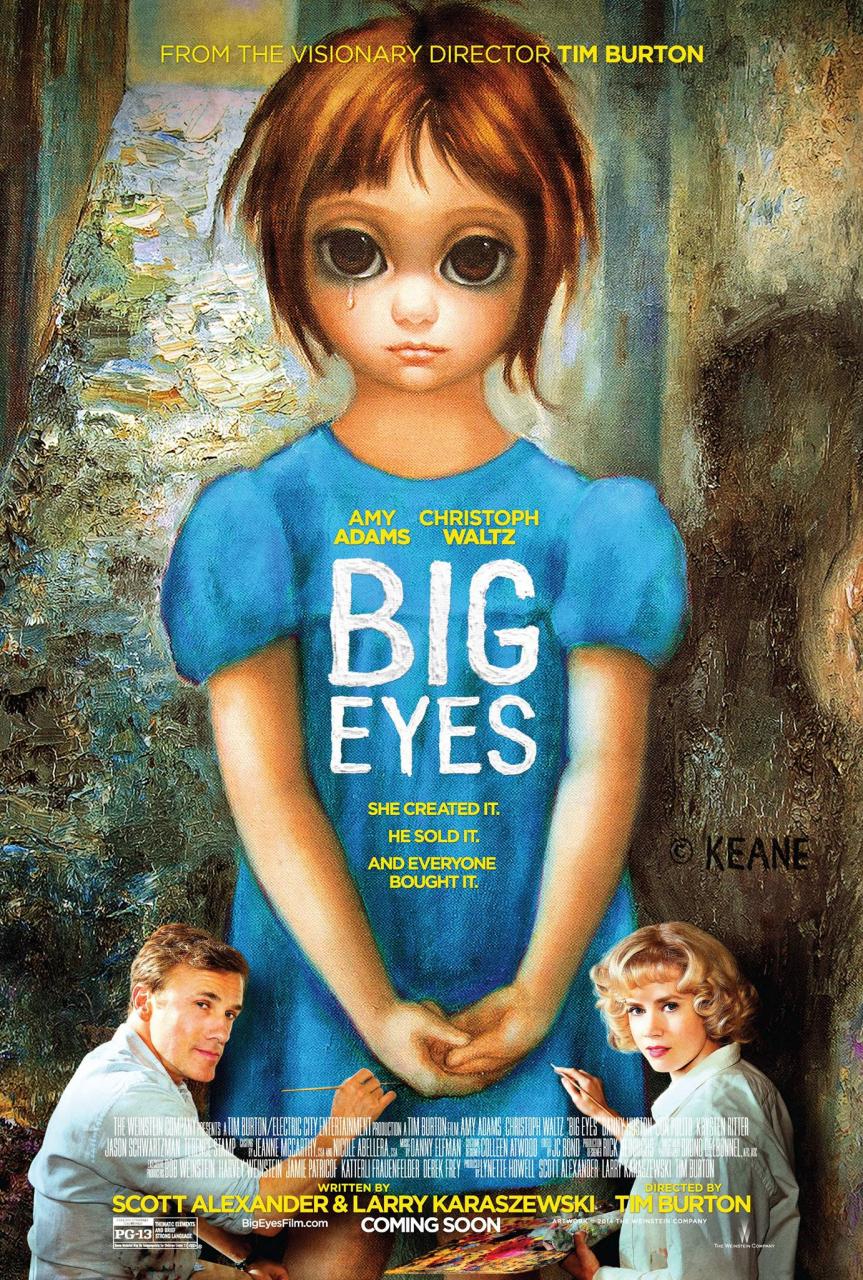 Like most people, Tim Burton is a filmmaker who likes working with a select set of familiar faces. Since 2001, Burton’s wife Helena Bonham Carter has appeared in every one of his films. Johnny Depp has appeared in every Burton film since 1999’s Sleepy Hollow, save for Planet of the Apes. It got to the point where you knew if Burton were attached as director, these two would be riding shotgun. No so fast, as Big Eyes is absent Depp, Carter, other longtime collaborators like editor Chris Lebenzon, and really any noticeable sign that Burton actually was the director. This bizarre biopic about a scandalous secret in the art world fails to justify more than a casual viewing.
In the 1960s, Margaret Keane’s (Amy Adams) portraits of waifish children with large, tragic eyes were the most popular art of the decade. They fascinated the public who couldn’t get enough, including clamoring for reprints so everyone could have their own Keane work of art. Except the world at large never knew that Margaret had painted them. Her husband, Walter (Christoph Waltz), was posing as the real creator. He appeared on television, ran with famous celebrities, and always looked for the next platform to elevate the Keane name, all while Margaret stayed home and painted. She agreed to go along with Walter’s version of events because the public was more accepting of a male painter, and Walter was such a natural salesman. The world could never know the truth.
 Being a true-life story, there are certain limitations inherent in sticking to the facts while still telling an engaging story, and Big Eyes suffers from this. There is an interesting story here, no doubt, and that is clear and on display when Margaret and Walter square off in court as a majority of the third act. Before then, the screenplay by Scott Alexander and Larry Karaszewski (Ed Wood, The People vs. Larry Flynt) plays in a very linear fashion, telling the story very conventionally except for the annoying narration of a news reporter (Danny Huston). The reason this character is clumsily inserted into being our narrator is because the real main character, Margaret, spends two acts being so passive and often hidden before she gathers the courage to challenge her husband and expose him. Naturally, there’s got to be a realistic character arc where our heroine goes from naïve and inactive to stronger and active, but it takes most of the movie. In the meantime, she paints and paints and literally hides herself from the world. It feels like the movie forgets about her while Walter is gallivanting around on her fame. Ironically, the movie actually becomes a series of men attempting to tell Margaret’s story; the first is her husband but the other is the invented and unnecessary narrator.
To make up for the time the film seems to paint a more flattering than deserved picture of Walter. I think perhaps they want the audience to fall under his spell just like Margaret and then slowly come to the same dawning realization. His initial argument is that female artists are not taken as seriously in their era, and I’m sure there’s truth to this. It was generally harder for a woman to be seen as legitimate in just about any capacity other than homemaker in the 1960s. We spend a full two acts with him charming others and hoodwinking the art world. He’s portrayed as more of a used car salesman con man than what could be described as a dangerous egotistical drunk who exploits his wife. The movie gives him a few nasty moments but it seems to portray Walter with light judgment, even after he endangers Margaret and their daughter’s lives. With Margaret figuratively and literally a kept woman cooped up for so long, Walter’s antics start to come across as vamping, filling time until Margaret hits that point on her character arc to leave him. It becomes tiresome then to just watch Walter sputter and spin his way to greater fortune and fame, though he deserves credit for popularizing the printing of painting reproductions that sell for cheap. Walter Keane, footnote in the art world for commercializing it for the masses. Waltz (Django Unchained) is an effortlessly entertaining actor and charming cads with a thinly veiled air of menace are his specialty. It’s a waste of his talents because Walter is kept as an ongoing mystery rather than an opportunity to explore a complicated character’s psyche. We find one falsehood after another, but in the end, he’s still just a mystery left unsolved.
There is amusement to be had at points as to be expected when it comes to keeping up a con, almost getting caught, the scrambles to continue hiding the big lie. This fun is at the expense of Margaret, which the movie wants you to think about and not think about at various points. There are streaks of comedy but I’d hardly call Big Eyes a comedy (sorry Golden Globes categorization). Terrence Stamp is enjoyable as a disapproving art critic who cannot believe what Walter is doing or why he is popular. The final act is easily its most entertaining as Margaret finally gets to call out her scoundrel of a husband for his bad behavior. It takes several unexpected turns that seem too fanciful to be true, and yet they are. The courtroom setting feels right for this script, and if there were a rewrite, I would have used it as the primary setting. The story could be introduced through a series of flashbacks. At least that way we don’t have to wait for Margaret to be the strong heroine we need, and we don’t have to be constrained by the wait of linear storytelling. This approach would strip away some of the redundancies of the plot and at least allow Margaret an opportunity to be the one telling her story.
 Another problem with Big Eyes is that at no point does it feel like a Tim Burton film. The man is better known for his dips into Gothic fantasy, but in 1994 he showed he could more than pull off a conventional film in Ed Wood. Just because the story doesn’t involve weird fantasy characters and violence doesn’t mean that Burton cannot still add value being the man to tell that tale. Unfortunately, there is no point while watching Big Eyes that feels like it was directed by Burton. The director could have been anybody. If you kept the identity of the director secret, I cannot imagine more than a slim number of participants accurately guessing who directed the picture. I wonder what attracted Burton to the script, which does have its share of true-life eccentrics and hucksterism, both appealing aspects for the man. It’s just lacking a sense of vision that Burton usually has in spades, even if that vision over three decades has become a tad commoditized. I won’t go as far to say the film is poorly directed because a majority of the problems remain with its script rather than the actors or shot selections. Still, Burton doesn’t bring much to elevate the material. Perhaps that’s a positive, he didn’t attempt to overpower the narrative with a superfluous detour in style, but then why hire Burton?
Adams (American Hustle) is a consistently good actress and she does her best with the part, but the limitations are even too much for her talents. By no means is she bad but she’s playing a passive character often given to worry. She’s stashed away for a majority of the movie. You feel like Adams is acting with one hand tied behind her back.
Big Eyes is a movie that intrigues you with its potential only to frustrate you with its eventual execution. The true story behind the film is juicy and outlandish, crying out for the venue of cinema. The struggle between husband and wife over the ownership of an empire is a conflict that hooks an audience. Thanks to a repetitive plot structure and character vamping, the film limits the heights it can achieve. Burton’s presence is not felt at all throughout the film. The comedy often sours when you realize the full context of what’s going on, a much more serious affair than the film often wants you to think about. The characters are kept at a distance and given arcs rather than deeper exploration. She will become active and find her voice, fighting for credit. He will be the con man who wants to keep everyone distracted, fueled by jealousy at his wife’s abilities. There’s more psychological complexity here, but Waltz and Adams are slotted in very narrow boxes. They have little to work with and their performances show it. Big Eyes isn’t a bad film but it’s one that deserved to be better in just about every regard. It’s a fleeting curiosity more than a fully developed film, and that’s a shame given the source material. Expect Burton to return back to the safe embrace of Johnny Depp’s arms at any moment.
Nate’s Grade: B-
Share this:

Unbroken (2014)
 Angelina Jolie is one of the biggest stars on the planet but as a director she’s still a mystery. Jolie was so enamored with Lauren Hillenbrand’s best-selling novel Unbroken that she felt like she was the only person who could translate this story to the big screen. Somehow that passion got lost in translation.
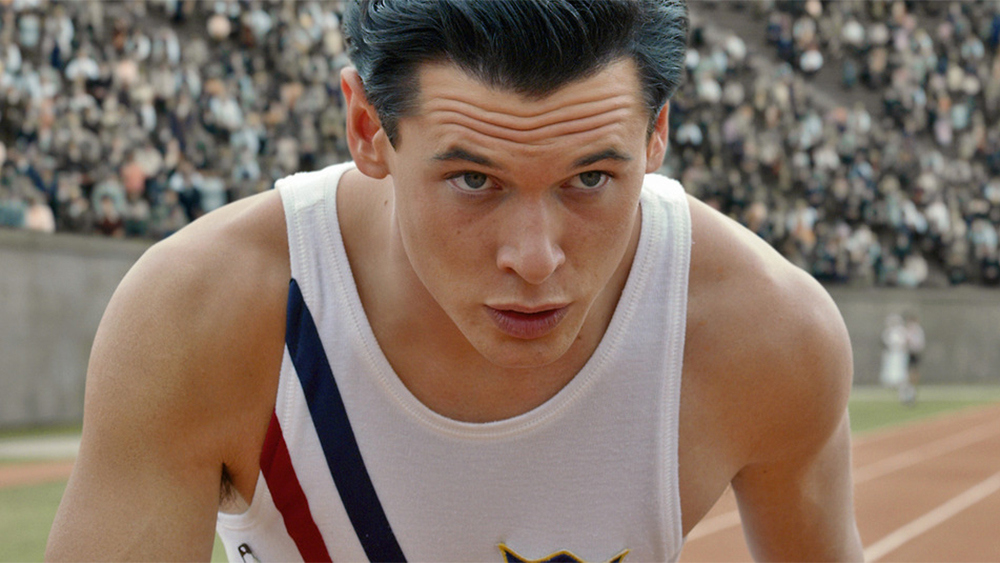
Louis Zamperini (Jack O’Connell) is a man who ran for his country in the Olympics. He fought on a bomber plane over the Pacific. He was shot down and survived in a raft for over 40 days at sea. He was taken to a Japanese P.O.W. camp and endured harsh and cruel treatment, and he still persevered and returned home a hero.
It’s hard not to feel a general calculation about the entire film. I’m not trying to say that Jolie or her crew had any sort of nefarious ulterior motives, but the entire product seems like it was made in an Oscar Bait factory. This is the kind of movie that the Academy typically salivates for, and it’s based on a true story, and it’s set during World War II! There’s a reason that, sight unseen, Unbroken was often at the top of the prediction lists for Oscar pundits. It is those same Oscar-friendly elements, though, that act as a detriment to the story, because the thematic elements stand in for the story and sense of commentary. The movie is so caught up with Louis’ dilemma that it forgets that it needs to make you care about him as a person rather than a martyr. The biggest hindrance for Unbroken is just how little it develops its protagonist. The only emotion he seems to exhibit in the two-plus hours is suffering. The guy ends up being a human punching bag with the movie clobbering the audience with the same message again and again as well, the will to survive. Unlike other war stories or concentration camp survival tales, Louis doesn’t survive through any great networking of allies, skill, scheming, or prescient decision-making. We do not see him adapt and outsmart his adversaries. He merely outlasts them as he wastes away. Like what I wrote in my review of last year’s Best Picture winner 12 Years a Slave, I need more characterization than suffering. It’s a frustrating experience because you know there has to be more to this character.
 The danger with any film that purports to tell a true story of a hero is making sure the audience doesn’t lose sense of the person beneath the hero. We glorify their positive qualities and what we admire but when placed upon a pedestal, our heroes can start to become otherworldly, separate from the rest of us mortals. A biography that idealizes its subject is called a hagiography, and that is where Unbroken falls. Louis Zamperini is lost in this story, instead replaced with Louis the Survivor or, occasionally, Louis the Runner. Amidst the swelling music, the pretty cinematography, and the supporting characters channeling the audience with their encouraging mutterings of, “Come on,” and the like, Louis is painted more saint than man, which is a shame. Considering all of the peril he survived, it would make sense for him to struggle with his own doubts and fears. The most we get a sense of him and his internal struggle is when he prays aloud to God during a thunderstorm at sea and Louis promises to serve Him somehow if he survives. The movie forgets about this moment until the end credits text. If Louis Zamperini is going to be the focal point for a true story of heroism, then the movie needs to do better to make him human rather than resorting to having him only bleed.
The entire first act flashbacks could likely have been jettisoned. Watching Louis as a young man learn to run and then eventually compete in Berlin’s Olympics (way to take all of his luster away, Jesse Owens), we expect these moments to have relevance again, pointing toward some kind of grit or training regiment or lesson learned that will become useful or comforting solace during his internment. It all boils down to one skill, endurance, and that’s all we keep coming back to. We don’t need to see the Olympics or his younger life to establish as back-story in the P.O.W. camp, just as we didn’t get back-story for the prisoner who was revealed in the moment to be a concert musician. The flashbacks do little to flesh out Louis as a character. He was a troubled son of immigrants and found popularity and purpose with running, which he did to the Olympics, and then… the war. Too bad running doesn’t really come into play during his torment in Japan. I understand that we’re working with a true story but what has been added by including 20-30 minutes of flashbacks, particularly when they fail to illuminate our main character? Skipping right to the war, with perhaps a smattering of brief memories during physically and mentally fraught times, would have been preferable and more useful.
The other aspect that makes Unbroken frustrating is the potential it does flash in sparse moments. For the majority of its running time, the film is a perfectly decent war drama with an extra glossy sheen to it provided by expert cinematographer Roger Deakens (Skyfall). When adrift at sea, there’s an inherently interesting survival story there. Louis and his comrades are still in an active war zone. In one scene, a plane approaches and the guys realize late it’s no rescue but a Japanese fighter plane. They leap into the ocean as the plane fires bullets after them. This scene is made all the worse by the fact that sharks are swimming below. There’s an extra kick of dread worrying what will happen next if anyone gets wounded or killed by that gunfire. It’s a great sequence, but then it’s over and the film goes back to autopilot glorifying the resolute nature of Louis. Likewise the opening with Louis crawling along and having to manually close the bomber plane’s doors during a dogfight is great. Unbroken does get a lift when it introduces its main antagonist, Watanabe (played by rock star Takamasa Ishihara), nicknamed “The Bird.” The film now has a sense of direction and a renewed sense of danger with “The Bird” eager to break down his Olympic prize runner. The story feels more personal and interesting and it feels like this fresh antagonism will allow us to develop Louis more as a character. Sadly, he remains the same film martyr.
 This is Jolie’s second film as a director and she’s revealing some pretty old-fashioned tastes and instincts. Actors are judged at a somewhat harsher standard when they turn to directing, but the audience must simply ask if this person elevated the performances of their actors and whether they found an incisive and insightful way of telling a story. The jury’s still out on Jolie as a directing talent. The direction is more than adequate and quite fine, especially aided by having a team of gifted technicians. If you had taken Jolie’s name off the film I wouldn’t be any more or less effusive. Perhaps a more experienced director would have insisted on fixing the screenplay’s development, but then again, perhaps that director wasn’t going to get the gig of a major Oscar bait film for a studio.
I’ve spent the majority of this review criticizing Unbroken and may have given the impression that it’s a bad movie. It isn’t. It is a perfectly fine film by all accounts and a movie that will likely find a welcoming audience this holiday season. It’s got emotions and survival and danger and all set to a rousing score. It looks the part of an Oscar contender and that will be enough for many ticket-buyers. Unbroken is a perfectly good-looking tale of survival that unravels upon reflection. The necessary work of building up strong, complex, interesting characters takes a backseat to setting up a series of punishing obstacles for our protagonist. It’s like the filmmakers wanted to make an inspirational tale but didn’t want to complicate that with ambiguity and nuance and doubts. Louis is canonized in the movie’s flattering glow, and his suffering is shrugged off as “character-building.” Cogent or potent commentary on war, man’s capability for evil and good, or the nature of forgiveness, are absent, which means the film can only go as far as the immediate impact of its plot beats. Supposedly the whole movie was about forgiveness but I got no sense of that until the end credits. Unbroken is a by-the-book rendition on how to make a movie that looks good and about Important Things. It just lacks the deft storytelling, characterization, and subtext to make it important on its own.
Nate’s Grade: B-
Share this:

The Theory of Everything (2014)
 A biopic on the life of Stephen Hawking, arguably one of the most brilliant men in the world, stricken with ALS and given only two years to live, should be resolutely fascinating and inspirational. And it is at points, but there’s still a gnawing dissatisfaction with The Theory of Everything, a sense that there isn’t more to it, that it lacks a center, that, primarily, it should be better. The film follows Stephen (Eddie Redmayne) as a PhD student who immediately falls in love with Jane (Felicity Jones). Shortly after their courtship, he is diagnosed with ALS and rather than preparing for the end, he pushes forward to great intellectual discovery and achievement, though the hardships and care for his physical disability places tremendous strain on his marriage to Jane. The film does a nice job of examining how a relationship comes to an end and without having to cite one party or another as a villain. It’s so measured and understanding and empathetic, but it’s also somewhat docile and hesitant, keeping its distance when it could dive deeper into Hawking and his family. Theory is far too reliant upon the tropes of biopics, speeding through significant moments for Stephen and Jane with an almost comical degree (watch how quickly the kids multiply). The moments that stray from this formula are the ones that stick the most, like a shocking moment where Stephen exits his chair to pick up a fallen pencil, a striking and poignant moment so effectively communicating the desires of its character. The film needed more creative detours. Director James Marsh (Man on Wire) has a good command of his visuals but I was left wanting a more daring approach to a story of human endurance, like 2007’s Diving Bell and the Butterfly. The real reason to watch the film is the amazing performance by Redmayne (Les Miserables). The physical control he’s able to have over his body in the latter stages is astounding, but his performance is much more than just a collection of tics. There’s a moment late in the film where, even in his limited facial configuration, he breaks your heart with the richness of his acting. It’s such a great performance that you just wish the rest of The Theory of Everything could measure up.
Nate’s Grade: B-
Share this:

Devil’s Knot (2014)
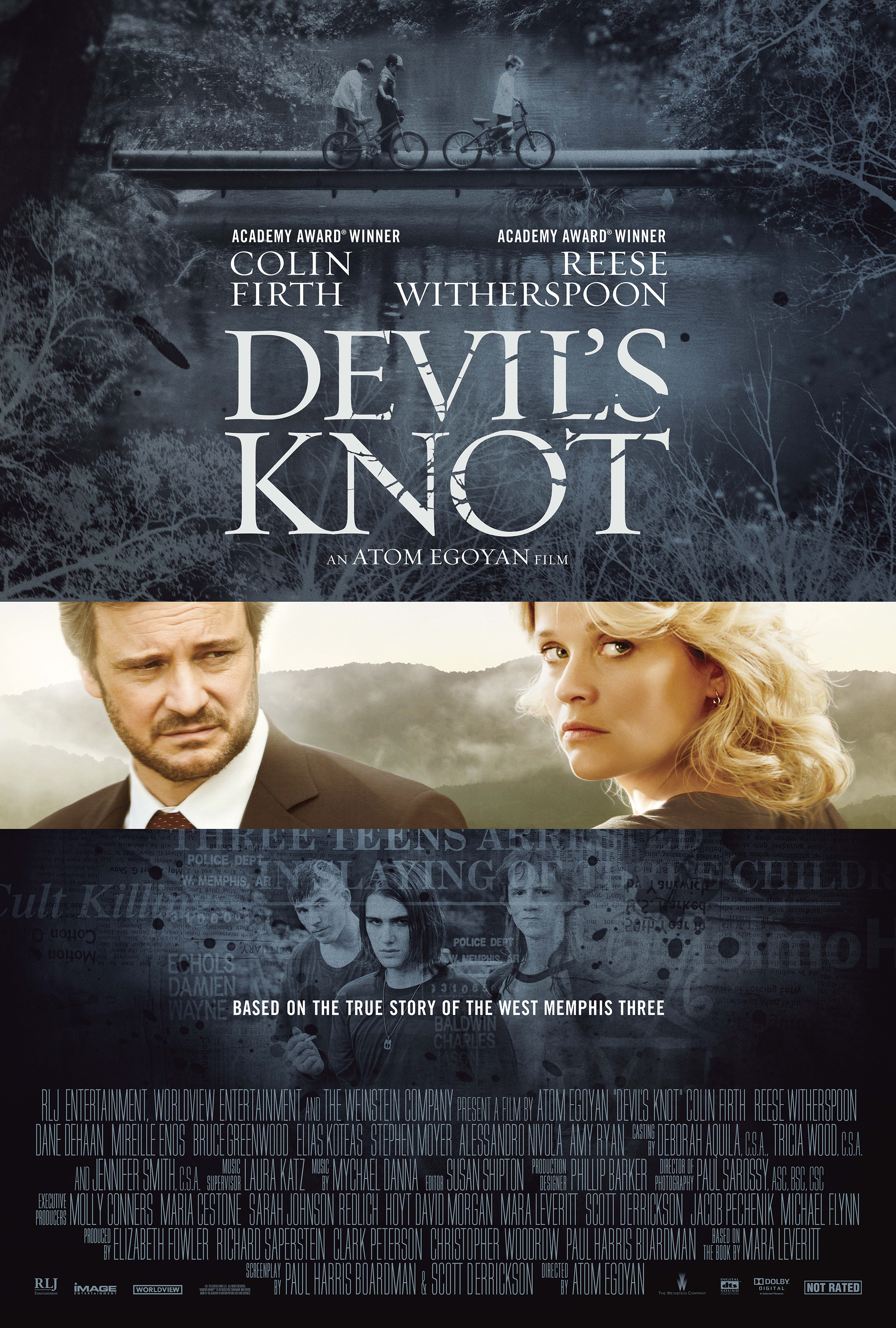 In 1993 in West Memphis, Arkansas, three eight-year-old boys went out late one night to ride their bikes. They were never seen alive again. The ensuing media circus that erupted lead to the conviction of three teenagers (The West Memphis Three) who many believed were innocent of these heinous crimes. Stop me if you’ve heard this story before. It was the basis of three stirring, powerful, galvanizing documentaries by Joe Berlinger and Bruce Sinofsky, two men credited with saving the West Memphis Three. Now after their release from prison, here comes Devil’s Knot, the first fictional film about the notorious case, Hollywood’s first crack at well-tread material. Is there anything new to be found?
Director Atom Egoyan (The Sweet Hereafter, Chloe) and his screenwriters do a credible job of distilling the complicated case against the West Memphis Three to its basics, relying on a modulated tone that shies away from the sensationalism that dominated the case back in 1993. With the benefit of time and hindsight, it’s easy for the movie to point out the erroneous thinking of the prosecution, the jump to conclusions, and the Satanic panic engulfing the community of Arkansas. We’re told by a police officer that they knew this “Satanic cult stuff” would hit town; they’ve just been waiting for the day. To its credit, the movie does a fine job of calmly and objectively pointing out the deficiencies in the police and prosecution’s case against the West Memphis Three. We’re told that from the twelve hours of interrogation with Jessie Misskelley, only 40-some minutes was recorded. The obvious mistakes in his confession, as well as the police coaching and coaxing him to their desired response, is made readily apparent. There’s “witness” Vicki Hutchernson (Mireille Enos of the oft-canceled The Killing) who says she say chief suspect Damien in a Satanic ritual, but the film cuts back from the imaginary to Vicki watching a movie on TV, the real source of her descriptive flourishes. Egoyan’s direction has a calm, objective overview that is reverent and respectful of the dead and the bereaved. It’s rarely boring and the facts of this case are such that any retelling would be somewhat compelling.
 So that brings me to the ultimate question: why even make a fictional movie about this subject? Four lengthy documentaries have covered the intricacies of the legal story, the breakdown in justice, and the personal toll on all sides of the crime. The only thing a fictional movie provides is: 1) the fun/distracting game of seeing relatively famous actors play the real-life people we’ve previously seen, and, 2) as an option for people who hate documentaries. If you’re one of those people who dislikes documentaries and doesn’t view them as “real movies,” then Devil’s Knot is for you, you dismissive filmgoer. Otherwise, literally everything was handled better in the Paradise Lost films. With the West Memphis Three thankfully out of prison, the omnipresent sense of urgency from the documentaries is now absent, replaced with a Monday morning quarterback sensibility pointing out all the obvious bias, judicial hypocrisy, and flaws of the case. And as anyone who has plowed through the powerful and addicting documentaries knows, there are plenty of flaws to point out for harsh scrutiny and incredulity. Movies have a long history of showing us an example of judicial injustice, and this is a prime example. However, Egoyan has put the emphasis of his movie on two outsiders rather than people in the center of this case. The West Memphis Three themselves are barely supporting actors in their own movie. I suppose the filmmakers may have wanted to present a different angle to the case since the Paradise Lost films showed the accused up close and personal. The construction of this plot just doesn’t work under the perspectives of Pam (Reese Witherspoon) and Ron (Colin Firth).
Ron serves as a pro-bono adviser to the defense, but that doesn’t mean he has the same access inside and outside the court. He can gather evidence on his own but really this guy is meant to be a fly-on-the-wall for the planning and frustration of all the legal roadblocks thrown at the defense. Is an added body in the room necessary? Could not one of the defense attorneys have provided the same purpose? Instead, he gets to grumble in the court and out about all the legal shenanigans going on to railroad innocent boys. He is essentially spelling it out to an audience. Pam has even less narrative purpose in the film. Her perspective makes sense early on as the mother of one of the murdered young children. Her panic, her worst nightmare come to life, it all makes for the stuff of major drama, which is why you’d imagine Witherspoon was drawn to the part. But once the case against the West Memphis Three gets going, Pam transforms into our Chief Reaction Shot Provider. Whenever a curious moment happens in court, we cut back to Pam and Witherspoon cocking her head in dawning curiosity and uncertainty. It’s as if she is meant to symbolically represent the entire community that was so fervent in their beliefs that these boys were guilty… until they heard the shaky case and the questionable experts put on the stand. So Pam and Ron end up becoming signals to the audience on how to feel and what to think. The movie doesn’t have enough faith in its audience to keep up with the minutia of the trail, or even the lawyers’ arguments, reducing a complex legal trial down to two nonessential characters nodding or shaking their heads.
 I’ll admit that I had some interest watching the actors inhabit the roles, and there are scads of people involved in this story. Bruce Greenwood (Star Trek) does a valiant job showcasing the head-scratching decisions of the trail judge, David Burnett, and his slimy dismissive nature. Stephen Moyer (TV’s True Blood) is particularly infuriating as John Fogleman, chief prosecuting attorney. Seth Meriwether (Trouble with the Curve) looks eerily like his character, the young and accused Jason Baldwin, and he nails his moral convictions and gentle nature. Dane DeHaan (The Amazing Spider-Man 2) gets to do his troubled youth thing he does so well. Kevin Durand is an actor I normally enjoy but even he can’t do justice to John Mark Byers, step-father to one of the slain boys, and easily the most memorable figure in the Paradise Lost films; the man is so theatrical and larger-than-life, and yet Devil’s Knot treats him like a featured extra, with many of his speaking scenes off camera. There isn’t a bad actor in the extremely large cast, though Firth’s Southern accent isn’t the most refined. If the movie lacks much reason for existing, at least the bevy of good actors respectfully bringing new life to these people, good, bad, and many somewhere in between, is the one credible quality to this movie.
What to make of Devil’s Knot, an example of a decent, modulated, and well acted movie that ultimately has no reason to exist in the wake of three excellent documentaries (Paradise Lost) and one other pretty good one (West of Memphis). The ground has been covered. However, that doesn’t mean that a well-told story can’t be told again, with a different angle, with a different approach, but Devil’s Knot hinges on two characters serving as metaphorical barometers to teach the audience what to think and how to feel. Then there’s the matter that the trail covers the entire 114-minute running time. There’s so much more that happens after the initial trial, so much that the last two minutes of this movie are almost a nonstop barrage of text updating the audience on many of the post-trial developments, including the West Memphis Three being released from prison in 2011. The movie feels too limited; there is so much more depth here, to the details of the case, to the personalities and human drama, to the story after the trial. Egoyan and his cast and crew have made a respectful fictional version of these sensational events, but the problem is that they don’t do enough to justify their own film’s existence. Unless you have an irrational hatred for documentaries, just watch those instead.
Nate’s Grade: C+
Share this:

Philomena (2013)
 A more family-friendly alternative to the wrenching The Magdalene Sisters, the drama Philomena is ostensibly a good movie, but woe unto thee if you thought you were in store for a crackling comedy. Philomena Lee (Judi Dench) was forced to work in a Catholic workhouse in Ireland when she became pregnant as an unwed teenager. Her child was placed into adoption into America and now, 50 years later, she wants to find her long-lost son and learn about him and his life. Helping her in her quest is Martin Sixsmith (Steve Coogan, co-writer as well), a recently unemployed journalist. Their odd couple pairing should inspire comedic repartee, as so the ads would also have you believe. The film is funny, in spurts, but it’s much more effective as an illuminating drama on the abuses of the church-run workhouses that guilted poor girls into, sometimes lifelong, slave labor. At the thirty-minute mark, when Martin comes across a makeshift graveyard of dead teen mothers, who were forced to give birth on the workhouse premises as punishment for their sins, you can pretty much abandon any hope of a ribald road trip comedy. Once your expectations are realigned, you can enjoy the film for what is has to offer: an intriguing mystery, solid characterizations, a terrific Dench performance, and an ending that doesn’t pull punches. Be warned, you will walk away from this movie wanting to punch nuns in the face. Coogan’s role is one of anger and outrage, and there’s plenty to go around with church corruption, scandals, and cover-ups uncovered. But it’s Philomena herself who is the life lesson for us all; her church fails her but her forgiveness is the model we should all strive for. It’s a moving film with as much compassion as it has criticism. Just don’t watch it in the company of a nun.
Nate’s Grade: B+
Share this:

The Monuments Men (2014)
 An all-star cast, a true-life tale that incorporates a treasure hunt, a race against time, Nazis, and fish-out-of-water tropes as non-soldiers are placed in harm’s way, plus the skills of George Clooney behind the camera; in short, how could this go wrong? With that plot makeup and this cast it would take more effort to tell a boring big screen adventure of the real-life Monuments Men (and women). And yet, the movie found a way. It’s by no means a bad film and its heart is in the right place, but allow me to explain why The Monuments Men sadly fails to live up to its mission.
It’s 1944 and Adolf Hitler doesn’t just have his sights on constructing a permanent empire, he wants all the world’s art treasures as well. The Nazis have been plundering famous works of art, and while the war is coming to a close with the Allied invasion, the fate of these priceless works of art may be in jeopardy. Frank Stokes (Clooney) is tasked with putting together a team to save Europe’s art from the Nazis. He puts together an unconventional group of soldiers (Matt Damon, John Goodman, Bill Murray, Bob Balaban, Jean Dujardin, Hugh Bonneville) and search for the hidden loot.
 The film looks like it’s going to be a high-concept heist film when it reality it’s a series of vignettes that do not add up to a solid whole. Early on, the Monuments Men team is scattered to the wind, divided into pairs, and so we have four or five competing storylines that don’t develop as desired. To be fair, there are some very good scenes, well executed and written by Clooney and Grant Heslov (The Men Who Stare at Goats) where the conflict is turned up, but the film cannot escape the fact that it feels more like a series of scenes than a cohesive story. Not all of the stories are equal in their interest as well. The Cate Blanchett (Blue Jasmine) and Damon storyline in France amounts to little else than her stalling for as long as the plot necessitates, then handing over the Very Important Info, then she’s swept aside. The comical asides, notably with Murray and Balaban, feel like scene fillers when there could be stronger material. Once they’re reunited as a group, you wonder why we even needed the time apart. Perhaps it’s an attempt to showcase a wider sampling of stories and perspectives on a complicated war, which is fine, but the characters don’t get the same complicated examination. Despite physical descriptors, these guys are fairly one-note and stay that way, which is a real shame especially when we start losing Monuments Men. The attention is split amongst a bunch of characters lacking proper development. If I felt like we knew these guys on any substantive level, I would feel more at their untimely passing.
Another issue that exacerbates the directionless feeling pervading the film is that it lacks a clear and concise goal. I understand they’re saving and rescuing art, but that’s kept vague until the very end of the film when it becomes more concrete. Until then, the guys are just traveling from place to place, retrieving this piece or that, having comic misadventures, and the movie just feels like it needs a stronger guiding force to corral all these stories, a concise goal that each scene builds onto and where the urgency increases. Late in the film, I got a glimpse of exactly what kind of movie Monuments Men could have been. Once the war is over, the Germans are replaced as antagonists by the Russians (two-for-two with classic American movie villains) and it becomes a race against time to get to the art before the Russians confiscate it. There was always a ticking clock in the film, as Hitler was assembling his art and his command would destroy them in spite of returning them. However, in the very end of the film, the urgency is cranked up, made real, and for once the film emerges with a sense of suspense. I think it would have been a more engaging film experience if the scope of the film were narrowed simply to the material covered in the climax, namely beating the Russians to the art reserves. It practically has a Raiders of the Lost Ark feel with two parties trying to outrace the other to the next precious treasure. How cool would that movie have been?
 Another problem is the film’s seesaw tone never really gels together in a satisfying manner. The film awkwardly switches gears from drama to comedy to action without smooth transitions. Clooney wants his film to be a comical buddy comedy but also a poignant remembrance of the lives lost so that we can enjoy our great treasures. Clashing tones take away from the effectiveness, making us feel that Clooney didn’t feel confidant with either direction to make a movie. Alexander Desplat’s overbearing musical score instructs the audience what they should be feeling at any given moment. It vacillates without similar transitions informing you with little transparency that you should feel whimsical, now sad, and now heroic, now go back to whimsical. The entire film, from a story standpoint to a technical standpoint, cried out for a greater sense of unity.
Then there’s the question of whether art is worth people giving up their lives, and this is a valid question that deserves consideration. I was never in doubt what Clooney and company would say to this ethical query, but it’s as if Clooney has little faith in his own audience. He gives three separate speeches about the significance of art and culture and why it is worth dying for. I expected one hefty speech, but three? It’s like Clooney is afraid his audience will waver when blood starts to be shed, and so we need to be reminded by the professor why art is significant to mankind’s value. The point has been made; it doesn’t need to be belabored. The film even ends on recycling this debate, with Clooney putting one final stamp of judgment before the credits roll.
One gets the sense while watching The Monuments Men that it would make a better documentary than a fictional feature film, at least this incarnation of a fictional film. Hearing from the men who lived it will be far more interesting than watching the comic squabbles of Clooney’s crew through Europe. I was instantly reminded of an engrossing documentary from a few years ago called The Rape of Europa, which looked at the subject of saving the arts from Hitler, not specifically the Monuments Men. That documentary was filled with so many different fascinating stories, I remember thinking that any one of them could have made a stellar movie. Monuments Men is further proof that a sharper, more contained focus would be best rather than trying to tell as many war stories involved on the topic. Clooney has proven himself an excellent director and despite his film’s faults it’s still an entertaining film in spurts. I just think we all expected better given the pedigree of talent involved and the can’t-miss quality of the history.
Nate’s Grade: B-
Share this:

Saving Mr. Banks (2013)
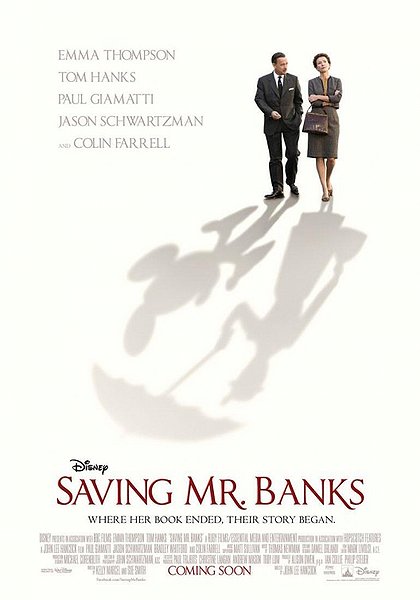 Seemingly sure-fire Oscar bait, Saving Mr. Banks left enough Academy voters cold and it’s easy to see why. First off, the behind-the-scenes sparring to adapt Mary Poppins is the movie we want to see, watching crotchety author P.L. Travers (Emma Thompson) butt heads with head honcho Walt Disney (Tom Hanks). The movie is at its best when these two share the screen, with Walt’s genial strong-arming finding little traction with Travers stern refusals (no Dick van Dyke, no animation, no mustaches). What I wasn’t expecting was a parallel storyline detailing Travers childhood in Australia dealing with an unstable home life thanks to a drunken father (Colin Farrell). It literally takes up half the movie, and while there are a few interesting juxtapositions, the screenplay just trades off scenes; one in 1961, then one in 1906, then back again, etc. The issue is that the flashbacks are never very revelatory and have no business dominating the running time. All of the information gleaned from these flashbacks could have been corralled into one late flashback, or even mentioned in a speech. Saving Mr. Banks gives you two movies running parallel, but most people will only be interested in the one. It’s a pleasant film, benefiting from strong performances by Thompson and Hanks (perfectly cast), but one can’t shake the feeling of Disney P.R. pervading the film’s retelling. It comes from the perspective that Disney is always right and that Travers was always wrong, having to work through her personal issues before relenting, even tearing up at the final product. In real life, Travers never forgave Disney and never allowed another of her Poppins books to be adapted into a film, though not for want of trying by the studios. It feels unfair to portray an author’s artistic integrity as an obstacle that needs to be defeated, but there it is, and Disney’s Mary Poppins, while beloved, resembles much of what Travers feared. Who defends the cranky authors of the world when they have a point? Saving Mr. Banks is an entertaining film, charming and likeable, until you begin to look beyond the fairy dust and realize the revisionism before your eyes.
Nate’s Grade: B-


 nathanzoebl
You must be logged in to post a comment.