Blog Archives
Jarhead (2005)
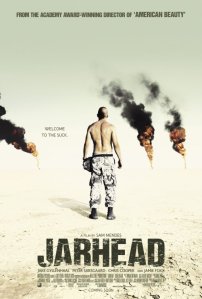 The controversy surrounding Jarhead, a hotly anticipated movie dealing with the 1991 Gulf War, seems rather misplaced. Some argued it would be anti-American, anti-war, anti-Marines, and on the other side of the coin, some even argued that it would be pro-war and pro-aggression. Now the movie seems to be taking flak for not being too political. Director Sam Mendes (American Beauty, Road to Perdition) is interested in crafting a movie about the soldiers, a true first-person war. I was actually very pleased, and somewhat relieved, that Jarhead didn’t try to bend over backwards and make any forced parallels to our current Gulf War conundrum. When you’re arguing about whether a movie leans right or left then perhaps the movie stands tall on its own, and Jarhead stands very tall indeed.
Anthony Swofford (Jake Gyllenhaal) is a “jarhead” the nickname for Marines because of what their heads resemble after their sheering, but it’s also indicative of a vessel, ready to be filled with knowledge. Swofford says he entered the corps because he “got lost on the way to college.” He’s humiliated, beaten, and looking for a way out when Staff Sergeant Sykes (Jamie Foxx) offers (more like orders him) to try out for the elite position of Marine snipers. It’s during this new training regiment that Swofford becomes “hooked” on being all he can be. He’s partnered with his barrack buddy Troy (Peter Sarsgaard), who serves as Swofford’s moral anchor. The boys get their hopes up when they catch the news that Iraq has invaded Kuwait. They’re shipped out to the action and are finally going to get a taste of combat … or so they think. They spend months in the Saudi desert amongst 114 degree heat and interminable boredom. They drink water, they play football in their gas suits for the cameras, they goof off, but mostly they wait. And wait. And wait. When the war does finally come into being, any action is short-lived: “Four days, four hours, one minute. That was my war.” Swofford, Troy, and his fellow Marines are aching for some kind of combat, any kind of violence that they’re physically and mentally breaking down in the monotony.
 Even the safety nets in previous war films, like the chickadee at home waiting for you, are ripped away in Jarhead. Usually the life at home is a source of release for movie soldiers, but in Jarhead it’s just one more source of mounting anxiety. The men have a Wall of Shame with pictures of ex-wives and girlfriends who have left them or cheated on them.
The acting on display is tremendous. Gyllenhaal (The Day After Tomorrow[) gives a sensational performance that should turn him into a bona fide, A-list leading man. All at once he can display fraternal bravado, closeted fear, confusion, and dulled horror. His show stopping moment is when he’s amidst a mental breakdown and turns a rifle on a comrade and then on himself, pleading that a shot be taken. The scene is a powder keg of intensity and Gyllenhaal is utterly captivating, startling, and horrifying with every teeth-grinding second. What?’ even better is that his performance doesn’t stop when the camera isn’t centered on his beautiful baby-eyes. He draws stronger performances out of those around him, and he does it quietly with confidence. He masks his fear and does so in fascinating, layered ways. Performances like this are what Oscars are for. And for any Jake fans out there, yes he does show a good bit of flesh in the film.
Foxx (Ray) breathes fiery life into what otherwise could have been a stock character, the tough love drill sergeant. He’s given much more screen time than I had ever thought and makes the most of it. Sarsgaard (Garden State) is a steely, dependable shoulder of support in the film, and his own big breakdown scene is amazing to witness. He?s so close to a kill but is overruled by the military brass, and Sarsgaard just lets everything go. It’s incredible. Chris Cooper (Adaptation) and even Dennis Haysbert, 24‘s president Palmer himself, have brief but very memorable small turns.
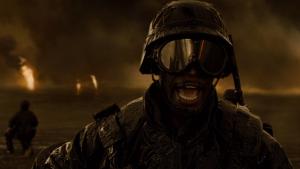 The cinematography by Roger Deakins (replacing Mendes previous Oscar-winning collaborator, the late great Conrad Hall) is gorgeous and uses light and shadow in remarkable ways to convey the turmoil of the soldiers and the other-worldliness of the desert. There are scenes amongst the lit oil fields that look like some alien world. It’s a perfect visual representation of how alone these men are and how ill-equipped they are for that scenario. The camerawork beautifully echoes the emptiness of their surroundings. Jarhead should easily score a much-deserved Oscar nomination for Deakins (House of Sand and Fog).
Jarhead is really an analysis of the psychology of what it takes to go to war. There is a transformation process, where young boys get stripped down and turned into killing machines. Jarhead poses a central question: what happens when you create the ultimate killing machine and give it nothing to do? Essentially, these men are breaking down in the tedium and many will be broken for the rest of their lives. A very poignant scene comes late in the film during their triumphant bus ride home. A Vietnam vet hops on to cheer his fellow Marines and in his hazy jingoism, you see how haunted and broken this man is from his own war experiences decades past. The future is staring them right in the face. Swofford opens and closes the film with narration explaining that once a man holds a rifle in combat, no matter what else he does in his life his hands will feel that rifle. These are men trained for war and adjusting to everyday life where the only war resides inside. Jarhead is a monstrously powerful study on the lasting effects of turning young men into monsters of combat.
Jarhead‘s inherently anticlimactic nature works against it, which will cause some level of disconnect with an audience. This is a very loosely structured flick about delayed gratification with no payoff. That’s not exactly a recipe for success. Jarhead is essentially the Waiting for Godot of war movies. The film is about monotony, about inaction, and the movie achieves a surprising yet palpable tension simply from drawing the viewer along for so far. In lesser hands a movie about boredom would still be boring, but Mendes brings an unprecedented art to it. Mendes has a confidant vision and the technical skill to bring out the drama of boredom. Jarhead has a deadpan sense of humor and some very sobering moments, like when Swofford comes across the remains of a traffic jam caught in napalm. These killing machines are getting rusty and will come back home without ever getting to pull a trigger, and what does that do to a man? These are important questions and Mendes is interested in answering them at a pace that still serves his characters. I love that Mendes has directed three films that are wildly different from one another. In my view, this guy is three-for-three.
 Jarhead is no Full Metal Jacket and yet Mendes gives passing nods to Vietnam and how our culture has shaped its history. The Marines watch Apocalypse Now and cheer as helicopters mow down villages set to a thundering soundtrack by Wagner. They’ve completely missed the point of one of the most anti-war films ever, transforming it into a bloodlust ritual. When Mendes reaches the desert then Jarhead becomes a war movie unlike any other. It’s a war movie without a war, sort of. All wee see are the results, both external and internal.
In a way, Jarhead is all about transformations and transitions, one of which is the Gulf War itself. This was arguably the first made-for-TV war and viewers were amazed at the green-tinted images of explosions and military might. War had been brought into the video game age where what once took months on the ground could be accomplished by pushing a button. Jarhead shows you the side of the Desert Shield/Storm that never made it to the cameras. The movie also presents some of the more obscured details of the war, like the care for and disposal of human waste from outhouses. That stuff never made CNN. Jarhead shows, very quietly and somberly, that sometimes the soldiers who return home have still been left behind.
Jarhead is an intense, sobering, evocative, and deeply contemplative film about the psychology of turning young men into killers and then leaving them with nothing to do. The inherent anticlimactic nature will likely push some audiences away while others will simply find it tedious. Mendes’ direction is strong and confidant and able to squeeze drama and tension from inaction, crafting an existential war movie that feels relevant and profound. Gyllenhaal is amazing and utterly captivating; you can’t take your eyes off him and, for many out there, a certain strategically located Santa hat. This movie isn’t anti-America, anti-troops, or even anti-war for that matter. Jarhead tells us that all wars are different and all wars are the same. We know war is hell, but for some, the absence of war is an even greater hell.
Nate’s Grade: B+
Share this:

Cinderella Man (2005)
 Let’s talk a little about screenwriter Akiva Goldsman. This is the man responsible for travesties like Lost in Space and the franchise killing, pun-crazy Batman and Robin. There’s plenty of junk writers in Hollywood and plenty of good writers just saddled by junk to make a living, and either might apply to Goldsman. How in the world did he become a Hollywood go-to guy?It probably has something to do with Ron Howard. Goldsman adapted the screenplay for Howard’s film A Beautiful Mind and both walked away with Oscars. Suddenly the man who wrote Mr. Freeze saying, “You’re not sending MEEE to the COOLER,” had an Oscar on his mantle. Goldsman and Howard, in retrospect, seem like a match made in heaven. They both enjoy big Hollywood event movies that spoon-feed an audience and shave off the gray areas. Cinderella Man serves as the duo’s second collaboration and it’s exactly what you would expect a big Hollywood event movie to be from them.
Jim Braddock (Russell Crowe) is an up-and-coming New Jersey boxer who’s on a warpath to the heavyweight title. His wife Mae (Renee Zellweger) loves him dearly and he dotes on his three kids. Life seems so perfect in 1929 America. And then the Depression hits. Braddock breaks his hand in a fight and his skills slip tremendously. The boxing commission revokes his license and Braddock is forced to take a dock job to provide for his family. Times are tough and there doesn’t appear to be a way out, until Braddock’s old boxing manager (Paul Giamatti) offers him a one time only bout in the ring. Braddock is seen as a has-been but he knocks his opponent flat out. More fights come and so do more victories, and Jim Braddock seems destined for a remarkable storybook comeback. But then there’s the reigning champ Max Baer (Craig Bierko), an arrogant playboy. Baer also is a ferocious fighter and has actually killed two men in the ring. The championship leads through him and Braddock is unafraid. Mae is terrified she’ll become a widow and pleads with her husband not to fight. But now that he’s been through the gutter, Braddock knows what he?s fighting for: the survival of his family. To do that, he?s headed for a title match with Baer.
 What elevates Cinderella Man from an “okay” film into a “mostly good” film is the singular brilliance of Russell Crowe. This man is simply one of the most amazing actors we’ve ever seen, and he’s been on an incredible hot streak since 1999’s The Insider (forget 2000’s Proof of Life, please). Yet again mastering another accent, Crowe excels at playing a noble man with guarded emotions and honest intentions. He’s an actor that can display such an intense wealth of emotions in the same moment. When he visits his old boxing bosses, hat in hand, begging for enough money to turn the electricity back on, Crowe has laid a sucker punch to your emotions. It’s getting to the point where I will go out and see any movie Russell Crowe stars in just to soak up his brilliant performance. He can throw a phone at my head anytime. Crowe’s stellar and resonant acting will hopefully be noticed come Oscar time; however, I doubt much else of Cinderella Man will be remembered.
Crowe’s sparring partner doesn’t fare as well. I’ve liked Zellweger in a lot of her roles (even the sappy One True Thing), but she’s entirely miscast as Braddock’s underwritten stand-by-your-man wife. She scrunches her face too much and squints for most of the movie.
Two great actors make the most of their meager roles. Giamatti serves as Braddock’s growling pit dog of a corner man and works up a good froth. Bierko almost transcends the film’s one-note villain caste and becomes a figure of showboating sensuality. He struts in the ring with a gallant pride that’s fun to watch, even though you know Howard?s whispering in your ear, “Booooo. Don’t like him. He’s the mean man. Booooo.”
The production design on Cinderella Man is great and really recreates the look and feel of the 1930s in all walks of life. The cinematography, on the other hand, seems washed out and overly dark in spots, though it may have just been my theater?s projection. I miss Roger Deakins, DP on A Beautiful Mind. Deakins knew how to beautifully light a scene and capture the audience with a precise, eye-pleasing angle. In contrast, Cinderella Man seems to think that sepia tones defined the time period of the 1930s.
Howard still has little to no trust in his audience. He can’t rely on the performances of his actors to express their motivation. We know why Braddock is fighting during the Depression, Howard. We don’t need split-second cuts of his family for reminders. It’s almost like Howard wants to point to the screen and tell the audience what to feel. It should be obvious by now but ambiguity doesn’t work here. That’s why Braddock is seen as almost saintly (never mind the connections to organized crime). That’s why Baer is seen as dastardly (never mind that in 1933 Baer heroically wore a Jewish star and knocked out Hitler’s favorite prize fighter, Max Schmeling). It seems that the details just get in the way when Howard wants to turn true-life stories into calculating crowd-pleasers.
At the docks, just in case we don’t get how tragic the Great Depression is (you know, in case you forgot what either the words “great” or “depression” meant), Howard has to bend over backwards to show someone stepping over a newspaper declaring how high unemployment is. When Braddock finds a friend in Hoovertown (Central Park turned into a neighborhood of shanties) we see him run over by a horse and buggy as another man crushed by the system or a runaway metaphor. When Baer fights in the ring Howard makes sure to get that sneering close-up of our villain. And surely anyone who’s a womanizing playboy must go down for the good of the nation. Howard is aggressive in his pandering.
Thanks to Goldsman and Hollingsworth’s mawkish script, Cinderella Man has the myth of complexity to it when it’s really content to go the easy route. It plays this story too close to the rules: embittered hero with humanity intact, stalwart wife, cocky villain, the grumbling manager. Cinderella Man is stripped of complexity and Goldsman and Hollingsworth want to lead the audience by the nose. When Braddock promises his son in a heart-to-heart that he’ll never split up the family, we know it’s only a matter of time before it happens. Their script is also full of workmanlike dialogue that does enough to just push the story forward but give little shading to its people (Zellweger’s, “You are the champion of my heart, Jim Braddock” is particularly not great.
 Cinderella Man really is a film more about the Depression than boxing, except for its pummeling and gritty final act of non-stop boxing. The script paints an almost insulting idea that the Depression was good for people to learn important life lessons, like family comes first, hard work will be rewarded, and one man can heal a nation. Seabiscuit fell into this same trap with its depiction of the Depression but at least Gary Ross’ film dealt with characters that weren’t tired genre archetypes. Cinderella Man could be described as “Seabiscuit in a boxing ring,” as yet again the triumph of an underdog pulls the country back together and gives the common man something to believe in. What I’d like to see is Braddock vs. Seabiscuit in a ring or even on the horse’s turf. Then we can finally decide once and for all who is responsible for getting America out of the Depression (somewhere FDR is spinning in his wheelchair-accessible grave).
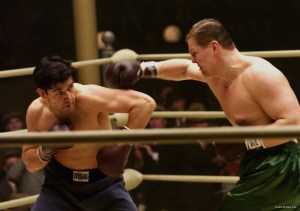
The film does come alive when Braddock steps into the ring. The boxing matches are finely choreographed and pack a real wallop. You can practically feel the bruises and taste the sweat during the 15-round bout between Braddock and Baer. These scenes give you a good understanding of the progression of a boxing match and the real strategy that can turn a loser into a winner. Howard also has a smart visual cue during these lively moments. Whenever a bone gets broken, like Braddock’s hand, we cut to an X-ray shot of that scene and see the bone snap. It might seem old in a CSI-drenched landscape of entertainment but it’s effective and neat.
Cinderella Man is a rousing, heartstring-tugging crowd-pleaser that will inspire hope and redemption. Until you look at it more objectively. It?s easy to get sucked into Howard’s underdog tale and that’s because it’s been tailored to satisfy your emotions. Crowe rises above this heavy-handed yesteryear yarn with a riveting performance. I’m positive most people will walk away from Cinderella Man feeling uplifted and touched and would view me as being overly cynical. But with a maudlin story by Goldsman that simplifies the details, Cinderella Man feels like a feel-good-movie that’s been rigged. These people have no trust in their audience, so why should you put your trust in them?
Nate’s Grade: C+
Share this:

Hotel Rwanda (2004)
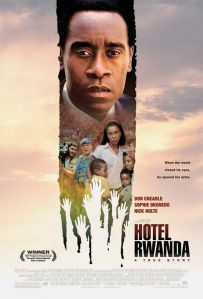 Hotel Rwanda almost didn’t get off the ground. You see, veteran supporting actor Don Cheadle is a favorite actor for directors but he’s not exactly box-office gold. Initial producers of Hotel Rwanda wanted none other than Will Smith to star. I don’t know about you good people but a sobering, challenging movie shedding light on the Rwandan genocide would lose some credibility if Smith was the above-the-title star. Producers also wanted Denzel Washington as a candidate; a better choice but still not right. The true-life portrayal of Paul Ruseabagina needed to be done by an actor that didn’t look like he could kick your ass. Paul was an ordinary man that didn’t ask to be a hero, not a hero looking for a fight. Cheadle was the perfect man for Hotel Rwanda. It just took a while for it to happen.
Back in 1994, Rwanda underwent a tumultuous civil war. In Rwanda, there are two ethnic groups, the Hutus and the minority Tutsis. Though the two look indistinguishable, there is an underlying tension because way back when Rwanda was under Belgian colonial control, the Belgians separated the Rwandan people by arbitrary rules like nose size, skin tone, etc. There is a rising tide of Tutsi resentment (radio propaganda refers to them as “cockroaches” needing to be exterminated). The Rwandan president has been assassinated and Hutu radio broadcasts are already pointing the finger at Tutsis.
 Paul Ruseabagina (Cheadle) is a Rwandan hotel manager that stocks up favors by scratching the backs of the right people. The wheels of Rwandan authority need to be constantly greased, and Paul knows when to deploy a well-timed gift, joke, or bribe. Paul?s wife Tatiana (Sophie Okonedo), a Tutsi as well as their children, is concerned when she starts seeing neighbors taken away at night. Paul assures her that their Tutsi relatives will be safe. Hutu rebels begin to start corralling neighborhoods to root out any Tutsis. Paul and his family retreat back to the hotel. As the violence increases more refugees arrive at the hotel for sanctuary, but Paul must keep the illusion that the hotel is still operational to ward off violence.
The United Nations promises to do something, but they remain only peacekeepers and not peace enforcers. The commanding officer (Nick Nolte) laments that he has only a handful of U.N. peacekeepers in charge of the whole nation. The United Nations and the West does do something: they evacuate all the white people. Citizens of Western nations are escorted out of the conflict, while they leave the rest of Rwanda to its own devices. Paul?s clinging hopes for Western involvement get bleak, and he assumes the responsibility for saving as many lives as he can, Hutu or Tutsi.
Cheadle gives one of the best performances of the year and he’s been nominated for a Best Actor Oscar. The strength of his character’s power lies in Paul’s ordinariness. He’s not a figure of intimidation, nor is he some kind of altruistic saint. There’s more than a passing resemblance to Oscar Schindler in Schindler’s List. Like Schindler, Paul is a man reluctantly pulled into risking his life for others and by the end he becomes consumed with saving as many lives as he can. Cheadle is so commanding that he can make you wince just by watching the weariness in his eyes.
There’s a moment late in Hotel Rwanda, where Paul is stalking the hallways trying to find his wife and children. And in an instant he suddenly remembers careful instructions he gave to his wife. Paul nearly bowls over with the sudden pang of terror but keeps his stride. It’s a sharp and powerful moment where the audience thinks alongside Paul and experiences the same awful gasp. In that moment, as well as countless others, Cheadle has worked his way so deep into his character that the two are one in the same. Cheadle has long been one of the most underrated actors, and now with Hotel Rwanda there is no doubt that Cheadle is one of the greatest living actors we have.
But Hotel Rwanda is not just a one-man show. Sophie Okonedo also garnered a Best Supporting Actress Oscar nomination. Okonedo is no pushover and she does more than needle Paul when it comes to the well being of their family. She’s a strong, caring, thoughtful woman. What makes her even more impressive is that, as a Tutsi, she could be murdered at any time. She gives an equally powerful performance of a woman finding strength amongst her own fear.
Writer/director Terry George keeps the emotion high by smartly relying on restraint when telling his portrait of horror. The events of the Rwandan genocide are so appalling, that it would have been so easy, and even understandable, had George loaded his film with scene after scene of graphic violence to jar the viewer. However, George refrains from numbing an audience with violent depictions, and instead chooses quieter, more somber moments that turn out to be far more terrifying than just seeing blunt violence. Hearing an aid worker recount witnessing a massacre of children to wipe out the next generation of Tutsis will chill you to the bone. There are some disturbing moments, like when Paul takes a very bumpy ride in the mists, but George refuses to numb an audience and works our emotions to a breaking point.
 Hotel Rwanda is sobering and very emotional, but you will also leave the theater with an overwhelming feeling of shame. It’s easy to watch films about dated atrocities like depictions of the Holocaust. You can say, “Well, I wasn’t alive. If I was, and people like me, surely we would not sit back and let such actions take place under our watch.” Not this time. Not with Hotel Rwanda. Everyone seeing Hotel Rwanda more than likely was alive in 1994, and we did exactly as a character warned: we watched what was happening on TV and went back to eating our dinners. Nolte’s U.N. rep tells Paul that the West refuses to see him and Rwandans as valuable (“You’re worse than a n****r [to them]; you’re an Af-ri-can.”). You?ll feel many emotions while viewing Hotel Rwanda and the deepest and longest lasting may be shame.
The film is clearly in the genre of “outrage cinema,” normally a genre that overpowers a viewer’s emotions. In lesser hands Hotel Rwanda would have been unrelenting to maintain a level of shock. George allows an audience to feel for the story’s characters before he lets the horrors loose. The result is that an audience attaches itself to characters because of who they are, not just because of the anguish they endure. As the intensity of the situation mounts we feel stronger ties to the people of Hotel Rwanda. That is good cinema.
Hotel Rwanda is an emotionally gripping portrait of the dignity found during our darkest days. George has skillfully created a sobering movie. Cheadle and Okonedo deliver wrenching performances as the faces of good amongst ongoing genocide. This isn’t like Black Hawk Down where the faces of screaming, angry black people merge into one black form the audience uneasily grows to hate. In Hotel Rwanda, the heroes are everyday Africans, the bad guys are everyday Africans, and the West is the apathetic referee unwilling to act. Hopefully after George’s film, it’ll be hard to hear about a million massacred and go back to eating your dinner.
Nate’s Grade: A
Share this:

Finding Neverland (2004)
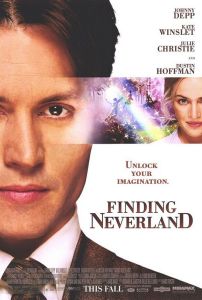 My friend George Bailey and I came to a similar conclusion during a recent conversation. There are a handful of movies, usually released around this time of year, that are packed to the gills with awards hype and general goodwill. Then I see them and feel underwhelmed for whatever reason and I walk out and feel that I should like the movie more than I do (if I do at all). I don’t know what to call it, societal guilt, elitism, but this is exactly what I felt when I left Finding Neverland.
J.M. Barrie (Johnny Depp) is in search of his next play. It?s 1903 London, and the financier (Dustin Hoffman) of his last play has taken a financial bath. Barrie’s also emotionally closed off from his wife (Radha Mitchell). One day in the park, Barrie stumbles across Sylvia (Kate Winslet), a widow managing four boys by her lonesome. Barrie takes a shining to her children and delights in spending long days with Sylvia and her boys. From his encounters with Sylvia and the boys, Barrie works up the inspiration to write a new story, called Peter Pan. Of course the public has its own gossip about a married man gallivanting about with a widow and her boys (think recent Michael Jackson scandals). Then there?s Sylvia?s mother (Julie Christie), who is set to put her house back in order starting with removing Barrie from their lives.
 The message of the movie is about the need for adults to slow down, open their imagination, and become bewitched by the power of believing. Because it’s not like there aren’t any other Hollywood movies out there that teach us to loosen up and enjoy life. Thank you Finding Neverland, I never would have found this out by myself. The message of belief overpowering all is also a bit naive, but then it works into the whole cross-stitching of sap the movie is generating.
Not even Depp can save the film. Long established as one of the most versatile and exciting actors, Depp finds ways to disappear into his oddball characters. In Finding Neverland, Depp sports an impressive Scottish brogue, but, sadly, this is the most impressive aspect about his performance. There had been much talk about Finding Neverland being Depp’s next opportunity at finding Oscar, but it would be a shame if Depp won for such a lackluster, artificial performance especially when he’s been brilliant so consistently in other movies. J.M. Barrie was somewhat eccentric, but in Finding Neverland he comes off as mostly vacant. The film tries to show that Barrie didn’t really fit in, but instead of becoming a showcase for Depp’s acting it becomes a showcase for Depp’s silence. The performance is so subtle that it doesn’t even come off as a performance. If Depp stood in the background of a movie, it would be akin to this performance.
Winslet has also been a very versatile actor. Her role in Finding Neverland never really deepens beyond Disadvantaged Woman. She’s been hit by adversity, she’s beset by four rambunctious kids and an icy mother, but that’s about all the film does for her characterization. Winslet is a tremendously talented actor, as evidenced by her Oscar-worthy performance in this year’s Eternal Sunshine of the Spotless Mind. So why strand her in a role where her character’s greatest acting moment is coughing fits?
Director Marc Forster (Monster’s Ball) has the frustrating habit of having two shot styles he shoots in. He decides between medium shots which usually involve two or three people, or large close-ups. While I was watching Finding Neverland I never once thought to myself that something was filmed in a visually interesting way. Some of Forster’s decisions seem unnecessary, like when he has to visually show us scenes of imagination instead of allowing the audience to, gasp, use their own imagination (hey, isn’t that the message of the movie?).
Finding Neverland tries so hard to be a three-hanky movie (and truth be told I heard a lot of sniffling in my theater during the last half hour), but what stops the film short is how unbelievably transparent everything is. Finding Neverland could have explored the rich complexity of an enigmatic figure like J.M. Barrie, but instead it settles for goopy sentimentality at every opportunity. Barrie becomes sugar-coated into an earnest father figure, and in the process key facts are sugar-coated as well. What do you mean? Well, Sylvia’s husband didn’t die until several years after Barrie wrote Peter Pan. Barrie’s wife didn’t have her affair until long after Peter Pan. Also, the original Peter threw himself in front of a train because of how upset he was about his connection to the famous character. I guess that’s why this is a biographical movie merely “inspired” by true events, much like Hidalgo.
The filmmakers rely on cloying tricks to make an audience care about its characters. The movie paints in very stark black and white tones, mainly “adults = shortsighted” and “children = special.” This is a film that is proud to take the easy road and makes little effort to cover its pride. It plays toward audience expectation and thus loses any long lasting magic.
Finding Neverland takes the easy road for audience-friendly sappiness. Barrie insists that 25 orphans be strategically placed around the theater on opening night of Peter Pan. Sure enough, the theater is full of old white men with monocles, and apparently they just don’t get the spirit of theater. The orphans laugh and squeal from the stage antics, and somehow this triggers all those old curmudgeons to learn to laugh once again. You see, all it takes is strategically placed orphans to make us laugh at life again.

When Sylvia is hanging laundry she starts to gently cough. If you’re smart, you’ll instantly figure out what trajectory is in store for her, but even if you miss this single cough don’t worry, because Sylvia will be doubled over with coughing later to spell it out for everyone. You can all but see the strings being pulled (the audience will cry… now!). All can be overcome in the end, those who didn’t understand will, and we’ll all be happier and live life to the fullest, in theory of course.
Finding Neverland wants to be Shakespeare in Love, another whimsical movie that shows how a writer utilized the people and events around them to pen a masterwork. Except in Shakespeare in Love there was a romance to fall back on, as well as some ripe comedy, but with Finding Neverland there isn’t anything to fall back on. It’s a Hallmark card mass-marketed to the largest possible audience.
Everything about Finding Neverland is disappointingly under whelming. The direction is shabby, the actors are marooned by their weak roles, and nothing is sacred in the film’s pursuit of that tearjerker ending. This is a movie for people that ask little of their movies, and yet I can reasonably see Finding Neverland becoming an audience favorite and riding good word of mouth all the way to awards season. Finding Neverland is a film that never takes flight because it’s too content to stay grounded by going the easy route.
[Nate’s Grade: C
Share this:

Kinsey (2004)
 Bill Condon’s probing, fascinating biopic of Indiana University sex pioneer Kinsey (Liam Neeson) could not come out at a more important time. Kinsey lived in the Dark Ages of sexuality and fought against what he saw as “morality disguised as fact.” Kinsey broke barriers studying the science of sexuality and gathered nationwide statements to amass the first thorough book on what’s under the sun and what’s going on under the sheets. Today, we live in a splintered world where people listen to information that affirms their beliefs, and tune out contradictory evidence even if it’s fact (look at the latest report on abstinence-only programs dishing out highly erroneous information). Kinsey railed against this dangerous line of thinking. The man was no saint and had issue comprehending some of the more complicated human emotions. Kinsey is exceptionally well acted and Neeson gives a career best performance. Kinsey is fearlessly graphic in its frank discussion but also enormously intelligent. The fact that conservative groups are actually protesting it shows that Kinsey’s work is far from over.
Nate’s Grade: A-
Share this:

The Alamo (2004)
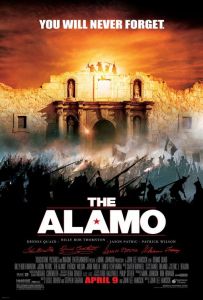 The Alamo was originally going to be the jewel in Disney’s 2003 Oscar crown. It began with a star-studded pedigree: Ron Howard directing, a screenplay by John Sayles and Stephen Gaghan, and Russell Crowe starring. Things got dicey when budget figures were debated, and Howard insisted on an R-rated cut for authenticity. After some creative wrangling, Howard left to get his gore fix on with another flick (The Missing), Crowe went off to sea (Master and Commander), and Disney tapped Johnny Lee Hancock to direct in the wake. Trouble is, Hancock had only directed one previous film, 2002’s The Rookie. The 90 million dollar movie was supposed to be released during December 2003, just in time for Oscar season. However, the editing needed more time, so Disney’s supposed award-grabber was delayed until April 2004. Now, given the final PG-13 product, were the wait and creative compromises worth all the trouble?
In The Alamo we follow the men of Texas, including surly drunk Jim Bowie (Jason Patric), idealistic Sam Houston (Dennis Quaid), girly aristocrat William Travis (Patrick Wilson), and legendary Davey Crockett (Billy Bob Thornton). They want to make Texas their home, but Mexican General, Santa Anna, has different plans and wants to reclaim the land for the glory of Mexico and, more importantly, for the glory of himself. As Santa Anna storms into Texas, a meager number of men take refuge in the Alamo, an old Spanish mission, and arm themselves for an eventual battle between the merciless General and his thousands of soldiers.
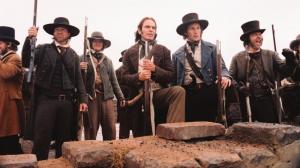 The pacing of this movie is about as fast as a tumbleweed. An entire act of this movie involves Texans and Santa Annas men exchanging a shot here, a volley there, back and forth and back and forth for no reason. It certainly doesn’t build tension. It just squanders time, and this thing is 2 hours and 20 minutes long! If it weren’t for my free bag of popcorn I would have fallen asleep countless times during viewing.
The acting of The Alamo may make you want to throw up a white flag yourself. Jason Patric spends the majority of his time on his back with teeth clenched, and when that’s not the case hes lookin’ to get his famous blade a cameo. Quaid seems to have a frog permanently lodged in his throat. The only performer who walks away unscathed is Thornton. He gives a humanistic touch to the familiar character of Davey Crockett and shows the wear of living up to legend.
Perhaps the most shocking thing about The Alamo is how poorly directed it is. I know Johnny Lee Hancock has only one previous movie under his saddle, but my jaw hit the floor when I saw how flat his direction was. Scenes and angles are very awkwardly framed, everything is too flat or too rigid, his cinematography is an underwhelming mixture of silhouette shots and dusty hues, his sets look like a high school production, and his action scenes are staged without any sense of excitement or tension. Excluding one shot that shows the battle on all four sides of the Alamo, seen prominently in the trailers and TV spots, there isn’t a single shot in this entire film that looks great. This is one of the worst looking $90 million film I have ever seen.
The script is another factor in driving down the entertainment. The makers strive for historical accuracy and to show both sides of the conflict without bias. So we get what all modern historical films feature now, namely the Famous People with Flaws. Bowie drinks a lot. Travis is unsure of himself and leaves his family. Boone doesn’t live up to hyperbolic legend. This information is fine, but The Alamo tries so hard to get the characters accurate that it fails in getting the characters right. I’m not calling for the return of myths, but The Alamo is so focused on the details that that’s all these characters become: historical details instead of living, breathing people.
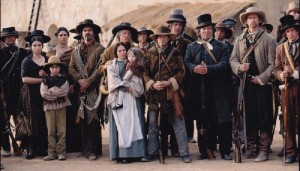 The script also shirks any kind of detailed look at the role of minorities involved during the siege. Black people hardly mention slavery (and Texas would go on to become the largest slave state), women are designated as caregivers, either tending to the wounded or becoming floaty fantasies. The Alamo feels more like a eulogy than a film. And how many eulogies do people pay 5-10 bucks to go see?
I think what ultimately sinks this movie for me is my roots. I’m not from Texas, I dont know anyone from Texas, I dont know if everything is bigger in Texas, and I dont know if I’ve ever messed with Texas, but the lone star state clings to the martyrdom of the Alamo like the crucifixion of Jesus. When I was watching The Alamo I kept having one reoccurring thought: is this accomplishing anything? In my assessment, no it did not. A bunch of Texans banded up in an old mission and fought Santa Anna but there was no reason for it and nothing was really gained. Someone will argue that they held up Santa Anna and allowed Sam Houston to collect his army and eventually take down Santa Anna. I would counter that with, ”You know what else could delay Santa Anna? Anything.”
The Alamo is an overlong, overly serious, flat, uninteresting bore. It feels more like a textbook and less like a story. Sure its not the jingoistic flag-waver that John Wayne’s 1960 version was, and I can appreciate trying to get history right, but The Alamo is so insanely by-the-book serious that its as fun as a funeral march. It seems like the director and the producers were so afraid of telling the story of the Alamo wrong that they lost the ability to tell a good story. Only ardent history buffs, and maybe ardent Texans, will find anything appealing about this boring history lesson.
Nate’s Grade: C
Share this:

Monster (2003)
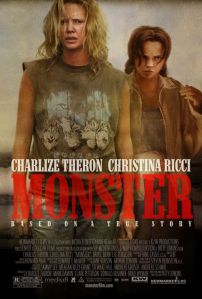 Monster follows the life of Aileen Wuornos (Charlize Theron, now nominated for a Best Actress Oscar), Americas only known female serial killer. In the late 1980s, Wueros was a roadside prostitute flexing her muscles with Florida motorists. She describes hookin’ as the only things shes ever been good at. One day Wuornos has the full intention of taking her own life, but she meets 18-year-old Selby (Christina Ricci) at a lesbian bar and finds a companion. Driven by a growing hatred of men from sexual abuse, Wuorno’s starts killing her johns to try and establish a comfortable life for her and Selby.
Let’s not mince words; Theron gives one of the best performances I have ever seen in my life. Yes, that’s right. One of. The. Best. Performances. Ever. This is no exaggeration. I’m not just throwing out niceties. Theron is completely unrecognizable under a mass of facial prosthetics, 30 extra pounds, fake teeth and a total lack of eyebrows. But this is more than a hollow ploy to attract serious attention to the acting of a pretty face. Theron does more than simple imitation; she fully inhabits the skin of Aileen Wuornos. The closest comparison I can think of is Val Kilmer playing Jim Morrison in The Doors.
Theron is commanding, brave, distressing, ferocious, terrifying, brutal, stirring, mesmerizing and always captivating. It may be a cliché, but you really cannot take your eyes off of her. Her performance is that amazing. To say that Theron in Monster is an acting revelation is perhaps the understatement of the year.
With previous acting roles in Reindeer Games and The Cider House Rules, Theron is usually delegated to pretty girlfriend roles (who occasionally shows her breasts). Who in the world thought she had this kind of acting capability? I certainly did not. If Nicole Kidman can win an Oscar for putting on a fake nose and a so-so performance, surely Theron should win an Oscar for her absolute transformation of character and giving the performance of a lifetime.
With this being said, and most likely over said, Monster is by no means a perfect film. Minus the terrific central performance, Monster is more of an everyday profile of a grotesque personality. The film weakly tries to portray Wuornos more as a victim, but by the end of the film, and six murdered men later, sympathy is eradicated as Wuornos transforms into the titular monster. Some supporting characters, like Ricci’s narrow-minded Christian up bringers, are flat characters bordering on parody. The supporting characters are generally underwritten, especially the male roles that serve as mere cameos in a film dominated by Sapphic love.
Monster is proof positive that human beings will never be phased out by advancing machinery when it comes to acting. Monster boasts one of the greatest acting achievements in recent cinematic history, but it also coasts on sharp cinematography and a moody and ambient score by BT (Go). Monster is a haunting film that you wont want to blink for fear of taking your eyes off of Theron. She gives an unforgettable tour de force performance that will become legendary.
Nate’s Grade: B
Share this:

The Magdalene Sisters (2003)
 There’s a certain genre of films as well-defined as say, the Western, Film Noir, or even Romantic Comedies. The genre Im speaking of is I-can’t-believe-that-happened cinema. This is a genre made up of little-known true stories where people with power abuse those below them. These include films like Rosewood, Rabbit Proof Fence, Matewan, Mississippi Burning, and just about every movie with a Holocaust setting. These films are intended to antagonize the audience and to get them to ask, How could something like this happen? The Magdalene Sisters is a film that an audience will walk away with very much wondering how something so cruel, amoral, and heartless could carry on in our modern world.
In 1960s Ireland, the Catholic Church was life. The Magdalene Sisters sheds light on the little known work asylums, which were institutions set up to help girls who had transgressed against God. The girls admitted to the asylum, a kind of extreme reform school, are there to work away their sins and reach forgiveness, thus saving their immortal souls. Rose (Dorothy Duffy) had a child out of wedlock. Bernadette (Nora-Jane Noone) was caught by school officials for being too pretty and tempting teen boys. But perhaps the most startling admission is Margaret (Anne-Marie Duff), admitted to the asylum by her own father for the grievous sin of being raped by a cousin. The Magdalene Sisterhood asylum is run by Sister Bridget (Geraldine McEwan), an old nun who subscribes to the cruel to be kind theory in spades. The girls at the asylum toil tirelessly in sweatshop conditions, are physically abused by the nuns, sexually abused by the asylums priest and are left hopeless of escaping. Girls who run away are turned back in by their parents or cooperative police. Some of the women at Magdalene have been there for their entire lives. It seems the only ways out are death or joining the convent. Get thee to a nunnery indeed.
 The Magdalene Sisters is full of sadistic moments that will shock an audience. One of the most disturbing scenes transpires late into the film. The girls of the asylum line up completely nude, shivering and crying. Two nuns, with a nauseating smugness, chortle and play a game seeing who has the largest breasts and the smallest nipples, among other things. When the winner of this sick experiment stands forward and clenches her teeth from crying so hard, one of the nuns asks, ”What are you crying for? It’s just a game.”
The young ladies at the films core deliver magnificent performances tinged with honest emotional devastation. Noone is the standout as Bernadette. She utilizes steely rebellious gazes that speak volumes about her characters resourcefulness. Noone can convey more poignant emotion in the raising of an eyebrow or the biting of her thumb than most starlets can ever hope to express.
McEwan is terrifying as the head nun and head source of torment. Her grandmotherly voice, tinted with an Irish brogue, is enough to send shivers down your spine. She is surely 2003’s greatest movie villain, next to Johnny Depp in Once Upon a Time in Mexico.
Writer/director Peter Mullan keeps the suffering at an almost unbearable level but allows the spark of human resistance to keep us going. His film is one brimming with anger and disbelief; ensuring the audience will experience that same burning anger before the credits roll. Mullan’s passionate story can be deemed one-sided, but then again, what exactly is the other side going to say about the abuse of innocent girls for life-long slave labor? Not much I suspect.
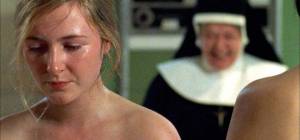 The Magdalene Sisters is a somber, unflinching look at the abuses of the church as well as the upward battle for equality women faced. This film is tough to sit through. It might be too much for some, especially if they don’t have a strong relationship with the Catholic church to begin with. The decades of abuse The Magdalene Sisters sheds light on is incredible, but it’s also a beginning for healing. Before we can overcome atrocities we must acknowledge them, and this is something I’m sure Mullan is arguing that the Church is failing to do. In fact, the Catholic church has denounced The Magdalene Sisters for its portrayal of church abuses. Something tells me Mullan is not surprised.
Not only is The Magdalene Sisters an eye-opener, it’s also great cinema. The characters, pacing, realistic sharp-eyed direction, and superb acting render it more than just a snuff film. This film is more than watching people mistreated and suffer; this is a film about perseverance and resolve. It’s about the enduring human spirit. I’ll gladly (well, not gladly) watch sequences of misery in order to see human triumph. This isn’t just a sad story, it’s exceptionally well told and acted and it bathes you in the pain of its characters. You feel their heartbreak and tragedy, but you also feel their victory.
The Magdalene Sisters is, without a doubt, the must-see feel-bad movie of this year. Now, there will be plenty out there saying, Why should I pay to see a movie that will make me feel bad? This is my defense: because the movie is so good at having its fears, tortures, and ultimate triumphs resonate that it makes you authentically feel something. And isn’t this the purpose of art, to feel something? The Magdalene Sisters is unflinching, passionately powerful and unforgettable. Just one more item to get your blood boiling: the last of these Sisterhood work asylum closed in 1996.
Nate’s Grade: A
Share this:

City of God (2003)
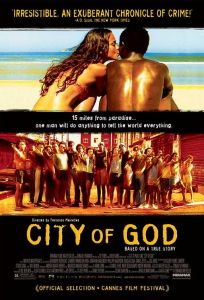 Looking for a film that really packs a genuine wallop? Take the visual panache of a pre-Madonna Guy Ritchie (Snatch) film, the juvenile delinquency and debauchery of a Larry Clark (Kids) film, the propulsive narration and bloody violence of a Martin Scorsese (Raging Bull) film and mix it with a cast of about 40 characters. What you get is City of God, a brilliant and vibrant film that pulsates with exhilarating action, thoughtful commentary and devastating power.
In the 1960s, the Brazilian government transported its impoverished citizens outside of Rio de Janeiro, a glamorous tourist magnet. This new place of residency was a distant housing project of shabby slums, ironically titled City of God. In this begotten neighborhood the police rarely emerge (except to occasionally pick dead people’s pockets) and crime has become rampant. A mixture of poverty and an overabundance of guns and testosterone have bred a culture of criminals where teenagers populate ruthless gangs.
 Our story focuses on Rocket (Alexandre Rodrigues) narrating the rise, and many falls, of all the flashy thugs of the City of God and the ripples they create in the community. Hes a young boy who is too scrawny to be a hoodlum like his older brother Goose. His brother belongs to a gang known as the Tender Trio, who are used to hijacking propane tanks for small gain. They get the idea to knock off a brothel at the urging of Lil Dice, a younger kid with ambition and a heart like a stone. After the successful robbery Lil Dice cleans up after the Trio, sifting through the brothel killing everyone inside and laughing insidiously.
The murder spree has long lasting effects, with each member of the Tender Trio finding an untimely end. Lil Dice grows from calculating child into a big-time burgeoning cruel gangster, who now calls himself Lil Ze (Leandro Firmino De Hora Phellipe). Ze has climbed to the level of kingpin the most pragmatic way possible: systematically eliminating all of the competition. Ze attains reign over the city. He instructs others not to do anything to arouse the outside police (the locals are paid off), and thus has made the City of God a safe place for rich tourists to drive in and purchase their drugs. It seems that Ze ruling by fear has brought newfound safety and prosperity.
Rocket’s path is quite different. As he matures into a teenager he discovers a love of photography. His attempts at a life of crime are short-lived; he simply likes his victims too much to rob them. Ze has Rocket take pictures of his gang strutting their machismo that eventually gets published onto the front page of a newspaper. Rockets reaction is that he thinks his death certificate has been signed. Ze’s reaction is delight. Lil Ze’s great weakness is his self-believed sexual inadequacy. When turned down by a girl he seeks out her good-looking boyfriend, Knockout Ned (Seu Jorge), and humiliates him. He terrorizes Ned, raping his girlfriend in front of him and inspiring him to long bloodthirsty battles of vengeance against Ze that will engulf the City of God.
 A complaint that could be levied against City of God is the numbing effect of its violence. The gangsters in this film aren’t the mustache-twirling types of Gangs of New York, but merely kids. This isn’t any kind of glamorized Hollywood gun battle. When these kids get hit their bodies go limp; they drop to the ground in weeping masses. The films message of the hereditary nature of barbarism is clear. One of the amazing parts of the film is that it was mainly filmed in the actual City of God and uses a cast almost entirely of non-actors.
City of God is a loud announcement to the world of the arrival of a fresh, invigorating and monumental talent with director Fernando Meirelles. The visual flair he utilizes to advance his storyline is amazing yet never falters into the land of gimmickry. The narrative folds in on itself time-wise (much like Tarantino films) yet rhythmically connects the numerous lives and history of the City of God in one lustrous and captivating tapestry of urban decay. A fantastic example is a scene that chronicles the entire history of one apartment and the origins of the entrance of drugs in one un-moving shot. Imagine the Natalie Imbruglia “Torn” video but with drugs and guns.
 There is one sequence of crushing emotional power that has been burned into my memory. The sequence involves a bawling child, no older than seven, being forced to decide where he would rather be shot, in his foot or his tiny trembling hand as punishment for his mischief. The reality of City of God is a harrowing one. As you can clearly see, City of God is not for the weak. The movie has its definite squirm-worthy moments of discomfort and will not be a good choice if you and your date are looking for that perfect weekend movie. This is a difficult movie to sit through at times, and the reality can be grim and uncompromising, but City of God is rewarding in respect to the amazing narrative and visual accomplishments. This is an unforgettable film.
The film piles on the body count while at the same time advancing a pacifist message between the bursts of adrenaline and bullets. Meirelles’ film will leave your jaw dropped to the floor by its sprawling complexity. This is what great filmmaking is all about. City of God is one of those movies that once you’ve left the theater you excitedly claim, “Now thats why I see movies.” City of God is simply a cinematic masterpiece and not only the best film I’d seen in 2003 but also one of the best movies I’ve seen in my life.
Nate’s Grade: A+
Share this:

Catch Me If You Can (2002)
January at the theaters is a tale of two kinds of films. One type are the studio bombs (take Just Married and Darkness Falls, please take them far away). The other type are the prestige pictures expanding their releases in hopes of garnering some of that Oscar magic. A lot of prestige films were released around the holidays and though not every one could be a winner, they were all better than Kangaroo Jack. Well, except for The Hours.
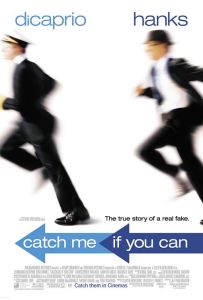 Catch Me If You Can (2002)
Premise: Successful true-life con artist Frank Abagnale Jr. (Leo DiCaprio) zips across the world posing as a pilot, doctor and lawyer all before the age of 18. A mousy Tom Hanks provides the chasing.
Results: Breezy and light-hearted, Catch is an entertaining and fun romp that works with a charming Leo (unlike in Gangs), a jazzy score and a skillful recreation of the 1960s life and mood. Spielberg hasn’t made a film under two hours since 1989, so Catch is a tad long.
Nate’s Grade: B


 nathanzoebl
You must be logged in to post a comment.