Blog Archives
The Taking of Pelham 123 (2009)
 This needless remake is yet another nail in the coffin for the filmmaker that is (was?) Tony Scott. The director seems to have a love affair with irritating and superfluous visual artifice. Scenes will jump into slow-mo, or stutter-stop speed, or the visuals will all of a sudden turn into blurry shadows. Scott proves yet again that he’d rather fiddle around with film stocks and random jarring effects than aid his narrative. The story of Pelham is rather mediocre, as a tattooed gunman (John Travolta) and his crew take a subway car hostage. A train dispatcher (Denzel Washington) becomes the only one allowed to speak to the gunman. Travolta is wholly unconvincing as a profane criminal mastermind. The villains are gruff idiots, some of whom think at the end that maybe, just maybe, they can get the jump on 30 armed policemen surrounding them. They were not the top of their class at Henchmen School. The story is frustrating and the character motivations for Travolta remain vague and unclear. Sure, he gets financial gain, but what else? What about his shady past? Why this specific route to this mundane goal? It’s like Scott and the movie simply just didn’t care anymore because they knew it was time for the film to end in a big chase scene. Also, the movie seems to make a case that NYC cops are the worst drivers in the world. They crash more cars than Billy Joel (joke brought to you by the year 2003). This is one train to miss.
Nate’s Grade: C
Share this:

Man on Fire (2004)
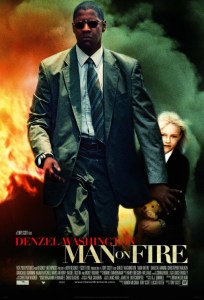 By far, the most entertaining moment of Man on Fire occurs shortly after the movie ends. A message comes on screen more or less saying, Mexico City is a very special place and we thank them. Now, after having watched a lengthy 2 hour and 25 minute film that shows Mexico City as a chaotic equal to the Middle East, a city that experiences four kidnappings a day we are told, these ending sentiments feel like a mea culpa. To say a place is great after showing it to be a corrupt war-zone is hilarious. I doubt Mexico City will be using Man on Fire to lure tourism, just like I doubt Germany uses Hogan’s Heroes for its tourism.
The man on fire is Creasy (Denzel Washington), a former soldier with a drinking problem. Hes hired dirt cheap to be the bodyguard for Pita (Dakota Fanning), the daughter of a wealthy Mexican politician (Marc Anthony). Creasy is pragmatic about his job and shirks Pitas attempts at friendship. Eventually, the precocious tyke gets the better of him and Creasy forgoes his self-loathing for coaching Pita on how to swim better. Creasy has found his recovery in the form of Pita’s love, but his world is ripped apart when Pita is kidnapped and Creasy is left for dead. When he recovers, he vows merciless vengeance on anyone involved in Pita’s kidnapping.
 Denzel Washington is competent in his role, but there aren’t many films that wouldn’t be better by having a Denzel Washington performance in it. Fanning has a robotic nature to her delivery. The wacky Christopher Walken is in this movie somewhere, but you would be hard-pressed to find him in the last hour or so. It’s kind of nutty that Walken of all people plays the voice of reason in a revenge movie.
Director Tony Scott (Crimson Tide, Top Gun) has flat-out forgotten or lost interest in telling stories. His direction of Man on Fire is erratic and heavy on stop-the-action-dead visual flourishes. Scott is a slave to visuals, but so many of them are jarringly miscalculated that the audience can never fully immerse themselves in the film. It’s like a kid fiddling with a new camcorder and wanting to try all the super cool special features (Whoa, I can make things slower … now grittier stock … now sepia … now I can make a mirror of things … etc.).
It takes over an hour to get to the key kidnapping plot point. Until then the audience is relegated to watching scenes of Creasy find redemption through the eyes of a child. Denzel and Fanning have a nice mentor camaraderie, but after an hour the audience is impatiently waiting for the inevitable kidnapping that the movies foreshadowing has been tripping all over.
 When Man on Fire does hit the kidnapping, the ensuing movie gets very messy, and boy does it get ugly. Creasy goes on a grisly killing spree that turns him from a sympathetic loner into a one-man wrecking crew. Vengeance is an easy emotion for an audience to get behind a character, but Man on Fire goes way beyond audience empathy. Are we to cheer when Creasy goes about ruthlessly killing unarmed people and threatening families, pregnant women, and kids? I didn’t cheer. I was somewhat appalled that the filmmakers expected us to revel in this violence as if it was more than justified. It’s just ugly, plain and simple. It is also sickeningly sadistic.
The most bizarre thing about Man on Fire is the subtitles. When I think back on this film in the future, that is the one thing that will stand out for me. These arent your ordinary stay-at-the-bottom-and-do-as-you’re-told subtitles. Oh no. These subtitles dance, jump around, float, fade, expand and shrink in size, and do about everything but make balloon animals (or, I should say, subtitle animals). It’s like a living comic book; however, this is yet another visual trick that draws the audience out of the film. The unusual subtitles call too much attention to themselves, especially when they just pop up for a single word, spoken in English, as if to clue in the audience that this point of information will be vital somehow.
Man on Fire is a sadistic action film that is too full of itself for amusement. By the time that mea culpa comes onscreen its almost a relief to laugh again. The hard-driving ugliness of Man on Fire might make you forget how to. Fans of revenge films may find some redeemable qualities, but Man on Fire is one gruesome 145 minutes to squirm through.
Nate’s Grade: C-


 nathanzoebl
You must be logged in to post a comment.