Blog Archives
Oppenheimer (2023)
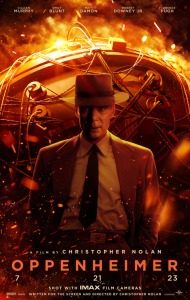 I finally did it. I watched all three hours of Christopher Nolan’s Oppenheimer, one half of the biggest movie-going event of 2023, and arguably the most smarty-pants movie to ever gross a billion dollars. It was a critical darling all year long, sailed through its awards season, and racked up seven Academy Awards including Best Picture and Best Director for Nolan, a coronation for one of Hollywood’s biggest artists whose name alone is each new project’s biggest selling point. I’ve had friends falling over themselves with rapturous praise, and I’m sure you have too, dear reader, so the danger becomes raising your expectations to a level that no movie could ever meet. As I watched all 180 lugubrious minutes of this somber contemplation of man’s hubris, I kept thinking, “All right, this is good, but is it all-time-amazing good?” I can’t fully board the Oppenheimer hype train, and while I respect the movie and its exceptional artistry, I also question some of the key creative decision-making that made this movie exactly what it is, bladder-busting length and all.
As per Nolan’s non-linear preferences, we’re bouncing back and forth between different timelines. The main story follows Robert Oppenheimer (Cillian Murphy) as an upstart theoretical physicist creating his own academic foothold and then being courted to join the Manhattan Project to beat the Nazis in the formation of a nuclear bomb. The other timeline concerns the Senate approval hearing for Lewis Strauss (Robert Downey Jr.), the former head of the Atomic Energy Commission (AEC) with a checkered history with Oppenheimer after the war. A third timeline, serving as a connecting point, involves Oppenheimer undergoing a closed-door questioning over the approval of his security clearance, which brings to light his life of choices and conundrums.
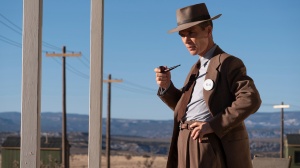 If I was going to be my most glib, I would characterize Oppenheimer in summary as, “Man creates bomb. Man is then sad.” There’s much more to it, obviously, and Nolan is at his most giddy when he’s diving into the heavy minutia of how the project came about, the many brilliant minds working in tandem, and sometimes in conflict, to usher in a new era of science and energy. Of course it also has radical implications for the world outside of academic theory. The world will never be the same because of Oppenheimer dramatically upgrading man’s self-destructive power. The accessible cautionary tale reminds me of a Patton Oswalt stand-up line: “We’re science: all about ‘coulda,’ no about ‘shoulda.’” Oh the folly of man and how it endures.
For the first two hours, the focus is the secretive Manhattan Project out in the New Mexico desert and its myriad logistical challenges, all with the urgency of being in a race with the Nazis who already have a head start (their break is Hitler’s antisemitism pushing out brilliant Jewish minds). That urgency to beat Hitler is a key motivator that allows many of the more hand-wringing members to absolve those pesky worries; Oppenheimer says their mission is to create the bomb and not to determine who or when it is used. That’s true, but it’s also convenient moral relativism, essentially saying America needs to do bad things so that the Germans don’t do worse things, a line of adversarial thinking that hasn’t gone away, only the name of the next competitor adjusts. This portion of the movie works because it adopts a similarly streamlined focus of smart people working together against a tight deadline. Looking at it as a problem needing to surmount allows for an engaging ensemble drama complete with satisfying steps toward solutions and breakthroughs. It makes you root for the all-star team and excitedly follow different elements relating to nuclear fusion and fission that you would have had no real bearing before Nolan’s intellectual epic. For those two galloping hours, the movie plays almost like a brainy heist team trying to pull together the ultimate job.
 It’s the time afterwards where Oppenheimer expands upon the lasting consequences where the movie finds its real meaning as well as loses me as a viewer. The legacy of the bomb is one that modern audiences are going to be readily familiar with 80 years after the events that precipitated their arrival, and they haven’t exactly been shelved or become the world war deterrent hoped for. As one of Oppenheimer’s physicists says, a big bomb only works until someone creates a bigger bomb, and then the arms race starts all over again fighting for incremental supremacy when it comes to whether one’s military might could destroy the world ten times or twelve times over. When Oppenheimer begins having reservations of what he has brought into this world is when his character starts becoming more dynamic, but it’s also too late. He can’t undo what he’s done, the world isn’t going back to a safer existence before nuclear arms, so his tears and fears come as short shrift. There’s a scene where Oppenheimer’s wife, Kitty (Emily Blunt), castigates him and says, “You don’t get to commit the sin and then make all of us to feel sorry for you when there are consequences.” Now this is in reference to a different personal failing of our protagonist, but the message resonates; however, I don’t know if this is Nolan’s grand takeaway. The movie in scope and ambition wants to set up this man as a tragic figure that gave birth to our modern world, but like President Truman says, it’s not about who created the bomb but who uses it. Oppenheimer is treated like a harbinger of regret, but I don’t think the story has enough to merit this examination, which is why Oppenheimer peters out after the bomb’s immediate aftermath.
It reminded me of an Oscar favorite from 2015, Adam McKay’s The Big Short, a true-ish account of real people profiting off the worldwide financial meltdown from 2008. It fools you into taking on the perspective of its main characters who present themselves as underdogs, keepers of a secret knowledge that they are trying to benefit from before an impending deadline. Likewise, the conclusion also makes you question whether you should have been rooting for this scheme all along since it was predicated on the economy crashing; these guys got their money but how many lives were irrevocably ruined to make their big score? With The Big Short, the movie-ness of its telling is part of McKay’s trickery, to ingratiate you in this clandestine financial world and to treat it like a heist or a con, and then to reckon whether you should have ever been rooting for such an adventure. Oppenheimer has a similar effect, lulling you with its admitted entertainment factor and beat-the-deadline structure. Once the mission is over, once the heroes have “won,” now the game doesn’t seem as fun or as justifiable. Except Oppenheimer could have achieved this effect with a judicious resolution rather than an entire third hour of movie shuffled throughout the other two like a mismatched deck of cards.
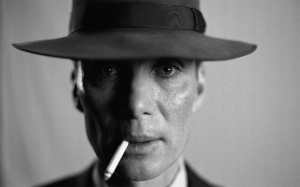 The last hour of the movie features a security clearance interrogation and a Senate confirmation hearing, neither of which have appealing stakes for an audience. After we watch the creation of a bomb, do we really care whether or not this one testy guy gets approved for a cabinet-level position or whether Oppenheimer might get his security clearance back? I understand that these stakes are meaningful for the characters, both essentially on trial for their lives and connections, but Nolan hasn’t made them as necessary for the audience. They’re really systems for exposition and re-examination, to play around with time like it was having a conversation with itself. It’s a neat effect when juggled smoothly, like when Past Oppenheimer is being interviewed by a steely and suspicious military intelligence office (Casey Affleck) while Future Oppenheimer laments to his project superior (Matt Damon) and then Even More Future Oppenheimer regrets his lack of candor to the review board. The shifty wheels-within-wheels nature of it all can be astounding when it’s all firing in alignment, but it can also feel like Nolan having a one-sided conversation with himself too often. It’s another reminder of the layers of narrative trickery and obfuscation that have become staples of a Christopher Nolan movie (I don’t think he could tell a knock-knock joke without making it at least nonlinear). The opposition to Oppenheimer is summarized by Strauss but I would argue the man didn’t need a public witch hunt to rectify what he’s done.
Lest I sound too harsh on Nolan’s latest, there are some virtuoso sequences that are spellbinding with technical artists working to their highest degree of artistry. The speech Oppenheimer gives to his Los Alamos colleagues is a horrifying lurch into a jingoistic pep rally, like he’s the big game coach trying to rally the team. The way the thundering stomps on the bleachers echo the rhythms of a locomotive in motion, driving forward at an alarming rate of acceleration, and then how Nolan drops the background sound so all we hear is Oppenheimer’s disoriented speech while the boisterous applause is muted, it’s all masterful to play with our sense of dread and remorse. This is who this man has become, and his good intentions of scientific discovery will be rendered into easily transmutable us-versus-them fear mongering politics. The ending imagery of Oppenheimer envisioning the world on fire is the exact right ending and hits with the full disquieting force of those three hours. The meeting with Harry Truman (Gary Oldman) is splendid for how undercutting it plays. Kitty’s interview at the hearing is the kind of counter-punching we’ve been waiting for and is an appreciated payoff for an otherwise underwritten character stuck in the Concerned Wife Back at Home role. The best parts are when Oppenheimer and Leslie Groves (Damon) are working in tandem to put together their team and location, as that’s when the movie feels like a well orchestrated buddy movie I didn’t know I wanted. The sterling cinematography, musical score, editing, all of the technical achievements, many of which won Oscars, are sumptuously glorious and immeasurably add to Nolan’s big screen vision.
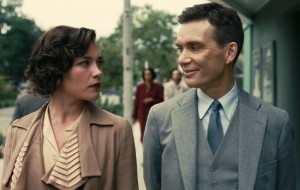 I think I may understand why the subject of sex is something Nolan has conspicuously avoided before. Much has been made about the sex scenes and nudity in Oppenheimer, which seem to be the crux of Florence Pugh’s performance as Jean Tatlock, Oppenheimer’s communist mistress through the years. The moment of Oppenheimer sitting during his hearing about his sexual tryst with an avowed communist leads to him imagining himself in the nude, exposed and vulnerable to these prying eyes and their judgment. Then Kitty imagines seeing Pugh atop her husband in his hearing seat, staring directly at her, and this sequence communicated both of their internal states well and felt justified. It’s the origin of the famous “I am become death” quote where the movie enters an unexpected level of cringe for a movie this serious. I was not prepared for this, so mild spoilers ahead if you care about such things, curious reader. We’re dropped into a sex scene between Oppenheimer and Jean where she takes a break to peruse his library shelves. She’s impressed that he has a Hindu text and pins it against her naked chest and slides atop Oppenheimer once again, requesting he read it to her rather than summarize it. “I am become death,” he utters, as he reads the Hindu Book of the Dead off Pugh’s breasts while they continue to have sex. Yikes. A big ball of yikes. If this is what’s in store, please go back to a sexless universe of men haunted by their lost women.
It’s easy to be swept away by all the ambition of Nolan’s Oppenheimer, a Great Man of History biopic that I think could have been better by being more judiciously critical of its subject. It’s a thoroughly well-acted movie where part of the fun is seeing known and lesser known name actors populate what would have been, like, Crew Member #8 roles for the sake of being part of this movie (Rami Malek as glorified clipboard-holder). Oppenheimer takes some wild swings, many of them paying off tremendously and also a few that made me scratch my head or reel back. It’s a demonstrably good movie with top-level craft, but I can’t quite shake my misgivings that enough of the movie could have been lost to history as well.
Nate’s Grade: B
Share this:

The Last Kiss (2006)
 Zach Braff has exploded in such a short amount of time. He was underappreciated on the perennially underappreciated Scrubs, but then his breakthrough came in 2004 with Garden State, an aloof, charming love story about personal awakening. After just one movie Braff is now a name-above-the-title headliner. For his second film, The Last Kiss, Braff stars as another young man going through another personal crisis. He even selected the radio-friendly songs for the soundtrack just like he did with Garden State. This new movie is actually a remake of a 2001 Italian film, adapted by Oscar-winning screenwriter Paul Haggis (Crash). But there’s one big difference between Garden State and The Last Kiss? Garden State is actually good.
Michael (Braff) works as an architect in Wisconsin. He’s having a bit of a crisis with the state of his life close to his impending thirtieth birthday. His girlfriend, Jenna (Jacinda Barrett), is pregnant with his child and the two are planning for their future, but all around them relationships are falling apart. Chris (Casey Affleck) feels crushed by the demands of his newborn child and wife. Kenny (Eric Christian Olsen) is looking for guilt-free sex. Izzy (Michael Weston) is a wreck after having his heart broken by his ex. Jenna’s parents (Blythe Danner and Tom Wilkinson) may be splitting after 30 years of marriage, not all of them blissful.
With all this in mind, Michael worries that his life seems too scripted now and deficit in surprises. Then along comes Kim (The O.C.‘s Rachel Bilson), a young flirty college student that shows a strong interest in Michael. He must decide where his life is heading and whose hand he’ll be holding.
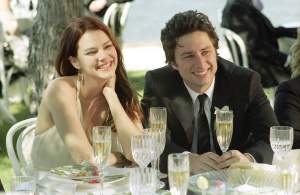 One of the reasons The Last Kiss is hard to get into is that the film never really elaborates why this foursome of guys have it so bad. Chris complains about a dead marriage but maybe his wife would nag him less if he spent more time trying to chip in around the house instead of avoiding his fatherly duties. Kenny is all gung-ho about a hot girl who’s interested in relationship-free sex, but then he runs the other way when, heaven forbid, the girl mentions the idea of commitment. Next thing you know, Kenny is not only running away from this girl but he’s joining Izzy on his cross-country road trip. He’s leaving the state because of the potential whiff of commitment. My friend, after we saw the movie, thought it was too stereotypical (woman: says one thing, wants other, man: scared of anything lasting). She suggested that Kenny slowly turns around his stance and wants to commit to this girl, who he obviously feels to be special. But that would mean The Last Kiss actually cares about the characters of Kenny and Izzy. These two serve more as a spare tire in a male relationship, and both their storylines are tied up with great time to spare.
Worst of all is Michael’s plight. He’s told by his buddies that he’s snagged the “perfect girl,” and from what we see she really is a lovely catch. Michael is freaking out because his life seems too tidy and empty of “surprises” now that a baby on the way. Boo hoo. So to jazz up his surprise-free life he has a fling with a college girl. Surprise! Isn’t your life better now, Michael? If it weren’t for the affable charm of Braff, who emits certain Dustin Hoffman Graduate vibes, the audience would feel no varying degree of sympathy for the dolt. Michael really bruises two innocent people just to needlessly reaffirm what he already knew. It’s hard to get behind all this. We don’t have to like characters, or their actions, but it hurts the drama when you’re simply watching one character hurt others for foolhardy reasons only evident to that character. In Unfaithful, we never really knew why Diane Lane had an affair but at least we saw complexity and strong repercussions.
There’s an element of maturity here and there with the screenplay, but twice as many moments of juvenile fantasies/fears (Look out, women will trap you and control you and expect equal work in return!). The movie has some adult material that works and hits its target but it also falls apart with idiotic musings. The best moments seem to come from the examination of the fading marriage between Jenna’s folks. It’s an interesting slice of life not commonly seen in youth-obsessed Hollywood, and Danner’s outbursts about what it takes to hold a 30-year union together ring true. But this moment falls victim, like many, to a tidy, simpleminded answer. Almost every storyline in The Last Kiss ends with a bow on it all wrapped up. Michael’s told not to give up and he essentially sleeps on his porch, wearing down the anger of his girlfriend through dogged persistence. In fact, the ending reminds me a bit of Secretary, another romance that ended with one lover proving their devotion by staying in one place a really long time. It’s almost insulting that the film presents Michael behaving badly and then excuses him as long as he just sticks it out. It’s not the idea that’s insulting; it’s the fact that The Last Kiss uses this ending as a cheap and easy out.
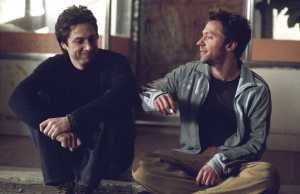 One of the benefits of movies directed by actors is that they tend to generate good performances. Director Tony Goldwyn (A Walk on the Moon) has assembled a nice cast that gives more than the material they get. The real find is Barrett, who may just be the greatest alum of a reality TV show (she was on the London edition of MTV’s The Real World). She showed promise in 2003’s The Human Stain and The Last Kiss is really her declarative ascent. She might start getting a lot of offers that would have normally gone to a Meg Ryan or a Julia Roberts. She shows a range of emotions and her breakdowns are hard to watch because of how well she sells her distress. She handles has a natural ease about her, which pairs nicely with Braff’s laid back, unorthodox charisma. Bilson is cute and crimples her doll face in a way that makes her character seem more naïve than seductress. Braff plays his role a bit subdued. He flashes enough life to not seem like he’s sleepwalking though the same steps he plowed in Garden State. Still, it’s not a very remarkable performance for someone people keep tabbing as a potential voice of a generation (a term nobody could feasibly live up to).
The Last Kiss is an unconvincing, simpleminded, disingenuous drama populated by whiny dolts afraid of the good things they have. It’s hard to sympathize with any of these flawed characters when we never really feel like their gripes hold water. Michael can’t believe his life seems planned out with a wonderful woman who’s having his baby. Solution: screw it up for variety. While it may be the spice of life, it’s also a heedless decision for someone who needs to wreck everything in order to realize what he has/had. This would all be easier to swallow if The Last Kiss didn’t tie everything up with a happy ending that lacked the groundwork. In the end, according to the film, all bad behavior can be wiped clean if you just wear down your significant other. The drama feels forced and the conclusions feel inappropriate. All human beings make mistakes and so do filmmakers.
Nate’s Grade: C
Share this:

The Last Samurai (2003)
 The Last Samurai (2003)
Premise: Alcoholic Civil War vet (Tom Cruise) is hired by the Japanese emperor to modernize his army. After being captured by samurai, he finds solace and fights alongside his former enemy against the emperors modernized army.
Results: A miscast Cruise is not turning Japanese, no matter if he really thinks so. The Last Samurai is a conservative by-the-book epic the limply transports the framework of Dances with Wolves and effectively creates Dances with Japanese People. Dont believe me? Lets go to the videotape. Civil War vet (check) haunted by massacre of Native Americans (check), finds peace with a foreign culture (check), falls in love with one of the foreign women (check), and must battle the invading former culture that threatens his new happiness (check). The film does have lovely cinematography and production design, if that means something to you.
Nate’s Grade: C+
Share this:

Bounce (2000)
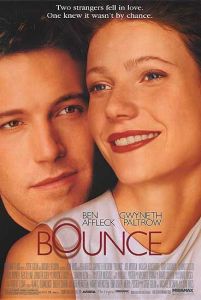 The romantic comedy genre is in a slum of development, it’s own personal ring of hell. It’s become a playing field with a paint-by-numbers coloring book. Color in this section blue for the ignoring bastard of a boyfriend that the heroine is attached to, color this section red for some “misunderstanding” to occur that shatters the perfection of the relationship for ten minutes before a wise-cracking best friend convinces otherwise and reveals their honest true feelings, color this part yellow for eccentric yet lovable colloquial supporting relatives… etc. You hopefully get the idea. It’s all been done before. But can you make a romantic comedy that sticks to the aforementioned rules but is still enjoyable in a non-brain sucking sort of way?
Ben Affleck plays a cocky ad guru with malicious flair. He’s brimming with confidence and a sly charm. One evening he encounters two strangers in an airport bar. One is a sexy blonde that Buddy works his moves to make his own layover. The other man just wants to get back to his wife and family for Christmas but his flight isn’t until the next afternoon. Buddy does the honorable win-win situation and gives up his ticket. The man cheerfully thanks Buddy for his generosity and beams about on his way toward the flight home. Buddy beams about on his way back toward a hotel bedroom. That is until he flips on the TV to see a news report of flaming wreckage that was supposed to be his plane.
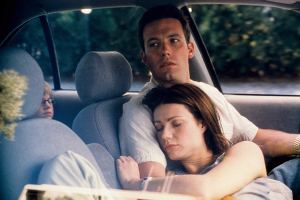 The realization of his close encounter with death and the grief of sending another man to replace him takes its toll. Buddy becomes an alcoholic and belligerent at an awards special where his agency is responsible for spinning the crash for the airline. After some time spent to recover buddy feels the personal need to search for the widow of the man he exchanged tickets with and see if she is doing okay. His widow is played by a brunette Gwyneth Paltrow and little do each think that they will fall in love with one another.
Granted, the story and all the so-called surprises that happen in it are telegraphed much sooner than their arrival. We know he’ll fall for her, we know she’ll find out, we know they’ll be a blow out, we know there will be a reconciliation. We just know. What makes Bounce surge from the formula is the ability of the actors and the wit of writer/director Don Roos. The sophomore film from the man who gave us The Opposite of Sex and lesser screenplays shows controlled and understated direction when dealing with the emotions of his characters.
Affleck quite possibly is showing his finest acting work yet. His Buddy runs the transformation of cocky socialite to a man haunted by grief and weary of his advances on the woman he accidentally widowed. The chemistry between Gwyneth and Affleck is electric and they mesh together very positively. In my later review of Proof of Life I mentioned how because Ryan and Russel Crowe fooled around during film that it didn’t transpire to anything on film. Well the past relationship of the two leads here sure as hell allows for some sizzle. Paltrow is quite fine as a harrowed widow trying to raise her boys. A scene where she slowly discovers the truth of her husband’s fate is wrenching. She also looks good as a brunette.
Roos may have to still play by the rules of romantic comedies but at least he utilizes skill to come away with something that doesn’t seem like Pretty Woman meets Random Hearts. And you know what Random Hearts could have used to make it a little livelier? A supporting performance by Johnny Galecki of course. Well, then again nothing could save that movie.
Nate’s Grade: B
Share this:

Tarzan (1999)
 The next installment in Disney’s stranglehold on children is strikingly beautiful in its fluid animation, color, picture, and at times true excitement. But again it’s just more of the same.
Despite its rich animation, the story is again the lacking problem ringing in Disney’s big ears. Every word and action falls under the strict Disney formula code, which is restraining imaginative thought more than helping it. But that’s what you gotta’ do I guess if you wanna’ sell a billion of Tickle me Tarzan merchandise.
The plot is like a ghost of what Burroughs’ novel was originally, but with the typical Disney formula points; there’s the hero suffering from an identity crisis wanting something more, the fawn-like love interest who will eventually fall in love with the only available white man in central Africa, the treacherous one-note villain, and of course the bumbling sidekicks with comic relief and one-liners of slapstick and amusement for the kids. None of this was in The Iron Giant and it still managed to be a great film. Can we at least drop some of the items on the list?
The movie can get overly pretentious at times with the hammering of the ideals that nature… good, animals… good, man… bad. I’ve heard it all before, do I need it set to Phil Collins’ monotonous radio-friendly pop songs as well now?
Despite some flaws and the worse villain in a Disney movie of recent memory (a poor man’s Gaston) it is still enjoyable and worthwhile even with the creative constraint of the Mickey Mouse. Sure it’s already made millions but for my money Mulan was better.
Nate’s Grade: C+


 nathanzoebl
You must be logged in to post a comment.