Blog Archives
Michael Clayton (2007)
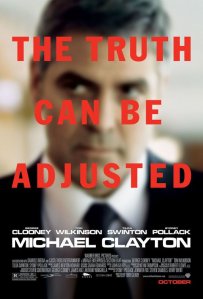 A smart, suspenseful, terrifically acted corporate thriller, this movie hums along with great precision thanks to a deeply articulate screenplay by writer/director Tony Gilroy. The acting trio (George Clooney, Tom Wilkinson, Tilda Swinton) delivers sensational performances muddled with doubt and weary, nervy complexity; each comes across a full human being in what could have come across as a dull Law and Order episode. I don’t understand why Gilroy plays around with the film’s timeframe, because he spends nearly ten minutes at the end in a suspenseful car chase where we already know the outcome. There is a murder that is played against Hollywood convention; it’s quick, grimly efficient, and scary in how soon it’s all over. Michael Clayton is a first-class movie that respects the intelligence of an audience.
Nate’s Grade: A
Share this:

The Last Kiss (2006)
 Zach Braff has exploded in such a short amount of time. He was underappreciated on the perennially underappreciated Scrubs, but then his breakthrough came in 2004 with Garden State, an aloof, charming love story about personal awakening. After just one movie Braff is now a name-above-the-title headliner. For his second film, The Last Kiss, Braff stars as another young man going through another personal crisis. He even selected the radio-friendly songs for the soundtrack just like he did with Garden State. This new movie is actually a remake of a 2001 Italian film, adapted by Oscar-winning screenwriter Paul Haggis (Crash). But there’s one big difference between Garden State and The Last Kiss? Garden State is actually good.
Michael (Braff) works as an architect in Wisconsin. He’s having a bit of a crisis with the state of his life close to his impending thirtieth birthday. His girlfriend, Jenna (Jacinda Barrett), is pregnant with his child and the two are planning for their future, but all around them relationships are falling apart. Chris (Casey Affleck) feels crushed by the demands of his newborn child and wife. Kenny (Eric Christian Olsen) is looking for guilt-free sex. Izzy (Michael Weston) is a wreck after having his heart broken by his ex. Jenna’s parents (Blythe Danner and Tom Wilkinson) may be splitting after 30 years of marriage, not all of them blissful.
With all this in mind, Michael worries that his life seems too scripted now and deficit in surprises. Then along comes Kim (The O.C.‘s Rachel Bilson), a young flirty college student that shows a strong interest in Michael. He must decide where his life is heading and whose hand he’ll be holding.
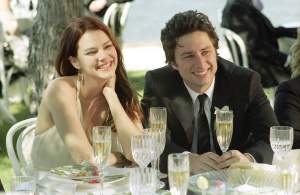 One of the reasons The Last Kiss is hard to get into is that the film never really elaborates why this foursome of guys have it so bad. Chris complains about a dead marriage but maybe his wife would nag him less if he spent more time trying to chip in around the house instead of avoiding his fatherly duties. Kenny is all gung-ho about a hot girl who’s interested in relationship-free sex, but then he runs the other way when, heaven forbid, the girl mentions the idea of commitment. Next thing you know, Kenny is not only running away from this girl but he’s joining Izzy on his cross-country road trip. He’s leaving the state because of the potential whiff of commitment. My friend, after we saw the movie, thought it was too stereotypical (woman: says one thing, wants other, man: scared of anything lasting). She suggested that Kenny slowly turns around his stance and wants to commit to this girl, who he obviously feels to be special. But that would mean The Last Kiss actually cares about the characters of Kenny and Izzy. These two serve more as a spare tire in a male relationship, and both their storylines are tied up with great time to spare.
Worst of all is Michael’s plight. He’s told by his buddies that he’s snagged the “perfect girl,” and from what we see she really is a lovely catch. Michael is freaking out because his life seems too tidy and empty of “surprises” now that a baby on the way. Boo hoo. So to jazz up his surprise-free life he has a fling with a college girl. Surprise! Isn’t your life better now, Michael? If it weren’t for the affable charm of Braff, who emits certain Dustin Hoffman Graduate vibes, the audience would feel no varying degree of sympathy for the dolt. Michael really bruises two innocent people just to needlessly reaffirm what he already knew. It’s hard to get behind all this. We don’t have to like characters, or their actions, but it hurts the drama when you’re simply watching one character hurt others for foolhardy reasons only evident to that character. In Unfaithful, we never really knew why Diane Lane had an affair but at least we saw complexity and strong repercussions.
There’s an element of maturity here and there with the screenplay, but twice as many moments of juvenile fantasies/fears (Look out, women will trap you and control you and expect equal work in return!). The movie has some adult material that works and hits its target but it also falls apart with idiotic musings. The best moments seem to come from the examination of the fading marriage between Jenna’s folks. It’s an interesting slice of life not commonly seen in youth-obsessed Hollywood, and Danner’s outbursts about what it takes to hold a 30-year union together ring true. But this moment falls victim, like many, to a tidy, simpleminded answer. Almost every storyline in The Last Kiss ends with a bow on it all wrapped up. Michael’s told not to give up and he essentially sleeps on his porch, wearing down the anger of his girlfriend through dogged persistence. In fact, the ending reminds me a bit of Secretary, another romance that ended with one lover proving their devotion by staying in one place a really long time. It’s almost insulting that the film presents Michael behaving badly and then excuses him as long as he just sticks it out. It’s not the idea that’s insulting; it’s the fact that The Last Kiss uses this ending as a cheap and easy out.
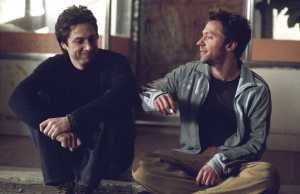 One of the benefits of movies directed by actors is that they tend to generate good performances. Director Tony Goldwyn (A Walk on the Moon) has assembled a nice cast that gives more than the material they get. The real find is Barrett, who may just be the greatest alum of a reality TV show (she was on the London edition of MTV’s The Real World). She showed promise in 2003’s The Human Stain and The Last Kiss is really her declarative ascent. She might start getting a lot of offers that would have normally gone to a Meg Ryan or a Julia Roberts. She shows a range of emotions and her breakdowns are hard to watch because of how well she sells her distress. She handles has a natural ease about her, which pairs nicely with Braff’s laid back, unorthodox charisma. Bilson is cute and crimples her doll face in a way that makes her character seem more naïve than seductress. Braff plays his role a bit subdued. He flashes enough life to not seem like he’s sleepwalking though the same steps he plowed in Garden State. Still, it’s not a very remarkable performance for someone people keep tabbing as a potential voice of a generation (a term nobody could feasibly live up to).
The Last Kiss is an unconvincing, simpleminded, disingenuous drama populated by whiny dolts afraid of the good things they have. It’s hard to sympathize with any of these flawed characters when we never really feel like their gripes hold water. Michael can’t believe his life seems planned out with a wonderful woman who’s having his baby. Solution: screw it up for variety. While it may be the spice of life, it’s also a heedless decision for someone who needs to wreck everything in order to realize what he has/had. This would all be easier to swallow if The Last Kiss didn’t tie everything up with a happy ending that lacked the groundwork. In the end, according to the film, all bad behavior can be wiped clean if you just wear down your significant other. The drama feels forced and the conclusions feel inappropriate. All human beings make mistakes and so do filmmakers.
Nate’s Grade: C
Share this:

Batman Begins (2005)
 I have been a Batman fan since I was old enough to wear footy pajamas. I watched the campy Adam West TV show all the time, getting sucked into the lead balloon adventures. Tim Burton’s 1989 Batman was the first PG-13 film I ever saw, and I watched it so many times on video that I have practically worn out my copy. Batman Returns was my then most eagerly anticipated movie of my life, and even though it went overboard with the dark vision, I still loved it. Then things got dicey when Warner Brothers decided Batman needed to lighten up. I was only a teenager at the time, but I distinctly remember thinking, “You’re telling the Dark Knight to lighten up?” Director Joel Schumacher’s high-gloss, highly stupid turn with Batman Forever pushed the franchise in a different direction, and then effectively killed it with 1997’s abomination, Batman and Robin. I mean these films were more worried about one-liners and nipples on the Bat suits. Nipples on the Bat suits, people! Is Batman really going, “Man, you know, I’d really like to fight crime today but, whoooo, my nipples are so chaffed. I’m gonna sit this one out”?
For years Batman languished in development hell. Warner Bothers licked their wounds and tried restarting their franchise again and again, only to put it back down. Then around 2003 things got exciting. Writer/director Christopher Nolan was announced to direct. Nolan would also have creative control. Surely, Warner Brothers was looking at what happened when Columbia hired Sam Raimi (most known for low-budget splatterhouse horror) for Spider-Man and got out of his way. After Memento (My #1 movie of 2001) and Insomnia (My #5 movie of 2002), Nolan tackles the Dark Night and creates a Batman film that’s so brilliant that I’ve seen it three times and am itching to go again.
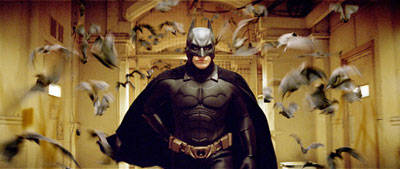 The film opens with a youthful Bruce Wayne (Christian Bale) in a Tibetan prison. He’s living amongst the criminal element searching for something within himself. Henri Ducard (Liam Neeson) offers Bruce the chance to be taught under the guidance of the mysterious Ra’s Al Ghul (Ken Watanabe), the leader of the equally mysterious warrior clan, The League of Shadows. Under Ducard’s direction, Bruce confronts his feelings of guilt and anger over his parents’ murder and his subsequent flee from his hometown, Gotham City. He masters his training and learns how to confront fear and turn it to his advantage. However, Bruce learns that the League of Shadows has its judicial eyes set on a crime ridden Gotham, with intentions to destroy the city for the betterment of the world. Bruce rebels and escapes the Tibetan camp and returns to Gotham with his own plans of saving his city.
With the help of his trusted butler Alfred (Michael Caine), Bruce sets out to regain his footing with his family’s company, Wayne Enterprises. The company is now under the lead of an ethically shady man (Rutger Hauer) with the intentions of turning the company public. Bruce befriends Lucius Fox (Morgan Freeman), the company’s gadget guru banished to the lower levels of the basement for raising his voice. Bruce gradually refines his crime fighting efforts and becomes the hero he’s been planning on since arriving home.
Gotham is in bad shape too. Rachel Dawes (Katie Holmes), a childhood friend to Bruce, is a prosecutor who can’t get anywhere when crime lords like Falcone (Tom Wilkinson) are controlling behind the scenes. Most of the police have been bought off, but Detective Gordon (Gary Oldman) is the possibly the city’s last honest cop, and he sees that Batman is a figure trying to help. Dr. Crane (Cillian Murphy) is a clinical psychologist in cahoots with Falcone. Together they’re bringing in drug shipments for a nefarious plot by The Scarecrow, a villain that uses a hallucinogen to paralyze his victims with vivid accounts of their own worst fears. Bruce is the only one who can unravel the pieces of this plot and save the people of Gotham City.
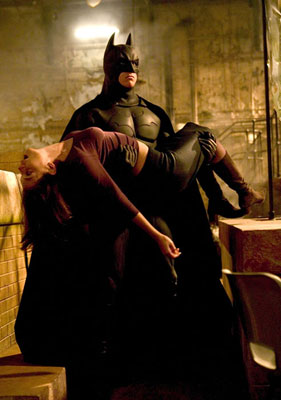 Nolan has done nothing short of resurrecting a franchise. Previous films never treated Batman as an extraordinary character; he was normal in an extraordinary world. Batman Begins places the character in a relatively normal environment. This is a brooding, intelligent approach that all but erases the atrocities of previous Batman incarnations. Nolan presents Bruce Wayne’s story in his typical nonlinear fashion, but really gets to the meat and bone of the character, opening up the hero to new insights and emotions, like his suffocating guilt over his parents murder.
Nolan and co-writer David S. Goyer (the Blade trilogy) really strip away the decadence of the character and present him as a troubled being riddled with guilt and anger. Batman Begins is a character piece first and an action movie second. The film is unique amongst comic book flicks for the amount of detail and attention it pays to characterization, even among the whole sprawling cast. Nolan has assembled an incredible cast and his direction is swimming in confidence. He’s a man that definitely knows what he’s doing, and boy oh boy, is he doing it right. Batman Begins is like a franchise colonic.
This is truly one of the finest casts ever assembled. Bale makes an excellent gloomy hero and really transforms into something almost monstrous when he’s taking out the bad guys. He’s got great presence but also a succinct intensity to nail the quieter moments where Bruce Wayne battles his inner demons. Caine (The Cider House Rules, The Quiet American) is incomparable and a joy to watch, and his scenes with the young Bruce actually had me close to tears. This is by far the first time a comic book movie even had me feeling something so raw and anything close to emotional. Neeson excels in another tough but fair mentor role, which he seems to be playing quite a lot of lately (Kingdom of Heaven, Star Wars Episode One). Freeman steals every scene he’s in as the affable trouble causer at Wayne Enterprises, and he also gets many of the film’s best lines. Oldman (The Fifth Element, Harry Potter and the Prisoner of Azkaban) disappears into his role as Gotham’s last good cop. If ever there was a chameleon (and their name wasn’t Benicio del Toro), it is Oldman. Holmes works to the best of her abilities, which means she’s “okay.”
The cast of villains are uniformly excellent, with Wilkinson’s (In the Bedroom) sardonic Chicagah accented mob boss, to Murphy’s (28 Days Later…) chilling scientific approach to villainy, to Watanabe’s (The Last Samurai) cold silent stares. Even Rutger Hauer (a man experiencing a career renaissance of his own) gives a great performance. Seriously, for a comic book movie this is one of the better acted films of the year. And that’s saying a lot.
Batman Begins is such a serious film that it almost seems a disservice to call it a “comic book movie.” There are no floating sound effects cards and no nipples on the Bat suits. Nolan really goes about answering the tricky question, “What kind of man would become a crime-fightin’ super hero?” Batman Begins answers all kinds of questions about the minutia of the Dark Knight in fascinating ways, yet the film remains grounded in reality. The Schumacher Batmans (and God save us from them) were one large, glitzy, empty-headed Las Vegas entertainment show. No explanation was given to characters or their abilities. Likewise, the Gothic and opulent Burton Batmans had their regrettable leaps of logic as well. It’s hard not to laugh at the end of Batman Returns when Oswald Cobblepot (a.k.a. The Penguin) gets a funeral march from actors in emperor penguin suits. March of the Penguins it ain’t. Nolan’s Batman is the dead-serious affair comic book lovers have been holding their breath for.
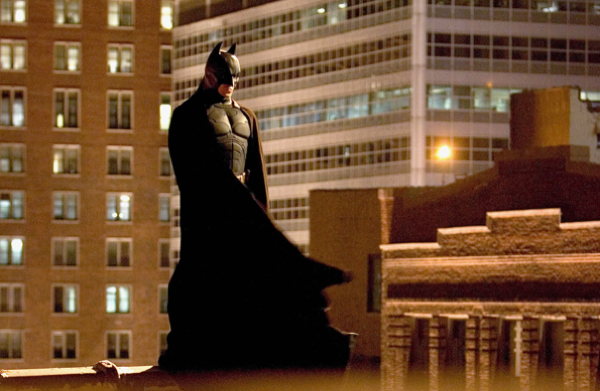 The action is secondary to the story, but Batman Begins still has some great action sequences. Most memorable is a chase sequence between Gotham police and the Batmobile which goes from rooftop to rooftop at one point. Nolan even punctuates the sequence with some fun humor from the police (“It’s a black … tank.”). The climactic action sequence between good guy and bad guy is dutifully thrilling and grandiose in scope. Nolan even squeezes in some horror elements into the film. Batman’s first emergence is played like a horror film, with the caped crusader always around another turn. The Scarecrow’s hallucinogen produces some creepy images, like a face covered in maggots or a demonic bat person.
There are only a handful of flaws that make Batman Begins short of being the best comic book movie ever. The action is too overly edited to see what’s happening. Whenever Batman gets into a fight all you can see are quick cuts of limbs flailing. My cousin Jennifer got so frustrated with the oblique action sequences that she just waited until they were over to see who won (“Oh, Batman won again. There you go.”). Nolan’s editing is usually one of his strong suits; much of Memento’s success was built around its airtight edits. He needs to pull the camera back and let the audience see what’s going on when Batman gets physical.
Another issue is how much plot Batman Begins has to establish. This is the first Batman film to focus solely on Batman and not some colorful villain. Batman doesn’t even show up well into an hour into the movie. As a result, Batman Begins perfects the tortured psychology of Bruce Wayne but leaves little time for villains. The film plays a shell game with its multiple villains, which is fun for awhile. The Scarecrow is really an intriguing character and played to gruesome effect by the brilliant Cillian Murphy. It’s a shame Batman Begins doesn’t have much time to develop and then play with such an intriguing bad guy.
Batman Begins is a reboot for the film franchise. Nolan digs deep at the tortured psyche of Bruce Wayne and come up with a treasure trove of fascinating, exciting, and genuinely engrossing characters. Nolan’s film has a handful of flaws, most notably its oblique editing and limited handling of villains, but Batman Begins excels in storytelling and crafts a superbly intelligent, satisfying, riveting comic book movie. The best bit of praise I can give Batman Begins is that I want everyone responsible to return immediately and start making a host of sequels. This is a franchise reborn and I cannot wait for more of it.
Nate’s Grade: A
Share this:

Eternal Sunshine of the Spotless Mind (2004)
 No other movie this year captured the possibility of film like Michel Gondry and Charlie Kaufman’s enigmatic collaboration. Eternal Sunshine was a mind-bending philosophical excursion that also ended up being one of the most nakedly realistic romances of all time. Joel (Jim Carrey restrained) embarks on having his memories erased involving the painful breakup of Clemintine (Kate Winslet, wonderful), an impulsive woman whose vibrant hair changes as much as her moods. As Joel revisits his memories, they fade and die. He starts to fall in love with her all over again and tries to have the process stop. This labyrinth of a movie gets so many details right, from the weird physics of dreams to the small, tender moments of love and relationships. I see something new and marvelous every time I watch Eternal Sunshine, and the fact that it’s caught on with audiences (it was nominated for Favorite Movie by the People’s friggin’ Choice Awards) reaffirms its insights into memory and love. I never would have thought we’d get the perfect romance for the new millennium from Kaufman. This is a beautiful, dizzingly complex, elegant romance caked in visual grandeur, and it will be just as special in 5 years as it will be in 50, that is if monkeys don’t evolve and take over by then (it will happen).
Nate’s Grade: A
Share this:

In the Bedroom (2001)
 In the Bedroom hits all the right notes of agonizing pain, devastation and loss. The heart of the film is on the grief encompassing Matt and Ruth Fowler (Tom Wilkinson and Sissy Spacek) over the loss of their son. The Fowlers are well regarded in their cozy New England town. Matt is a flourishing local doctor and Ruth teaches a chorus of local high school girls.
In the Bedroom opens with Frank Fowler (Nick Stahl) chasing his older girlfriend Natalie (Marisa Tomei) across an open grassy field. Frank is a budding architecture student home for the summer and thinking of prolonging his time so he can stay together with Natalie. Frank and Natalie have a distinct age divide but also seem to have been given different lots in life. She has a pair of boys from her abusive husband Richard (William Mapother) that she is finalizing a divorce from. Richard is hopeful he can reconcile with Natalie if he just gets another chance, but Natalie is stern in her refusal.
 Ruth sees the relationship as a detriment to her son’s future. She’s even more upset that Matt is so casual with their son dating an older, working-class mother. Frank rushes over to calm Natalie after another of Richard’s outbursts of violence has left her house in shambles. She rushes her children upstairs just as Richard returns back. He manages to sneak in through a back door and confronts Frank in their kitchen, shooting and killing him. What should seem like a clear-cut case begins to unspool. Natalie admits she didn’t actually see the gun fire and the charges are dropped from murder to manslaughter. Richard is released on bail and free to stroll around occasionally bumping into the grieving and outraged Fowlers.
The majority of the film is the aftermath of the murder and the strain it puts upon Matt and Ruth and their marriage. Beforehand jealousy, anger, and bitterness would simply sit but slowly the tension begins to bubble to the surface. Ruth holds resentment and blames the leniency of Matt for the death of their son. Matt tries to get out of the house as much as possible, even if it means sitting in his car in their driveway at night.
One of the most harrowing scenes of In the Bedroom is also its emotional and acting centerpiece. After the mounting frustration with justice, Ruth and Matt explode into an argument that had slowly been building long before their son’s death. This is the first time they have truly talked about the whole situation and accusations fly like bullets in their first emotional confrontation. In the Bedroom could have easily fallen into the area of sticky made-for-TV land, but the exceptional performances all around by the cast and the deft and studied direction never allow it to falter.
Spacek (Carrie, Coal Miner’s Daughter) can begin writing her Oscar acceptance speech right now. Her portrayal of Ruth displays the pride and seething anger, but keeps her human throughout. She exhibits pure, raw emotion that strikes directly inside you leaving a knot in your stomach and in your throat. Her performance is truly breathtaking and so emotionally visceral to watch. Wilkinson (The Full Monty) plays Matt with passive-aggressive doubt and repression. He dominates in any scene he is in and takes the audience on a wide range of emotions. He has a commanding presence and compliments Spacek’s Ruth nicely. Perhaps the greatest thing Tomei (My Cousin Vinny, Slums of Beverly Hills) was known for was miraculously winning an Oscar and dumbfounding a nation. With ‘In the Bedroom’ she is given the ubiquitous “And” credit at the end of the opening cast list. She has less to work with and less screen time to work it, fully earning the “And”‘ credit she has.
 Todd Field is an actor-turned-director and has appeared in such a wide array of films from Twister to Eyes Wide Shut. Field has layered his film with rich symbolism and an intelligent, patient pace. Most of the action in movies is centered on what is going on in a scene, but the most telling moments of In the Bedroom are what are not going on in the scenes. Field creates such an intimate portrait that the camera almost turns into another character, catching the lingering silences and the burgeoning inner turmoil. Field also adapted the screenplay from a short story by Andre Dubus, whom he dedicates the film to.
In the Bedroom is not going to be for everyone. Some will find it slow and some might even find it boring. As it stands, it is a powerful film on the study of loss that grips you and refuses to let go. You will feel all the blame, jealousy, anger, and pain of this family and for such emotions to resonate from the screen to the audience is a great achievement.
Nate’s Grade: A
Reviewed 20 years later as part of the “Reviews Re-View: 2001” article.
Share this:

The Patriot (2000)
 For all the controversy this flag-waving picture is garnering over historical accuracy, turning British commanders Nazi-like, ignoring slavery like Spike Lee said, people forget it’s a well tuned and fairly touching and always exciting movie.
The battle sequences are shot with great suspense and visual expertise. The gore flies often, as this would be a very gory war indeed. On a personal note this movie has had the best squib hits (blood shot explosions for those who don’t know) I’ve ever seen. But the main focus isn’t the war, it’s merely a back drop for the story of a family man Benjamin Martin (Mel Gibson) avenging the death of one of his sons and being pulled into the war fighting for a purpose. Mel Gibson gives a wonderful performance as the troubled father man afraid of his past sins and what the future may bring. His thoughts are never on the enemy but on his children he loves dearly. Heath Ledger (10 Things I Hate About You) plays Gibson’s oldest son Gabriel and is the break-out star. His acting is as sharp as a bayonet and the future looks very promising for this Aussie actor.
The most necessary quality a movie must have to pull for the hero is a hissable villain, and The Patriot has a villain that will likely be the best (worst?) of the summer and possible year. Well known British stage actor Jason Isaacs gives such delight in every snarl and evil grin that Tavington, his character, exudes. You can peer into his eyes and see evil — and that’s great acting. He truly relishes his actions. With a wonderfully bad villain it only pulls more emotional heft to the story written by Saving Private Ryan‘s scibe Robert Rodat on a personal mission to pen a movie about every major American war.
The Patriot isn’t spot free, especially after a multiple tomahawk attack. Some of its characters are sloppy and the end is rather predictable and somewhat cheesy that the two men do battle as the focal point of the entire war. And you might just laugh when Gibson races back to the front of a quivering line and waving the flag to inspire the troops. There’s also many unnecessary and stupid sub-plots. Some work like Gabriel’s love story, some don’t like the one black man entering the unit to fight for his freedom met with the usual hostility.
The Patriot is a movie filled with excitement, great direction, and worthy characters. So do something for your nation and plop down seven bucks and see this movie.
Nate’s Grade: B


 nathanzoebl
You must be logged in to post a comment.