Blog Archives
Until Dawn (2025)

I’m going to do something I don’t know if I’ve ever really done before in my twenty-five-plus years of toil as a film critic. I’m going to devote almost the entirety of this review to try and make sense of the ending and its cascading choices that confound and astound me. I’ll present some spoiler-free analysis beforehand but, dear reader, this is going to be a spoiler-heavy review because, quite simply, it’s all I want to talk about as it concerns Until Dawn. The horror movie is an adaptation of a 2014 PlayStation video game that itself was fashioned like a ten-hour horror movie. It was a love letter to the horror genre and your goal was to keep as many of the characters alive as you could through quick-time events and choices that could have lingering and unexpected consequences later in the game. It was, above all else, fun, and news that Hollywood was going to turn it into a movie made a degree of sense. After all, it was practically an interactive movie to begin with. Then news matriculated that they weren’t really adapting the game and instead were making something new and different, so why call it Until Dawn? Beyond the cash-grab from the use of a familiar name, if you’re going to be Until Dawn in name only, why not just be that original horror idea and let someone else actually adapt Until Dawn as it was? You’re not going to get another crack at this title, so why is the first attempt one that could be done without the game existing? Regardless, the movie is a bad adaptation of the game and a bad use of dwindling brain cells.
Five teenagers make a trip to search of Clover’s (Ella Rubin) missing older sister. They trace her last recording to a gas station just outside the mining town of Gore County. The gas station attendant (Peter Stormare) lets these curious kids know that weird things happen in town, and sure enough the weird stranger is right. The teens take refuge in a visitor center with a guestbook and a peculiar hourglass time piece on the wall. Soon enough they’re beset with masked killers and monsters and each of the five friends is slaughtered. Then they wake up back in the visitor center with the hourglass starting over. They have to learn about this mysterious location to try and stay alive all the way… until dawn!

Before the heavy spoilers begin, I’ll provide a few accolades to what the movie does well. Director David F. Sandberg (Shazam!, Lights Out) has a clear affinity for the horror genre and can summon some pretty effective and skin-crawling imagery. I actually like the premise of a horror time loop, though this was also covered with the tongue-in-cheek genre tweak that was 2017’s Happy Death Day. However, that movie primarily dealt with a slasher scenario whereas Until Dawn can mix and match different genres, which makes each new iteration feel like a blank slate to explore. I loved the shortest loop, where the characters hold up in a bathroom and gruesomely discover what happens if you drink the local water. It’s the best development in the movie and one I’m glad the script revisits from time to time. With most time loop movies, once the characters adjust to the reality that death is not final, they get a little more loose with their physical well-being. I enjoyed some of the turns the characters make with the understanding that they’ll come back again. The visual nods and connections to the game are there without feeling too gimmicky. Plus, having Stormare come back to play a variation on his nattering psychiatric weirdo from the game is exactly what the movie adaptation needs. Stormare is on his own unique wavelength.
Now, the madness. Abandon all hope ye who enter the spoiler section of this review.
I don’t understand this movie. At all. I read over its Wikipedia summary and watched a few of those YouTube explanation videos to see if it was just me and I missed important pieces of information that would connect the various elements together. It’s not me, folks. These story elements don’t connect. They don’t form a coherent whole. I don’t need a reason why time loop scenarios happen; they never explained it with the genre grandaddy Groundhog Day, and if it’s good enough for Groundhog Day, it’s good enough for your movie. The problem is when they try to explain and it actively makes things worse, because now you begin to question everything. I liken it to 2019’s Us, a movie with plenty of outlandish story elements including the existence of a same-age evil twin for every person but living in a subterranean mimicry of surface life. I would have happily accepted that as-is, but then the movie tries to find a real explanation for where these people came from and why, and now the illusion of ignorance is shattered. Now all those pesky questions start flooding the mind that could have before been kept at bay.

Let’s examine the explanations for the two primary mysteries: 1) why there are monsters, and 2) why there is a time loop trap. Again, both of which didn’t even need explanations but here we go.
The mythology of the game gets ported over in starts and stops, but the movie keeps the setting of a mining town that had a tragic collapse that devastated the town. In this version, the majority of the town fell into a sinkhole below the earth. Do we get to explore these exciting and creepy locations? Nope. One of the town’s psychiatrists (Stormare) is still alive and continuing his mad experiments for… reasons. Like the game, there is a curse wherein if you resort to cannibalism you will become a spooky wendigo monster, so the creatures are a result of the former townspeople and other past residents from the previous time loops. Fine. I can accept that. However, late in the movie, our creepy psych doc clarifies for Clover that things aren’t just all in her head, a nod to the original game. Except that ending would have made more sense. The new ending says that Clover’s fears are responsible for manifesting the different antagonistic monsters and killers. Okay, so we’re externalizing the internal, fine, but why her? Why not any of the other friends? Does this mean every previous group was also responsible for manifesting their own tormentors based upon personal psychological fears? Why are we including this roulette wheel of terrors on top of the constant of the wendigo creatures? How is this even happening because the movie gives no scant indication? Do the deadly rules get reset with each new group? In our story, the characters can’t drink the water, but what about other groups? If every group is manifesting the same avatars of fear then why not just adopt them as stable rules? Why is this one man staying behind to catalogue the results? He’s mortal so he just lives in the sinkhole or works at the gas station, waiting for wayward teens to stumble into his next experimental group? Who is keeping the lights on in this visitor center? What does this guy do during the “off season” when there are no looky-loos? Does he have to feed the existing wendigos like some kind of demented zoo? What is to be gained from all these experiments? Is he planning on publishing his research later? What is this guy’s regular life like?

Then there’s the time loop explanation which is -wait for it- nothing. Absolutely nothing. Why are characters getting second and third and thirteenth chances to survive until dawn? Why is it thirteen? The movie doesn’t even have the time to demonstrate thirteen loops, instead jumping from like the fourth straight to the last one through the annoying use of, “Oh, let’s watch these film clips we took that we don’t remember.” If you didn’t have the interest or time for thirteen loops, why even make it thirteen? Why does the number matter if they inevitably turn into wendigos from desperate cannibalism? You would think the loops should be infinite to guarantee this result. Why would the other victims bother writing their name in the guestbook every loop? It establishes a timeline of sorts, but if writing can last in this guestbook, why doesn’t anyone write anything other than their name over and over? Detailing your experiences and lessons learned as a living record might be helpful to future loopers. Also, what obligations do these people feel about signing their names in the guestbook? Who accepts getting murdered over ten times but is still being a stickler for signing their name, and for what? Are they getting some little feeling of superiority that they were able to scribble their name thirteen times? Where did the hourglass come from? It definitely looks like it was installed with purpose, so did these just materialize? Why do the timeloops even consider having a mechanism for letting participants win and escape? What about the other quirks like how the weather is affected by the bad vibes of this place? Even the rain knows better.
So, in summation, the time loops and manifesting monsters are unrelated to one another and there is no added context provided for like some ancient curse or witchy magic or anything to cause this mess. There is one nefarious wacko doctor who just hangs around for kicks, though why he is immune from the loops or the larger effects of the manifested monsters is beyond me. Is he recruiting the monsters like some sort of work foreman, telling this gnarly creature, “Need ya to pull a double today, Fangy.” It just all feels like scary elements working in parallel and occasionally drifting into one another’s orbit, but there’s no fitting or acceptable explanation, so why does the movie even try to present one in the first place? I’m stunned at how Until Dawn just completely unravels into incoherent madness by the conclusion, which sets up that there might be a larger universe of these doctors overseeing experiments. At that point, you might as well be watching The Cabin in the Woods. If you have no allegiance or familiarity with the video game, you might find enough to amuse you, at least for fleeting moments. I was open-minded to what an Until Dawn-in-name-only adaptation could do with a time loop gimmick, but the final results feel like an uneven grab-bag of imagery and ideas and directions that go nowhere.
Nate’s Grade: C-
Share this:

Boss Level (2021)
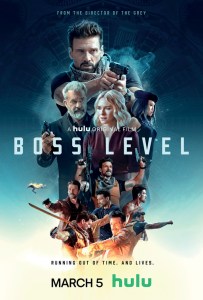 It’s a time loop action movie where Frank Grillo (The Purge: Anarchy) plays a special forces agent going through one long, hellish, bullet-heavy day of violence on repeat. As with other time loop movies, the joy is watching the many different iterations and building from previous excursions and finding the fun detours to discover with the many “what if” scenarios at play. Boss Level is simply fun and disposable entertainment. We watch Grillo strut through the day with amazing clairvoyance and annoyance as he does over and over again, with a team of flashy Smokin’ Aces-esque super assassins chasing him down through the day to score the big hit. The story is rather generic with Grillo learning to take responsibility for being a father, with a generic villain played by Mel Gibson and a generic damsel-in-distress ex-wife played by Naomi Watts. The appeal is Grillo and his gruff charm as well as the darkly comic violence and the creative ingenuity of Grillo dying over and over and then persevering. The action, while definitely scaled down through its lower budget, is filled with fast cars, explosions, gun fights, and pulpy over-the-top deaths to really make the movie feel like perhaps the best video game adaptation even if it was never a video game. The biggest drawback is that this movie is packed, wall-to-wall, with excessive and grating voice over where Grillo’s character will explain EVERYTHING on screen and I just wanted him to shut up. It’s not like his constant verbal commentary is really adding anything; he’s not exactly a character with a strong personality. I am not kidding when I say that 90 percent of this voice over could be eliminated entirely. Imagine being stuck beside an annoying and ceaselessly chatty neighbor in a theater and having that intrusion drown out the experience of the movie, and that’s how prevalent and irritable the constant voice over can be. Seriously, there’s more voice over than dialogue here. Otherwise, Boss Level is a suitably stylish, slick, and action-packed B movie with enough flair and imagination to fill up 90 minutes of entertainment. Three time loop movies in under one year makes me wonder what genre will next be explored. Get ready for the medical drama time loop, the courtroom thriller time loop, and maybe even the disaster movie time loop. Whatever they may be, they guarantee at least a watch from me.
Nate’s Grade: B-
Share this:

The Map of Tiny Perfect Things (2021)

Reader, I love time loop movies and their very playful nature of storytelling that allows for plenty of payoffs and creativity and inherent pathos of being stuck reliving life experiences. Palm Springs was my second favorite movie of 2020, so how soon am I ready for yet another time loop romantic comedy, this time from a very Young Adult perspective and with an overly precious title? The Map of Tiny Perfect Things is very much a time loop formula by heavy amounts of YA twee whimsy and worldly lessons. It’s charming, witty, predictable, and maybe a little too content, much like its central characters, to meander when there was more meaning to explore.
17-year-old Mark (Kyle Allen) lives in a small town and is stuck in a time loop living the same day over and over. He argues with his younger sister, rolls his eyes at his out-of-work father’s Civil War novel he’s devoted to writing, and skateboarding around town and skipping school. His buddy Henry is stuck on the same video game level, his mom leaves for work before he wakes up, and every night his father tries to talk to Mark about what he wants to do with a future that he will never see. Then Mark meets Margaret (Kathryn Newton) who appears to be aware of the same loop. Now he has a partner and together they have fun being mischievous in a world where people are eternally asleep and unaware, a world without larger consequence.

The Map of Tiny Perfect Things is an immediately entertaining movie that glides by on charm and cuteness before bringing the heavier emotional catharsis we know is coming. Kyle’s daily routine is reminiscent of the beginning of Palm Springs (for fairness, I’ll try to refrain from making comparisons at every turn) where we see the breadth of the man’s knowledge and implication of how long he’s had to accrue this god-like understanding of timed events. It’s fun to watch Mark push a man out of the way before getting pooped on by a bird, or catch a falling book in the library, or know the answer before a person can even ask their question. The movie takes a while to fully get going but it keeps entertaining you in the meantime with these pleasant quirks. This is indicative throughout the movie. Even when the plot is just coasting, screenwriter Lev Grossman (adapting from his own short story) keeps things swift and entertaining. There’s a montage of Mark getting awful haircuts and sending pictures to Margaret, and then lamenting maybe they can meet up the next day instead once his hair resets. The script is packed with quick-witted jokes and fun visuals that it can return to for elevated and imaginative payoffs. Each side character has their own sustained loop and checking in on each is a reminder that they all have their own little universe of struggle and desire and despair. It’s one of those benefits of time loop movies; they are like getting 32 flavors of stories in one delicious 90-minute serving.
Just like Palm Springs (I lied), the big plot change comes with the discovery of a partner also re-living the same day in infinity. From there, the story becomes a very standard YA romance but set in an extraordinary setting. Margaret doesn’t qualify as a Manic Pixie Dream Girl but she is more blunt, assertive, and seeking out a deeper meaning for their shared purgatory. She’s not the quirky free spirit we associate with the type. She’s more goal-oriented and literal than Mark, and she even takes on teaching him algebra. Once the love interest is introduced, the movie starts a countdown clock for how long it will take for a romance to kindle. Mark is clearly lonely and we see his failed attempt to spark up a potential romance with another girl who will forever be trapped in, at best, a first date mentality. You can’t build a relationship when everyone else only has 24 hours unless it’s like Before Sunrise. Margaret expresses a deep reluctance about anything going beyond the platonic, especially if she and Mark are the only two humans in this “temporal anomaly” for a potential eternity. Just imagine a failed relationship with a co-worker and having to uncomfortably mingle at the same job for years. Mark, being the headstrong young lad in a YA drama, is certain he can win her over in the long run and that his feelings must be true and therefore honored. Since the movie is being told from his perspective, his yearning is given primacy and it makes for an uncomfortable arc.

But it’s the last act of the movie where the larger emotional connection takes root and where the actual life lessons are to be had. This is not a movie about stopping to enjoy the little things in life that otherwise might go ignored. That element is present, and the subsequent scavenger hunt across town to catalogue all the cute little moments of humanity and nature dominates Act Two. It’s a cute little premise and something we’ve seen in countless other YA tales, finding the hidden beauty right under our noses in our lives. The message is clear and fine, but it’s what takes place toward the end where The Map of Tiny Perfect Things takes off from its YA orbital decay of preciousness. If you’ve watched enough movies, you should likely start to guess where Margaret disappears every day after six o’clock and what secrets she may be hiding. I won’t spoil what is revealed but I was waiting for Mark to wise up as quickly as I did. He does, and the movie takes on a transformation toward the end that changes perspective, weight, and even provides a little subversion on the previous male gaze that was our primary filter. The end provides a satisfying enough conclusion that examines the nature of grief and processing. The way the secret design of this universe is discovered is slight and ridiculous, but it doesn’t take away from the movie successfully landing the most difficult part of its emotional journey.
It also helps that both of our leads have great chemistry and are genuinely likeable. Allen (All My Life) has a laid-back presence that fits nicely with the genial vibes of the movie. He’s funny without being obnoxious and emotive without being melodramatic. He starts off sardonic and flip but becomes more earnest as his character learns to stop and listen and invest in others. Newton (Freaky) is enjoyably no-nonsense without being prickly. Margaret is a character with layers and ultimately, you’ll wish the movie had been retold from her point of view from the very beginning. There’s a reason for this, but there’s much more depth and sadness to Margaret. Still, even just hanging out with them as they observe the day, share their stories and discoveries, and pop-culture-heavy banter back and forth is entertaining because the writing and acting carry the day.

What holds The Map of Tiny Perfect Things back is that it never really goes into larger questions of self, identity, and the existential conundrum of at once being the center of a universe with limitless time and being unable to move forward. It feels a bit too content to stay on a lower level and dust off many familiar YA tropes to have a diverting good time. That’s fine, though in direct comparison to something like Palm Springs (my apologies), it can feel lacking. Think about Mark’s inability to see his mother again and how that unique circumstance forms its own loss. More attention to these details would have been preferred than on-the-nose pop-culture references and deep cuts for hipster points. It’s a good cheerful time with plenty of wry amusement and some well-earned emotions, but it also feels a little too content to simply hang around and follow the YA map for programmed spiritual affirmation. It manages to subvert the quirky-girl-shows-guy-how-to-carpe-his-diem formula, but that’s not before devoting plenty of time walking the same walk for a little longer than needed. If you’re a fan of time loop parables, YA stories, or unconventional rom-coms, check out The Map of Tiny Perfect Things and then, maybe, if you haven’t already, also Palm Springs.
Nate’s Grade: B
Share this:

Run Lola Run (1999)
 There is a certain vibe some movies resonate while watching. With some it’s the mood of pure nausea, some the feel of being derivative and meandering, but there are those few that seem to leap from the screen, slap you in the face, and scream cool. It happened with Pulp Fiction, it was there with Trainspotting and The Matrix, and you better believe every precious frame of Run Lola Run drips with a feeling of absolute cool.
Since the movie is foreign, German, and subtitled, I’m sure most out there don’t know about it. It’s the tale of Lola’s desperate quest to save her boyfriend Manni. See Manni runs money for a very shady character and has accidentally lost a bag of money earlier. Lola has twenty minutes to retrieve 100,000 Deutschmarks somehow or else he will in an act of desperation rob a corner grocery store which inevitably means his doom. So Lola dashes out the door and she runs. And does she ever!
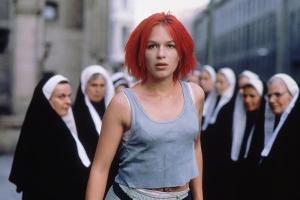 Born in an age of avant garde MTV videos and a declining attention span nationwide, Lola is a dizzyingly kinetic concoction of energy ]and excitement.The movie is a colorful fireworks display of multiple outcomes and the varying degree minute choices and details can have on our lives. The movie is a living video game telling Lola’s trek three different ways and showing the possibilities of chance and fate.
With each run the audience’s heart beats to the thumping presence of the blistering electronica soundtrack pulsing along Lola’ runs. It simulates her racing heart and that of the audience watching. Within an hour of seeing the flick I had to run out and get the soundtrack, and after a brief listen it made me want to run myself.
The movie has more energy than the Energizer bunny, and our carrot-topped heroine could run circles around his fluffy ass. The narrative structure poses the question to audiences how our lives could be different with any of the small choices that occur day-to-day in our lives. The idea was seen in last year’s Sliding Doors but is much better played out here. All I can say is that Run Lola Run will go down as one of the coolest movies of the millennium and ushers in a new time and genre for the world of cinema. I want my Lola running shoes.
Author’s note: I was so enamored with this film I went as Lola for two Halloweens in a row.
Nate’s Grade: A


 nathanzoebl
You must be logged in to post a comment.