Blog Archives
The Predator (2018)
 It’s been 31 years since the first Predator strutted its camouflaged self onto the big screen and bedeviled Arnold Schwarzenegger and company. Since then the dreadlock-sporting intergalactic sportsman has become a familiar vaginal face to movie audiences around the world. One of those company deaths in the original movie was none other than Shane Black, years before the writer/director became a bankable Hollywood commodity. Black is going back home to revive the dormant franchise with The Predator, a big-budget sequel/reboot that aims for the stars and falls far, far too short.
An alien spaceship belonging to a rogue Predator crashes on Earth, scattering important debris. Quinn McKenna (Boyd Holbrook) is a black ops sniper and the only surviving member of his team who happened to be on site when the ship crashed. The government says he’s crazy and transfers him onto a bus filled with other mentally disturbed military vets who call themselves “the Loonies” (Trevante Rhodes, Keegan-Michael Key, Thomas Jane, Alfie Allen, Augusto Aguilera). A tough-talking government agent, Traeger (Sterling K. Brown), seeks out a biological specialist, Dr. Brackett (Olivia Munn), to examine their interstellar prize. At the secret lab, the Predator breaks free, Dr. Brackett chases after the specimen, and she teams up with the “Loonies” to track down the alien. After his initial Predator encounter, Quinn mailed the alien helmet and other evidence to his son, Rory McKenna (Jacob Tremblay), a young boy with autism who cracks the alien code and becomes the target of a Predator, a Super Predator, and the government.
 The Predator is a supremely messy movie, often feeling like two separate screenplays inelegantly stitched together, one a big bloody action thriller, the other a winky Shane Black vehicle with a cavalier, macabre sense of humor. It doesn’t quite work because the movie can’t fully settle on a tone, or a direction, and thus it keeps providing glimpses of the many versions of the kind of movie it could have been instead. I’ll openly admit to being a Shane Black fan when he embraces his sly instincts, command of genre, and ribald wit (Kiss Kiss Bang Bang is a modern comic masterpiece; The Nice Guys is… pretty good), so the Black touches were my favorite part especially because they stood out the most. I enjoyed the characters entering into scene-breaking asides, like Dr. Brackett questioning why the alien would be named a “predator” given its behavior is more akin to a hunter or a fisherman, and Traeger shrugging, “Yeah, well, we took a vote and ‘predator’ was cooler. Right guys?” Or when a character is being held at tranquilizer gunpoint and mocks the danger, only to be tranqued point blank in the eye, killing him. Or a bully suddenly getting drilled by the defense mechanisms of the Predator helmet and murdered. It’s these moments that kept me most entertained, demonstrating Black’s unique voice that can take genre filmmaking within a studio sphere and turn it on its head with a devilish grin. If The Predator had been more a Shane Black vehicle than a Shane Black studio reboot, then perhaps the final product would have risen above the mediocrity that sinks it.
Much of that mediocrity comes from the middling plotting, mostly after the first act. For a solid half hour, I think Black has something promising, having set up the various characters and gotten them to intersect and go on the run together as a merry band of outlaws and amateur alien hunters. Once the “Loonies” break free with Dr. Brackett is where the movie loses its sense of direction. The plot just stumbles from one set piece to another, rarely with good reason. One minute they’re running away from a Predator creature and the next they run into an apparently unlocked high school building rather than flee in cars and RVs. Most of the plot movement follows little Rory, first reaching him before the bad men do, then rescuing him from Predator dogs, and Predator, and then he’s kidnapped by the bad guys, then he’s hunted by the Super Predator and I’m tired. This kid is a spectrum-walking, spectrum-talking plot device (more on that below). It feels decidedly odd to have a super sniper paired with a renegade group of mentally disturbed and dangerous military castoffs and instead of them primarily hunting and killing a space alien they are rescuing a little boy with special needs. It would be like having a Tarantino rouges gallery teaming up to teach a child how to read. It feels like a misapplication of the character dynamics onscreen, which again gets to my central criticism of the final film feeling too much like separate movies in conflict. The studio elements (supportive yet feisty ex-wife, autistic savant, Predator dogs) feel too obvious.
 The action is serviceable with a few dandy practical gore effects. There’s a nasty, visceral quality of the action that proudly wears its R-rating as a badge of honor, as a PG-13 Predator movie would be a disservice to the universe’s most fearsome hunter (the first Alien vs. Predator was PG-13; I suppose acid and florescent blood are less traumatic to be seen gushing from hacked limbs?). The action gets a lot more boring once the Super Predator is introduced, an eleven-foot all-CGI monstrosity that needed a bit more work. Beforehand the Predator is a combination of makeup and practical effects, allowing longer interaction with its environment. I enjoyed the Predator breaking out of the lab. I did not enjoy the team taking on the Super Predator at night in the middle of the woods because it decided to go… sporting. Seriously, the second-to-last action set piece has the flimsiest formation. Rather than accomplish its mission, the Super Predator invites all the humans to one more game, though the alien acknowledges that “McKenna” is their only true champion. It devolves to jump scares in the spooky woods, but hey, at least characters can start being eliminated (some of them so abruptly that it’s a blink-and-you’ll-miss-it exit). There are touches throughout the action that keep things lively before ultimately succumbing yet again to the freefall of the project’s creative dissonance.
The actors are enjoyable but I felt bad they weren’t given more. Holbrook (Logan) is consistently upstaged by his eccentric band of compatriots, but only Jane, Key, and Rhodes get any personality. The other guys are just kind of there. I don’t think I laughed once at Key’s (Netflix’s Friends from College) many, many wisecracks. The Tourette’s syndrome tic given to Jane (TV’s The Expanse) is rarely funny, and yet Black goes back to it again and again (the adolescent kid behind me in my theater thought every profanity was the funniest thing ever committed to film). The actors glide by on Black’s signature macho, cocksure style, clinging to every new quip like a lifeline. Munn (X-Men: Apocalypse) has a few fun, feisty moments but is still basically featured as The Girl. Tremblay (Wonder) is making me rethink my evaluation of him after Room. The best actor in the movie, by far, is Brown (Black Panther) who has a malevolent charm that connects most fluidly with Black’s sensibilities. Even his self-satisfied laughter made me laugh.
 We need to talk about the film’s views on autism (there will be some spoilers in this paragraph, so skip ahead if desired). Rory McKenna is of that kind of Hollywood Autism, the kind we see on TV (The Good Doctor) or of classic movies (Rain Man). It’s the designation of autism as a gateway to super powers (never mind that having savant abilities only impacts ten percent at best). Whatever, it’s an unrealistic depiction in an age of better, more nuanced depictions of mental health and disabilities. Where The Predator gets crazy is when Dr. Brackett offers this nugget: “You know many people think autism is just the next step in human evolution.” No. Nobody thinks this. As someone who has worked extensively with children with autism, this is not a thing. I’m not saying by any rationale that those with autism are lesser by any means but they’re no more the next stage in human evolution than any other condition. Ask a person with autism if they feel like the next stage in human evolution, like an X-Men mutant. What makes matters worse is that Black confirms this strange notion when the Super Predator, surprise surprise, was most impressed with Rory McKenna and not his big bad dad. The Super Predator plans to take the kid back to, presumably, harvest his autism DNA so the future predators will… know how to fly their spaceships that they already know how to fly? I don’t know.
The Predator is part sequel, part reboot, part Shane Black genre riff, part muscular R-rated action movie, part chase movie, and part Hollywood mishmash. Apparently the film underwent extensive reshoots as well, retooling the entire third act, which seems obvious in hindsight and only magnifies the disconnect between the central story elements. Shane Black’s signature elements are but glimmers of what could have been. It needed to be more of a genre send-up of 80s-action farce, or a more straight-up action movie, or something where the plot generally made sense and had characters we liked. Was Shane Black playing a joke on the studio? The Predator will probably be most known for editing out a real-life sexual predator, or from its dreadlocked alien dog being domesticated after getting shot in the head, or its depiction of autism, or anything that isn’t really the entertainment level of a mediocre rehash. Check out Predators instead.
Nate’s Grade: C
Share this:

Scott Pilgrim vs. the World (2010)
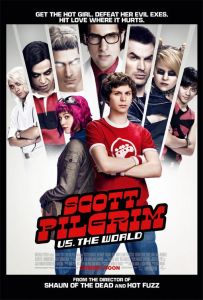 What happens when the millennial generation gets its own (attempted) seminal movie? It stays home and plays video games, letting the film, Scott Pilgrim vs. the World, languish at the box-office. I guess that’s what happens when you finance a movie whose target demographic will just as readily download the movie for free off the Internet.
Scott Pilgrim (Michael Cera) is a 22-year-old Toronto slacker. He?s the bass player for the band Sex Bob-Omb, along with lead singer Stephen Stills (Mark Webber) and acerbic drummer Kim (Alison Pill), a former ex-girlfriend of Scott’s from high school. The band’s biggest fan is 17-year-old Knives Chau (Ellen Wong), who also happens to be Scott?s new girlfriend. The world of Scott Pilgrim is abuzz with this scandal, especially Scott’s gay roommate Wallace (Kieran Culkin) and Scott?s younger sister (Anna Kendrick). Scott insists it’s all on the level and he has no ulterior motives for dating a high schooler. Then he sees the mysterious and alluring Ramona Flowers (Mary Elizabeth Winstead) who?s new to the area and American. Scott rabidly pursues her in what could best be described as stalking, eventually getting her to agree to date him. Trouble is, he hasn’t broken up with Knives just yet before starting this new venture. Scott is then confronted at the Battle of the Bands concert by a man who comes bursting out from the ceiling. He is the first of Ramona’s seven evil exes and Scott must defeat them all in order to earn the right to the violet-haired beauty. “Everybody has baggage,” Ramona says. “Yeah, but my baggage doesn’t try and kill me,” Scott wearily replies.
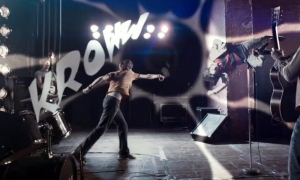
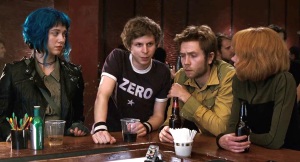 Visually, this movie showcases director Edgar Wright (Hot Fuzz, Shaun of the Dead) using every crayon in the Crayola box. This is a visually resplendent film where every scene seems crammed with details to delight the eyes and light up the senses. It’s a rush to watch the kaleidoscope of colors and motions. The Scott Pilgrim universe clearly differs from our own. This is a realm that borrows heavily from old school video games, where people burst into coins when vanquished, where life-decisions are met with “leveling up,” where people have onscreen pee bars that will deplete after a trip to a urinal. Sound effects will routinely be verbalized on screen, everything from a “RIIIIIIIIIIING” of a telephone to the “Ding Dong” of a door. It’s amusing, though also easily overused. Jobs and stuff like that are for the real world, hence too square to be depicted. It’s this entire idiosyncratic comic book world treated like everyday reality.
The enormous display of style is impossible to ignore. Scott Pilgrim is a slick, flashy piece of entertainment that is riddled with nostalgic references for a select crowd. I appreciated how a nice walk was accompanied by the theme song from The Legend of Zelda, or that sound effects and onscreen graphics echoed the fights from Street Fighter II (don’t ask me which of the 800 versions). Scott Pilgrim is an excellent pop pastiche of a specific culture, namely a slacker, hipster, amiable, comics and gamer group. I myself was an avid Nintendo gamer back in my day, but I admit to waning interest when the games got too complicated and grisly (“Back in my day we had two buttons to push, one to jump and the other to shoot, and that’s how we liked it!”). The movie is an explosion of color, light, and (lo-fi garage rock) sound, which also might sound like the description of a seizure or a stroke to some. Like those ailments, Scott Pilgrim will be seen by some as an infliction. It’s hyperactivity and eagerness to please via nostalgic reference points will be what drives people to this film and what drives them away in equal measure.
The Scott Pilgrim graphic novels total six volumes and approximately 1200 pages, which means it?s not the easiest fit for a two-hour window. It also hurts that the Pilgrim books have a wide supporting cast of characters to tussle with, plus there?s the whole seven deadly exes thing which means the movie has to provide about a solid 20 minutes of set-up before finding enough time for seven antagonists (or boss battles, following gamer parlance) and a reasonable amount of resolution. Add on top of this the fact that Wright keeps the movie moving at an outrageous, ADD-addled pace, like the plot conveyor belt lever got broken and the scenes speed one after another. Everything about this movie feels fast and over caffeinated. The editing in particular has characters holding conversations where every line is in a new location, implying an added sense of movement. So you shouldn’t be too surprised when the Scott Pilgrim film feels like a whole lot of a little; it’s moving at the speed of light to entertain.
 Because of the plot mechanics and oversized cast of characters, Pilgrim can give off the impression of shallowness. It seems like all style and little substance and that’s because the movie attempts to cram an entire series of stories, back-stories, and conflict into two hours. The film version only has enough time to attempt to give Scott and Ramona characterization, though both come across as weak-willed, tentative, and less than charismatic, wondering if either party is worth the trouble. The movie tries to paint over these differences through distraction and force of will. The large cast of supporting players all elbows each other just to be mouthpieces for one-liners. Knives actually comes across as the most complete character, consumed by her infatuation, heartbreak, and then quest for misguided vengeance. She’s somewhat dismissed and yet she is the most developed person on screen thanks to Wong’s endearing and relatable performance. The entire experience of Scott Pilgrim vs. the World can be somewhat fatiguing when there’s little evidence presented for emotional investment. The books supplied the reasons for caring besides the whole underdog angle.
The movie aims to be a battle over love, but it’s not entirely convincing. Scott appreciates Knives because she’s simple, a relationship he doesn’t have to invest much within, something casual and enjoyable while it lasts or until it becomes too taxing. Then he goes ga-ga for Ramona and stalks her, wearing down her defenses. He’s purely smitten with her and willing to do whatever it takes to earn her affections, though he can?t explain why he feels this way. Here’s a note to screenwriters: when characters are asked why they love somebody, do not have them say, “I don’t know.” But for Ramona, Scott is her Knives. He’s something easy that won?t break her heart, an escape from the jerks she’s been dating before. He?s low maintenance. He’s something to pass the time. There’s an interesting dynamic here, made even more complicated by the fact that Scott’s time with Knives blended with his time with Ramona. There was not a clear end point. The movie takes a literal approach to the idea of love being a destructive force of nature. Scott is punished throughout because of his infatuation with Ramona, but he persists despite the bruises. And he doesn’t even really know much about her. There’s an interesting statement somewhere there about the punishment we endure, sometimes foolishly, over the affections of people we may love, or convince ourselves of, but not even like.
 It may sound peculiar but I’m paying Michael Cera a compliment by saying his performance in Scott Pilgrim is the least Michael Cera the actor has ever been on screen. Gone is his gawky, awkward, ironic shtick that has fast become the Cera persona in films like Superbad and Year One. Scott is unjustifiably confident in his life’s pursuits, and Cera gets to act cocky and quippy, even if it?s done with a wink. He?s an unlikely kung-fu star but then again he?s also an unlikely leading man. Winstead (Live Free or Die Hard) is cute but plays her part a bit too toned down, like Ramona’s still searching for the right medication combination. Culkin and Pill are both scene-stealers of the first order, doing so with unabashed and flippant sarcasm. Every scene is made better by their presence. Among the evil exes, Brandon Routh (Superman Returns) has plenty of fun as a dim-witted super-powered Vegan bassist (“Vegans are just better than other people”), and Jason Schwartzman epitomizes hipster snark with such relish. The film is exceedingly well cast from top to bottom.
I’ve read some reviews positing that Scott Pilgrim vs. the World is an elaborate fantasy taking place in the mind of its titular hero, that he blends his knowledge of comics and video games to help make sense of the troubled waters of relationships and lingering hurt from the demise of love. I think that’s a nice explanation but perhaps trying too hard to frame this film as some form of psychoanalytical commentary on modern youth’s interpersonal relationships and the value of love. Scott Pilgrim vs. the World is really just a spastic, hip, clever wank that, as presented, gives little room or emotional investment. It?s a blurry, messy, prankish good time at the cinema that doesn’t translate into much more than the equivalent of sensory button mashing (video game reference). It’s fun while it lasts but it doesn’t have much beyond those astounding visuals to make it feel lasting, and I say this as a genuine fan of the graphic novels by Bryan Lee O’Malley. Alas, heavier discussions about the thorny, maddening issues of love are better left to more dramatic, and romantic, movies like Brokeback Mountain, Eternal Sunshine of the Spotless Mind, and even WALL-E. This movie is more preoccupied with spinning as fast as it can and then vomiting.
Nate’s Grade: B
Share this:

The Punisher (2004)
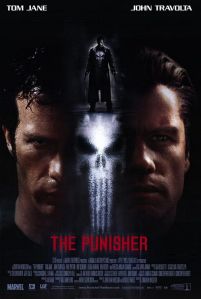 It’s probably a bad omen when the co-writer of Armageddon makes his directorial debut (J.J. Abrams is a fluke). The Punisher is one of the ugliest movies I have ever seen. The action isn’t exciting; it’s pat, poorly shot and grotesque. The story isn’t interesting. It’s not enough that The Punisher has his family killed; he has to have his ENTIRE family killed during a reunion. When he does exact his vengeance, the film stops an audience from engaging with the characters and pushes them away by callous misstep after callous misstep. This is just sadistic, ugly, and over-the-top while simultaneously being entirely, sadly predictable. By the time John Travolta gets dragged by a slow-moving car through a field of explosions, you may have thrown up in your mouth, swallowed it, and thrown up again.
Nate’s Grade: D
Share this:

Dreamcatcher (2003)
 Stephen King movie adaptations are usually a mixed bag. For every Carrie there’s a Sleep Walkers or a Sometimes They Come Back. Let’s not even discuss how many straight-to-video Children of the Corn releases there are (the answer, of course, is far too many). So what can we expect from a novel that featured butt weasels?
Dreamcatcher centers on four friends and their annual hunting trip in the woods recounting an earlier time when they befriended a mentally retarded child who would later give each of them psychic gifts. At the same time it appears an alien invasion is nearby, the military are to quarantine the area, and the lost hunter has expelled a bloody serpentine-like creature from his bowels. What does it add up to? The craziest spring break ever man!
There are several moments in Dreamcatcher where you think to yourself, ”Well, it can’t possibly get more stupid,” and yet the movie routinely will find a way. It doesn’t know when to stop. Just when you think the bottom of the Stupid Hole has been hit, here comes an alien possession where the alien uses a freaking British accent (and actually says the word ”guvna,” proving to be the most dangerous interstellar chimney sweep). The only reason I knew what was going on was because I read the book over the summer.
The story is a mixture of different King staples: schmaltzy coming-of-age buddy stuff (It), alien invasions (Tommyknockers), gory monsters (take your pick). Dreamcatcher feels like a Stephen King greatest hits tape. The different narrative elements have great trouble gelling, as you can only segue from mentally challenged boy with mystical powers to crazy Morgan Freeman shootin’ up slimy aliens so often. The story does not work and has too many leftover bits it doesn’t know what to do with. Dreamcatcher is a proverbial square peg being jammed into a round hole.
 The movie shows some promise in its opening, displaying the camaraderie of actors Thomas Jane, Jason Lee, Damien Lewis and Timothy Olyphant (a younger looking Bill Paxton if I ever saw one). The notion of the memory warehouse is a fun idea that is used for nice comic touches.
Director/co-writer Lawrence Kasdan has written some of the most exciting films of the past 25 years, and screenwriter William Goldman is an old hand at adapting King (having done the masterful Misery and the mawkish Hearts in Atlantis). So what in the world went so horrendously wrong? For starters, the book is a whopping 620 pages and would be more suited in the frame of mini-series. Condensed into a messy two-hour movie, Dreamcatcher is sloppy with its pacing and scope. The movie drags for an eternity and then makes a mad dash at a finish (I wont spoil its unbelievable awfulness but will say it veers SHARPLY from the novel).
The most interesting part of the novel, for me, was the second half that involved the alien (Mr. Gray) taking over the body of Jonesy (Lewis). What kept me reading was Mr. Gray finding a liking to human temptations like bacon and, later, murder. Seeing Mr. Gray become intoxicated with humanity and perplexed by it at the same time was interesting. Sadly, all you get in the movie is the British accent and some goofy faces as Lewis holds two conversations in one person.
Few movies come along that are as incredibly stupid as Dreamcatcher. I cant exactly recommend it for this quality. They are playing that Matrix cartoon after it (my theater showed it before the film started). It looks like a video game and features a woman doing flips and sword fighting in a thong, because, quite simply, that’s what women do in these things. It’s not really that good either.
Nate’s Grade: D
Share this:

Deep Blue Sea (1999)
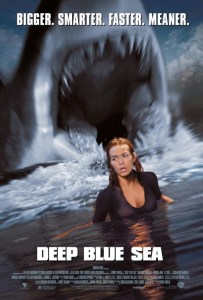 So what if the movie is crammed with one-note cardboard characters that double as stereotypes and other reliable characters in the action world? So what if the script was most likely written on the back of a bar napkin in between showings of Jaws on TNT? So what if the movie is helmed by Mr. ex-Geena Davis with a track record of box office losses always following him? So what? And so what if the best acting in the movie is from animatronic sharks? Because despite all these things the movie is pure fun.
The movie actually offers some genuine thrills and suspense. It’s easy to just pigeonhole the movie as another Jaws rip-off, but it’s more of a sweet homage than any blatant rip-off. Deep Blue Sea never seems to take itself seriously and actually seems to revel in the cheese it wallows in.
Despite the fact that the sharks still look like they were created out of Jim Henson’s Muppet workshop, they do come off as believable. The story isn’t even worth printing because it’s all one giant excuse to somehow pose dangerous situations to our crew. It’s all purely corny but it’s just too much fun.
Deep Blue Sea shouldn’t be thought heavily upon because all the movie is at it’s heart is big dumb fun. Don’t try and analyze it above the thrills you get in your seat, you might hurt yourself. At least there’s one movie that’s out that you can just sit and have fun with.
Nate’s Grade: B


 nathanzoebl
You must be logged in to post a comment.