Blog Archives
Last Night in Soho (2021)
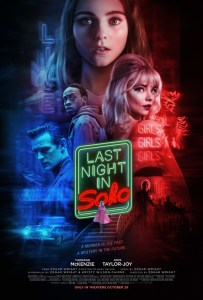
Edgar Wright’s Last Night in Soho is the writer/director’s first work of genuine horror and it’s in many ways unlike his previous movies, both in good ways and not as good. We follow an aspiring fashion student, Eloise (Thomasin McKenzie), as she leaves her small town for the bright lights of London. She has difficulty fitting in with the snobby city girls at school and her new apartment might be haunted. When she goes to sleep, under the alternating neon light filtering through her window, she wakes up back in the 1960s and takes the form of another woman, Sandie (Ana Taylor-Joy). Eloise investigates what happened to Sandie and grows increasingly consumed with solving the crimes of the past and possibly getting lost in it as well.
This is the least Wright-ian movie when it comes to his signature sense of frenetic visual decadence and creative, intuitive editing. This is a more modulated and patient movie, one that doesn’t ape the style of other flashy genre movies for post-modern, meta-textual in-joke commentary. If you had told me that Last Night in Soho was directed by another filmmaker, I would have believed you. It’s a different kind of story and movie, co-written by Krysty Wilson-Cairns (1917, Penny Dreadful), and while mysteries have factored into other Wright films, this one is built upon one. The technical recreation of the swinging ‘60s in London is impressive on every level. The film has an acute sense of style that doesn’t overshadow the unsettling mood of its horror. There’s a period of discovery that keeps your attention into the first half. When Eloise travels back in time, she’s attached as the reflection of Sandie, and this creates very beguiling and imaginative images, like watching Eloise keep pace with Sandie down a mirrored staircase. It made me start to mentally dissect the filming ingenuity, even though it was likely filming the scene in separate pieces, but part of me wondered if they just got the two actresses precise at timing one another’s movements. There are some knockout disturbing images to crank up the horror, like hands reaching out from all manner of spaces, and the grey faces of male phantoms blurring together. There is one visual shot that is so striking on multiple levels, watching the panic of eyes in the reflection of a knife and it plunges in and out of the frame, only increasingly bloodier. Even though I’d consider Soho to be perhaps less visually audacious as Wright’s past works, it’s still a cut above even the better giallo genre homages.

Last Night in Soho is a clear homage but the spooky story ultimately gets caught up in its own machinations and narrative off-ramps. Once the central premise is established by the end of Act One, I was ready for the movie to develop its plot by establishing further rules as we explore the mystery. Is it time travel? I thought if this was established the movie could go several different enticing routes. Perhaps Eloise is going to solve the 1960s tragedy by collecting evidence and investigating witnesses through two different time periods, including people and leads that are lost in present-day. Perhaps Eloise was going to steal the fashions of the 1960s she found as inspirations for her class assignments, becoming more and more dependent on taking the ideas of others rather than trusting her own creative instincts. Is it physical or psychic possession? Perhaps Eloise is finding a freedom in pretending to be someone else and gets addicted to that power and possibility. Perhaps it’s a partnership where both women interact to resolve an unresolved murder case and avenge a past wrong. Perhaps it’s Sandie who discovers the new freedom of being able to be alive in modern-day and it becomes a battle over who will have dominance over Eloise’s body and soul. What about Eloise seeing her dead mother? Does this mean she herself has a special connection to the dead? Will her mother follow her to aid in her safety? Or could Eloise use her trips to the past to find her grandmother? Could this be a manner of learning more about her grandmother while they were similar ages? There are many routes that Wright could have gone, and I would have been interested by any of them with careful plotting and natural development to layer the intrigue and complications. To my surprise, Last Night in Soho doesn’t really clarify or develop its out-of-body setup with more rules.
Without additional rules or development from the plot, it comes down to watching the personal impact this has on Eloise, and at least there the film provides enough of its attention. She’s becoming haunted by the tragic story of Sandie. The movie is very much about the horror of rape culture and how it can traumatize for decades after. It may have been postponed a year due to COVID but it feels very much in response to the Me Too movement that raised awareness of sexual harassment and assault. For Wright’s position, his last movie, 2017’s Baby Driver, starred two actors that have since had their careers affected by reports of predatory behavior, Kevin Spacey and Ansel Elgort, and it almost feels like Soho is a reflective response, in a manner of speaking. It’s Wright’s latent acknowledging how ensnared one can find themselves in an industry or system that profits from the exploitation, humiliation, and silencing of women. Naturally, Hollywood has been an exploitation factory from its very troubled start, with many young women arriving with stars in their eyes only to be taken advantage of by hungry men looking for their next fix. This acknowledgement is nothing new, but Soho feels like repackaging the woman-terrorized-by-unknown giallo films into something more socially relevant and reflective.

The story of Sandie is meant to be an intentional stand-in for thousands of other women who have suffered similar fates at the hands of predatory men promising fame and fortune. It has an undeniable horror, but it’s also somewhat limited with its impact or intrigue because Sandie is kept chiefly as symbol. I didn’t find the extended excursions with her in the past to be as interesting as I’d hoped because Sandie herself isn’t presented as a multi-dimensional figure. That doesn’t mean she’s undeserving of sympathy, it just means I found her to be rather boring. We don’t really learn more about her, until a third act twist that creates some very uncomfortable and potentially troublesome questions. There was a moment where I thought, “Is Wright really trying to make me root for…?” and it did not work. The ending twist feels more like the kind of thing you’d find in the hacky direct-to-DVD version of this kind of genre homage, not from the likes of Wright, a master study on genre recreation. The story of Sandie serves as an industry cautionary tale but by the end I don’t know if Eloise or the audience have learned anything more meaningful other than bad things happen to women.
This is Dame Diana Rigg’s last performance. She died on September 10, 2020 at the age of 82 (the movie opens with a dedication, “For Diana”). The woman who came to fame from the BBC’s Avengers spy series in the 1960s and renewed resurgence from playing the tart-tongued Queen of Thorns on Game of Thrones has a final role that lets her go out in grand style. By the end, it might not fully make as much sense, and invites all sort of questions that tear away the logic of staying in her living conditions for 50 years, but it’s fun to watch this octogenarian go all-in on the messy horror. She’s also the best actor in the movie. Too many other characters are meant as symbols, stand-ins, or conflations, and in fact I wish other characters had been conflated but that’s going into potential spoiler territory to detail. McKenzie (Jojo Rabbit) is a solid lead but not as much is asked of her that could have been. I was expecting her character to become more mentally and emotionally undone, though she sells her fear with effective wide-eyed terror. Matt Smith looks alarmingly identical in 2021 as he did in 2011 with Doctor Who.

I mean no great offense to say that Last Night in Soho is the least of Wright’s impressive and exciting filmography. It’s a solid genre movie with style and intrigue, and while it doesn’t live up to the tantalizing possibilities of its premise, as a horror movie, as a character study, and as a genre homage, it’s still plenty entertaining and with a relevant message about how often women in our society have been the sacrificial victims, not just in the movies.
Nate’s Grade: B
Share this:

Get Smart (2008)
 Get Smart was a beloved spy satire that aired on television from 1965 to 1970. Don Adams starred as Agent 86 and he bungled his way through scene after scene, oblivious to his shortcomings. The show was created by Mel Brooks and Buck Henry and maintained a genial, goofball appeal as it satirized James Bond style spy movies and tweaked Cold War paranoia. And as is written in stone by Hollywood, anything that was ever once on television must eventually become a big screen theatrical version. Get Smart already produced one unfortunate movie, 1980’s The Nude Bomb (which doesn’t sound too different from the U.S. Air Force’s plan to create a Gay Bomb — true story). I’m pleased to report that the big-budget modern Get Smart retains enough of the show’s flavor even while producing something with little resemblance to the source.
The updated Get Smart exists in a world not too different from our own (the president is still a boob). CONTROL is still in operation but secretly underground. Agent Maxwell Smart (Steve Carell) is an expert analyst who specializes in knowing the enemy and compiling 400-page reports. He’s failed the field agent test several times and desperately wants to get out from behind a desk. The Chief (Alan Arkin) says that he needs more men like Max. He gets his chance when CONTROL is attacked by KAOS. Many of the Agents identities have been compromised. The only agents remaining are the dashing and hulky Agent 23 (Dwayne “The Rock” Johnson), the svelte and beautiful Agent 99 (Anne Hathaway), a group of science techs (including Heroes‘ Masi Oka), the Chief, and newly appointed Agent 86, Maxwell Smart. KAOS, perhaps thanks to the end of the Cold War, has become a group of shadowy men making ties to terrorist groups worldwide. Siegfried (Terence Stamp) and his henchmen are aiming to sell nuclear devices to terrorists. Agent 99 and Max must travel across the globe to ensure that KAOS does not fulfill its villainous schemes.
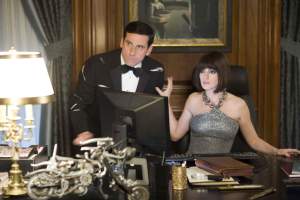 The plot is fairly workmanlike and it doesn’t really establish much in the way of an ongoing threat. As a result, the movie feels like it lives in the moment, going from gag to gag, but it just so happens that a decent number of those gags are funny. Get Smart is mostly a chuckler of a movie, sure to bring smiles and giggles but rarely hard, gut-busting laughter. I never found myself laughing too hard but I did find myself enjoying the time. Get Smart is a very amiable experience that manages to maintain a healthy level of silliness without ever falling victim to stupidity. It’s pleasantly goofy without becoming farce. Sure there is crude slapstick but the film, and Carell in general, manage to give them a slight edge that elevates them beyond your typical juvenile behavior. There may be a pee joke or a quasi-homophobic joke but Carell manages to make it worth your time.
The relationship between Carell and Hathaway provides significantly more interest than the ho-hum plot. The filmmakers find a clever way around the potentially unsettling reality of the age difference between Carell and Hathaway, who is nearly 20 years younger. The two have a spunky chemistry and their combative interaction elicits some of the most amusing laughs. Hathaway, with her doe eyes and dewy features, is just as eager and up to the task as Carell, so watching them spar and tease gives the movie a bit more juice. Kudos to the casting director because the cast is packed with capable comic actors that know when to seize the moment, and Arkin seizes every one of them (it seems that with every new film, my man crush on The Rock only grows greater).
The film is a hybrid of comedy and ramped-up action set pieces, and surprisingly they aren’t that bad. Director Peter Segal, who has directed three Adam Sandler vehicles, stages some fairly exciting action sequences with a decent degree of visual flair but the film overindulges on action. The movie should focus more on its cast of characters instead of loud, brash action sequences. It’s a little weird watching Maxwell Smart expertly shoot people like he went to a John Woo camp. The tones never fully match up, and Get Smart begins to feel like a comedy that thinks it?s a James Bond movie or an action film that thinks its overly absurd. The tonal struggle means that the comedy is handicapped by all the action interrupting and stalling the pace of jokes. There are times when Carell and Hathaway are firing one-liners at one another and then -WHAM!- they have to dodge bullets and kick bad guys. The stunts are impressive but I kept feeling a sense of disappointment when the action would cut short the momentum of the comedy. The spurts of action shortchange the humor. Segal’s direction is also blunt at times, so whenever a character thinks reflectively we have to witness a mash-up of past clips to visualize what the character is reflecting upon, in case our memories of a two-hour movie fail us while it’s still ongoing.
 Get Smart is greatly benefited by the considerable comic charms of Carrell. His Agent 86 isn’t so much incompetent as he is bumbling, but best of all the man keeps a gloriously self-deprecating and deadpan sense of humor from beginning to end. He doesn’t lack self-awareness, and is not ignorant of the feminine charms of his partner, and as a result this new version of Maxwell Smart ends up being, well, kind of smart. Carrell shoulders the film and is able to save lackluster gags by his sheer comic ability and immense likeability. The film doesn’t push the envelope in any regard but it also doesn’t condescend or try and flirt with being too clever for its own good. Thanks to Carell, Get Smart manages to be much more entertaining than it has any right to be.
Fans of the Get Smart TV show, such as myself, will find it hard to recognize the source material inside the big screen transformation. The filmmakers have turned a goofy satire of Cold War paranoia into a full-fledged summer popcorn action cartoon. The movie moves at a brisk pace, despite pushing toward the two-hour mark, and its screenplay is packed with enough enjoyably silly and smartly stupid jokes to guarantee a string of smiles. Like Carell’s 2007 entry Dan in Real Life, the movie presents such a jovial, good-natured spirit that becomes mildly infectious. You may roll your eyes a few times but you forgive and forget. Carell proves he is fast becoming one of the most capable and leading comics, and he proves yet again that his force of personality can elevate material that doesn’t meet his same qualities. I just wish that Get Smart had focused more on the yuks and less on gunplay and explosions. I guess, to quote a certain agent, you could say they missed it by that much.
Nate’s Grade: B
Share this:

The Haunted Mansion (2003)
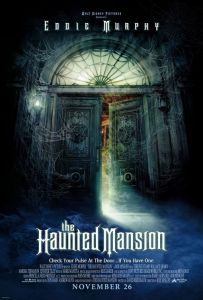 The best way to describe Disney’s third movie based on a theme park ride is this: its exactly like the ride. Which means it’s nice to look at but little else is there. Eddie Murphy, in his soul-selling kid friendly phase of his career, is a real estate salesman who cant pass up the prospect of a mansion. Never mind it’s haunted. He brings the family along, which includes a drop-dead beautiful wife, Sara (Marsha Thomason), and two annoying kids. There’s some storyline about Sara being the one to break the curse of the mansion, something about love never dying and a mystic key which leads to a mystic chest … I know, I’m bored already too. Despite being a mere 98 minutes The Haunted Mansion has sluggish pacing and some cheesy special effects. This is the kind of movie someone has a fear only because they need a moment to overcome that fear to save others. Murphy mugs for the camera and occasionally its funny, but he has the expression that even he doesn’t believe hes funny. Never good for an actor. Terrence Stamp is amusing as the butler. Jennifer Tilly is a highlight at the floating gypsy head in the crystal ball. The direction by Rob Minkoff (Stewart Little 2) is solid, and his opening sequence of the film’s back-story being played across the credits is the highlight. But what does it say when the highlight of the film is the opening titles? I don’t know who this film is for. It’s a bit too scary for young kids. Tweens won’t want to see a “Disney scary movie” and would rather see some of the PG-13 scares, like The Ring. It certainly isn’t for adults. Who is this movie for Disney? And I may be the only one, especially after recent events in the news, but when all the skeletons came out of their crypts … I thought Michael Jackson was going to come out and theyd all dance.
Nate’s Grade: C


 nathanzoebl
You must be logged in to post a comment.