Blog Archives
Rent (2005)
 Rent is one of Broadway’s biggest sensations in the last decade and has become a cultural cornerstone for many. Jonathan Larson updated Puchini’s famous opera La Boheme, transplanting the setting to East Village New York, swapping TB for AIDS, and turning his characters into struggling bohemians fighting for their voices to be heard and love to be kindled. The musical also has an added sense of tragedy. Larson suddenly died on an aneurysm during the final dress rehearsal, sadly never getting to see his finished creation. Rent went on to win Tonys (including Best Musical), a Pulitzer Prize, and damn near the heart of every girl I went to college with. To say it’s been a smash is an understatement. And where ever there’s money and an insatiable audience, there will be Hollywood’s eyes. Now comes time for the Hollywood gloss with director Chris Columbus (Home Alone, Stepmom) and when Rent ditches the intimate confines of theater and hits the big screen, it’s much harder to hide its flaws.
The story takes place within the span of one year (or 525,600 minutes as you’ll be told repeatedly in song), covering Christmases from 1989 to 1990. Mark (Anthony Rapp, Dazed and Confused) and Roger (Adam Pascal) are roommates trying to keep warm during the winter in their giant New York loft. They’re flat broke and their former friend and current landlord Benny (Taye Diggs) expects a full year’s rent to be paid pronto. Roger is racking his brain trying to write that one perfect song; he’s also HIV positive, the unfortunate side effect of a relationship with a junkie. Mark is an aspiring filmmaker and has also recently been dumped by the impetuous performance artist Maureen (Idina Menzel) for … another woman, Joanne (Tracie Thoms), a lawyer. It must be noted that all three of these characters do not have HIV/AIDS; they’re in the minority. Tom Collins (Jesse L. Martin, Law and Order), a gay school teacher, is visiting Mark and Roger when he gets mugged in an alleyway. Angel (Wilson Jermaine Heredia), a drag queen with a heart of gold comes to his rescue. Both men have HIV but won’t let their shortened time stop them from falling in love with one another. Mimi (Rosario Dawson) lives below Roger and Mark and works as an exotic dancer down the street. She too has HIV from a nasty smack habit. She also has her heart set on Roger but he needs a little motivation. For a year these characters will interact and live, love, die, and sing a whole lot.
 The villain of the piece seems to be Benny by default (unless you count AIDS, poverty, and ignorance). Our unemployed band of heroes is upset because dear Benny expects them to, gasp, pay their rent. The scoundrel! Here’s what I don’t get; clearly Benny has a dream for a business and the other artists denounce this artistic dream because it involves money exchanging hands. Benny’s passionate about his dream and actually does something productive like make friends and influences with the business establishment, people with capital to bankroll an entrepreneur’s dream. It’s like everyone’s mad at Benny because he put a suit and tie on and got a job.
Besides, there is something inherently pretentious about Rent’s anthems of sticking it to the man and brash commercialism. Guess what, after 9 years Rent is a franchise. You can get Rent T-shirts, coffee cups, soundtracks, and practically anything that can be merchandised and marketed to the disenfranchised youth with disposable incomes. A musical about the soullessness of commercialism is itself a cash cow, so it rings a little hollow when the deadbeats thumb their noses at the evils of capitalism. Seriously, Mark just about gets hives at the thought of being a cameraman for a TV news show (he calls it “selling out”). In the end he quits his job so he can make his masterpiece … cobbling together home movie footage.
The film version of Rent is populated with 6/8 of the original Broadway cast (Dawson and Thoms are the only fresh faces). This is a well-intention move by Columbus but it backfires. It’s one thing to listen to 20-something bohemians fight for their artistic integrity and worry about food, shelter, rent. It’s quite another thing when the majority of your cast is in their late 30s. You’ve gone from a bohemian to a potential bum. I’m not condemning the pursuit of your artistic ideals and making your name in the world, but not at the price of food and shelter. I’m reminded of a line from The Big Lewbowski: “Your revolution is over! The bums lost. The bums will always lose!”
 It’s hard to feel for some of these characters, who come across as whiny, pretentious, or just plain misguided. Maureen is irritated that her life partner is upset that she was flirting during their engagement party. I mean, really, what’s to get upset about? It’s pretty bad when Rent kills off one of its main characters in a musical montage. A MONTAGE! Afterwards all the characters eulogize what made this person so great. Hey, all that character stuff would have been handier before the death, and then I would have felt something.
Some of these same problems exist with the original stage version, but Rent the movie, and especially Columbus as director, make some bad additions. The original stage version of Rent took place in modern day when it opened. Here, Columbus has dialed back the timeframe and set his story from 1989-1990 (someone forgot that a song references Thelma and Louise, which came out in 1991, but oh well). What makes this time jump shaky is that the film also adds a scene of the happy families championing each other over their racially mixed lesbian daughters’ engagement. They moved time backwards but people’s tolerance was moved forward. That’s not all. It’s bad enough that Roger has a Bon Jovi haircut for the entire film, but then Columbus adds scenes of his escape to New Mexico and we, the audience, are treated to Roger belting his heart out to nature on top of a desert gorge … just like in Bon Jovi’s “Blaze of Glory” music video. Maybe this finally explains why they transported the film to the 1980s.
Where the musical does strain credibility is its fear of fulfilling the dark end of Puccini’s opera. Moulin Rouge! is also based on Puccini’s tragedy and it had the guts and the ambition to end on a tragic note. I‘ve cried at the end of Moulin Rouge!, but I didn’t feel like misting up during Rent. (Spoilers) It’s rather terrible that Mimi can be brought back from the dead by the power of a cheesy rock ballad, and if this holds true, then Bon Jovi is wanted to the E.R., stat! The cheap fake-out ending for Rent is just the nail in the coffin. Everyone has AIDS and thus on borrowed time and yet we can’t have an adult ending dealing with tragedy.
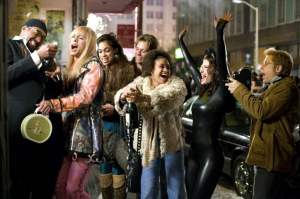 With all this in mind, some things in Rent really do work. The songs are catchy, somewhat fun, and the splashy lyrics follow suit. The cast collectively are entertaining and sing well, though Dawson can get a bit monotone at times. Some of the dance numbers are exciting and amusing, like the “Maureen: Tango” between Joanne and Mark chatting about the spotty behavior of their former and current lover. At one point we flash to them in full classic dress buffeted by a chorus line of fellow tango-ers. “La vie Boheme” is the sassiest and most electric song, finally piecing Larson’s sardonic, witty pop culture lyrics with a lively image. This is a musical that’s got clever lyrics, good singing, and catchy pop rock songs.
For many, especially the Rent heads, a movie version of their favorite musical will be bulletproof. They’ll be thrilled to enjoy an afternoon with their best friends on the silver screen singing their favorite harmonies. I’m sure fans of Rent and fans of broad musical theater will be pleased. For me, the movie falls apart when you pay attention to the story, the characters, the drama, and then the choices in adapting it to film. I just didn’t care for most of the characters and found the story dated, pretentious, and overly romantic, even if the majority of the characters do have HIV and/or AIDS. Columbus’ poor decision making turn Larson’s rock-opera into a movie that wants points for being different when everything about it has practically become marketable and cliché. I’d recommend buying the soundtrack instead of seeing the movie, because at least then you can turn it off when you reach your breaking point.
Share this:

Way of the Gun (2000)
 Way of the Gun is screenwriter Christopher McQuarrie’s follow-up to the twisty smash who-dunnit The Usual Suspects. This time he takes the reigns of directing himself and establishes that he is a born man behind the camera and in the chair.
Gun unfolds its tale through the center of two antisocial hoodlums “Parker” (Ryan Phillippe) and “Longbaugh” (Benicio Del Toro), two men brought to the point of selling plasma and sperm to pay the bills. One afternoon they overhear a conversation in the doctor’s office about a wealthy couple paying a woman (Juliet Lewis) to act as the surrogate mother for their child. It seems the real mother just doesn’t want to be burdened with a child hanging on her for nine months. The two men use this information to plot what should be their big break and their big score. After a scheduled doctor’s visit they get into a heated shoot out with the bodyguards (Nicky Katt and Taye Diggs) protecting her for their wealthy employer. Parker and Longbaugh kidnap their impregnated prize and hold her to squeeze a fat ransom.
 The story-telling Way of the Gun plays is a mix of older mature films where they would have room to breathe as well as Quentin Tarantino flicks. This is a story of characters and their devious multiple back stabbings, crosses, secret affiliations, and ultimate intentions. ‘Gun’ moves methodically with an armada of gaunt twists and turns keeping the audience alive and awake.
James Caan comes in mid-way to play a conniving intermediary in the exchange. His character is the wisest of the bunch and knows more then he’s always telling. It’s also quite a perplexing site to see Caan’s nipples through his shirt in an interrogation scene. Up to this point I never thought about James Caan having nipples.
The action in the flick is pulse-pounding. The shootouts are probably the best on film in a long while. You see and hear every effect a bullet has. The final climax which involves a drawn out gun battle in an empty Mexican brothel is a scene of sheer excitement and relentless entertainment that it may well be my favorite 10-15 minutes of film all year.
There can be a word to describe Way of the Gun and that word could be “ugly.” This is not a film for everyone. The violence and its after-effects can be gruesome at times, as I heard just as much groans and shrieks in my theater than anything else. There’s scenes of picking shards of glass from one’s own arm, performing stitches on one’s eyebrow, and even an impromptu hand done C-section. This will not be something to take grandma to.
Way of the Gun pacing is also a problem. There are moments of drag as we wait and wait. The languid pacing works for the story and the characters but the double-edge sword creates dry spells of interest. The score uses tympani to full extent, sometimes beyond that which it reasonably should.
McQuarrie has sold me with his re-spinning of tired cliches and familiar elements into gold. Way of the Gun is a flick I’ll see with my friends time and again.
Nate’s Grade: A-
Share this:

House on Haunted Hill (1999)
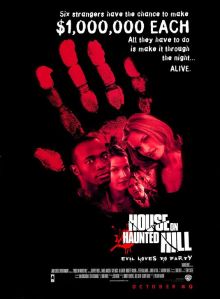
There are some classic horror pics in haunted houses, and the Vincent Price cheese-fest original of House on Haunted Hill is one. The original was campy fun and worth rewatches, but how does the remake fare with a 40 year age gap between the two?
What House on Haunted Hill miraculously achieves what Jan DeBont’s Haunting had tumble through its sticky CGI fingers: the establishment of a true unsettling mood. All throughout Hill you can actually feel the seething, eerie mood inspired from the wonderfully creepy ambiance of the constructed sets. It has a darker component and launches into many sequences of frightening imagery that seem like left-overs from Jacob’s Ladder but are no less effective. So maybe the plot is basically a premise that once established pretty much thins out to non-existence. You will be thinking to yourself that half of the flick is people wandering aimlessly in the bowels of an asylum when they should have enough common sense to not be.
There is no relevant acting since the cast is regarded to fill out the standard stereotypes and yell cheesy zingers at one another with F-bombs spliced into every line. This ain’t yo’ daddy’s House on Haunted Hill! Geoffery Rush, who talked funny in Shine and won an Oscar and who talked funny in Shakespeare in Love and got an Oscar nomination, gleefully plays the host of the supernatural shindig. And he talks funny. Taye Diggs surmises the “funny non-white” character, Chris Kattan surmises the “goofy nutball” character, Famke Janssen plays the “bitchy wife… who can crush people with her thighs” character, and the rest of the cast are interchangeable blondes who actually do get a bit interchanged physically.
Hill is a good shift in your seat spooker up until the end which just really drops the ball beyond belief into a cheap cop-out. Everything up until the part where the “ultimate evil” cloud of charcoal or something is visually haunting and solid entertainment even if it has to run to gore well once too often. But this whole slow moving cloud descends the movie into mediocrity and it just gets more hokey as it goes. The effects for the “ultimate evil” are preposterously bad and wouldn’t frighten a 4-year old with a bladder problem.
Up until the final ten minutes or so, House on Haunted Hill is a guilty pleasure directed sharply to instill the correct senses one should bring out of the story and setting. Hill has moments of inspiration and memorable scenes of horrific faceless demons and hallucinatory flashes of the macabre and bizarre. But the absurdly thrown together ending drowns what could have been a real Halloween treat.
Nate’s Grade: B-
Share this:

Go (1999)
 The sophomore outing of director Doug Liman, the man who put the swinger in Swingers baby, is far from any slump – no it’s more like an achievement. Liman is a man that knows what he wants and an excellent visual artist. Go is a spinning tour-de-force joyride of energetic fun. The movie is down right infectious. It stays in your system for many days, no weeks, after viewing. Consult your physician for proper treatment.
Born in the shadow of Pulp Fiction with the disjointed narrative structure, interlocking plots, retelling of events through different perspectives, and out-of-place editing, Go is the first movie to deserve having the comparisons to Tarantino’s masterpiece of blood and violence. It’s like a child of Fiction, with teens as the main stars and doing some awfully idiotic things mainly because… they’re teenagers. The story of Go is bursting to the seams with clever and embraceable characters, witty and hilarious dialogue, and enough plot twists to keep any viewer frothing at the mouth for more. Again, consult your physician.
The movie reminds me in a way as a American Graffitti or Fast Times at Ridgemont High for the fresh stable load of young talent displayed. Everyone fits nicely and performs excellently, like Timothy Olyphant’s devilishly charming and dangerous turn as a drug dealer, and Taye Diggs who helped get Stella’s groove back and is now the too cool for words friend of a grocery clerk on their trip to Vegas which turns into a comedy of errors. But the standout amongst all the talent is that little delectable Canadian bundle of joy known as Sarah Polley. Playing one of the chief protagonists, she is fascinating and compelling. She takes the role and shines the brightest in a movie filled with equally bright stars. I look forward to seeing what she does in the future.
Set against the L.A. rave scene Go tells the story circling around a 24-hour period of tantric sex, drug deals, a police sting, a lap dance, gay soap stars, and good ole’ chew-able aspirin. The movie is driven by an awesome soundtrack of techno and rock that seems to act like the narrator of our little tale. Go is brisk, breathless, rigorously hip and smart. Finally an INTELLIGENT teen movie. Too bad not too many teens went to see it at the theaters judging from box office scores. I guess they all wanted to see Ryan Phillipe’s ass one more time in Cruel Intentions. But Go is a fascinating trip you’ll want to take over and over and wish the sun would never come back up. Do not pass Go.
Nate’s Grade: A


 nathanzoebl
You must be logged in to post a comment.