Blog Archives
Locked Down (2021)
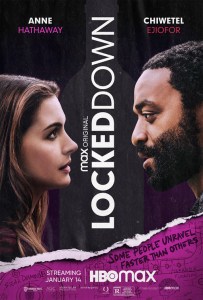 I’m already starting to dread the inevitable onslaught of movies and fictional narratives tackling the COVID crisis, and I don’t know if that’s ever going to be truly inviting for me. After the near year of pandemic fatigue, I can’t see myself wanting to relive the experience through my media. Naturally, this is partially because of how fresh everything is. Years down the road I may hold a different opinion and find COVID-19 stories more engaging. I’m sure there will be worthy ones to explore with the best storytellers that movies and television can afford. Right now, I’m not looking forward to the rom-coms about couples being forced together, or forced apart, and I’m not looking forward to the zombie movies that seem all too obvious in commentary. It is with this context that I watched the new 2021 movie Locked Down with wary curiosity. It was filmed during the quarantine in London over 18 days. It stars big actors, has a director and writer who have worked on highly esteemed projects, and it’s the first big project to feature the pandemic while we’re still in the middle of a worldwide pandemic. It has temporary notoriety but is it any good?
Linda (Anne Hathaway) and her husband Paxton (Chiwetel Ejiofor) are stuck at home like everyone else in London thanks to COVID-19. He’s struggling for work and she’s struggling with the mental weight of her job and the impending knowledge her friends and co-workers will soon be laid off by Linda herself. The couple is also heading for a divorce, though they’re keeping that quiet from concerned family members checking in. Paxton’s sense of self is falling apart, and the rebellious biker who got into one unfortunate bar fight long ago seems to be fading. Now he doesn’t know what he’ll be and he’s forced to sell his prized motorcycle. Linda gets the idea to pull off a jewelry heist that she and Paxton have an unique opportunity for. Could it be the thing that makes them feel excited again? Could it bring them back together?
 Locked Down has some significant tonal shifts but more so in ambition than execution, because at its core its really a talky, mumblecore relationship drama, but one that I found a little too lax and shapeless and ponderous to jibe with. Screenwriter Steven Knight can be a tremendous writer. He’s written Eastern Promises, Locke, Dirty Pretty Things, and created Peaky Blinders. He knows plot, he knows character, he knows structure. This, though, doesn’t feel so much like it was a script needing to be told as it was an experiment in could they make a movie about the pandemic and film it during the pandemic. The heist elements are rather haphazard and ultimately mean little to the overall storyline, merely serving as an instrument to reconcile our couple and force them to rely upon one another for a shared triumph (this shouldn’t be a spoiler). I think your overall view of Locked Down will depend upon your opinion of how the heist elements are handled. If it seemed like the start of something more exciting, more engaging, then you’ll be disappointed. If you didn’t care about the particulars of a heist during COVID times, and you didn’t want a more purely genre plot device to take over from the character-driven relationship drama,then you might be more charitable. For me, I love heist movies and the formula is ready-made for payoffs and entertainment. However, I also enjoy character-driven relationship dramas but I just wasn’t connecting with this one.
The characters of Paxton and Linda felt too overly written for me and lacking the more intriguing nuances that I find in the best of observational mumblecore cinema. To be fair, being overly written is not an indictment in itself. Quentin Tarantino characters are overly written and we love them. Viewers love big characters that demand your attention and equipped with monologues that we wish we could recite when life’s challenges afforded us the opportunity to wax poetic. The central agreement we have with characters, whether they’re realistically drawn or idiosyncratic or cartoonish, is that they need to at least be interesting. You need to want to spend time with the characters.
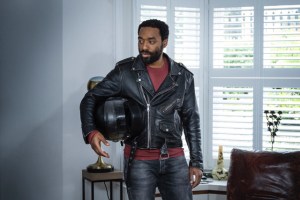 With Locked Down, I was getting as restless as the onscreen couple. I didn’t find them interesting because the same character notes were being hit over and over with little variation. The monologues, while having moments of life and personality, didn’t provide me greater insight at minute 80 than they did at minute 40. The experience felt like watching actors workshop characters and looking for extra meanings that seemed to be elusive. Listening to these characters talk more should make them more interesting, make them more personable, and make them more complex, right? While they uncork some well written asides, they’re each just rubbing the same nub of an identity crisis. The pacing also made the repetitive portions feel even longer. The metaphor of what Paxton’s motorcycle represents is so overblown and simplified. After spending so much time listening to these two bicker and argue in the same rooms, I was hoping for the heist as a needed escape, something that could finally serve to motivate the characters out of their pity parties and force them into a new conflict. I needed something, anything more to hold my waning attention. Alas, I finished Locked Down in the same patient, pursed-lip stupor as it began. These characters did not deserve this much extra breathing room.
I like Hathaway (Colossal) and Ejiofar (12 Years a Slave). Watching them leap into what is essentially a two-hander filmed play sounds like a good bet for entertainment, especially with a writer with the credentials of Knight (we’ll ignore the outlandishly bonkers 2019 Serenity). Hathaway and Ejiofor are good together too. They have a spark that works, her anxiousness melding well with his dismissive pessimism. Again, the characters they’re portraying aren’t poorly written. There just isn’t enough polished material for them. That’s why each feels like they’re grasping to discover the character like it’s being formed in the moment. The entire movie feels like an overextended improv workshop everyone involved is developing in the moment. Good mumblecore movies can make you feel like a fly-on-the-wall with real people, but these characters are so overly written that an improv feeling doesn’t so much replicate the recognizable rhythms of life as it does an ungainly acting class in search of more direction and discretion. There are some other celebrity appearances in the form of Zoom cameos, and that’s something I’m not looking forward to with the incoming COVID movies, the ugly selfie aesthetic prevalence.
 Locked Down feels more like an experiment to see if the filmmakers could make a movie under such unique and trying circumstances. It feels more like an acting exercise in need of more development and a little more vitality. There are fleeting moments that seem to tap into a universal despair and uncertainty many of us have wrestled with during our COVID isolation, but then the movie will just as likely throw in a hidden patch of poppies in a garden and a joke about nobody seeming to recognize the name Edgar Allen Poe. I watched Locked Down over the course of two nights, and mt girlfriend and I literally had forgotten we watched the first hour until coming across it again and going, “Oh yeah, we need to finish that after all.” I feel like that sums up the movie well. Within a day, I had already forgotten it, and that was before I even finished the full movie. They made a movie during COVID. Now make better ones in the future.
Nate’s Grade: C
Share this:

Serenity (2019)
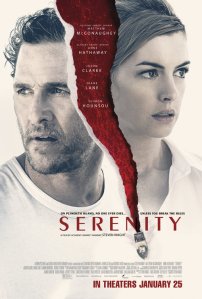 Serenity might have the most bizarre plot twist of any film this year, or maybe even the last few years. For the sake of you, dear reader, I’ll not spoil it, but it’s hard to talk about this neo-noir crime thriller without revealing its larger grand design. I have no real idea what writer/director Steven Knight, a talented wordsmith who has written Eastern Promises, Locke, and Peaky Blinders, was going for with this murky genre mishmash. Matthew McConaughey plays Dill, a local fisherman who for the first 18 minutes of the movie is obsessed with a hard-to-catch tuna like it’s Moby Dick. Literally, this is the key plot for 18 minutes. Then his old flame (Anne Hathaway) comes to town and looking for Dill to help her kill her abusive husband, Frank (Jason Clarke). Now we’re on fertile noir ground, and then one hour in the film throws a curve ball that nobody will see coming, and it spends another 45 minutes dealing with those repercussions. Some of this added knowledge leads to creepy exchanges where Dill is peeling back the veneer of his sleepy island town residents, but really it’s a confusing and unnecessary twist that leads to strange thematic implications and tonal oddities that may lead to unintentional laughter. The sentimental ending conclusion, born out of murder both real and imaginary, feels like it was ripped out of Field of Dreams and forcibly grafted on. So much of the drama is about following what is expected of us, and there are more than a few passing, though intriguing, Truman Show-esque moments that reward further examination, but these are put on hold to slay the abusive husband/step dad through the power of an elusive fish. I don’t know what to make out of Serenity. The acting is fairly solid, the photography is stylish, and Knight knows how to spin a mystery, but to what end exactly? It feels like a passionate albeit misguided student film trying to say New Things about old tropes. In the end, it’s a fish tale that is better off being thrown back. See, I can do fish things too.
Nate’s Grade: C
Share this:

Locke (2014)
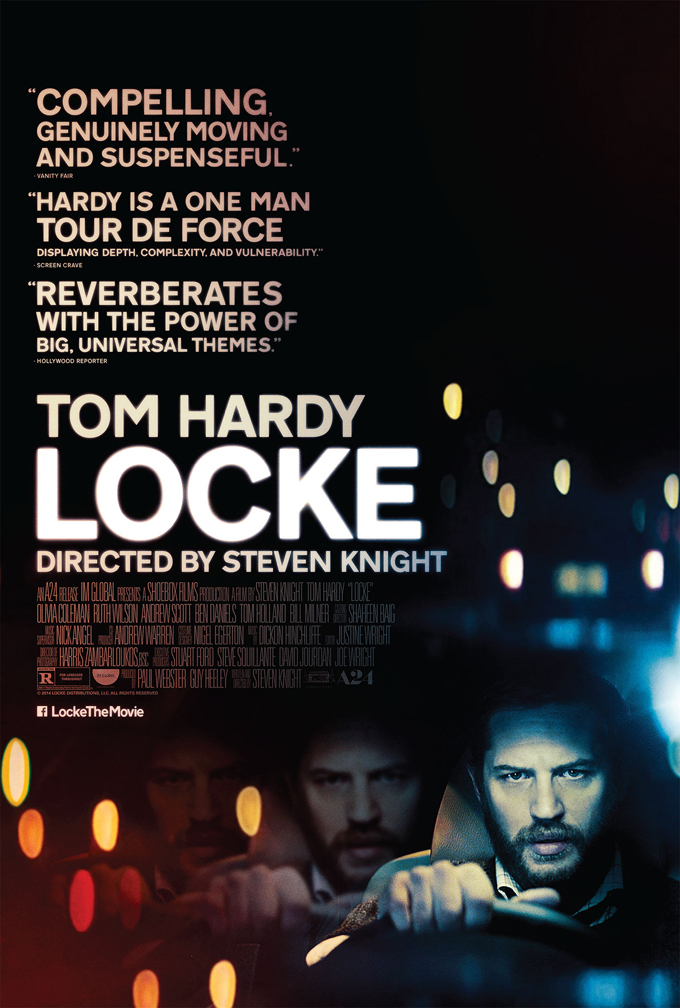 Essentially a one-man show, write/director Steven Knight’s film spends every one of its minutes inside a car with its titular star played by Tom Hardy. Over the course of one real-time late-night drive to London, our driver confronts a series of moral crossroads both personal and professional. It takes a while to get going but once the main conflicts are established, it’s a pleasure watching Hardy try and orchestrate all of them into complacency in the comfort of his car. I kept imagining how someone would translate this into an intimate stage show. The tension builds nicely as Locke has to come to terms with accepting he cannot fix his mistakes. The biggest drawback is that the film abruptly ends without much in the way of a payoff. The whole time Locke is on a mission, berating his invisible absentee father he envisions in his backseat, determined not to make the same mistakes, but then the movie just limps to a finish. It could have used another 10-15 minutes of resolution to feel more complete. Hardy is strong and keeps your attention, often offering glimpses of the complex emotions he’s trying to hide. An intriguing film experiment in minimalism, there are worse ways to spend 85 minutes than inside a car with Tom Hardy. However, there are also better ways.
Nate’s Grade: B
Share this:

Eastern Promises (2007)
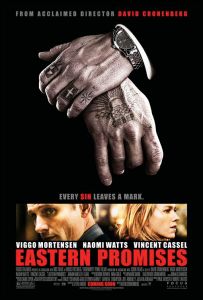 Director David Cronenberg is an idiosyncratic director who explores Big Ideas through the context of creepy horror movies where the body is violated. He’s covered everything from evil gnome-like children, ravenous monsters in Marilyn Chambers’ armpit, and Jeff Goldblum’s face unfortunately peeling away. But then Cronenberg struck it big with 2005’s A History of Violence, giving him the highest profile of his long Canadian career. The auteur of ick is now back in a similarly themed tale of the true impacts of bloodshed with Eastern Promises, a gripping and thoughtful work.
Anna (Naomi Watts) is a midwife working in London and come across a young Russian girl who dies in childbirth. She leaves behind a diary that Anna seeks to have translated so that she can find family members to contact about the newborn. This brings her unknowingly to the doorstep of Senyon (Armin Mueller-Stahl) who runs a restaurant in London’s Russian district. She inquires if Senyon or any of the employees knew the dead girl, and as soon as Senyon hears about the reality of a diary he becomes more concerned. And he should be since he is the head of one of London’s most notorious organized crime families. His loose canon of a son, Kirill (Vincent Cassel), has authorized a hit behind his father’s back and repercussions may soon be approaching. Nikolai (Viggo Mortensen) serves as the family’s chauffeur but takes an interest in Anna and is willing to assist her as she stumbles into impending danger the more she translates from the diary.
 Much like writer Steven Knight’s excellent previous film Dirty Pretty Things, this is a film that shines a light on the underbelly of London and focuses on the immigrant experience and how apt they are to be exploited. Eastern Promises is both a straightforward crime thriller with an intriguing, albeit simple central mystery, but then as it moves along it transforms into something far richer. Through the diary, we uncover the hidden inner workings of the Russian mafia, which is a truly global enterprise. Women are promised with great riches and freedoms in their Slavic homeland, and then once transported will spend the rest of their lives behind the bars of a whorehouse, kept dependent thanks to a drug habit forced upon them. We’re immersed in the culture of this crime family. Eastern Promises takes its noirsh sensibilities and then gives us the foreboding and enigmatic Nikolai, a mysterious figure that the audience, like Anna, is drawn to. He spent time in a Siberian prison and is covered in telling tattoos that serve as a resume for the mafia. Nikolai is such a dominating presence and proves to be more intriguing than the central diary mystery, and it’s here where the film performs a balancing act and transfers our attentions fully to this brooding brute.
Cronenberg subverts his usual irony and weirdness to stay true to his tale, and this may well be, even more so than A History of Violence, the most accessible Cronenberg movie yet. We’re a long way from flesh-eating-monster-in-Marilyn-Chambers’-armpit. He still works with such compact efficiency so that no scene feels wasted, and Eastern Promises is a brisk 1 hour 40 minutes. Where Eastern Promises really succeeds is by layering in strong characters within a relatively genre movie. People are not exactly who they seem and the actors do their best to give remarkable depth to their roles.
Cronenberg seems to have found an actor that shares his artistic sensibilities. Scorsese has Leonardo DiCaprio, Wes Anderson has Bill Murray, Kevin Smith has Ben Affleck, and now Cronenberg has Viggo Mortensen. I never thought much of Mortensen as an actor until Cronenberg unlocked something deep and mesmerizing in their first pairing. With Eastern Promises, Mortensen establishes himself as an extremely capable actor. Nikolai is a complex figure and he Mortensen displays a mastery of understatement; his stony silences and piercing stares speak volumes, but you can practically watch the decision-making of the character pass through the face of Mortensen. He skillfully displays the good inside a man bred for evil.
 Watts is an actress with few equals and she dazzles once more in a role that requires her to do a lot of legwork. And yet, there’s a sad, haunting quality to her thanks to the back-story where she lost a child due to miscarriage. Cassel is also impressive in a complicated role that requires a lot of internal languishing. He’s at one an impudent child willing to live high off the power of his family name, and at other times he comes across as a severely wounded man who cannot thrive in his hostile family (both little and big F) environment. There are interesting revelations that make Kirill a much more complex and captivating figure, and Cassel plays the many dimensions very well. Personally, I’m happy to see Armin Mueller-Stahl in another high profile movie. There was a time shortly after his 1996 Oscar nomination for Shine where if you needed an old guy for a movie, you got the Armin. Lately, it seems James Cromwell has taken his place as go-to old guy. In Eastern Promises, he has such a sly menace to him from the moment his ears prick up at the notion of a diary. He insists upon inserting himself into Anna’s life and casually makes remarks like, “You know where I work, now I know where you work,” with just the right amount of finesse to sound intimidating and yet potentially harmless.
One scene I will never forget is when Nikolai is ambushed in a bathhouse by two revenge-hungry thugs. He sits there naked and exposed and these two unhappy gentlemen descend upon him (fully clothed) with knives. Nikolai fights like a wounded animal and manages to successfully take down both men even though he is unarmed and un-clothed. Up to this point the character has been something of a gentle giant, knowing the vicious ways of the Russian mob but seemingly at distance from them for whatever ethical decision. But it’s at this moment that we bare witness, no pun intended, to the cagey survival instincts of a man who must live his life looking over his shoulder. It’s a bravura scene that is played out in agonizing detail. Nikolai is slashed and thrown against tiled walls (much penis-related mayhem is glimpsed), but he keeps coming back and knows precisely when to strike. It really is the actors doing all the hard knocks and brawling, which heightens the tension. Cronenberg stages the violence in his realistic drawn-out style, which horrifies an audience while simultaneously fascinating them. This is by far one of the most indelible film moments of the entire year.
 Eastern Promises is an engaging character-based thriller, and yet I wish it finished as strongly as it began. This is the kind of movie where much is implied or said in silence, which works great at respecting the intelligence of an audience as well as staying consistent with a believable reality where everyone in such dangerous positions is not explaining everything aloud. However, one of the drawbacks of a film where much is implied is that when it’s over you may wish that they implied less and showed more. The climax to Eastern Promises is a little weak, especially when it comes shortly after the incredible bathhouse attack. There’s a very hazy sense of a resolution. From an artistic standpoint, I suppose I can appreciate a thriller that doesn’t feel the need to end with a pile of dead bodies and much blood being spilt, but at the same time, from an audience point of view, I was really left wanting for more when the film finally comes to a halt.
Thanks to a smart, twisty script, Cronenberg’s sharp yet quirk-free direction, and some stirring performances, Eastern Promises is a first-rate thriller with the added benefit of strong characterization to add richer depth to this tale of mobsters, retribution, and sex slavery. Mortensen is the real deal when it comes to acting, folks. Cronenberg may have found a true match with Mortensen, and the added cache may give the director greater financial opportunities to tell more intriguing tales that may or may not feature ravenous armpits.
Nate’s Grade: B+
Share this:

Dirty Pretty Things (2003)
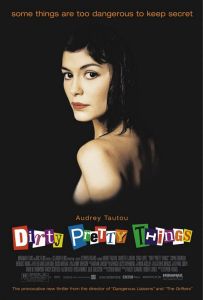 Director Stephen Frears (Dangerous Liaisons, The Grifters) has shown an unflinching eye at the fringe elements of society. In the new thriller Dirty Pretty Things the focus is on the struggling lives of illegal immigrants in over their heads.
The London that Frears displays is the sordid underbelly, the type that hasn’t seen the light in ages. These people are treated like theyre disposable. Those with whatever menial amount of power, even if its a single step higher, prey on these immigrants. ”How come I haven’t seen you before?” one character asks another. ”Because we are the people who are not seen,” he replies.
The heart of the film (you’ll get the pun soon) follows the lives of two immigrants. Okwe (Chiwetel Ejiofor) is from Nigeria and works days as a cab driver and nights as a front desk clerk at a hotel. Senay (Amelie’s Audrey Tatou) is a Turkish housekeeper at the same sleazy hotel trying to stay one step ahead of immigration police. Okwe is instructed to ignore all the salient comings and goings of the hotel. People come to us to do dirty things, says the creepy hotel manager Mr. Sneaky (yes, that is his name). Its our job to make things pretty the next morning. Things get more complicated when Okwe discovers a human heart clogging a room toilet. It seems that for some who check into the hotel, they dont check out. Okwe and Senay become entangled in a bloody scheme that threatens their lives and their immigration status.
Dirty Pretty Things is never boring, sometimes compelling, and more thrilling than you would believe with a plot concerning immigration. The characters earn our attention and emotions with Senay’s vulnerability to Okwe’s tenderness and resolute integrity. They draw us in and we genuinely care what happens as they are snared into the creepy clutches of Mr. Sneaky.
 It’s here that I feel obliged to mention that Steven Knight, the writer of Dirty Pretty Things, is the co-creator of Who Wants to Be a Millionaire?. Just consider the possibilities of future game show creators-turn-thriller screenwriters: Merv Griffin’s hard hitting thriller on the lives of firemen, anyone? It could have the corny tagline, ”There’s only one rule of firefighting – never fall in love.” Maybe this only fascinates me.
Frears’ direction is rock solid. He plays to the best aspects of thrillers, like a suffocating feeling of paranoia but doesn’t suffer the thriller flaws because of such resonant and buoyant characters. Frears is confidant to not overcompensate with his storytelling and lets the grimy locations create his stark mood for him. You can almost taste the stale air.
The acting is exceptional. Ejiofor is amazing. He gives a stellar performance rich in complexity, anxiety, uncertainty, and just plain goodness. He seems to be the last honest man in all of London. There are several scenes you can feel the debate of emotions raging inside him. Tatou, in her first English language role, gives a strong performance, though I’m curious as to where her Turkish accent went. With her penetrating dark eyes and elfin smirk, Tatou is still one of the most adorable actresses on either side of the pond.
Dirty Pretty Things is a searing look at the faceless underprivileged seeking a new life, and those who would deviously prey upon them. The film is a smart, superbly directed, and wonderfully acted thriller. It’s a thriller without weird kids who see ghosts, or lesbians with ice picks, but Dirty Pretty Things is a film thatll stay with you long after the lights go up in the theater.
Nate’s Grade: A


 nathanzoebl
You must be logged in to post a comment.