Blog Archives
Dan in Real Life (2007)
 What is it about advice columnists that make filmmakers want to turn their lives upside down? I suppose there’s some karmic twist seeing someone who instructs others fall on their face when it comes to living their own life. I can readily think of several movies, mostly in the romantic comedy and sentimental weepie genre, that all involve an advice columnist who has their life torn asunder by fate. I suppose the extra dose of irony seems less cruel when dished out to someone who, supposedly, has all the answers. Dan in Real Life is an observant and enjoyable movie that centers on the stumbles and joys of the life of cinema’s favorite whipping boy.
Dan (Steve Carell) is an advice columnist raising three daughters on his own. His wife died years ago from an undisclosed illness and ever since he has been trying his darndest to be the best, if not slightly overprotective, dad. His oldest (Alison Pill) is eager for the car keys, his middle daughter (Brittany Robertson) is defiantly insistent upon her undying love for a boy, and his youngest (Marlene Lawston) is the kind of tyke that provides sage wisdom in time of need, usually at the very end of the movie. The lot of them head out to the family home along the Rhode Island coast to spend the week with the extended brood. Dan sleeps in the laundry room, is hated by his spiteful daughters, and forced into a blind date thanks to his concerned parents (John Mahoney, Dianne Wiest).
 While Dan is out trying to decompress he stumbled across Marie (Juliette Binoche) in a bookstore. They spend hours talking, well Dan does, and suddenly the rain cloud over his head seems destined to fade. He stammers to tell his family the good news when he discovers that his brother, Mitch (Dane Cook), has brought his new girlfriend to meet the folks and it’s, surprise, Marie. Dan respects his brother and tries to control his feelings of desire but still cannot help but flirt and pine for Marie, who is all too aware of the under the radar advancements.
I’m actually somewhat amazed at how well Dan in Real Life plays out in real life. The idea of a big family get-together as a source of comedy has been done to death, and this clan exists in an exaggerated world popularized by movies where families have spirited games of charades, robust sing-a-longs, and then perform a talent show complete with decorative furnishing. The family’s emphasis on togetherness plays out in expected wacky scenarios that would be regularly seen on TV sitcoms, but it is refreshing that an entire film based around an annual family reunion instills no fraternal bickering or bitterness. That’s got to be something new, and again, potentially a pure product of the cinema. Dan in Real Life has familiar staples and walks some dangerously sappy territory but the film manages to surprise and amuse because it all comes back to being character-centered. There’s a great scene where Dan is hiding in a shower and Marie is forced, in order to maintain the rouse, to step naked into the shower with him. Dan is thrown into some contrived situations, like the shower scene, but it is his wounded, deferential sensibilities that save him and also save the film from movie-of-the-week trappings.
Director/co-writer Peter Hedges (Pieces of April) knows how much anguish Dan can suffer before pulling back, and it gets to a point where Dan starts to seem like a comic Job (that might be redundant). Of course, like most sitcoms, lessons will be learned and wisdom will be doled out thanks to full and honest communication, and Dan in Real Life is no different in that regard. There’s a level of believability to the film that helps ground it even during the familiar sitcom moments, like the late rush to testify one’s feelings of true love.
 Carell isn’t a stranger to drama or comedy with some painful underpinnings to it, just look at his work in Little Miss Sunshine or the brilliant awkwardness of TV’s The Office. He’s very effective at communicating the exhausting exasperation of raising a trio of feisty females. There are some tender moments and Carell plays them well. He just has a physically natural look of sad befuddlement with his droopy yet piercing eyes and those bushy brows, so he knowingly underplays broad expressions and gestures and this works exceedingly well with the film’s un-sensational tone. When Dan does unleash the wilder, sillier side it’s usually a culmination of his pent up feelings; being denied happiness that appears within reach. He is a quietly becoming unwound as he tries to squash the feelings he doesn’t want to extinguish.
Binoche is a famous French actress who has an Oscar to boot, but she is simply radiant in this film and makes her character a prize worth perusing. She has an adorable sense of displacement and she and Carell exhibit a nice chemistry. Even in the tight timeframe, both the plot (3 days) and the film’s running length (93 minutes), Binoche manages to make us believe that someone could fall in love with her so easily.
Dan in Real Life is laid back, affable, and a sweet homespun comedy that escapes the sitcom trappings it very easily could have fallen prey to. What makes Dan so winning, ultimately, is how quietly and unassuming it goes about telling a familiar story of a sad man taking his first steps toward happiness. The movie has a gentle nature to it and succeeds thanks to an effective Carell performance and a really great turn by Binoche. Dan in Real Life is a feel-good drama that seems primarily aimed at adults, at least those with a working knowledge of the terrors of teenagers. This isn’t anything new or groundbreaking but it is heartfelt, somewhat moving, and very easy to like. My advice: give this movie a chance and prepare to be surprised.
Nate’s Grade: B
Share this:

Little Miss Sunshine (2006)
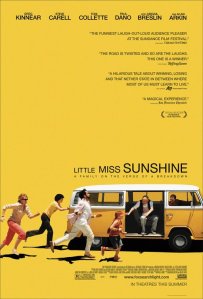 Slowly but surely, Little Miss Sunshine is gaining momentum as the breakout comedy of the summer. It’s gotten some of the most glowing reviews of the year and is poised to capture the hearts of not just fans of indie cinema but also patrons of the big suburban multiplexes, your red state soccer moms and NASCAR dads. After having seen Little Miss Sunshine, I feel like I must have missed the bandwagon.
Little Olive (Abigail Breslin) is bursting with shriek-worthy excitement. She just found out she’s a regional contestant in the national Little Miss Sunshine child beauty pageant. Her family crams into a beaten down, canary yellow Volkswagen bus and heads off on a cross-state journey for Olive. Along for the ride are Olive’s fractured family — older brother (Paul Dano), who has taken a vow of silence until he becomes a fighter pilot, stressed-out but supportive mom (Toni Collette), ambitious self-help failure dad (Greg Kinnear), a potty-mouthed, heroin-snorting grandpa (Alan Arkin), and a suicidal gay uncle (Steve Carell). It’s a long road to the pageant, especially with such an eclectic group of people whose only thing in common are their chromosomes.
 I just couldn’t shake the overwhelming feeling that Little Miss Sunshine should be more. It’s not really much of a comedy. There are some funny moments, and pushing the bus is a running gag with better legs than I would have guessed, but the film has a lot of stretches where the laughs are low to nonexistent. It’s not really much of a character piece either. None of the characters are that well defined or allowed to stretch out. The family members are all archetypes of indie film weirdness: the gay intellectual, the verbally inappropriate grandparent, the self-deluded father, the frazzled mother, the loner brother, and the precocious tyke. Little Miss Sunshine does a fine job of setting up its family of cracked characters but then seems to twiddle its thumbs when it comes to development. The only character insights come in a scattered few small moments with Olive. Dad is essentially poisoning his family with his self-help claptrap, casting the world into “winners” and “losers.” There’s a heartfelt moment brilliantly played Breslin where she confesses to grandpa that she doesn’t want to be a loser because her dad would stop loving her. Aside from that, Little Miss Sunshine seems to wind its characters up and then leave them be. I wanted more of just about everything but the movie wouldn’t budge.
The movie spends quite arguably too much time at the Little Miss Sunshine beauty pageant. Child beauty pageants are a well deserved, albeit easy, satirical punching bag, and they creep the hell out of me. Seriously, turning little girls into highly sexualized Barbie dolls seems cruel, unnatural, and very very creepy to me. There was a stupendous documentary that aired on HBO years ago called Living Dolls that traced the life of a six-year-old girl and her stage mother. It was a harrowing film, and the obsessive mother is one of the most disturbing villains I’ve ever seen in a movie, scripted or otherwise. In the film you see how people transform little girls into flirty, overly made-up little adults. It’s sickening.
The reason I bring this up is because Little Miss Sunshine because they lift a direct metaphor. In Living Dolls the main girl is playing one of those tiny slide puzzles where the finished result is an honest to God yellow smiley face. It’s a perfect metaphor of this child attempting to find happiness when no one seems to want her to live as a child. And then I saw the exact same moment in Little Miss Sunshine. Rip-off or accidental homage, you decide. In the same vein, every time Kinnear invokes the name of his literary agent, Stan Grossman, I kept thinking of Fargo.
In Sunshine, the family is aghast at the pageant scene but support Olive anyway. Then things get way too easy. The film concludes with the 5,785th rendition of the weirdos celebrating what makes them who they are, their weirdness, and sticking it to the thumb-nosing naysayers. Then the movie abruptly ends. That’s all, folks. Little Miss Sunshine was already built on the aching backs of two very familiar indie staples, dysfunctional families and road trips, and offers little else to justify its existence.
 It’s hard to really drag this film through the mud. It was proficiently made by the music video directing team of Jonathon Dayton and Valerie Faris (Smashing Pumpkins’ Tonight Tonight). The acting is generally good. The better actors rise to the top despite their limited character depth. Carell is a big name in comedy right now, and he gives a rather subdued, sarcastic performance that will resonate best with audiences. Kinnear is better at playing smug types than pathetic types. His character really is the villain of the piece, so it’s nice to see his transformation even if it is awfully spontaneous. Collette always looks to be on the verge of a nervous breakdown. Breslin (Signs) is pretty cute and will pierce your heart during the aforementioned talk with grandpa.
There are some amusing moments and fun pieces of dialogue, and the film has its heart in the right place. The screenplay needed to go through a few more drafts to strengthen character and story. I can honestly say my favorite part of Little Miss Sunshine was listening to its very Sufjan Stevens-like soundtrack full of meloncholic horns, cellos, violins, squeezebox and electronic whispers. I would recommend the soundtrack ahead of the movie.
I feel some shades of guilt as I gather my opinion, however I cannot deny the overwhelming urge that Little Miss Sunshine should have been more. It needed more comedy, more character depth, more attention to story, and more opportunity for its ensemble of actors to sink their teeth into the material. This appointed indie darling is intermittingly amusing, has some laughs, and may be worth a free afternoon or as a rental. To me, it’s also a big example of wasted potential. Little Miss Sunshine is a beauty that needs more work before it can shine on a greater stage.
Nate’s Grade: C+
Share this:

The 40-Year-Old Virgin (2005)
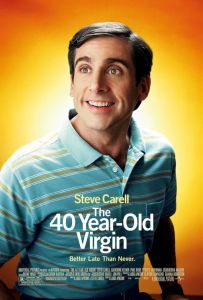 Yes it’s an uproarious sex farce, that’s a given from the ads, but this movie is also surprisingly sweet and genuinely moving. A lot of credit goes to star/co-writer Steve Carell and co-writer/director Judd Apatow, creator of some of the best, most honestly funny TV series unjustly cancelled. Apatow is a master at mining human comedy for pathos, where you get a great sense of character and really feel for those onscreen, and yet nothing feels cheap or unwarranted, all the while deriving comedy from the situations. We need more men like Apatow in the film industry. Carell can do it all whether it’s deflecting his insecurity, which we feel so bad when he comes up with outrageous things he’s overheard to make himself seem like one of the guys. The supporting cast is top-notch. They’re basically the stock roles in a sex comedy and yet they bring so much more to the table, with a true-to-life boys-will-be-boys camaraderie that you can identify with. The character relationships in The 40-Year-Old Virgin really elevate the story and the jokes and make the film something really special. It’s not merely a barrage of gross-out humor; it’s a nice story with some very tender moments. This is a movie that goes well beyond its gimmick premise, never feeling like a skit blown up into a feature film. It mixes in psychology, heartbreak, awkwardness, but also insights into loneliness and human connection. The best character-based comedy in years.
Nate’s Grade: A


 nathanzoebl
You must be logged in to post a comment.