Blog Archives
Atlas (2024)
 In the world of Netflix releases, it’s hard to judge what is gauged as a success. Take for instance their new sci-fi action movie Atlas. It cost the streaming giant $100 million and they now tout it as being the top movie across the globe on their platform. This could very well be true, though Netflix has long been cagey about sharing their viewing numbers, instead preferring to go with the, “Hey, just trust us, okay?” defense, which hasn’t exactly been reassuring in an era where bonuses are linked to number hits. With the ever-expanding catalog of titles, being a reported hit on Netflix can sometimes feel like being, say, Homecoming Queen from 1989, an accomplishment soon eclipsed and forgotten. What was the last big Netflix action movie that had cultural staying power, that caused people to continue to discuss weeks or months later? Netflix swears their most-watched movie is 2021’s Red Notice, a star-laden breezy adventure caper that I challenge anyone to remember much about besides its stars. This is the challenge of gaining traction in a world of near endless content choices. Atlas is an above average film benefiting from a strong character dynamic at its core even if the rest of its story elements feel forgettably disposable.
Atlas (Jennifer Lopez) is a data analyst who has also helped develop Earth’s orbital security system. An A.I. program/robot named Harlan (Simu Liu) was born from Atlas’ mother, and then Harlan went and murdered millions of humans. The killer robot fled Earth with his robotic followers and Earth has been awaiting his return for decades. Atlas joins a mission to land on a distant planet where they think Harlan has operated as his base. However, Atlas must work with an A.I. program inside her mech suit that calls itself Smith. In order for them both to survive in this new world, they must work together.
 I found everything within the mech suit of Atlas to be engaging and dynamic, and everything that happens outside that giant suit to be underdeveloped and mediocre. I was genuinely surprised how Atlas essentially becomes a buddy survival movie. It’s the human who is distrustful of accepting help from others and especially from advanced technology with a mind of its own, and an A.I. program that is trying to improve its capabilities by getting to know its user and learning how to grow from her. They need each other to survive and that requires a trust and relationship to be fostered, and it’s a surefire enjoyable plot to watch two enemies become allies and maybe even friends over the course of their united struggles. The growth between them also feels relatively organic, coming at a natural progression with personal insights and offerings without clunky leading dialogue lines, like, “So why don’t you trust robots, huh?” This dynamic reminded me a bit of 2004’s I, Robot where Will Smith played a detective who hates robots who has to work with a robot and the two of them form a bond (there are other similarities I’ll get to later). Much of the movie takes place within a three-foot window from the capsule inside this mech suit, and the shared struggle between Atlas and Smith is the heart of the movie, and it’s actually quite good. Both of these characters find ways to surprise one another, both of them shed preconceptions, and both of them will discover the lengths they go to protect the other even if it puts their own existence in question. As a story about a woman and her robot, Atlas is a fun and fairly involving sci-fi buddy movie adventure.
Now, the world building and story that gets Atlas to this alien world, and the escalating stakes of world destruction are where the movie dissipates into an amorphous cloud of sci-fi action keywords. I don’t know why it had to be killer terrorist robots that brought out Atlas and her team of mech-suited warriors to this foreign planet. The reason why the characters are stranded on this unknown planet is unimportant. It could just as likely be a science team exploring a potential new habitable world for an Earth burning through its natural resources too quickly. It could be exploring the remnants of a possible alien civilization. It could even simply be the closest planet available during a distress from their spaceship going down for whatever mechanical or orbital obstruction. The story is about the relationship between the human being and the robot/A.I. working together to survive in an unfamiliar and hostile land.
 The robot insurrection feels like an acceptable plot device but it’s so under-explored until the movie needs to dramatically escalate the stakes into an apocalyptic cataclysmic scale. The fact that Harlan, which let’s agree is a terrible name for the villain of your movie, determines that the best way to save humanity is to annihilate humanity is already a tragically familiar refrain we’ve heard from numerous sci-fi villains, from The Hunger Games to Infinity War to The Day the Earth Stood Still to even I, Robot. In that last movie, the A.I. system determines the only way to protect humanity is through controlling and ultimately eliminating them, and this same motivation comes to Harlan. This character is introduced as our Big Bad through an opening montage, he disappears, and then only comes back at the end to be a force to threaten Earth. The entire robot uprising is so tremendously underwritten that the movie doesn’t even do the barest whiff of ambiguity to question whether humanity has been mistreating its robot servant class. Instead, Harlan is introduced right away as a terrorist figure and stays true to this characterization. I thought that Act Three would be upending for Atlas, where she learns the robots were framed or at least the conflict is more nuanced and her “side” might be more culpable than the military’s cover story. Nope. Evil Robot King is simply Evil Robot King. Fine, he’s a boring killbot, but then why go to such lengths to provide a personal connection for Atlas and Harlan. It’s unnecessary when she has to stop the killer robot from killing the Earth; we don’t need a personal connection for this to work. The level of personal guilt attached to Atlas is ridiculous, including multiple levels of tragedy that feel far too overwrought. Atlas didn’t need to feel guilty over her involvement in developing Evil Robot King as a child; she could have been simply the daughter to the woman who unintentionally brought this killer tech forward, or she could have simply been a woman who experienced a tragedy linked to the robot uprising without having a mom who developed the technology. She could just be a victim. She doesn’t have to be the first victim.
 Atlas is really a one woman show, so your feelings of Lopez (Hustlers) as an actress will dominate how you feel about the overall experience. I don’t know if Atlas is made substantially better with her as the lead actress but she certainly performs ably and doesn’t seem left unmoored by the fact that she’s talking to a voice in an empty space for most of her months filming. Lopez has a determination that gives her action novice character an underlying strength to tap into upon the call of action.
As a sci-fi action spectacle, the blockbuster aspects are sufficient for our casual entertainment fulfillment. The special effects and action are pretty solid under director Brad Peyton (San Andreas, Rampage) who knows his way assuredly around effects-heavy spectacle (he was also co-creator of the delightfully daffy 2019 Netflix apocalyptic series Daybreak). Much of the movie takes place within one mech suit, but I never felt a sense of visual claustrophobia thanks to the buddy dynamic and Peyton’s use of space. The big action sequences at the end have their share of impressive cool moments, but they also benefit from coming at the end of a character relationship that has helped to make the action more satisfying. I do lament the modern trend of filming on such large green screens or LED stages that lighting is always the same bright overhead setting without significant variance with shadows and other light sources.
If you’re looking for a Netflix action movie to divert your attention, or even barely pay attention to, then you could do far worse than Atlas. It might even hold your attention and keep you engaged thanks to the fun buddy film dynamic that serves as its foundation. There are plenty of elements that feel tacked on, underdeveloped, or blandly familiar, but the core works and Atlas is worth a couple hours of escapism.
Nate’s Grade: B
Share this:

American Fiction (2023)
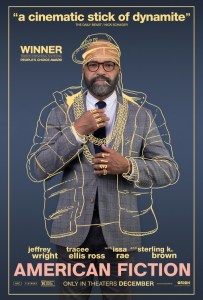
Cord Jefferson’s hilarious, inflammatory, and insightful comic fable can be boiled down to the question of what exactly does it mean to be a “black writer” in this day and age? According to the main character, English professor and middling writer Thelonious “Monk” Ellison (Jeffrey Wright), he would pointedly argue that he is a black writer and thus his novels, never ones to climb a best-seller chart, should qualify as black literature. The publishing industry seems to think differently. Their conception of a “Black story” is one defined through poverty, guns, drugs, gang violence, degradation, and all sorts of depressing stereotypes of socioeconomic disadvantage. If there are stories of triumph, they will usually be relegated to the same familiar settings of struggle: slavery, the Civil Rights era, and modern ghettos. A simple slice-of-life about a middle-class family isn’t necessarily seen with the same level of acceptance. With American Fiction, Jefferson and Monk push through, trying to exploit a system of exploitation at its own game, and the results are biting and hilarious and a condemnation of the low expectations that can govern the supposedly open-minded values of others when it comes to celebrating authentic minority stories.

The movie really takes off once Monk decides to, as a sarcastic lark, give the publishing world what it seems to crave, a novel (My Pafology) that plays into every urban stereotype. He adopts a nome de plume, “Stagg R. Leigh,” and riffs that he’s currently a fugitive from the law. The intention was to make fun of the limited black literary stories that he despises, and yet the incendiary manuscript becomes a hot commodity. They’re already talking about turning it into a movie. Monk is aghast but the money is very appealing, so he puts his moral superiority aside to see how far he’s willing to pander if the check is right. His alter ego is deemed more authentic and compelling when he doesn’t even exist and is only a combination of the same worn-out and destructive stereotypes. It becomes an ongoing game for Monk to see where exactly a line can be drawn. He actively tries to make his manuscript objectively worse, and at every step it only seems to have the opposite reaction among white editors and agents and producers salivating to celebrate it. There’s a very telling scene where Monk is part of a literary award body scouring through manuscripts for potential worthy award-winners. He and another prominent black author (Issa Rae), the best-selling author of We’s Lives in Da Ghetto, are critical of My Pafology and its adherence to harmful stereotypes, but the white liberals won’t hear it and want to reward it. “It’s really important that we listen and uplift black voices,” one of them says obliviously. Of course, if they knew the truth that the author was really an upper middle-class East Coast academic, there wouldn’t be the same rush to elevate this “brave and inspiring” story of the streets. To Monk’s ire and chagrin, there is no bottom when it comes to the appetite for degrading stories that neatly fit into a pre-existing mold.
Jefferson’s screenplay, based upon the 2001 novel Erasure by Percival Everett, is bristling with biting intelligence. This extends beyond the identity crisis of Monk in the world of publishing to his personal life, and the time spent with his fractured family is just as illuminating as the time spent in publishing. Monk’s need for money is driven less from his own desire to live large and more about caring for his ailing mother who needs to be placed in a costly assisted living home as she plunges further into dementia. His shared moments with his mother can be heartbreaking as well as informative. His relationship with his brother, Clifford (Sterling K. Brown), who is embracing his black sheep status as a now openly gay middle-aged man, is a regular point of reflection for both characters who feel their identities are in free fall. Their conversations about being accepted as you fully are help reinforce the major themes mirrored through Monk’s publishing odyssey with his alter ego. The Hollywood satire is best encapsulated by Adam Brody’s shallow movie producer, a good white liberal who is sold on the project after he perceives that Monk leaves their meeting after hearing police sirens. His every appearance is a gift. Not everything in Jefferson’s adaptation feels as exceptionally well integrated. I don’t think the romantic subplot quite works but Jefferson is smart enough to frame that as possibly the larger point, an offshoot that presents an alternative of happiness for our bitter protagonist that he will inevitably decline.

This is also a deserving showcase for Wright (Westworld, The Batman), one of our best character actors who rarely gets the plaudits he deserves. He’s a brilliant actor when it comes to consternation and exasperation, and his unexpected journey of discovery and success allows him to assess how much he’s willing to go along with a deceptive narrative in a ludicrous industry of perception. Wright’s performance is equal parts amusement, like a conman who can’t believe he keeps getting away with his ruse, and head-shaking anger at being marginalized unless he erases the complicated, unique parts of himself.
I also want to celebrate the very ending of American Fiction that goes even harder on industry satire. Jefferson gets extra meta and presents a series of possible endings for Monk’s story, from Monk’s preferred ending that leans more ambiguous and open-ended, to the Hollywood happy ending and other versions, each their own condemnation on the studio system and the larger demands of mass audiences for tidy endings. It’s a level of comic bravado that American Fiction hasn’t really fully channeled until that moment and its absence makes this conclusion, a choose your own adventure of bad endings, hit even harder. He’s been saving his full satirical might until the very end and it was worth it.
Who exactly gets to qualify what constitutes the black experience? Certainly not I, a 41-year-old white guy writing on the Internet. Even though the source material is over twenty years old, the struggles of identity and acceptance and the lens of which we subject others’ experiences through are still relevant in an increasingly hostile cultural environment for different attempts at diversity. American Fiction is hilarious and smart and produces as many thought-provoking questions as solid belly laughs. It’s a cutting satire but with characters that are compelling beyond their connection to larger satirical points. This is more than a message movie, and it’s a statement debut film for Jefferson as a filmmaker and primarily as a storyteller. Jefferson began as a journalist and has worked on several critically-acclaimed TV shows, winning an Emmy for an extraordinary episode of HBO’s Watchmen. He is a talent, and American Fiction is proof that he has a voice and the confidence to carry it through into one of the best films of 2023.
Nate’s Grade: A-
Share this:

The Rhythm Section (2020)

I like Blake Lively as an actress. I like spy thrillers. I think Reed Moreno has real talent as one of the signature directors of TV’s Handmaid Tale series. So where did The Rhythm Section go wrong, besides its clunky title (it’s a reference to different parts of the body working together like an orchestra so…. yeah)? I think it’s because the movie, based on a book by Mark Burnell, is stuck in a tonal middle ground between spy escapism and spy realism, and it doesn’t quite work. The movie is filmed with the herky-jerky docu-drama camera movements of a Paul Greengrass Bourne flick, which when done well creates a visceral sense of immersion, but here it just creates an unstable atmosphere that makes it hard to settle on what is important. The story has Lively as Stephanie, whose family died in an airplane crash that may have been a terrorist bombing. She is trained by former MI6 agent Jude Law and then sets off on a messy path of vengeance tracking down the suspected perpetrators. Stephanie’s actually really terrible as a killer and it makes for an amusing, and confusing, batch of run-ins, as Lively’s character is far more vulnerable than the famous names of spy fiction. It should make the missions and fights more exciting but The Rhythm Section is drained of most excitement. It’s so suffocating and dreary. The characters aren’t well developed or even given memorable personalities. Stephanie, once she is set off on her mission, fails to grow as a character or, really, as an assassin. It makes the entire movie feel hard to engage with emotionally or intellectually. There are some interesting moments of combat or suspense but nothing that carries over into a sustained sequence. A car chase shot entirely within Stephanie’s vehicle should be exciting but it just felt underdeveloped too. The plot is packed with needless flashbacks and obtuse to the point I had to read a Wikipedia summary after the movie was over. It’s not fun spy hi-jinks with interesting characters to draw our appeal, and it’s not really a twisty John le Carre thriller (Tinker, Tailor, Soldier, Spy) that’s dense in its plotting, character ambiguities, and the realities of actual spycraft. It’s just a non-invigorating mystery with blandly developed action and suspense sequences, when you can make out what’s going on, and very minimal characterization. It’s a thoroughly mediocre bore.
Nate’s Grade: C
Share this:

The Predator (2018)
 It’s been 31 years since the first Predator strutted its camouflaged self onto the big screen and bedeviled Arnold Schwarzenegger and company. Since then the dreadlock-sporting intergalactic sportsman has become a familiar vaginal face to movie audiences around the world. One of those company deaths in the original movie was none other than Shane Black, years before the writer/director became a bankable Hollywood commodity. Black is going back home to revive the dormant franchise with The Predator, a big-budget sequel/reboot that aims for the stars and falls far, far too short.
An alien spaceship belonging to a rogue Predator crashes on Earth, scattering important debris. Quinn McKenna (Boyd Holbrook) is a black ops sniper and the only surviving member of his team who happened to be on site when the ship crashed. The government says he’s crazy and transfers him onto a bus filled with other mentally disturbed military vets who call themselves “the Loonies” (Trevante Rhodes, Keegan-Michael Key, Thomas Jane, Alfie Allen, Augusto Aguilera). A tough-talking government agent, Traeger (Sterling K. Brown), seeks out a biological specialist, Dr. Brackett (Olivia Munn), to examine their interstellar prize. At the secret lab, the Predator breaks free, Dr. Brackett chases after the specimen, and she teams up with the “Loonies” to track down the alien. After his initial Predator encounter, Quinn mailed the alien helmet and other evidence to his son, Rory McKenna (Jacob Tremblay), a young boy with autism who cracks the alien code and becomes the target of a Predator, a Super Predator, and the government.
 The Predator is a supremely messy movie, often feeling like two separate screenplays inelegantly stitched together, one a big bloody action thriller, the other a winky Shane Black vehicle with a cavalier, macabre sense of humor. It doesn’t quite work because the movie can’t fully settle on a tone, or a direction, and thus it keeps providing glimpses of the many versions of the kind of movie it could have been instead. I’ll openly admit to being a Shane Black fan when he embraces his sly instincts, command of genre, and ribald wit (Kiss Kiss Bang Bang is a modern comic masterpiece; The Nice Guys is… pretty good), so the Black touches were my favorite part especially because they stood out the most. I enjoyed the characters entering into scene-breaking asides, like Dr. Brackett questioning why the alien would be named a “predator” given its behavior is more akin to a hunter or a fisherman, and Traeger shrugging, “Yeah, well, we took a vote and ‘predator’ was cooler. Right guys?” Or when a character is being held at tranquilizer gunpoint and mocks the danger, only to be tranqued point blank in the eye, killing him. Or a bully suddenly getting drilled by the defense mechanisms of the Predator helmet and murdered. It’s these moments that kept me most entertained, demonstrating Black’s unique voice that can take genre filmmaking within a studio sphere and turn it on its head with a devilish grin. If The Predator had been more a Shane Black vehicle than a Shane Black studio reboot, then perhaps the final product would have risen above the mediocrity that sinks it.
Much of that mediocrity comes from the middling plotting, mostly after the first act. For a solid half hour, I think Black has something promising, having set up the various characters and gotten them to intersect and go on the run together as a merry band of outlaws and amateur alien hunters. Once the “Loonies” break free with Dr. Brackett is where the movie loses its sense of direction. The plot just stumbles from one set piece to another, rarely with good reason. One minute they’re running away from a Predator creature and the next they run into an apparently unlocked high school building rather than flee in cars and RVs. Most of the plot movement follows little Rory, first reaching him before the bad men do, then rescuing him from Predator dogs, and Predator, and then he’s kidnapped by the bad guys, then he’s hunted by the Super Predator and I’m tired. This kid is a spectrum-walking, spectrum-talking plot device (more on that below). It feels decidedly odd to have a super sniper paired with a renegade group of mentally disturbed and dangerous military castoffs and instead of them primarily hunting and killing a space alien they are rescuing a little boy with special needs. It would be like having a Tarantino rouges gallery teaming up to teach a child how to read. It feels like a misapplication of the character dynamics onscreen, which again gets to my central criticism of the final film feeling too much like separate movies in conflict. The studio elements (supportive yet feisty ex-wife, autistic savant, Predator dogs) feel too obvious.
 The action is serviceable with a few dandy practical gore effects. There’s a nasty, visceral quality of the action that proudly wears its R-rating as a badge of honor, as a PG-13 Predator movie would be a disservice to the universe’s most fearsome hunter (the first Alien vs. Predator was PG-13; I suppose acid and florescent blood are less traumatic to be seen gushing from hacked limbs?). The action gets a lot more boring once the Super Predator is introduced, an eleven-foot all-CGI monstrosity that needed a bit more work. Beforehand the Predator is a combination of makeup and practical effects, allowing longer interaction with its environment. I enjoyed the Predator breaking out of the lab. I did not enjoy the team taking on the Super Predator at night in the middle of the woods because it decided to go… sporting. Seriously, the second-to-last action set piece has the flimsiest formation. Rather than accomplish its mission, the Super Predator invites all the humans to one more game, though the alien acknowledges that “McKenna” is their only true champion. It devolves to jump scares in the spooky woods, but hey, at least characters can start being eliminated (some of them so abruptly that it’s a blink-and-you’ll-miss-it exit). There are touches throughout the action that keep things lively before ultimately succumbing yet again to the freefall of the project’s creative dissonance.
The actors are enjoyable but I felt bad they weren’t given more. Holbrook (Logan) is consistently upstaged by his eccentric band of compatriots, but only Jane, Key, and Rhodes get any personality. The other guys are just kind of there. I don’t think I laughed once at Key’s (Netflix’s Friends from College) many, many wisecracks. The Tourette’s syndrome tic given to Jane (TV’s The Expanse) is rarely funny, and yet Black goes back to it again and again (the adolescent kid behind me in my theater thought every profanity was the funniest thing ever committed to film). The actors glide by on Black’s signature macho, cocksure style, clinging to every new quip like a lifeline. Munn (X-Men: Apocalypse) has a few fun, feisty moments but is still basically featured as The Girl. Tremblay (Wonder) is making me rethink my evaluation of him after Room. The best actor in the movie, by far, is Brown (Black Panther) who has a malevolent charm that connects most fluidly with Black’s sensibilities. Even his self-satisfied laughter made me laugh.
 We need to talk about the film’s views on autism (there will be some spoilers in this paragraph, so skip ahead if desired). Rory McKenna is of that kind of Hollywood Autism, the kind we see on TV (The Good Doctor) or of classic movies (Rain Man). It’s the designation of autism as a gateway to super powers (never mind that having savant abilities only impacts ten percent at best). Whatever, it’s an unrealistic depiction in an age of better, more nuanced depictions of mental health and disabilities. Where The Predator gets crazy is when Dr. Brackett offers this nugget: “You know many people think autism is just the next step in human evolution.” No. Nobody thinks this. As someone who has worked extensively with children with autism, this is not a thing. I’m not saying by any rationale that those with autism are lesser by any means but they’re no more the next stage in human evolution than any other condition. Ask a person with autism if they feel like the next stage in human evolution, like an X-Men mutant. What makes matters worse is that Black confirms this strange notion when the Super Predator, surprise surprise, was most impressed with Rory McKenna and not his big bad dad. The Super Predator plans to take the kid back to, presumably, harvest his autism DNA so the future predators will… know how to fly their spaceships that they already know how to fly? I don’t know.
The Predator is part sequel, part reboot, part Shane Black genre riff, part muscular R-rated action movie, part chase movie, and part Hollywood mishmash. Apparently the film underwent extensive reshoots as well, retooling the entire third act, which seems obvious in hindsight and only magnifies the disconnect between the central story elements. Shane Black’s signature elements are but glimmers of what could have been. It needed to be more of a genre send-up of 80s-action farce, or a more straight-up action movie, or something where the plot generally made sense and had characters we liked. Was Shane Black playing a joke on the studio? The Predator will probably be most known for editing out a real-life sexual predator, or from its dreadlocked alien dog being domesticated after getting shot in the head, or its depiction of autism, or anything that isn’t really the entertainment level of a mediocre rehash. Check out Predators instead.
Nate’s Grade: C


 nathanzoebl
You must be logged in to post a comment.