Blog Archives
Goodbye Christopher Robin (2017)
 The young author sub-genre has become an awards season cottage industry. We’ve seen recent stories about J.M. Barrie, Jane Austin, P.L. Travers, Beatrix Potter, Ernest Hemingway, and a whole assortment of the Beats. Even in 2017 there have been stories about a young J.D. Salinger (Rebel in the Rye), the creator of Wonder Woman (Professor Marston and the Wonder Women), and soon Charles Dickens (The Man Who Invented Christmas). We seem to relish watching the formation of brilliance, or at least watching a recognizable creative voice find their flights of inspiration. Goodbye Christopher Robin is meant to be another in the tradition of young author movies served up on a platter for season-ending awards and recognition. Goodbye Christopher Robin is so serious, clumsy, and tacky in final execution that it enters awards bait self-parody.
Alan Milne (Domhnall Gleeson) is coming to terms with his PTSD after his experience sin WWI and trying to re-enter the literary and theatrical world of London. He finds inspiration through the imaginative play dates with his young son, Christopher Robin a.k.a. “Billy Moon,” and in time the formation of Winnie the Pooh’s world. The book is met with immediate success and Alan and his wife, Daphne (Margot Robbie), are all too ready to ride the wave of fame. Christopher is raised by his kindly nanny, Olive (Kelly Macdonald). Eventually, Christopher grows to resent his parents, the public’s assumption about himself, and the very name of Pooh itself, so much so that he volunteers to go to war as a means of just escaping the overbearing attention of the spotlight.
 The opening act of this movie is the best part, and it’s all pre-Pooh. It also helps that it focuses more on Alan Milne rather than his son, who will take a far larger role later. Milne is already a slightly prickly character who doesn’t exactly fit in with the British upper class. He’s also trying to process his PTSD and return to some semblance of a normal life. He’s also struggling artistically, and this is where the film is at its most interesting because it has the most focus. We get to really delve into the triggers and emotional state of a character in a way that feels engaging. We spend time establishing a person, a trauma, and how it impacts his relationships. It’s not the most singularly compelling drama but it’s still more effective than what regrettably follows.
Where things start to go irreversibly downhill is the exact emergence of Pooh. While Milne is spending more time with the son he doesn’t fully know how to relate to, he’s also pumping his boy for ideas during their play for a children’s story. We get the expected but still lazy moments of all the little signifiers in their lives that connect with future characters. Then one Pooh gets published it becomes an international best seller and the movie just zooms through plot. It goes from releasing the book to everyone in the world loving it literally in a minute of screen time. The Milne family, and especially Christopher Robin, can’t go anywhere without being recognized and hounded by fans. This is also where the film makes a sharp turn and reveals Alan and Daphne Milne to be really terrible parents. As soon as success appears, they’re actively exploiting their child at every opportunity, including such stunts as a radio station also listening in to father wishing his son a happy birthday over the telephone. If there’s a chance they can sell more books, get extra publicity, or simply parlay their fame into something, they take it, and often Christopher Robin is left home alone with his nanny while mom and dad lap it up. Rarely have you seen childhood neglect made to appear so strangely whimsical.
 Even this abrupt plot turn could have worked as an interesting and unexpected portrayal of a literary family that lost the “family” sensibility once fame and fortune arrived. Unfortunately, this is not really a movie about consequences being felt because we’ve got to speedily move onto the next plot point in order to fulfill the formula. After Olive has her big speech about how the Milnes have been mistreating Christopher Robin, it’s literally two scenes later where Alan comes to agree. Lot of internal turmoil there, huh. Christopher Robin’s life gets so bad he’s practically begging to go to war. Even his fate during the war is something the film doesn’t leave unanswered for long. Why dwell on the consequences of decades of bad parenting when we can still careen into a feel-good ending that will attempt to poorly wipe clean the slate? Everything is resolved so rapidly and without larger incident that rarely does the story have time to register. We’re never going to feel great insights into these characters if the film doesn’t give us time. Who cares about hardships and betrayals if they’re just going to be erased in the next scene or if some life lesson will be ham-fistedly learned, but not earned, in short succession?
This is not a subtle movie by any means. The second half of Goodbye Christopher Robin is all about how the boy’s life is awful and how much he dislikes the spotlight. The father comes up with the solution of sending Christopher Robin to a boys’ home way out in the country. As soon as dad leaves, the boys instantly start bullying and harassing Christopher Robin, literally throwing him down flights of stairs while chanting insults. Dear reader, the next part astounded me. It is during the shot of him being pushed down the stairs that the movie uses this sequence as a transition device. By the time Christopher Robin stumbles to the bottom of the stairs he is now a teenager. It’s as if he has been falling down the stairs for a hellish decade. Then there’s the moment where dad sees his son off to war at the train station. As he looks back, for a brief moment it’s not teenage Christopher Robin boarding that train but young child Christopher Robin. I laughed out loud at this moment. It’s too earnest and too clumsy not to.
 The acting cannot save this movie. Gleeson (The Revenant) gets to be that kind of aloof where the actor pronounces words with great care. His acting style is a bit too removed and opaque to really feel much for his character, especially when he cedes the spotlight to his neglected and exploited son. Robbie (Suicide Squad) is just completely wasted. She might be the film’s biggest villain and her disapproving stares look like they should be accompanied by cartoon steam coming out of her ears. Macdonald (HBO’s Boardwalk Empire) fares the best mostly due to her genuinely appealing nature. It also doesn’t help matters when it appears that our young Christopher Robin, newcomer Will Tilston, was hired for his toothy grin and dimples. This is not an especially good child performance. It’s powerfully winsome but in an overly cloying manner. It was hard for me to work up much empathy for Christopher Robin because the performance kept left me cold.
Goodbye Christopher Robin is a feel-good movie that made me feel like checking my watch. It’s tonally off with its mixture of sentiment and indifference, zooms through important plot points rather than dwell on the impact of decisions, and looks for any opportunity to bludgeon an audience rather than deliver something genuine and subtle. If you’re a major fan of Winnie the Pooh perhaps you’ll get something out of it knowing its author was a terrible parent. This wasn’t a movie that made me feel authentic emotions. It felt too clumsy, too mechanical, and ultimately too miscalculated. The only awards this might be contending for at the end of the year are not the kind it’s going to want.
Nate’s Grade: C-
Share this:

My Week with Marilyn (2011)
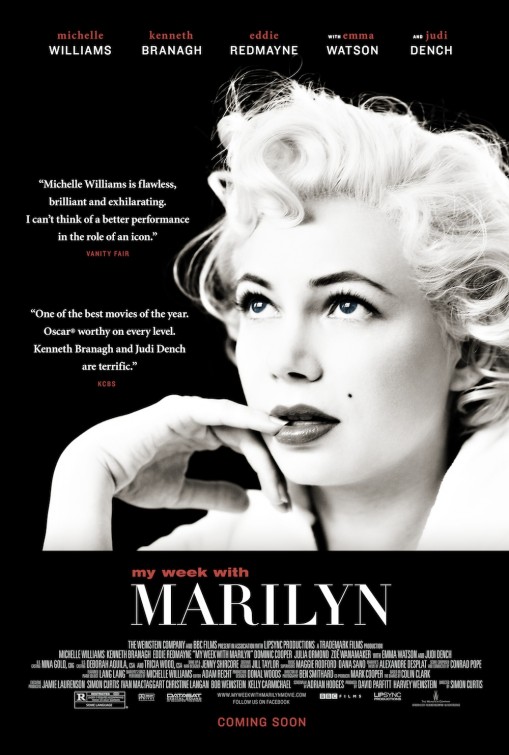 In 1957, Marilyn Monroe (Michelle Williams) was the biggest star in the world but she wanted to be taken seriously as an actress. Laurence Olivier (Kenneth Branagh) was an award-winning thespian considered to be acting royalty, but he was looking to siphon some of Monroe’s fame and vigor. Monroe flew over to England to shoot the light comedy The Prince and the Showgirl, directed by and starring Olivier, and it was here that she changed the life of Colin Clark (Eddie Redmayne). Clark was an ambitious young chap who served as the third assistant director and Oliver’s personal assistant as well. He was mainly a glorified go-fer but the position allowed him to glimpse the world of Marilyn Monroe and her various handlers, Paula Strasberg (Zoe Wanamaker) and Milton Greene (Dominic Cooper). Monroe’s flighty behavior and struggles with acting drive the more professional Oliver stark raving mad. Monroe’s rocky marriage to playwright Arthur Miller (Dougray Scott) is causing her fits of depression. Who better to cheer her up than young Colin Clark? Over the course of nine days, the two become inseparable and Clark falls head over heels for the world’s most glamorous woman.
The character of Colin Clark seems to be stripped of all defining personality traits. He’s this bland kid caught in continual awe. He just seems to be smiling and twinkling those big, compassionate eyes of his, typifying the earnestness of young love. I think he’s been rendered into a cipher for the audience to put themselves in his shoes, becoming star struck with Monroe’s attention. The screenplay takes far too much time on showing Clark coming to the repetitive rescue. His romance with a costume girl (Emma Watson) is a nonstarter and the movie doesn’t even try and hide the fact. She’s the backup romantic option, so the fact that he goes back to her after being spurned by Monroe and we’re supposed to feel that this is growth seems disingenuous and a bit caddish. Perhaps she didn’t take it too hard; if you’re going to be dumped for anyone else, there’s no shame if it’s Marilyn Monroe. Judging by the movie’s depiction, Clark is a rather boring young man, and I didn’t buy for a second that Monroe would cling to him as her hero.
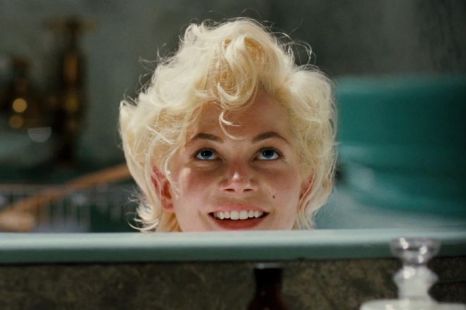 My Week with Marilyn is really focused on the titular star. Clark is just out path to the real star. I doubt there’s anything particularly revelatory about Monroe here. She was plagued with insecurities, a need to be loved, and the fatigue of “playing” herself all the time, all hips swivels and winks. At one point Clark and Monroe are taking a walk and met with a group of fans. “Shall I be her?” she coyly asks Clark and then turns into the vampy goddess the public loved, striking poses and smiling wide. By the very constricted nature of the timeline, we’re not going to learn too much about the famous beauty. She flubbed her lines, she and Olivier didn’t get along, and a mini-entourage of sycophants who were meant to be a surrogate family for the troubled gal surrounded her. Was she a lonely gal crushed by the weight of stardom or a manipulative lady who knew how to get what she wanted? The movie doesn’t take a side, instead serving up all sides of Marilyn Monroe, including a few in the buff. The film has some enjoyable juicy bits, particularly the friction between Monroe and Olivier, but the movie ultimately becomes another fawning admirer of its star. There are a couple musical numbers with Monroe that feel clumsily reproduced and the tone seems too light too often for the dramatic moments to have any real bearing. It becomes another fan that celebrating her image and sponging off her fame and legacy.
While the film may not be revelatory, Williams (Blue Valentine) herself is the revelation. She’s not exactly a dead ringer for the curvaceous, buxom blonde beauty, but she inhabits the spirit of the woman rather than sticking to a breathy imitation. She doesn’t capture the baby-doll voice but the demeanor she has down pat; when she turns it on you can feel the screen light up with the luminescence of star power. There’s quite a difference between the sad, depressed, codependent Marilyn and the sexy pinup fantasy. It’s an incredible performance in an otherwise so-so movie, though I wish the screenplay had given her more complexity to work with. Branagh (Valkyrie) is great fun as the stuffy, overbearing Olivier who gets plenty of snappy lines to vent his frustration over Monroe’s antics (“Teaching Marilyn how to act is as useful as teaching Urdu to a badger!”). Both actors are so good, and so good together, that I wish we could just remove the “my week with” from the title and focus on the relationship between Monroe and Olivier.
Allow me to question the voracity of Clark’s account. He waited until 1995 to publish his film set diaries, and then after his first memoir of his time with Monroe sold well he published another one in 2000, this one filling in a nine-day gap he says was that fateful week with the sex icon of the twentieth century (eat it, Clara Bow!). The second memoir was written fifty years after the fact and from the nostalgic perspective of an old man looking back to his youth. I feel that the particulars have been smoothed over and romanticized. The fact that surviving actors from The Prince and the Showgirl cannot verify any sort of relationship, and that several sources say that Monroe and her new husband Miller were inseparable at the time, cause me to doubt the validity of this personal account. In his first memoir, Clark even criticizes Monroe’s physical appearance (“Nasty complexion, a lot of facial hair, shapeless figure and, when the glasses came off, a very vague look in her eye. No wonder she is so insecure.“). Yet in the second book he becomes her defender. So which is it? Who wouldn’t, with sixty years of hindsight and a best-selling first memoir, embellish their one-time dalliance with a star like Monroe? The most desired woman in the world and he, a 23-year-old nobody, was the one to become her confidant? Aren’t we full of ourselves? And he crawled into her bedroom and was asked to stay the night and didn’t consummate that relationship? In the book she offers and he declines. Talk about the biggest mistake of your life.
 If you’re going to embellish, then you might as well get some action out of it. Then again, maybe in the books Clark says that Monroe gave him a pity handjob and the filmmakers deleted this (I can hear him screaming from beyond the grave, “You fools! The handjob was a metaphor. The whole tale falls apart without it!”). If I ever had even a fighting chance of getting lucky with Marilyn Monroe, you’d best believe I would be telling that story so often that my grandkids would roll their eyes in disgust (“Geez, we get it grandpa. Marilyn gave you a handy once.”). The post-script tells us that after The Prince and the Showgirl, Monroe went on to Some Like it Hot and Olivier went back to the theater for some of his best-reviewed runs of his career. So clearly, these two stars owe all their good success to the heroics of Colin Clark, who nudged them from greatness to legendary. We have only Clark’s take since Monroe cannot dispute Clark’s claims so I feel like the memoir, and the film adaptation, is an exercise in serving Clark’s ego.
My Week with Marilyn is a light, weightless movie that retells the shooting of a light, weightless movie. Well done, everyone. The emphasis on this bland kid and his fairly unbelievable whirlwind romance of the twentieth century’s most iconic sex symbol makes the movie feel self-serving. Does anyone honestly believe the events of this story? Whatever the validity of the events, a movie should be entertaining on its own rights. My Week with Marilyn has its bouncier moments and is saved by stellar acting from Branagh and the radiant Williams. But even the best acting in the world can’t save a movie that feels like it’s completely some old man’s exaggerated, embellished, and somewhat boring fantasy. If this is the relaxed standard for getting a movie made, then I look forward to the eventual film adaptation of my soon-to-be-released novel titled, My 28 Hours of Incredible Sex with Angelina Jolie.
Nate’s Grade: B-


 nathanzoebl
You must be logged in to post a comment.