Blog Archives
Damsel (2024)
 After a decade of having a creative partner who literally has compiled over 4,000 pitches for possible movie and TV concepts, it was inevitable that Hollywood would eventually get close to some of them. This has happened before a few times, again given the significant library of my friend’s imagination, but never has it gotten as close as Damsel, Netflix’s new action fantasy film flipping the script of the shrinking violet being sacrificed to the clutches of a monster. In my friend’s pitch, the young girl is presented to a dragon with the implication that this regular offering will spare her small town from angry dragon fire. Just as she’s waiting to be eaten, the dragon undoes her bindings and they talk, because the dragon can talk, and he’s very curious why these people keep leaving him young girls every so many years. The revelation is that the dragon is not savage but intelligent, and the two bond, forming a partnership where she brings the dragon back to her community and shows them the error of their long-standing prejudices. Of course it all gets bigger from there, with warring kingdoms wanting to harness the last dragon to capture this unparalleled weapon of mass destruction. There was even a budding romance between the dragon and the young woman, with the possibility of the dragon turning into a human Beauty and the Beast-style. The title: Damsel. While my friend’s Damsel and Netflix’s Damsel have some core similarities, they do tell different stories built upon the same premise of the virgin sacrifice and the killer creature being more than what they seem.
Unfortunately, Netflix’s version is too narrow to be fully satisfying with its fairy tale script flip. We have Millie Bobby Brown as our titular damsel, Elodie, a woman trying to do well for her family, notably her father (Ray Winstone), stepmother (Angela Bassett), and younger sister. The young prince needs a bride, and the Queen (Robin Wright) isn’t too shy to still turn up her nose at her new in-laws that she sees as merely a means to an end, nothing more. Of course it’s revealed that this end is as “human sacrifice” to a dragon that has reportedly stalked the kingdom for centuries. Elodie is thrown down a vast canyon into the lair of an angry dragon (voiced by the unmistakable Shohreh Aghdashloo). From there, Elodie must use her wits to survive the dragon, escape above ground, and save her younger sister from being doomed to a similar fate.
 The premise is so strong, upending ages-old tropes of the female sacrifice and the monstrous creature, as even with Netflix’s Damsel the dragon is a victim of historical slander. There’s so many places you can go with this, especially building upon the dynamic of the two of these discarded outcasts banding together to push back against the cruelty of society. However, that’s not the movie Netflix’s Damsel becomes. It sort of is, at the very end in resolution, with a latent promise of possible further adventures, but it’s mostly a locked-in survival thriller.
I was not expecting the majority of Damsel to be Elodie’s basic survival once she’s been hurled into the pit by her recently dearly beloved (just following orders from mom, he says). It works, but it feels very constrained creatively. Now, I am generally a fan of these kinds of stories, the step-by-step survival tales where we are thinking alongside the plucky protagonist. I find them fun and follow a satisfying structure of amassing payoffs. It’s naturally enjoyable to watch a character tackle problems and succeed. However, it’s also vital that the audience understands the problem to know the challenge. In a fantasy setting, this requires more time to establish new rules and circumstances. Here we have a few sequences like when Elodie discovers bio-luminescent slugs and uses them as a light source for exploring her captivity (bonus: their sticky slime is healing). The timeline is relatively short, maybe a day at most, so it’s not like Elodie has to think about long-term survival; it’s much more immediate about escaping from the wrath of the predator. Just finding a safe hiding spot is enough. It’s engaging but by limiting the focus to an almost real-time survival cat-and-mouse game, it caps the movie’s creative possibility. I was far more interested in the prospect of eventually moving beyond the initial amity between Elodie and the dragon, where they could share their royal rage together. I kept waiting for this initial battle to give way into a different level of understanding, something to deepen and alter this relationship, but this doesn’t arrive until the very resolution of an hour after Elodie first hides from the fearsome dragon.
While I was never bored by watching Elodie think how to get over a crevasse, or how to navigate a treacherous pass, I was reminded of 2022’s The Princess, a spirited and gleefully violent feminist romp with a similar starting point of a damsel taking matters into her own hands and fighting for her freedom. With that film, the upturned premise was simple, but each new floor down the tower revealed something about our heroine, each new challenge was different and relied upon a different skill or tactic. Unfortunately, that movie was “deleted” from the Disney/Fox/Hulu library for tax purposes, though you can still rent or purchase it on Amazon but, as of now, no physical media exists. This is an excellent example of a movie with a limited scope that knows how to play to the limitations of story while still revealing character through action. While that movie lost some momentum and clarity when the princess was kicked out of her tower imprisonment, I found much to celebrate with the movie’s ingenuity and spirit. With Netflix’s Damsel, I was getting antsy to leave the cave and move things along. The twist about the true nature of the dragon, and her past with the legendary royal hero, should be obvious to most.
 Let it be said that this is where Brown (Enola Holmes) graduated to being a steely and capable adult actress. She’s the star of the movie and has to command our attention and hold it for long stretches on her own. Brown throws herself into the physicality of the role with a relish that only makes her eventual triumph feel that much more worthy. The side characters don’t amount to much but have reliably winning actors to draw our attention. Aghdashloo (The Expanse) is a wonderful scene companion even with only a smoky voice. Wright (Wonder Woman) is haughty to the point of thin-lipped camp. Although this is a criminal under-utilization of the talents of Bassett (Black Panther: Wakanda Forever), who plays the concerned stepmother. That’s what happens when most of your movie is about one girl in a cave. The other characters are confined to the opening and closing of your survival thriller.
I suppose I’m being cheeky by referring to the movie as “Netflix’s Damsel” considering there isn’t any other version out there. I’m not accusing Netflix or screenwriter Dan Mazeau (Wrath of the Titans, Fast X) of ripping off my friend; it’s more an example of parallel thinking playing around with old fantasy tropes and giving them a new spin for modern times. I mostly enjoyed Netflix’s Damsel but couldn’t help but wonder what might have been, not just with my friend’s competing take on the material but with the story possibilities not taken here thanks to its limited scope. As a survival thriller in a fantasy setting, it works. There was just more that could have been, and while I should judge the movie that exists rather than the movie that could have been, Netflix’s Damsel is a fantasy action vehicle that swings its sword ably but had so much more potential to slay.
Nate’s Grade: B-
Share this:

The Lake House (2006)
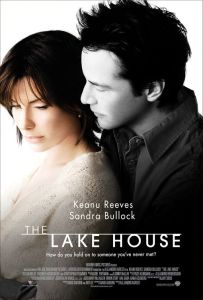 The first time I saw the trailer for The Lake House, a time-travel romance that reunites the stars of Speed, I said to myself at its conclusions, “If this lake house drops below 55 miles per hour…” I know, I’m a comedic genius, that much is obvious but what I was really reminded of was a 2002 film called Happy Accidents, a delightful gem of a movie with a similar time-travel romance. In that film you felt like anything could happen with its intricate plotting and off kilter, potentially seriously disturbed characters. Now it seems like Hollywood’s on board. The Lake House is based on an Asian film I’ve never heard of (though, in all honesty, I’ve never heard of 99.99% of them; sorry Asian cinema). This new East-West The Lake House doesn’t come across as that romantic but it’s hard to deny its points of interest.
Kate (Sandra Bullock) has taken a new job in Chicago and is moving out of a giant glass house on stilts that overlooks a lake. She leaves a note for the new resident, Alex (Keanu Reeves), an architect that struggles to fulfill his talent and his father’s (Christopher Plummer) legacy. Alex is confused; to his recollection, no one has lived in this house for years. Kate writes back and slips her notes into the nearby nostalgic mail box. But there’s something magical with this mail box. Kate is living in the year 2006 and Alex is living in the year 2004. Neither understands how it’s possible they’re even communicating by transporting letters through the mailbox. What’s even worse is that they’re falling in love with each other through their correspondence. Talk about your long-distance relationships.
 To go along with this kind of movie you really need to take it at face value. Once you start that slippery slope of questioning paradoxes of time travel or the narrative plot holes, you’ll be left in the cold for the remainder of the film. Yes, there are all sorts of logic paradoxes to clog the brain with, like the fact that every time Alex does something thoughtful, like plant a tree by Kate’s building, she won’t notice because she’s never had memories of anything being different. The characters themselves just shrug at the movie’s concept and accept this bizarre predicament. No explanation is given for this short circuit in the time space continuum, and frankly, no explanation is needed. The Lake House is not emphasizing the “why” but more the “what now?”
The Lake House is still a Hollywood romance in most senses. There’s little doubt that a happy ending is just around the corner, but at least the wrinkles and the road map to that point are not altogether predictable. The typical big moments are foreseeable, including that ever popular 11th hour misunderstanding, but The Lake House manages to tickle with surprise in the details of its journey. You don’t so much pull for the leads to get together but just see them tackle this mighty daunting obstacle before them.
The biggest flaw of The Lake House is that you never really believe these sad pretty people are falling in love. There is something indelibly romantic about falling in love with someone just from their words, constructing a potential soul mate with the few puzzle pieces given to you through long correspondence. Unfortunately, there’s nothing in those many pieces of parchment that Alex and Kate pass along that pinpoints why either pen pal would fall for the other. Both seem to have spotty luck with the opposite sex or are at least seeking more from a mate. But if The Lake House is any indication, these people have been chiefly seeking celibacy and verbosity in a mate. They talk about their lives, they talk about their pasts (in Kate’s case is a bit more extended), but it’s not too long before they start swooning and clutching those letters ever so tightly. The audience is left to fathom what invisible combination must have been unlocked that these sad pretty people have fallen for each other. While a lack of sustainable, let alone believable, romance in a romantic drama might be disastrous, at least The Lake House has a conceit strong enough to engage the brain even if it fails to engage the heart.
 The time jumps manage to keep the audience on its toes, plus there’s some fun in witnessing Alex and Kate try to locate each other and become bewildered. Director Alejandro Agresti (Valentin) and playwright David Auburn (Proof) play around with different techniques like split-screens and dissolves to present their lovers together. The conversational back-and-forth voice over does present problems; how exactly can they interrupt each other? The Lake House leans a little too hard on faith that we want to see these people end up together. Problem is that Kate and Alex are essentially void of depth; two characters defined more by the clunky subplots around them than their own personalities. Bullock and Reeves don’t help matters much, each perpetuating a vacant pretty android quality, like they’re waiting for a button to be pushed to explain human emotion.
I don’t know about you but if I was writing to someone in the past I’d use my knowledge and tell them to play certain lottery numbers or sports bets (“The Red Sox win what?”). Maybe it’s simply unromantic to start the basis of a relationship on gambling earnings. Then again, maybe it’s just unromantic to start a relationship with Keanu Reeves anyhow.
The Lake House is an old fashioned Hollywood romance but with some intriguing wrinkles and a playful structure. There’s a degree of predictability, the high-wattage stars fail to generate even low-wattage heat, but with the time-slip premise the film cannot be judge as familiar. The unusual situation and obstacles presented are more interesting than the main characters. Their love feels artificial and neither Kate nor Alex is rather deep, involving, or particularly smart (e-mail anyone?). Despite the limited help by the leads, The Lake House is a pleasant, different, if not terribly romantic Hollywood drama. For Hollywood, sometimes “pleasant and different” is enough for an enjoyable evening with the stars and someone special by your side. For everyone else, rent Happy Accidents.
Nate’s Grade: B
Share this:

X-Men: The Last Stand (2006)
 The story behind the making of X-Men: The Last Stand is more interesting than most. Bryan Singer had directed the first two X-Men films and had done a fine job establishing many loveable characters and the universe that housed them. Warner Brothers has been trying to get their Superman franchise flying for so long, going all the way back to 1996 when Kevin Smith wrote the script, Tim Burton was to direct, and Nicolas Cage was going to be the man in tights. Since then directors and drafts of screenplays have come and gone, including Brett Ratner, best known for directing both Rush Hour movies and a slate of mostly mediocre movies. Then Warner Brothers poached most of the X-Men 2 team to make Superman Returns, hiring Bryan Singer as director, plus X2‘s screenwriters, cinematographer, editor/composer, and maybe even the cat that licked Wolverine’s claws. Fox was left without a captain for X-Men 3. They daringly picked Matthew Vaughn (Layer Cake) but then he dropped out for family reasons. Then Fox went with their second choice … Brett Ratner. Both directors had essentially switched projects. Hollywood’s funny like that.
It’s been a few months since the events in X-Men 2. Scott “Cyclops” Summers (James Marsden) is still mourning the loss of his love, Jean Grey (Famke Jannsen), who sacrificed herself to save the rest of the X-Men. He’s tormented by her voice, whispering all around him and pleading with him to return to Alkali Lake, the site of her death. Miraculously, Jean returns from the dead but she’s much different. Her persona has broken and the Phoenix has taken over, a destructive killing force unparalleled on earth.
Magneto (Ian McKellen) has great use for such a force. There’s been news of a new drug that suppresses the gene that causes people to be born as mutants. This discovery has been dubbed a cure. The question persists, is should being different be curable and what would that even mean? Magneto sees the writing on the wall, knowing that any cure would only be voluntary for so long. He collects new mutant fighters along with his stalwarts the shape-shifting Mystique (Rebecca Romijn) and fire starter Pyro (Aaron Stanford), a former student at Xavier’s School for the Gifted.
 Over at Professor X’s (Patrick Stewart) school, the mutant students are each questioning life with a cure. Rogue (Anna Paquin) is considering it so she can finally touch her boyfriend, Bobby “Ice Man” Drake (Shawn Ashmore) without killing him. Plus, so he’ll stop spending so much time with Kitty “Shadowcat” Pryde (Ellen Page), a girl who can walk through matter. Storm (Halle Berry) and Wolverine (Hugh Jackman) are left to run the team after some disastrous setbacks. Henry “Beast” McCoy (Kelsey Grammer) is a man covered in blue fur and appointed as head of Mutant Relations for the president. He senses the growing danger and anxiety the administration has with mutants and joins the X-Men to do what he feels is right.
It feels like that in a rush to production that character development, subtlety, and subtext were chucked out the window to make time for more boom-boom action. The first two X-Men flicks juggled the characters and introductions but still managed to squeeze in one great moment for the characters we cared about. The plot moved at a mature pace, insightful and touching on elements of psychology, politics, and personal struggles to fit into a society that fears you. There was some sophisticated, relevant stuff bandied about this franchise in between the kick-ass action. But with X-Men 3, you basically have Halle Berry doing less with more. She’s got more screen time, in part to her demands, and now she can use that extra time onscreen to show us how perfectly bland her character is as the film’s most laughable moral ideologue. The idea of a cure for the mutant gene is vastly interesting with all kinds of great avenues for character introspection and socio-political debate. But X-Men 3 renders all of its debate to be merely superficial, another in a series of plot points to get the action moving quicker.
The X-Men franchise was already overpopulated with lots of characters vying for screen time, so I don’t understand the decision to add even more characters to the ensemble and cut down the running time to a brisk 100 minutes. As a result, certain characters sit out for long stretches of the film, are inactive during key moments, some are mostly forgotten, or some meet unjustifiably hasty ends. If I was still an ardent comic book fan, and a follower of the X-Men, I might view the third film as heresy. Why even bother bringing the character of Angel into the movie if he’s just going to be on for two minutes, including a forehead-smacking deus ex machine moment? The Dark Phoenix storyline is the most pivotal storyline in the comic’s history, so why even bother dragging it into X-Men 3 if it’s just going to be Zombie Jean Grey? It feels like Ratner is off screen with a pole poking Janssen whenever the story needs her to wake up and stir up some stuff.
 I hope comic fans enjoy the brief glimpses of some of their favorites, because X-Men 3 does a good job of throwing characters into a meat grinder. I had to check online to just to find out who they were, and even then my realization was followed by, “Her? Him? What?” And what the hell is up with Porcupine Face? That has got to be the worst mutant ability of all time. What’s he going to do to his enemies? “Hey, will you come a little closer. I have a secret to tell you. Closer … closer … closer still … that’s right, now please lean against my face.”
The movie trades character for action, so is the action even good? Ratner is a workmanlike director devoid of any personal style, which further brands X-Men 3 as ordinary. The action sequences aren’t anything extraordinary, there just happens to be more of them. The climax pits mutant against mutant in short-lived bursts. A battle between Ice Man and Pyro should be awesome, but Ratner stages the showdown like he was choreographing his neighbor’s kids. This battle lasts a whopping 45 seconds. The climactic end battle, the “war to end all wars,” is rather sloppy. Ratner keeps cutting back and forth between his pairing of Good mutant vs. Evil mutant (why do the two black girls seem forced to fight each other?), but his showdowns are all too quick to quicken the pulse. Wolverine’s brawls in the woods never rise up to the adrenaline-soaked fights in X-Men 2. The special effects and make-up are just as good; they’re just not being put to as good a use. If Ratner is going to dump character for action he has to make his action exceptional. The movie feels on autopilot.
Ratner is not fully to blame for the shortcomings of X-Men 3. Screenwriters Simon Kinberg and Zack Penn (Elektra) have crafted an overly rushed story that is more tailored for getting the job done than telling a good story. They present some big ideas and interesting elements, like a love triangle between Rogue-Ice Man-Shadowcat, but then most of the promise is either skipped over or dropped. They’re trying to juggle too many balls at once, and it just makes me miss Singer and the X2 screenwriters and how effective they were in defining character even in the smallest of moments. Some of the X-Men 3 dialogue is awfully stilted, like “You of all people know how fast the weather can change” and “Sometimes when you cage the beast, the beast gets angry.” There’s also a silly subplot about Storm teaching Wolverine what it means to be responsible. Try and count how many times you roll your eyes with that one. How many times are they going to have the president look blankly at a TV screen and gasp, “My god”? There’s some clever use of mutant powers during battles (mostly involving Shadowcat) but there’s just as many routine moments as well.
 The acting is all over the map. Jackman owns his role as Wolverine. McKellen and Stewart bring a needed dose of grandeur to the proceedings. The X-kids are enjoyable, and Ellen Page (knocking ’em dead in Hard Candy) makes a very nice addition to the fold. I’ve likely enjoyed Paquin the most in this series, next to Jackman of course, so it’s so frustrating that she just plays Jealous Girlfriend at Window. I think it’s criminal how little she’s examined in the movie, especially since the supposed cure has the most questions and ramifications for her. Grammer is essentially Frasier in blue fur, but that’s essentially what Beast is so it works. He has a very nice moment when he sees what life would be like minus his mutant likeness. It’s really hard to judge most of the performances because of how short they appear in the movie.
X-Men: The Last Stand is far from boring but it’s more serviceable than special, and lacks the maturity and imagination that its previous films held. This was a franchise full of limitless potential, so to see it drop to something ordinary is sad, especially if this is the rumored end of the franchise (a record opening gross over Memorial weekend says otherwise). This franchise feels dumbed down; yes it’s still entertaining on a mass market level but it doesn’t have the creativity and precision that Singer’s movies had. X-Men 3 is fast-paced and not without its great geek moments, but it’s also the least emotionally involving of the films. When the deaths and departures come you’ll probably shrug your shoulders because of how the film presents them. X-Men 3 is fine, but I expect better from this franchise.
Nate’s Grade: C+
Share this:

House of Sand and Fog (2003)
 House of Sand and Fog (2003)
Premise: Kathy (Jennifer Connelly) has lost her family home due to a bureaucratic error, and a former Iranian colonel (Ben Kingsley) and his family move in for a rock-bottom price. Neither is willing to budge, and their turf tussle soon becomes a tragedy.
Results: Perhaps the first real estate thriller, House of Sand and Fog is a smartly written, emotionally harrowing film with phenomenal acting. Kingsley is superb and deserves a Best Actor nomination. Shohreh Aghdashloo is heartbreaking as Kingsley’s wife, who doesn’t know a lot of English but loses sleep over the word ”deportation.” The drama is meant to convey that both sides have a convincing claim to the house, but who are audiences going to side with, an American screw-up who could have avoided the whole mess by mailing in a letter, or a hard-working family ere the son is willing to take a second paper route to help out? The final act is a bit overly bleak, and the cop boyfriend character is an easy go-to for plot turns. House of Sand and Fog is one of the more compelling films of the year. What more could you want in a prestige picture?
Nate’s Grade: B+


 nathanzoebl
You must be logged in to post a comment.