Blog Archives
X-Men (2000) [Review Re-View]
 Released July 14, 2000:
Take a storied franchise that has long been the backbone of Marvel comics and develop it into a feature film where the last superhero movie was the purple-spandex-in-the-jungle The Phantom and you’re just asking for trouble. A nation of fans is breathing down the neck of the film crew nitpicking every fine detail. Studio execs want the film done as fast as possible and under budget regardless of the numbers of effects needed. Despite what would seem like a cataclysmic set-up, X-Men proves that Hollywood can occasionally take a comic book and get it right. For the most part.
X-Men is basically the pilot for a movie franchise. It sets up characters, conflicts, origins, but periodically forgets its audience. Numerous people are introduced and then given a grocery list sized amount of dialogue to read. Some even have atrocious John Watters-like wigs they are forced to wear. It’s a good thing then that the film centers mainly around Wolverine (Hugh Jackman), Rogue (Anna Paquin) and Magneto (Ian McKellen), the three most interesting characters.
 Often times the action in X-Men is surprisingly lackluster and contained. The battle royale finale atop the Statue of Liberty might induce more than a few eye rolls. I can’t help but hope that with all the groundwork laid out with this film that the eventual sequel will be more efficient with its action set pieces.
For the most part the dialogue in X-Men is passable and it even has a few rally snazzy sound bites. However, there is that ONE line delivered by Ms. Berry (“You know what happens when a toad gets struck by lightening? The same thing that happens to everything else.”) that is groan-worthy and destined to be notorious.
It may sound like I’m coming down hard on X-Men, but for a comic adaptation it got a whole hell lot more right than wrong. I want to congratulate director Bryan Singer (The Usual Suspects) for the amount of pressure he had looming over his head and what he pulled through with. X-Men is no campy nipple-plate festival but an attempt at possibly serious drama with tortured characters. The whole mutant/racism metaphor may be a little bludgeoned at times but for the most part is handled very well. The best aspect X-Men has is its patience. The film is in no rush and takes its time even if it is only like an hour and 40-some minutes. Still, it’s a welcome change in the summer action.
 Singer’s direction is smooth and well executed. The casting of the movie is near perfection with some minor exceptions. Stewart and McKellen were born to play their dueling think tank leaders. Jackman is an exciting breakout in a role that was supposed to be occupied by Dougray Scott (thank you MI:-2 delays). I look forward to more from this actor. And does anyone know when young Oscar recipient Anna Paquin became so attractive? Someone buy this casting director a fine steak dinner.
X-Men may have its flaws, one of which is an absolute mundane score, but the film is one of the better summer entries into the world of explosions and noise. I just hope the sequel(s) will be a tad better.
Nate’s Grade: B
——————————————————
WRITER REFLECTIONS 20 YEARS LATER

It’s hard not to understate just how eventful the first X-Men movie was back in 2000. Beforehand, the public’s conception of super heroes was that they were kids’ stuff, fed by recent duds like Batman and Robin and Steel. Then came X-Men and it changed everything. There wouldn’t be a Spider-Man without X-Men. There wouldn’t be a Marvel Cinematic Universe (MCU), arguably the defining cultural franchise of the twenty-first century, without X-Men. It was an immediate hit with audiences and would go onto spawn two sequels, four prequels, three direct spinoffs, and two indirect spinoffs (Deadpool) over the course of 19 years. It’s a franchise that has made over $6 billion dollars worldwide and will soon be intermingled into that MCU, re-imagined with new actors filling out the famous names for the first time in decades. I can recall the importance of the X-Men in my own maturation and love of comics. I grew up adoring the animated series in the early 90s, and this began my relationship with the Marvel universe. I have boxes filled with old comics and I even started one of my own in my junior high school years (it’s unfinished and about 160 pages). I fondly recall seeing X-Men opening weekend with my pal Kevin Lowe and both of us just being relieved. A big studio had done it justice. They got it right.
Twenty years later, one must remember how different X-Men was with the super hero landscape. The more grounded, more political, and more reverent take on splash pages and spandex was in direct contrast with the cheesier, dumber, and more slapstick-heavy comics movies. Sure, you’d have your occasional hit like Blade, but the vampire genre inoculated it from larger scrutiny as a “comic book venture.” Director Bryan Singer wanted to make a brooding, serious version of the X-Men, a fact bolstered by his opening a summer super hero blockbuster with a Holocaust flashback. The mutant metaphor inherent in the X-universe has always lent itself to broad social commentary, easy to apply to any disadvantaged and targeted group for simply being different. It had men and women, and aliens and robots and more, doing amazing feats of derring-do, but it also featured these same characters fighting for equality with a public that increasingly feared and despised them for their gifts. Singer recognized this greater political allegorical relevancy and wanted his foray into blockbusters to be more meaningful than another disposable punch-em-up to consume mass quantities of popcorn. The X-Men franchise might not have ever been as successful without Singer’s early vision, and of course, many years later upon its demise, the producers might wish differently given the director’s righteous career reckoning.
 But let’s talk about the movie first before we get into the controversy of the man in the director’s chair. I haven’t watched the original really since the superior X-2 came out in 2003, and I was amazed at how patient and assured the movie plays. For a super hero action movie, there really isn’t that much action until the final act. There are confrontations and what I would call “action beats” but nothing lasting longer than a minute in conflict. In its place is a patient movie that takes its time to establish its world, its ideological counterpoints, and its characters and their relationships. We have two entry point characters with Wolverine (High Jackman) and Rogue (Anna Paquin) being hunted and taken in by Charles Xavier (Patrick Stewart). Even though the final movie is barely longer than 100 minutes, it doesn’t feel rushed in its pacing. It has a lot to do in establishing a new world but by grounding it with a scared runaway and a lonely drifter followed by trouble, the movie taps into Western archetypes to act as a helpful surrogate guideline. Fortunately, screenwriter David Hayter (and un-credited writers Ed Solomon, John Logan, Christopher McQuarrie and a heavily rewritten Joss Whedon) anchors us with the most interesting characters who have the most to fear and rebel. Wolverine and Rogue are an excellent pair and Jackman and Paquin have a real nurturing onscreen connection that provides an emotional investment. By taking its time to set up characters and their internal conflicts, X-Men makes a wide audience care about what’s to come.
When it does transition to action, you can see the beginnings of something great tempered with the growing pains of staking out new territory. The special effects are still relatively good, especially Rogue’s life-draining powers on the human body. That’s another thing the screenplay does well is finding ways to demonstrate and then incorporate every mutant’s special ability. We learn about Wolverine’s metallic claws through him being antagonized, and his healing ability from going headfirst through a windshield after Rogue admonishes him about wearing his seat belt. Later Rogue uses her powers to tap in Wolverine’s healing ability to save herself, setting up the Act Three climax where she is the key to Magneto’s (Ian McKellen) evolutionary-charged scheme. One more note on that (I apologize for the deluge of digressions) because Magneto’s big evil scheme is really about empathy. He plots to turn the world’s leaders into fellow mutants so they can understand the plight of a subjugated minority class, and yes, sure, some of them will not survive the genetic re-calibration, like the prejudiced firebrand Senator Kelly (Bruce Davison), but it’s not like Magneto wants them all dead. He wants them to understand (at least until the next sequel where he welcomes an opportunity to kill all non-mutant humans). Thanks to Singer, the movie has plenty of dynamic visual compositions and a few wow-moments to pack a trailer. I was reminded what an excellent visual artist Singer can be as he stages his scenes. The placement of figures, the depth of focus, the fluidity of his camera movements. He was certainly one indie darling ready for a bigger stage, at least in an artistic sense and not necessarily a personal one.
 It’s impossible to think of any other actor than Jackman as Wolverine but it almost never happened. Dougray Scott was in place but because of Mission: Impossible 2 delays which themselves were previously affected by Eyes Wide Shut delays, the role had to be recast already weeks into filming. Jackman entered the picture per a suggestion from Russell Crowe, to our collective pop-culture elation. Jackman is rugged, rebellious, funny, gruff, secretly warm-hearted yet clearly still the enjoyable F-You anti-hero, and watching him inhabit what, in comics lore, was a short, stout, hairy Canadian grump is a reminder that you can still recognize star-making performances when you see them. He fully inhabits the character and brings him to startling life. Jackman would become indispensable to the X-Men franchise and earn three spinoff movies, culminating in 2017’s R-rated and Oscar-nominated neo-Western, Logan. It’s only a matter of time before the MCU reboots this character because he, like Batman, is simply too valuable an IP to keep on the sidelines. It feels like heresy to consider another actor in this role, much like it will if anyone other than Robert Downey Jr. steps into the role of Tony Stark/Iron Man. This is a role defined by its signature actor where possible early choices now seem offensively wrong (like Tom Selleck as Indiana Jones, or Christopher Walken as Harrison Ford, or John Travolta as Forrest Gump).
The ensemble was extremely well cast with Oscar-winners and nominees past (Paquin, McKellen) and future (Halle Berry, Jackman). Stewart (Star Trek: The Next Generation) was born to play Professor X, enough so that when he first viewed X-Men comics he said, “What am I doing on this cover?” McKellen brings a gravitas to his villainous role as well as a smirky flair that makes him hard to hate. He had his shooting schedule re-arranged to accommodate the Lord of the Rings shoot in early 2000. Most people can only hope for one generational, pop-culture defining role, and McKellen had two after the age of 60. Paquin was making her transition from child-actor to adult, which was further solidified with HBO’s bloody and steamy vampire series, True Blood. Marsden was filling out his fledgling leading man potential, though he’s always been more appealing to me as a charming comedic actor (27 Dresses, Enchanted). Supermodel Rebecca Romijn (Femme Fatale) made a favorable impression as the shape-shifting Mystique thanks to low expectations and a costume made of 100 scales covering her nearly nude body that took nine hours to apply. The only real miss for me was Berry (Monster’s Ball) because I always envisioned Angela Basset (Black Panther) as my Storm. This is also the only X-Men where Berry adopts her character’s Kenyan accent.
 Looking back over 19 years of movies, the wonky timelines of the X-Men world begin to break apart if given even cursory contemplation. Given what happens in the prequels set in the 1970s and 80s, including Apocalypse (Oscar Isaac) launching all of the world’s nuclear missiles, it certainly seems like the worldwide perception of mutants would be more pronounced. Then there’s characters being alive, like Mystique, when she dies in the 1990s in the last X-Men film, 2019’s Dark Phoenix. The back-story of Jean Grey (first Famke Janssen, later Sophie Turner) and her Phoenix powers got two big screen showcases that also happen to be two of the worst movies. The biggest issue was the prequels arbitrarily following a movie-a-decade model, hopping from the Cuban Missile Crisis in 2011’s X-Men: First Class to the 1990s three films later. That means that somehow within less than ten years that Michael Fassbender (12 Years a Slave) and James McAvoy (Split) were going to resemble old men McKellen and Stewart. Do they get exposed to radiation? The conclusion of X-Men: Days of Future Past was meant to rewrite the timeline miscues, erasing the bad X-Men movies at that point from existence (2006’s Last Stand and 2009’s first solo Wolverine). Instead, the producers then followed with two more of the worst films of the franchise. You tried.
And now it’s time we discuss the controversy that has followed Singer for decades from film set to film set. There have been uncomfortable rumors and allegations that have surfaced ever since 1998’s Apt Pupil when Singer filmed a high school shower scene and insisted two underage actors be physically naked during the onset filming. Seems pretty questionable, right? This was eventually settled out of court, as were other allegations of abuse. According to a revealing Hollywood Reporter article, the teen who played Pyro, Alex Burton, was personally flown from L.A. to the Toronto X-Men set. This is quite bizarre considering he doesn’t have any lines and the part is a glorified cameo. Burton said he was held hostage by Singer and his wealthy friends for months and was repeatedly raped. Singer has been out as a gay man in Hollywood early into his career, and he would host regular all-male parties that reportedly descended into lurid bacchanals. Ironically, his status as a prominent and out gay director in the industry might have afforded him an aura of perceived protection, the idea that any journalist snooping too closely would be accused of homophobia or a double standard. It wasn’t just Singer but also the company he kept. Several associates of Singer have been accused of sexual abuse and against underage men that have led to undisclosed settlements.
 These allegations of abuse continued when Singer rejoined the X-universe again in 2014’s Days of Future Past but he weathered it out, and then again during the filming of 2018’s Bohemian Rhapsody, and this time he wouldn’t be able to weather it out. He was fired with a month left to film and Dexter Fletcher (Rocketman) was brought onboard to finish directing the eventual Oscar-winning and shockingly successful Queen blockbuster (nobody seemed to cite Singer by name in their acceptance speeches). Singer also built a reputation of showing up to his sets extremely late, sometimes impaired, and for sudden and unknown disappearances. It’s amazing that with all of this chronic misbehavior he was still getting big studio offers, but the man kept producing hits, including the long-running TV show House, and so his shady behavior was overlooked until, finally, it wouldn’t be in a post-Me Too world. Even after he was attached for a Red Sonja remake for a time until another round of accusations made him too radioactive for the time being. I would not be surprised if in a few years some production company happily offers him another project. Singer seems like a new test subject as far as what can be forgiven for the hitmakers.
So, what do we as viewers do with this damning profile of Singer? It’s become a regular habit now of re-examining an artist’s legacy in light of new or old allegations of wrongdoing. I personally have no interest in ever listening to a Bill Cosby comedy album again or watching any of his many heralded TV shows. I feel different listening to Michael Jackson’s music now. I wince when I watch Kevin Spacey in performances now and try to only see the character instead (Spacey won his first Oscar for 1995’s Usual Suspects, directed by… Bryan Singer). Can you watch the early X-Men films, or the later sequels, and still enjoy them knowing that Singer has been repeatedly accused of sexual misconduct including against minors? I have no answer. This is a deeply personal call for every person. I have too much personal attachment to 1999’s American Beauty to cast it aside, and that’s a movie that prominently features Spacey lusting after an underage girl. I’ll never look at the film the same but I cannot discard the whole. X-Men might mean too much to too many to disregard as well.
Looking back on my original review in 2000, I’m genuinely a little stunned because it’s almost word-for-word my assessment upon re-watching in 2020. It does feel more like a pilot to a franchise, laying the groundwork for the world and character relationships. The action is surprisingly contained. The “toad struck by lightning” dialogue line did become notorious. The casting was marvelous. The score was weak, greatly improved by the addition of John Ottman as editor and composer in the sequel (that Nightcrawler assassination attempt scene is a matserclass of editing and shot design). I even note the patience. I even think my original grade is fair. The original X-Men is a perfectly good movie but it led the way for great movies to come.
Re-View Grade: B
Share this:

The Ruins (2008)
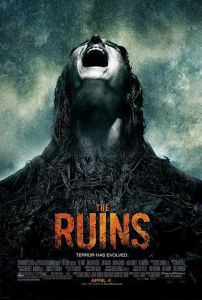 Author Scott Smith is from Ohio, my home state, which makes me like him. What made me respect him was his adaptation of his own novel, A Simple Plan. The movie version was splendid and taut, well acted and riveting and disturbing. Smith even received an Oscar nomination for his screen adaptation. When Smith released The Ruins, his second book, in 2006 I was mildly intrigued but never got around to reading it. Something about tourists, and Mayan temples, and bad things, and it got plenty of good reviews. Then I saw that Hollywood was producing a film version and that Smith had written the screenplay himself. Well, I figured, I’m going to be in for a chilling treat. Let’s just say my opinion of Smith has been slightly diminished.
Four over privileged American tourists are enjoying their final hours of a vacation to Mexico. Jeff (Jonathan Tucker) is studying to be a doctor. His girlfriend Amy (Jenna Malone) is best friends with Stacy (Laura Ramsey), and the two pal around together. Stacy’s boyfriend Eric (X-Men’s Shawn Ashmore) is along for the ride and enjoying every sun-soaked, boozy second. Lounging around the hotel pool, the group comes across a German (Joe Anderson, Across the Universe) who has a map to a hidden Mayan ruin. It’s a bit off the beaten path but the group decides to witness some genuine history. They take a taxi 12 miles into the jungle, hoof the rest, and discover a not very well hidden path to a not very well hidden Mayan temple (seriously, you’re going to have to do better than a couple of palm leaves if you want to obscure the path and keep people out. Try a fence next time). As soon as they arrive so do a band of armed Mayans that really insist the tourists do not leave the site. The Mayans chase the tourists onto the ruins and then they set camp around the perimeter. The Americans are being kept quarantined. Why? Inside and atop the ruins are a deadly plant that has a powerful hunger.
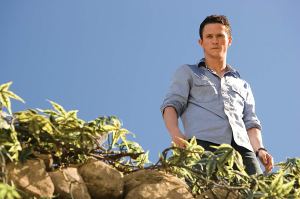 For a horror movie filled with unremarkable and generally unlikable characters, I must say that they at least don’t do anything incredibly stupid as is accustomed to the genre. Once they are chased to the top of the ruins you, the audience, are now put in their shoes. Every choice they make seems decently reasoned and cautious, exploring their surroundings and testing their boundaries. The Ruins features cheesy killer plants, yes, but the more interesting element to me was the survival game. These characters are quarantined in a remote area with little water, armed guards, and a handful of useful tools. What will they do next? This scenario grabbed my interest, as I played out my own personal survival scenario step-by-step and it wasn’t too different from what befalls the characters onscreen. However, I’m surprised no one tried setting the freakin’ plants on fire. The eventual psychological meltdowns and increasingly grim outlook help The Ruins maintain some level of credible drama.
But I think in the end I just couldn’t get over the fact that the main culprit was killer fauna. I can accept carnivorous plants, but seeing them is a whole different matter. Somewhere from pages to screen a step was forgotten to make them believable. The ancient plant system inhabiting the ruins looks like an overgrown swatch of ivy and marijuana leaves, and the vines would slowly inch forward to retrieve fallen pieces of meat. It’s downright comical to see a stringy piece of a vine trying to discreetly drag a dead body away, and frankly that’s where the movie fails. I shouldn’t be giggling at the killer plants. The execution comes across as way too goofy and made me shudder that I could be watching Little Mayan Shop of Horrors. I’m also wary that this highly localized plant has evolved to the point that it can duplicate exact sound. It mimics a specific cell phone ring tone to lure our vacationers deeper inside the ruins. Now, how in the world would it know well enough to do that? I can’t imagine in its potentially thousands of years of existence that it was come across a significant amount of cell phones. How would it know that exact sound would effectively lure others? I did enjoy the notion that the indigenous birds and insects have wised up and learned generations ago not to go anywhere near the ruins. Let this be a lesson to you, backpackers of America, that when insects refuse to go somewhere then perhaps you should take note.
 The Ruins should play out with a slow-burn sense of dread where the characters sadly realize with setback after setback that they are doomed; to be played right the plot needs to be methodical. Instead, Smith’s adaptation is more like a haunted house tale with crummy, obvious jump scares and lackluster spook setups. It seems like most of the film is intended to be a setup but the payoff is badly muffed, like seeing the stupid thin, twisty vines creeping out to sneak inside people’s open wounds. The Ruins has some fittingly disturbing scenes where something is moving and growing under the surfaces of people’s skin, but then you remember it’s just a plant vine and your mind starts racing with questions that illuminate how inane this whole situation comes across (How does a plant stem continue to grow inside a human body? What purpose does having an offshoot inside the prey serve? How does it penetrate open wounds without anyone noticing at all? Why should I be watching this?). I would have preferred if the under-the-skin creatures were some kind of insect or worm that had a symbiotic relationship with the plants. That would be cool and far creepier than stupid ivy vines.
From a gore standpoint, The Ruins has a few squirm-inducing moments. One character is badly injured and needs to have their legs amputated to survive. Oddly enough, this amputation sequence comes across as the most memorable part of a movie dealing with killer vegetation that can mimic cell phone ringtones and, later, lovemaking noises (now who goes out to have sex atop Mayan ruins?). The imprecise nature of the amputation is what makes it so gruesome. In one feel swoop, this character has to have leg bones crushed, then legs sliced off, and then have the stumps cauterized with a frying pan. And the only anesthetic is a bottle of Jack Daniels. Yikes. The amputation is played out with a deliberate pace and allows a satisfying buildup of nervous, queasy anticipation. Aside from that, there isn’t anything notable from the makeup department.
 None of the characters approach anything closely resembling characterization, but the acting is a notch above what you might expect from a horror movie populated with expendable, good-looking twenty-somethings. Tucker makes for a capable lead and projects a cool and controlled persona, never rising to hysterics. When he does realize the inevitable he begins to crack and it’s more effective because of how stoic he was before. The actor who gets tested the most is Ramsey, and this isn’t because she started her career in the derided “reality TV documentary” The Real Cancun. Her character is put through an emotional wringer and she sells the distress and Stacy’s fraying mental state. I never once was tempted to laugh even as she sliced herself open and fished around her insides. Malone and Ashmore are stuck being in the stock roles of whiny girlfriend and horny carefree dude.
The Ruins is a horror movie that’s far from horrible but not scary or perverse or funny enough to be recommended. The setup of isolation in unfamiliar territory could definitely produce some chills and thrills, however, when you throw in a ridiculous carnivorous plant that looks as menacing as your mother’s flower bed, well then, things just fall apart. I’m sure The Ruins worked well on the page, since it demands the reader create their own version of what goes bump in the night. Too bad that when you see it fully realized on the big screen it comes across as stupid. I really expected a lot more from Smith than this. The Ruins doesn’t justify why it should be treated any different than cheap, straight-to-DVD cheesy horror flicks (If there are multiple horror movies about killer snowmen, then there has to be an entire sub-genre of killer plants). I know M. Night Shyamalan’s upcoming summer release The Happening also features plants turning on humans. Let’s hope the creative force that brought us Lady in the Water can do more with the subject.
Nate’s Grade: C


 nathanzoebl
You must be logged in to post a comment.