Blog Archives
Mass (2021)
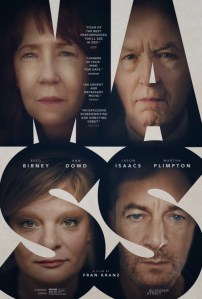 I can completely understand if anyone chooses to ignore the indie movie Mass for its subject matter alone. It’s heavy. I get it. It’s about two sets of parents, one pair (Jason Isaacs, Martha Plimpton) whose child was murdered in a school shooting, and the other pair (Reed Birney, Ann Dowd) whose child was the school shooter. It took me weeks to even work up the courage and proper mood to sit down and watch the movie. I’m glad I eventually watched Mass because it was so emotionally engaging and ultimately cathartic. That’s what I want more people to understand so that they give this hard-hitting indie gem a chance. It’s not all doom and gloom. It’s not all angry finger-pointing and gnashing of teeth. Mass is much more than you expect while being exactly what it sets out to be. It’s a small film brimming with big emotions and an even bigger wealth of empathy, allowing every participant to be a multi-dimensional human being struggling to make sense of the unimaginable that has dominated their life. Mass is one of the best written and acted movies of 2021 and deserves your time and consideration.
As you would expect given this set-up, it’s a lot of powerful conversations and grueling personal details. If you were unfamiliar with the premise, the movie teases out is main scenario like the key info are valuable kernels, and slowly and surely, we get a fuller idea of what has transpired years in the past and what the connection between these two groups of people is. It’s also a terrific setup to build anticipation and dread, so those first few moments face-to-face have the awkward niceties but we’re really waiting for the big subjects to be get their due, and they will, oh boy will they ever. However, if you’re going in looking for blood and easy answers, then this isn’t going to be the witch hunt you crave. I’m reminded of a Ted Talk I watched recently from Sue Klebold, the mother of Dylan Klebold, who was responsible for the Columbine school massacre in 1999. She talks about not recognizing signs, not of homicidal tendencies, but of suicidal tendencies, of depression manifesting as something else. It’s easy to cast blame and formulate our own assessment of parenting failures and ignored warnings, but what if the situation is far more complicated than that? What if the parents of the shooter are just another set of victims, except they never get to be honored as such by the public? They’re often looked at with suspicion, doubt, and culpability, defined by tragedy but transformed to social pariahs (the perspective illustrated so exquisitely and humanely by 2011’s We Need to Talk About Kevin). Where Mass excels is with its mighty empathy. Everyone in this story is a victim. Full stop.
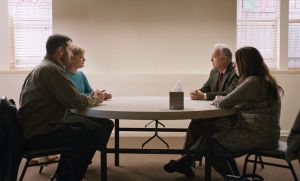 You’d be forgiven thinking Mass is based upon a stage play given its dialogue-driven story and single location setting, but it’s an original screenplay by director Fran Kraz, an actor best known for his comic relief parts in Joss Whedon projects (TV’s Dollhouse, The Cabin in the Woods). I was blown away by the immersive writing and empathy. For the first half of the movie, the parents of the shooter dominate the discussion, as they’re delivering us needed exposition on the day in question but really all the steps beforehand, the red flags that didn’t appear to be so permanent until they were. For every school shooting we read about in the news, the next question is where the parents were or why didn’t they act sooner if they had their suspicions. This is the period of the movie that answers those pertinent questions. The second half is more about the response to this news, culminating in a catharsis of tears and grace, facilitated first through anger. It’s a script structure that feels fully without manipulation, meaning the bend of the conversation occurs in a natural drift and pace. Nobody just blurts out what they want to talk about because the script is in a rush to leap to this next topical area of conflict. Franz is also very generous as a writer, able to make sure each character has their opportunity to shine and making sure we understand each character’s perspective. By the end of it, you should hopefully understand that there are no bad guys here, just victims on different sides of trauma suffering to make sense of tragedy. The monologues in this, beautifully written and performed, broke me each and every time.
Every actor holds their own but Issacs (Star Trek: Discovery) and Plimpton (TV’s Raising Hope) each get their big Oscar moment. It’s always peculiar to watch Isaacs play “normal roles” as we’re so accustomed to seeing him portray snide villains because he’s so damn good at them. Here he’s a grieving father who gets his fiery meltdown moment, and Franz has the great sense to never let his camera off the actor, allowing the full take to just derive from the live-wire emotions of the scene. It leaves the actor shaking and you just might do the same while watching. Isaacs is more the force of anger, while Plimpton is more the force of resolution, seeking an ending for all the heartache that has transformed her marriage. Her plea toward the end of the movie is an attempt at reconciliation that ends a heavy movie on uplift.
 I want to also credit Dowd (Handmaid’s Tale) and Birney (House of Cards) for their performances. They’re the more subdued ones, castigated for their position, afraid to show too much emotion because of the guilt they feel that they should have done more. Both are great, and Dowd’s final monologue, a story about her son she wants to share for better understanding, also had me in tears and especially what it results in. It’s worth it, folks, so stick around through several minutes of dithering discussion over where to find a box.
Mass is a hard movie to watch by design. It’s a delicate subject matter that will prove triggering for some and simply emotionally unpleasant and crushing for most. It’s ultimately a powerful movie about understanding, about shared grief, about empathy and relationships and similarities. It’s brilliantly written, brilliantly acted, and confidently directed. It’s little more than four people in a room hashing out their grief and conflicts, but when the drama is this potent and the characters are this complex, then it’s worth the prolonged discomfort and knots in your stomach.
Nate’s Grade: A-
Share this:

Vox Lux (2018)
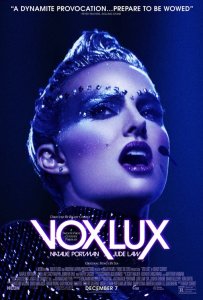
I don’t know what this movie was trying to say about anything. Vox Lux stars Natalie Portman as the adult Celeste, a survivor of a school shooting as a teen who became an international pop star in the months after. Is there something writer/director Brady Corbet wants to say about the transformation of tragedy into mass entertainment? The dulling effect of an entertainment industry to grind up human beings and re-purpose them into shiny, inauthentic, easily marketable figurines? I don’t know. I warily thought as we open on an upsetting school shooting, “I don’t know if the final product will justify this tone,” and it doesn’t. There are decisions that feel like they should mean something, like having the same actress, Raffey Cassidy (Tomorrowland), play both young Celeste and her eventual teen daughter, but what? It feels like an idea looking to attach to an interpretative message. Then there’s a modern terrorist group dressing like one of Celeste’s iconic music videos. She distances herself from the violence and even publicly challenges the perpetrators. This will obviously come back and mean something, drawing upon her own beginning stages of fame derived from the bloodshed of others, right? Or during her big concert the terrorists will invade and attack her, bringing the main character face-to-face with the ramifications of hubris. None of these things happen. Instead, Portman enters the scene at the 45-minute mark and proceeds to lash out at others, lament her parenting deficiencies, gets drunk, and then puts on her show. That’s it. It’s like Vox Lux forgot to be a movie for the final 20 minutes and just becomes a numbing series of EDM pop dance numbers. Portman is actually very good and digging deep into her anxious, entitled, and spiraling pop star, rounding out her dimmed humanity when Corbet cannot. There’s a solid storyline here between the adult Celeste trying to reconnect with her teen daughter who she’s been neglecting. This isn’t it. The pretension level of the pedantic exercise made me think of Lars von Trier as filmed by Darren Aronofsky. Skip it.
Nate’s Grade: C-
Share this:

We Need to Talk About Kevin (2011)
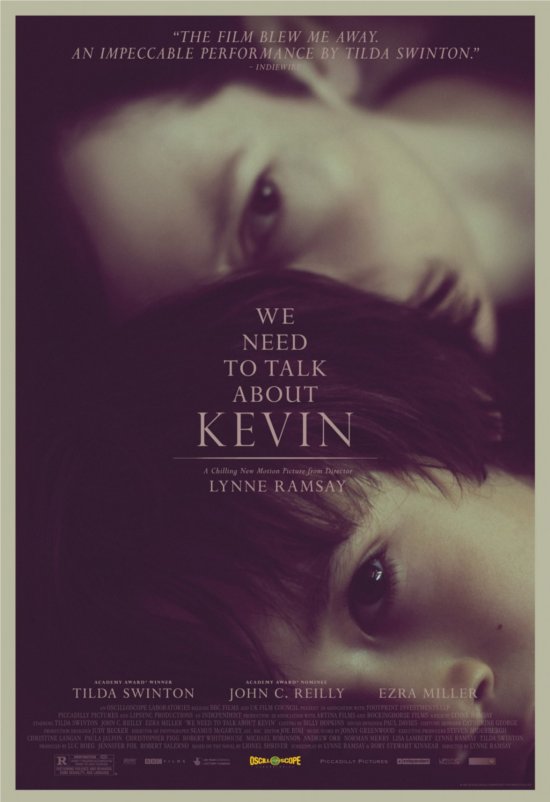 If you’re contemplating having children, then We Need to Talk About Kevin may not be the movie for you at this moment. It takes a stab at the nature/nurture debate and proposes that some children are just born broken and beyond the reach of even the most dedicated parent. It’s not exactly the cuddly message we get from most stories about the joys of parenting, but We Need to Talk About Kevin is a startling, provocative, and powerful portrait of grief, aggravation, and slowly dawning horror. Can even a mother love her monster?
Motherhood has not been the rewarding venture as promised for Eva (Tilda Swinton). Kevin (Jasper Newell at a child; Ezra Miller as a teen) wails so incessantly as a baby that she seeks out the sweet sounds of a jackhammer to drown out her shrieking babe. Even as a toddler, she knows there’s something just not right about her sullen, uncommunicative son. He seems to deprive her of any affection or attention she might find gratifying. Truly it seems much of Kevin’s motivation in life is to humiliate and torment his mother. It starts with being deliberately unresponsive as a child, and turning on a dime when in the presence of his father, then to delayed toilet training because he seems to enjoy making his mother clean up his mess (metaphor?), to the unexplainable massacre at her son’s hands. We Need to Talk About Kevin is an immersive experience, occasionally piling on how irredeemable Kevin is as a character. It also speaks to the unreliable nature of our shell-shocked point of view. It’s a disquieting film to say the least but I found it riveting and compelling at every second, artfully exploring a form of grief and social isolation that few will ever be able to fully understand.
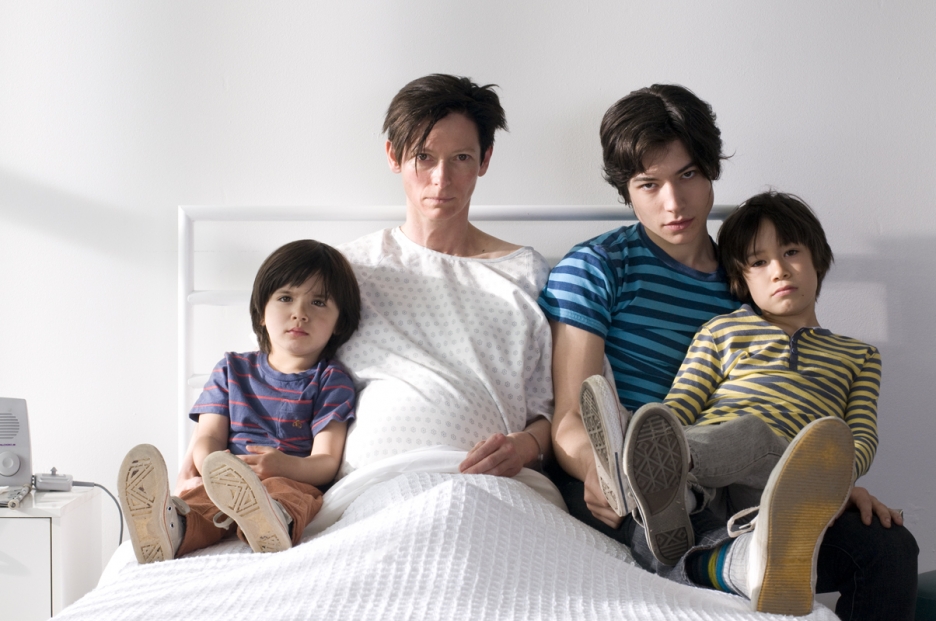 There’s tremendous psychological detail to this nightmarish parenting tale, and it’s those details that make the film feel eerily authentic and not exploitative. I found it fascinating to be drawn into this world, like I was watching an intimate, illustrated case study come alive. I found it very telling that after Eva accidentally injures her son in a fit of frustration, she apologizes but can only bring herself to do so under the shield of third person, saying, “Mommy shouldn’t have done that,” rather than, “I shouldn’t have done that.” And then when they get home, little Kevin unspools a perfectly believable story to cover-up what really happened. Even at six this kid is a shockingly adept liar, possibly because he’s a budding sociopath. Horror movies have been bringing us little pint-sized terrors for decades, from Bad Seed to the Village of the Damned, but those wicked kids seem like child’s play compared to Kevin, a startling, vacant child who is the scariest of the bunch exactly because he feels completely real. No Satanic imagery, glowing red eyes, or over-the-top associations needed; this is one messed up kid.
Watching this tumultuous and combative struggle for domination is equal turns compelling and terrifying. In many ways Eva adopts the role of Cassandra, the Greek figure cursed with visions of the future that nobody believed; Eva warns the people in her life that Kevin isn’t right, that he’s entirely capable of great evil, yet everyone ignores her dire warnings, and even Eva is culpable to some degree of enabling. Rather than discipline Kevin or stick to her principles, she passively accepts the situation and carries on with full knowledge that Kevin is going unchallenged. To everyone else he seems like a bright, helpful, normal teenage boy, which is why dear old dad (John C. Reilly) is so condescending and dismissive when Eva voices concern. Parenting is supposed to be instinctive, right? Eva feels like a failure, that this young soul has been steered to the dark side under her watch, and I think her hesitation to continue ringing alarm can be summed up by the fact that she’s just exhausted, tired of fighting a fight that everyone else ignores. I think she may also be desperately hopeful that she can ride this out, that it’s only a phase for her son, that somehow he’ll grow up to be a normal, loving child through some miracle, like a switch will be flipped. The only time Kevin ever shows his mother compassion is when she reads him a bedtime story involving archery, a hobby that would prove deadly.
The film is told non-linearly as we observe the fragmented memory of Eva. We have to pick up the pieces of life much like Eva recovering from her son’s destruction. It’s interesting to discover the symbolic connections between scenes, the connective tissue binding the memories together, and director/co-writer Lynne Ramsay (Ratcatcher) does an exceptional job of filling in key details to enrich this woman’s horrid life. The scenes don’t seem to last long, but Ramsay and her team provide all the meaning and weight we need so that the scenes matter. There’s a heavy amount of dread suffused into every scene in this movie, as the totality of events starts to become clear. The metaphors aren’t subtle but they are effective. Prepare for a lot of red in the color palate: squashed tomatoes, strawberry jam, splattered paint across Eva’s front porch as an act of vandalism. She spends the rest of the movie trying to clean away the red stains on her home (see what I mean about subtlety?). The splintered narrative also serves as a statement on Eva’s frame of mind, trying to move forward but haunted by a tragedy that goes down to the marrow.
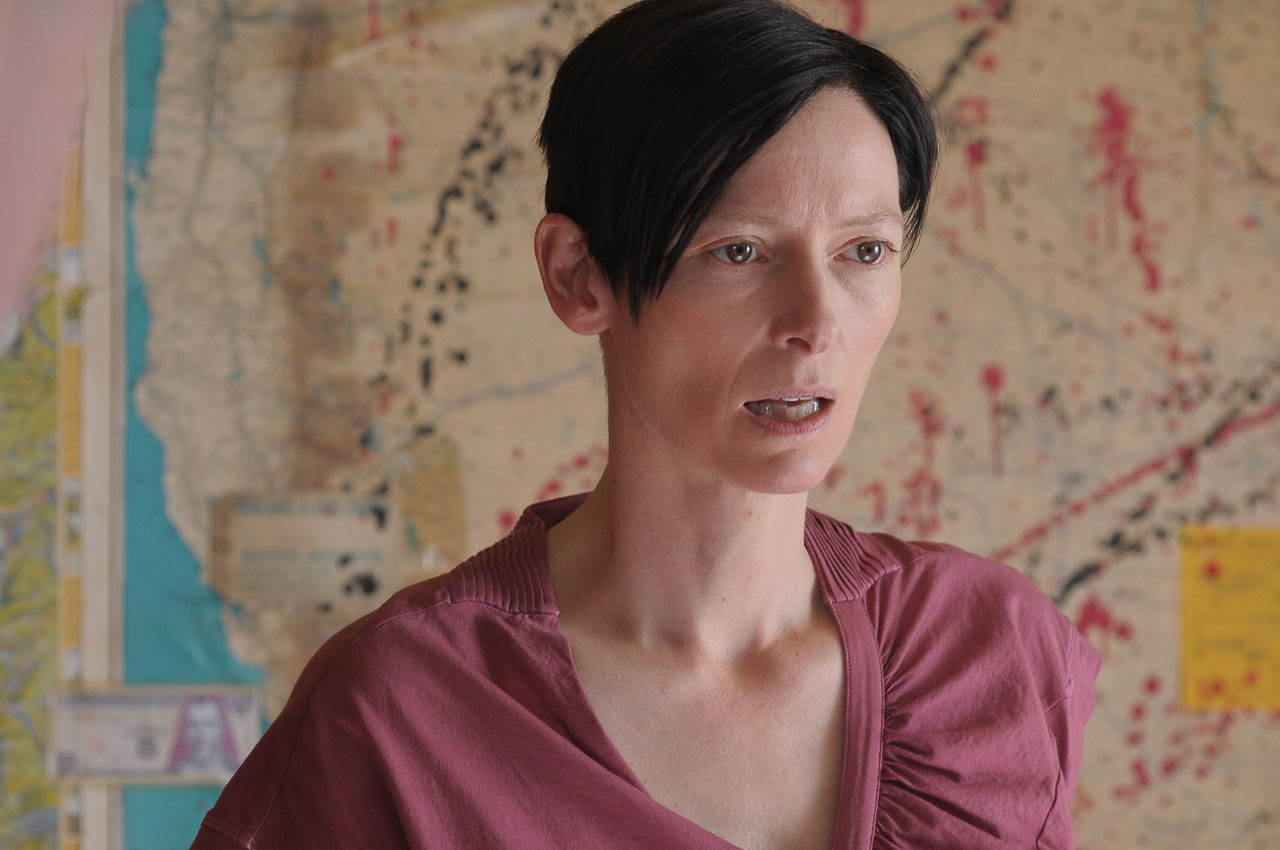 And of course all praise of the film needs to also be placed at he feet of versatile actress Tilda Swinton (Michael Clayton). She’s not given many lines of dialogue but what she is able to do to make her character feel fully lived-in is astonishing. There are so many different points of her life to play, from young exuberance to growing disdain to zombie-like pariah, and Swinton doesn’t strike one false note. Even during her grief and guilt she doesn’t go into hysterics. This is a woman that simply wants to waste away and be forgotten. Even when it looks like she might find some small measure of satisfaction or affection from another person, the movie sucker punches you. You realize that her son may be in jail but she’s serving a sentence all her own. Swinton is heartbreaking and subtle and nuanced even when it appears she’s simply staring off into space. You don’t really want to be in this woman’s head, and yet Swinton’s performance puts us there, hence all of my analytical assessment above. She’s a mixture of self-loathing, denial, bitterness, and penitence, and Swinton gives us telling glimpses of the storm below the surface. Her guilt is eating her away from the inside out. I’ll go on record and say it’s a crime that Swinton wasn’t nominated for a Best Actress Oscar (I personally apologize for not nominating her for the PSP Silver Cines).
I feel the need to talk and talk about We Need to Talk About Kevin, to sing its despairing praises, to encourage lovers of challenging, complex, and emotionally devastating film to experience this exceptional movie. It’s psychologically rich, bold, and revealing with even the smallest details to round out this hellish family scenario. It’s not an easy two hours to sit through, not by a long shot, but there are certain rewards for those who choose to wade through the darkness, Swinton’s haunting performance among them. This is a difficult subject and it’s produced a difficult film, but sometimes we need to be put in uncomfortable circumstances to get at a greater truth. What is the greater truth of the film? Maybe that parenting is really, when it’s all said and done, a leap of faith, maybe that avoidance of hard decisions is no solution, and maybe that some people are just beyond redemption. A movie that makes you think? Somebody ought to talk about this one.
Nate’s Grade: A
Share this:

Elephant (2003)
 Writer/director Gus Van Sant could never be accused of taking the easy road. He’s been an indie provocateur whose long career has involved Keanu Reeves, Uma Thurman with giant thumbs, villainous weather girls, and Sean Connery uttering the immortal line, “You’re the man now, dawg.” After 1997’s Good Will Hunting made over $100 million, Van Sant had an artistic blank check. He chose to do a shot-for-shot remake of Alfred Hitchcock’s masterpiece Psycho, now with added scenes of masturbation at no extra charge. So, as you can tell, there’s no telling what Van Sant will do next. On the heels of the experimental 2002 Gerry (where Matt Damon and Casey Affleck wander around and that’s it) comes his Cannes-winning portrait of high school violence, Elephant. But is Elephant an influential eye opener, or does it fall short of its artistic intentions?
Van Sant’s exploration on school violence is startling, realistic, and ultimately a failure. Van Sant does a great job of echoing the mundane reality of high school life with long, elegant tracking shots and numbing classical music; however, Elephant merely becomes an overindulgent and pretentious art exercise. There’s little below the surface, and Van Sant’s actors do little in their brief gasps of screen time to empathize with.
 There are some jolting moments of violence but by the time they arrive Elephant has worn out its welcome. Once we’re even introduced to a character and thirty seconds later they’re killed off. It’s hard to get emotionally attached to so many characters we get mere fleeting glimpses of before they are murdered in the name of artistic statement. The horror of high school violence is less jarring when you feel nothing for the characters. Some of the scenes are shocking, but by the time the school shooting actually arrives the audience might actually be feeling pangs of guilt over their reluctant happiness that something finally is going on, even if it is students being murdered by their peers.
Van Sant also trades heavily in tired stereotypes, from the sexually promiscuous jock, to the nerdy bookish girl, to a trio of bulimic girls used as shameless comic relief. His teen killers watch documentaries about Hitler, play violent shoot-em-up video games, and, of course, have negligent parents. In a very peculiar scene, before the school shooters march off they share a shower and lament that they’ll never be able to kiss a girl… and then they kiss each other. I don’t know exactly what Van Sant is trying to say and I don’t think he knows either.
 This is the longest, most appallingly boring 80 minutes of my life. Elephant’s running time should be brisk, but oh boy does it feel like an eternity. The pacing of the film is practically non-existent. Old women in check-out lanes could move along faster than Elephant. All the drawn out tracking shots give the viewer an eventual idea of the school’s geography, but it also lulls the viewer into a coma. The long bouts of static nothingness set to the soothing classical music might be the downfall for a sleepy audience. Perhaps in the future Elephant will be the cure for insomnia, but right now, in the present, it’s the dullest, most monotonous waste of 80 minutes you could spend in a theater.
Elephant sure takes its time to say a whole lot of nothing. On paper, Elephant could have been an artistic exploration into the reality of high school and the glazed indifference teenagers face in a society of apathy. Instead, Elephant equates cinema verite with real time. It’s not enough we have to watch someone do a film test strip but we have to watch the whole thing in real time. It’s not enough we have to watch one of the school shooters practice piano but we have to watch and listen to the whole thing. It’s not enough to see one inconsequential scene but we have to witness it three different times from alternating points of view. It’s a monumental waste of time for everyone involved, especially the poor audience.
What may be most terrifying about Elephant isn’t that it has no answers for school violence, but that it doesn’t even have the ambition to pose any questions. Van Sant’s followers could have their interest piqued by Elephant, but this film is going to appeal to a very very small number of people (I’m thinking maybe six, tops). Elephant is an artistic overindulgence masquerading as thoughtful meditation.
Nate’s Grade: D


 nathanzoebl
You must be logged in to post a comment.