Blog Archives
Spiral (2021) / A Quiet Place Part II (2021)
 Chris Rock seems like an odd choice to spearhead a revival of the dormant Saw franchise, but the actor was a rabid fan of the grisly horror series and came to producers with an idea for a new Saw movie, and the results are Spiral: From the Book of Saw, like it’s a Biblical chapter. A Jigsaw copycat killer is targeting corrupt police officers and those who protected them, and Rock plays a detective who dared to turn in his partner after he murdered a crime scene witness. Rock’s character is seen as a traitor by his fellow brethren in blue, and as the Jigsaw copycat continues his or her bloody rampage, the history of police abuse and cover-ups comes to light. The problem with Spiral is that it feels like an entirely different independent script that somebody attached gory Saw set pieces and said, “Reboot.” The Saw set pieces get increasingly ludicrous and gross and the drama in between, where Rock tracks clues and barks at his peers, feels like boring connective tissue the movie can’t even bother to pretend is worth the effort. Both parts feel rote, the police conspiracy thriller and the gory death traps. The movie is also entirely predictable by the nature of the economy of characters. Within 15 minutes, I was able to predict the identity of the copycat killer as well as their connection and motive. This movie desperately needed more time with Rock and Samuel L. Jackson together. Another issue is that the movie ends abruptly and with a needed extra turn missing, perhaps where Rock agrees to work with the killer and justifies the executions as righteous reform. I wanted this new Saw to be more in keeping with Saw 6, the best sequel and most topical of the franchise where health care employees were put to fiendish ironic tests to punish them for denying medical coverage. It feels like targeting bad cops would produce more social commentary, but I guess that would get in the way of watching people try and sever their own spine on a single nail. Spiral doesn’t feel any more promising than the other attempted Jigsaw reboot in 2017 even with its topical elements. It might be cheap enough to earn a sequel, but it feels like a franchise eternally going in circles.
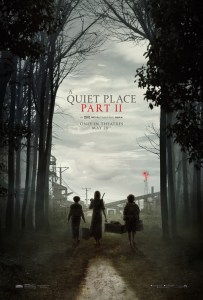 A Quiet Place Part II is the first movie I’ve seen physically in theaters since the middle of March 2020, and I genuinely missed the experience. It’s been the longest I’ve ever gone in my adult life without seeing movies in the theater, and this was one that felt like the presentation would be elevated by the big screen and superior sound system. Taking place nearly minutes after the conclusion of the 2018 hit, the surviving Abbott family ventures off their farm to find refuge and potentially find a way to protect themselves and neighboring communities from the killer monsters attracted to noise. The opening is the only flashback we get; everything else is forward-looking. I would have enjoyed getting more Day One experiences where the monsters first attacked, especially as we become open to new characters and their own harrowing journeys. The movie, written and directed by John Krasinski, isn’t quite as novel and brilliantly executed as its predecessor, but it’s still a strong sequel that gives you more while leaving you wanting more by the end. The majority of this lean 97 minutes is split between the family, one half staying put in a warehouse basement, and the other traveling out into the open to find a radio tower. The set pieces are still taut though rely more on jump scares this go-round, granted well executed jump scares that still got me to jolt in my seat and squeeze my girlfriend’s hand a little tighter. Cillian Murphy (Batman Begins) is the most significant addition as an Abbott family friend who has lost his whole family since that opening flashback. He’s a broken-down man, a parallel for Krasinski’s father figure from the first film, and at points it feels like he’s being set up to appear sinister, or at least hiding some dark secret that never really comes to fruition. The world building is expanded and introduces a very Walking Dead-familiar trope of desperate people being just as dangerous as deadly monsters, though in a world of hearing-enhanced creatures, I would think there’s more danger in larger numbers than security. The movie earns its triumphant ending even if the staging, and cross-cutting, is a little heavy-handed. A Quiet Place Part II is a successful sequel that understands the unique appeal of its franchise and how to keep an audience squirming while also remain emotionally involved and curious for more.
Nate’s Grades:
Spiral: C
A Quiet Place Part II: B+
Share this:

Saw 7 (2010)
 The story behind Saw 7 (or as presented in theaters, Saw 3D) is more intriguing than anything you’ll find in this lackluster chum bucket of guts. The director of Saw 6, series editor Kevin Greutert, was all prepared to go off and direct the sequel to the surprise smash, Paranormal Activity. The folks at Paramount even penciled in a Halloween release date, long the fertile ground for the annual Saw sequels. It seemed like Paramount was rubbing in the fact that they now had the more exciting, buzz-worthy franchise and they would tap dance on the grave of Saw. Well the studio suits didn’t take too kindly to this broadside, so they activated a clause in Greuter’s contract. The man was legally required to leave the Paranormal Activity 2 project so that he could direct a seventh Saw film. Because nothing says “work of art” like forcing your director to make a movie by threat of legal action.
Saw 7 is billed as the “Final Chapter” but it doesn’t feel like a satisfying conclusion, more like an overdue mercy killing. It’s no secret that the Saw franchise has been flailing and sputtering for quite some time, with the bizarre exception of Saw 6 (my friend Eric proudly deems it the “Godfather II of the Saw franchise”). It was because of Saw 6, a fascinating return-to-form by tackling the topical issue of health care reform, that got my hopes slightly renewed for the franchise’s finale. Having health insurance employees as the victims gave the franchise some much-needed populist anger, a renewed morbid fascination that was surprisingly enjoyable. Imagine Saw 7 taking on the extension of the Bush tax cuts? Alas, my fledgling hope was for naught.
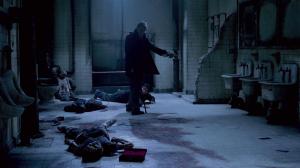 Part Seven follows a self-help guru Bobby Dragan (Sean Patrick Flanery) who talks about surviving a Jigsaw death trap as a spiritual awakening. Except that he’s a fake; he’s devised this phony survival tale as a scheme to get rich. Naturally Jigsaw (Tobin Bell, as always, in flashback) doesn’t take too kindly to this misrepresentation. Dragan would seem like a prime candidate for the haunted warehouse of horrors that Jigsaw usually specializes with, except that Jigsaw has been dead for four films now. His second apprentice, Hoffman (Costas Mandylor), is wanted by the police and FBI and even Jigsaw’s own widow (Betsy Russell), who unsuccessfully tried killing Hoffman with one of the series’ infamous bear traps masks. So let’s stop and think this out. Hoffman, who is on the run and established as a serial murdering fiend, still takes time out to set up a warehouse full of death traps for Dragan to fulfill his late employer’s wishes. If it’s not obvious now let me make it pointedly clear – in whatever city these murders, take place, it has the most incompetent police force in the history of the universe. Did they literally hire the Police Academy crew? That would make for an entertaining diversion that might reboot two franchises.
As always, the sinister death traps are the real draw of the franchise, and these convoluted killing devices have been getting less inspired from each shallow sequel. These contrived contraptions always bothered me in their uniform intricacy. The franchise began with some pretty simple scenarios: crawl through barbed wire to reach an exit, while covered in kerosene hold a candle to see a written combination, saw off your feet if you want to escape a filthy bathroom of doom. Then in order to top the previous film, the death traps got more contrived and involved a lot more engineering muscle. The more complex they got the less interesting they became. Now with Part Seven, some traps include a three-headed saw with each member of a love triangle in its aim. Two guys, the boyfriend and the “other man,” have to overpower a saw or they can relax and let the woman that’s come betwixt them lower onto a saw blade. This opening trap is the start of some dubious misogyny even for a genre as female punishing as horror. There’s a gauntlet of grisly horror in store for a bevy of female characters, usually involving something sharp penetrating them. But for the lone man who falls into a Jigsaw trap he meets his death by… hanging. Yes, a simple almost merciful hanging compared to the gruesome fates the women encounter. I’m not seeking feminist sensibilities from a genre that profits from their half-naked terror, but Saw 7 is even sicklier because of the undercurrents of misogyny. The traps in number seven aren’t memorable, interesting, and they feel like they’ve been done before in some earlier incarnation (a woman being “smoked” in a mechanical pig does seem to be different).
 The biggest problem with Saw 7 is that it doesn’t feel like anybody gives a damn anymore, including the filmmakers and actors. The production values seem like a world away from other movies in the series. The entire affair reeks of “direct to video” even though it was shopped as a 3-D theatrical experience. As you can imagine, because of the gimmicky 3-D, the movie is filled with plenty of pointy objects pointed at the screen. When watching in traditional 2-D, it gets fairly tiresome. Also because of the 3-D presentation, the filmmakers had to compensate for how dark the 3-D glasses make the movie. That means that the spurts of blood are in a rather unrealistic pink lemonade shade, like the retro blood from 1970s exploitation flicks. Without the glasses, as most will view the film at home, it further cements the overall cheap atmosphere. The production design, cinematography, and editing all feel like the Lionsgate intern team performed them. Every technical aspect feels more than sub par, it feels like no effort was exerted whatsoever. Sure it got finished, but finished and complete are different.
The Saw franchise has always been built around the craft death traps and a last-second twist ending accompanied by a barrage of scenes given new context. This formula has been repeated with each installment, so I expected nothing more and “nothing more” is what I received. Saw 7 thinks its audience demands to know its convoluted back-story, which gives way to all sorts of behind-the-scenes flashbacks that are always retroactively changing and channeling the timeline of events and participants. I think it’s all frightfully boring. I don’t care who screwed what bolt into what. I’m not watching Saw for realism (hence why the police NEVER think about tracking what vacant warehouses are sucking down gads of electricity). But at this point, with the thrill of the death traps long beaten into a bloody submissive pulp, I don’t even know what I would watch this series for. The appeal seems to have died along with its boogeyman, Jigsaw, four films back. The subtitle “The Final Chapter” seems like a promise destined to be broken. In the annuls of horror, any successful franchise will live on forever with cheap made-for-DVD sequels. Saw 7 just feels like the first made-for-DVD sequel, except it got a theatrical release as one final gasp at cash. Just wait twenty years and the whole thing will be rebooted as some sort of prestige picture that speaks to man’s inhumanity to man circa 2030.
Nate’s Grade: D
Share this:

Saw VI (2009)
 I checked out on Saw 4 and Saw 5 feeling like this horror series had grown stagnant, plus its central villain was killed off by the conclusion of the third movie. I thought the series wouldn’t go on for much longer, and oh how wrong I was. Jigsaw (Tobin Bell) has a second apprentice now fulfilling his departed master’s bidding, capturing even more people and trapping them into the franchise-favorite death traps. This means that there are yet even MORE recorded messages and vast, abandoned warehouses out there. FBI Agent Hoffman (Contas Mandyor, an amazingly horrible actor) has taken up the contrived contraption mantle. Of course it’s all preposterous and overly gory, but that never stopped the series before. Saw 6 boasts the franchise’s fourth director (the editor of all the previous movies just graduated to the big leagues). But this is mainly a franchise built around the hardened desires of its fans, indoctrinated in the gospel of gore. As I said before with Saw 3: “Just like the collapse of the Final Destination franchise, these movies started big but then bottomed out when their audiences had the rules memorized. At that point the only thing left is curiosity in what fiendishly outlandish ways people will get horribly killed.” This pretty much still holds true.
The real interesting draw for the sixth entry, and the only reason I drifted back in curiosity, is because Saw 6 is the weirdest participant yet in the current health care debate. The victims in this installment are health insurance employees. The people in charge of deciding who live and who dies are now put through morally challenging, queasy challenges. It’s a lot harder to kill somebody deliberately rather than by omission, by denying coverage or finding a loophole to get out of paying for a perfectly reasonable, and much needed, procedure. There’s a macabre enjoyment in watching health insurance officials put through Jigsaw’s battery of tests, though some of his victims seem pitiable — one guy is thrown in just because he’s a smoker (I suppose Jigsaw didn’t consider giving the guy a nicotine patch first). The main character going through the funhouse of horrors is an insurance company CEO (Peter Outerbridge) who has his mathematical equation about who earns coverage put to the test. Jigsaw is exacting vengeance after the CEO denied him coverage on an experimental treatment for cancer. It’s easy to see what side of the issue Jigsaw is on; he says that insurance companies put profits over human lives and get in the way between doctors and patients. This is a Saw movie even Michael Moore could cheer. I wish at the recent health care summit on Capitol Hill that the president had said, “Gentlemen, we’ve heard what the Democrats had to say about health care, we’ve heard what the Republicans had to say. I’d now like us all to see what Saw 6 has to say on the matter.”
 The story again is cut into two halves: the health insurance CEO going from death trap to death trap, and Agent Hoffman trying to stay ahead of the FBI investigation into the new Jigsaw killer. Guess which is more interesting? The FBI agents in this movie are those classical trained bumbling FBI goons that always come in late, take things over, and properly muck everything up. These people are lousy detectives and even worse at hiding their suspicions about Hoffman. It’s no surprise then that he manages to outsmart these idiots when Hoffman is, in fact, a dolt. This is not a smart man. Case in point, he’s using the severed thumb of a dead agent (Scott Patterson, apparently on Hoffman’s trail for the previous two films) to mark up bodies and frame the guy. Problem is that he’s framing a dead man, which means Hoffman has a really small window of plausible time to make this frame credible. It’s not going to work months later when the FBI wonders how a dead agent keeps kidnapping new people and putting them through hell. Then again, given the intelligence level of these onscreen agents, I’d assume that the FBI would blame zombies.
The apprentice aspect has always been the worst part of this series. I do not care whatsoever about the ins and outs of how Jigsaw set up his traps and who helped build the damn things. This isn’t some Discovery Channel series. I don’t need to watch the behind-the-scenes look at the grisly garage of doom. Just like the third Saw film, this is another entry that wants to play around with the bigger Saw picture. Scenes are introduced that retroactively alter the Saw timeline of events, causing characters to grow different motivations. I swear, the Saw movies all start to feel like they’ve been built from the rotting leftovers from each previous and less effective movie.
The only thing of note as far as acting goes is that the opening player (Tanedra Howard) won a VH1 reality show competition for a spot in this movie. Ladies and gentlemen, we now live in an age where people will compete for the luxury of being the first to cut open their insides in the SIXTH movie of a flagging horror franchise. You don’t want to know what they’re willing to do for a spot in the next flick.
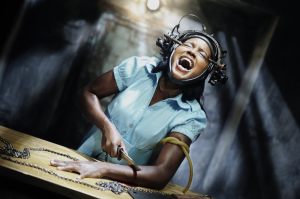 The draw of this franchise are its clever yet queasy death traps where the audience can place itself in the victim’s position and wonder what they would do given the life-and-death circumstances. How far would we all go to live? Well, in Saw 6 the traps aren’t that fiendish or memorable. The best one involves a group of six insurance actuaries (experts at finding loopholes to deny and cancel coverage) tied to a carousel with a shotgun pointed at them. One by one they swing by the kill zone, making it the most proverbially deadly game of musical chairs ever. Even better is the fact that the CEO is given the opportunity to “save” two on the carousel from the shotgun blast, so they each start screaming little arguments why they are worthy and their peers are not. It’s a neat little pressure-cooker of a scene, especially when one guy on the carousel realizes he’s the last to die. The thing slowly reels back around as he uses his final seconds to demand that the CEO look at him (“You look at me when you kill me!”). That defiant little moment manages to pierce through the ponderous personal growth edict the series has foolishly heralded as its purpose. The rest of the death traps are just cruel and labored and not nearly as interesting. You ca only watch people singe their skin on hot burners so many times before the body begins to involuntarily yawn.
Saw 6 is certainly no better than the other movies but neither is it worse. It’s the topical subject matter that makes this the only Saw movie worth a dubious look after the first flick. It taps into a populist rage against insurance companies that makes it vicariously satisfying and truly bizarre. It would be questionable to say that the franchise has recaptured any sort of creative juice, but I wouldn’t mind catching a future Saw film take on other big issues plaguing our country. Imagine Saw tackling predatory lending and the negligible banking industry resisting reform tooth and nail. Wait until the heads of Goldman Sachs and AIG get a load of Jigsaw.
Nate’s Grade: C
Share this:

Saw III (2006)
 Horror works in cycles and seems to ebb and flow every three years or so. The popular horror cycle right now is all about torture and realism. I guess people have had it with masked men with large pointy things. Pasty Asian children don’t seem as gloomy as they once did; in fact, in today’s world-on-the-go, who wouldn’t want an extra hand in the shower? In a world bombarded with carnage leading the six o’clock news, I guess American audiences desire something more universal than ghosts and boogeymen. The Saw franchise has exploded and seems destined to place a new entry every Halloween until the public looks to a new en vogue horror cycle. After seeing the loss of luster that is Saw III, I am already looking.
Jigsaw (Tobin Bell) is back with a fresh new batch of his twisted games. Unfortunately, he’s bedridden and dying. His serial killer apprentice, Amanda (Shawnee Smith), has to do the grunt work. She kidnaps a depressed doctor, Lynn (Bahar Soomekh), and orders her to keep Jigsaw alive as long as she can. Around Lynn’s neck is a crude explosive device that will detonate if Jigsaw’s heart flatlines. He has to stay alive just long enough to witness one final game. Jeff (Angus Macfadyen) is trapped in a typical Jigsaw-engineered series of traps. He has to pass through three tests of resolve and forgiveness, each involving someone related to his young son’s unexpected death.
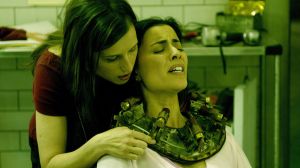 The Saw franchise seems to be losing momentum with each additional thrown-together sequel. I found the first film to be mostly entertaining and very inventive, but this was because of a smart narrative device: we wake up in the same dingy bathroom as our figures and must learn with them about what is happening. It plied some neat tricks and twists and was an altogether enjoyable horror movie that didn’t mind mucking around. But with all invention, if it sells then it becomes repeated in mass-market form, dulling the edges and losing the bite it once had. What once startled and amused is now the expectation. Just like the collapse of the Final Destination franchise, these movies started big but then bottomed out when their audiences had the rules memorized. At that point the only thing left is curiosity in what fiendishly outlandish ways people will get horribly killed. The Saw films still have more smarts to them than your typical man-chases-teens-with-axe slasher flick, but the franchise definitely seems, like Jigsaw, to be dying a slow death.
Saw III spends far too much of its time and energy trying to be a compendium to the franchise, filling in the blanks and the resolutions for Saw and Saw II. The film bends over backwards trying to tie up loose ends that didn’t really need tying up (Finally, now I know what happened to that foot that was cut off!). I don’t need to know how the incidents of the previous movies were set up, or who kidnapped who; the minute details are pointless in a horror film, especially one with such flights of frightful fancy. This movie spends too much time feeding the audience needless back-story. The film’s two major storylines are uneven in interest. There’s a real lack of danger and development for Lynn playing nursemaid to Jigsaw. We know the only time he may die is late in the movie, so her storyline becomes prime thumb-twirling time. We see some nifty medical procedures but I?d rather get back to Jeff’s descent into the funhouse of doom.
Saw III seems too concerned with how it fits within the framework of a trilogy when it should be worrying how it works as a movie. Saw III, for stretches, feels like it was cobbled together from the dull deleted scenes of previous films. And true to form, this Saw sequel ends with a familiar rush of twists, deaths, and a very nihilistic close. Let’s just say the inevitable Halloween 2007-bound Saw IV is going to have to go back to the ridiculous plot device drawing board. I truly wonder how many little tape recorders Jigsaw has stashed around and for what occasion (“Note to self: clean gutters.”).
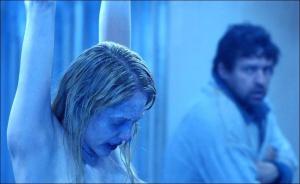 Some of the ingenuity is downright admirable; Jigsaw sure puts a lot of thought and care into his skin-crawling craft. Some notably gruesome torture tests include a naked woman being frozen to death by routine sprays of water, a man having his limbs twisted all the way around, and a man drowning in the slimy goo of ground up pig carcasses. Now that takes discipline just to plan, let alone fully stage. I’d like to see Michael Myers or Freddy Kruger try something like that. Part of the macabre fun of the Saw franchise was playing along, wondering what you would do in the situation and how far you?d go to save your own life. But in Saw III the deck is stacked for about half of the twisted games. There’s no way to win. A character goes through great lengths to free herself from a death trap but, alas, there is no escape and she gets her rib cage ripped out for the bloody hell of it. This … lack of sportsmanship, let?s say, does play a crucial part to the Saw III storyline, but it still knocks the film’s fun level down when you’re just waiting for the moment the person becomes a corpse instead of waiting to see what they do next.
It seems like the Saw movies become less engaging the gorier they get, and Saw III may be the goriest yet. These films have never been afraid to get messy, and Saw III has some squirmy moments, particularly a very protracted scene that involves the peeling, drilling, and scraping of the human skull. Horror fans should be happy with the results but there’s nothing that will make the squeamish cover their eyes (a bone snapping through a leg comes closest). Worst yet, despite the yucky credentials I’ve mentioned above, there really isn’t anything too memorable about the death traps this go-round, though the pureed pig entrails is certainly praise-worthy.
After three movies in three years, it feels time for a breather. The Saw movies are losing their sheen as their audiences become hungrier for blood and harder to fool. 2004’s Saw was clever and different, but like the demise of the Final Destination franchise, the sequels are victims of expectation. When the unexpected becomes the expected, then you may need to rework your scare formula. For whatever reason, Saw III feels compelled to be a refresher on the other films, devoting serious chunks of wasted time to clarifying loose ends that never mattered. I’d rather get to more sticky, icky death traps than examine the father-daughter-mentor relationship between Jigsaw and Amanda. Yawn. Saw III feels uneven, distracted, less fun, and a middling close to a franchise that began with wicked promise. This kind of movie just isn’t cutting it like before.
Nate’s Grade: C
Share this:

Saw (2004)
 Saw was pieced together by two first-time filmmakers, director James Wan and writer Leigh Whannell. They envisioned that old movie favorite, the imaginative serial killer. Their killer would put people in horrific life-or-death situations, testing our will to live even if it meant rummaging around the intestines of a live human being for our key to freedom. With a budget of a mere million dollars, Wan and Whannell have executed a dark, slick, sometimes thrilling, sometimes laughable fright flick. The only question is if audiences are hungry enough for the splashes of blood Saw can deliver, or if they’d rather watch Sara Michelle Gellar turning Japanese.
Adam (Whannell), a private photographer, and Dr. Gordon (Cary Elwes), a workaholic surgeon, are in a very strange circumstance. They’ve both just awoken and find themselves chained by their feet at opposite ends of a bathroom with a dead body between them. Neither has any idea how they got there. Dr. Gordon theorizes that they’re the culprits of the Jigsaw Killer, a psycho that places his victims in elaborate death traps they must fight to get out of. In the pants pockets of Adam and Dr. Gordon are audio tapes from Jigsaw establishing the rules of this “game.” In eight hours, if Dr. Gordon does not kill Adam, his wife and daughter will be killed. Jigsaw has even left them clues to their escape, most notably a pair of rusty saws not strong enough to cut through their chains, but still plenty strong to slice through their feet if they so choose. Outside this game, Detective Tapp (Danny Glover) is closing in on the identity of the Jigsaw Killer and may be the only hope Adam and Dr. Gordon have.
 Saw is a grisly horror movie that hits the right macabre marks. Horror is such a tricky genre, and you can either build tension in an effective what’s-around-the-corner kind of way (The Ring, 28 Days Later), or, if that fails, and it often does (The Grudge anyone?), you can cut your losses by showing the gory goods (Texas Chainsaw Massacre, any slasher film). This isn’t to say one version is inferior to the other; sometimes we just want to be grossed out. Saw is a horror film committed to horror, sometimes to a rather unpleasant and sadistic point. In a way, the fact that Saw goes for broke in its depiction of the grotesque makes it more enjoyable than recent horror fair that tried to hedge their bets on jump scares and nosy cats.
In some manner, Saw is like a dumber, trashier Seven. They both involve serial killers with agendas and they both give the killer the upper hand. While Seven is a masterpiece of the thriller genre, Saw is a mostly entertaining horror entry. Its premise is razor-sharp and really hooks an audience. We know only as much as the characters do, so their discoveries work two-fold. The pacing is tight, the cinematography is exceptional for its budget, and the end had me jump out of my seat. I will say this; Saw reluctantly seems to think that it needs to reveal the identity of the Jigsaw killer, as well as his motives, to satisfy an audience. I think no answer could ever be satisfying; however, the actual reveal of Saw‘s true killer had me wanting to give the filmmakers a standing ovation. There are fleeting moments of greatness here among the misery. Whannell knows when to show which cards, and it makes the story more enticing.
There are glaring issues with Saw. The acting is one of them. Elwes is usually a stable character actor, but chain him to a wall and say,”Go!” and the man will overact as if his real wife and child depended on it. Whannell, a first time actor and the co-writer, goes deliriously over the top in some battle of scenery chewers. Don’t feel too bad if you feel like laughing during certain moments of “emotional turmoil.”
Saw seems to exist in that magical place known as It Could Only Happen in Movies World. For example, a serial killer designing highly elaborate, and personally clever, death traps could only happen in a movie. I love the fact that the film even shows evidence that the Jigsaw Killer builds dioramas of his future death traps. If he entered them in the Third Grade Sadistic Science Fair, I’m fairly certain he?d at least earn a blue ribbon or a gift certificate.
Yes, only in a movie are we expected to believe one man can kidnap people, lug them around, set up his elaborate Rube Goldberg puzzles, and then kick back and elude police capture. The entire premise of Saw is whole-heartedly ludicrous, and the plot turns are heavily contrived, but, as an audience, you must yield such ordinary eye-rolling to enjoy the pleasures of Saw. If you can swallow plot holes and just go with the film’s skewed logic, there is some enjoyment to be had.
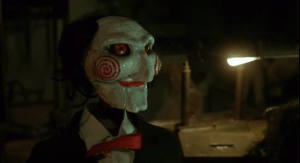 Wan can also be his worst enemy. Too often he punctuates chase scenes with pounding heavy metal, which does little more than numb an audience. Wan’s film loses some of its focus in the middle as the audience endures flashback after flashback. To goose up the viewing, Wan shoves in extraneous flashes of gore. Just like The Exorcist prequel, flashes of something horrific do little more than to cause an audience to yelp. They’re immediate. If you want true gut-churning reactions, you have to build, and in the end Saw remembers what it came to do and sprints to the finish line.
Saw also exists in the grimiest possible world. Whether it be parking garage, office, or even personal apartment, the characters of Saw exist in some netherworld of filth crying out for an army of scrubbing bubbles. I’m sure this was intentional, but can’t any place in horror movies afford a coat of paint nowadays?
Saw is a gruesome, twisted, sometimes sadistic horror movie with a knock-out premise, a moderately good ending twist (not the final end, though), and some lag time in between. Wan and Whannel really stretch their budget to impressive ends and imply more blood and guts than are shown. Fans of hardcore gore horror should be pleased with Saw, though they may find themselves giggling at it from time to time. I was hooked by its premise and found myself getting more intrigued as the revelations began to sift. Many will find Saw too ugly, gory, or stupid, but for fans of the genre, it should satisfy the itch recent PG-13 horror couldn’t efficiently scratch. Saw is violent, contrived, ridiculous, but also, in the end, gruesomely entertaining in parts.
Nate’s Grade: B-


 nathanzoebl
You must be logged in to post a comment.