Blog Archives
The Whale (2022)
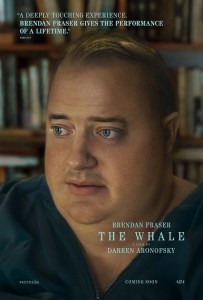 Much has been written about Brendan Fraser’s comeback role and the mountain of prosthetics he was buried under to portray a self-loathing 600-pound man in director Darren Aronofsky’s The Whale. The concern was that the movie would stigmatize overweight people as disgusting and treat fatness like a moral indictment, condemning their lifestyles as slovenly and doomed to misery. I watched the film ready to cringe at a moment’s notice with the hyped portrayal that earned such livid and divisive reactions. I found The Whale to be deeply empathetic but I’m uncertain about whether or not it was fully compassionate, and it’s that artistic distinction that I’m trying to square as I analyze Aronofsky’s melodramatic yet flawed character study.
Charlie (Fraser) is a morbidly obese English teacher who keeps his camera off during his online classes. The closest relationships he has is with his nurse, Liz (Hong Chau), who checks on him regularly with alarm and concern, as she’s also the sister of Charlie’s deceased partner. The movie chronicles one eventful week in Charlie’s life as he tries to make the most of his dwindling time and reconnect with his estranged teenage daughter, Ellie (Sadie Sink).
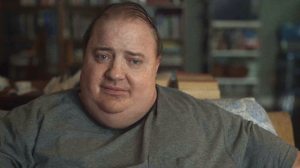 For me, Charlie is less a clinical case of what being morbidly obese can do to a person and he’s more a case study of self-destruction. In 1995’s Leaving Las Vegas, Nicholas Cage won an Oscar playing a man determined to drink himself to death over the course of one eventful weekend in Vegas, and I saw more parallels with his character and Charlie, a man who turned to eating as his source of grief that then became his vehicle for self-destruction. The movie is not casting judgment that all fat people, even those approaching the size of Charlie, are destined for eternal loneliness or crying out for help. However, this specific man is using his increasing weight as a form of suicide. This facet makes Charlie interesting but also increasingly confounding as well. He seems genuinely remorseful about the time he’s missed from his now-teen daughter’s life. He’s saved up his life’s money and plans to give it to her, but I kept wondering why, exactly, he had to die for this? He won’t take care of himself because any medical cost could take away from the handsome sum he plans to leave, in full, to Ellie. He apologizes for being absent but seems unable to see an alternative where he can be present. After so many years apart, maybe she would actually prefer having her dad back in her life? Charlie stubbornly holds to an all-or-nothing ideal, like some kind of fumbling romantic gesture, but he doesn’t have to die for his daughter to live her best life. She doesn’t even get a say. It’s his inability to see through this false choice he’s determined is the best outcome that makes the character frustrating. He only views his death, and I’m sure the insurance to go with it, as his biggest reward that he can offer his estranged daughter, and that makes it even more frustrating at the very end, where he’s trying to prove something to her but is also likely traumatizing her for life. That love he proclaims so readily for his daughter seems questionable when he prefers a misguidedly noble demise to getting to know her and allowing her to choose for herself. The character seems so frustratingly myopic about his own life and its value only being its end.
Complicating this matter is the reality that Ellie is, quite clearly, a horrible person. She’s angry at the world and trained her ire on her absentee father, who she believes left her and her mom to pursue an illicit affair with one of his male students (the reality is a bit more complicated). She is well and truly awful. Ellie insults her father repeatedly. She yells that she wants him to die and that she would be better off. She agrees to spend time with him for a hefty price. She even takes pictures of him and posts them online for social media derision. She’s detestable, and yet the screenplay by Samuel D. Hunter (Baskets), adapted from his play, wants me to yearn for a hopeful father/daughter reconciliation. There isn’t a hidden pool of depth with this character, a brilliance that we know just needs to be nurtured and that Ellie can tap back into. She’s just the unrepentant worst. I think The Whale errs by placing so much of its dramatic foundation on this pairing. It made me question why this man is literally killing himself for this bratty teen. The late reveal for Charlie’s essay that he often quotes like a religious mantra is obvious and still doesn’t open up Ellie as a character. There’s a brief tear-stricken moment at the end that I guess is meant to represent Ellie with her guard down, but I didn’t buy it, and I found her to be a thinly written archetype that is unwinnable. She’s more of a plot device to motivate a redemption arc. Maybe the point is she’s undeserving of her father’s graceful overtures but I guess that’s parenting, folks.
 Charlie says he’s always been a bigger guy but his weight got away from him after the loss of his partner, and it’s this unfathomable grief that caused Charlie to go on feeding binges. He sought comfort in the immediate appeal of food, and plenty of people can relate to stress eating or eating their feelings when times are turbulent. I don’t think the movie is setting Charlie up as a cautionary tale to avoid. Charlie’s grief is tied to religious intolerance and its own trauma. He opened himself to another person and then had his new sliver of happiness dashed away directly related to a religious intolerant mindset that his partner was unable to break free from. He’s a victim who saw no way out including a heavenly reward supposedly denied to him. It’s not this dead man’s fault that he was raised in a diseased environment that viewed his own identity as an illness, and it’s not worth blaming this man for being unable to break free from this mentality. It’s the intolerance that has contributed to Charlie’s weight gain and his fatalistic sense of self. Heartbroken, Charlie has retreated from the world, and it’s the guise of spiritual salvation that proves alluring to the determined young missionary, Thomas (Ty Simpkins, Jurassic World). He sees the flesh as the prison for the soul, and he tries to sell Charlie on a salvation that asserts itself as liberation from his body, which the young man views with horror. Charlie doesn’t want the spiritual guidance, especially from the same community that poisoned the mind of his late partner. Like the Ellie character, I don’t think we gain much with this storyline and the amount of time that the screenplay gives Thomas. I guess we’re meant to see him as another wayward soul trying to live authentically, but he’s another underwritten archetype given misplaced emphasis.
The best reason to sit through The Whale are the performances from Fraser and Chau. We’ve never seen Fraser in a movie quite like this, a man best known for broad slapstick comedies (George of the Jungle, Furry Vengeance) or dashing action-adventure movies (The Mummy films), and he’s great. His performance is less mannered than you would assume for an actor undergoing such a physical transformation. In fact, his vocal range makes Charlie often sound anesthetized, like he’s already given up moving out of a comfortable yet limited range of emotional output. It’s kind of heartbreaking but he’s also got a gentle heart that chooses to see the best in people, even when they might not be there. Fraser is compelling in every moment and disappears into the role of Charlie. His best scene partner is Chau (The Menu), and the movie is at its best when they’re sharing the screen. Liz is the closest friend Charlie has, and they have a shared special kind of pain relating to the loss of Liz’s brother. She’s also enabling his self-destructive impulses and is devastated that Charlie is accepting a doomed fate rather than letting her take him to a costly hospital. Chau is heartbreaking as you feel her fear and guilt, afraid of losing another person so dear to her but also severing another connection to her brother.
 The Whale is an experience that makes me wonder about its best artistic intentions. Even the title of the movie feels like a glancing blow; what other analogy are you supposed to make other than Charlie as our very own Moby Dick? The critical essay he keeps reciting takes a sympathetic view of the marine animal and posits the fruitless efforts of those who wish to cruelly hunt it down and how this will not provide personal fulfillment (it shouldn’t be too hard to figure out who represents who in this dramatic dynamic). It’s also the least distinguishable Aronofsky film of his provocative career, confined to a single location and devoid of the director’s usual vision and verve. It feels like a challenge in restraint for Aronofsky, almost like he’s approaching theater and just wanting to get transfixed by the dramatic surges of the actor’s interactions. I found the central character to be interesting but confounding, not that human beings are ever so clearly understandable in every facet of their being. I don’t think the supporting characters really added much, with the exception of Hong Chau, and I wish the daughter plot had been scrapped. But if you’re sitting down to watch The Whale, you’re doing so to experience Fraser’s career-best performance where he reveals layers to his acting that you never knew were possible. He can still lean into his innate generous spirit and charm to get you to root for Charlie to find some peace. For Fraser alone, The Whale is worth watching and might open some hearts.
Nate’s Grade: B-
Share this:

She Said (2022)
 The fall of Harvey Weinstein was a long, long time coming, and the journalistic procedural drama She Said demonstrates just how hard it is to hold bad men accountable. This is a very similar movie to 2015’s Best Picture-winning Spotlight, following hard-nosed professionals as they go through beat-after-beat of assembling their case, following the leads, and convincing those who have been wronged to come forward and share their personal stories. The star is the details, the main crusading New York Times journalists (Carey Mulligan, Zoe Kazan) being defined by their tenacity and determination. As should be obvious, it’s galling how many people protected this awful man, including the police, because of how influential he was as a movie producer. Peeling back the layers of protection revolves around working on the niggling moral concerns of many who looked the other way, out of financial incentive or fear or disregard for rocking the “way things were.” When the expose picks up actual momentum, you can feel the same excitement of holding the powerful to account, even already knowing the end results that would land Weinstein in jail for the remainder of his life. It’s a simple yet effective approach. She Said is little more than a dramatized in-depth news article on its relevant subject, but the ensemble of actors give it a fire that simply scanning the written word can miss. The direction is very matter-of-fact, the writing is thoughtful though a bit heavy with data dumps, and outside of the victims narrating their experiences, or relatives discovering the extent of those experiences that have been kept hidden from them, there isn’t much sustainable tension. Much has been made of Samantha Morton’s one-scene wonder but I think Jennifer Ehle (Braveheart) does even more with her scenes as a victim choosing to speak during a health scare that reassess her thinking. I wish the movie had extrapolated about the entire film industry protecting abusers, but it keeps its focus squarely narrowed on taking down Weinstein. She Said is a worthy movie with a worthy subject and heavy in the details but maybe light on its own drama.
Nate’s Grade: B
Share this:

Synecdoche, New York (2008)
 Nothing comes easy when dealing with acclaimed screenwriter Charlie Kaufman. The most exciting scribe in Hollywood does not tend to water down his stories. Kaufman’s latest head-trip, Synecdoche, New York, is a polarizing work that follows a nontraditional narrative and works on a secondary existential level. That’s enough for several critics to hurtle words like “incomprehensible” and “confusing” as weapons intended to marginalize Synecdoche, New York as self-indulgent prattle. I guess no one wants to go to the movies and think any more. Thinking causes headaches, after all.
Caden (Phillip Seymour Hoffman) is a struggling 40-year-old theater director trying to find meaning in his beleaguered life. His wife (Catherine Keener) has run off to Germany with his little daughter, Olive. He also manages to botch a potential romance with Hazel (Samantha Morton), a woman who works in the theater box-office who has an unusual crush on Caden. He’s also plagued by numerous mysterious health ailments that only seem to multiply. While his life seems to be in the pits, Caden is offered a theater grant of limitless money. He has big ambitions: he will restage every moment of his whole life to try and discover the hard truths about life and death. Caden must then cast actors to portray the various people in his life. Sammy (Tom Noonan) argues that no other actor could get closer to the truth of Caden; Sammy has been following and studying Caden for over 20 years (don’t bother asking why in a movie like this). Caden also casts his new wife, Claire (Michelle Williams), as herself. The theater production gets more and more complex, eventually requiring the “Caden” character to hire his own Caden actor. Caden hires Hazel to be his assistant and Sammy falls in love with her. Caden admonishes his actor, “That Hazel isn’t for you.” Caden then tries sleeping with “Hazel” (Emily Watson) to get even with the real Hazel. By producing a theatrical mechanism that almost seems self-sustaining, Caden wants to leave his mark on the world and potentially live forever.
 I heard plenty of blather about how mind-numbing Synecdoche, New York was and how Kaufman had really done it this time when he composed a script that involves characters playing characters playing characters. People told me that it was all too much to keep track of and that it made their brains hurt. The movie is complex, yes, and demands a viewer to be actively engaged, but the movie is far from confusing and any person or critic that just throws up their hands and says, “Nope, too much to think about,” is doing their brain a disservice. The movie is relatively easy to follow in a simple linear cause-effect manner; Kaufman only really goes as deep as two iterations from reality, meaning that Caden has his initial doppelganger and then eventually that doppelganger must get his own Caden doppelganger (it’s not nearly as confusing as it sounds if you see it). Now, where the movie might be tricky to understand is how deeply contemplative and metaphorical it can manage to be, especially at its somber close. That doesn’t mean that Synecdoche, New York is impossible to understand only that it requires some extra effort to appreciate. But this movie pays off in huge ways on repeat viewings, adding texture to Kaufman’s intricately plotted big picture, unfolding into a richer statement about the nature of life and death and love.
Theater has often been an easy metaphor for life. William Shakespeare said, “All the world’s a stage, and all the men and women merely players; they have their exits and their entrances; and one man in his time plays many parts.” Kaufman movies always dwell substantially with the nature of identity, and Synecdoche, New York views identity through the artifice of theater. Caden searches for something brutal and true via the stage, but of course eventually his search for truth becomes compromised with personal interests. Characters in Caden’s life are altered and in the end when Caden steps down, as himself, reality starts getting revised. The truth is often blurred through the process of interpretation. Caden ends up swapping identities with a bit player in the story of his life, potentially finding a greater sense of personal comfort as someone else. Don’t we all play characters in our lives? Don’t we all assume different identities for different purposes? Do we act differently at a job than at home, at church than at a bar? Caden remarks that there are no extras in life and that everyone is a lead in his or her own story.
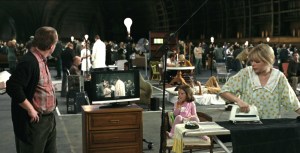 Kaufman’s movie is also funny, like really darkly funny and borderline absurdist to the point of being some strange lost work by Franz Kafka (Hazel even mentions she’s reading Kafka’s The Trial). You may be so caught up trying to render the complexities of the story to catch all of the humor. The movie exists in a surreal landscape, where the characters treat the fantastic practically as mundane. Hazel’s house is constantly on fire and yet none of the characters regard this as dangerous or out of the ordinary. It is just another factor of life. The entire subplot with Hope Davis as a hilariously incompetent therapist is deeply weird. Caden suffers some especially cruel Job-like exploits, particularly what befalls his estranged daughter, Olive. He’s obsessed with her hidden whereabouts and European upbringing, to the point that Caden cannot even remember the name of his other daughter he has with Claire. There is a deathbed scene between the two that is equally sad and twisted given the astounding behavior that Caden is forced to apologize for. There are running gags that eventually transform into metaphors, like Caden’s many different medical ailments and the unhelpful bureaucratic doctors who know nothing and refuse to divulge any info. Kaufman even has Emily Watson, an actress mistaken for Morton, play the character of “Hazel.”
This is Kaufman’s debut as a director and I think the movie ultimately benefits by giving its writer more control over the finished product. The movie is such a singular work of creativity that it helps by not having another director; there is no other artistic vision but Kaufman’s. While the film can feel slightly hermetic at times visually, Kaufman and cinematographer Frederick Elmes (The Ice Storm) pack the film with detail. Stylistically, the film is mannered but this is to make maximum impact for the vast amount of visual metaphors. Synecdoche, New York never feels as mannered as the recent Wes Anderson films, henpecked by a style that serves decoration rather than storytelling. The production design for the world-within-a-world is also alluring and imaginative, like a living, breathing dollhouse.
 The assorted actors do well with their quirky, flawed characters, but clearly Hoffman is the linchpin to the film. He plays a character from middle age to old age, and at every step Hoffman manages to infuse some level of empathy for a man routinely disappointed by his own life. The failed yet lingering and hopeful romance between Caden and Hazel provides an almost sweet undercurrent for a character obsessed with death. Hoffman is convincing at every moment, even as a hobbled 80-year-old man, and gives a performance steeped in sadness but with the occasional glimmer of hope, whether it be the ambition of his theater project or the dream of holding Hazel once more. Morton is also wonderfully kindhearted and endearing as the woman that just seems to keep slipping away from Caden.
There’s no other way to say it but Synecdoche, New York is a movie that you need to see multiple times to appreciate. The plot is so grandiose in scope and ambition that one sitting does not do it justice. Kaufman has forged a strikingly peculiar movie that manages to be surreal and bleakly comic while also being poignant and humane. This is a big movie with big statements that can be easily missed, but for those willing to dig into the wealth of metaphor and reflection, Synecdoche, New York is a rewarding film experience that sticks with you. By the end of this movie, Kaufman has earned the merging of metaphor and narrative. I have already seen the movie twice and still cannot get it out of my thoughts. This isn’t the kind of movie that you feel warm affection for, like Kaufman’s blissfully profound Eternal Sunshine of the Spotless Mind. This movie is less a confounding puzzle than an intellectually stimulating examination on art, the human experience, and, ultimately death. If people would rather kill brain cells watching whatever dreck Hollywood secretes every week (cough, Street Fighter: The Legend of Chun-Li, cough) then that’s their prerogative. Give me a Charlie Kaufman movie and a bottle of aspirin any day.
Nate’s Grade: A


 nathanzoebl
You must be logged in to post a comment.