Blog Archives
Napoleon (2023)
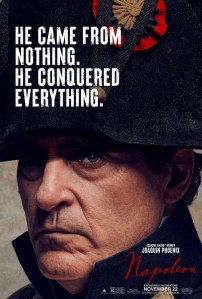
I may be completely in the wrong, but I feel the only way to view Ridley Scott’s latest historical epic, a 158-minute account of the life of Napoleon Bonaparte, is as a comedy with the full intention of not retelling history but of de-mythologizing the grandiosity of its star. Otherwise, these 158 minutes feel like an accelerated Wikipedia summary of the man’s many famous deeds as he rose from general to Emperor and swept his armies across the continent conquering much of Europe. Rather, I choose to think of the movie as a strange comedy that shows how this fearsome military genius might also have been just a strange little guy with a temper.
The Revolution in France is burning out of bodies and the people are growing restless at the lack of meaningful democratic progress. Enter Napoleon Bonaparte (Joaquin Phoenix) as a successful general who will eventually crown himself as Emperor of France. He will wage war across the continent, lead to the deaths of three million by his final defeat 1815, and reshape and revolutionize the military of its days. He will also die alone, exiled, and without the love of his life, his wife, Josephine (Vanessa Kirby).

This all has to be a comedy, right? Ridley Scott (Gladiator, The Last Duel) went to elaborate lengths to make fun of the little general, right? How else to read scenes where Napoleon and Josephine argue at the dinner table where he accuses her of being infertile, she accuses him of being fat, and he agrees that he heartily likes his food and says, “Fate has brought this lamb chop to me.” How else to read a scene where he throws a hilarious hissy fit before the English ambassador, who Napoleon feels has been rude and less than deferential, and he screams, “You think you’re so great because you have boats!” How else do you read a montage of Napoleon seizing power with the military pushing out the old figures of power and one of them, aghast, shouting, “This cannot be. I am enjoying a succulent breakfast!” How else to interpret the scene where Napoleon is going to achieve his coup from the French parliament and he’s run out of the chamber, falling and scampering out like a child caught playing tyrant. It’s moments like these, as well as the acting choices, that push me in the direction of interpreting this movie less as another handsomely mounted biopic of The Great Men of History and more tearing down the lockstep reverence for this figure glorified through centuries of back-patting. I’m reminded of Josh Trank’s relatively unloved Capone movie from 2020, and while imperfect, I appreciated that Trank spent the entire movie tearing down the legend and myth of this bad man and showed him for what he was late in life, a pathetic, decrepit loser riddled with syphilis losing his mind and crapping his pants. I think we need more biopics that have a less reverent approach to their subject because then it provides a public service of inviting viewers to be more critical of history rather than blindly accepting.
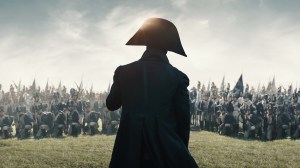
I think this is also showcased by the fact that Scott and screenwriter David Scarpa (All the Money in the World) are choosing to tackle the legends rather than the history. Take for instance the acclaimed Battle of Austerlitz, one of the film’s high-points. Napoleon surprises the combined Russian and Austrian troops by firing cannons at the frozen lake, causing it to shatter and entomb thousands of men to their watery graves. It’s a stunning visual sequence that blends the beauty and terror of the events and of course little of it happened in real life. In reality, the lake was really more a series of small ponds and reportedly very few enemy soldiers drowned. In reality, Napoleon never rode into battle as part of his cavalry. The generals stayed behind with orders. Or take for instance Napoleon’s ill-fated march into Russia, and when he arrives he’s so bored and thoroughly depressed as he sits on the empty throne in Moscow, acting like a little kid who is eager to go home already. That’s the difference between history as it happens and history as it is remembered, and that’s the myth-making that Scott is attempting to work through and re-contextualize for the many people who aren’t fanatical acolytes of the historical record. This is Scott saying he’s going to take all the myths and legends and make you critically reconsider.

Then there’s the relationship with Josephine which defines much of the movie, so much so that it provides explanations for why Napoleon left his first exile, because, apparently, he was upset his wife was seeing other people. The relationship plays out like one more of political maneuvering than romance, with some eyebrow-raising bedroom kinks to modernize the tale. Much of their conflict is on Napoleon’s inability to sire a male heir, which is put through the steps of the scientific method by his concerned and opportunistic mother as he attempts to father bastards with other women. This is the storyline that suffers the most from the accelerated pacing and editing, so consumed with moving from place to place and fitting in all the historical checkpoints. The larger nuance of this relationship, and Josephine as a character, is taken out by simplifying it as a tale of two people who realize that gender-specific baby-making is their top priority. In reality, Napoleon absolutely adored his wife and wrote lengthy love letters that you can read today, with lines such as, “I hope before long to crush you in my arms and cover you with a million kisses burning as though beneath the equator,” and, “Without his Josephine, without the assurance of her love, what is left him upon earth? What can he do?” It’s a shame so much of this is reduced to heir-production anxiety.
Phoenix (Beau is Afraid) plays the titular role like he’s sleepwalking, slumped and grumpy and rarely providing much energy except around plates of food. It’s a curious performance and one that helps me to further see the depiction as one through the lens of a critical offbeat comedy. He’s certainly not playing the man like he’s one of the great inspirational figures, and he’s certainly not playing the man like he’s tearing through a multitude of doubts and inner demons. He’s playing Napoleon like a grumpy weird little guy who would rather be dining than conquering. Kirby’s (Mission: Impossible Dead Reckoning) more an accessory in her character’s limited scope but she does have a few moments that reflect Josephine’s moxy.
I would be remiss to pass up this chance to sing the praises of my former high school AP history teacher, Mr. Jerry Anglim, who had been teaching history and government for over 26 years before I stepped foot in his classroom. The man brought history alive for me and really crystalized my love for the subject, seeing how it’s all just one big canvas of storytelling. And this man loved teaching the Napoleonic Wars in great detail, and I loved scribbling down those notes every day. I even thought about getting a Napoleon poster to hang in my room, which would have been quite the odd teenage decorating choice. We watched the 1970s Waterloo movie starring Rod Steiger as Napoleon in class on a tiny TV attached to the corner, and yet I was spellbound because of what this teacher had done for me with the subject. So, wherever you are Mr. Anglim, thank you, and I’m sure you have your complaints with this new movie and I would love to hear them.
As a long movie still barely chronicling the major events of its subject, Napoleon feels lacking unless viewed through the lens as a critical comedy tackling his legends and myths. Then the abrupt nature of the plotting becomes more an addition than a subtraction. However, Scott has gone on record that he has a four-hour director’s cut that Apple plans to make available on its streaming platform in the near future, so perhaps my entire interpretation could be blown up. To be fair, the real Napoleon was a military genius and did revolutionize and modernize the French military, and while he didn’t “conquer everything,” especially Great Britain and Russia, the man and his ambitions and good fortune dominated the first fifteen years of the nineteenth century. Human beings will always be drawn to the stories of conquerors, but it’s important to also see them as people, quite often terrible people, but human beings with failings and complexities that are often left behind from decades if not centuries of propaganda and historical whitewashing. As a biopic, Napoleon the movie feels too short and shrift. As a comedy, it’s a lamb chop served up by fate.
Nate’s Grade: C+
Share this:

Stardust (2007)
 Director Matthew Vaughn is about as far away from his previous film as he can get. 2005’s Layer Cake is about as far from princesses and unicorns and pixie dust as can be expected. He turned down X-Men 3 to helm this adaptation of famed comic scribe Neil Gaiman’s graphic novel, Stardust. In style with one of the film’s characters, allow me to say to Vaughn, well played, sir.
In turn of the century England, Tristan (Charlie Cox) is trying to woo Victoria (Sienna Miller), the haughty town hottie in the small village of Wall. The town is called such because there is a winding stonewall that runs alongside that people are forbidden to cross. He’s given seven days to retrieve a fallen star for Victoria to prove his affection for her. In order to do so, he needs to venture beyond the wall, and beyond the wall is another world altogether. The fallen star is a result of an dying king (Peter O’Toole) hurling his enchanted necklace to the heavens. The jewelry collides with a star and causes it to crash to earth. But it’s no smoldering rock taking refuge in that crater; the star has actually taken the form of a slender, long-haired blonde woman named Yvaine (Claire Danes). I can only hope other astral bodies that crash into this planet will result in the same lucky outcome. But Tristan is not the only one after the fallen star. Three very old witches have taken notice and seek to cut out the star’s heart and consume it, which will grant them youth once again. The oldest witch (Michelle Pfeiffer) uses the last bit from the previous star to shed her wrinkles, but every time she uses a speck of magic she loses part of her much-desired youth. Also on the hunt for the star are the king’s ruthless sons, each trying to retrieve their father’s necklace and declare themselves the next king, and each trying to bump off their family competition.
 Stardust is very much in the fractured fairy tale style of The Princess Bride, complete with nudges and winks. The movie works more with the macabre, but this only seems to heighten its magical qualities. I loved the ongoing wisecrack-filled commentary from the increasing number of ghost princes (“Well played”), and I loved that each was stuck in limbo Beetlejuice-style looking as they did when they died. Stardust is stuffed with hocus pocus hokum but it never seems foolish; the movie takes great steps to present the rules and characters of its universe, and as all of the assorted creatures race toward a showdown, Stardust makes total sense. It doesn’t betray the logistic parameters it establishes for such a fantastical parallel world. It means that if you can accept the opening 20 minutes than you should be fine for the duration of Stardust. The film spins a familiar tale of hidden princesses, races against time, battles over a throne, and wicked witches, but it handles the material with aplomb. Stardust‘s biggest asset, beyond the cheeky sense of humor Vaughn instills, is that literally anything could happen next. Suddenly there’s a flying pirate ship out to harness lightning, or a goat-turned-inn keeper, and it’s all so exciting what could be waiting around the corner next.
Vaughn assembles a lot of pieces and then keeps the momentum strong. He makes judicious use of special effects and keeps the audience involved with all the story’s moving pieces. Vaughn has taken the usual fantasy quest framework and channeled the imagination and dry wit of Gaiman. Not every moment runs as smooth as possible, and some are downright awkward, but Stardust stokes a nice balance between high-flying adventure and doodle-on-your-notebook romanticized love. Vaughn’s steady control and vision allow the material to really shine because the audience can open themselves to the magic of the movie.
The acting ensemble brings a lot of enjoyment to this enchanted tale. Pfeiffer is a bewitching villain and relishes her bad girl role; she’s a devious delight but is even better when dealing with the physical comedy of her increasingly aging body. De Niro is immeasurably enjoyable thanks to a role that conflicts with audience expectations for the famous force of movie masculinity. I was howling with laughter watching him cross-dress, swish, and become a giant exaggerated gay stereotype. It might seem trite or offensive to some had it not been for the setup and the film’s tolerant philosophy. Danes delivers a performance that seems to teeter on camp. She ramps up her vocal inflections thanks to her hyper English accent and seems to perform like she’s in front of a mirror and testing out all of her facial muscles. A bit odd. Cox fits snugly into the Hollywood slot of bland male lead.
 The one main drawback for the film is that the screwball bickering between Tristan and Yvaine never really works. The constant arguing rarely comes across as funny and is too poorly veiled to camouflage the film’s romantic intentions. The romantic setup is pretty formulaic. The audience will know right away that Tristan is not meant for his conceited and high-maintenance village girl, and that true love is staring him in the face along the course of his most fantastic voyage. We know from the first second of their meeting that their combative relationship will in time transform into a romantic relationship. But that’s not to say Stardust isn’t a romantic fable. Its heart is simple but it is genuine. While its path is predestined and unshakable, this does not stop the audience from feeling something between Tristan and Yvaine and their eventual coupling. I may be going soft, or perhaps Stardust just won me over completely, but I found myself even slightly moved by the romantic climax.
Stardust is assembled, like most fairy tales, from the working parts of other tales. It’s rather predictable with its big moments (boy meets star girl, boy loses star girl, boy regains star girl), but oh what a fun time the film has from point to point. Stardust is vibrantly alive and cheerfully creative and watching the film almost becomes a dizzying experience. It has a sweet and gentle romance at heart, and its knowing whimsy and charms are hard to resist. You’ll never look at Robert De Niro the same way again.
Nate’s Grade: A-


 nathanzoebl
You must be logged in to post a comment.