Blog Archives
R.E.D. (2010)
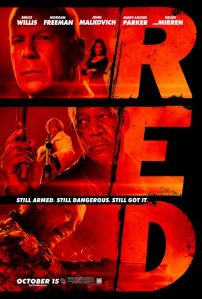 I can watch Helen Mirren fire high-powered weapons all day. RED is a jaunt throwaway that manages to be far more entertaining than it has any right to be. This isn’t excess on the level of The A-Team, nor is it all cynical and emotionless like Wanted. RED is the film that The Expendables could have been with a bit more polish and a little less muscle flexing. The premise almost seems worn out by this point in 2010: retired CIA agents are being hunted down and killed for some mysterious reason. Thus Bruce Willis must travel across the country and recruit his former spooks like Morgan Freeman, a daffy John Malkovich, and dame Mirren. He also gets a rather charming romance with Mary-Louise Parker (TV’s Weeds) as a pension customer service rep that Willis dials up for small talk. She gets whisked along this madcap adventure and enjoys it for the ride that it is. And I think that’s the best summation of the film. What other movie of this sort has actors of this caliber? Four Oscar winners, one nominee, plus solid work from Karl Urban (Star Trek) and beloved character actor Brian Cox to boot. The film definitely has a style, slick enough to please without being heavy-handed to rip you out of the film. The plot may be full of holes, the characters aren’t fully drawn, and certain action sequences are derivative, but thanks to the charms of its golden cast, RED is fun while it lasts.
Nate’s Grade: B
Share this:

The Time Traveler’s Wife (2009)
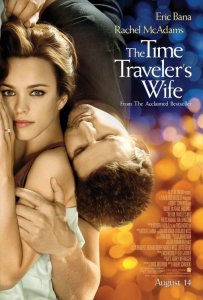 You think your romantic foibles are complicated? Based on Audrey Niffenegger’s best-selling novel, The Time Traveler’s Wife, we follow the life of Henry (Eric Bana), a librarian stricken with the unique genetic disorder of uncontrollable time travel. He first discovered this condition when he was six years old and disappeared out of his mother’s car, only to rematerialize and watch her die from afar. An older version of Henry happened to also be on hand and fill in his younger self on the details. Henry will randomly move backwards and forwards through time, and there’s nothing he can do to stop it. One of the side effects of spontaneous time travel is, naturally, nudity, as Henry travels in the buff a la the Terminator. So usually the first thing he must do when he winds up some place new is find some clothes. Henry seems destined to be a sad and lonely man, but then one day Clare (Rachel McAdams) enters his life, confessing that she’s known Henry for years and been waiting for this exact moment to arrive. She asserts herself and asks Henry for a dinner date that’s been in the works for some time. They fall in love, or fall further in love in Clare’s case, and try to make a relationship work despite Henry’s hiccups through time.
There’s a tenderness to the movie, though I found it tricky to fully engage in the characters. Much of the movie concerns the plot complications that befall such a strained and unique relationship. The flick gives new meaning to cold feet when Henry literally vanishes during his wedding, only to reappear as a mid-40s version of himself (hey makeup department, you couldn’t do more to effectively age Bana than add a dash of grey?). There is a great mind-bending section where Clare cheats (?) on Henry with… a younger version of himself. I was interested in the subdued proceedings and I felt underpinnings of empathy for Henry and Clare, but then my mind wandered into something a little darker and pessimistic. Now, The Time Traveler’s Wife is a polished traditional romance despite the sci-fi trappings but I started thinking about if what I was witnessing was actual romance? Henry first visits Clare as a child, telling her he will be her eventual husband. She falls in love with him in that moment and rejects all other suitors, knowing with absolute certainty that she will marry Henry. She just has to find him. And when adult Clare does meet Henry the librarian, he has never seen her before up to that point (it’s not as confusing as it may sound). She’s been waiting years to see his face again and she tells him that they are destined to get married. You see what’s at play here? The romantic plot is a loop where each character supplies the other’s conviction. Henry locked Clare into a life of looking for him and said they would marry, but then the adult Clare is the one who convinces Henry that they will indeed marry, and he tells young Clare this who will then convince Henry, etc. Is there any free will at play here, or is each partner in this relationship being manipulated by the certitude of the other? It’s sort of a metaphysical chicken/egg scenario.
 The best portion of the movie comes across during the second half when the movie focuses more on the emotional consequences of Henry’s condition. Early on Henry’s uncontrollable time traveling is played for laughs and some forced and somewhat trivial conflict (oh no, he missed another dinner!). Henry has a chilly relationship with his father (Arliss Howard) until, well, I’m not quite sure, but things improve. In the second half of The Time Traveler’s Wife, the drama gets more serious and intriguing when Clare and Henry attempt to conceive. Henry’s genetic disorder gets passed down to the baby fetuses, which means little babies are vanishing out of the womb and perishing before being zapped back inside. That’s a rather disturbing image and yet it is a thoughtful and plausible problem given the premise. As a result, Clare suffers through several traumatizing miscarriages. But they keep at it because Henry has seen his future lineage, also a time-traveler, and he knows that one of these pregnancies will go full term and become their eventual daughter, Alba (Tatum McCann). It was this storyline that stopped my mind from occasionally wandering and hooked my interest. Perhaps it’s cheap sentiment, but it’s hard not to feel for this loving couple when they endure pregnancies fraught with danger. The movie misses out on a dynamite dramatic opportunity with Alba. If I were adapting this to the screen, I would make sure to include Alba as a grown 30-something woman visiting her father on his deathbed, tearfully informing her dear dad on all the eventful moments that he won’t be around to experience. Picture an adult Alba talking about her own children to her dying father. There wouldn’t be a dry eye in the house. Hollywood, if you’d like to tack on an extra emotional ending to this movie, there’s still time. Call me.
It is here that I must address some key scenes that may pique curiosity. During Henry’s travels, he frequently visits the young child version of Clare. The first time Clare meets her future husband she is a little girl sitting in a meadow on the boundary of her family’s palatial estate. Henry, as he does every time he becomes unstuck through time, arrives in the nearby woods without a stitch on. Director Robert Swentke (Flightplan) and screenwriter Bruce Joel Rubin (an Oscar-winner for Ghost) work diligently to make sure the movie walks a very fine tone, and I confess that the scenes between loving child and naked time-traveling man escape creepy pedophilic overtones. Take that blurb for what you will in a romance: “Hey, no pedophilic overtones!”
 There are some other complications when it comes to this matter of unexpected time traveling. Firstly, the rules seem to be flexibly applied. At one point Henry is talking about how he cannot prevent his mother’s deadly car accident. The movie professed a destiny-entrenched approach to time travel, meaning every action you think you’re engaging out of free will was predetermined (the TV show Lost also subscribes to this theory). It cuts out time paradoxes. But then in another moment Henry uses his knowledge of the future to win the lottery. So which is it? Are the filmmakers trying to convince me that it was destiny for Henry and Clare to win the lottery, because I’m not buying it. Having a time-traveler for a boyfriend takes out some of the natural drama o relationships when one party can peak ahead. Relationships have danger and excitement and uncertainty to them, but when Henry can just matter-of-factly say, “We’re gonna be fine. We’re still together and in love fifteen years later, I saw it,” well it may make for good romance for some, but it makes for rather inert drama. How can you hope to win arguments? Naturally, the hefty book has been streamlined as much as possible for a mainstream moviegoing audience, which means that Henry’s scope of time traveling is scaled back. At one point he quantum leaps beyond his own lifetime, and because this has never happened before and is really only done to introduce a ticking death clock. I suppose there will always be inconsistencies when it comes to breaking the space-time continuum.
McAdams (The Notebook) is a great choice for the romantic center of the movie. She’s glassy-eyed and smiles so hard in her early sequences you think her dimples are going to explode off her cheery face. She is such a winning presence and her warm-hearted glow powers the character and the movie. Unfortunately, she doesn’t have very good chemistry with her onscreen mate. Henry is a victim of an existential cruel joke. Bana (Munich) is light-footed and makes Henry more than a space-time martyr. He’s somewhat amorphous as a character, a collection of niceties and genial, puppy-dog affection, which means that Henry is routinely upstaged by his genetic condition. However, when Henry faces the specter of his impending death is when the character gets a lot more attention and Bana is able to work his considerable talents. He gets ample opportunities to showcase his time-traveling buttocks. I don’t think too many women out there would be that put off if a naked Eric Bana magically materialized in their bedroom.
 The Time Traveler’s Wife is mildly reminiscent of The Lake House, and not just because of the time travel romantic complications. Deep down, these are traditional Hollywood romances with a fresh sci-fi coat of paint. The movie is best if you set the logic portion of your brain off so that inconsistencies and potential contrivances don’t distract from an intriguing story that presents some nice developments. There’s a tender love story here, though the characters don’t leave as much of an impression as they could have with such a plot-heavy romance. It finishes strongly and the mood throughout has a somber bittersweet quality, hammering home the “enjoy the time you have” message. McAdams is darling, Bana gets in the buff, their chemistry isn’t great, and the filmmakers refrain from the material getting overly sentimental or solipsistic. In a summer of relative disappointments, a tricky, clever approach at traditional romance is welcome amidst the explosions and wacky studio comedies.
Nate’s Grade: B
Share this:

Flightplan (2005)
 Anyone else tired of seeing that damn trailer for Flightplan? Ever since maybe June, I’ve been seeing Jodie Foster freak out on an airplane. The trailer also had the misfortune of revealing way too much information about the film’s plot, seriously spoiling a key moment. This got me thinking about other movie trailers that spoil the movie. The worst offender I can fathom is 1998’s The Negotiator, where Samuel L. Jackson and Kevin Spacey are pitted against each other as hostage negotiators on opposite sides. The trailer had the nerve to reveal that Spacey and Jackson team up in the end to fight The Man collectively. Why does it seem that movie trailers these days spell out film twists? Are movie audiences demanding more investment before shelling out money? Do studios just not have faith in audiences anymore? With all this in mind, I ventured into Flightplan with my family thinking there might be more to the film than one poorly spoiled twist. I was wrong.
Kyle Pratt (Foster) is a very distraught woman. She’s returning from Berlin to the United States with the casket of her dead husband aboard. To make things worse, at 30,000 feet her daughter Julia goes missing. Kyle looks around the giant aircraft that she helped design, still not finding any trace of her absent little girl. Kyle becomes more frantic the more she looks and finds nothing, troubling an air marshal (Peter Sasrgaard) and the pilot (Sean Bean). No one remembers seeing Julia on board. She believes her daughter is somewhere and someone is definitely responsible. Kyle is dealt a crushing blow when word comes from a Berlin mortician that not only is the plane carrying the body of her dead husband but also her dead daughter. Is Kyle right or is she one crazy mamma? And so the drama unfolds.
 Flightplan is a rather boring trip. Well over half of this movie is spent watching Kyle wig out and search compartments for her missing kid. She’s frantic and possessed and it’s interesting to watch a woman come undone, especially of Foster’s talent, but after several searches and little progression, the film feels like it’s going nowhere. There’s very little story for very long stretches of time. Flightplan relies on its outlandish final twists to provide a story, because without them the film would just have been 60 minutes of a mother freaking out on a plane. You can see that with home movies.
The premise is a direct homage (or rip-off) of Hitchcock’s The Lady Vanishes, but Flightplan could have been something special if it wasn’t so afraid of going against convention. The film sets up our leading lady looking for her missing child, and as the hours tick away she becomes more and more undone, practically terrorizing the other passengers. In a bit of incisive bigotry, Kyle even unfairly blames a pair of Middle Eastern passengers, who then garner everyone’s suspicious eyes. Now, with all this set up, what if Flightplan took a different path and we remained in doubt whether Kyle ever had a living daughter, and then through her grief, confusion, frustration, and misplaced anger she became a terrorist and was the cause of the plane going down. Wouldn’t that be neat? A little thought-provoking about role reversals in a post-9/11 anxiety-riddled world? It’s not like I expected a dour, Twilight Zone-esque ending, but Flightplan presents Kyle as a crazy woman with the entire world against her, and yet the movie virtually winks at you to say, “Don’t worry, this is Hollywood, no matter how outlandish the conspiracy, our heroine will always be right.” At the end, the film even has the distasteful audacity to have a scene where Kyle walks past every airline passenger, shaming them for having ever doubted a crazy loud woman who had terrified them and jeopardizing their safety. Shame on you all, passengers. Don’t you know that she’s Jodie Foster? She has TWO OSCARS! Kyle doesn’t even offer an apology to the Middle Eastern passengers, and they even carry her bags for crying out loud!
 There’s suspension of disbelief and then there’s Flightplan. The missing-daughter scheme is so ridiculous, so convoluted, so rickety, that it makes Scooby-Doo schemes look downright like Hitchcock. For those who have seen the film, or just want to know the laundry list of variables to allow this plan to work, read on (massive spoilers ahead). Apparently, the ones behind everything are the helpful air marshal and one stewardess. They want to squeeze 50 million dollars from the airline. This is the best way they propose to do so: First, they locate an airline engineer living abroad and kill her husband and make it look like suicide. Then they pay off the mortician so they can stash explosives in her husband’s security sealed coffin. Then apparently they know when Kyle will want to fly again and it also happens to be a flight that the marshal and the stewardess will be scheduled aboard. Now, once the plane is in flight, the marshal somehow manages to steal the little girl, awakening no one, takes Kyle?s boarding pass and doesn’t awaken her, and stows the little girl away without being seen. They then let Kyle go nuts looking for her missing tyke so they can, get this, have a credible hijacker that they can accuse of plotting to blow up the plane unless … she gets 50 million wired into an account. Afterwards, the marshal will somehow get the Feds to kill Kyle and he’ll slip the detonator in her cold dead hand. Oh, and the stewardess changes the flight manifest twice too. What. The. Hell? Does this sound like the easiest way to make money? This plan also involves Kyle wiggling her way into the cargo hold and manually opening her hubby’s casket with the security code so that the marshal can get a hold of the hidden explosives. This entire tortuous plan revolves around a primary assumption that NO ONE will remember or interact with Kyle’s daughter the entire time. This assumes not a single person will remember little Julia, even though mother and daughter boarded first onto an empty plane. What would happen if Julia hit the call button for a pillow? Oops. What would happen if anyone next to them just said, “Hi?” Oops. What would happen if people on the plane contacted anyone at the airport? Oops. The entire conspiracy rests on 400 people’s bad memories. Those do not seem like good odds to me, but then again I’m not a movie villain. The entire heft of Flightplan is built around the revealing of this nefarious, fool-proof plot. The movie can’t help but crash and burn with such a laughable, preposterous Big Twist to give plausibility to the proceedings.
It’s a shame because Foster gives a real nail-biting performance. She’s splendidly rattled and lets the audience see the gears of fear turn in her eyes. The acting as a whole is the lone strength of Flightplan. Foster provides entertainment just from her sheer talent to be able to make a turkey like this flick even remotely watchable. The rest of the cast is okay to good and they all deserve pilot wings for keeping straight faces.
Flightplan is a timid, tedious, tiresome, and painfully preposterous thriller. Foster’s excellent performance is wasted in a film that spins its wheels before unleashing a dreaded torrent of illogical plot twists. You may be twisting your head around just to understand how any of this deeply flawed movie could be plausible. Flightplan should appeal to people that liked 2004’s The Forgotten, a very similar child-vanishes thriller. Another thing both movies have in common is that they’re utterly terrible.
Nate’s Grade: C-


 nathanzoebl
You must be logged in to post a comment.