Blog Archives
Beau is Afraid (2023)
 Beau is Afraid is a ramshackle mess of a movie, and that is both the highest compliment and an indictment on its tremendous excess and lack of focus. It’s Ari Aster’s big swing after his modest successes in elevated horror (Hereditary, Midsommar), so the indie maven studio A24 gave him a thirty-million budget and three hours and full artistic reign to do whatever he wanted, and love it or hate it, one has to objectively admit, Aster really went for something all right. I’m still deliberating where that final something falls on the artistic merit equation. There’s undeniable ambition and artistry here, but there’s also so many ideas and moments and bloat, it genuinely reminded me of 2007’s Southland Tales (did your stomach just drop, dear reader?). It’s because both movies are stuffed to the brim with their director’s assorted odd ideas and concepts, as if either man was afraid they were never going to make another movie again and had to awkwardly squeeze in everything they ever wanted into one overburdened project (in Richard Kelly’s case his suspicion might have been correct, as he did only direct one more feature -so far). While I certainly enjoyed -if that is the right word- Aster’s movie more, Beau is Afraid is not an easy movie to love, or enjoy, or even simply sit through, and not just because of its bloated time.
 If I had to boil down this sprawling movie into one easy-to-digest concept, it’s about Jewish guilt. If you’re not a fan of feeling uncomfortable or anxious from the intensity of a movie, I would skip this one entirely. Beau (Joaquin Phoenix) might as well be a stand-in for the biblical figure of Job for all the cruel punishments and indignities he endures. Just when you think, “Well, it can’t get any worse,” Aster rolls up his sleeves and rises to the challenge and makes things even worse for his pathetic put-upon plebeian. This is a movie of escalating discomfort, chiefly meant to convey the constant state of anxiety that is Beau’s daily existence, and for the first hour or so, Aster works marvelously at making you squirm. It’s a movie less meant to reflect our objective reality and more a projection of one man’s anxious feelings and paranoia, the unsettling urge that everyone secretly hates you and something bad is always ready to lethally strike.
Beau is Afraid is an absurdist comedy of heightened almost screwball proportions, with Beau becoming increasingly frazzled and muttering “Oh no” hundreds of times as fate has it out for him. Small worries become all-consuming, like the simple task of trying to get water to swallow his new prescription medication, and how this eventually spirals to the ransacking of his apartment building, which is also all Beau’s fault, inadvertently, though that won’t mitigate the guilt. There are numerous fears and worries amplified to breaking points, inviting morbid chuckles and nervous titters. Beau sits in his bathtub to stare at an unknown man squeezed against the walls of his ceiling and about to slip and fall. Why is this man there? Why does Beau not immediately leap out of the tub? Why do both men remain fixed in their positions until the inevitable? It’s because it’s a ridiculous paranoid fear manifested into a ridiculous scenario made even more ridiculous. It’s the same with ignoring his mother’s calls only to have a stranger answer her phone to inform Beau that she has been killed and happens to be without a head now. It’s a realistic fear, avoiding phone calls and the draining emotional energy required to answer, and following it up with a consequence of darkly absurdist proportions to make him feel even worse. The movie leaps from one squirm-inducing, grueling sequence to the next, testing your limits and patience. There’s a post-coital revelation debunking, and then confirming, an outlandish worry that made me laugh out loud with tremendous auditory force. What else could I do? It certainly feels like Aster is inviting the audience to laugh at Beau’s pain and tragedy because what other human response can there be but to laugh in the face of unrelenting torment?
 Where the movie loses momentum is about halfway through, after Aster has established the drive of the movie, Beau’s attempts to get to his mother’s funeral so they can finally bury her. Every hour he is delayed, Beau is reminded that his mother’s body is rapidly decaying and only furthering her “humiliation” at the hands of Beau’s inaction. The second part of the movie involves Beau recovering from injuries in an upper class family’s home, the same family (Nathan Lane, Amy Ryan) that accidentally ran him over and is now kind of holding him hostage against his weakened will. We have an urgent goal, we have obstacles keeping him from that goal, and this is where the movie continues to work, as each new attempt to escape only confirms how much stranger and dangerous this family unit is. This dynamic plays into the established heightened fears and absurdist complications. It’s keeping him from his goal. But when he does eventually free himself from this hostage scenario, he literally wanders into the woods and discovers a troupe of thespians that refer to themselves as the Orphans of the Forest, and then a theatrical production may or may not present the rest of Beau’s natural life. This was where the movie’s momentum, which had steadily been ratcheting up along with the dark comedy, began to flag, and when I started to worry, then suspect, then confirm my sinking feeling that this all isn’t going to add up to something more cohesive and thought-provoking. It’s really more a movie of sustained memorable moments and unpredictable, tone-shattering twists and turns. Beau is Afraid is unpredictable, and that both works as an asset and eventually as a handicap. That’s because every scene is hammering the same overall thematic point just with a different stylistic arrangement of fears and anxiety. Following this redundant framework, a 130-minute version of this movie world would feasibly have the same thematic impact as the 180-minute version, merely eliminating some of the many detours.
Another nagging aspect of the movie that failed to add up to much more for me was how little Beau seems to matter in his own story. He’s more intended to be the universe’s lone fall guy rather than a person, a victim whose chief characterization is his ongoing victimization. He suffers and that is his identity. Considering the movie is more a loose fable, this can work since Beau is essentially a stand-in for all of humanity, but there are more personal aspects of him worth exploring in finer detail. The toxic relationship with his mother is worthy of further examination, especially the decades of emotional manipulation to ensure Beau would never replace her with another woman. I wish Aster had devoted more of his 180-minute run time to exploring Beau as a person rather than pitting him against a proverbial assembly line of pies to the face. Phoenix (Joker) has so little to do here except stare wide-eyed, helpless, and mumble as the world constantly befuddles and antagonizes him. It’s a performance purely of pained reaction.
 Can I recommend Beau is Afraid? For most viewers, probably not. It’s too long, too sporadic, and doesn’t come to anything cohesive or cumulative or even meaningful beyond a mean-spirited sense of pessimism directed at our titular human punching bag. It’s wildly ambitious and off-putting and bloated and outlandish and the kind of big artistic swing that artists usually only get so rarely in their careers. And yet I have to admire the sheer gusto of Aster making a movie this strange and alienating, a movie that’s constantly altering its very landscape of possibilities, usually to the detriment of Beau’s physical and mental well-being. It is an exhausting experience, so that when the end finally arrives, we, much like Beau, are simply ready to accept the finality we’ve been waiting for after so much abuse. There are moments throughout these ungainly 180 minutes that are sheer brilliance, and sequences that are sheer torture, some of which are on purpose. There’s also just way too much of everything, and without variance or finer exploration of its themes and specific characterization, it becomes a cosmic game of whack-a-mole where you might be the one actually getting hit over the head, and after so long I can’t blame anyone for not enjoying the prolonged experience.
Nate’s Grade: B-
Share this:

Bombshell (2019)
 More an expose on toxic work environments than anything overtly political, Bombshell is an effective true-life drama about the many pitfalls, humiliations, traps, harassment, and compromises that women face in the workforce. We follow the downfall of news magnate Roger Ailes (John Lithgow), the imposing man who built the Fox News empire and who also bullied his employees and solicited sexual favors from the many women who were on his payroll. Margot Robbie plays an invented character meant to provide that entry point into Ailes the creep in creepy action. She’ll be harassed and pressured for sex by a man described as “Jabba the Hut,” and Robbie is terrific in her big dramatic moments portraying what the pressure and shame does for her ambitious anchor. The other two main characters wrestle with how far to go in a corporate culture of keeping secrets from very powerful, very dirty old men. Gretchen Carlson (Nicole Kidman) is consulting lawyers for a personal harassment lawsuit against Ailes the person, not Fox News, but she needs other women to come forward. Megyn Kelly (Charlize Theron) is struggling with the scrutiny she has endured after then-presidential candidate Donald Trump turns his small Twitter thumbs against her. The Fox bigwigs won’t go on record to defend her, and their journalists, because they need Trump to drive ratings. The movie uses several Big Short-style narrative tricks to help tell its sordid tale, including swapping narration and fourth-wall breaks; a run through of hearing from Ailes’ past victims in their own words is striking, especially a woman who says she was only 16 at the time. Part of the fun are the many many cameos and just watching actors portray different Fox News personalities (Richard Kind as Rudy Guiliani!). The makeup is also phenomenal and Theron looks unrecognizable as Kelly. The film itself doesn’t feel like it’s telling you anything you already don’t know about the subject; people will compromise their morals for personal gain, power leads to exploitation, women are unfairly treated, and it’s easier to fall in line than stand up to power. There’s still a thrill of watching the downfall of a serial abuser, and the acting is strong throughout, but Bombshell can’t shake the feeling of being a slicker, more star-studded TV movie version of recent history. Even with the urgency of the topic, it feels light, and not because of its use of incredulous humor. I could have used more behind-the-scenes details, and maybe that’s where Showtime’s miniseries The Loudest Voice comes in, retelling the same story with Russell Crowe as Ailes. It’s a solid movie on a very pertinent subject and worth seeing but it also makes me wish for a harder-hitting, more widely sourced expose on this very bad man who felt forever protected by the status quo of power.
Nate’s Grade: B
Share this:

A Serious Man (2009)
 The Coen brothers, Joel and Ethan, have been making stupendous movies for three decades, but they have never really gone too introspective. Usually their movies follow quirky characters making poor decisions and getting in too deep in a cruel world. A Serious Man is the first Coen film that feels personal. Set in the same landscape of the Coen’s own upbringing, 1960s Minnesota, A Serious Man gives a few insights into how these two remarkable men became who the filmmaking geniuses they are today. But if that isn’t enough for film fans, the movie is also hilarious and brilliant.
It’s 1967 in suburban Minneapolis. Larry Gopnik (Michael Stuhlbarg) is a meek physics professor up for tenure. Larry is beset at all sides, from his redneck neighbor encroaching on his land, to being bribed by a Korean student unhappy with his grade, to the news that his wife, Judith (Sari Lennick) is leaving him for his colleague, the more dignified Sy Ableman (Fred Melamed). Sy suggests that the best course of action is for Larry to move out to a hotel: “The Jolly Roger is eminently habitable.” The tenure board is having second thoughts because of anonymous letters, Larry’s daughter is stealing money from his wallet for a nose job, his son spends more time getting high than practicing for his bar mitzvah, and Larry’s unemployed, socially awkward brother (Richard Kind) is sleeping on his couch. Larry seeks counsel from three rabbis and tries to find meaning as to why his life is spinning out of control.
 This is a bleak comedy with almost all of the laughs coming from how much worse things get for Larry. Now, it’s not a pitch black comedy, something akin to being loathsome and eager to push an envelope; you simply can’t help but laugh at how he universe is ganging up on this poor man. His life is spiraling out of control and he is helpless to stop it, and his search for some sort of theological wisdom just leaves him more confused. The various rabbis don’t really have an answer to explain his suffering, and instead they each give comically nonsensical answers or stories. The junior rabbi, projecting his own low stature, asks Larry to seek God in small things, like the parking lot highlighted by his office’s lone window. “Just look at that parking lot,” he gushes hopefully. One rabbi gives a fantastic story about a Jewish dentist discovering a strange Hebrew message carved on a patient’s (a goy’s) teeth. The story eventually goes nowhere and the rabbi’s advice is merely a shoulder shrug and this bit of feeble wisdom: “Helping others? It couldn’t hurt.” To the Coens, Larry is the modern-day equivalent of Job, befalling misery and looking heavenward to ask, “Why me?” He could easily be any one of us. In the face of turmoil, it feels like the Coens prescription is to laugh, the only way to remain sane in this world. And so we do laugh, dubiously, and this is how we cope with life and its ongoing uncertainty.
And A Serious Man is seriously funny. I snorted out loud three times, unable to control my growing guffaws. The supporting group of characters is all wonderfully utilized, popping in for a perfectly timed plot development or a joke. This movie is relentlessly funny, structured like a runaway car that picks up momentous speed. Not a single frame feels at waste. The conversations between the supporting characters are priceless; every character has their precise place in this narrative, and the Coens manage them brilliantly. The writing is intricate and the Coens again showcase their magnificent ear for local color. Each of these people has a different speech pattern, from one Hebrew school kid’s abundant use of the F-bomb, to Larry’s daughter insisting she has to use the bathroom to always wash her hair, to Larry’s bathroom-hogging brother’s conditional response of, “Out in a minute.” It’s almost like a musical how well the various comedic elements harmonize. The mostly unknown cast of actors is all superb; I love how the Coens select actors with such great, easily recognizable faces. These people stand out just visually. Stuhlbarg, a theater veteran, is a terrific lead, and his performance is steeped in pursed-lip incredulity. I loved every conversation with the powerfully unctuous Sy Ableman, a character who hides his distaste in pompous vocabulary. I loved Larry’s interactions with his South Korean blackmailer and his broken English. I loved how Larry’s son will interrupt important occasions just to complain about the TV picture quality of F-Troop. I loved that the only person concerned for Larry’s well-being is the Columbia records salesman who signed up Larry for a subscription because he failed to reject their offer.
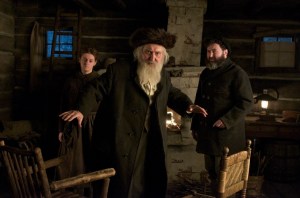 I haven’t done extensive research on this one, but A Serious Man may be the most Jewish film ever, or at least since Barbara Streisand cross-dressed in Yentl. I’m not talking movies that explore a significant chapter in Jewish history, like the Holocaust, but I can think of no other movie so steeped in the minutia of Jewish culture. A Serious Man even opens with a seemingly unrelated anecdote with a 19th century Eastern European Jewish couple arguing, completely in Yiddish, whether a guest is alive or a dybbuk (demon). Not only do we get notable religious events and observances like bar mitzvahs, sitting shiva, counsel from rabbis, the concept of a religious divorce known as a get so that a “serious man” could remarry in the faith, but the Coens get everything right down to the tiniest detail, like the exact sound of soup slurping. Even the overall tone, perseverance in the face of struggle, is an extremely Jewish perspective given what has transpired historically to the Jewish people.
The abrupt ending will likely win no favors from the people that thought they were shortchanged by No Country For Old Men‘s anticlimactic close, but it certainly fits the movie’s bleak worldview. Larry is, by his own accounts, trying to be a “serious man” in an ever-changing community, so beware what happens if he compromises his moral values. The pessimistic finale leaves much to the imagination and whether you want to connect the events as uncoordinated random plot points, or as an ongoing celestial judgment, well the Coens are canny enough to let you figure it out. They don’t have any more answers than the rabbi and the goy’s teeth.
This will not be a movie for everyone, especially considering 90 percent of the laughs come from one man’s unrelenting misery. Larry isn’t exactly the deepest character, making it spotty to emotionally invest in his troubles. However, I found him to be an everyman cipher allowing the audience a safe entry point into the Coen spectacle of doom. The Coen brothers have always been technical marvels, but they seem to have raised their inconsiderable talents at the close of this decade. No Country for Old Men was a genre masterpiece, Burn After Reading was an entertaining farce, but perhaps A Serious Man is the most lasting picture. How do we explain bad things and bad things happening to people striving to be serious men and women in the world? I?’m not sure if the Coens have an answer or even think the answer is important. I think their viewpoint is to enjoy the ride and laugh while you can. As the Korean student’s father puts it, “Accept the mystery.”
Nate’s Grade: A


 nathanzoebl
You must be logged in to post a comment.